
Life, 1889-02-14 · page 8 of 20
Life — February 14, 1889 — page 8: what you’re looking at
What you’re looking at
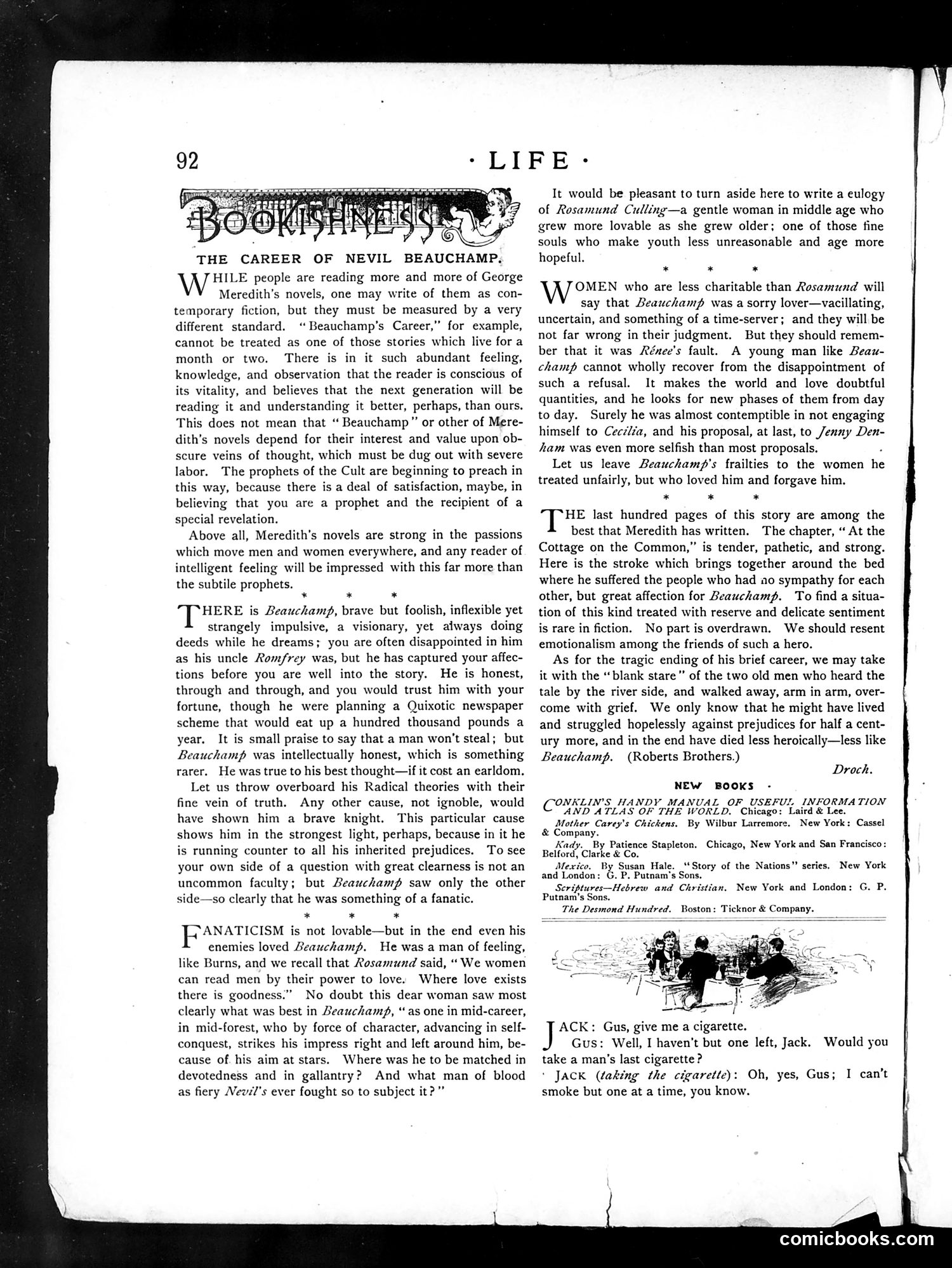
This page is primarily a **book review**, not a political cartoon. The main text discusses George Meredith's novel *Beauchamp's Career*, analyzing its protagonist Nevil Beauchamp as a character type: idealistic, impulsive, and intellectually honest but inflexible. The reviewer argues that Beauchamp represents a "fanatic" whose radical theories, while well-intentioned, make him difficult and ultimately tragic. The review praises the novel's final hundred pages as among Meredith's finest work. At the bottom is a brief **humorous dialogue** between characters Jack and Gus about cigarettes—a minor comedic interlude. The page includes a "New Books" section listing recent publications. No significant political satire or caricature is present on this page.
📄 Transcribed text from this page (OCR, searchable)
Machine-transcribed from the original scan — historical spelling and the odd misread are preserved.
> LIFE: THE CAREER OF NEVIL BEAUCHAMP, We people are reading more and more of George Meredith’s novels, one may write of them as con- temporary fiction, but they must be measured by a very different standard. ‘“Beauchamp’s Career,” for example, cannot be treated as one of those stories which live for a month or two. There is in it such abundant feeling, knowledge, and observation that the reader is conscious of its vitality, and believes that the next generation will be reading it and understanding it better, perhaps, than ours. This does not mean that ‘“ Beauchamp” or other of Mere- dith’s novels depend for their interest and value upon ob- scure veins of thought, which must be dug out with severe labor. The prophets of the Cult are beginning to preach in this way, because there is a deal of satisfaction, maybe, in believing that you are a prophet and the recipient of a special revelation. Above all, Meredith's novels are strong in the passions which move men and women everywhere, and any reader of intelligent feeling will be impressed with this far more than the subtile prophets. * * * “TSE is Beauchamp, brave but foolish, inflexible yet strangely impulsive, a visionary, yet always doing deeds while he dreams; you are often disappointed in him as his uncle Rom/frey was, but he has captured your affec- tions before you are well into the story. He is honest, through and through, and you would trust him with your fortune, though he were planning a Quixotic newspaper scheme that would eat up a hundred thousand pounds a year. It is small praise to say that a man won't steal; but Beauchamp was intellectually honest, which is something rarer. He was true to his best thought—if it cost an earldom. Let us throw overboard his Radical theories with their fine vein of truth. Any other cause, not ignoble, would have shown him a brave knight. This particular cause shows him in the strongest light, perhaps, because in it he is running counter to all his inherited prejudices. To see your own side of a question with great clearness is not an uncommon faculty; but Beauchamp saw only the other side—so clearly that he was something of a fanatic. * * * Panaticism is not lovable—but in the end even his enemies loved Beauchamp. He was a man of feeling, like Burns, and we recall that Rosamund said, “We women can read men by their power to love. Where love exists there is goodness.” No doubt this dear woman saw most clearly what was best in Beauchamp, “ as one in mid-career, in mid-forest, who by force of character, advancing in self- conquest, strikes his impress right and left around him, be- cause of. his aim at stars. Where was he to be matched in devotedness and in gallantry? And what man of blood as fiery Nevzl's ever fought so to subject it?” It would be pleasant to turn aside here to write a eulogy of Rosamund Culling—a gentle woman in middle age who grew more lovable as she grew older; one of those fine souls who make youth less unreasonable and age more hopeful. * * * OMEN who are less charitable than Rosamund will say that Beauchamp was a sorry lover—vacillating, uncertain, and something of a time-server; and they will be not far wrong in their judgment. But they should remem- ber that it was Rénee's fault. A young man like Beau- champ cannot wholly recover from the disappointment of such a refusal. It makes the world and love doubtful quantities, and he looks for new phases of them from day to day. Surely he was almost contemptible in not engaging himself to Cecé/va, and his proposal, at last, to Jenny Den- ham was even more selfish than most proposals. Let us leave Beauchamp’s frailties to the women he treated unfairly, but who loved him and forgave him. * * * Te last hundred pages of this story are among the best that Meredith has written. The chapter, “ At the Cottage on the Common,” is tender, pathetic, and strong. Here is the stroke which brings together around the bed where he suffered the people who had ao sympathy for each other, but great affection for Beauchamp. To find a situa- tion of this kind treated with reserve and delicate sentiment is rare in fiction. No part is overdrawn. We should resent emotionalism among the friends of such a hero. As for the tragic ending of his brief career, we may take it with the “blank stare” of the two old men who heard the tale by the river side, and walked away, arm in arm, over- come with grief. We only know that he might have lived and struggled hopelessly against prejudices for half a cent- ury more, and in the end have died less heroically—less like Beauchamp. (Roberts Brothers.) Droch. NEW BOOKS - ONKLIN’S HANDY MANUAL OF USEFU!, INFORMATION AND ATLAS OF THE WORLD. Chicago: Laird & Lee. Mother Carey's Chickens. By Wilbur Larremore. New York: Cassel & Company. Kady. By Patience Stapleton. Belford, Clarke & Co, Mexico. By Susan Hale. ‘Story of the Nations” series. and London: G. P. Putnam's Sons. Scriptures—Hebrew and Christian, Putnam's Sons. The Desmond Hundred. Boston: Ticknor & Company. Chicago, New York and San Francisco: New York New York and London: G. P. ACK: Gus, give me a cigarette. J Gus: Well, I haven't but one left, Jack. Would you take a man’s last cigarette? ‘ Jack (taking the cigarette): Oh, yes, Gus; I can’t smoke but one at a time, you know. comicbooks.com