
Life, 1889-02-14 · page 6 of 20
Life — February 14, 1889 — page 6: what you’re looking at
What you’re looking at
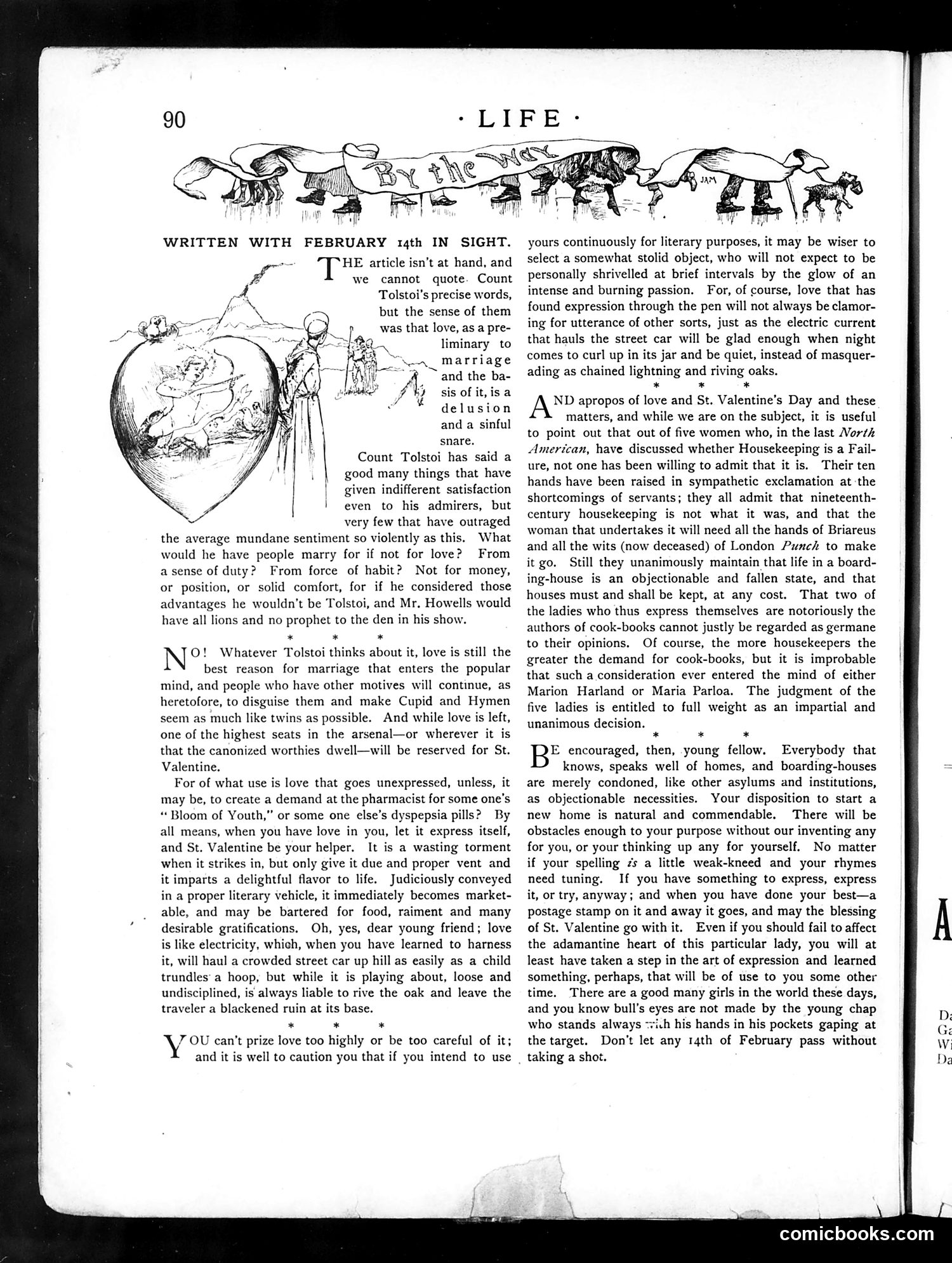
This page is a satirical essay about love and marriage written around Valentine's Day. The illustrations show a large heart with figures inside, and various couples in romantic situations. The text mocks the tension between idealized romantic love and practical married life. It references Count Tolstoy's views on love as preliminary to marriage, then argues that while love is important, it shouldn't blind people to reality. The article notably discusses five women from *North American* magazine who debated whether housekeeping is a "failure"—suggesting this reflects a contemporary women's rights discussion about domestic labor's value. The closing section encourages young men to express their feelings on Valentine's Day, warning against hesitation. The overall tone balances romantic sentiment with practical advice about marriage and self-expression.
📄 Transcribed text from this page (OCR, searchable)
Machine-transcribed from the original scan — historical spelling and the odd misread are preserved.
WRITTEN WITH FEBRUARY 14th IN SIGHT. HE article isn’t at hand, and gf we cannot quote. Count A Tolstoi's precise words, i but the sense of them was that love, as a pre- liminary to \-A. Marriage ~® ~ and the ba- sis of it, is a delusion and a sinful snare. Count Tolstoi has said a good many things that have given indifferent satisfaction even to his admirers, but very few that have outraged the average mundane sentiment so violently as this. What would he have people marry for if not for love? From a sense of duty? From force of habit? Not for money, or position, or solid comfort, for if he considered those advantages he wouldn't be Tolstoi, and Mr. Howells would have all lions and no prophet to the den in his show. * * * O! Whatever Tolstoi thinks about it, love is still the best reason for marriage that enters the popular mind, and people who have other motives will continue, as heretofore, to disguise them and make Cupid and Hymen seem as much like twins as possible. And while love is left, one of the highest seats in the arsenal—or wherever it is that the canonized worthies dwell—will be reserved for St. Valentine. For of what use is love that goes unexpressed, unless, it may be, to create a demand at the pharmacist for some one’s “Bloom of Youth,” or some one else’s dyspepsia pills? By all means, when you have love in you, let it express itself, and St. Valentine be your helper. It is a wasting torment when it strikes in, but only give it due and proper vent and it imparts a delightful flavor to life. Judiciously conveyed in a proper literary vehicle, it immediately becomes market- able, and may be bartered for food, raiment and many desirable gratifications. Oh, yes, dear young friend; love is like electricity, which, when you have learned to harness it, will haul a crowded street car up hill as easily as a child trundles’a hoop, but while it is playing about, loose and undisciplined, is always liable to rive the oak and leave the traveler a blackened ruin at its base. * * * Yo can’t prize love too highly or be too careful of it; and it is well to caution you that if you intend to use yours continuously for literary purposes, it may be wiser to select a somewhat stolid object, who will not expect to be personally shrivelled at brief intervals by the glow of an intense and burning passion. For, of course, love that has found expression through the pen will not always be clamor- ing for utterance of other sorts, just as the electric current that hauls the street car will be glad enough when night comes to curl up in its jar and be quiet, instead of masquer- ading as chained lightning and riving oaks. * * * A’ apropos of love and St. Valentine’s Day and these matters, and while we are on the subject, it is useful to point out that out of five women who, in the last North American, have discussed whether Housekeeping is a Fail- ure, not one has been willing to admit that it is. Their ten hands have been raised in sympathetic exclamation at the shortcomings of servants; they all admit that nineteenth- century housekeeping is not what it was, and that the woman that undertakes it will need all the hands of Briareus and all the wits (now deceased) of London Punch to make it go. Still they unanimously maintain that life in a board- ing-house is an objectionable and fallen state, and that houses must and shall be kept, at any cost. That two of the ladies who thus express themselves are notoriously the authors of cook-books cannot justly be regarded as germane to their opinions. Of course, the more housekeepers the greater the demand for cook-books, but it is improbable that such a consideration ever entered the mind of either Marion Harland or Maria Parloa. The judgment of the five ladies is entitled to full weight as an impartial and unanimous decision. * * * E encouraged, then, young fellow. Everybody that knows, speaks well of homes, and boarding-houses are merely condoned, like other asylums and institutions, as objectionable necessities. Your disposition to start a new home is natural and commendable. There will be obstacles enough to your purpose without our inventing any for you, or your thinking up any for yourself. No matter if your spelling zs a little weak-kneed and your rhymes need tuning. If you have something to express, express it, or try, anyway; and when you have done your best—a postage stamp on it and away it goes, and may the blessing of St. Valentine go with it. Even if you should fail to affect the adamantine heart of this particular lady, you will at least have taken a step in the art of expression and learned something, perhaps, that will be of use to you some other time. There are a good many girls in the world these days, and you know bull’s eyes are not made by the young chap who stands always -vich his hands in his pockets gaping at the target. Don't let any 14th of February pass without taking a shot. comicbooks.com Di Gi Wi De