
A complete issue · 16 pages · 1889
Life — January 24, 1889
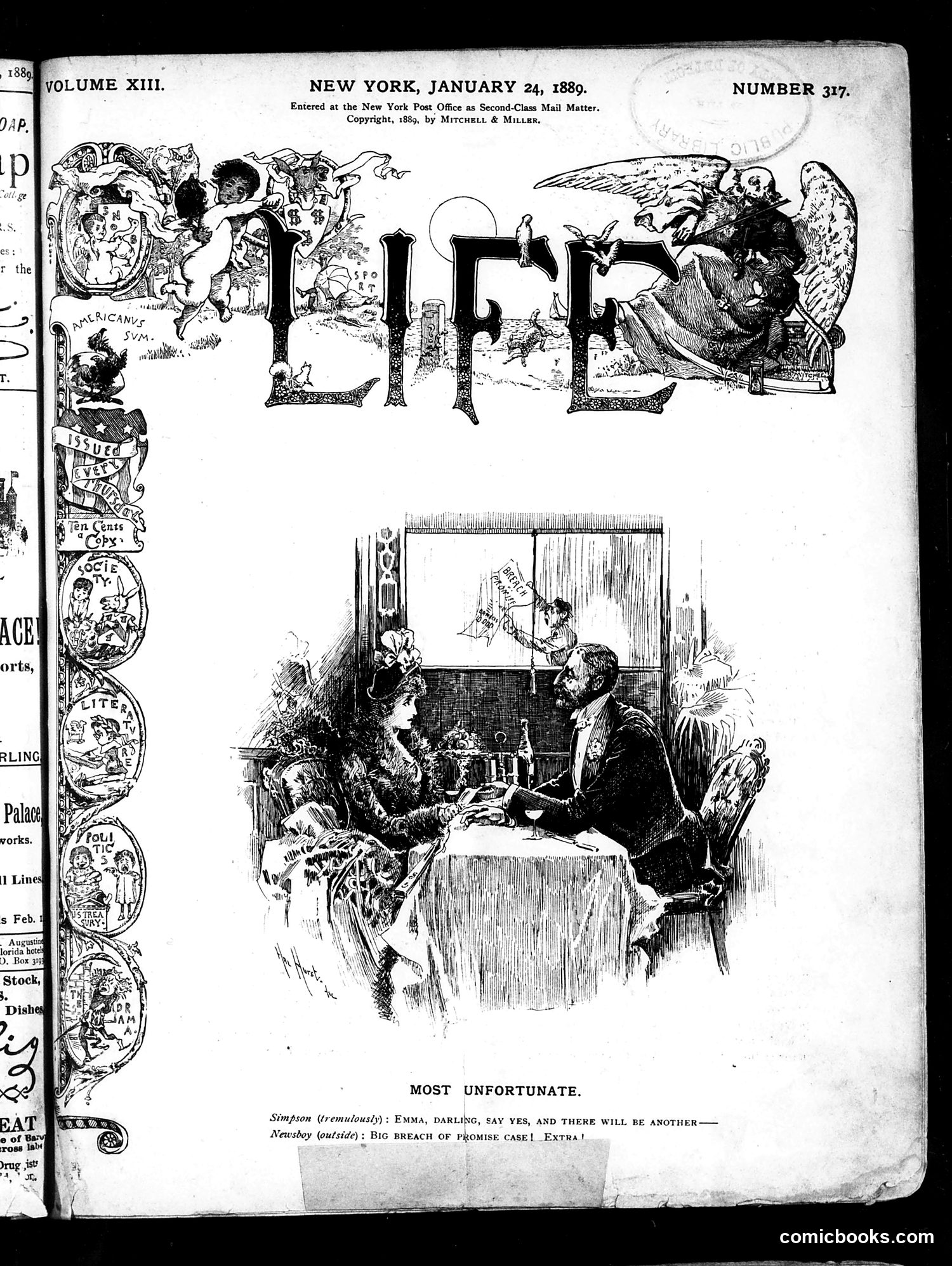
The cartoon depicts a domestic scene captioned "Most Unfortunate," showing a couple at dinner. The dialogue reads: "Simpson (tremulously): EMMA, DARLING, SAY YES, AND THERE WILL BE ANOTHER— / Neighbor (outside): BIG BREACH OF PROMISE CASE! EXTRA!" The satire targets the anxiety of a marriage proposal interrupted by news of a legal scandal. Simpson attempts a romantic moment, but the shouted announcement of "another big breach of promise case" undercuts the mood—suggesting marriage proposals were legally risky, with "breach of promise" lawsuits being common enough that the neighbor treats each new case as newsworthy. This reflects late-19th-century concerns about legal liability in romantic commitments and the social spectacle surrounding jilted women's lawsuits against broken engagements.
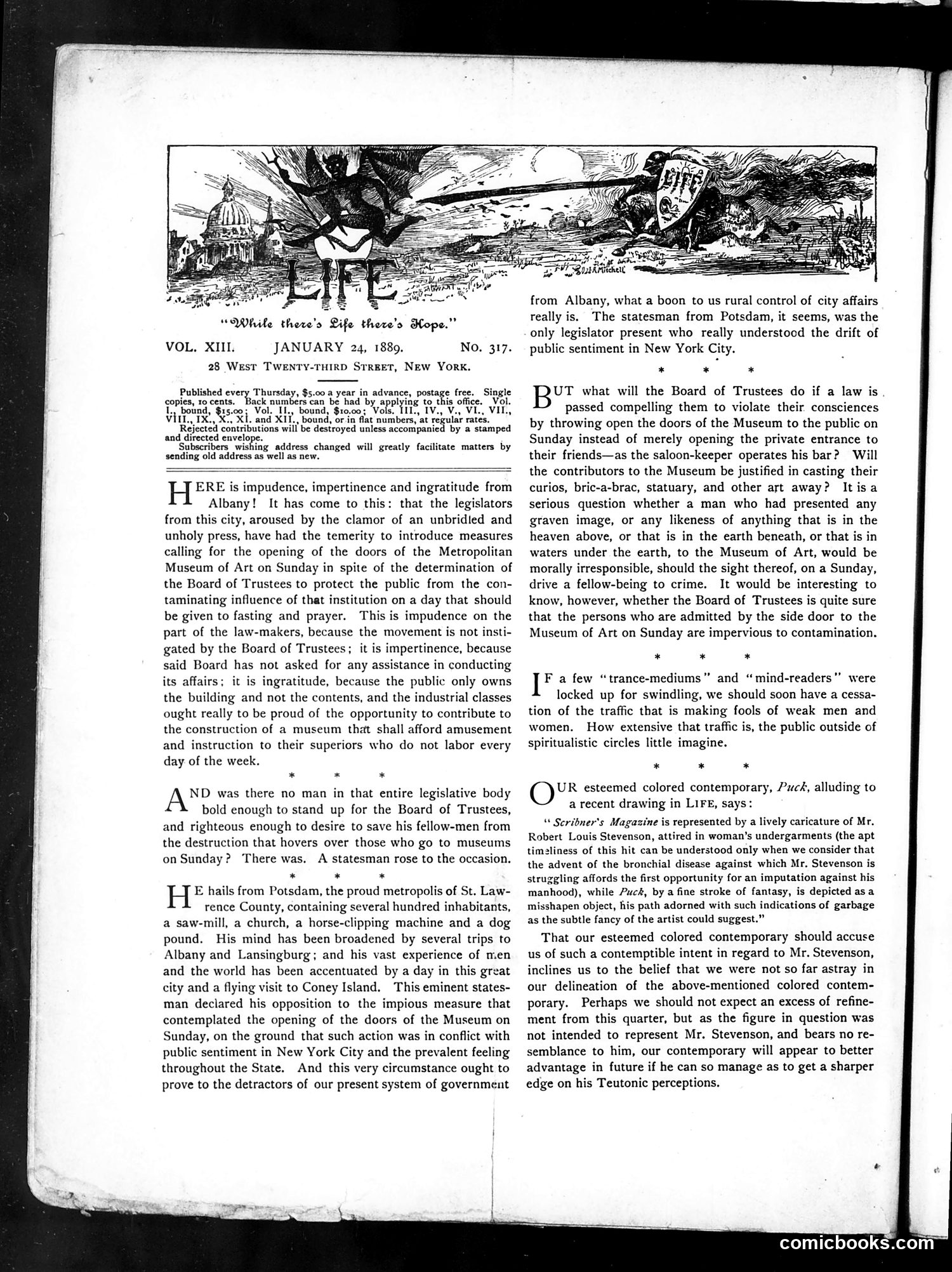
The masthead cartoon depicts a dramatic scene with "Life" text, though the specific figures are unclear from this reproduction. The editorial content addresses a heated controversy over the Metropolitan Museum of Art's decision to open its doors on Sundays. Religious conservatives opposed Sunday opening as desecrating the Sabbath, while progressives supported public access to culture. The writer sarcastically attacks Albany legislators for lacking courage to defend the Board of Trustees against "religious zealots" seeking to keep the museum closed Sundays. The piece dismisses claims that Sunday opening conflicts with religious observance, arguing the public owns the building and deserves access regardless of day. A secondary note criticizes *Puck* magazine for caricaturing Robert Louis Stevenson in what the author deems an unfair manner.
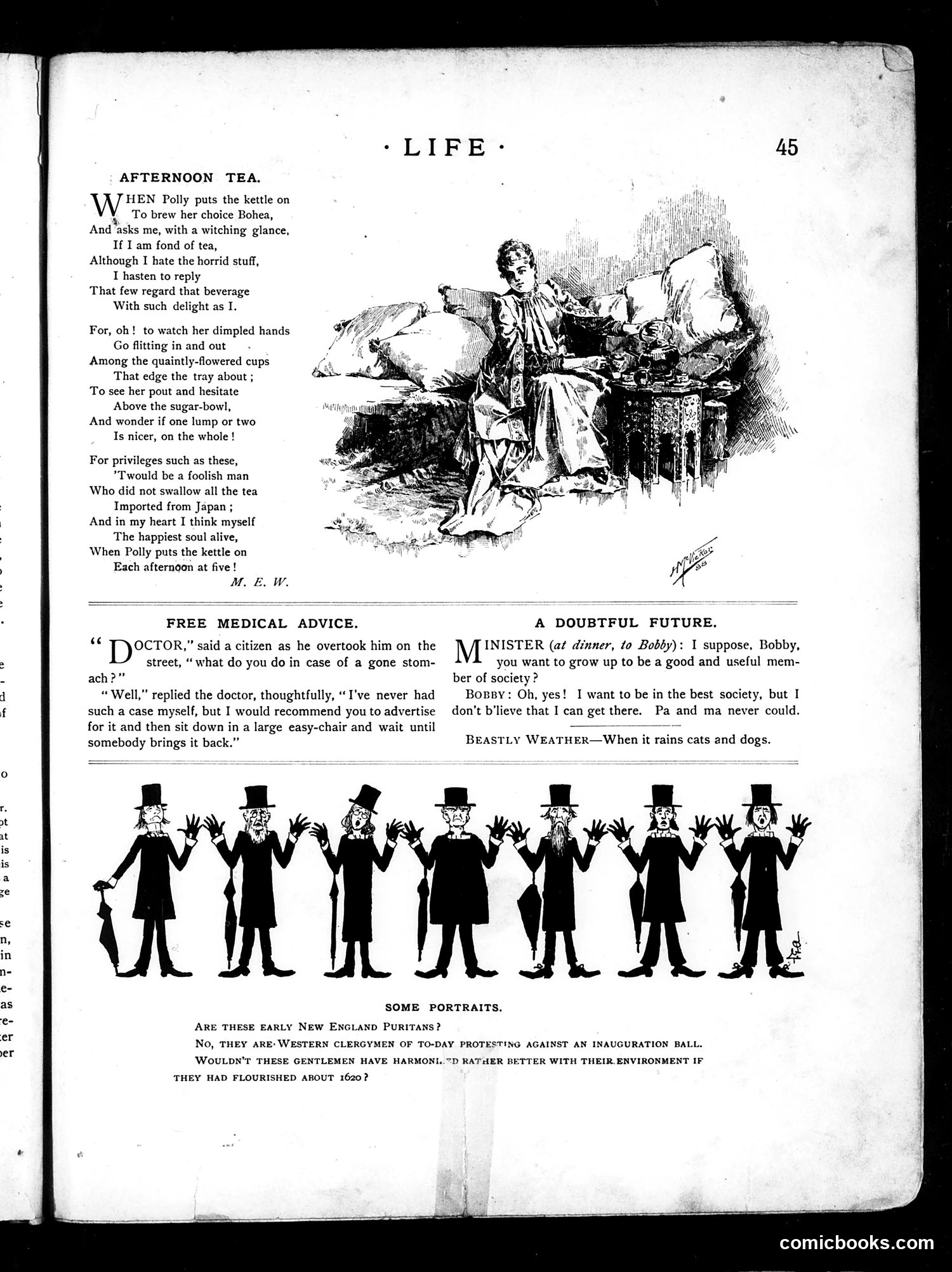
**"Afternoon Tea"** is a poem celebrating the British custom of afternoon tea service, humorously praising Polly's skill at brewing and serving tea with "dimpled hands" among delicate cups. **"Free Medical Advice"** presents a brief joke about a doctor's pragmatic response to an incurable stomach ailment: advertise the condition and wait for someone to bring it back—implying the illness is too common to treat seriously. **"Some Portraits"** depicts seven identical figures in top hats and formal dress, captioned as Western clergymen protesting an inauguration ball. The satire suggests these rigid, stern-faced religious figures would have been happier in 1620s Puritan times, when such revelry was condemned. The joke mocks Victorian-era religious opposition to modern secular celebrations.
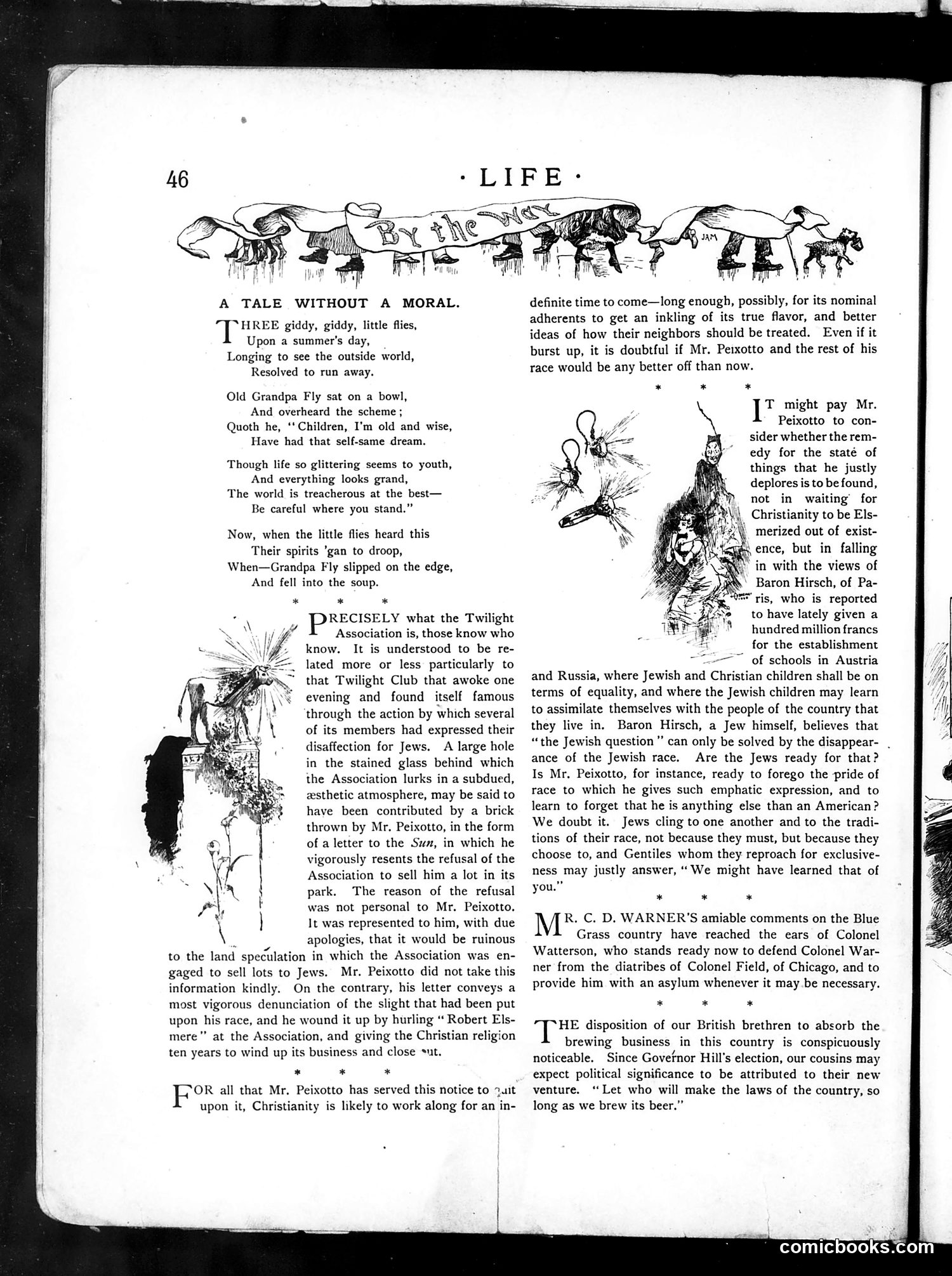
This page contains a satirical fable titled "A Tale Without a Moral" about three flies who ignore an old grandfather fly's warning and fall into soup—a cautionary tale about ignoring wisdom. The main political content appears in the prose section discussing the Twilight Club controversy. The text criticizes someone named Mr. Peixotto for resenting the club's refusal to admit him, attributing this to anti-Semitism. The passage argues against assimilationist pressure on Jewish immigrants, defending Jewish cultural identity against Baron Hirsch's philanthropic integration efforts in Austria and Russia. Additional commentary addresses Mr. C.D. Warner's remarks about Blue Grass country and Colonel Watterson's political position, plus commentary on British involvement in brewing business during Governor Hill's election. The illustrations appear to be decorative Victorian-style engravings rather than specific political caricatures.
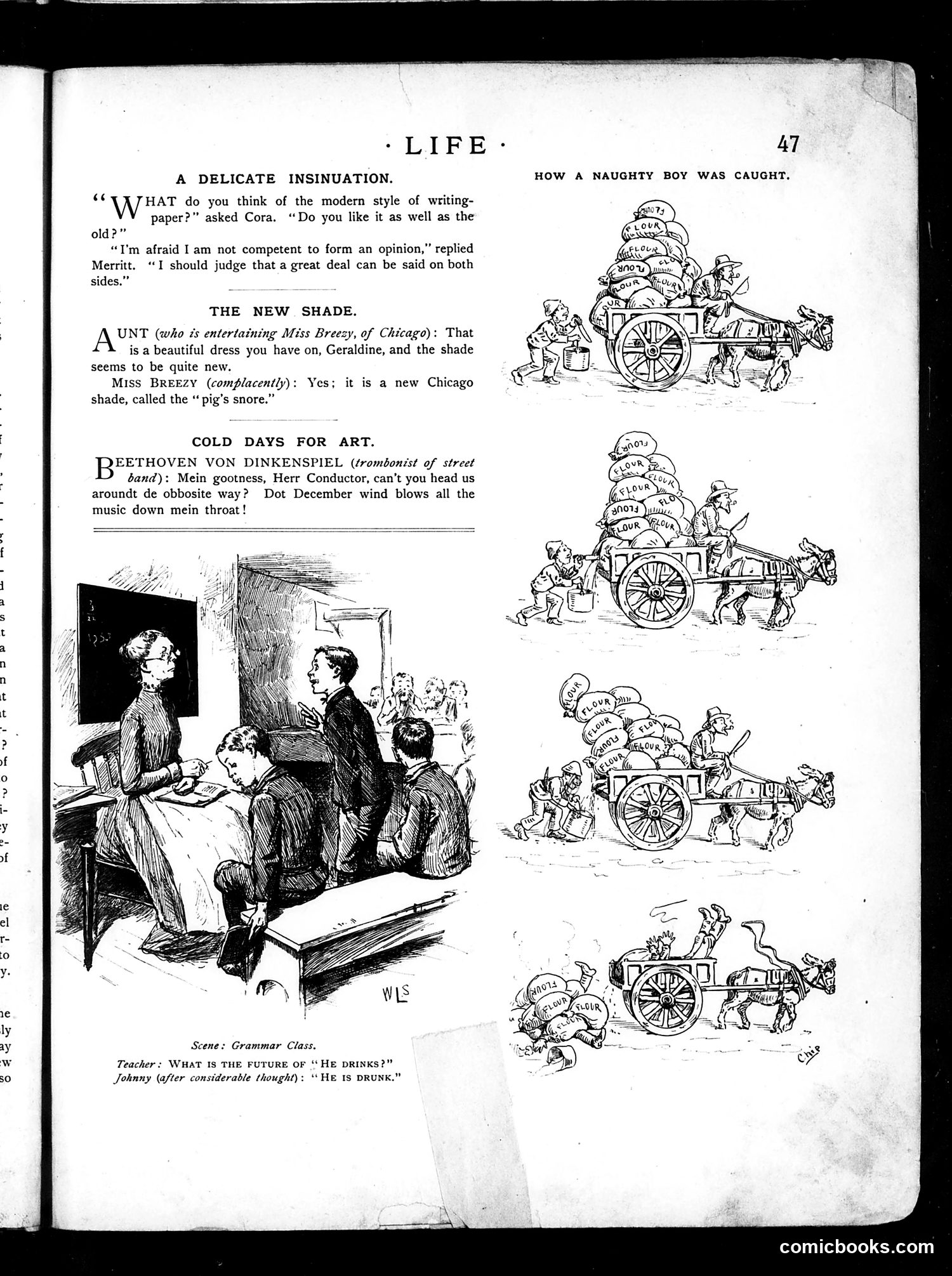
This page contains three separate satirical items: 1. **"A Delicate Insinuation"**: A brief exchange where Cora asks Merritt about modern writing paper styles. Merritt diplomatically avoids judging, suggesting both old and new have merit—a gentle jab at people who take strong positions on trivial matters. 2. **"The New Shade"**: Miss Breezy from Chicago introduces a new color called the "pig's snore," apparently a grayish shade. This appears to mock fashion's absurd color-naming trends. 3. **"Cold Days for Art"**: A classroom scene where a teacher asks about the future of someone who "drinks," and a student Johnny responds "he is drunk"—satirizing either poor grammar instruction or the student's crude logic. The right side shows an unrelated comic strip about a naughty boy being caught with overloaded baskets.
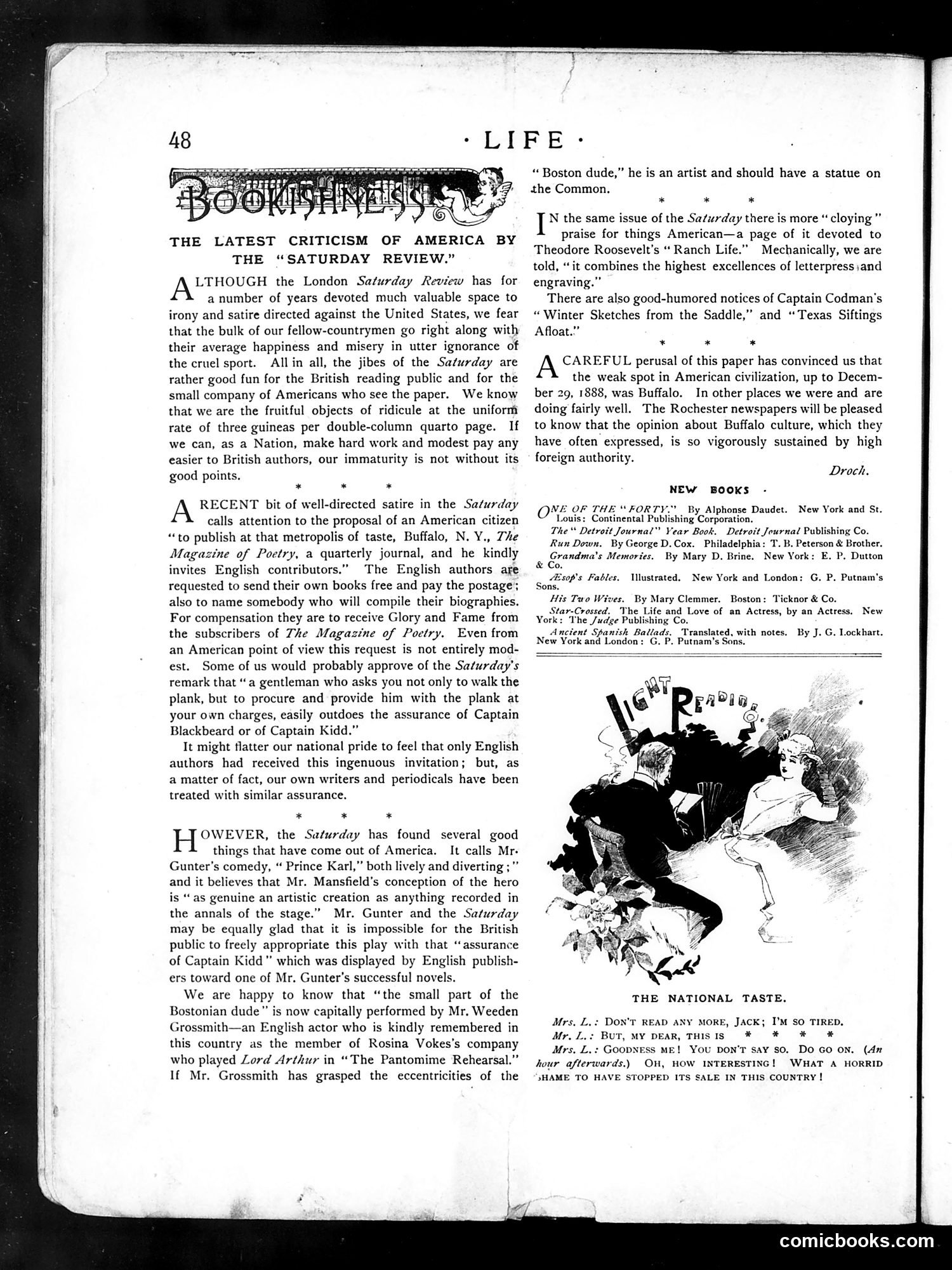
This satirical cartoon, titled "The National Taste," depicts a woman (labeled "Mrs. L.") rejecting a book titled "Light Reading" while expressing exhaustion. The accompanying dialogue shows her dismissing further literary suggestions, declaring she's "so tired" and won't read anymore because such works have damaged America's reputation. The satire targets American cultural standards of the late 19th century, suggesting the national appetite for frivolous "light reading" reflects poorly on American civilization. The cartoon connects to the article's broader critique of how the *Saturday Review* mocks American literary taste and cultural pretensions. The figure represents the average American reader consuming low-brow entertainment, embodying the magazine's concern that popular reading habits undermine national cultural credibility.
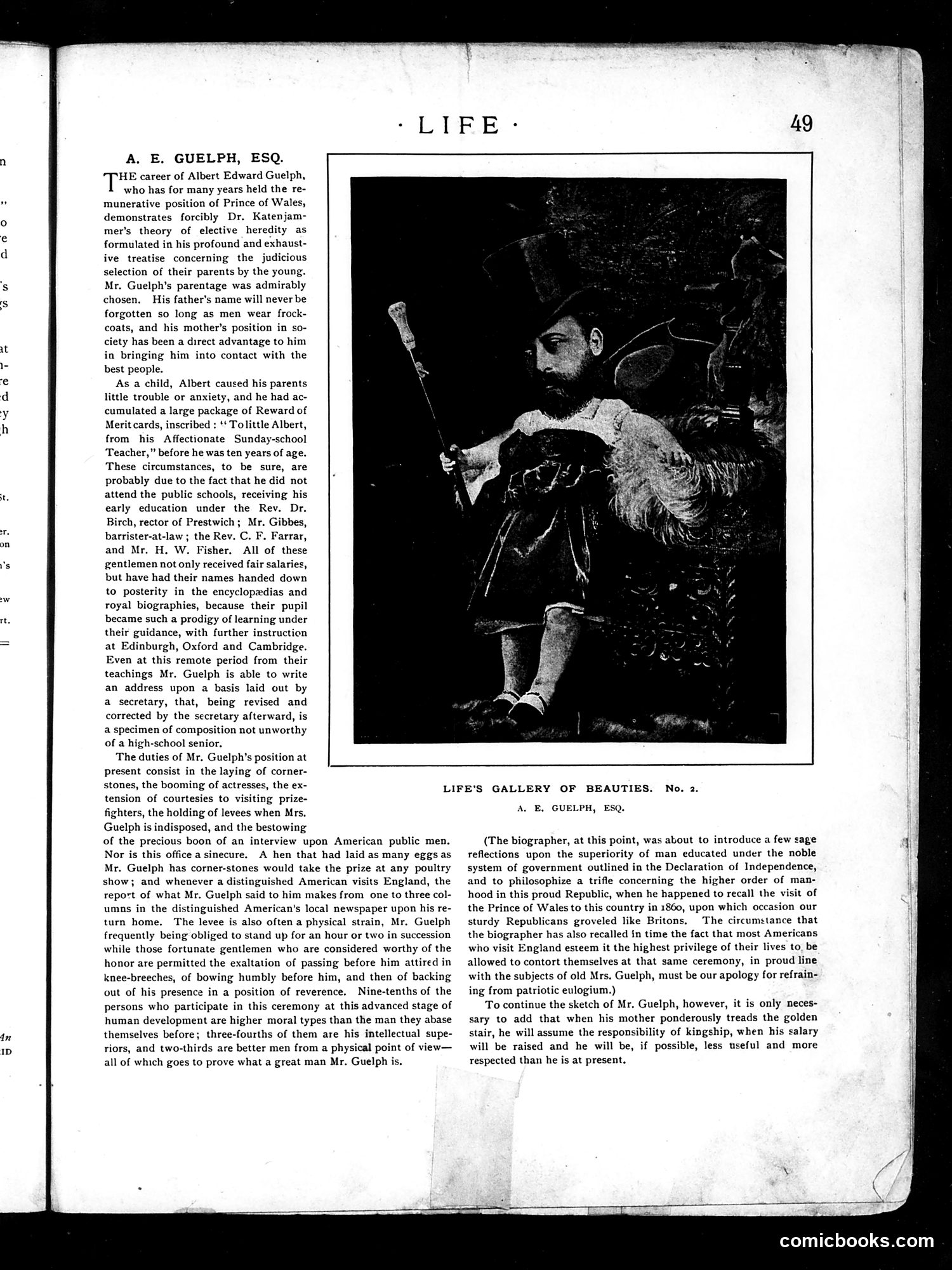
This page profiles Albert Edward Guelph, a prominent figure who held the position of Prince of Wales for many years. The accompanying photograph shows him in formal attire with decorative regalia. The text emphasizes Guelph's distinguished parentage and education under notable gentlemen, establishing his credentials as an intellectual and social figure. His current duties involve ceremonial responsibilities—laying cornerstones, hosting courtesies to visiting dignitaries, and attending formal events. The satirical tone suggests the magazine is gently mocking the ornamental nature of such aristocratic positions, where social status and ceremonial duties matter more than substantive work. The "Gallery of Beauties" title itself implies ironic commentary on celebrating prominent but ultimately decorative public figures.
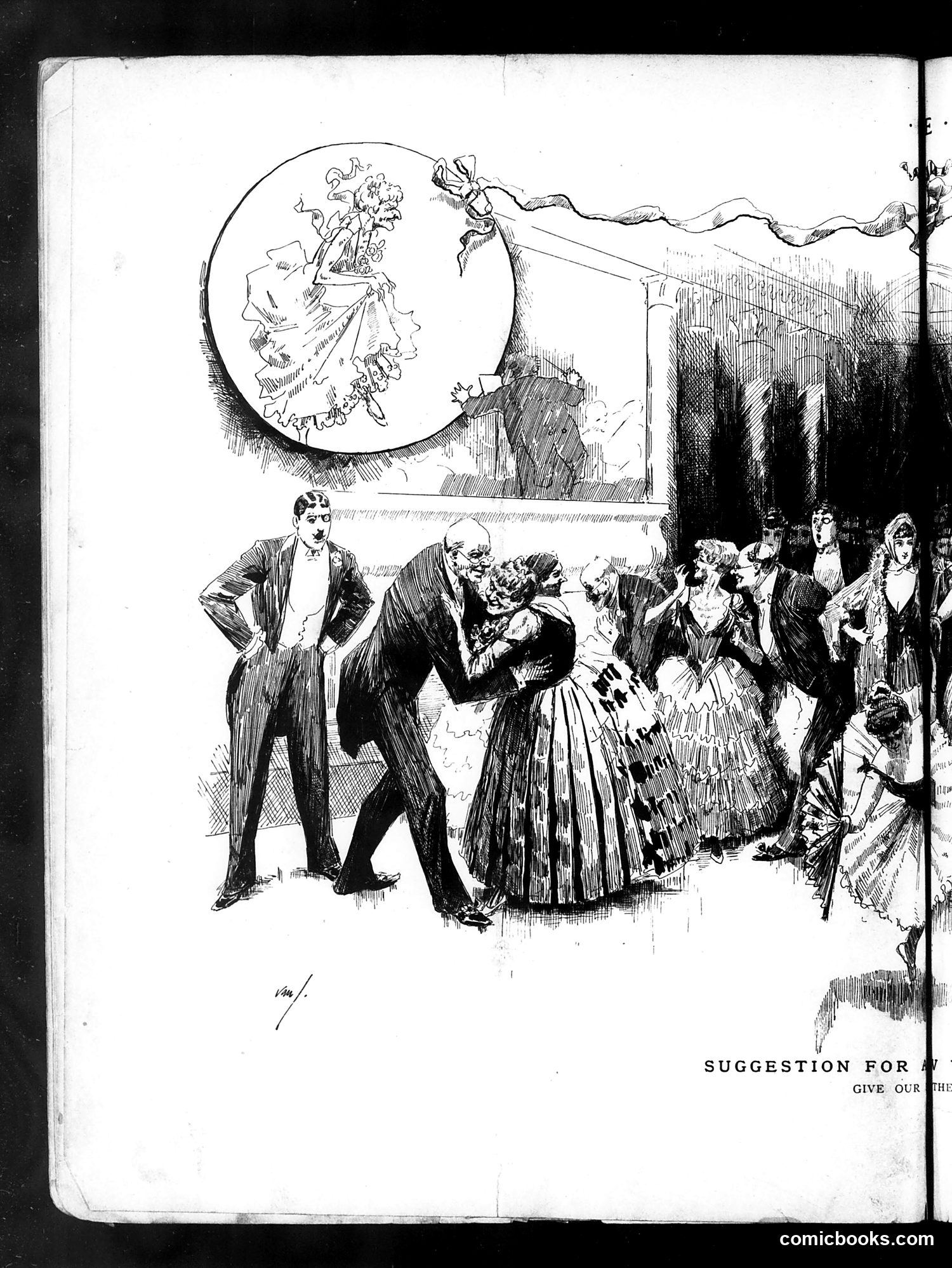
This satirical illustration depicts a formal social gathering where a distinguished gentleman in formal wear appears to be presenting or gesturing toward a woman. Above them hovers a large moon or circular frame containing figures engaged in what appears to be ethereal or fantastical activity—possibly a reference to theater, performance, or romantic imagination. The caption reads "SUGGESTION FOR" (text cuts off), indicating this is offering a proposal or idea to readers. The cartoon likely satirizes social pretensions, courtship customs, or entertainment trends of the era. The contrast between the formal, grounded party-goers below and the whimsical imagery above suggests commentary on idealism versus reality, or perhaps mocking theatrical affectation in high society. Without the complete caption, the specific target of satire remains unclear.
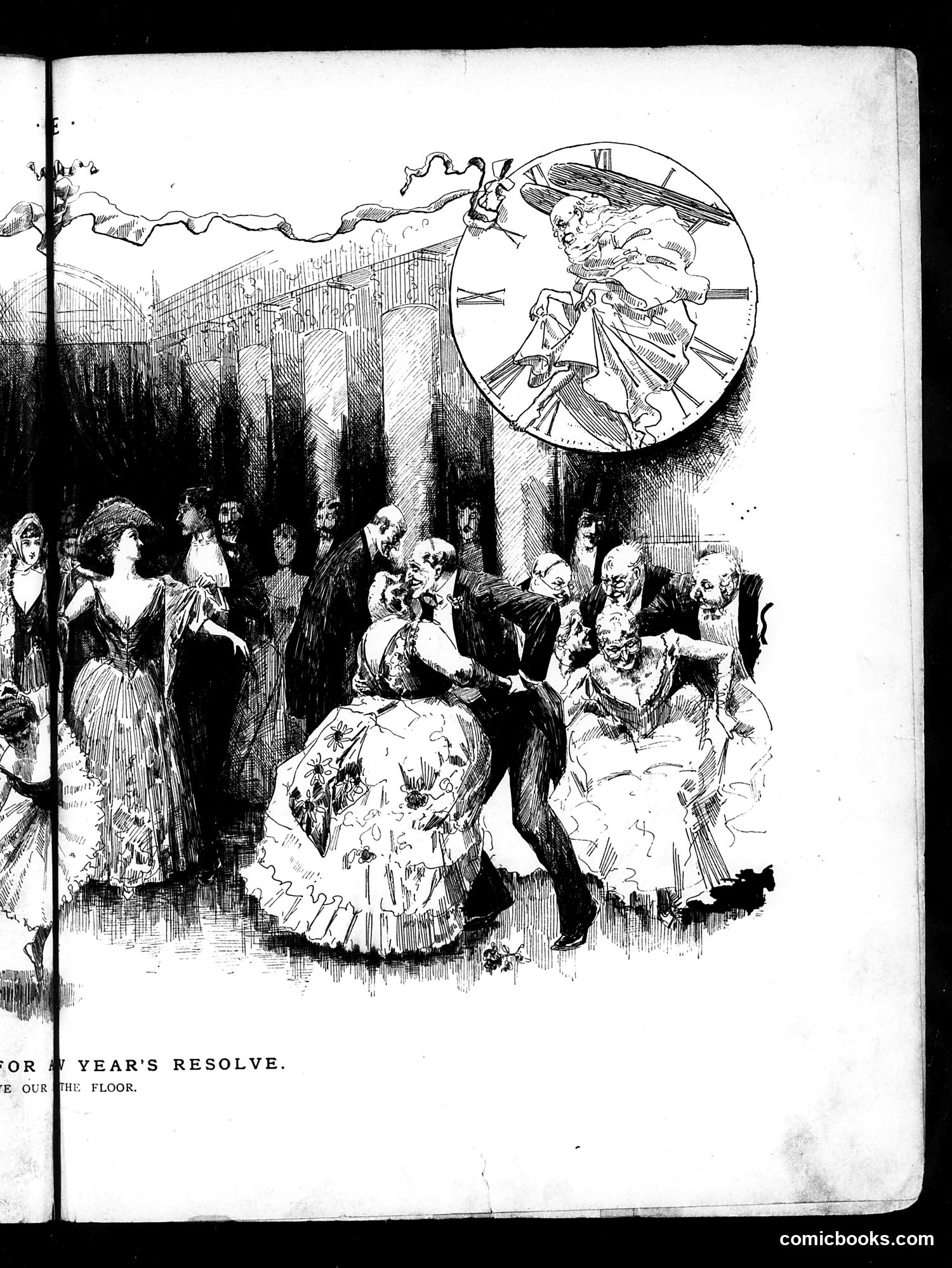
This satirical cartoon depicts a New Year's Eve ball scene with well-dressed socialites at what appears to be an elegant gathering. The title "For a Year's Resolve" suggests commentary on New Year's resolutions—the promises people make to improve themselves. The circular inset shows figures on a clock face, likely representing Time or Fate overseeing human affairs. The cartoon appears to satirize the gap between people's noble New Year's intentions and reality—wealthy socialites making grand resolutions while remaining fundamentally unchanged, or perhaps mocking the futility of such promises among the leisure class. The formal dress and crowded ballroom setting emphasize the scene's upper-class context, suggesting the satire targets society's elite and their superficial self-improvement rhetoric.
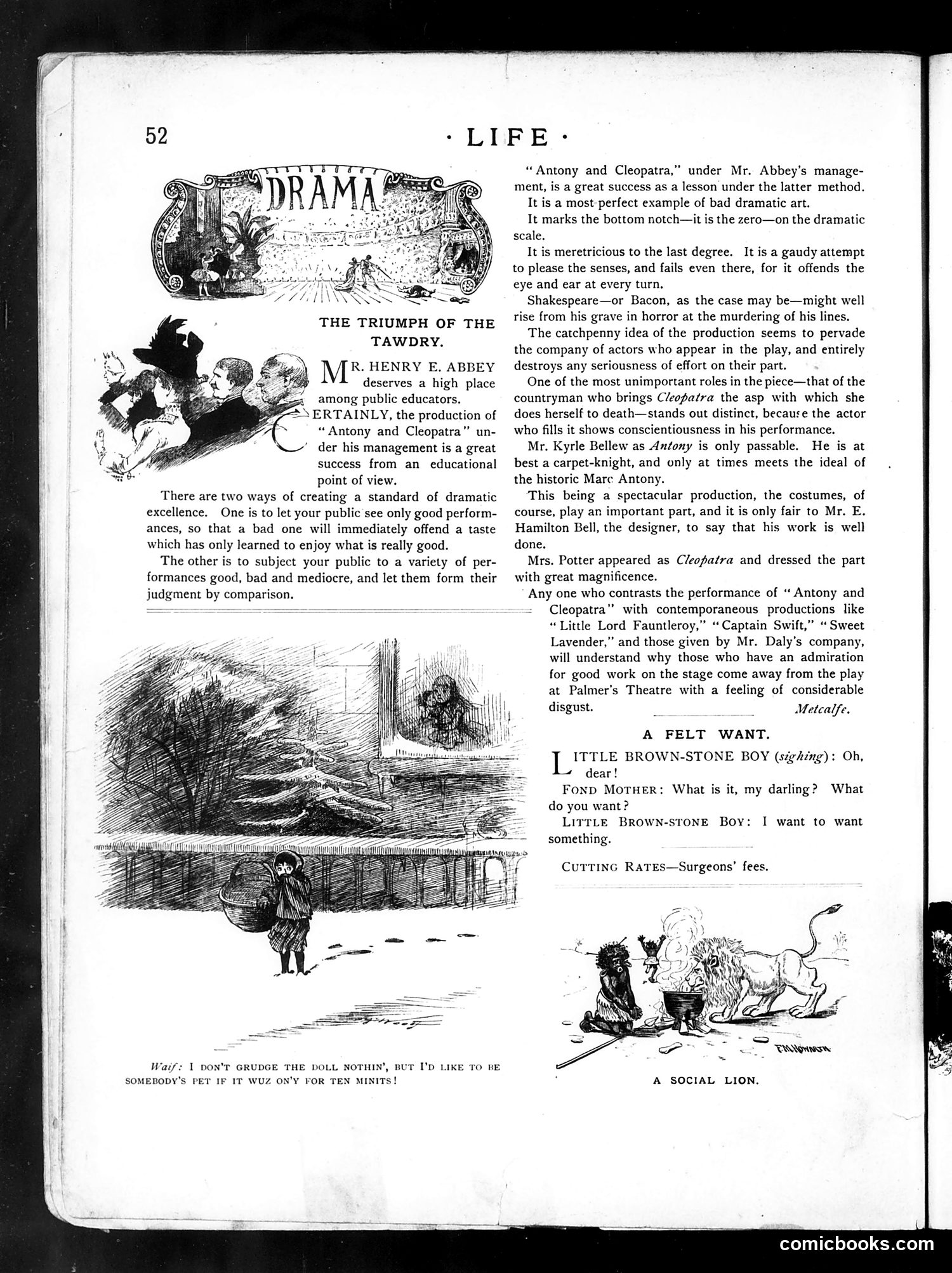
This page reviews Henry E. Abbey's production of "Antony and Cleopatra," criticizing it as dramatically poor despite elaborate staging. The reviewer argues Abbey pursued visual spectacle over artistic merit—appealing to audiences through "a variety of performances" rather than quality. The critique attacks contemporary theater's reliance on costumes and design (credited to E. Hamilton Bell) to distract from weak performances, particularly Kyrle Bellew's "carpet-knight" Antony and Mrs. Potter's Cleopatra. The humor pieces below—"A Felt Want" (a child's absurdist request) and "A Social Lion" (illustrated, likely depicting social pretension)—appear unrelated filler content typical of satirical magazines. The overall page reflects late-19th-century theatrical criticism emphasizing artistic integrity over commercial spectacle.
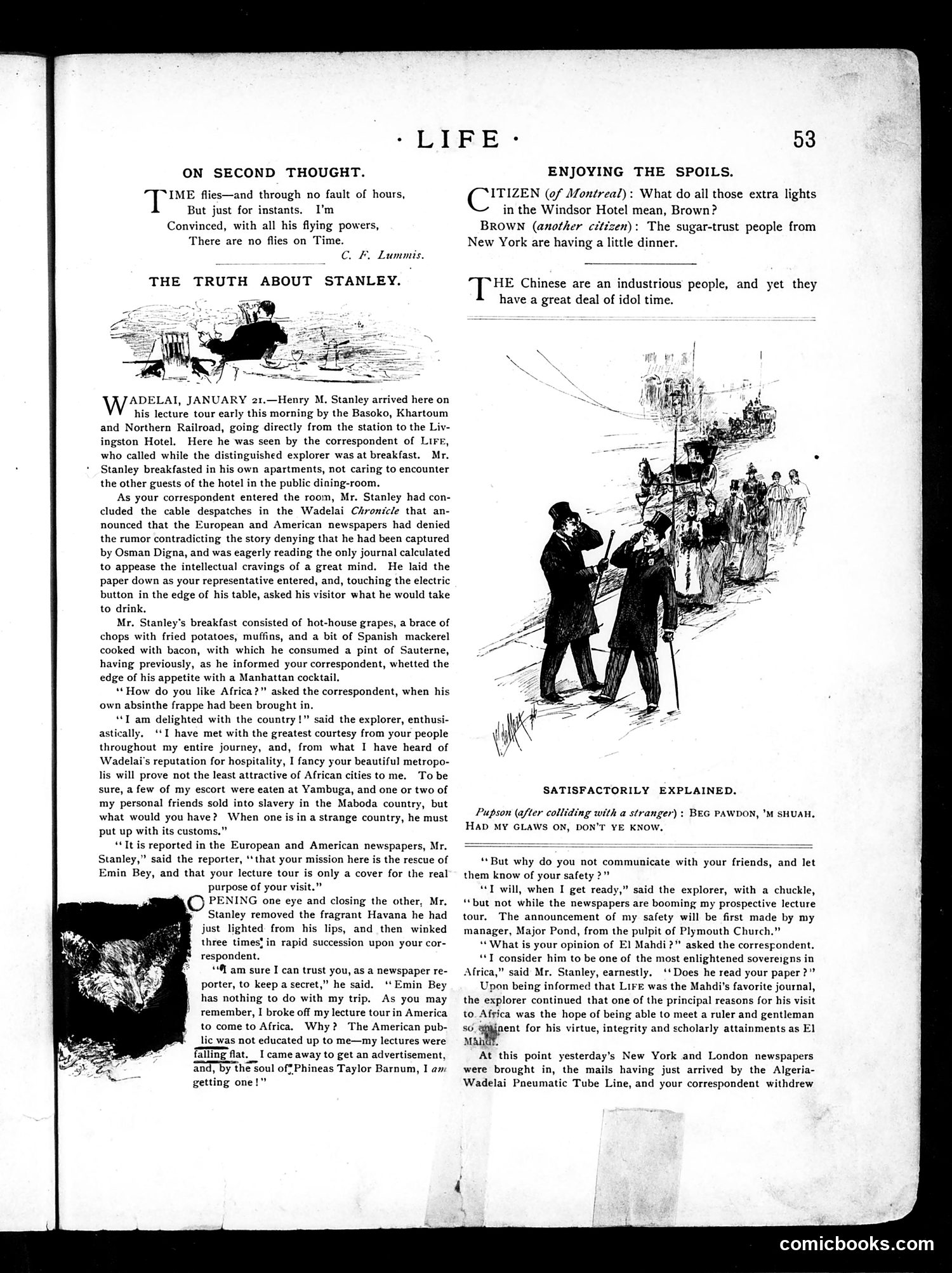
This *Life* magazine page satirizes **Henry M. Stanley**, the famous explorer/journalist who led a highly publicized 1880s expedition to "rescue" Emin Pasha in Africa. The main article mockingly presents Stanley as a self-serving charlatan exploiting his expedition for publicity. The satire's key point: Stanley claims his real motivation isn't rescuing Emin Pasha but generating advertising for himself. He abandoned his American lecture tour because audiences weren't interested, so he engineered this African expedition as a publicity stunt—referencing P.T. Barnum, history's most famous huckster. The article ridicules Stanley's pretensions by having him casually mention that some of his escorts were cannibalized or enslaved, treating human suffering as inconsequential. The cartoon illustrations and lighter items (the Montreal sugar-trust dinner, the "Satisfactorily Explained" pun about eyeglasses) provide comic relief typical of *Life*'s format. The satire reflects contemporary skepticism about Stanley's true motives and media savvy—he was already famous for sensationalized journalism before this expedition.
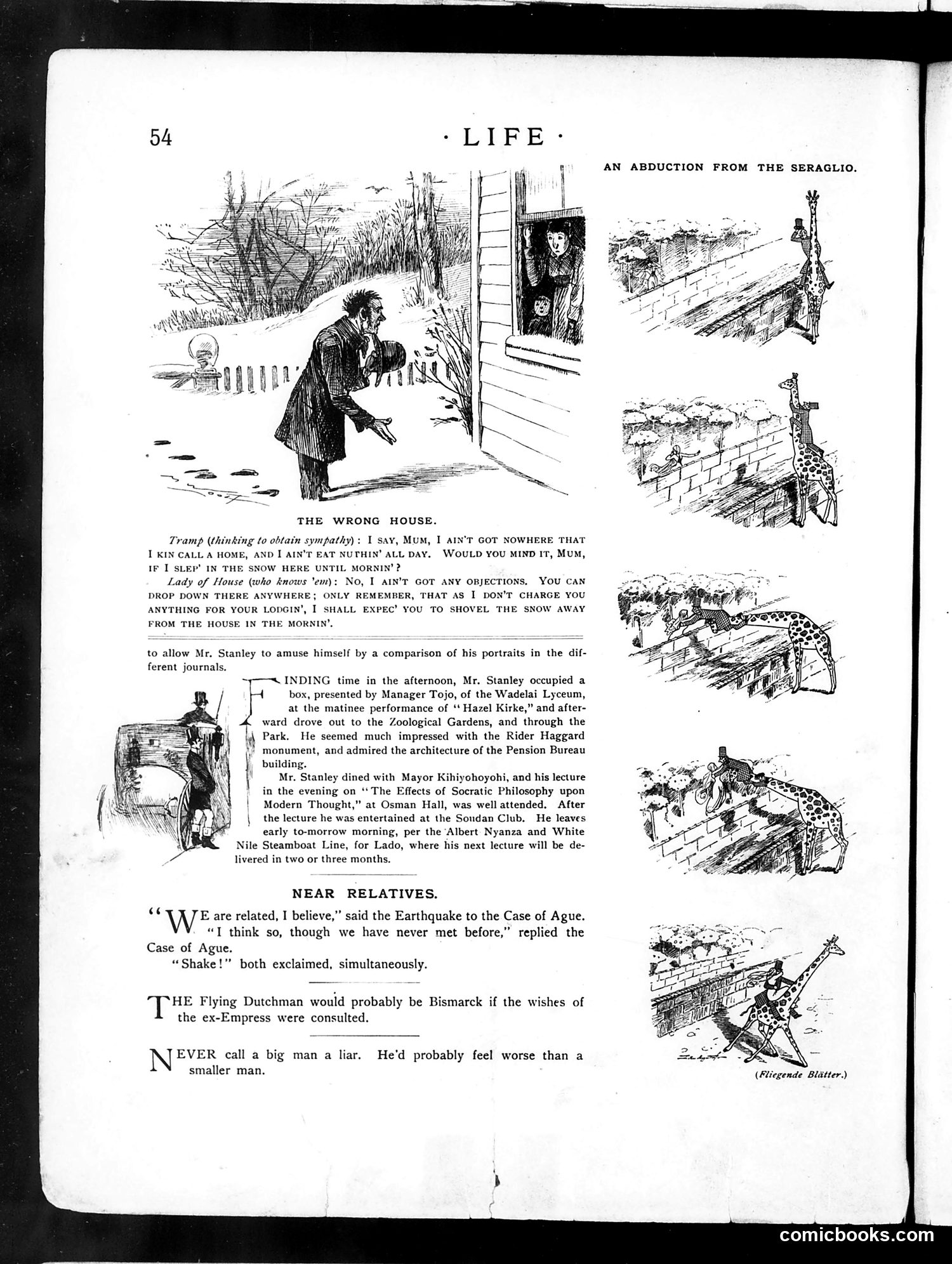
**"The Wrong House"** depicts a common Victorian-era trope: a cunning tramp exploiting middle-class sympathy. The poorly dressed man asks a homeowner for shelter in the snow, claiming destitution. The joke's twist: the savvy lady agrees—but with a catch: he must shovel snow from her property in exchange. This satirizes both the tramp's transparent manipulation and the shrewd householder who refuses to be duped by feigned poverty. **"An Abduction from the Seraglio"** appears to reference a Mozart opera, likely used as a title for unrelated comic sketches about architectural monuments and a visiting dignitary (Mr. Stanley). The page's final jokes are brief non-sequiturs: an anthropomorphic "Earthquake" and "Case of Ague" (chills/fever) greeting each other as relatives, and sardonic observations about calling large men liars. These serve as filler humor typical of satirical magazines of this era.
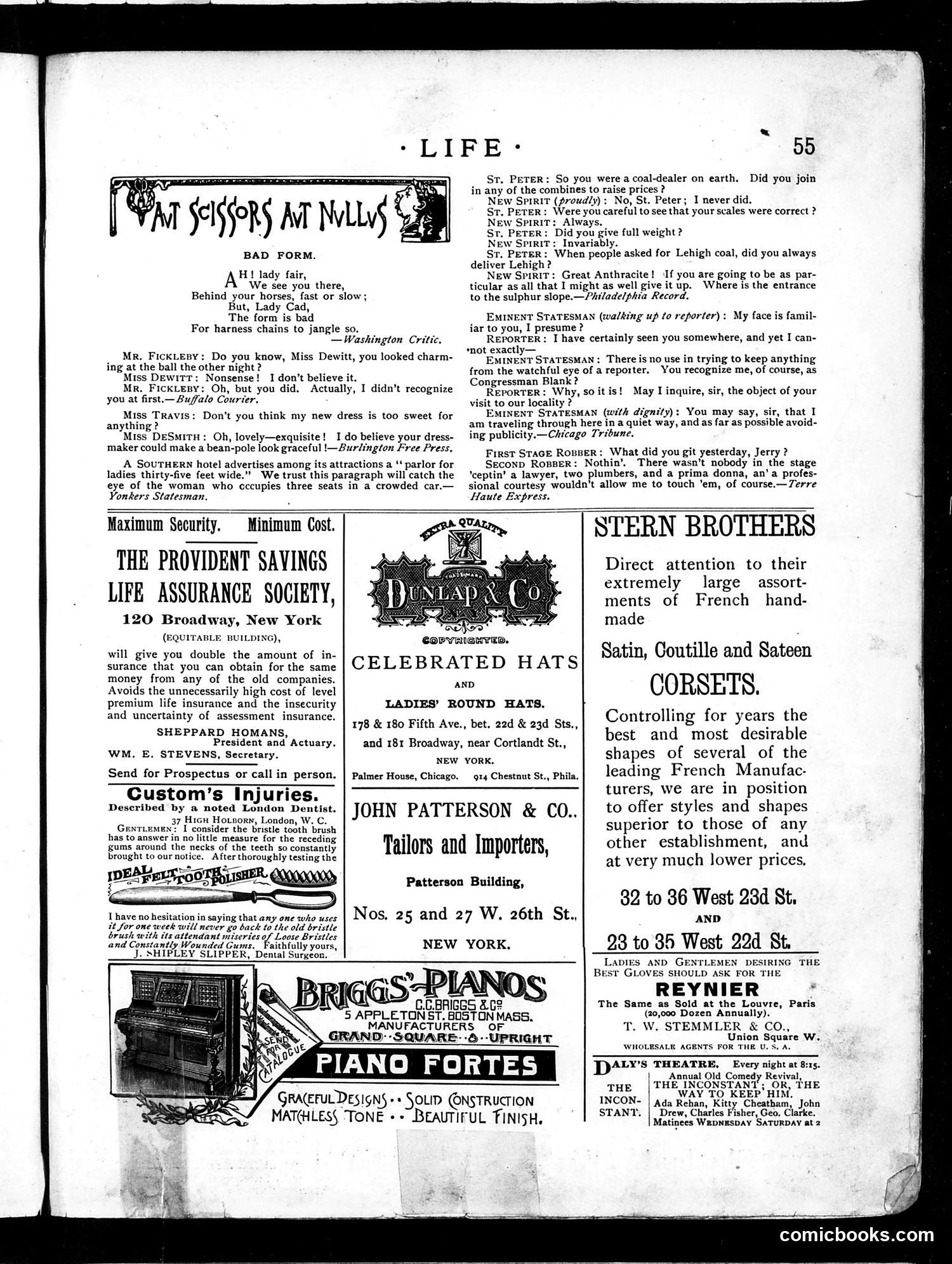
This page contains several satirical jokes typical of Life magazine's humor: **"Bad Form"** satirizes social etiquette violations—ladies driving too fast in carriages, women occupying excessive train seats, and shallow compliments. **The afterlife dialogue** mocks coal dealers and business ethics. A deceased coal merchant who claims perfect honesty about scales and weights is horrified when St. Peter demands he actually delivered the *correct* coal (Lehigh when ordered). The joke critiques widespread commercial fraud and dishonest business practices of the era. **The congressman joke** satirizes politicians' vanity—an "eminent statesman" believes he's so famous the reporter must recognize him, yet remains unknown. **The stage robbers' joke** presents an ironic inversion: criminals with professional courtesy refuse to rob lawyers and plumbers (suggesting these professions themselves are predatory), finding only a prima donna worth stealing from. The page is primarily advertisements for insurance, hats, corsets, and pianos. The humor reflects Gilded Age concerns: commercial dishonesty, class pretension, and professional ethics.
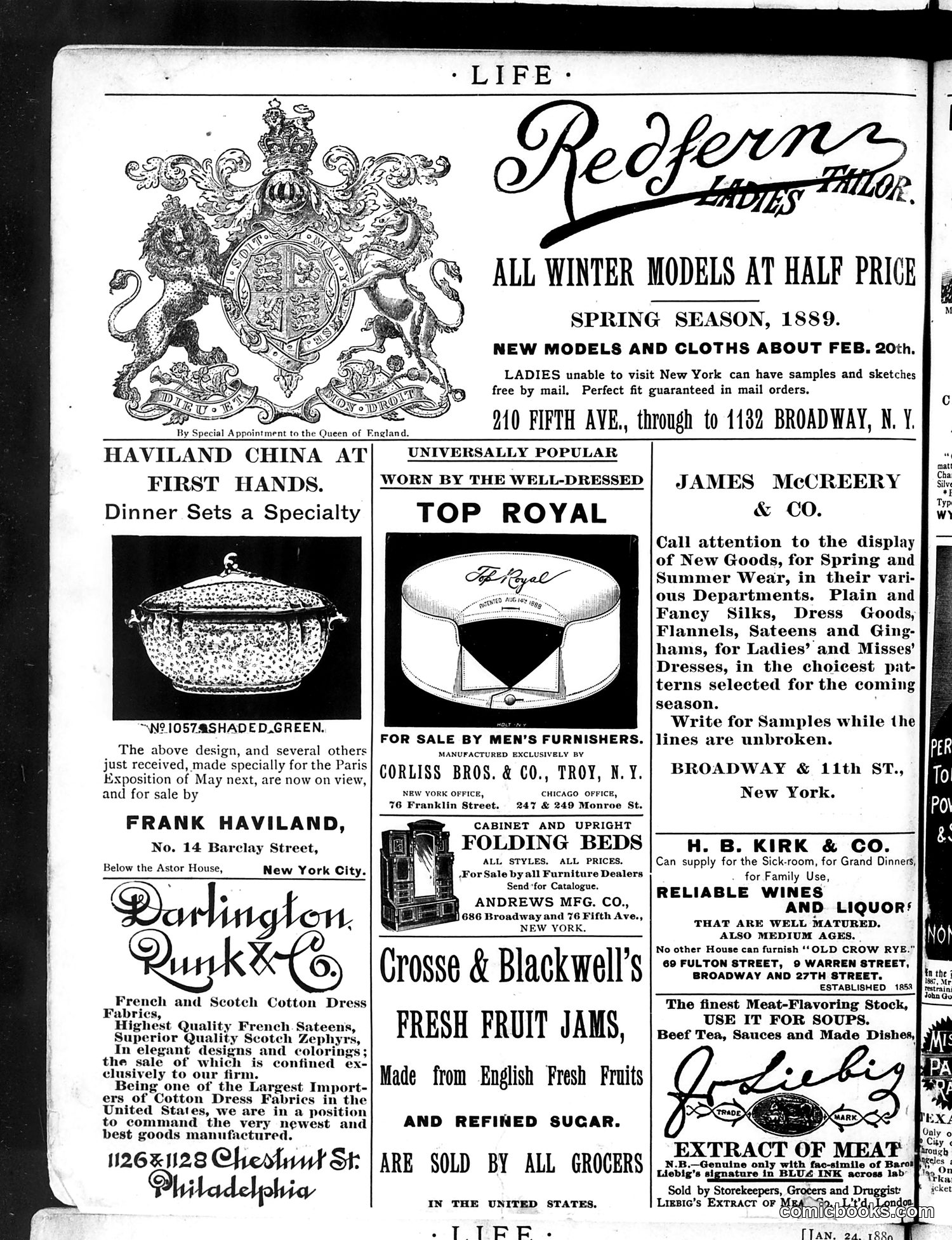
This is primarily a **commercial advertising page** rather than a satirical cartoon page. The masthead notes "By Special Appointment to the Queen of England," a common marketing claim of the era meant to convey prestige and quality. The page features luxury goods advertisements targeting wealthy New York consumers: Haviland china dinner sets, French and Scottish fabrics, the "Top Royal" hat, folding beds, and imported British products (Crosse & Blackwell jams, Liebig's meat extract). Notable is the **Redfern Ladies' Tailor** advertisement at top, offering spring fashions with samples by mail for women unable to visit New York—suggesting both the reach of mail commerce and gender-specific shopping limitations of 1889. The repeated emphasis on imported European goods reflects the era's association of European craftsmanship with quality and status. H.B. Kirk's wines and liquors advertisement underscores the market for luxury goods among the affluent. This page reveals late 19th-century consumer culture, advertising practices, and class assumptions rather than political satire.
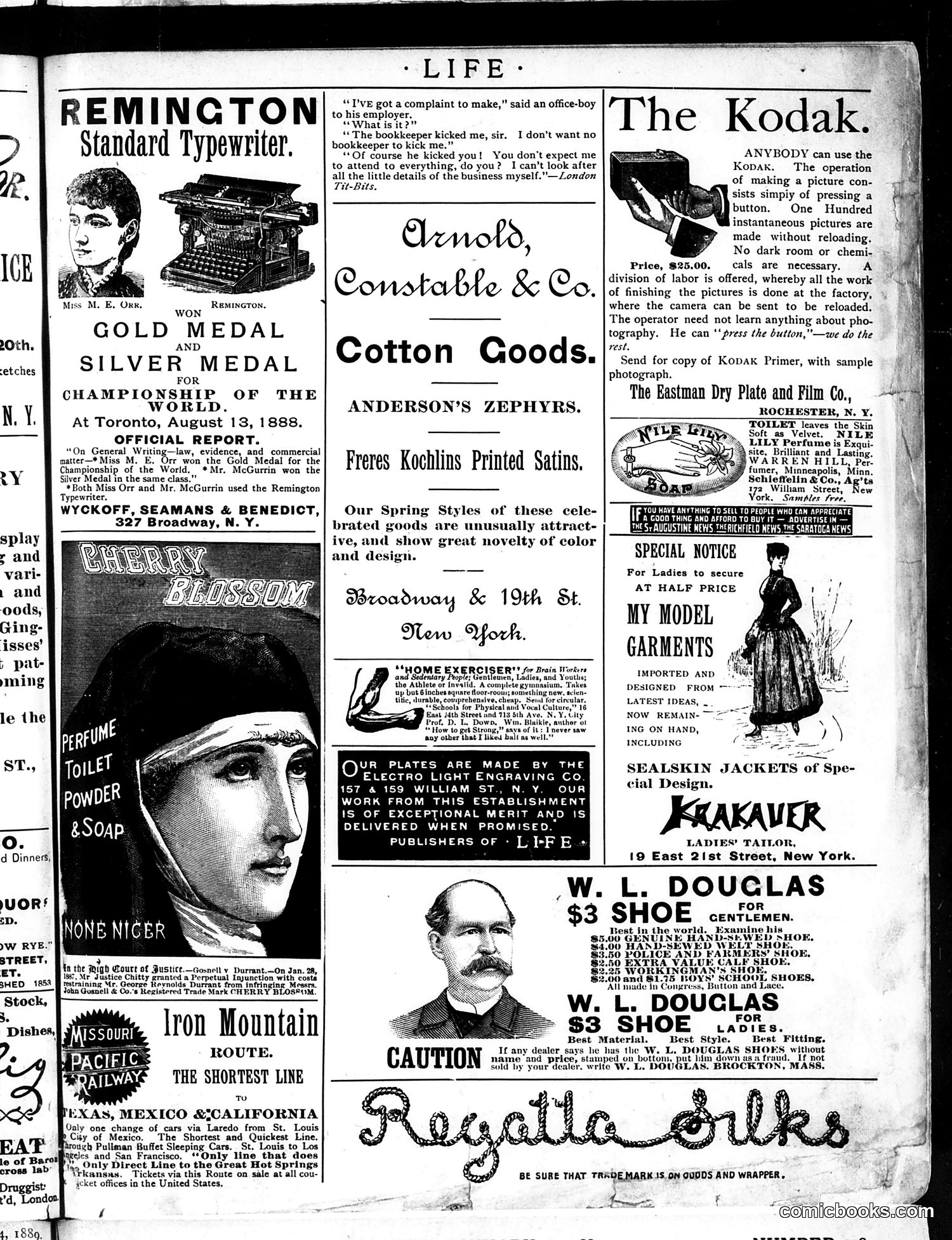
This is primarily an **advertising page** from Life magazine, not a political cartoon. The page features commercial advertisements for various products popular in the late 1800s: - **Remington Standard Typewriter** (top left, featuring Miss M.E. Orr) - **Kodak cameras** (top right) - **Perfume, toilet powder, and soap** (left side) - **Cotton goods and textiles** (center) - **Women's clothing and garments** (right side) - **W.L. Douglas shoes** (prominent, bottom) - **Railway and other services** (bottom left) The page demonstrates how Life magazine's revenue came from advertising. The ads reflect period consumer culture—typewriters, early photography equipment, and mass-produced clothing for middle-class audiences. No political satire is evident here.
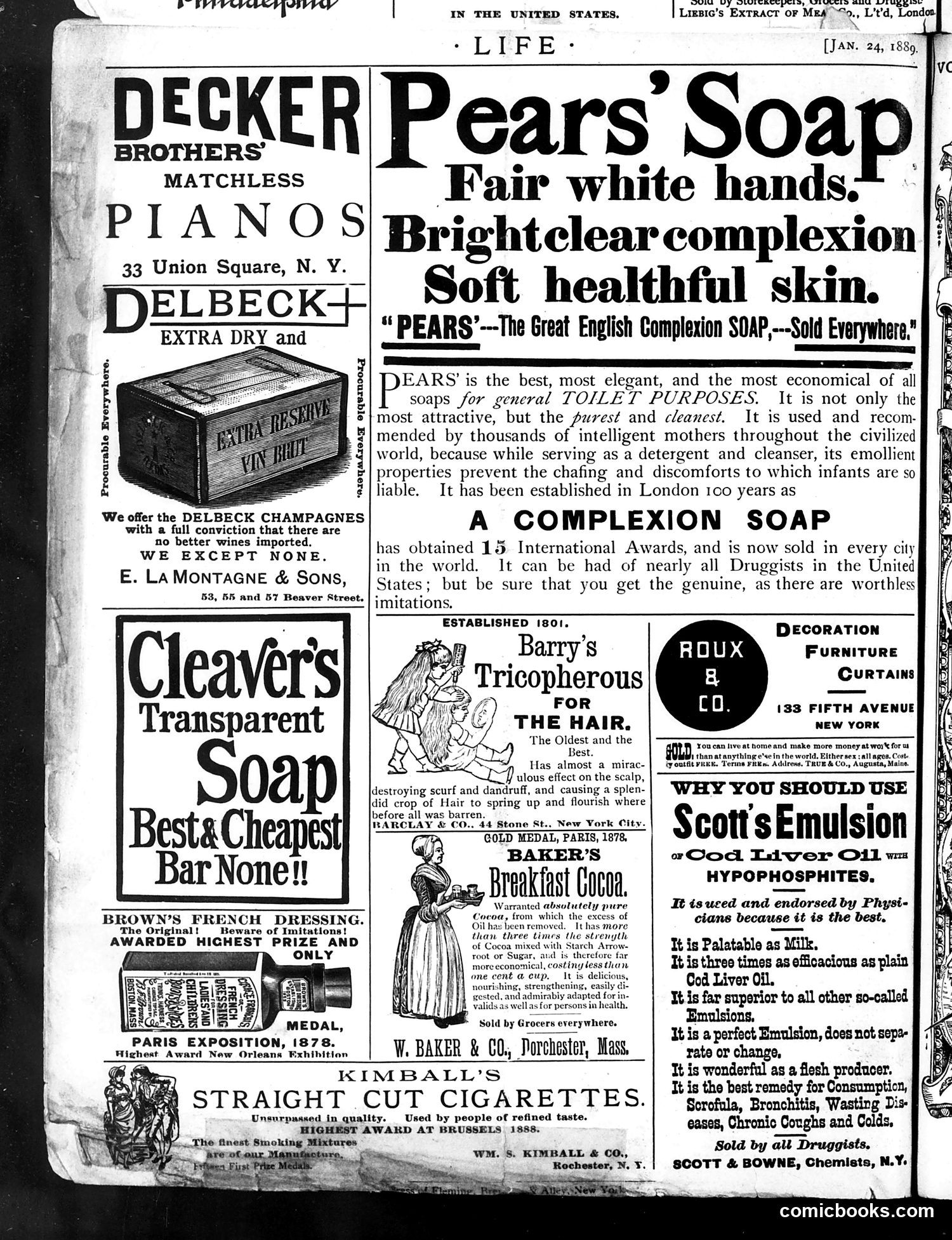
This is primarily an **advertising page**, not a political cartoon. It contains no satire or social commentary—rather, it showcases Victorian-era commercial products. The page features advertisements for luxury goods and patent medicines typical of the 1880s: Decker pianos, Pears' Soap (emphasizing "fair white hands" and "bright clear complexion"), Cleaver's Transparent Soap, champagne, hair products, Scott's Emulsion (cod liver oil), breakfast cocoa, and cigarettes. Notable to modern readers: These ads reveal period attitudes—particularly the **racial and complexion-focused language** in cosmetic advertising ("fair white hands," "bright clear complexion"), reflecting the era's beauty standards and implicit racial hierarchies. The prominence of **unregulated "patent medicines"** and their exaggerated health claims (Scott's Emulsion curing consumption and scrofula) reflects pre-FDA standards. The page documents 1880s consumerism and advertising practices before modern regulation and social awareness.