
Life, 1889-01-24 · page 4 of 16
Life — January 24, 1889 — page 4: what you’re looking at
What you’re looking at
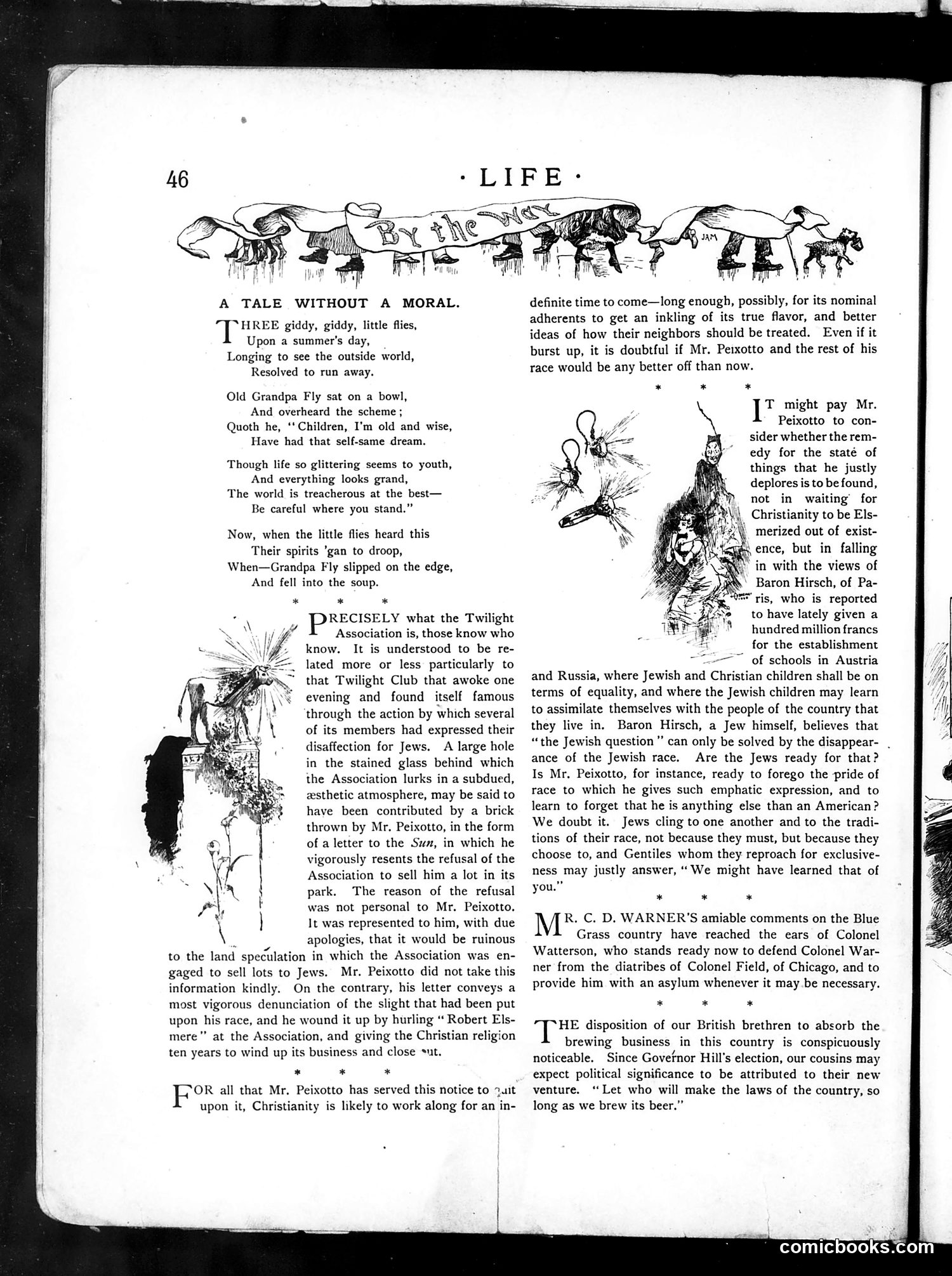
This page contains a satirical fable titled "A Tale Without a Moral" about three flies who ignore an old grandfather fly's warning and fall into soup—a cautionary tale about ignoring wisdom. The main political content appears in the prose section discussing the Twilight Club controversy. The text criticizes someone named Mr. Peixotto for resenting the club's refusal to admit him, attributing this to anti-Semitism. The passage argues against assimilationist pressure on Jewish immigrants, defending Jewish cultural identity against Baron Hirsch's philanthropic integration efforts in Austria and Russia. Additional commentary addresses Mr. C.D. Warner's remarks about Blue Grass country and Colonel Watterson's political position, plus commentary on British involvement in brewing business during Governor Hill's election. The illustrations appear to be decorative Victorian-style engravings rather than specific political caricatures.
📄 Transcribed text from this page (OCR, searchable)
Machine-transcribed from the original scan — historical spelling and the odd misread are preserved.
A TALE WITHOUT A MORAL. Tee giddy, giddy, little fies, Upon a summer's day, Longing to see the outside world, Resolved to run away. Old Grandpa Fly sat on a bowl, And overheard the scheme ; Quoth he, ‘Children, I'm old and wise, Have had that self-same dream. Though life so glittering seems to youth, And everything looks grand, The world is treacherous at the best— Be careful where you stand.” Now, when the little flies heard this Their spirits ’gan to droop, When—Grandpa Fly slipped on the edge, And fell into the soup. * * * RECISELY what the Twilight Association is, those know who know. It is understood to be re- lated more or less particularly to that Twilight Club that awoke one evening and found itself famous through the action by which several of its members had expressed their disaffection for Jews. A large hole in the stained glass behind which the Association lurks in a subdued, aesthetic atmosphere, may be said to have been contributed by a brick thrown by Mr. Peixotto, in the form of a letter to the Sun, in which he vigorously resents the refusal of the Association to sell him a lot in its park. The reason of the refusal was not personal to Mr. Peixotto. It was represented to him, with due apologies, that it would be ruinous to the land speculation in which the Association was en- gaged to sell lots to Jews. Mr. Peixotto did not take this information kindly. On the contrary, his letter conveys a most vigorous denunciation of the slight that had been put upon his race, and he wound it up by hurling “ Robert Els- mere" at the Association, and giving the Christian religion ten years to wind up its business and close sut. * * * OR all that Mr. Peixotto has served this notice to 7uit upon it, Christianity is likely to work along for an in- definite time to come—long enough, possibly, for its nominal adherents to get an inkling of its true flavor, and better ideas of how their neighbors should be treated. Even if it burst up, it is doubtful if Mr. Peixotto and the rest of his race would be any better off than now. * * T might pay Mr. Peixotto to con- sider whether the rem- edy for the staté of things that he justly deplores is to be found, not in waiting’ for ba i Christianity to be Els- merized out of exist- ence, but in falling in with the views of Baron Hirsch, of Pa- “ris, who is reported to have lately given a hundred million francs for the establishment —~ of schools in Austria and Russia, where Jewish and Christian children shall be on terms of equality, and where the Jewish children may learn to assimilate themselves with the people of the country that they live in. Baron Hirsch, a Jew himself, believes that “the Jewish question ” can only be solved by the disappear- . ance of the Jewish race. Are the Jews ready for that? Is Mr. Peixotto, for instance, ready to forego the pride of race to which he gives such emphatic expression, and to learn to forget that he is anything else than an American? We doubt it. Jews cling to one another and to the tradi- tions of their race, not because they must, but because they choose to, and Gentiles whom they reproach for exclusive- ness may justly answer, “ We might have learned that of you.” * * * R. C. D. WARNER'S amiable comments on the Blue Grass country have reached the ears of Colonel Watterson, who stands ready now to defend Colonel War- ner from the diatribes of Colonel Field, of Chicago, and to provide him with an asylum whenever it may be necessary. * * * HE disposition of our British brethren to absorb the brewing business in this country is conspicuously noticeable. Since Govetnor Hill's election, our cousins may expect political significance to be attributed to their new venture. ‘Let who will make the laws of the country, so long as we brew its beer.” comicbooks.com