
Life, 1889-01-24 · page 10 of 16
Life — January 24, 1889 — page 10: what you’re looking at
What you’re looking at
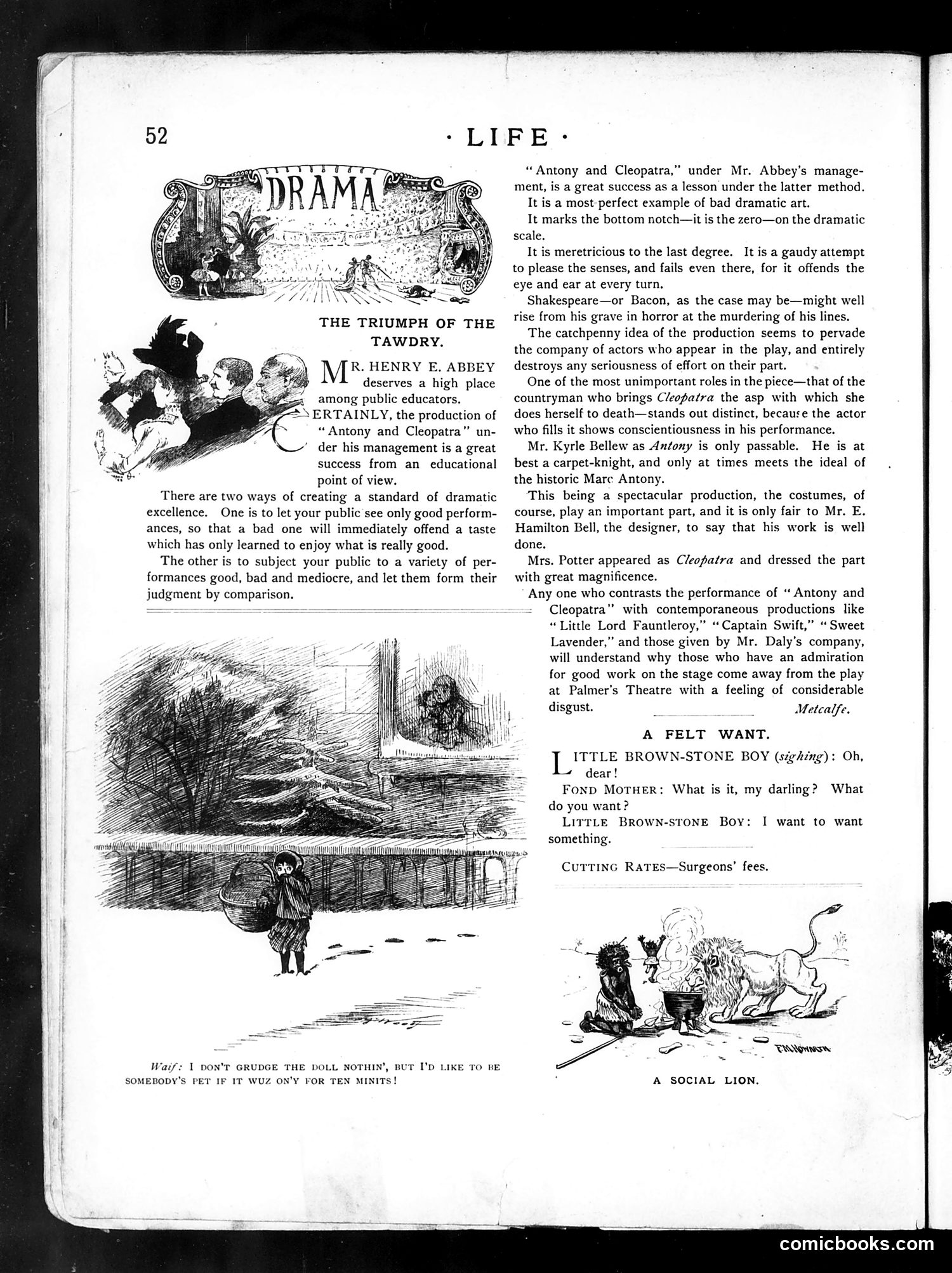
This page reviews Henry E. Abbey's production of "Antony and Cleopatra," criticizing it as dramatically poor despite elaborate staging. The reviewer argues Abbey pursued visual spectacle over artistic merit—appealing to audiences through "a variety of performances" rather than quality. The critique attacks contemporary theater's reliance on costumes and design (credited to E. Hamilton Bell) to distract from weak performances, particularly Kyrle Bellew's "carpet-knight" Antony and Mrs. Potter's Cleopatra. The humor pieces below—"A Felt Want" (a child's absurdist request) and "A Social Lion" (illustrated, likely depicting social pretension)—appear unrelated filler content typical of satirical magazines. The overall page reflects late-19th-century theatrical criticism emphasizing artistic integrity over commercial spectacle.
📄 Transcribed text from this page (OCR, searchable)
Machine-transcribed from the original scan — historical spelling and the odd misread are preserved.
> LIFE: THE TRIUMPH OF THE TAWDRY. R. HENRY E. ABBEY deserves a high place among public educators. RTAINLY, the production of “Antony and Cleopatra” un- ’ der his management is a great success from an educational point of view. There are two ways of creating a standard of dramatic excellence. One is to let your public see only good perform- ances, so that a bad one will immediately offend a taste which has only learned to enjoy what is really good. The other is to subject your public to a variety of per- formances good, bad and mediocre, and let them form their judgment by comparison. Waif: 1 von’? GRUDGE THE DOLL NOTHIN’, BUT I'D LIKE TO RE “Antony and Cleopatra,” under Mr. Abbey’s manage- ment, is a great success as a lesson under the latter method. It is a most perfect example of bad dramatic art. It marks the bottom notch—it is the zero—on the dramatic scale. It is meretricious to the last degree. It is a gaudy attempt to please the senses, and fails even there, for it offends the eye and ear at every turn. Shakespeare—or Bacon, as the case may be—might well rise from his grave in horror at the murdering of his lines. The catchpenny idea of the production seems to pervade the company of actors who appear in the play, and entirely destroys any seriousness of effort on their part. One of the most unimportant roles in the piece—that of the countryman who brings C/eopa¢ra the asp with which she does herself to death—stands out distinct, because the actor who fills it shows conscientiousness in his performance. Mr. Kyrle Bellew as Antony is only passable. He is at best a carpet-knight, and only at times meets the ideal of the historic Marc Antony. This being a spectacular production, the costumes, of course, play an important part, and it is only fair to Mr. E. Hamilton Bell, the designer, to say that his work is well done. Mrs. Potter appeared as C/eopatra and dressed the part with great magnificence. Any one who contrasts the performance of “ Antony and Cleopatra” with contemporaneous productions like “Little Lord Fauntleroy,” “Captain Swift,” “Sweet Lavender,” and those given by Mr. Daly’s company, will understand why those who have an admiration for good work on the stage come away from the play at Palmer's Theatre with a feeling of considerable disgust. Metcalfe. A FELT WANT. Lt BROWN-STONE BOY (sighing): Oh, dear! Fonp MoTHER: What is it, my darling? do you want? LITTLE BROWN-STONE Boy: something. What I want to want CuTTING RaTEsS—Surgeons’ fees. SOMEBODY'S PET IF IT WUZ ON'Y FOR TEN MINITS! A SOCIAL LION. comicbooks.com