
Life, 1889-01-24 · page 6 of 16
Life — January 24, 1889 — page 6: what you’re looking at
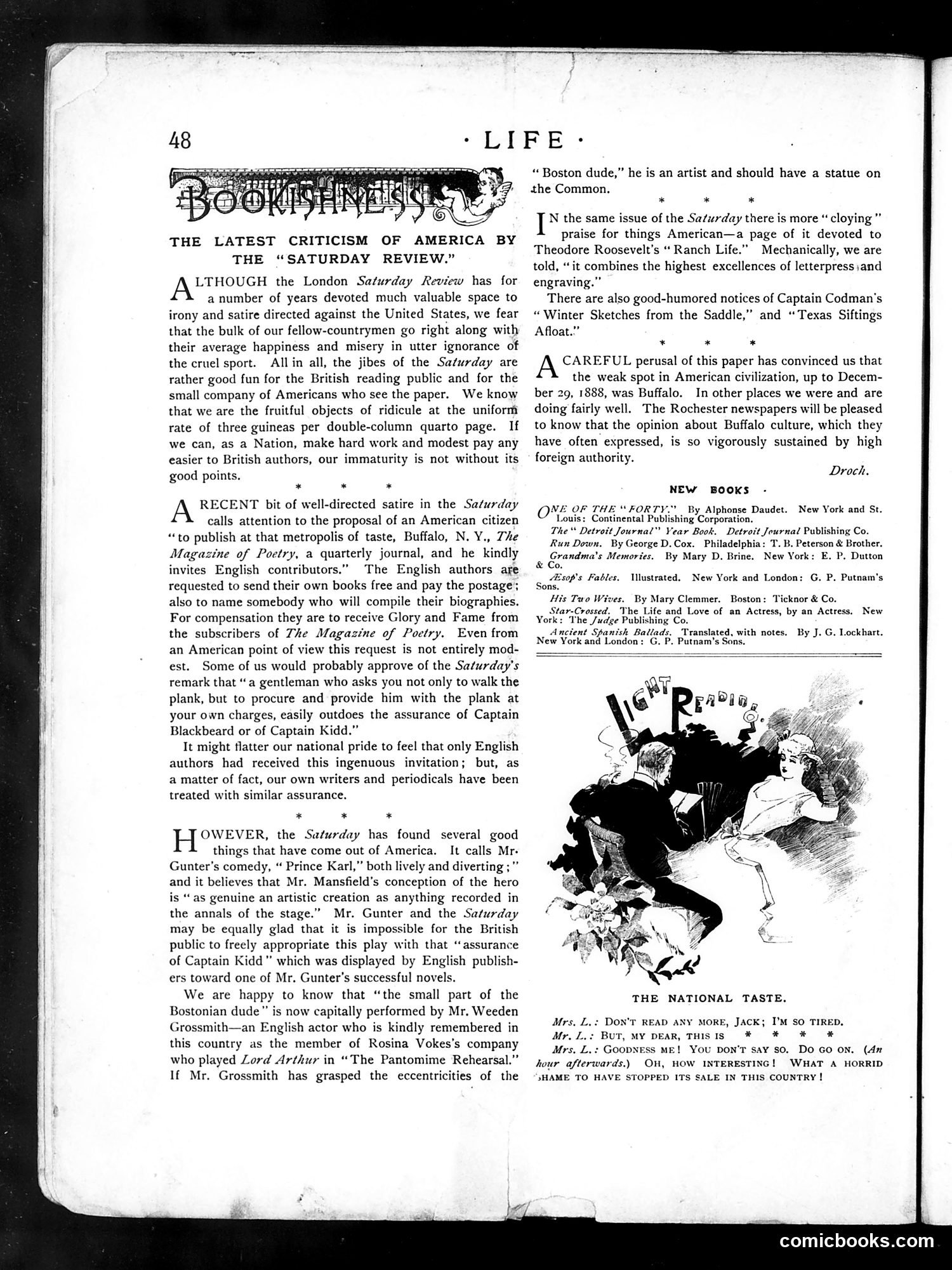
What you’re looking at
This satirical cartoon, titled "The National Taste," depicts a woman (labeled "Mrs. L.") rejecting a book titled "Light Reading" while expressing exhaustion. The accompanying dialogue shows her dismissing further literary suggestions, declaring she's "so tired" and won't read anymore because such works have damaged America's reputation. The satire targets American cultural standards of the late 19th century, suggesting the national appetite for frivolous "light reading" reflects poorly on American civilization. The cartoon connects to the article's broader critique of how the *Saturday Review* mocks American literary taste and cultural pretensions. The figure represents the average American reader consuming low-brow entertainment, embodying the magazine's concern that popular reading habits undermine national cultural credibility.
📄 Transcribed text from this page (OCR, searchable)
Machine-transcribed from the original scan — historical spelling and the odd misread are preserved.
THE LATEST CRITICISM OF AMERICA BY THE “SATURDAY REVIEW.” LTHOUGH the London Saturday Review has for a number of years devoted much valuable space to irony and satire directed against the United States, we fear that the bulk of our fellow-countrymen go right along with their average happiness and misery in utter ignorance of the cruel sport. Allin all, the jibes of the Saturday are rather good fun for the British reading public and for the small company of Americans who see the paper. We know that we are the fruitful objects of ridicule at the uniform rate of three guineas per double-column quarto page. If we can, as a Nation, make hard work and modest pay any easier to British authors, our immaturity is not without its good points. * * * RECENT bit of well-directed satire in the Saturday calls attention to the proposal of an American citizen “to publish at that metropolis of taste, Buffalo, N. Y., Zhe Magazine of Poetry, a quarterly journal, and he kindly invites English contributors.” The English authors are requested to send their own books free and pay the postage; also to name somebody who will compile their biographies. For compensation they are to receive Glory and Fame from the subscribers of Tze Magazine of Poetry. Even from an American point of view this request is not entirely mod- est. Some of us would probably approve of the Sa/urday’s remark that “a gentleman who asks you not only to walk the plank, but to procure and provide him with the plank at your own charges, easily outdoes the assurance of Captain Blackbeard or of Captain Kidd.” It might flatter our national pride to feel that only English authors had received this ingenuous invitation; but, as a matter of fact, our own writers and periodicals have been treated with similar assurance. * * * OWEVER, the Saturday has found several good things that have come out of America. It calls Mr- Gunter’s comedy, “ Prince Karl,” both lively and diverting ;"” and it believes that Mr. Mansfield’s conception of the hero is “as genuine an artistic creation as anything recorded in the annals of the stage.” Mr. Gunter and the Saturday may be equally glad that it is impossible for the British public to freely appropriate this play with that “assurance of Captain Kidd” which was displayed by English publish- ers toward one of Mr. Gunter’s successful novels. We are happy to know that “the small part of the Bostonian dude” is now capitally performed by Mr. Weeden Grossmith—an English actor who is kindly remembered in this country as the member of Rosina Vokes’s company who played Lord Arthur in “The Pantomime Rehearsal.” lf Mr. Grossmith has grasped the eccentricities of the “Boston dude,” he is an artist and should have a statue on the Common, * * * I N the same issue of the Sa/zrday there is more “ cloying ” praise for things American—a page of it devoted to Theodore Roosevelt’s “ Ranch Life.” Mechanically, we are told, “it combines the highest excellences of letterpress;and engraving.” There are also good-humored notices of Captain Codman’s “Winter Sketches from the Saddle,” and “Texas Siftings Afloat.”” * * * CAREFUL perusal of this paper has convinced us that the weak spot in American civilization, up to Decem- ber 29, 1888, was Buffalo. In other places we were and are doing fairly well. The Rochester newspapers will be pleased to know that the opinion about Buffalo culture, which they have often expressed, is so vigorously sustained by high foreign authority. Droch. NEW BOOKS ONE OF THE “FORTY.” By Alphonse Daudet. New York and St. Louis: Continental Publishing Corporation. The Detroit Journal” Year Book. Detroit Journal Publishing Co. Run Down. By George D.Cox. Philadelphia: T. B. Peterson & Brother. Grandina's Memories. By Mary D. Brine. New York: E. P. Dutton ¢ Co. ois? Fables. Mlustrated, New York and London: G. P, Putnam's So His Tuo Wives. By Mary Clemmer. Boston: Ticknor & Co. Star-Crossed. ‘The Life and Love of an Actress, by an Actress. New York: The /udge Publishing Co. Ancient Spanish Ballads. Translated, with notes, By J. G. Lockhart. New York and London: G. P. Putnam's Sons, THE NATIONAL TASTE. Mrs. L.: DON'T READ ANY MORE, JACK; I’M SO TIRED. Z.: BUT, MY DEAR, THISIS| * = * # # Mrs, L.: GOobNESs ME! You DON'T say $0, Do Go oN. (An hour afterwards.) OW, HOW INTERESTING! WHAT A HORRID sHAME TO HAVE STOPPED ITS SALE IN THIS COUNTRY ! comicbooks.com