
A complete issue · 16 pages · 1889
Life — January 10, 1889
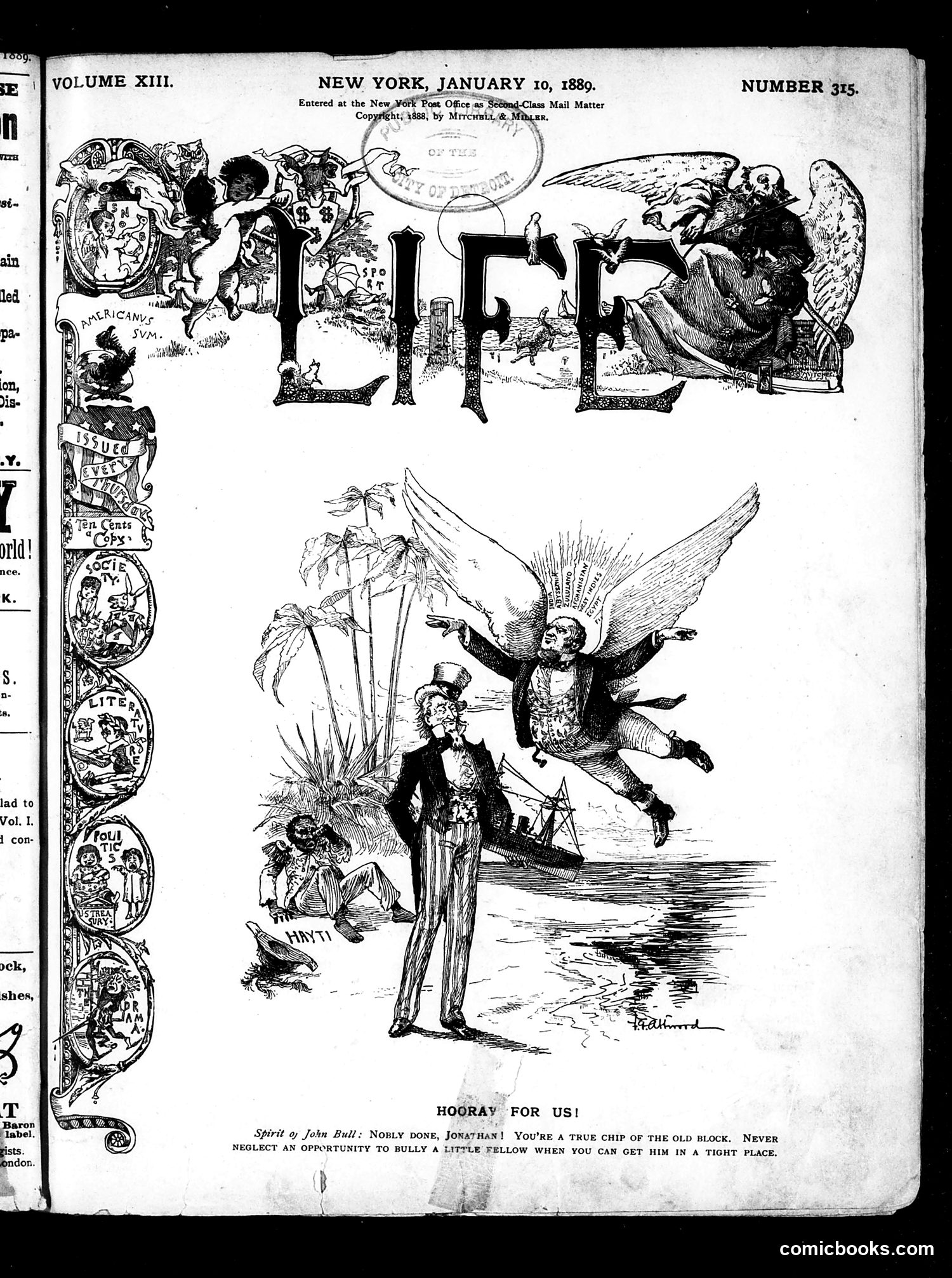
This satirical cartoon depicts a well-dressed gentleman (likely representing American interests or leadership) being congratulated by winged cherubs or putti while standing before what appears to be Haiti. The caption credits "Spirit of John Bull" (Britain), calling Jonathan (the American figure) a "true chip of the old block" and encouraging him to "bully a little fellow when you can get him in a tight place." The satire criticizes American imperialism and bullying of smaller nations, specifically Haiti. The "John Bull" reference invokes British colonial aggression, implying America is adopting similar imperialist tactics. The winged figures celebrating this behavior mock such international conduct as morally corrupt—presenting imperialism as something worthy only of mockery, not pride.
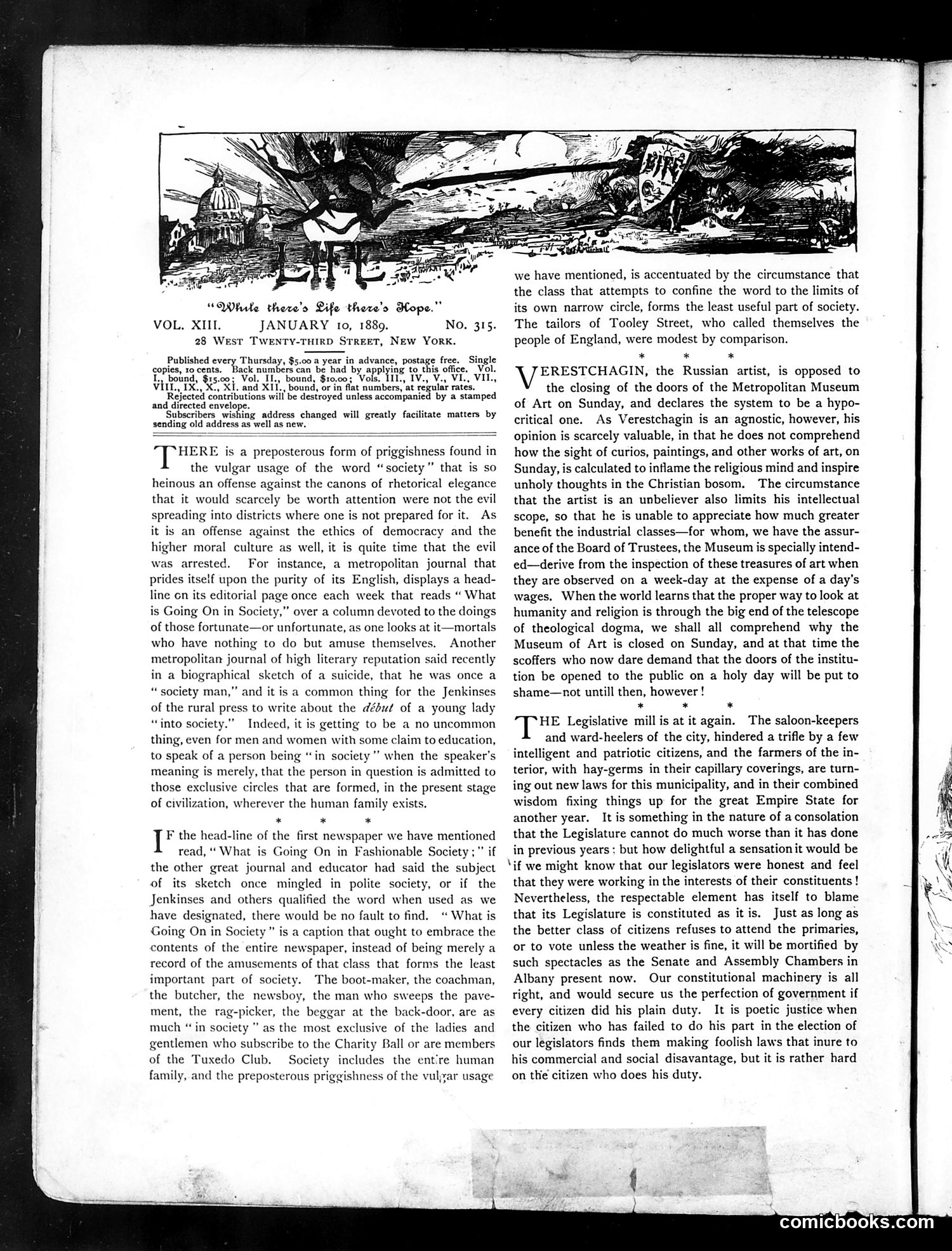
The header illustration "Where there's life there's hope" depicts a chaotic, apocalyptic cityscape with destruction and conflict, though its specific satirical target isn't immediately clear from the image alone. The text critiques the pretentiousness of high society's use of the word "society," arguing that wealthy elites falsely claim exclusivity while actually including tradespeople and their families. The author mocks newspapers that celebrate fashionable society gossip as meaningless. A secondary section attacks the Russian artist Verestchagin's opposition to Sunday museum hours, sarcastically defending the closing as protecting Christian morality—though the author clearly views this as hypocritical censorship benefiting working-class wages. The final paragraph discusses legislative corruption, suggesting legislators pass contradictory laws to benefit special interests like saloon-keepers.
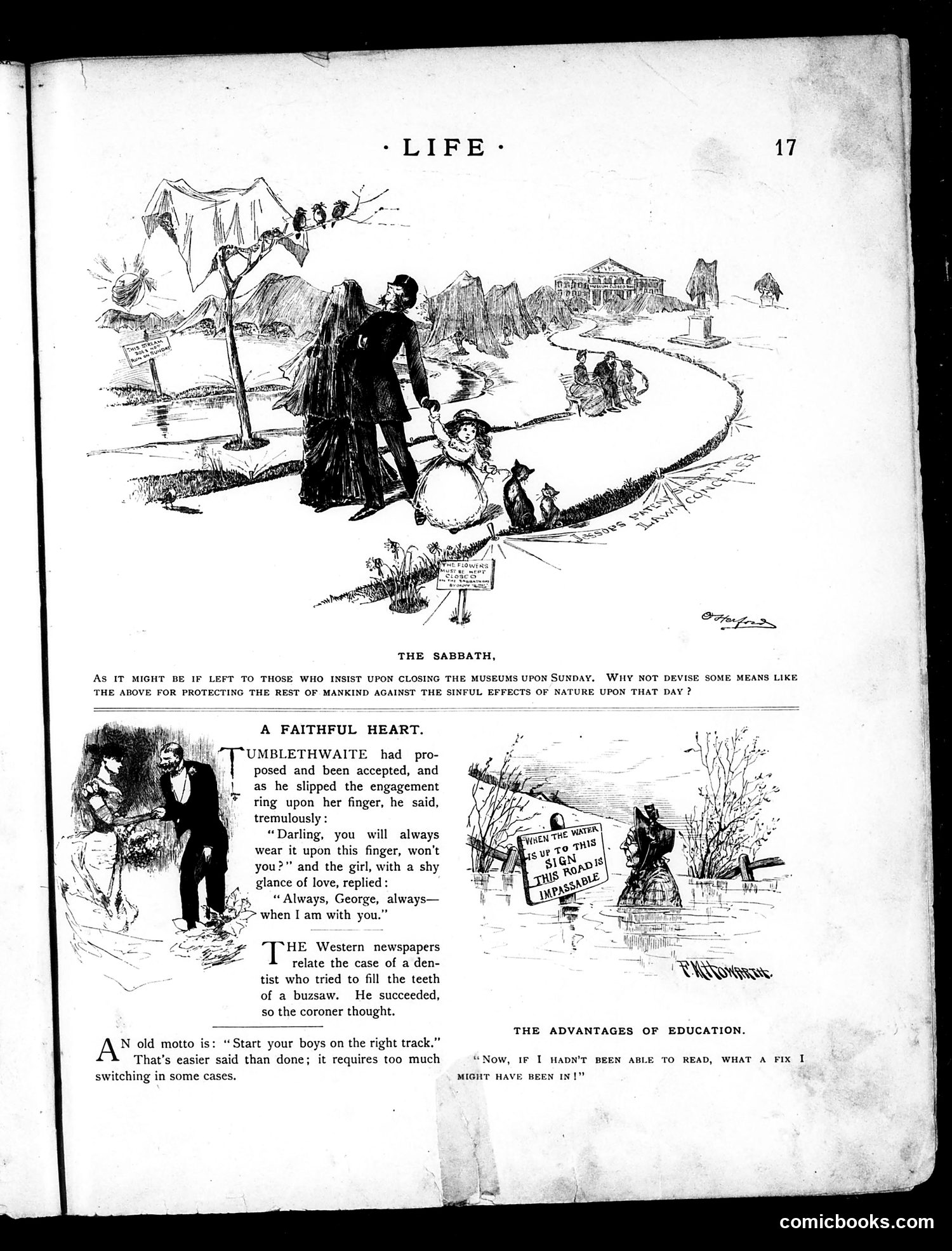
The top illustration satirizes Sunday closing laws for museums. A woman and child encounter a locked gate on their day off, while the caption questions why museums should close on Sundays—the one day working people have leisure to visit. The satire argues these restrictions prevent ordinary citizens from accessing educational and cultural resources, protecting "the rest of mankind" from "sinful effects of nature" (sarcastically). The lower sections contain unrelated brief comic pieces: "A Faithful Heart" depicts a romantic engagement, while "The Advantages of Education" makes a wordplay joke about literacy. The page represents *Life* magazine's typical format: combining social commentary with light humor, targeting educated middle-class readers skeptical of conservative religious restrictions on public institutions.
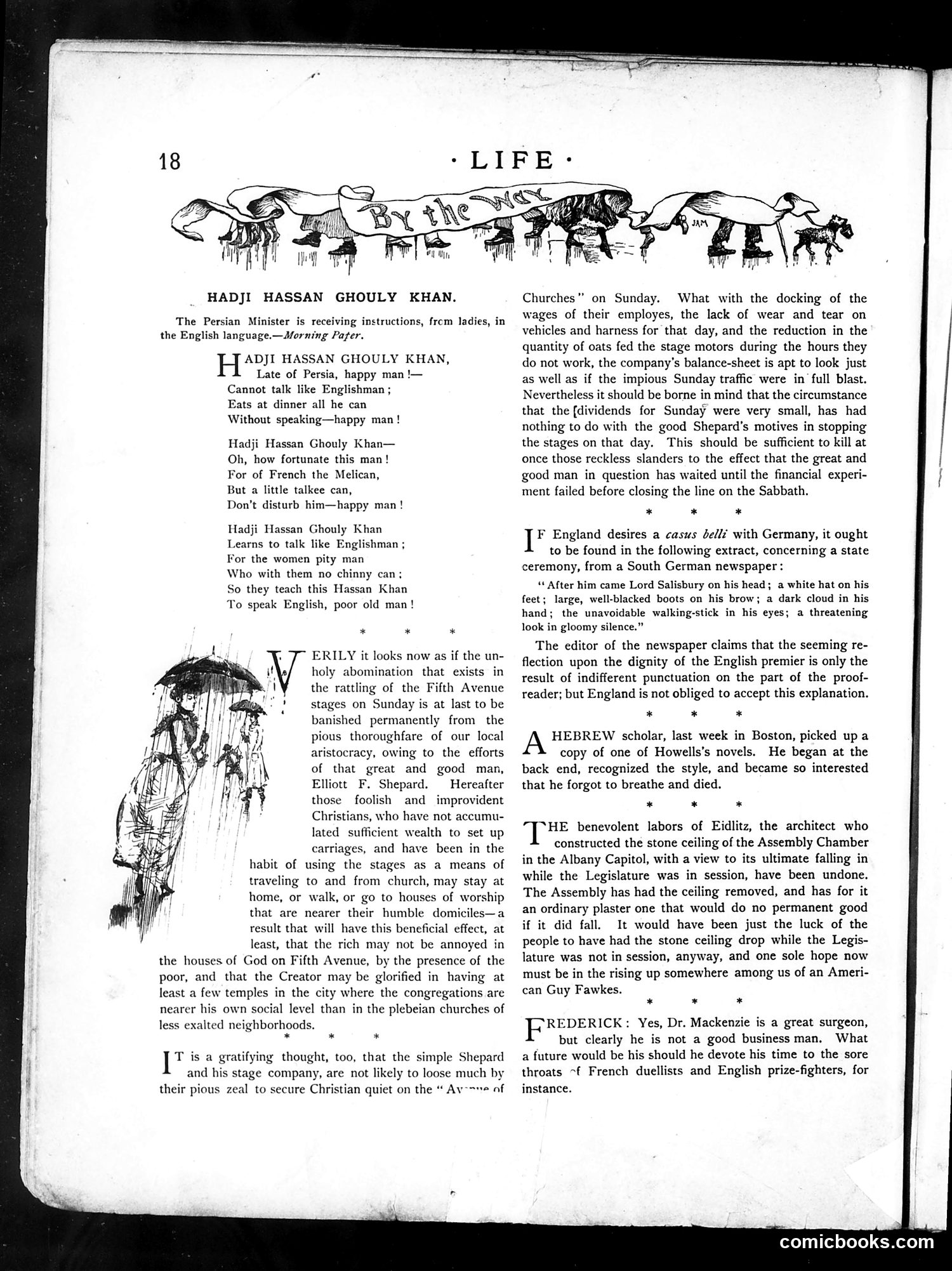
The page contains a satirical poem titled "HADJI HASSAN GHOULY KHAN" mocking a Persian minister learning English. The verse ridicules his inability to speak English properly while eating ("Eats at dinner all he can / Without speaking"), treating his linguistic struggles as humorous. The accompanying sketch shows a figure in traditional Persian dress looking disheveled and uncomfortable—visually reinforcing the text's mockery of the minister as a fish-out-of-water attempting Western civilization. The remaining content discusses unrelated contemporary issues: Fifth Avenue stage carriages disrupting church attendance, and various brief society anecdotes about a Hebrew scholar and architectural matters. The humor relies on ethnic stereotyping and the assumption that readers would find a foreigner's inability to master English inherently comedic—a common satirical approach in early-20th-century American publications.
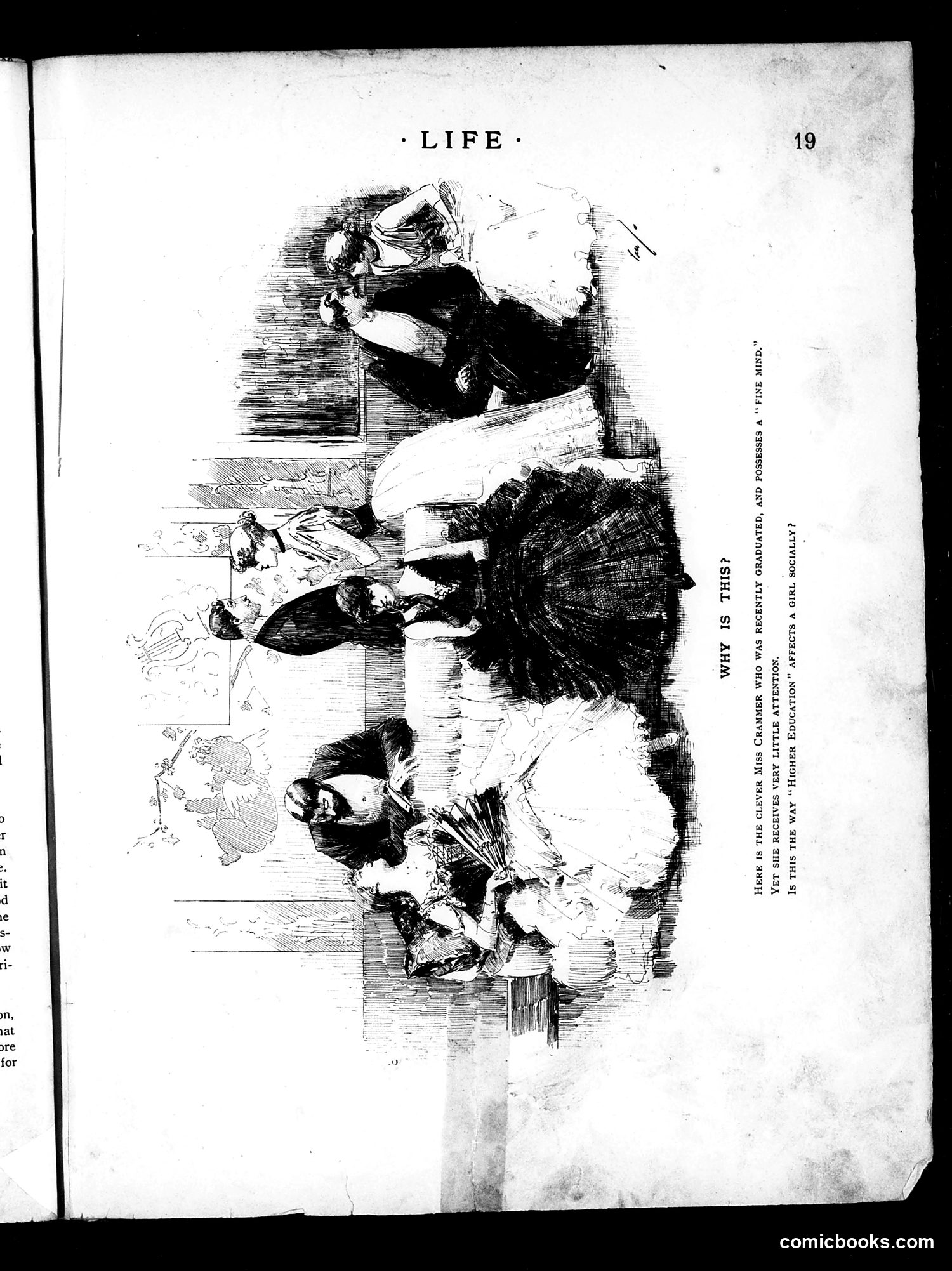
This appears to be a satirical illustration about wealth and social class. The image shows figures in Victorian-era dress, with the caption "HERE IS THE CAUSE WHY IS THIS" followed by text about "HEREDITY OBSCURED, AND POSSESSES A VIPER'S MIND? YET HE RECEIVED TITLE ATTENTION IS THE WAY 'HIGHER EXCEPTS' AFFECTS A DULL SOCIETY?" The cartoon likely critiques how aristocratic or wealthy individuals inherit status and privilege regardless of personal merit or character. The satirical tone suggests mockery of a social system where birth and inheritance determine social position, even when the person possessing wealth lacks moral character or intelligence. This reflects common Progressive-era criticism of inherited privilege and class inequality in American society. The exact figures remain unclear without additional context.
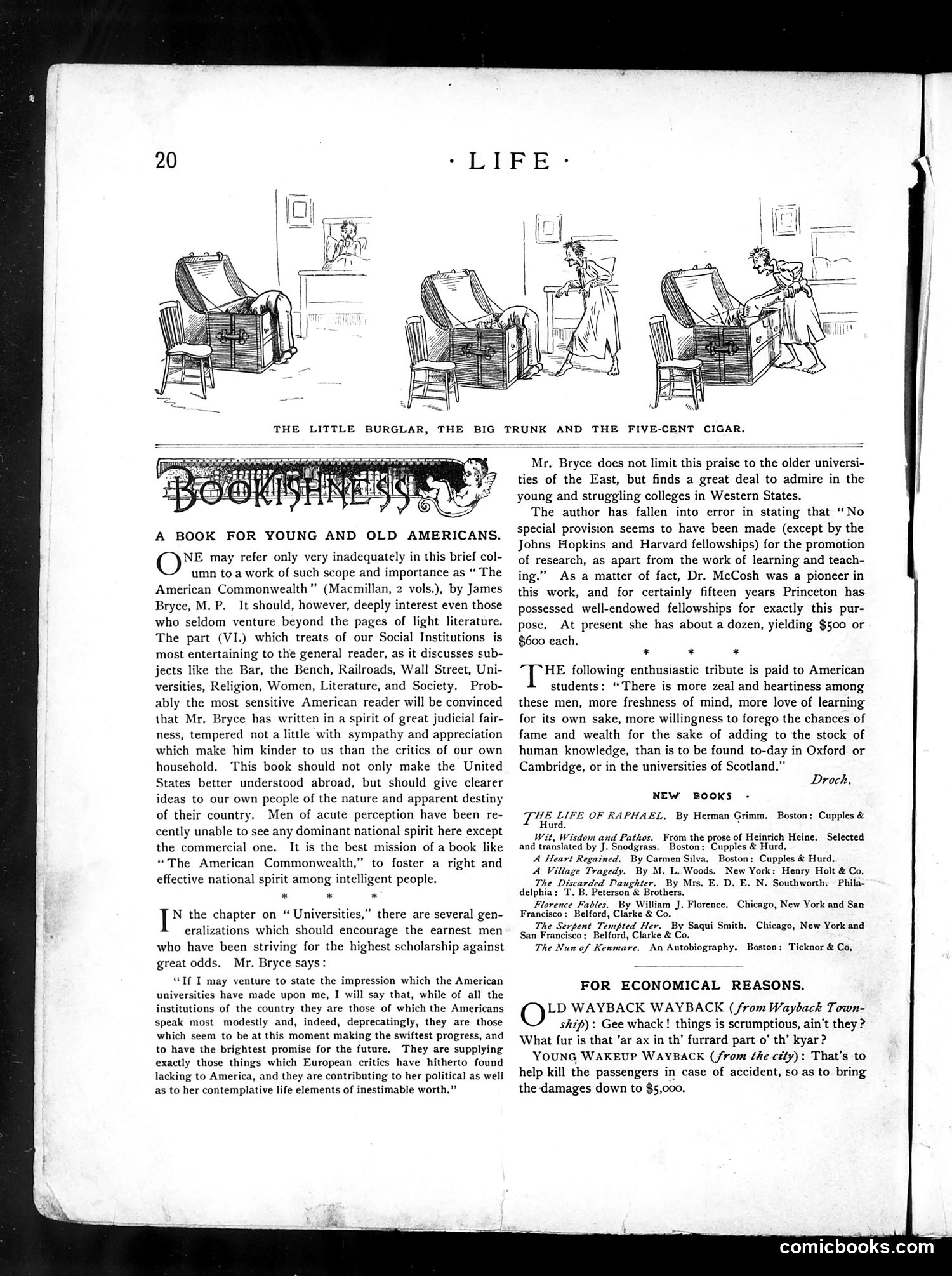
This three-panel cartoon depicts a slapstick scenario involving a child burglar attempting to steal from a trunk. In each panel, the progression shows the child struggling with an oversized trunk while an adult (likely the homeowner) reacts with surprise or alarm. The humor relies on visual comedy: a small child as an incompetent "burglar" unable to manage a large piece of furniture, combined with the incongruous detail of a "five-cent cigar" as the supposed prize. The title suggests satirizing petty crime or perhaps mocking sensationalist newspaper coverage of minor thefts. The cartoon's satire appears social rather than explicitly political, using domestic humor to comment on crime or class issues of the era.
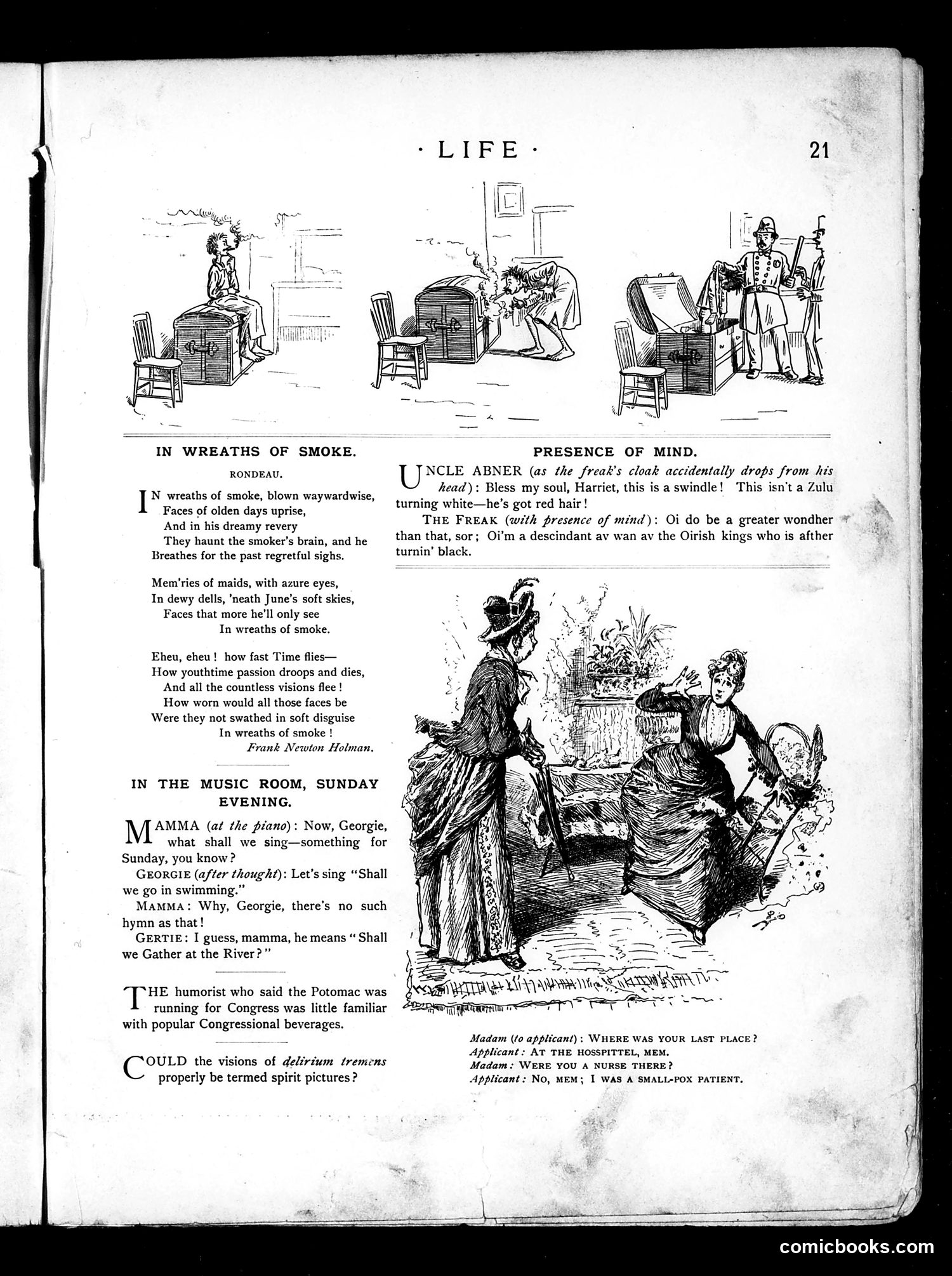
The page contains three distinct humorous pieces: 1. **"In Wreaths of Smoke"** (Rondeau by Frank Newbold Holman): A nostalgic poem lamenting how time passes and youthful faces fade, metaphorically "wreathed in smoke." 2. **"Presence of Mind"**: A brief comedic dialogue where Uncle Abner makes a racially offensive joke, apparently referencing hair texture and Irish ancestry. The humor relies on period stereotypes now considered deeply offensive. 3. **"In the Music Room, Sunday Evening"**: A domestic comedy sketch where a family debates hymn selections, with Georgie mishearing "Shall We Gather at the River?" as "Shall We Go in Swimming?"—a simple, innocent mix-up joke. The three illustrations show Victorian-era domestic and social scenes typical of Life magazine's satirical content from this period.
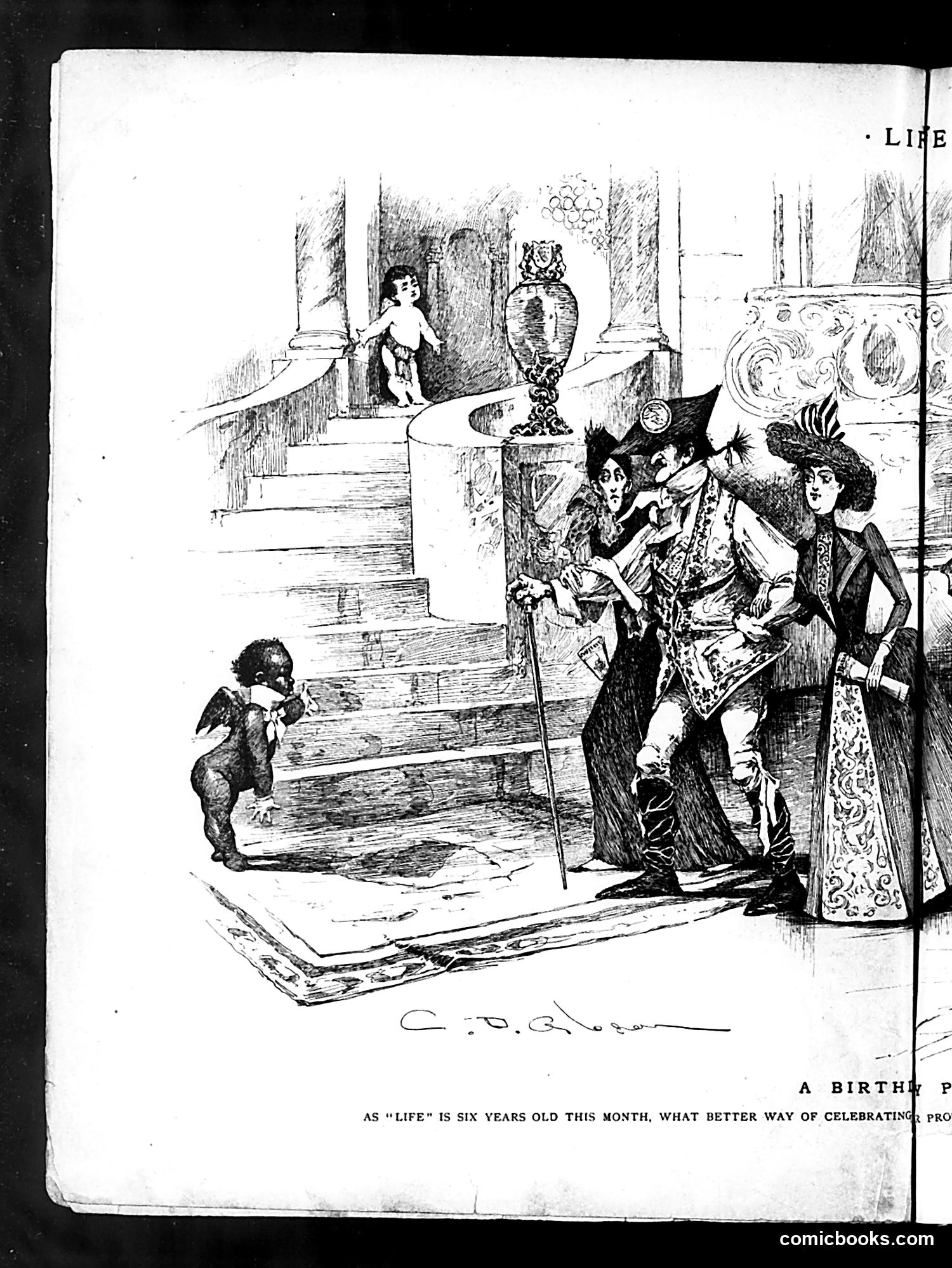
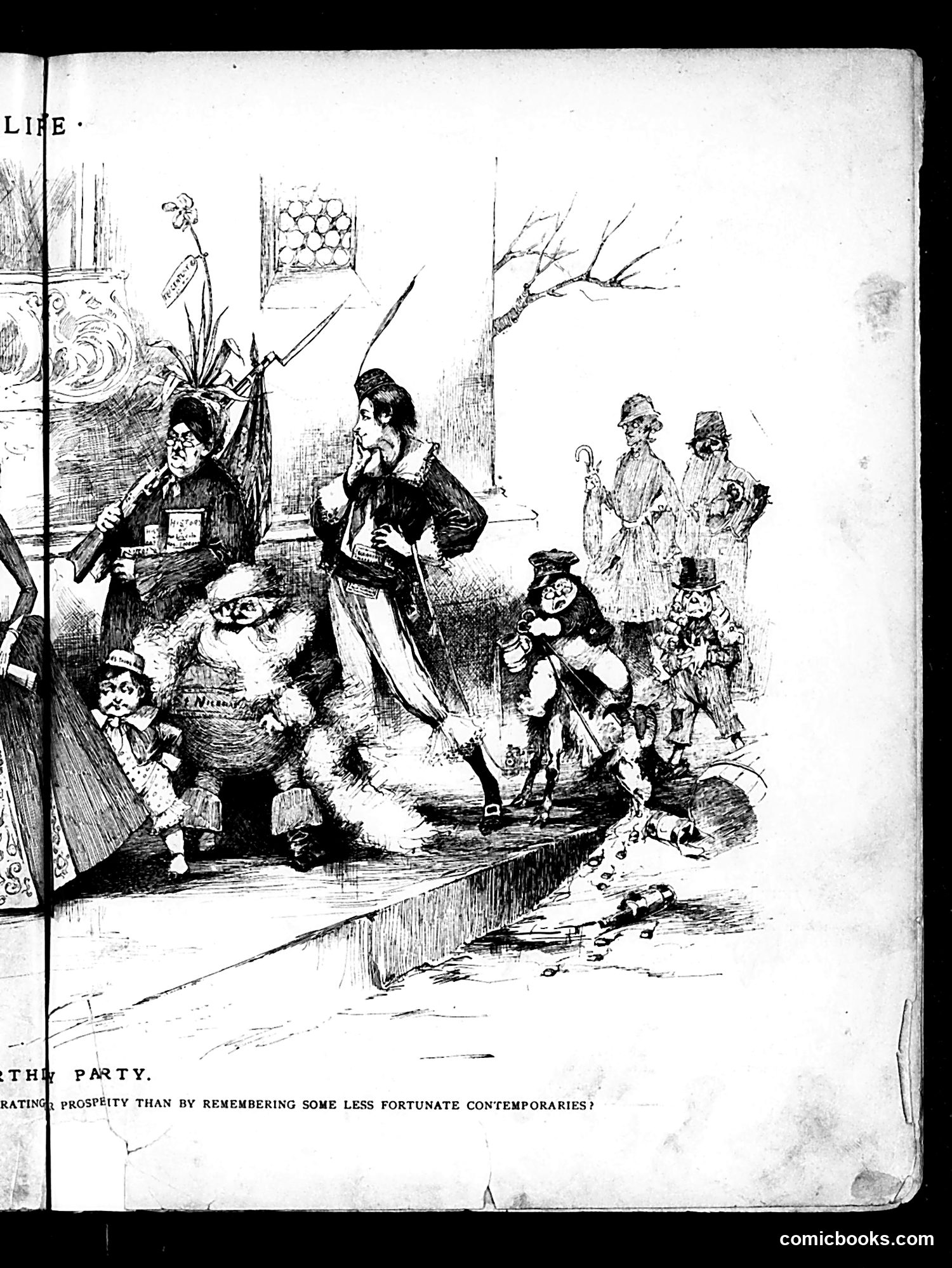
This appears to be a satirical illustration celebrating Life magazine's sixth anniversary. The caption reads: "AS 'LIFE' IS SIX YEARS OLD THIS MONTH, WHAT BETTER WAY OF CELEBRATING [?]" The scene depicts an elaborate palace or formal setting where a cherub or cupid figure (lower left) observes what appears to be a festive royal or aristocratic celebration. Well-dressed figures in period costume—including someone in ornate military dress with a feathered hat—gather in an ornate interior with classical columns and decorative urns. The satire likely mocks high society's pretentious celebrations or the magazine's own satirical stance toward the wealthy elite. The cherub's innocent observation of elaborate human pageantry creates comic contrast, suggesting Life magazine views such ostentatious displays with amused skepticism.
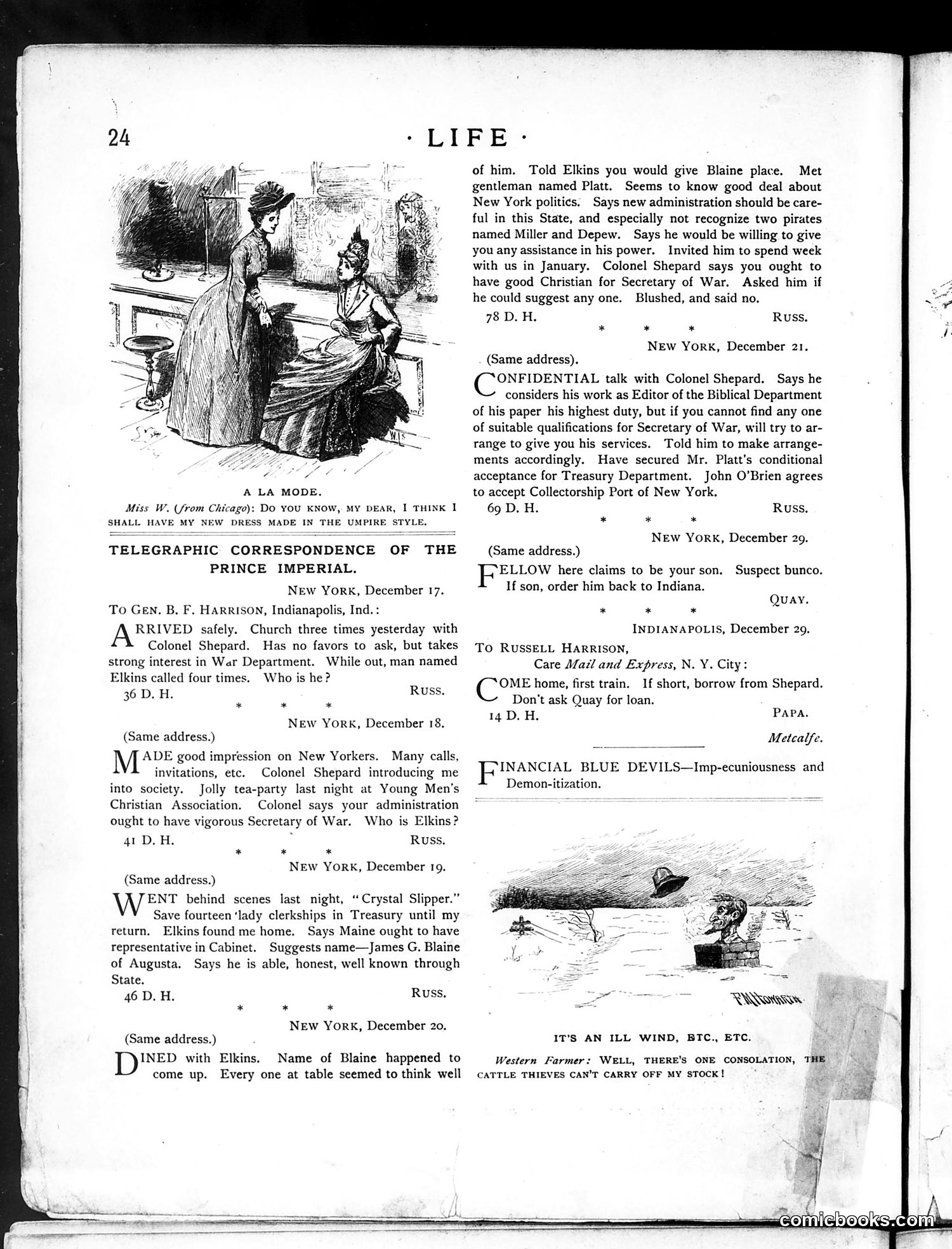
This page features satirical letters supposedly from "Russ" reporting on New York politics and high society during December 1880s. The correspondence mocks the incoming Harrison administration and political appointments—particularly discussion of potential Cabinet positions like Secretary of War, with names like Blaine and Platt mentioned as contenders or obstacles. The top illustration ("À La Mode") shows fashionable women discussing dress styles, captioned with a Chicago woman claiming her gown is made in "empire style"—likely satirizing pretentious fashion claims. The bottom cartoon depicts cattle thieves in windstorms, with crude visual humor about rustlers unable to steal livestock during bad weather. The page primarily relies on textual satire about political maneuvering rather than visual caricature.
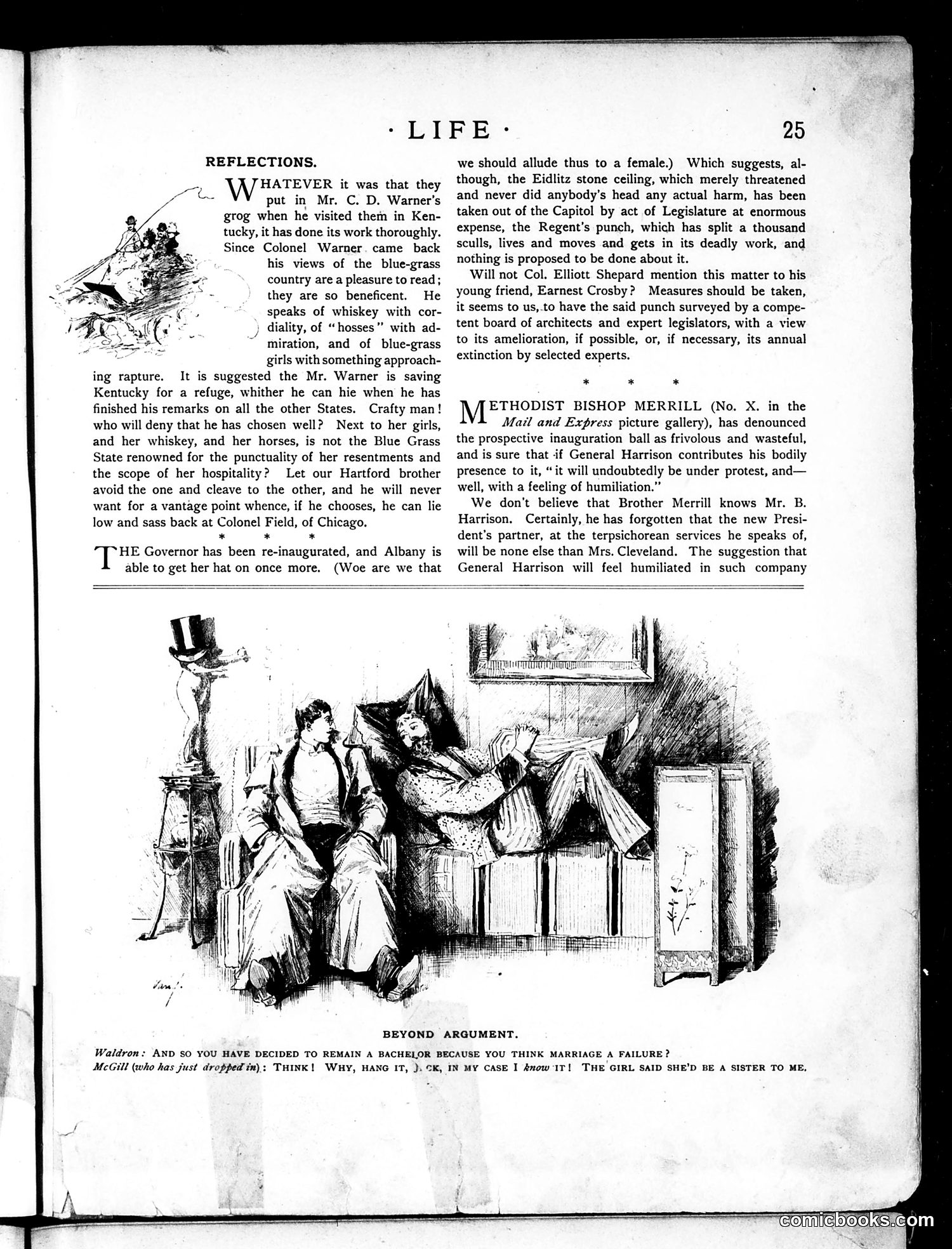
This page contains three satirical pieces mocking prominent figures and social issues circa 1889: **"Reflections" (top):** Humorously critiques C.D. Warner's sudden enthusiasm for Kentucky after visiting—suggesting he's been charmed by whiskey, horses, and women, and may use it as a refuge to escape Colonel Field of Chicago's criticism. **"Re-inauguration" (middle):** Jokes about Albany's relief that Governor (likely David B. Hill) has been re-inaugurated. It sarcastically compares removal of a dangerous stone ceiling from the Capitol to the ongoing danger posed by the "Regent's punch" (alcohol), which has caused many injuries yet remains untouched. **"Bishop Merrill" (bottom):** Mocks Methodist Bishop Merrill's claim that President Harrison will attend the inaugural ball "under protest." The satire notes Merrill apparently forgot Harrison's dance partner will be Mrs. Cleveland (the outgoing First Lady)—an awkward social situation that would genuinely justify embarrassment. **Cartoon caption:** A man explains he didn't choose bachelorhood theoretically but through experience—his intended said she'd "be a sister" to him, a polite rejection.
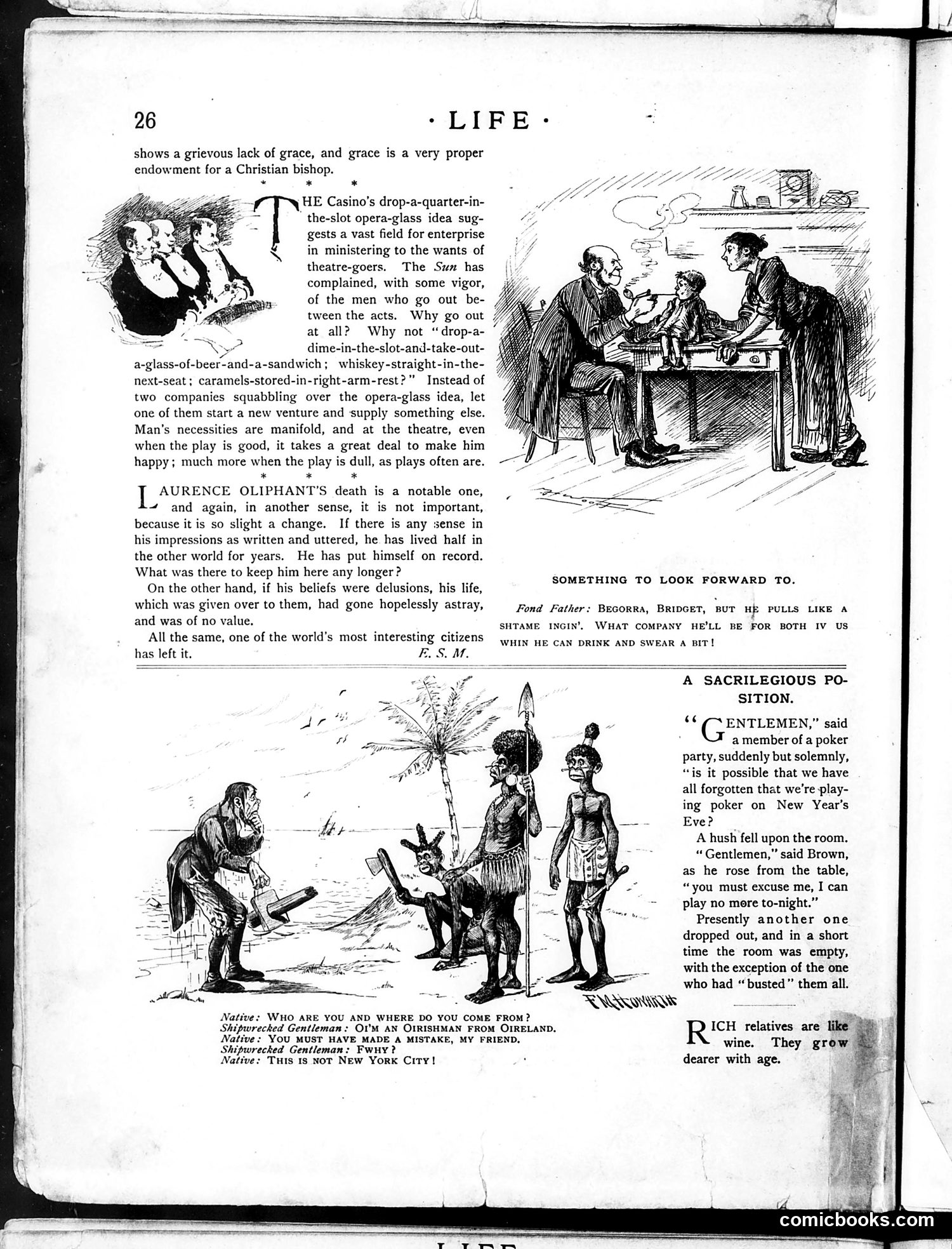
This page contains three separate satirical pieces from Life magazine: 1. **The Casino opera-glass editorial**: Mocks a vending machine concept (inserting coins for opera glasses) by sarcastically suggesting theaters should expand to vending machines for alcohol and snacks between acts—highlighting how theaters cater to audience desires for distraction rather than engagement with the performance. 2. **The shipwrecked Irishman cartoon**: Stereotypes Irish immigrants through dialect humor. An Irishman castaway insists he's from Ireland, but a native tells him "this is not New York City"—the joke being that Irish immigrants were so prevalent in New York that he expected to find fellow Irishmen there rather than an actual Irish island. 3. **The poker/New Year's Eve anecdote**: A player points out the moral impropriety of playing poker on New Year's Eve (a religious holiday), causing players to quit in embarrassment—satirizing selective piety and social hypocrisy around religious observance. All pieces mock contemporary social behavior through exaggeration and ethnic stereotyping common to 1880s-90s satire.
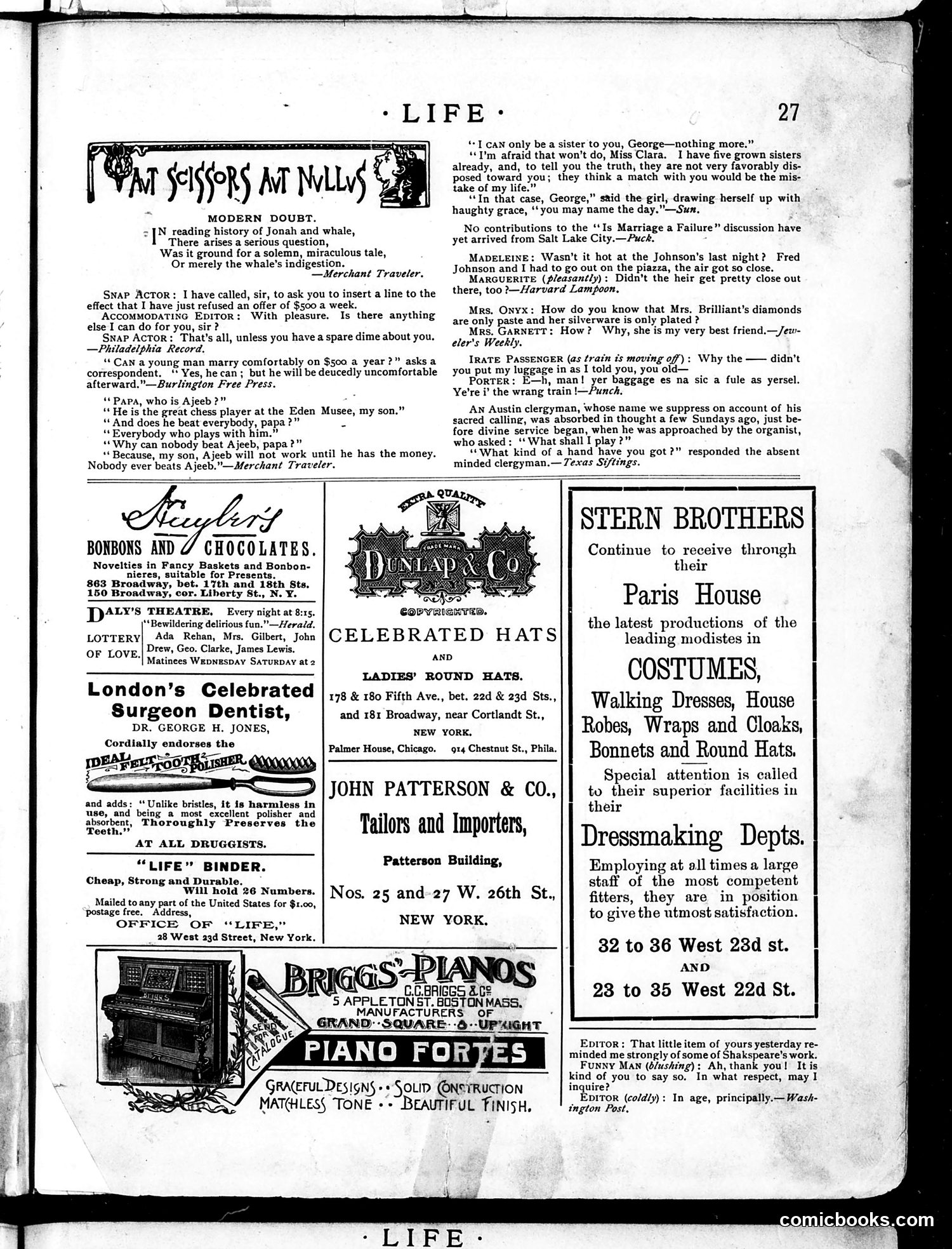
This page from Life magazine (page 27) consists primarily of short satirical jokes and advertisements rather than political cartoons. The jokes lampoon various contemporary social absurdities: a minister confusing a marriage proposal with a card game; newlyweds unable to afford privacy on a small income; a stage actor publicly claiming to refuse $500/week while asking for a dime; questions about whether marriage itself is a failing institution (with a jab at polygamous Utah). There's also a quip about the famous chess automaton "Ajeeb" at the Eden Musée (a wax museum), and mild satire on social climbing through friendship with wealthy women. One cartoon strip titled "AT SCISSORS AT NULLYS" appears at the top, though the image is unclear. The page is heavily dominated by period advertisements for theatrical productions (Daly's Theatre), confectioners, dentists, piano manufacturers, and dress shops—typical of Life's revenue model. The satire is gentle social commentary on marriage, money, and vanity rather than political critique.
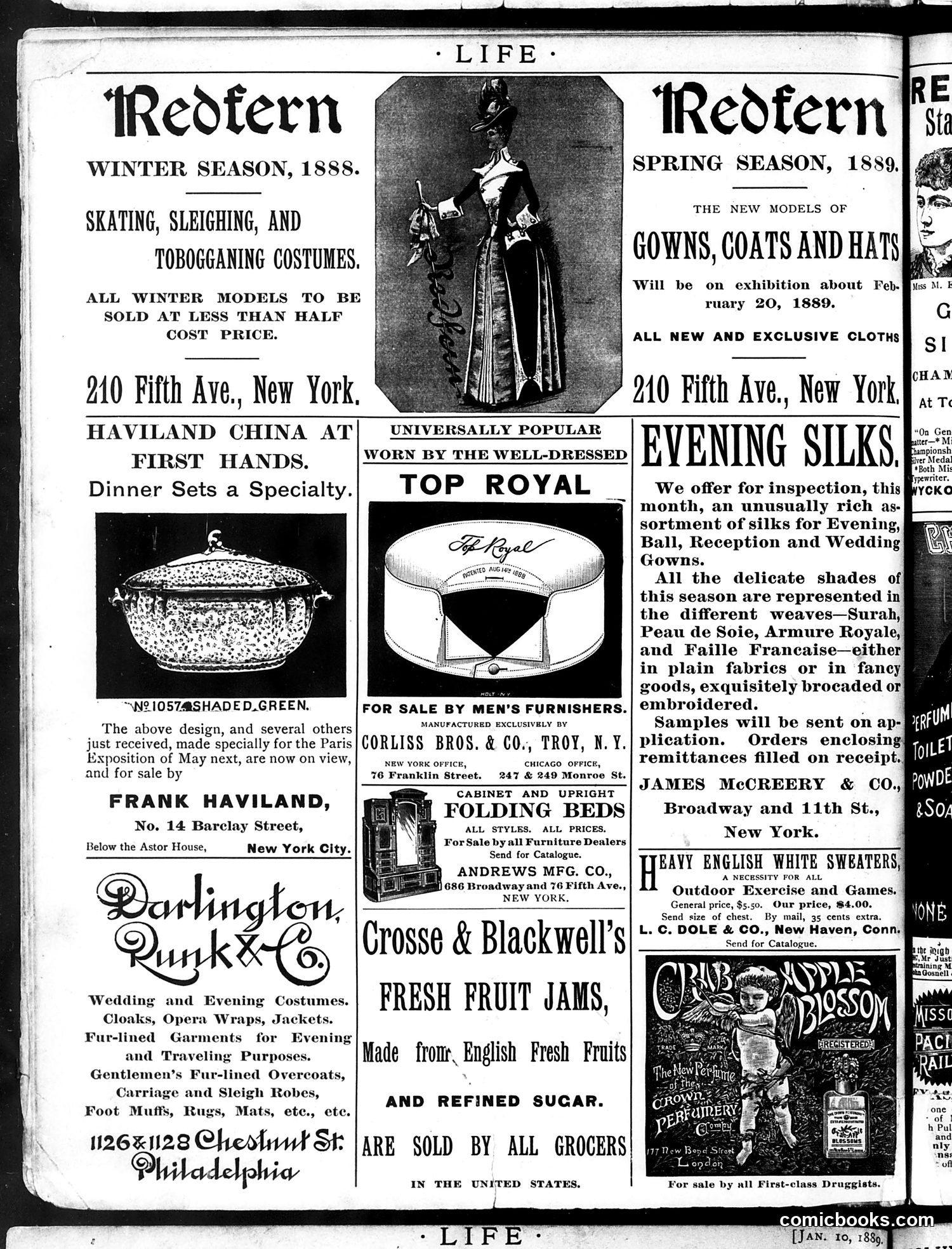
This is **primarily an advertising page**, not a satirical cartoon page. Life magazine from this era mixed editorial content with paid advertisements. The page showcases luxury goods for affluent 1880s consumers: Redfern's high-fashion clothing for winter sports and spring; Haviland china (with pieces made for the 1889 Paris Exposition); Frank Haviland dinnerware; Darlington Runk & Co.'s formal wear; English products like Crosse & Blackwell jams and Top Royal hats; and American furniture and textiles. The central image shows an elegant woman in formal Victorian evening dress—representing the aspirational "well-dressed" aesthetic these advertisers marketed to wealthy clients. This page reflects **Gilded Age consumer culture**: American prosperity, European taste-making (Paris, English goods), and the emergence of department stores and mail-order shopping. The repeated emphasis on "exclusive" and "new models" reveals period obsession with fashion seasonality and social status signaling through consumption.
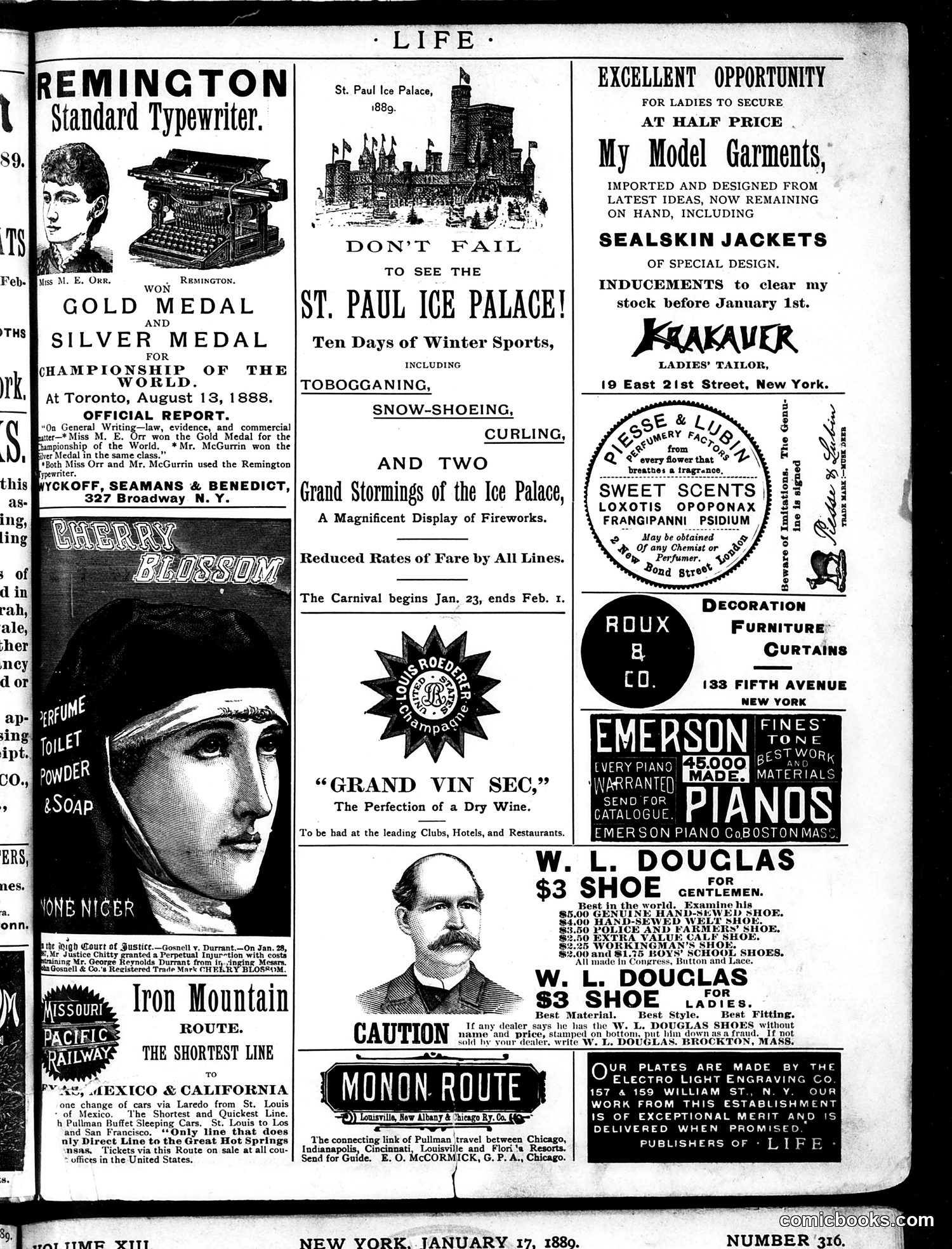
This is primarily an **advertising page** from Life magazine's early period, not a satirical cartoon page. The content consists almost entirely of period advertisements. Notable ads include: - **Remington typewriter**, promoting its championship medals won at Toronto in 1888 - **St. Paul Ice Palace** (1889), advertising winter sports and fireworks - **W.L. Douglas shoes** ($3 model), emphasizing quality and value - **Emerson pianos**, furniture, and fashion (sealskin jackets at half-price) - **Transportation ads** for railroads (Iron Mountain Route, Monon Route) The only illustration with potential satirical content appears to be a **Cherry Blossom perfume/toilet powder ad** featuring a woman's face, typical of beauty product marketing of the era. This page reflects the magazine's dual function: mixing satirical editorial content with commercial advertisements that subsidized publication. The ads themselves reveal late-19th-century consumer culture priorities: mechanical innovation, luxury goods, and winter leisure activities.
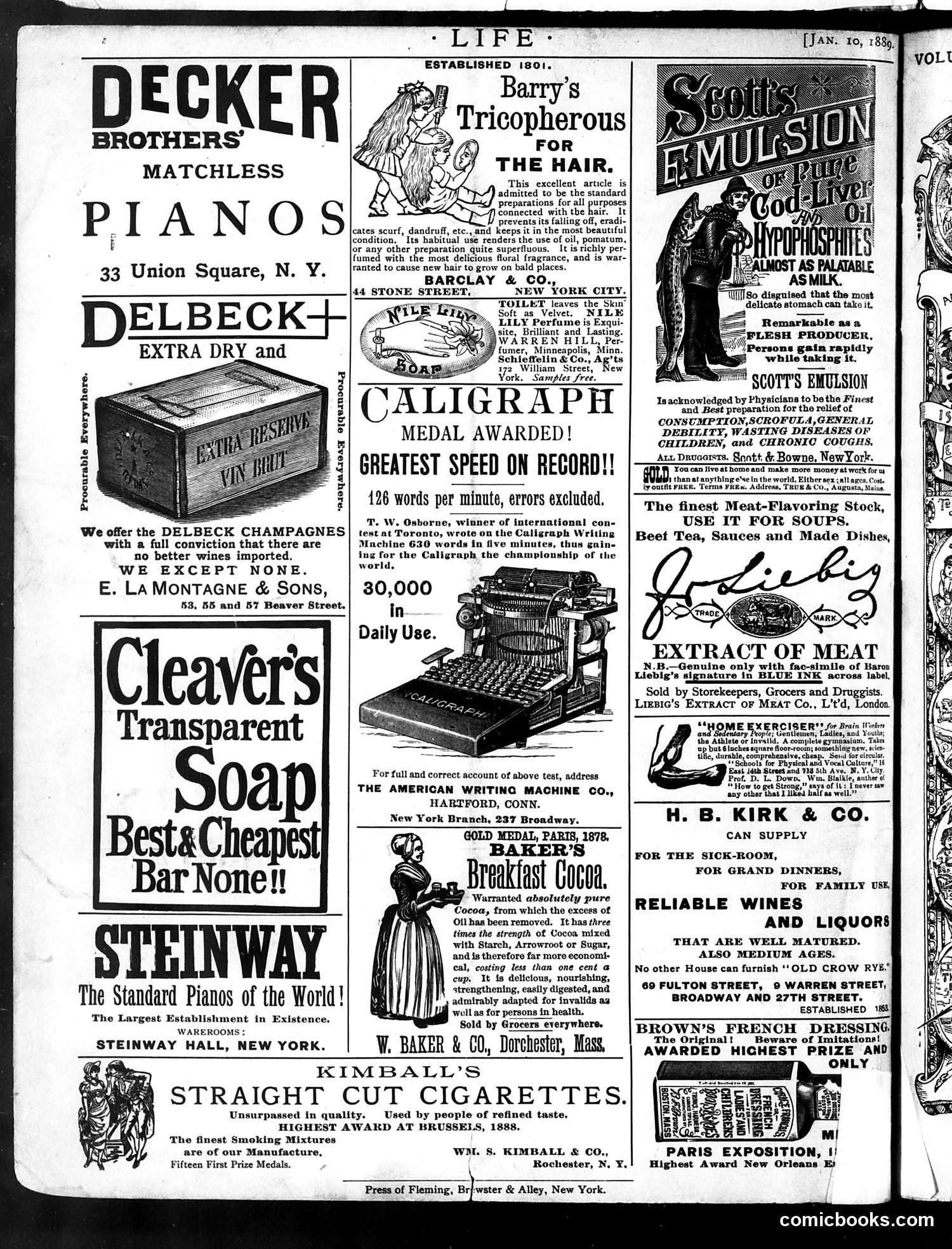
This is primarily a **late-19th-century advertisement page** rather than a satirical cartoon page. It's filled with product advertisements typical of the era—pianos (Decker Brothers, Steinway, Delbeck), champagne, soap, typewriters (Caligraph), and patent medicines. Notable to modern readers: the brazen medical claims. Scott's Emulsion promises to cure consumption (tuberculosis), scrofula, and chronic coughs; Baker's Cocoa claims extraordinary health benefits; and Liebig's Extract of Meat advertises vague medicinal properties. These would violate modern FDA regulations. The typewriter advertisement is historically interesting—it boasts a "greatest speed on record" of 126 words per minute, highlighting how novel and impressive this technology was in 1889. The page reveals **turn-of-century consumer culture**: wealthy Americans bought luxury pianos, French champagnes, and premium goods. It also shows the era's lack of regulations on medical advertising and the prevalence of patent medicine marketing.