
Life, 1889-01-10 · page 2 of 16
Life — January 10, 1889 — page 2: what you’re looking at
What you’re looking at
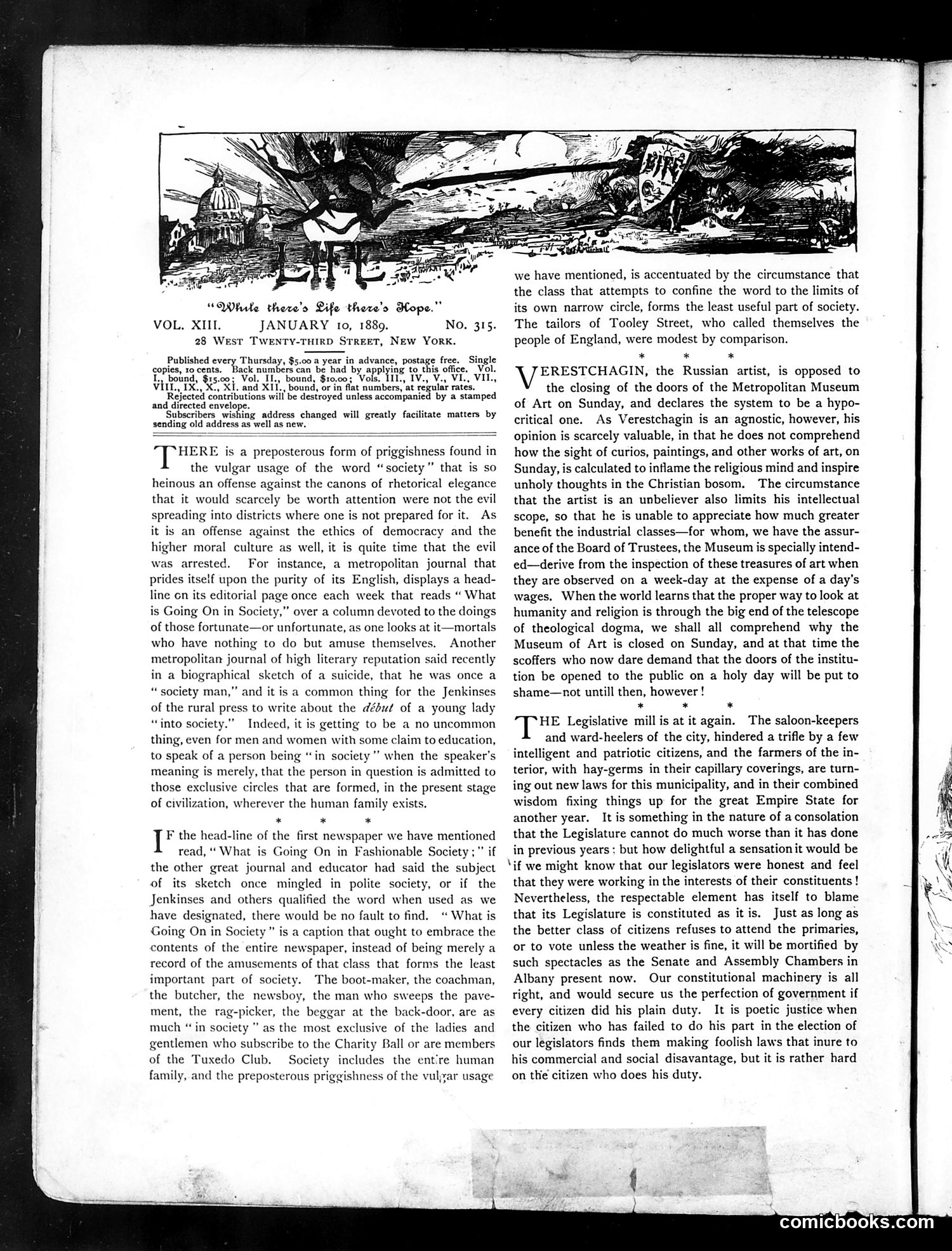
The header illustration "Where there's life there's hope" depicts a chaotic, apocalyptic cityscape with destruction and conflict, though its specific satirical target isn't immediately clear from the image alone. The text critiques the pretentiousness of high society's use of the word "society," arguing that wealthy elites falsely claim exclusivity while actually including tradespeople and their families. The author mocks newspapers that celebrate fashionable society gossip as meaningless. A secondary section attacks the Russian artist Verestchagin's opposition to Sunday museum hours, sarcastically defending the closing as protecting Christian morality—though the author clearly views this as hypocritical censorship benefiting working-class wages. The final paragraph discusses legislative corruption, suggesting legislators pass contradictory laws to benefit special interests like saloon-keepers.
📄 Transcribed text from this page (OCR, searchable)
Machine-transcribed from the original scan — historical spelling and the odd misread are preserved.
“Whe there's Life there's Hope.” VOL, XIII. JANUARY 10, 1889. No. 315. 28 West TWENTY-THIRD STREET, NEW YorRK. Published every Thursday, $5.00 a year in advance, postage free. | Single copies, 10 cents. Back numbers can be had by applying to this office. Vol. e bound, $15.00; Vol, Il., bound, $10.00; Vols {lly IV. V., VI, VII., Vitr., IX., X:, XL. and XI1., bound, or in flat numbers, at regular rates. Rejected contributions will be destroyed unless accompanied by a stamped and directed envelope. subscribers wishing address changed will greatly facilitate matters by sending old address as well as new. HERE is a preposterous form of priggishness found in the vulgar usage of the word “society” that is so heinous an offense against the canons of rhetorical elegance that it would scarcely be worth attention were not the evil spreading into districts where one is not prepared for it. As it is an offense against the ethics of democracy and the higher moral culture as well, it is quite time that the evil was arrested. For instance, a metropolitan journal that prides itself upon the purity of its English, displays a head- line cn its editorial page once each week that reads “ What is Going On in Society,” over a column devoted to the doings of those fortunate—or unfortunate, as one looks at it—mortals who have nothing to do but amuse themselves. Another metropolitan journal of high literary reputation said recently in a biographical sketch of a suicide, that he was once a “society man,” and it is a common thing for the Jenkinses of the rural press to write about the début of a young lady “into society.” Indeed, it is getting to be a no uncommon thing, even for men and women with some claim to education, to speak of a person being “in society’ when the speaker's meaning is merely, that the person in question is admitted to those exclusive circles that are formed, in the present stage of civilization, wherever the human family exists. * * * F the head-line of the first newspaper we have mentioned read, ‘‘ What is Going On in Fashionable Society ;" if the other great journal and educator had said the subject of its sketch once mingled in polite society, or if the Jenkinses and others qualified the word when used as we have designated, there would be no fault to find. “ What is Going On in Soci is a caption that ought to embrace the contents of the entire newspaper, instead of being merely a record of the amusements of that class that forms the least important part of society. The boot-maker, the coachman, the butcher, the newsboy, the man who sweeps the pave- ment, the rag-picker, the beggar at the back-door, are as much “in society ” as the most exclusive of the ladies and gentlemen who subscribe to the Charity Ball or are members of the Tuxedo Club. Society includes the entire human family, and the preposterous priggishness of the vulzar usage we have mentioned, is accentuated by the circumstance that the class that attempts to confine the word to the limits of its own narrow circle, forms the least useful part of society. The tailors of Tooley Street, who called themselves the people of England, were modest by comparison. * * * ERESTCHAGIN, the Russian artist, is opposed to the closing of the doors of the Metropolitan Museum of Art on Sunday, and declares the system to be a hypo- critical one. As Verestchagin is an agnostic, however, his opinion is scarcely valuable, in that he does not comprehend how the sight of curios, paintings, and other works of art, on Sunday, is calculated to inflame the religious mind and inspire unholy thoughts in the Christian bosom. The circumstance that the artist is an unbeliever also limits his intellectual scope, so that he is unable to appreciate how much greater benefit the industrial classes—for whom, we have the assur- ance of the Board of Trustees, the Museum is specially intend- ed—derive from the inspection of these treasures of art when they are observed on a week-day at the expense of a day's wages. When the world learns that the proper way to look at humanity and religion is through the big end of the telescope of theological dogma, we shall all comprehend why the Museum of Art is closed on Sunday, and at that time the scoffers who now dare demand that the doors of the institu- tion be opened to the public on a holy day will be put to shame—not untill then, however ! * * * T= Legislative mill is at it again. The saloon-keepers and ward-heelers of the city, hindered a trifle by a few intelligent and patriotic citizens, and the farmers of the in- terior, with hay-germs in their capillary coverings, are turn- ing out new laws for this municipality, and in their combined wisdom fixing things up for the great Empire State for another year. It is something in the nature of a consolation that the Legislature cannot do much worse than it has done in previous years ; but how delightful a sensation it would be ‘if we might know that our legislators were honest and feel that they were working in the interests of their constituents ! Nevertheless, the respectable element has itself to blame that its Legislature is constituted as it is. Just as long as the better class of citizens refuses to attend the primaries, or to vote unless the weather is fine, it will be mortified by such spectacles as the Senate and Assembly Chambers in Albany present now. Our constitutional machinery is all right, and would secure us the perfection of government if every citizen did his plain duty. It is poetic justice when the citizen who has failed to do his part in the election of our legislators finds them making foolish laws that inure to his commercial and social disavantage, but it is rather hard on the citizen who does his duty. comicbooks.com