
Life, 1889-01-10 · page 6 of 16
Life — January 10, 1889 — page 6: what you’re looking at
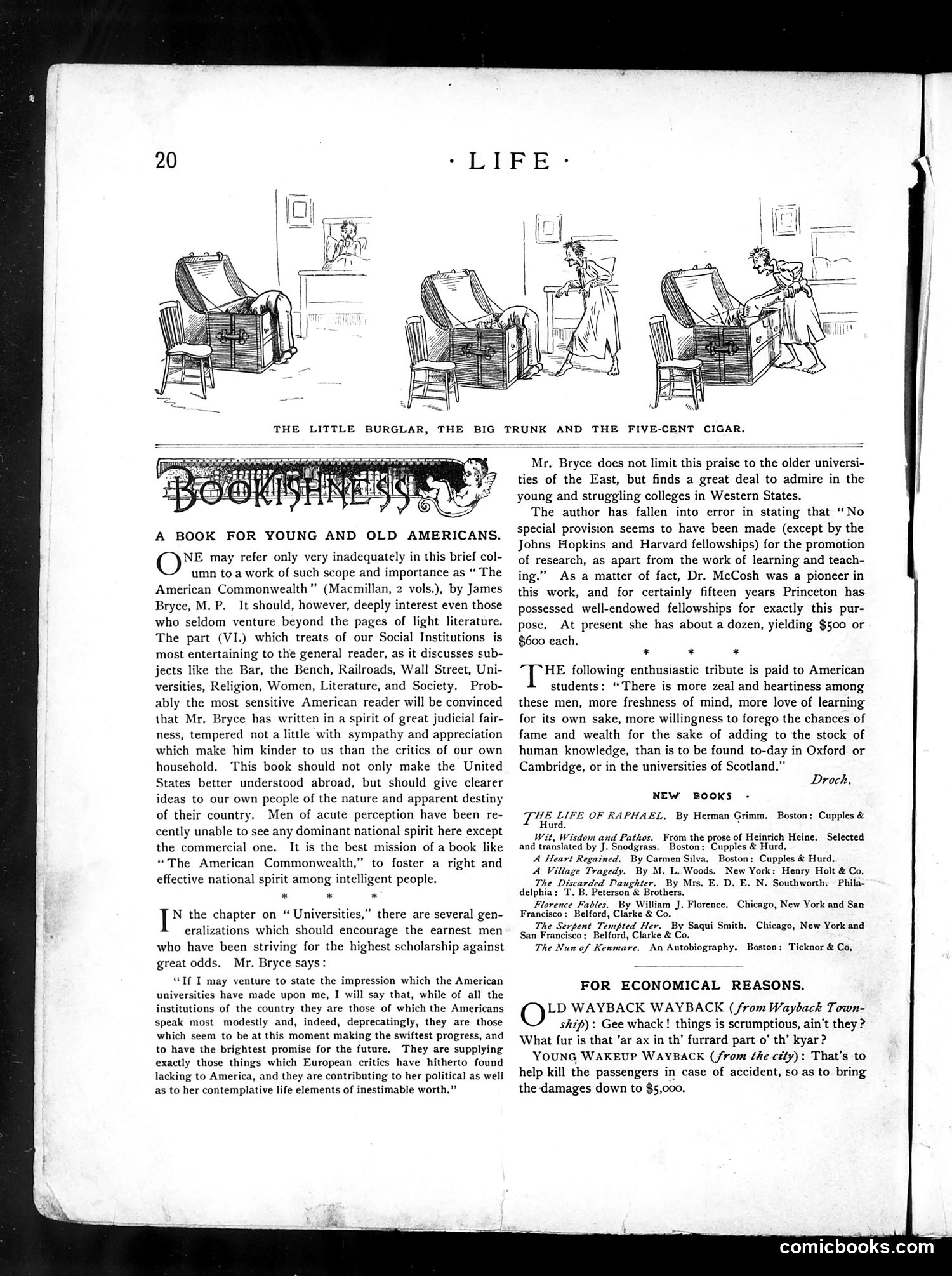
What you’re looking at
This three-panel cartoon depicts a slapstick scenario involving a child burglar attempting to steal from a trunk. In each panel, the progression shows the child struggling with an oversized trunk while an adult (likely the homeowner) reacts with surprise or alarm. The humor relies on visual comedy: a small child as an incompetent "burglar" unable to manage a large piece of furniture, combined with the incongruous detail of a "five-cent cigar" as the supposed prize. The title suggests satirizing petty crime or perhaps mocking sensationalist newspaper coverage of minor thefts. The cartoon's satire appears social rather than explicitly political, using domestic humor to comment on crime or class issues of the era.
📄 Transcribed text from this page (OCR, searchable)
Machine-transcribed from the original scan — historical spelling and the odd misread are preserved.
A BOOK FOR YOUNG AND OLD AMERICANS. NE may refer only very inadequately in this brief col- umn toa work of such scope and importance as “ The American Commonwealth” (Macmillan, 2 vols.), by James Bryce, M. P. It should, however, deeply interest even those who seldom venture beyond the pages of light literature. The part (VI.) which treats of our Social Institutions is most entertaining to the general reader, as it discusses sub- jects like the Bar, the Bench, Railroads, Wall Street, Uni- versities, Religion, Women, Literature, and Society. Prob- ably the most sensitive American reader will be convinced that Mr. Bryce has written in a spirit of great judicial fair- ness, tempered not a little with sympathy and appreciation which make him kinder to us than the critics of our own household. This book should not only make the United States better understood abroad, but should give clearer ideas to our own people of the nature and apparent destiny of their country. Men of acute perception have been re- cently unable to see any dominant national spirit here except the commercial one. It is the best mission of a book like “The American Commonwealth,” to foster a right and effective national spirit among intelligent people. * * * N the chapter on “ Universities,” there are several gen- eralizations which should encourage the earnest men who have been striving for the highest scholarship against great odds. Mr. Bryce says: “If I may venture to state the impression which the American universities have made upon me, I will say that, while of all the institutions of the country they are those of which the Americans speak most modestly and, indeed, deprecatingly, they are those which seem to be at this moment making the swiftest progress, and to have the brightest promise for the future, They are supplying exactly those things which European critics have hitherto found lacking to America, and they are contributing to her political as well as to her contemplative life elements of inestimable worth.” Mr. Bryce does not limit this praise to the older universi- ties of the East, but finds a great deal to admire in the young and struggling colleges in Western States. The author has fallen into error in stating that “No special provision seems to have been made (except by the Johns Hopkins and Harvard fellowships) for the promotion of research, as apart from the work of learning and teach- ing.” As a matter of fact, Dr. McCosh was a pioneer in this work, and for certainly fifteen years Princeton has possessed well-endowed fellowships for exactly this pur- pose. At present she has about a dozen, yielding $500 or $600 each. * * * HE following enthusiastic tribute is paid to American students: “There is more zeal and heartiness among these men, more freshness of mind, more love of learning for its own sake, more willingness to forego the chances of fame and wealth for the sake of adding to the stock of human knowledge, than is to be found to-day in Oxford or Cambridge, or in the universities of Scotland.” Droch, NEW BOOKS - THE LIE OF RAPHAEL, By Herman Grimm. Boston: Cupples & urd. Wit, Wisdom and Pathos, From the prose of Heinrich Heine. Selected and translated by J. Snodgrass. Boston: Cupples & Hurd. A Heart Regained. By Carmen Silva, Boston: Cupples & Hurd. A Village Tragedy. By M. L. Woods. New York: Henry Holt & Co, The arded Daughter. By Mrs, E. D. E. N. Southworth. Phila- delphia: T. B. Peterson & Brothers. Florence Fables. By William J. Florence. Chicago, New York and San Francisco: Belford, Clarke & Co. The Serpent Tempted Her. By Saqui Smith. Chicago, New York and San Francisco: Belford, Clarke & Co. The Nun of Kenmare. An Autobiography. Boston: Ticknor & Co, FOR ECONOMICAL REASONS. LD WAYBACK WAYBACK (from Wayback Town- ship): Gee whack! things is scrumptious, ain't they ? What fur is that ’ar ax in th’ furrard part o’ th’ kyar? YOUNG WAKEUP WAYBACK (from the city): That’s to help kill the passengers in case of accident, so as to bring the damages down to $5,000. comicbooks.com