
Life, 1889-01-10 · page 4 of 16
Life — January 10, 1889 — page 4: what you’re looking at
What you’re looking at
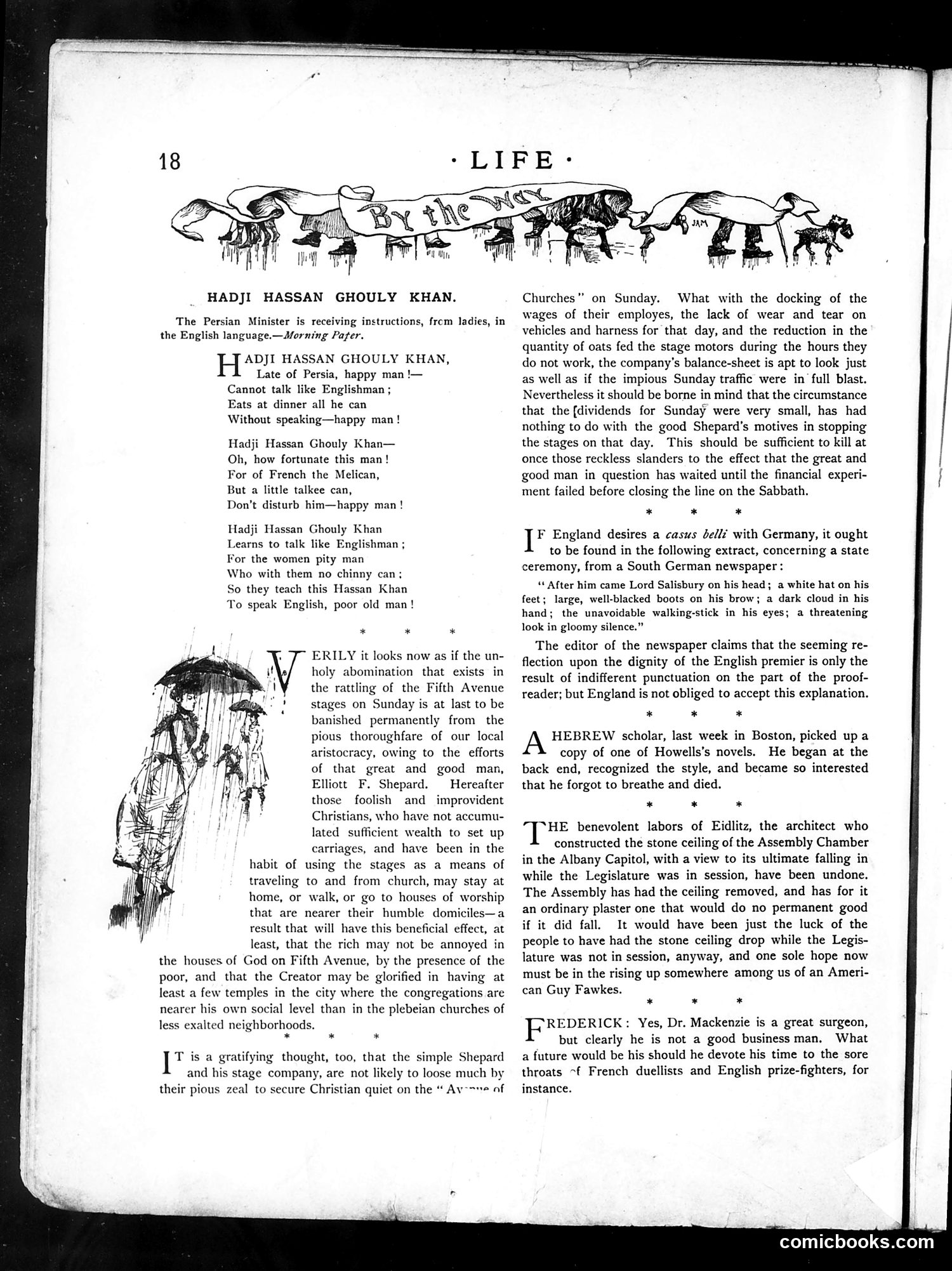
The page contains a satirical poem titled "HADJI HASSAN GHOULY KHAN" mocking a Persian minister learning English. The verse ridicules his inability to speak English properly while eating ("Eats at dinner all he can / Without speaking"), treating his linguistic struggles as humorous. The accompanying sketch shows a figure in traditional Persian dress looking disheveled and uncomfortable—visually reinforcing the text's mockery of the minister as a fish-out-of-water attempting Western civilization. The remaining content discusses unrelated contemporary issues: Fifth Avenue stage carriages disrupting church attendance, and various brief society anecdotes about a Hebrew scholar and architectural matters. The humor relies on ethnic stereotyping and the assumption that readers would find a foreigner's inability to master English inherently comedic—a common satirical approach in early-20th-century American publications.
📄 Transcribed text from this page (OCR, searchable)
Machine-transcribed from the original scan — historical spelling and the odd misread are preserved.
HADJI HASSAN GHOULY KHAN. The Persian Minister is receiving instructions, from ladies, in the English language.—Morning Pater. ADJI HASSAN GHOULY KHAN, Late of Persia, happy man !— Cannot talk like Englishman ; Eats at dinner all he can Without speaking—happy man! Hadji Hassan Ghouly Khan— Oh, how fortunate this man! For of French the Melican, But a little talkee can, Don’t disturb him—happy man! Hadji Hassan Ghouly Khan Learns to talk like Englishman ; For the women pity man Who with them no chinny can; So they teach this Hassan Khan To speak English, poor old man! * * * ERILY it looks now as if the un- holy abomination that exists in the rattling of the Fifth Avenue stages on Sunday is at last to be banished permanently from the pious thoroughfare of our local aristocracy, owing to the efforts of that great and good man, Elliott F. Shepard. Hereafter those foolish and improvident Christians, who have not accumu- lated sufficient wealth to set up carriages, and have been in the habit of using the stages as a means of traveling to and from church, may stay at home, or walk, or go to houses of worship that are nearer their humble domiciles—a result that will have this beneficial effect, at least, that the rich may not be annoyed in the houses of God on Fifth Avenue, by the presence of the poor, and that the Creator may be glorified in having at least a few temples in the city where the congregations are nearer his own social level than in the plebeian churches of less exalted neighborhoods. * T is a gratifying thought, too, that the simple Shepard and his stage company, are not likely to loose much by their pious zeal to secure Christian quiet on the “ Av-- of Churches” on Sunday. What with the docking of the wages of their employes, the lack of wear and tear on vehicles and harness for that day, and the reduction in the quantity of oats fed the stage motors during the hours they do not work, the company’s balance-sheet is apt to look just as well as if the impious Sunday traffic were in full blast. Nevertheless it should be borne in mind that the circumstance that the [dividends for Sunday were very small, has had nothing to do with the good Shepard’s motives in stopping the stages on that day. This should be sufficient to kill at once those reckless slanders to the effect that the great and good man in question has waited until the financial experi- ment failed before closing the line on the Sabbath. * * * F England desires a casus belli with Germany, it ought to be found in the following extract, concerning a state ceremony, from a South German newspaper: “* After him came Lord Salisbury on his head; a white hat on his feet; large, well-blacked boots on his brow; a dark cloud in his hand; the unavoidable walking-stick in his eyes; a threatening look in gloomy silence.” The editor of the newspaper claims that the seeming re- flection upon the dignity of the English premier is only the result of indifferent punctuation on the part of the proof- reader; but England is not obliged to accept this explanation. * * * HEBREW scholar, last week in Boston, picked up a copy of one of Howells’s novels. He began at the back end, recognized the style, and became so interested that he forgot to breathe and died. * * * HE benevolent labors of Eidlitz, the architect who constructed the stone ceiling of the Assembly Chamber in the Albany Capitol, with a view to its ultimate falling in while the Legislature was in session, have been undone. The Assembly has had the ceiling removed, and has for it an ordinary plaster one that would do no permanent good if it did fall. It would have been just the luck of the people to have had the stone ceiling drop while the Legis- lature was not in session, anyway, and one sole hope now must be in the rising up somewhere among us of an Ameri- can Guy Fawkes. * * REDERICK: Yes, Dr. Mackenzie is a great surgeon, but clearly he is not a good business man. What a future would be his should he devote his time to the sore throats ~f French duellists and English prize-fighters, for instance. comicbooks.com