
A complete issue · 16 pages · 1889
Life — January 3, 1889
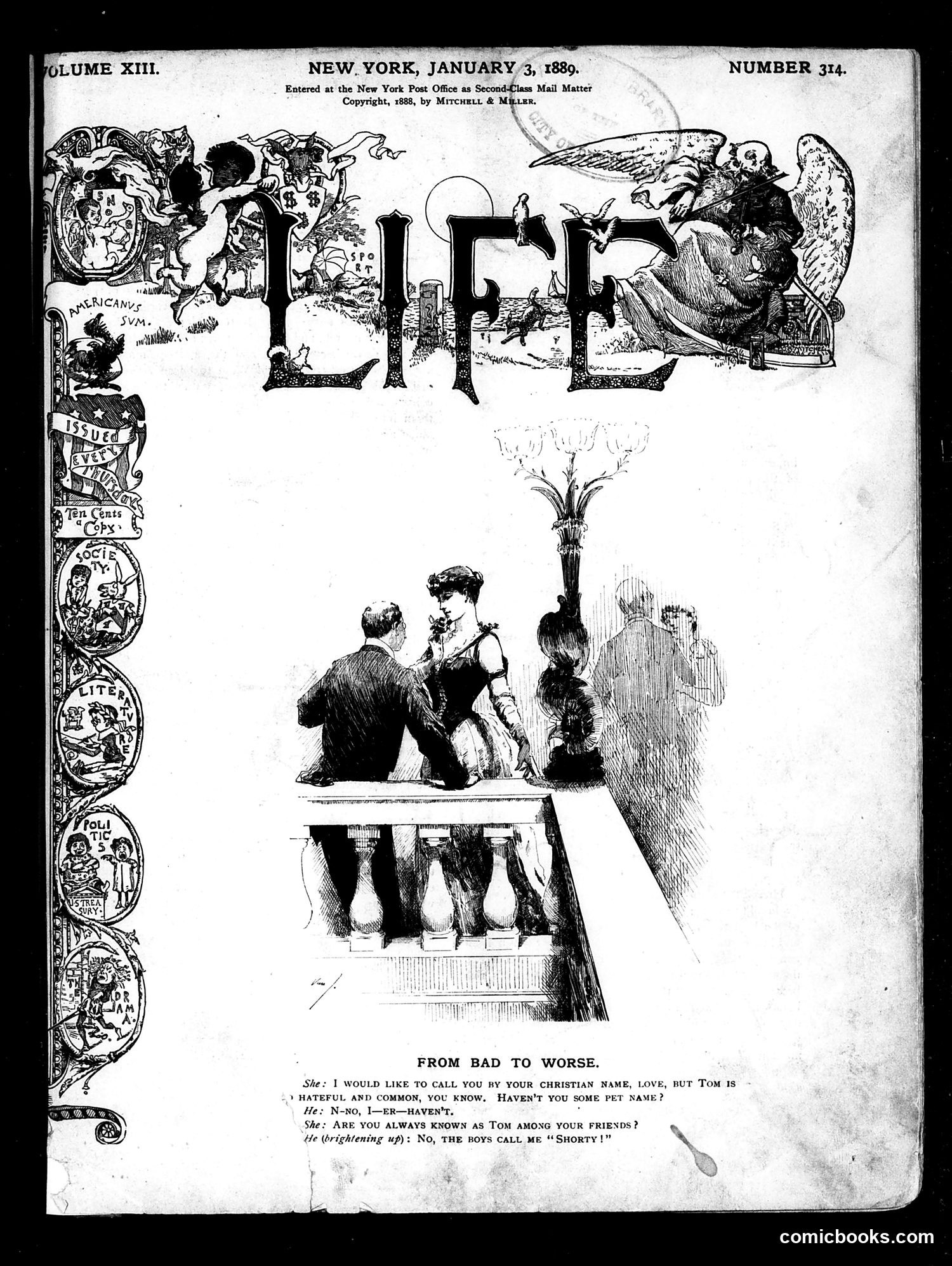
This cartoon illustrates a social comedy about courtship and names. A woman tells a man she'd prefer to call him by a different name—suggesting his actual name (Tom) is "hateful and common." When he asks if he's known as "Tom" among friends, she reveals they call him "Shorty" instead, which he finds even more insulting (his "brightening up" is sarcastic). The joke satirizes Victorian courtship rituals and social pretension: the woman rejects his given name as insufficiently refined, but the alternative nickname is actually worse and more unflattering. It captures the absurdity of romantic negotiations where superficial concerns about propriety mask underlying incompatibility or rudeness.
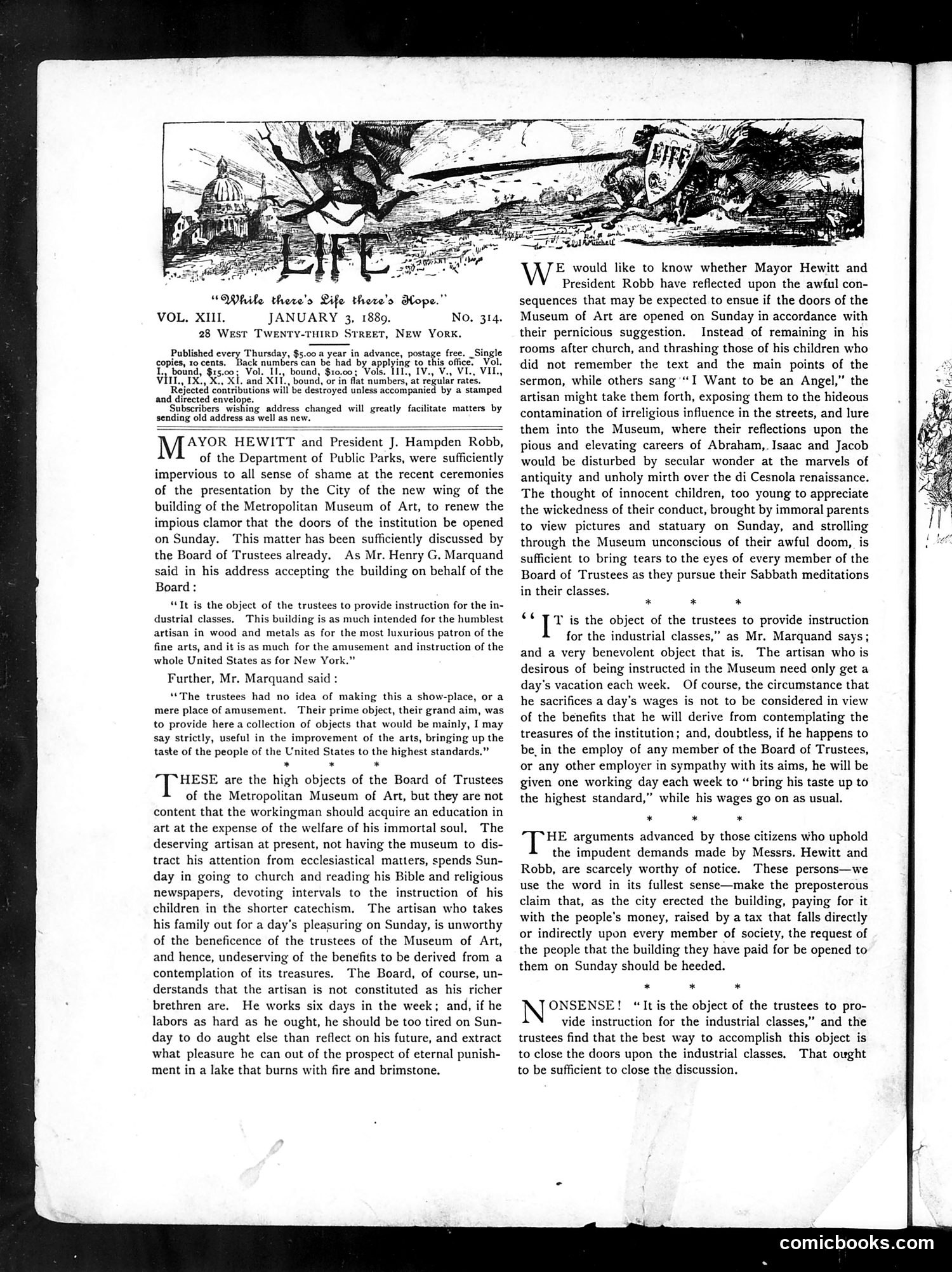
This page satirizes a heated debate over the Metropolitan Museum of Art's Sunday hours. Mayor Hewitt and Parks Commissioner Robb wanted to open the museum on Sundays, but religious groups objected—they feared working-class visitors would skip church for cultural activities. The cartoon's caption ("While there's Life there's Hope") is ironic: Life magazine defends opening the museum, arguing that artisans deserve one day weekly for cultural improvement without sacrificing wages. The editorial ridicules opponents' religious objections as hypocritical snobbery, claiming the wealthy erected this public building with taxpayers' money but wanted to restrict access. The debate reflects 1880s tensions between secular culture, working-class leisure, and religious conservatism.
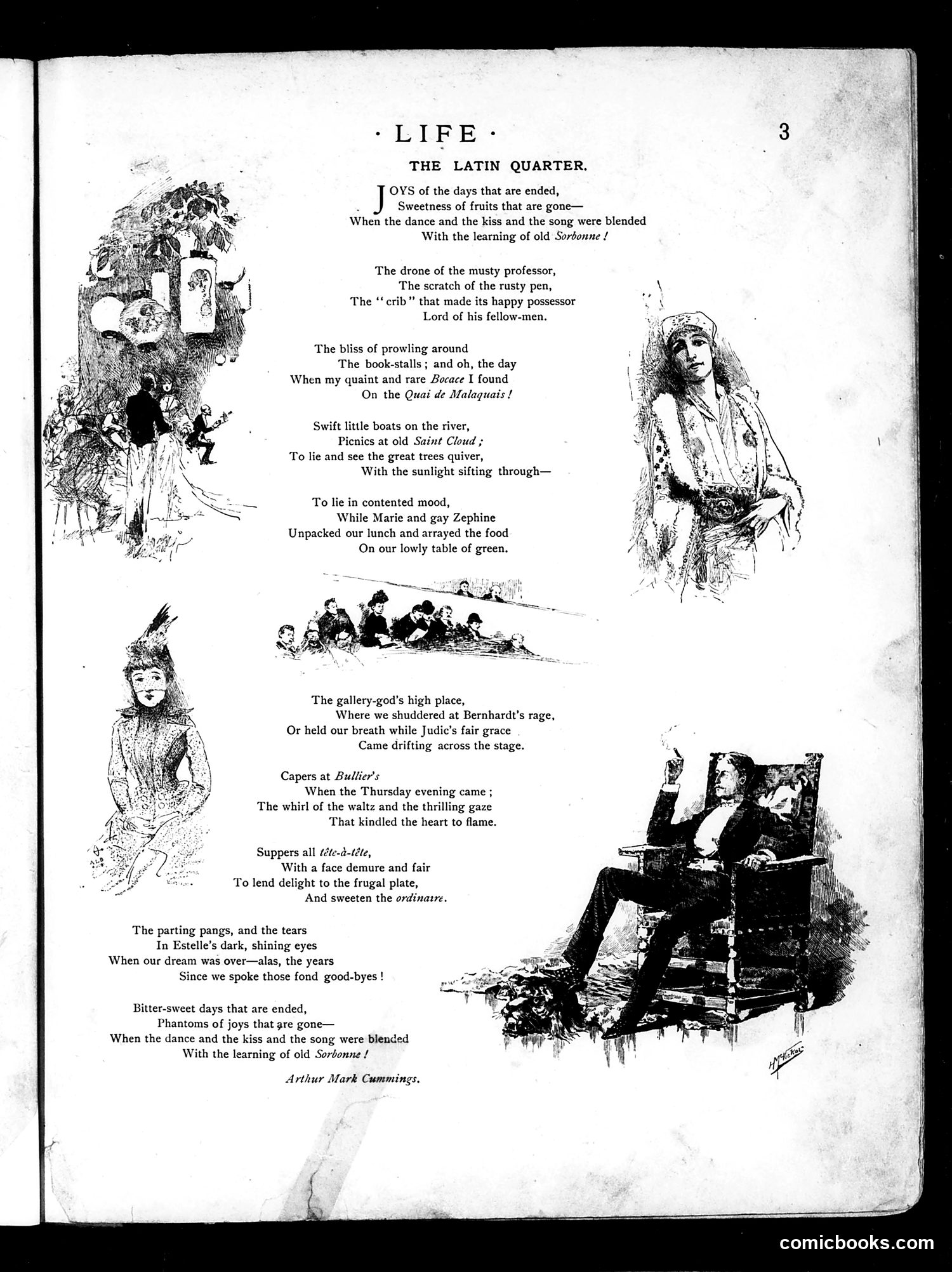
This poem by Arthur Mark Cummings celebrates bohemian student life in Paris's Latin Quarter, the historic neighborhood associated with intellectual and artistic culture. The illustrations depict romanticized scenes: students lounging outdoors, attending theater performances (references to "Bernhardt's rage" suggest Sarah Bernhardt, the famous actress), and enjoying café culture at "Bullier's." The piece nostalgically recalls youthful pleasures—picnics, literary discoveries, romantic encounters, and theatrical capers—contrasting carefree student days with adult melancholy. It's not primarily political satire but rather sentimental commentary on lost youth and the contrast between bohemian freedom and ordinary adulthood, reflecting American fascination with Paris as a cultural ideal during the late 19th/early 20th century.
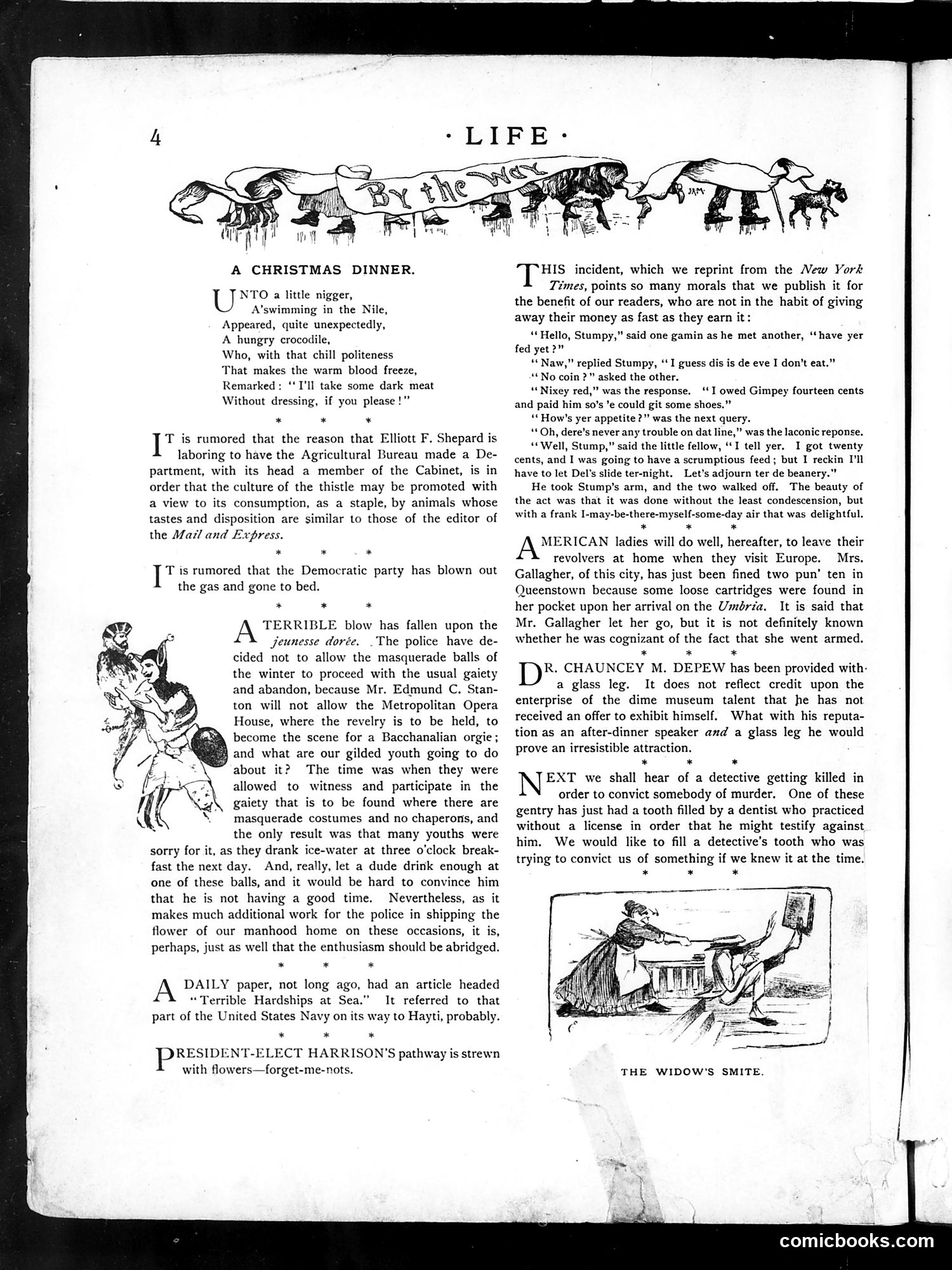
This page contains satirical commentary on contemporary issues, likely from the 1880s-1890s based on the magazine's style. **"A Christmas Dinner"** is a poem mocking poverty, describing a starving "little nigger" in the Nile delta—a cruel racial stereotype typical of the era. **The main cartoons mock:** - An apparent agricultural proposal involving thistle cultivation for animal feed - Democratic Party politics ("blown out the gas") - Metropolitan Opera House restrictions on masquerade balls, satirizing elite social gatekeeping - A dental charlatan practicing without a license - Various petty social scandals **"The Widow's Smite"** illustration (bottom right) references the biblical widow's mite, likely mocking charitable giving or widows' financial circumstances. The page exemplifies Life's satirical approach to social absurdities, though some references remain unclear without additional historical context.
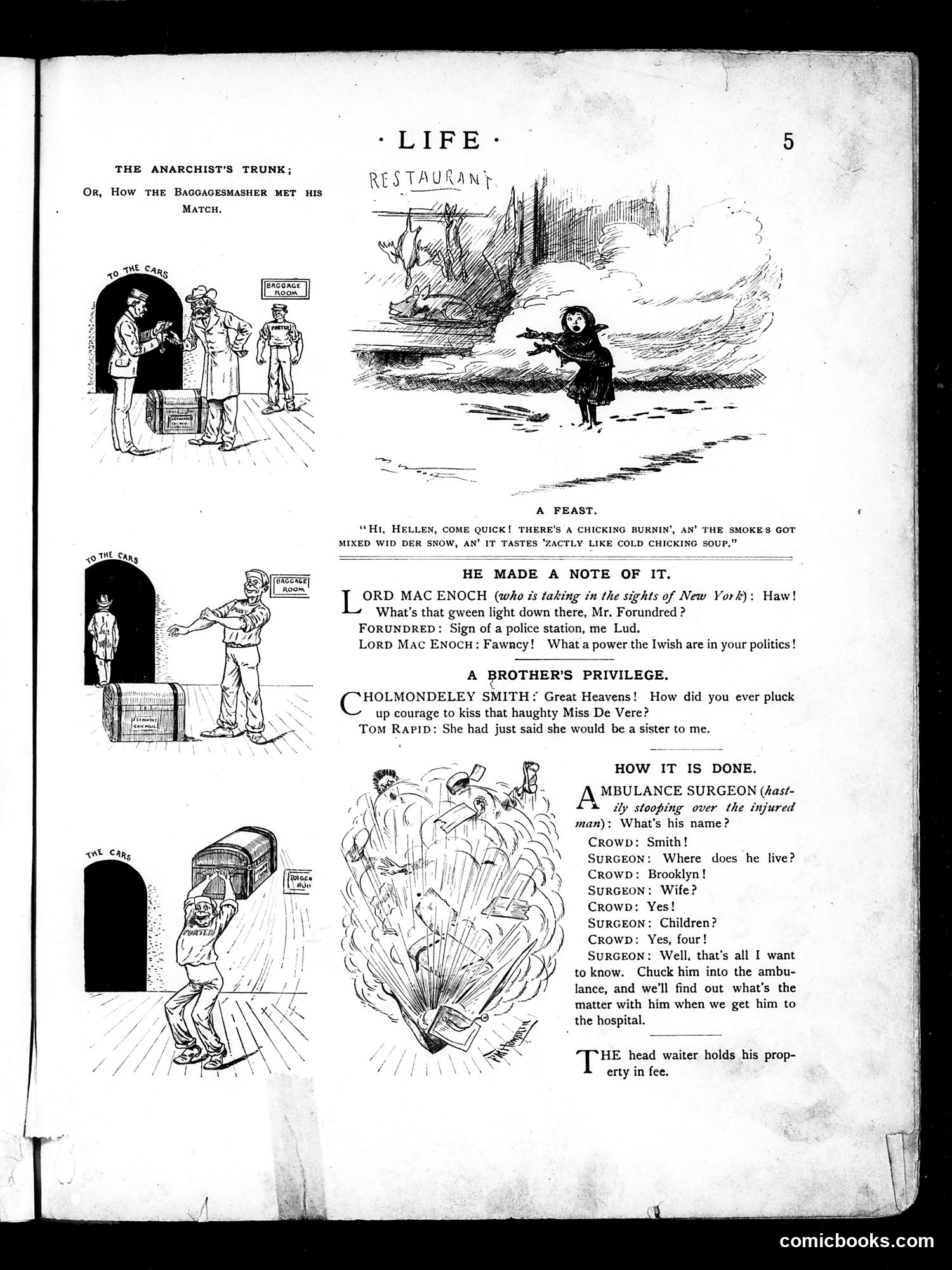
This page contains several short humorous sketches typical of Life magazine's satirical style. **"The Anarchist's Trunk"** shows a police baggage inspection, likely referencing contemporary anxieties about anarchist threats (common in early 20th-century America). **"A Feast"** depicts a figure offering "chicken burnin'" as food, the humor deriving from class or immigrant dialect humor. **"He Made a Note of It"** features Lord Mac Enoch commenting on New York politics, suggesting political satire about municipal governance or Irish-American political figures (the name suggests Irish heritage). **"A Brother's Privilege"** and **"How It Is Done"** are brief comic exchanges about social customs and urban interactions. The final item about head waiters holding property "in fee" is a legal/property pun. Overall, this represents turn-of-the-century American satirical humor targeting politics, class distinctions, and urban life.
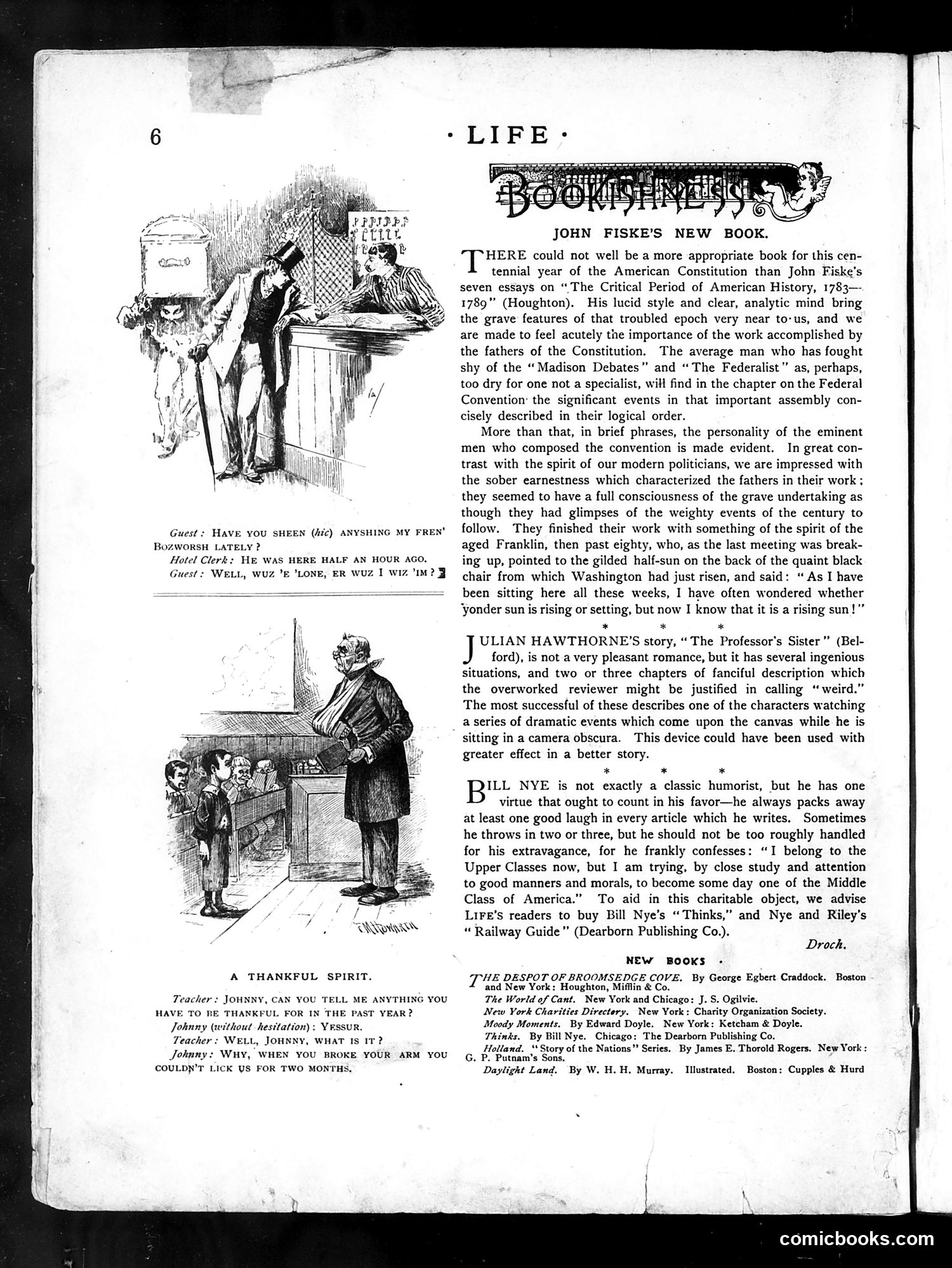
This page contains two cartoons with accompanying dialogue, both depicting social comedy: **Top cartoon** ("Guest" and "Hotel Clerk" dialogue): Shows a hotel clerk and guest discussing a broken arm. The joke hinges on the guest's casual attitude toward the injury—they've been there "half an hour" and already broke their arm, suggesting either clumsiness or the hotel's hazardous conditions. It's mild physical-comedy satire about hotel incompetence. **Bottom cartoon** ("A Thankful Spirit"): Depicts a teacher questioning a student (Johnny) about what he's thankful for. Johnny responds he's thankful his arm didn't break when he fell—the humor lies in the student's low expectations and the teacher's resignation to minor injuries as normal occurrence. This satirizes either dangerous school conditions or children's resilience to mishap. Both cartoons use injury humor typical of early 20th-century comic sensibilities.
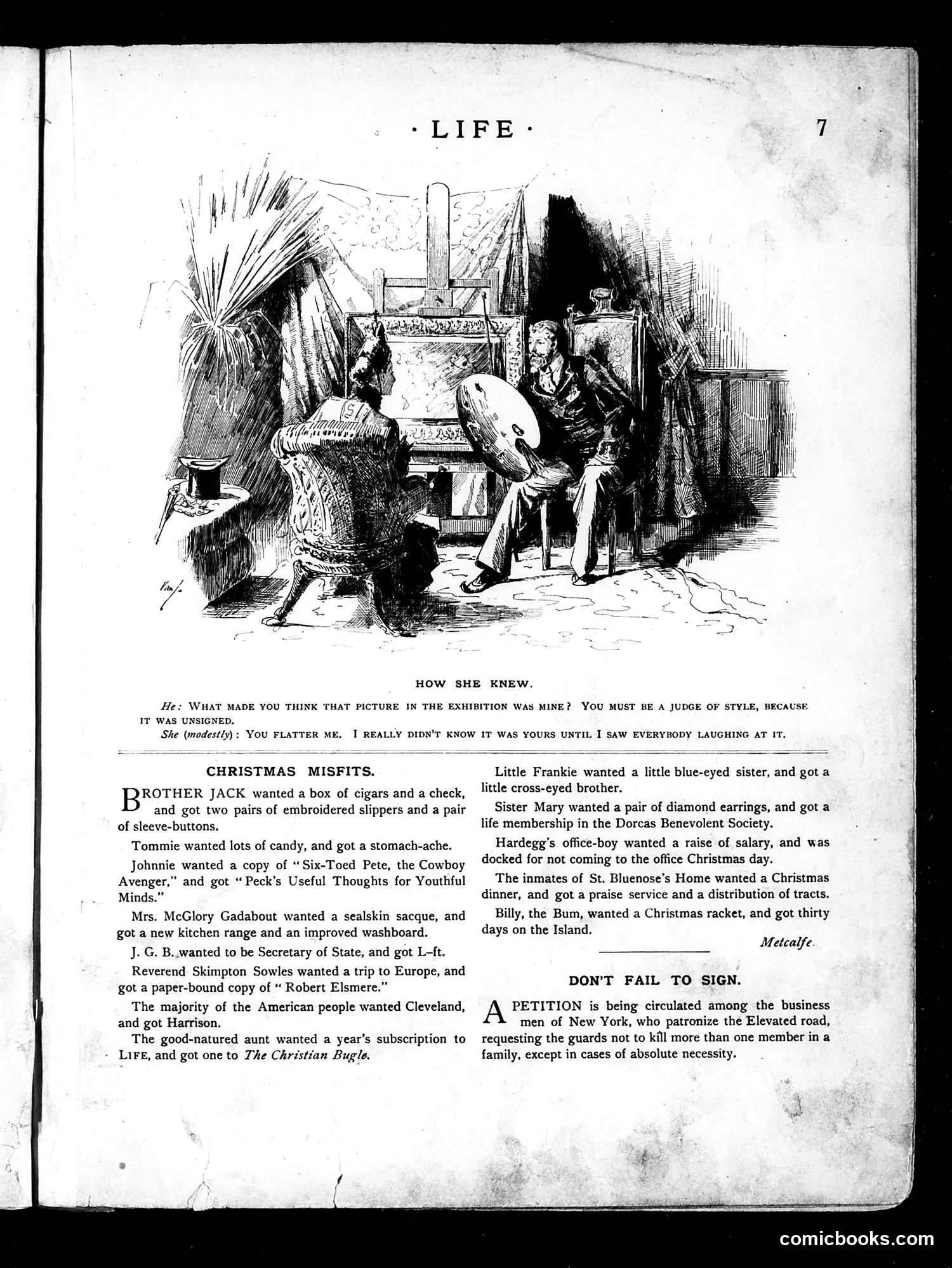
The top cartoon titled "HOW SHE KNEW" depicts a domestic scene where a woman claims she recognized a painting in an exhibition as her husband's work because "everybody [was] laughing at it." This is a joke about artistic merit—the implication being that bad art draws ridicule rather than admiration. Below, "CHRISTMAS MISFITS" is a humorous list of ironic Christmas wishes and their outcomes. Each entry follows the pattern of someone wanting something desirable but receiving something unrelated or unwanted instead (e.g., Brother Jack wanted cigars but got slippers; someone wanted Cleveland elected but got Harrison instead—likely referencing the 1892 presidential election). The satire mocks both personal disappointment and political outcomes through comedic juxtaposition.
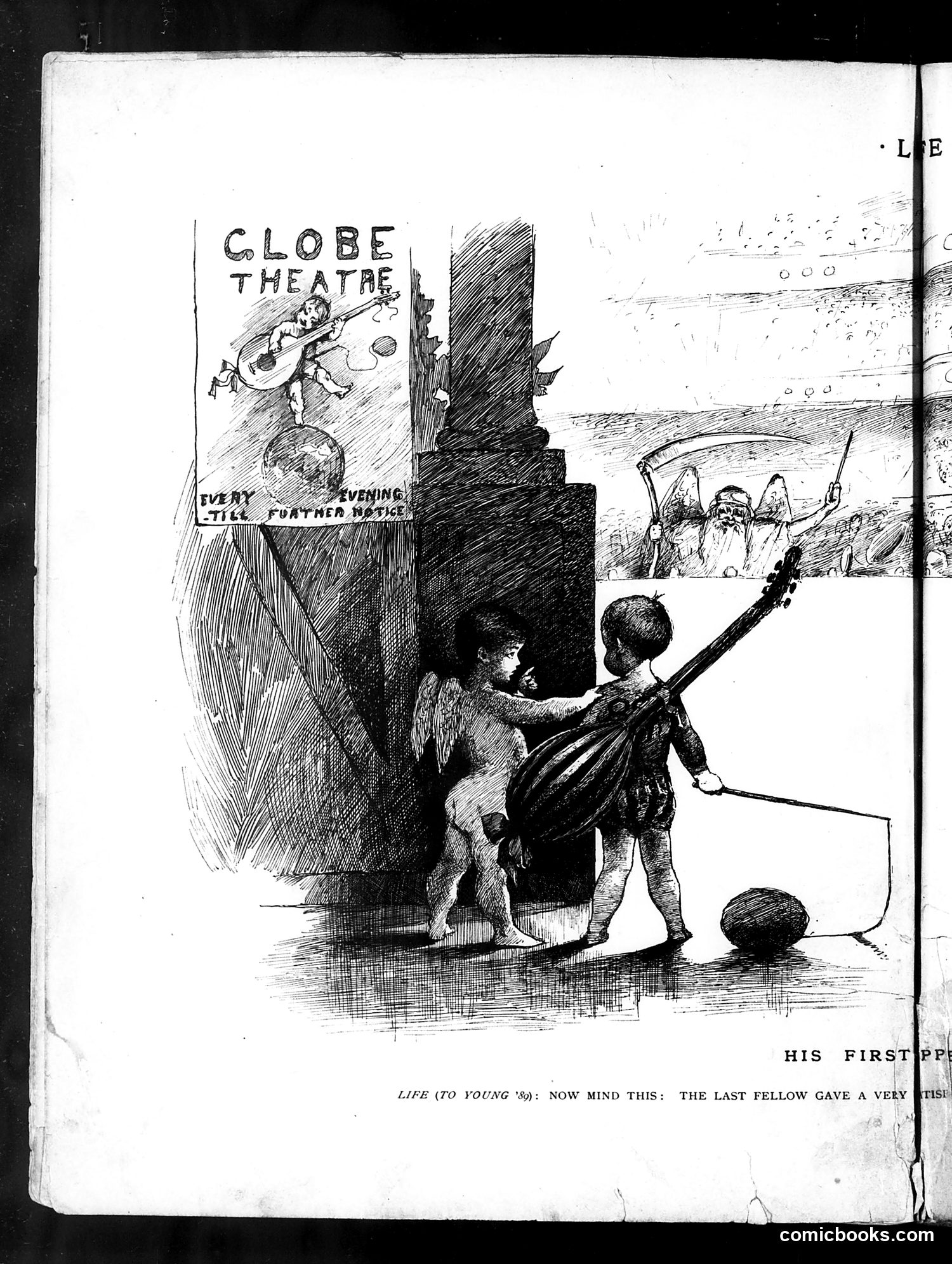
This is a satirical illustration about theatrical ambition. Two cherub-like figures stand before the Globe Theatre, gazing at a sign advertising performances "till further notice." One cherub holds a lute or stringed instrument. The caption reads: "LIFE (TO YOUNG 'UN): NOW MIND THIS; THE LAST FELLOW GAVE A VERY [text cuts off]" The satire appears to target young, aspiring performers drawn to the theater's glamorous reputation. The cherubs represent naive youth enchanted by theatrical dreams. The "Globe Theatre" reference evokes Shakespeare's famous playhouse, suggesting the enduring allure of theatrical fame across centuries. The incomplete caption suggests a warning about the dangers or disappointments of theatrical careers—"the last fellow" apparently met an unfortunate fate. It's a cautionary joke about youthful theatrical ambitions meeting harsh reality.
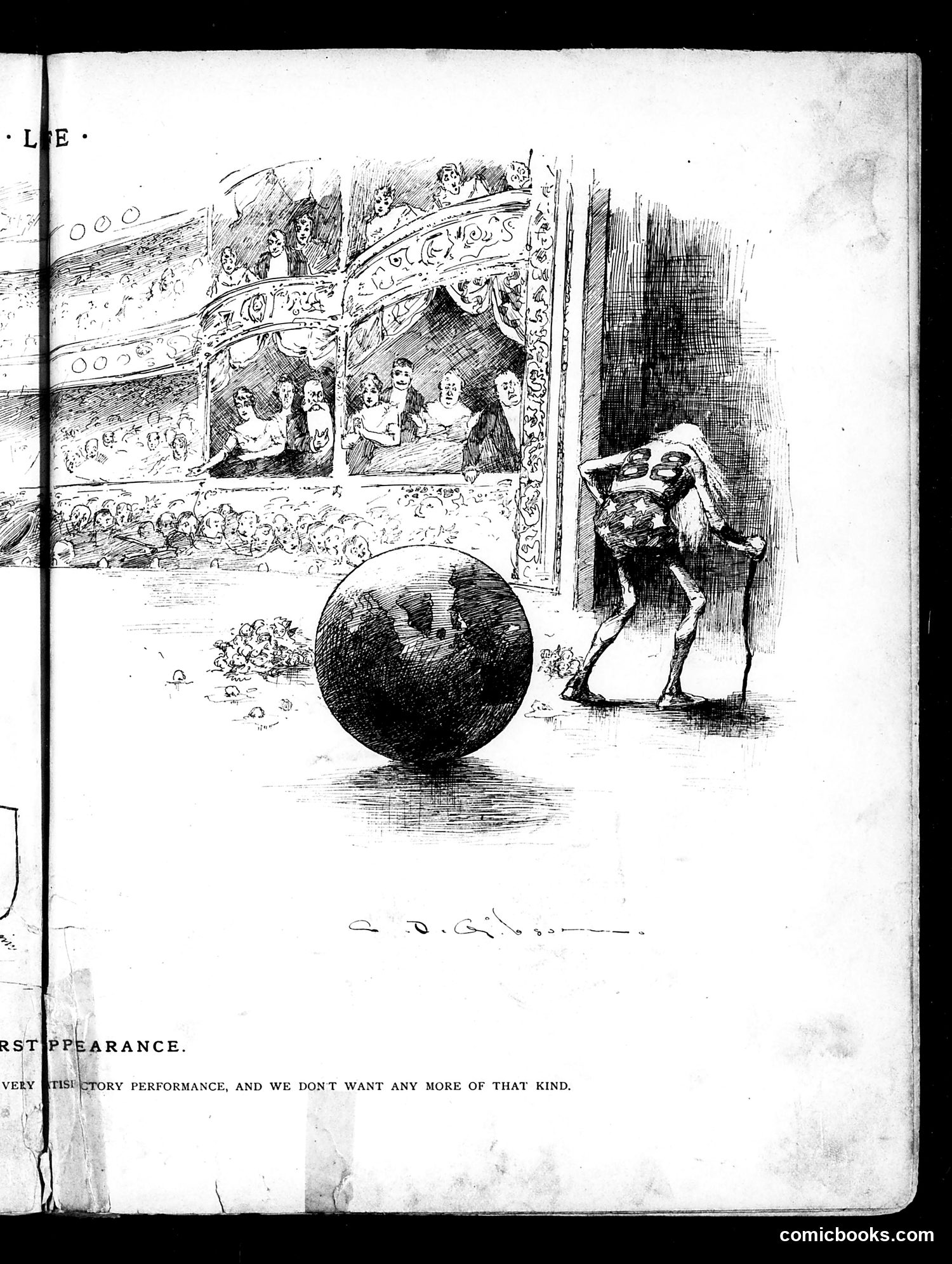
This appears to be a satirical illustration from *Life* magazine depicting a theatrical or performance context. The image shows an ornate theater box with well-dressed audience members observing a grotesque, skeletal or death-like figure performing with a large dark sphere. The visible text references "FIRST APPEARANCE" and mentions "VERY FISHY STORY PERFORMANCE, AND WE DON'T WANT ANY MORE OF THAT KIND." The satire likely critiques a disreputable theatrical performance or performer, with the skeletal figure suggesting either charlatanry or morally dubious entertainment. The "fishy story" reference suggests fraudulent or dishonest performance. The ornate theater setting contrasts sharply with the grotesque performer, emphasizing the satirist's mockery of audiences accepting poor-quality or deceptive theatrical offerings. Without clearer identification of the specific performer or event referenced, precise historical context remains unclear.
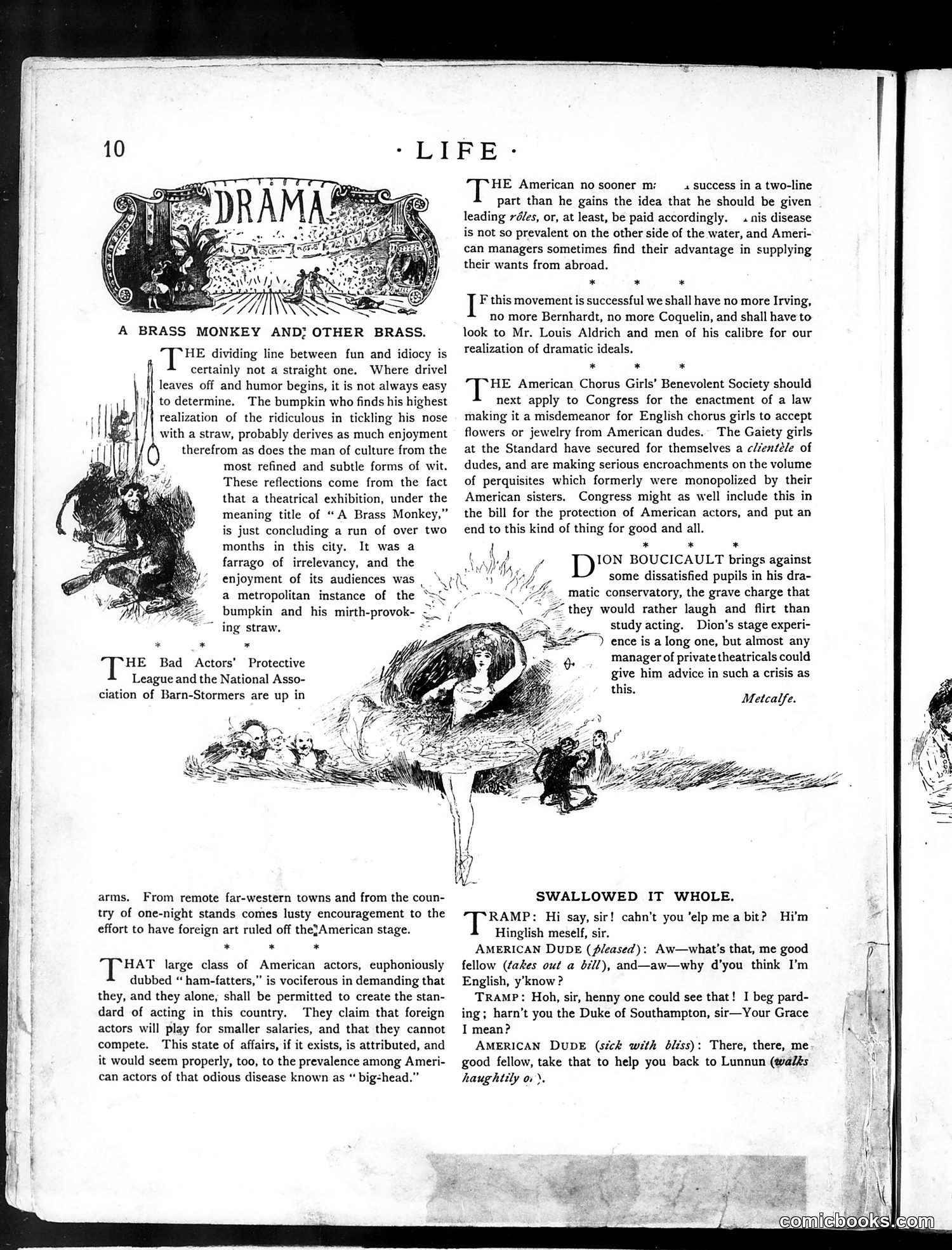
This page satirizes American theatrical management and acting. The main cartoon depicts a hanging figure labeled "A Brass Monkey," referencing a theatrical production that "concluded a run of over two months" in the city—apparently viewed as an embarrassing farce. The text critiques American actors demanding leading roles and higher salaries while claiming superiority over foreign performers. It mocks what it calls "big-head" disease among American actors who want preferential treatment. The lower section includes dialogue ("Swallowed It Whole") mocking an American character's pretentiousness about British nobility, suggesting American actors aspired to European sophistication they didn't possess. The satire targets American theatrical vanity and protectionism in early 20th-century entertainment.
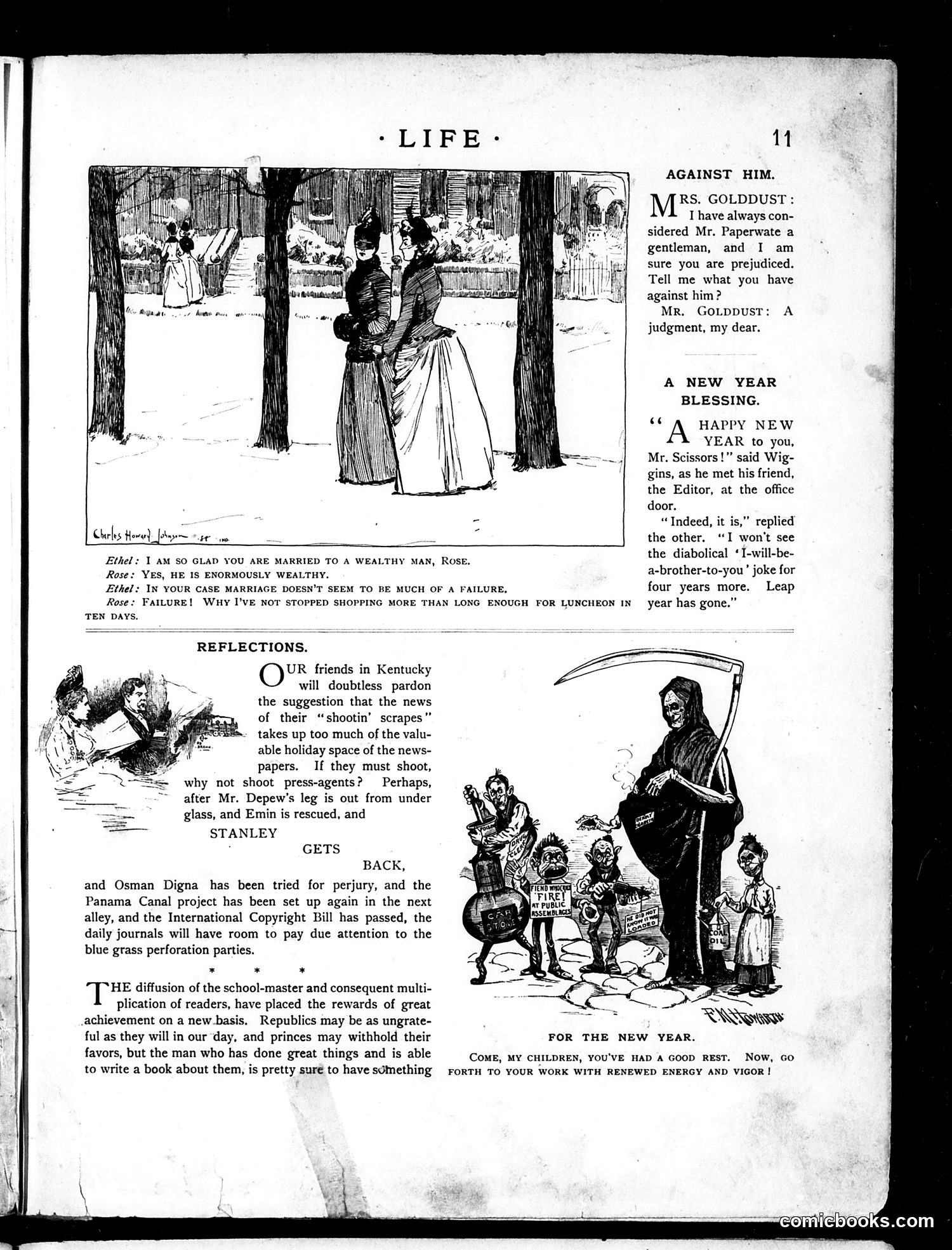
This page contains several short satirical pieces typical of *Life* magazine's humor. The top cartoon shows two women discussing marriage: one boasts her husband is "enormously wealthy," yet she hasn't stopped shopping for ten days—satirizing women's materialism and consumerism. "A New Year Blessing" jokes about an editor greeting his friend "Mr. Scissors," dreading the "1-will-be-a-brother-to-you" joke (a popular catchphrase) for another four years. "Reflections" mocks Kentucky's violent reputation, sarcastically suggesting newspapers cover Kentucky "shootin' scrapes" only after more important news (Depew's injury, Emin Pasha's rescue, Stanley's expedition, the Panama Canal, copyright law) is resolved—implying these backwoods conflicts are considered trivial. The final illustration shows Death collecting children, with the caption encouraging them to return to work with "renewed energy"—dark humor about childhood labor or simply the grim reality of post-holiday life resuming. The overall tone is cynical about wealth, gender, regional violence, and progress.
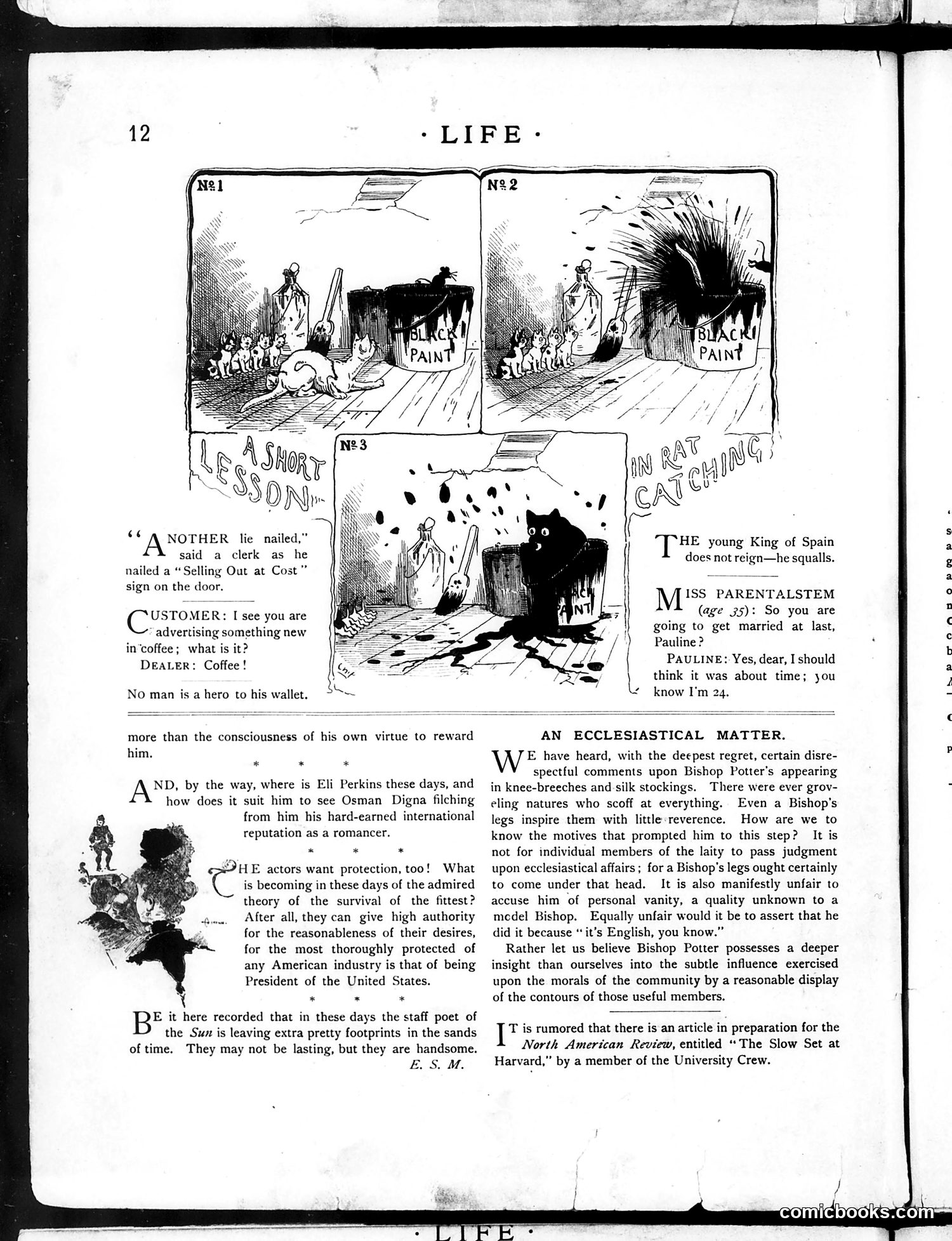
This page contains several brief satirical commentaries typical of Life's style: **"Selling Out at Cost"** mocks false advertising—a clerk nails up this sign while the text sarcastically notes "No man is a hero to his wallet," suggesting merchants deceive customers about pricing. **The paint-can cartoon** (three panels) depicts slapstick comedy: a figure repeatedly gets covered in black paint from an overturned can—visual humor requiring no explanation. **Bishop Potter's legs** satirizes prudish social criticism. The text defends Bishop Potter's appearance in knee-breeches and silk stockings (formal 18th-century clerical dress), mocking those who found it scandalous. The satire suggests critics lack sophistication and that the Bishop's choice reflects "deeper insight" into morality—a tongue-in-cheek defense of ecclesiastical dignity. **Miscellaneous notes** reference Eli Perkins (a romancer/writer, unclear what's meant), the Young King of Spain, actress protections, and a Harvard Crew article—insider references for contemporary readers. The page exemplifies Life's mix of visual gags and witty social commentary targeting hypocrisy and pretension.
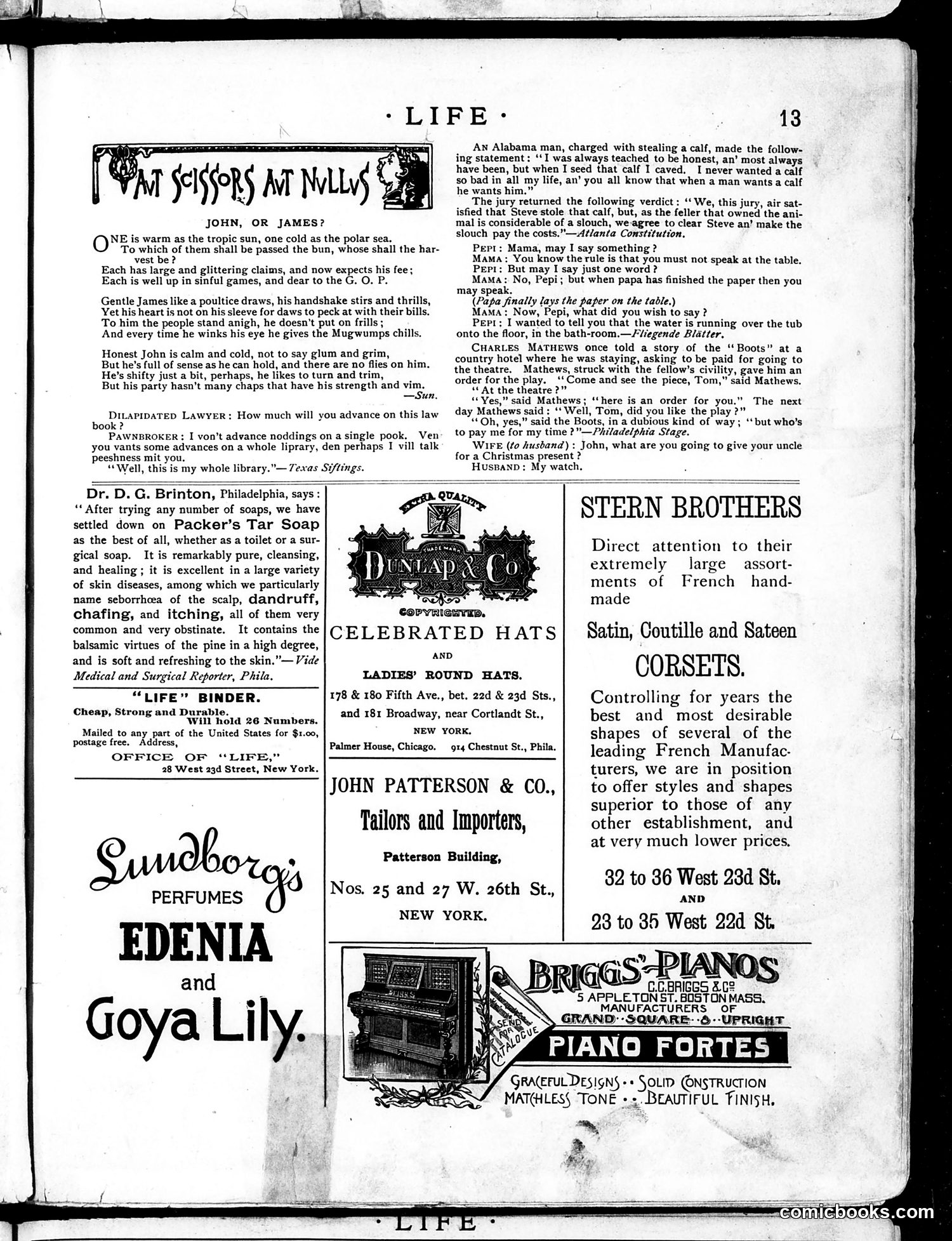
This page from *Life* magazine consists primarily of **humorous anecdotes and advertisements** rather than political cartoons. The opening poem "John, or James?" appears to reference a **Republican Party leadership dispute**—likely about presidential succession or nomination, comparing two candidates' contrasting personalities and appeal to different factions (notably "Mugwumps," reform-minded Republicans). The remaining content comprises **brief jokes and comic stories**: a pawnbroker refusing to advance money on a single law book, an Alabama theft case with an ironic jury verdict, dinner-table family humor, and an anecdote about 19th-century actor Charles Mathews. **The satire is mild and domestic**—poking fun at everyday situations (children's impatience, financial tight-fistedness, servant negotiations) rather than major political events. The numerous advertisements (perfumes, hats, corsets, pianos) dominate the page's real estate, indicating this was a revenue-driven publication mixing entertainment with commerce.
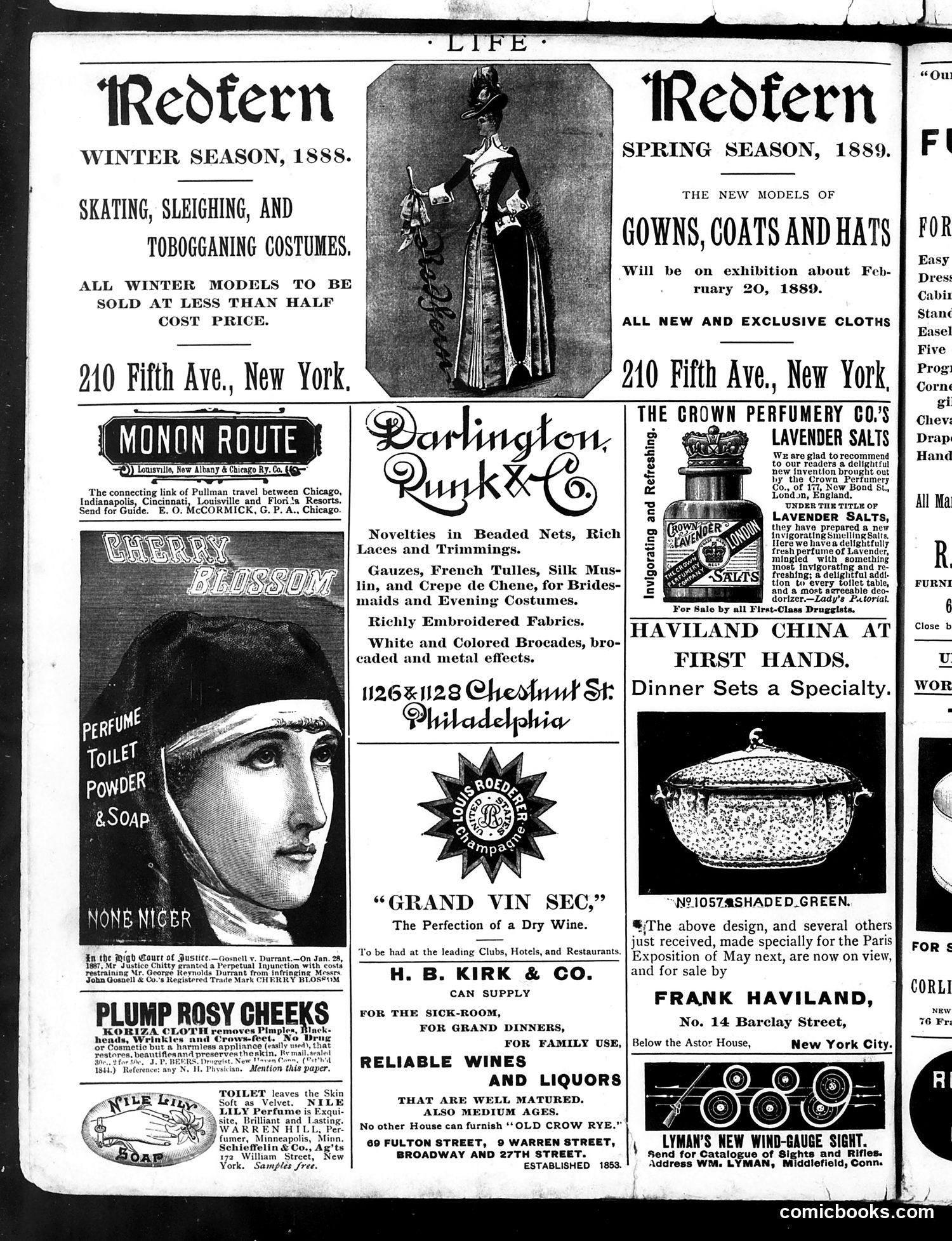
This is primarily a **fashion and luxury goods advertisement page** from late 1880s America, not a political cartoon. The page showcases high-end retailers advertising to wealthy consumers. The dominant content features **Redfern**, a prestigious fashion house at 240 Fifth Avenue, New York, advertising seasonal clothing collections (winter 1888 and spring 1889). Surrounding ads promote luxury items: fine wines and liquors, Haviland china dinner sets, perfumes, and toiletries like "Cherry Blossom" face cream and "Plump Rosy Cheeks" cosmetics. One notable image shows **"Cherry Blossom" perfume with a woman's profile**, apparently referencing a legal case (visible in small print regarding an injunction). The page reflects **Gilded Age consumer culture**—targeting affluent New Yorkers with imported French fashions, wines, and cosmetics. The railroad advertisement (Monon Route) served wealthy travelers to Florida resorts. This is a **lifestyle/commercial page**, not satire. Modern readers should note the conspicuous luxury consumption and the prominence of cosmetics marketed for women's appearance.
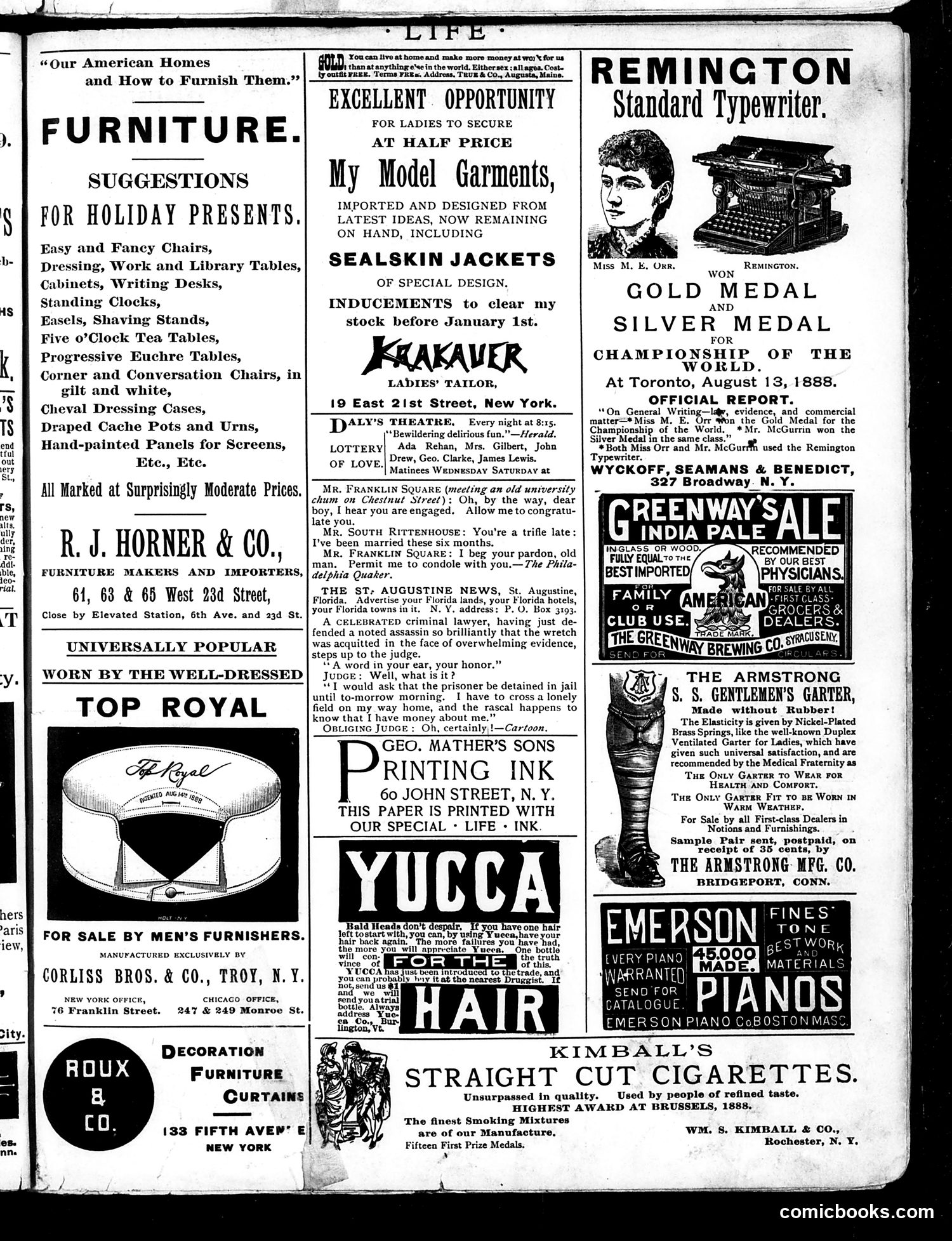
This is primarily an **advertising page** from Life magazine (circa 1888, based on the Remington typewriter championship date). The page contains two brief **satirical cartoons embedded among advertisements**: 1. **"Lottery of Love"**: A joke about a man who congratulates an acquaintance on engagement, only to learn he's already been married six months. The satire mocks the slowness of social gossip or the man's obliviousness. 2. **"A Celebrated Criminal Lawyer"**: A lawyer successfully defends an assassin through brilliant legal work, then asks the judge to keep the prisoner jailed—because the lawyer fears the now-freed assassin will rob him on his way home through a lonely field. This satirizes the moral contradiction of criminal lawyers who use their skills to free guilty parties without regard for public safety. Both jokes rely on dark humor about social awkwardness and professional hypocrisy. The rest of the page is **commercial advertising** for furniture, typewriters, garments, and patent medicines typical of the 1880s.
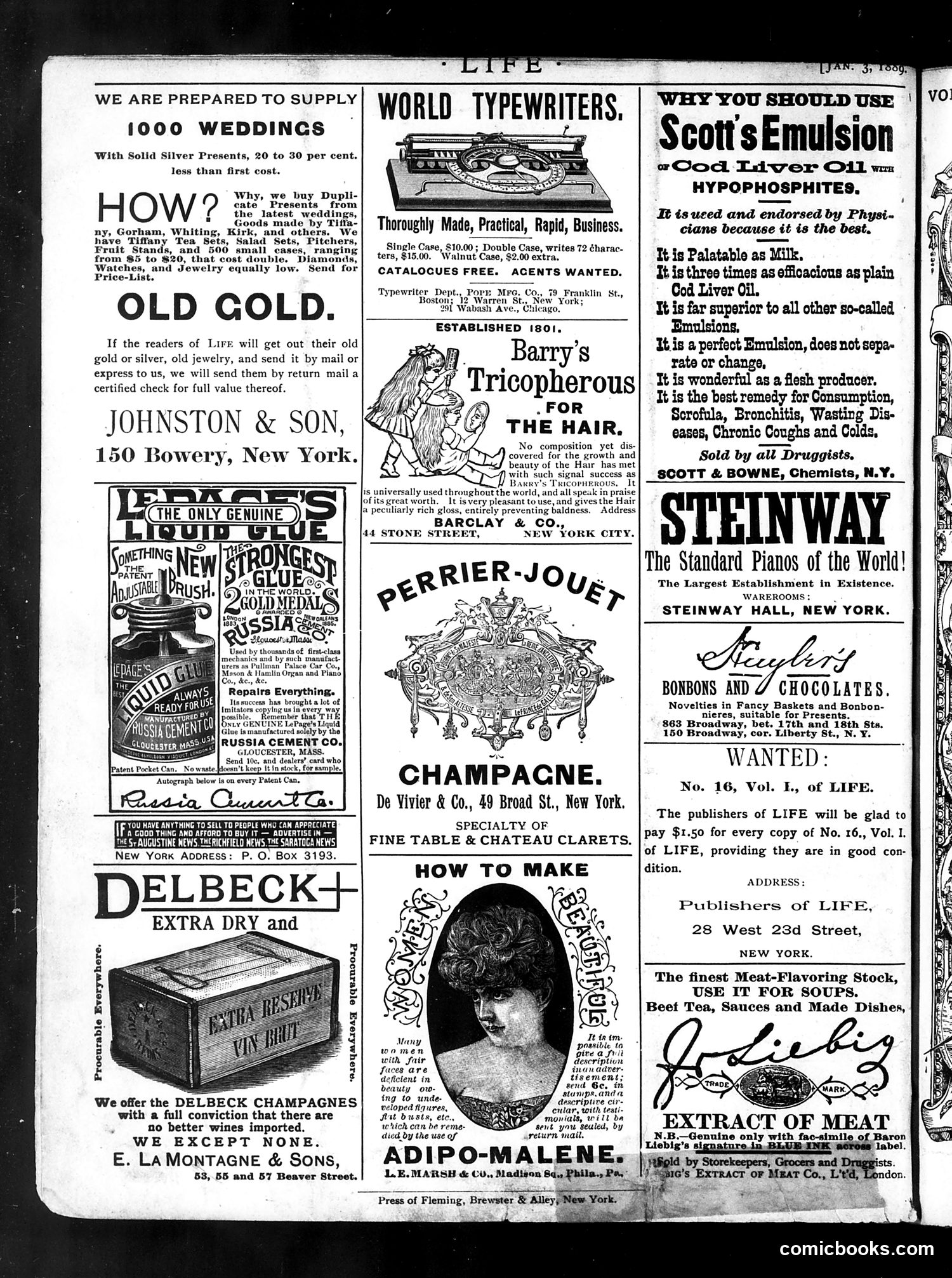
This is primarily an **advertising page** from Life magazine's early years, with minimal editorial content or satire. The page consists almost entirely of commercial advertisements for luxury goods and patent medicines typical of the Gilded Age. Notable ads include: - **Wedding gifts and jewelry** (Johnston & Son) — targeting affluent readers - **Patent medicines**: Scott's Emulsion (cod liver oil), Adipo-Malene (a bust-enlargement product featuring a woman's portrait), and Barry's Tricopherous (hair treatment) - **Luxury goods**: Steinway pianos, Delbeck champagne, Liebig's meat extract - **Business equipment**: World typewriters The **Adipo-Malene ad is most notable** for modern readers — it explicitly marketed a product to enlarge women's busts, revealing period attitudes about female beauty standards and the prevalence of dubious medicinal claims. The page reflects Life's dual nature: satirical publication *and* revenue source dependent on advertising to wealthy readers, promoting everything from legitimate products to questionable remedies without apparent editorial scrutiny.