
Life, 1889-01-03 · page 6 of 16
Life — January 3, 1889 — page 6: what you’re looking at
What you’re looking at
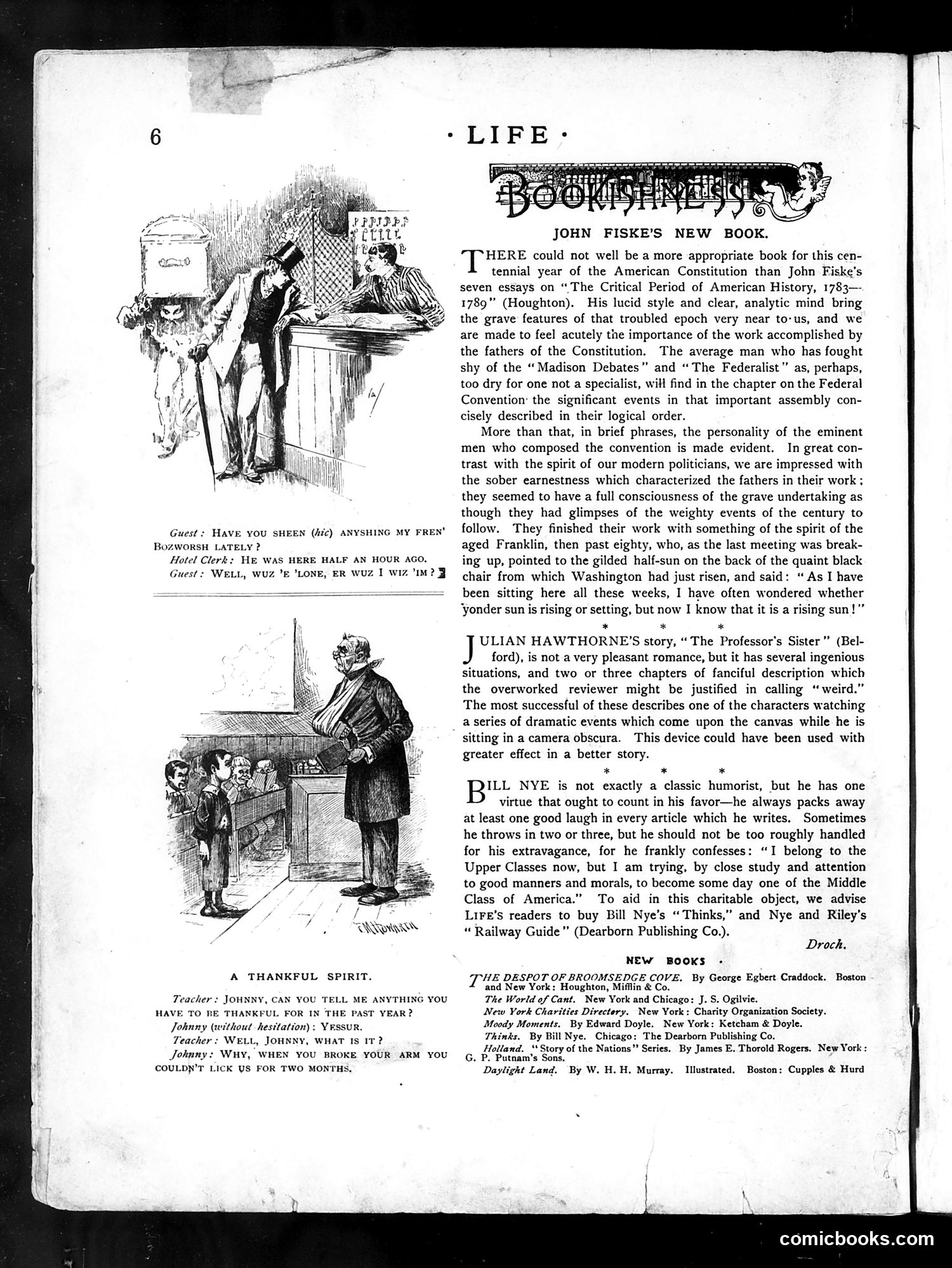
This page contains two cartoons with accompanying dialogue, both depicting social comedy: **Top cartoon** ("Guest" and "Hotel Clerk" dialogue): Shows a hotel clerk and guest discussing a broken arm. The joke hinges on the guest's casual attitude toward the injury—they've been there "half an hour" and already broke their arm, suggesting either clumsiness or the hotel's hazardous conditions. It's mild physical-comedy satire about hotel incompetence. **Bottom cartoon** ("A Thankful Spirit"): Depicts a teacher questioning a student (Johnny) about what he's thankful for. Johnny responds he's thankful his arm didn't break when he fell—the humor lies in the student's low expectations and the teacher's resignation to minor injuries as normal occurrence. This satirizes either dangerous school conditions or children's resilience to mishap. Both cartoons use injury humor typical of early 20th-century comic sensibilities.
📄 Transcribed text from this page (OCR, searchable)
Machine-transcribed from the original scan — historical spelling and the odd misread are preserved.
JOHN FISKE’S NEW BOOK. HERE could not well be a more appropriate book for this cen- tennial year of the American Constitution than John Fiske’s seven essays on “The Critical Period of American History, 1783—- 1789” (Houghton). His lucid style and clear, analytic mind bring the grave features of that troubled epoch very near to-us, and we are made to feel acutely the importance of the work accomplished by the fathers of the Constitution. The average man who has fought shy of the “Madison Debates” and “The Federalist” as, perhaps, too dry for one not a specialist, will find in the chapter on the Federal Convention: the significant events in that important assembly con- cisely described in their logical order. More than that, in brief phrases, the personality of the eminent men who composed the convention is made evident. In great con- trast with the spirit of our modern politicians, we are impressed with the sober earnestness which characterized the fathers in their work ; they seemed to have a full consciousness of the grave undertaking as though they had glimpses of the weighty events of the century to Guest: Have you SHEEN (jc) anysuinc My Frex' follow. They finished their work with something of the spirit of the BozWorsH LATELY ? aged Franklin, then past eighty, who, as the last meeting was break- Hotel Clerk; HE WAS HERE HALF AN HOUR AGO. ing up, pointed to the gilded half-sun on the back of the quaint black Guest: WELL, WUZ 'E 'LONE, ER wuz I wiz "IM? chair from which Washington had just risen, and said: “As I have = - been sitting here all these weeks, I have often wondered whether ‘yonder sun is rising or setting, but now I know that it is a rising sun!” * * * ULIAN HAWTHORNE'S story, “ The Professor's Sister” (Bel- ford), is not a very pleasant romance, but it has several ingenious situations, and two or three chapters of fanciful description which the overworked reviewer might be justified in calling ‘ weird.” The most successful of these describes one of the characters watching a series of dramatic events which come upon the canvas while he is sitting in a camera obscura. This device could have been used with greater effect in a better story. * * * ILL NYE is not exactly a classic humorist, but he has one virtue that ought to count in his favor—he always packs away at least one good laugh in every article which he writes. Sometimes he throws in two or three, but he should not be too roughly handled for his extravagance, for he frankly confesses: “I belong to the Upper Classes now, but I am trying, by close study and attention to good manners and morals, to become some day one of the Middle Class of America.” To aid in this charitable object, we advise / Lire’s readers to buy Bill Nye’s “Thinks,” and Nye and Riley's NSO SS “ Railway Guide” (Dearborn Publishing Co.). Droch. NEW BOOKS - A THANKFUL SPIRIT. HE DESPOT OF BROOMSEDGE COVE. By George Egbert Craddock. Boston and New York: Houghton, Mifflin & Co. Teacher : JOHNNY, CAN YOU TELL ME ANYTHING YOU The World of Cant. New York and Chicago: J. S. Ogilvie. HAVE TO RE THANKFUL FOR IN THE PAST YEAR? New York Charities Directery. New York: Charity Organization Society. Johnny (without hesitation) : YRSsuR. Moody Moments. By Edward Doyle. New York: Ketcham & Doyle. Teacher: WELL, JOHNNY, WHAT IS IT? Thinks. By Bill Nye. Chicago: The Dearborn Publishing Co. Jokuny: WHY, WHEN YOU BROKE YOUR ARM you, {i/and.,\\ Story of the Nations” Series. By James E. Thorold Rogers. New Yor COULDN'T LICK YS FOR TWO MONTHS, Daylight Land. By W. H.H. Murray. Illustrated, Boston: Cupples & Hurd comicbooks.com