
Life, 1889-01-03 · page 10 of 16
Life — January 3, 1889 — page 10: what you’re looking at
What you’re looking at
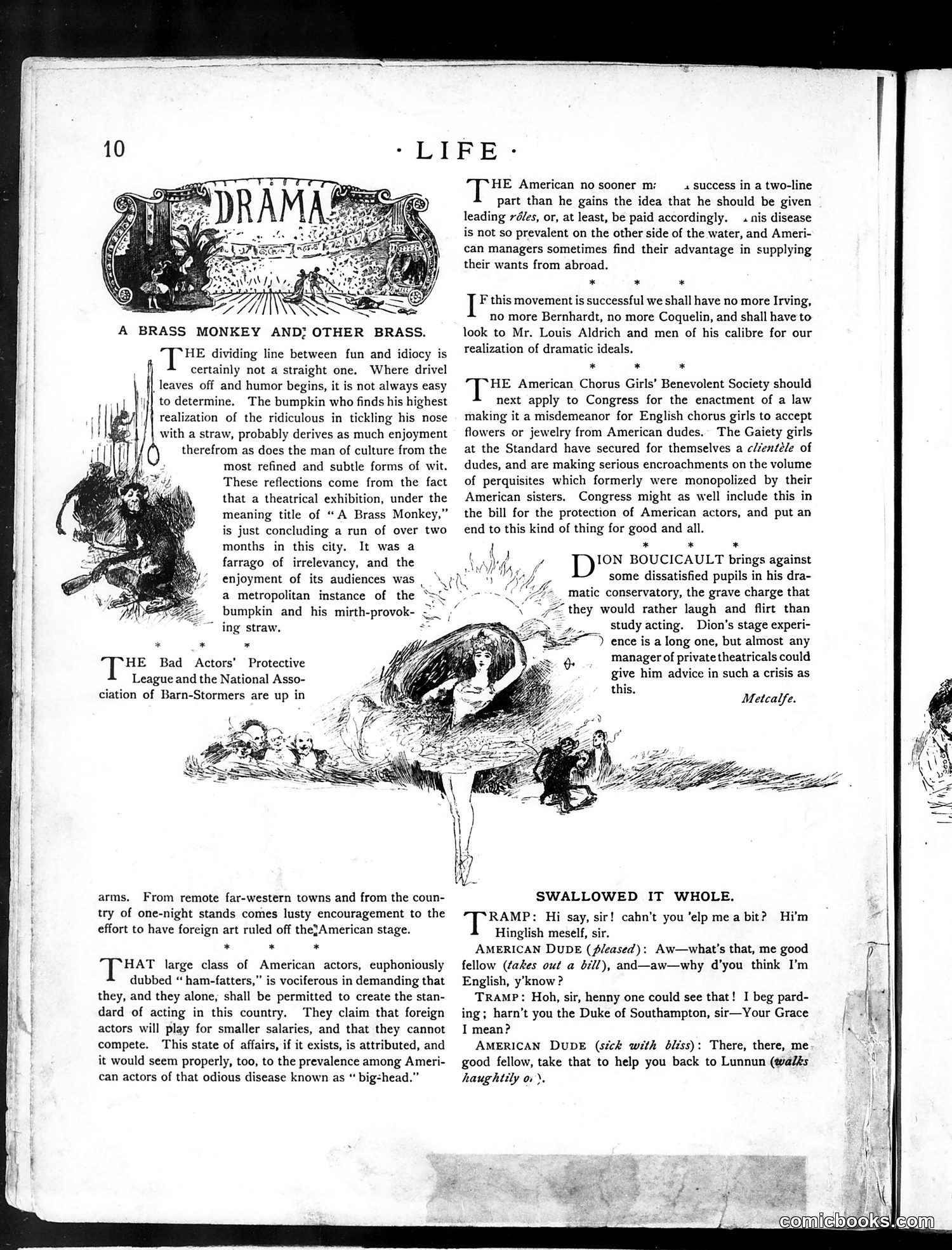
This page satirizes American theatrical management and acting. The main cartoon depicts a hanging figure labeled "A Brass Monkey," referencing a theatrical production that "concluded a run of over two months" in the city—apparently viewed as an embarrassing farce. The text critiques American actors demanding leading roles and higher salaries while claiming superiority over foreign performers. It mocks what it calls "big-head" disease among American actors who want preferential treatment. The lower section includes dialogue ("Swallowed It Whole") mocking an American character's pretentiousness about British nobility, suggesting American actors aspired to European sophistication they didn't possess. The satire targets American theatrical vanity and protectionism in early 20th-century entertainment.
📄 Transcribed text from this page (OCR, searchable)
Machine-transcribed from the original scan — historical spelling and the odd misread are preserved.
*~ LIFE: A BRASS MONKEY AND; OTHER BRASS. i linge dividing line between fun and idiocy is fj certainly not a straight one. Where drivel leaves off and humor begins, it is not always easy to determine. The bumpkin who finds his highest realization of the ridiculous in tickling his nose with a straw, probably derives as much enjoyment therefrom as does the man of culture from the most refined and subtle forms of wit. These reflections come from the fact that a theatrical exhibition, under the meaning title of “A Brass Monkey,” is just concluding a run of over two months in this city. It was a farrago of irrelevancy, and the enjoyment of its audiences was | a metropolitan instance of the bumpkin and his mirth-provok- = ~ ing straw. x HE Bad Actors’ Protective League and the National Asso- ciation of Barn-Stormers are up in ( arms. From remote far-western towns and from the coun- try of one-night stands comes lusty encouragement to the effort to have foreign art ruled off the}American stage. * * * HAT large class of American actors, euphoniously dubbed “ ham-fatters,” is vociferous in demanding that they, and they alone, shall be permitted to create the stan- dard of acting in this country. They claim that foreign actors will play for smaller salaries, and that they cannot compete. This state of affairs, if it exists, is attributed, and it would seem properly, too, to the prevalence among Ameri- can actors of that odious disease known as “ big-head.” NOY HE American no sooner m: 4 success in a two-line part than he gains the idea that he should be given leading réles, or, at least, be paid accordingly. . nis disease is not so prevalent on the other side of the water, and Ameri- can managers sometimes find their advantage in supplying their wants from abroad. * * * ] F this movement is successful we shall have no more Irving, no more Bernhardt, no more Coquelin, and shall have to look to Mr. Louis Aldrich and men of his calibre for our realization of dramatic ideals. * * * HE American Chorus Girls’ Benevolent Society should next apply to Congress for the enactment of a law making it a misdemeanor for English chorus girls to accept flowers or jewelry from American dudes. The Gaiety girls at the Standard have secured for themselves a c/entéle of dudes, and are making serious encroachments on the volume of perquisites which formerly were monopolized by their American sisters. Congress might as well include this in the bill for the protection of American actors, and put an end to this kind of thing for good and all. * * * ION BOUCICAULT brings against some dissatisfied pupils in his dra- matic conservatory, the grave charge that “they would rather laugh and flirt than -,.. _ study acting. Dion's stage experi- “32 ence is a long one, but almost any : @ manager of private theatricals could give him advice in such a crisis as this. 's Metcalfe. SWALLOWED IT WHOLE. RAMP: Hi say, sir! cahn’t you ’elp mea bit? Hi'm Hinglish meself, sir. AMERICAN DUDE (f/eased): Aw—what's that, me good fellow (takes out a b¢ll), and—aw—why d’you think I’m English, y’know ? TRAMP: Hoh, sir, henny one could see that! I beg pard- ing; harn’t you the Duke of Southampton, sir—Your Grace I mean? AMERICAN DUDE (sick with bliss): There, there, me good fellow, take that to help you back to Lunnun (walks haughtily 0.