
Life, 1889-01-03 · page 2 of 16
Life — January 3, 1889 — page 2: what you’re looking at
What you’re looking at
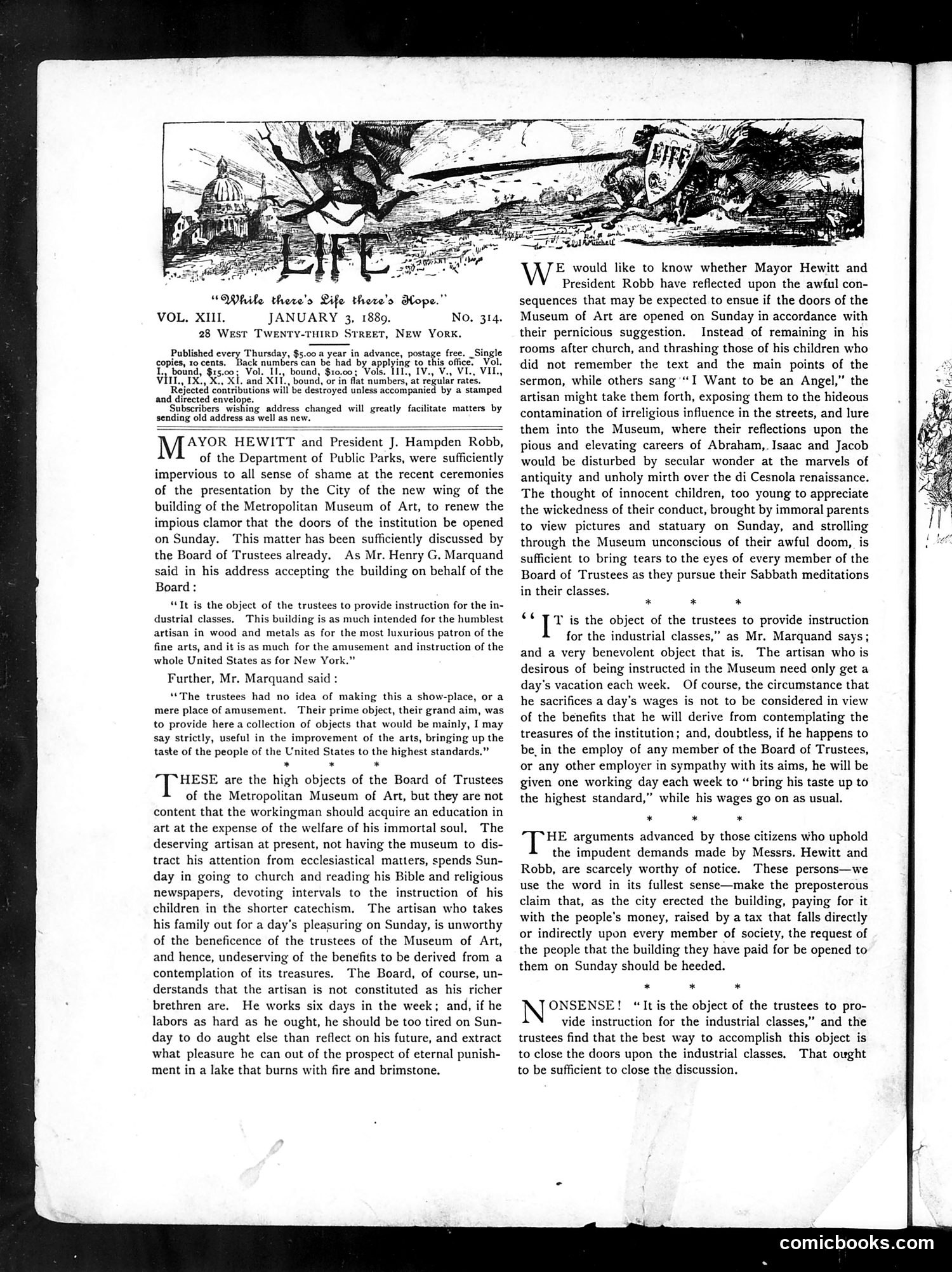
This page satirizes a heated debate over the Metropolitan Museum of Art's Sunday hours. Mayor Hewitt and Parks Commissioner Robb wanted to open the museum on Sundays, but religious groups objected—they feared working-class visitors would skip church for cultural activities. The cartoon's caption ("While there's Life there's Hope") is ironic: Life magazine defends opening the museum, arguing that artisans deserve one day weekly for cultural improvement without sacrificing wages. The editorial ridicules opponents' religious objections as hypocritical snobbery, claiming the wealthy erected this public building with taxpayers' money but wanted to restrict access. The debate reflects 1880s tensions between secular culture, working-class leisure, and religious conservatism.
📄 Transcribed text from this page (OCR, searchable)
Machine-transcribed from the original scan — historical spelling and the odd misread are preserved.
“While there's Life there's Hope.” VOL. XIII. JANUARY 3, 1889. No. 314. 28 West TWENTY-THIRD STREET, NEW YorRK. Published every Thursday, $5.00 a year in advance, postage free. _Single copies, 10 cents. Back numbers can be had by applying to this office. Vol. 1. bound, $15.00; Vol. Il. bound, $10.00; Vols til, 1V., V., Vi. VII, vitT., IX., X.. Xi. and XIT., bound, o in flat numbers, at regular rates. Rejected contributions will be destroyed unless accompanied by a stamped and directed envelope. Subscribers wishing address changed will greatly facilitate matters by sending old address as well as new. AYOR HEWITT and President J. Hampden Robb, of the Department of Public Parks, were sufficiently impervious to all sense of shame at the recent ceremonies of the presentation by the City of the new wing of the building of the Metropolitan Museum of Art, to renew the impious clamor that the doors of the institution be opened on Sunday. This matter has been sufficiently discussed by the Board of Trustees already. As Mr. Henry G. Marquand said in his address accepting the building on behalf of the Board : “It is the object of the trustees to provide instruction for the in- dustrial classes. This building is as much intended for the humblest artisan in wood and metals as for the most luxurious patron of the fine arts, and it is as much for the amusement and instruction of the whole United States as for New York.” Further, Mr. Marquand said : “The trustees had no idea of making this a show-place, or a mere place of amusement. Their prime object, their grand aim, was to provide here a collection of objects that would be mainly, I may say strictly, useful in the improvement of the arts, bringing up the taste of the people of the United States to the highest standards.” * * * HESE are the high objects of the Board of Trustees of the Metropolitan Museum of Art, but they are not content that the workingman should acquire an education in art at the expense of the welfare of his immortal soul. The deserving artisan at present, not having the museum to dis- tract his attention from ecclesiastical matters, spends Sun- day in going to church and reading his Bible and religious newspapers, devoting intervals to the instruction of his children in the shorter catechism, The artisan who takes his family out for a day's pleasuring on Sunday, is unworthy of the beneficence of the trustees of the Museum of Art, and hence, undeserving of the benefits to be derived from a contemplation of its treasures. The Board, of course, un- derstands that the artisan is not constituted as his richer brethren are. He works six days in the week; and, if he labors as hard as he ought, he should be too tired on Sun- day to do aught else than reflect on his future, and extract what pleasure he can out of the prospect of eternal punish- ment in a lake that burns with fire and brimstone. E would like to know whether Mayor Hewitt and President Robb have reflected upon the awful con- sequences that may be expected to ensue if the doors of the Museum of Art are opened on Sunday in accordance with their pernicious suggestion. Instead of remaining in his rooms after church, and thrashing those of his children who did not remember the text and the main points of the sermon, while others sang] Want to be an Angel,” the artisan might take them forth, exposing them to the hideous contamination of irreligious influence in the streets, and lure them into the Museum, where their reflections upon the pious and elevating careers of Abraham,. Isaac and Jacob would be disturbed by secular wonder at the marvels of antiquity and unholy mirth over the di Cesnola renaissance. The thought of innocent children, too young to appreciate the wickedness of their conduct, brought by immoral parents to view pictures and statuary on Sunday, and strolling through the Museum unconscious of their awful doom, is sufficient to bring tears to the eyes of every member of the Board of Trustees as they pursue their Sabbath meditations in their classes. * * * “e I" is the object of the trustees to provide instruction for the industrial classes,” as Mr. Marquand says; and a very benevolent object that is. The artisan who is desirous of being instructed in the Museum need only get a day's vacation each week. Of course, the circumstance that he sacrifices a day's wages is not to be considered in view of the benefits that he will derive from contemplating the treasures of the institution; and, doubtless, if he happens to be, in the employ of any member of the Board of Trustees, or any other employer in sympathy with its aims, he will be given one working day each week to “ bring his taste up to the highest standard,” while his wages go on as usual. * * * HE arguments advanced by those citizens who uphold the impudent demands made by Messrs. Hewitt and Robb, are scarcely worthy of notice. These persons—we use the word in its fullest sense—make the preposterous claim that, as the city erected the building, paying for it with the people's money, raised by a tax that falls directly or indirectly upon every member of society, the request of the people that the building they have paid for be opened to them on Sunday should be heeded. * * * ONSENSE! “It is the object of the trustees to pro- vide instruction for the industrial classes,” and the trustees find that the best way to accomplish this object is to close the doors upon the industrial classes. That ought to be sufficient to close the discussion. comicbooks.com