
A complete issue · 14 pages · 1888
Life — December 13, 1888
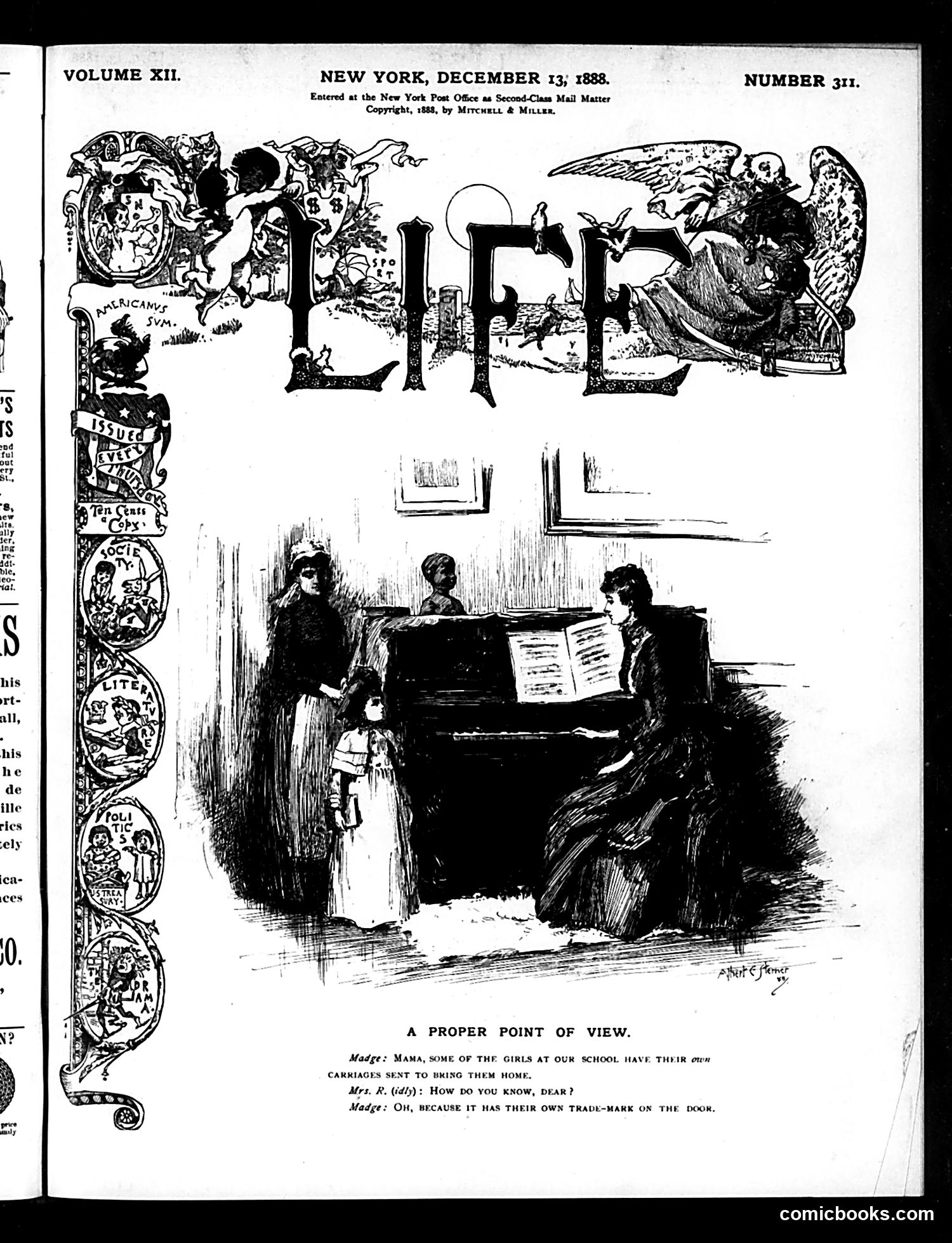
This cartoon satirizes wealthy mothers' status anxieties about their daughters' transportation. The dialogue shows a mother (Mrs. R. Gay) explaining to another woman (Mamma) that girls at their school have their own private carriages sent to collect them. When asked how she can identify which carriage belongs to her daughter, she replies it has its own "trade-mark on the door." The humor targets upper-class competitiveness and conspicuous consumption—the absurdity of mothers essentially branding their carriages like commercial products to display family status. By comparing a family coach to commercial merchandise, the cartoonist mocks how wealthy New Yorkers turned even transportation into status symbols requiring distinctive identification marks.
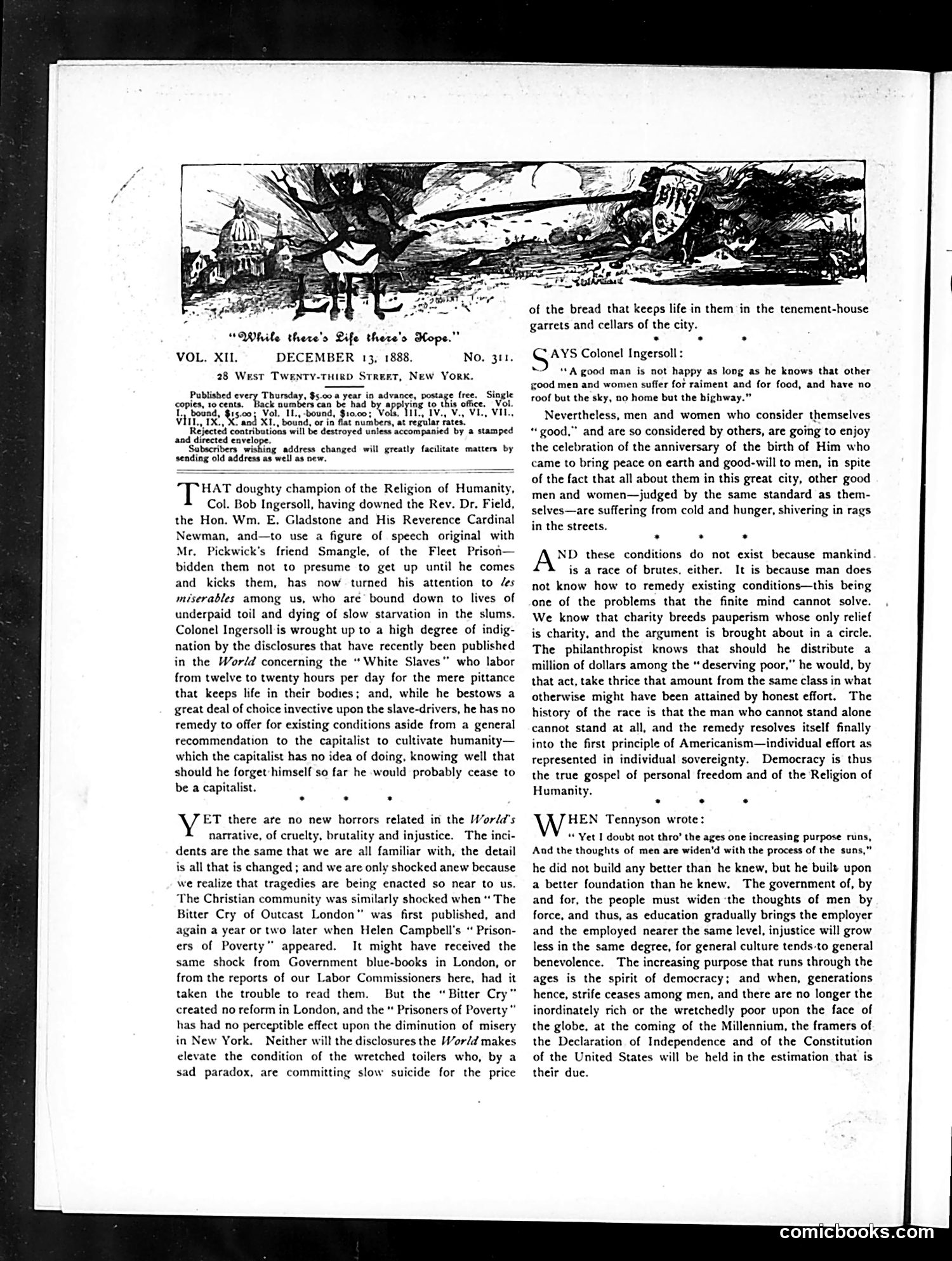
**The Cartoon:** The header illustration titled "While there's Life there's Hope" depicts a gnarled tree and landscape, likely symbolizing hardship or decay—a visual metaphor for the social conditions discussed below. **The Content:** This editorial page critiques Colonel Bob Ingersoll's response to Cardinal Newman and others regarding poverty. The article argues that Ingersoll, while championing "Religion of Humanity," offers no concrete solutions to working-class suffering—people laboring 12-20 hours daily in slums. The satire targets philanthropists and reformers who diagnose problems but propose no remedies. The author advocates for individual sovereignty and democracy as solutions, invoking Tennyson to argue that education and reducing inequality between rich and poor workers represents true progress toward the American ideals of the Declaration of Independence.
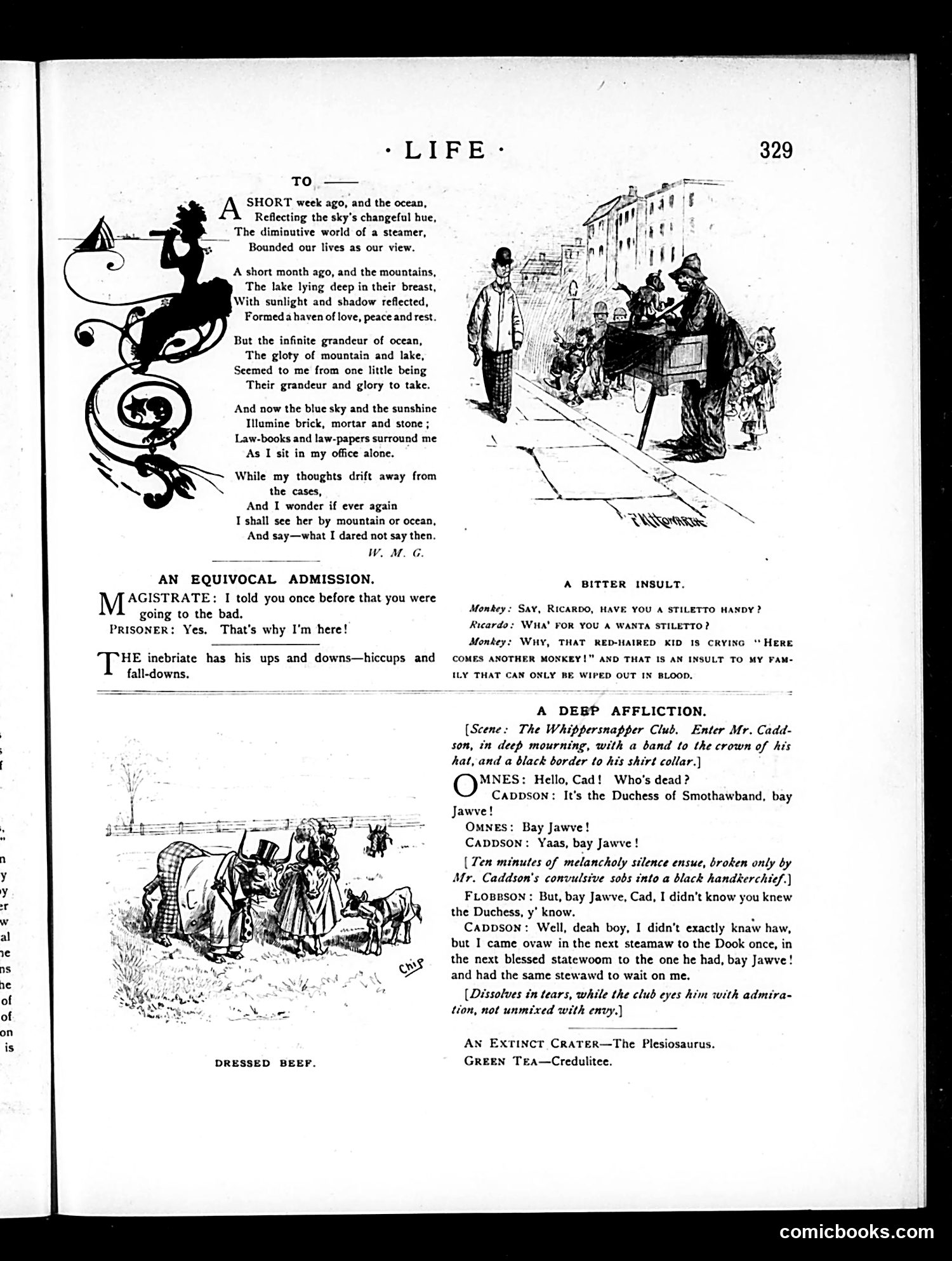
This page contains three satirical pieces: 1. **"To ___"** (top): A poem about contrasting life experiences—ocean voyages, mountain retreats, and office work. The accompanying illustration shows an urban street scene with a vendor and pedestrians. 2. **"An Equivocal Admission"** (middle): A brief comic dialogue between a magistrate and prisoner. The magistrate reminds the prisoner of a prior warning about "going to the bad," and the prisoner confirms this is why he's imprisoned. It's a simple joke about predictable outcomes of criminal behavior. 3. **"A Deep Affliction"** (bottom): A scene at the Whippersapper Club where Mr. Caddson mourns the Duchess of Smothawband's death. The humor appears to involve his emotional display despite apparently minimal prior acquaintance with the deceased. The page emphasizes class dynamics and social pretense typical of Life's satirical style.
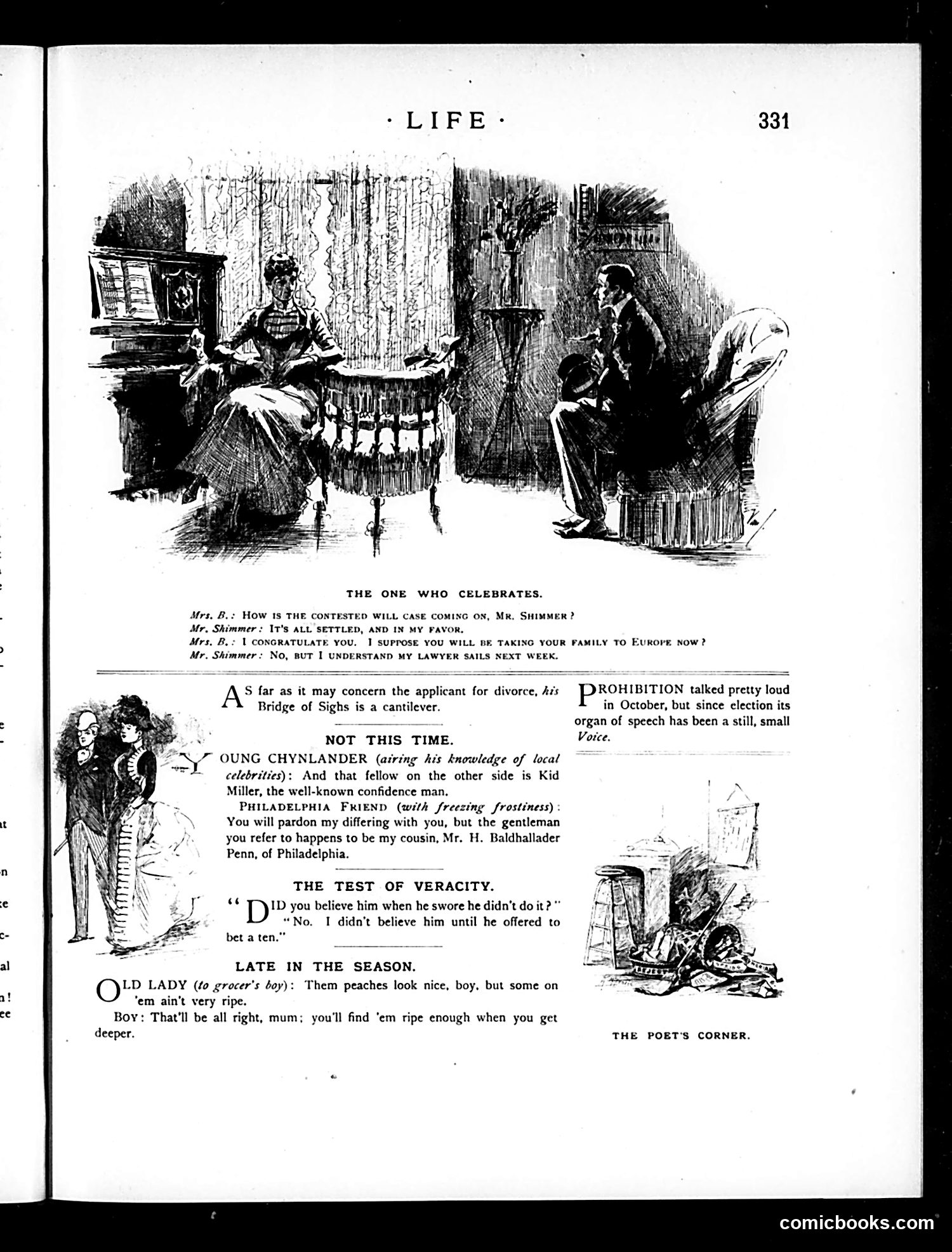
The top cartoon satirizes a divorce settlement. Mrs. B. congratulates Mr. Shimmer on winning his contested case, then asks if he'll take his family to Europe. Mr. Shimmer's reply—that his lawyer sails next week—is the joke's point: the legal fees were so enormous that only the *lawyer* benefits from the divorce, not the client. This mocks the financial toll of contested divorces and suggests lawyers are the true "winners" in such litigation. The page also includes three brief humorous anecdotes ("Not This Time," "The Test of Veracity," "Late in the Season") with accompanying sketches, typical of Life's satirical style mixing social commentary with everyday absurdities.
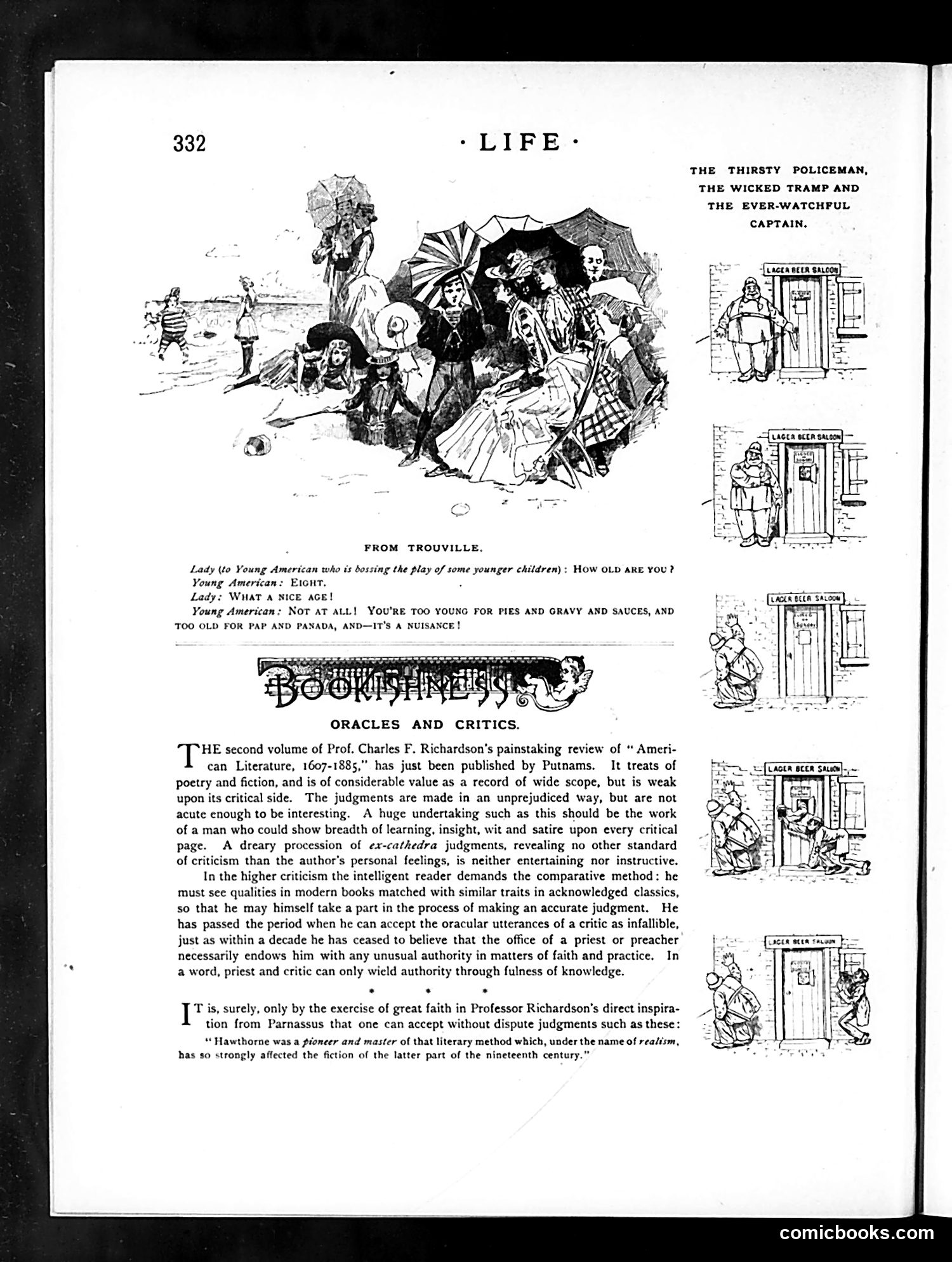
This page contains three distinct elements: 1. **Top cartoon ("From Trouville")**: A satirical scene showing a young American boy (age 8) encountering a fashionable lady at what appears to be a French seaside resort. The joke hinges on class and age: the boy innocently compliments her as "nice," but she sharply rebukes him, saying he's caught between childhood (too young for adult foods/interests) and adulthood (too old for childish ones)—essentially "a nuisance." It mocks both American informality abroad and rigid European class consciousness. 2. **"Books and Critics" section**: A lengthy literary review of Charles F. Richardson's second volume on American Literature (1607-1885). The critic dismisses Richardson's judgments as superficial and lacking genuine comparative analysis, arguing proper criticism requires deep knowledge, not mere pronouncement. 3. **Right side**: A series of small comic panels labeled "Lager Beer Saloon," likely depicting humorous bar scenes (details unclear from reproduction).
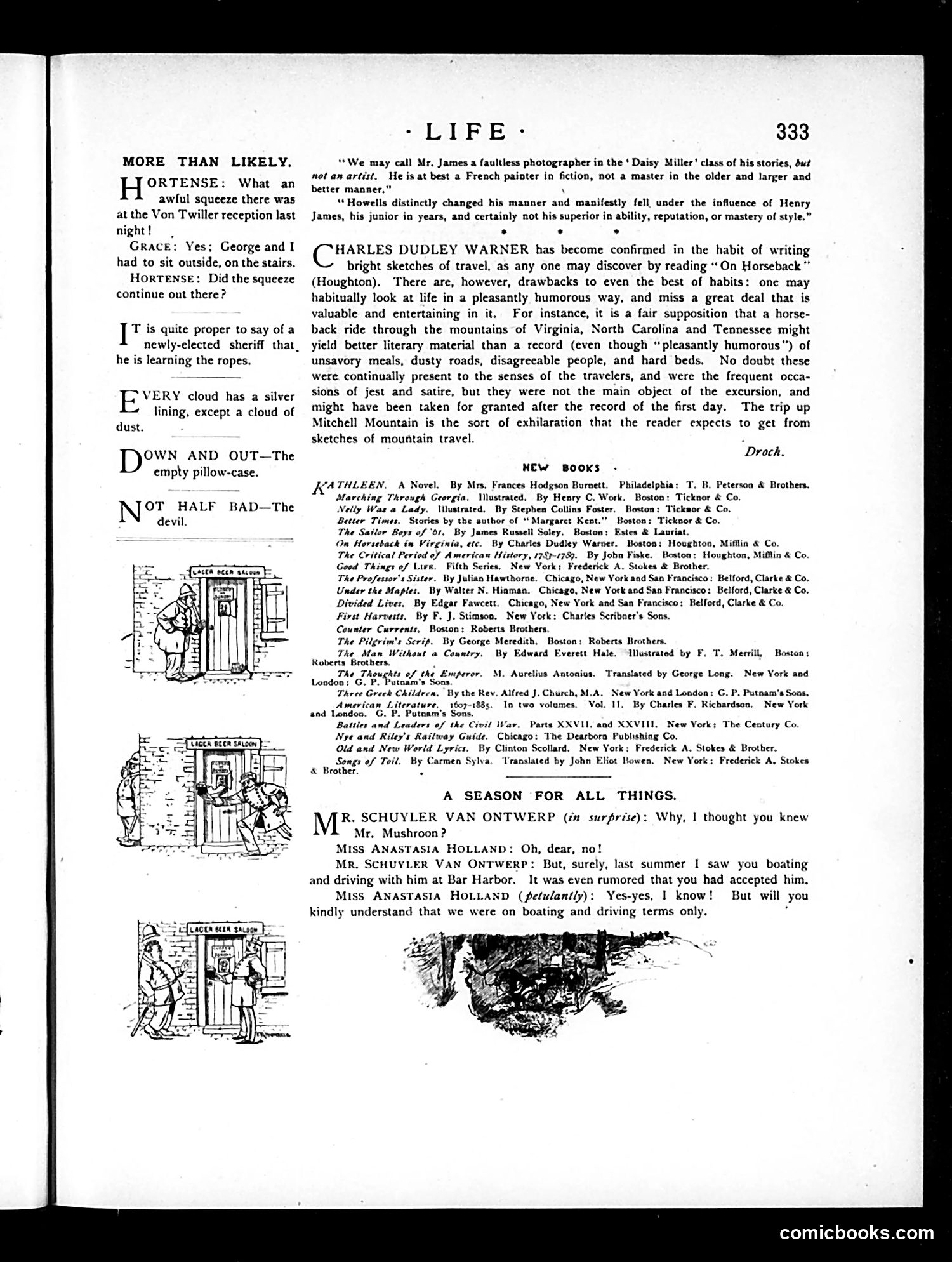
This page contains three small cartoon panels on the left side depicting scenes labeled "LAGER BEER SALOON," showing interactions between men and women in what appears to be a late 19th or early 20th-century bar setting. The cartoons appear to satirize social behavior and courtship rituals of the era, with the humor likely deriving from awkward encounters or misunderstandings between patrons. The bulk of the page is devoted to book reviews and literary criticism, including discussion of Charles Dudley Warner's travel sketches and other contemporary works. The bottom section begins a piece titled "A SEASON FOR ALL THINGS" featuring dialogue between characters Mr. Schuyler Van Ontwerp and Miss Anastasia Holland regarding a rumor about boating and driving together. The cartoons' specific satirical points remain unclear without clearer resolution of the dialogue or captions.
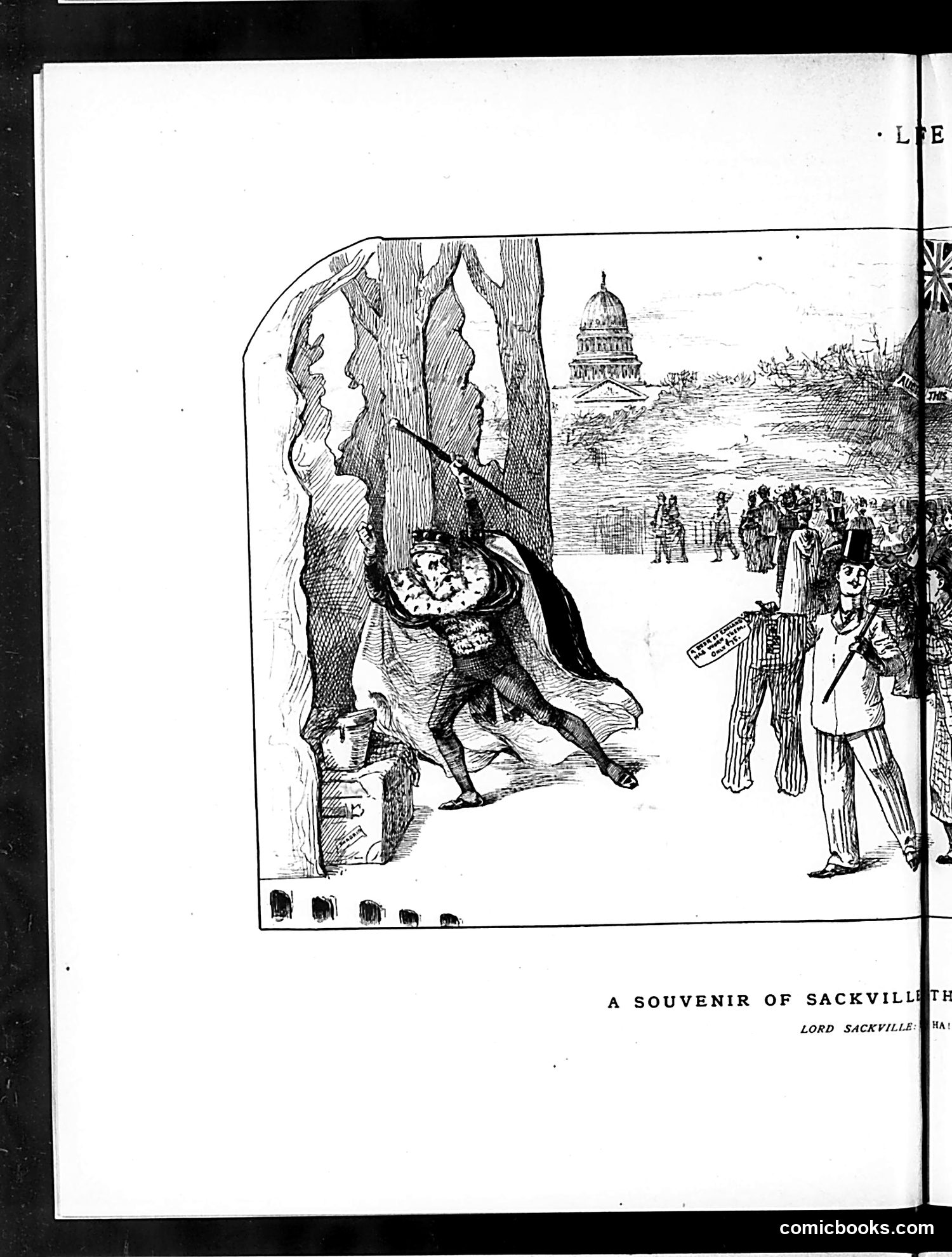
This cartoon depicts a dramatic scene labeled as a "souvenir" related to Lord Sackville. The illustration shows a figure being struck or knocked down near a tree, with a crowd of onlookers and what appears to be a capitol building in the background. The violent action suggests this references a significant political scandal or incident involving Lord Sackville. Without additional context, I cannot definitively identify the specific historical event, though the theatrical staging and prominent positioning suggests this was a notable controversy that Life's readers would have recognized. The satirical framing as a "souvenir" implies mockery of the incident or the figure involved. The exact political or diplomatic nature of the scandal remains unclear from the image alone.
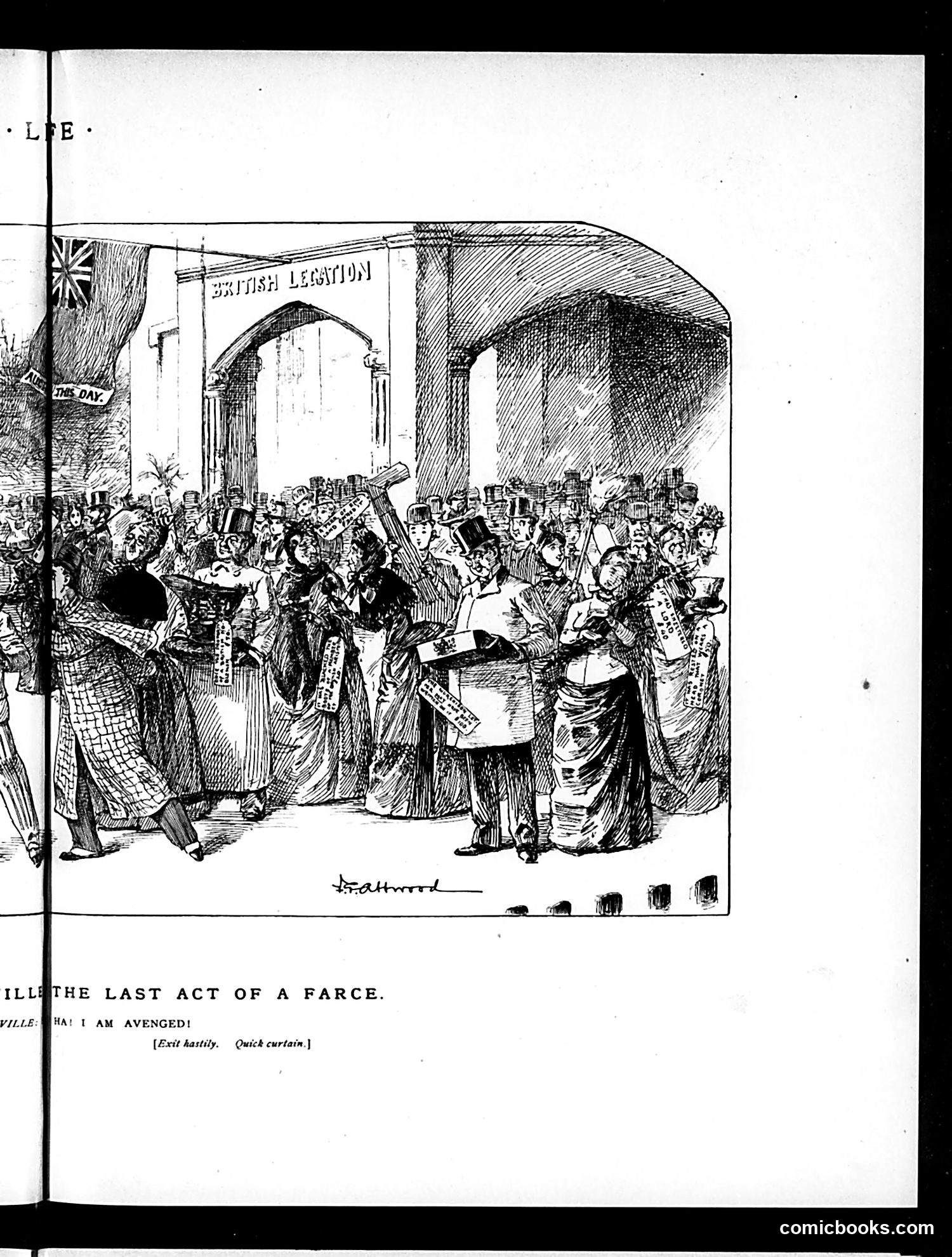
This political cartoon depicts a crowd gathered at the "British Legion" building. The scene appears to satirize a theatrical closing—the caption "The Last Act of a Farce" and the stage-like architectural framing suggest the British Legion itself is being portrayed as a failed or ridiculous enterprise worthy of mockery. The cartoon likely comments on post-WWI British veterans' affairs or politics, given the "British Legion" reference and Life magazine's American satirical perspective. The crowd's chaotic energy and the dramatic "Ha! I am avenged!" dialogue (exit stage left) reinforce the theatrical metaphor, suggesting whatever the Legion represented politically had become a laughingstock deserving of dramatic, final dismissal. The specific historical context remains unclear without additional documentation.
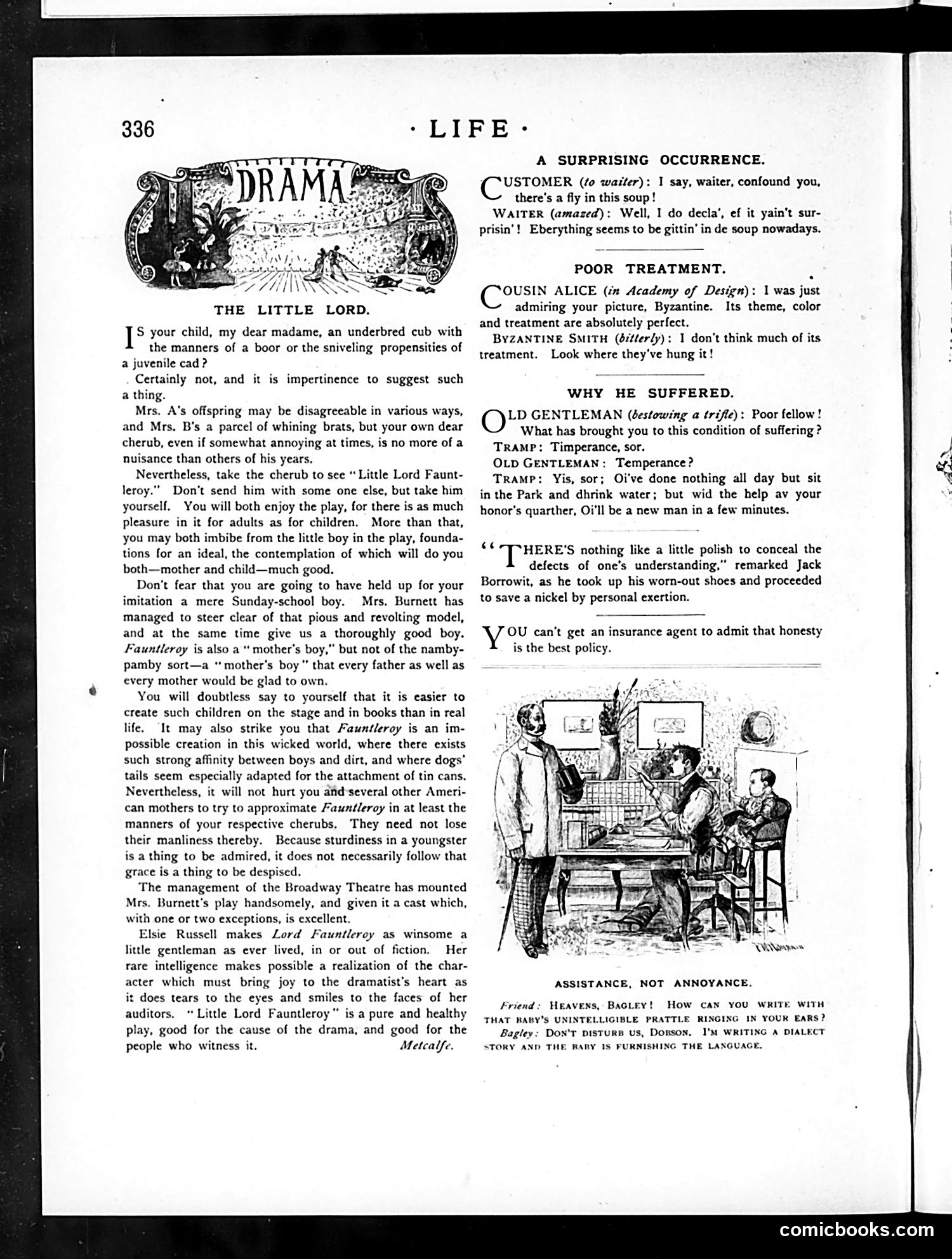
This page contains several short satirical pieces under a "Drama" heading. The main article reviews "The Little Lord Fauntleroy," praising the Broadway production and child actress Elsie Russell's performance. The reviewer defends the play against criticism that it portrays an overly genteel, "namby-pamby" boy, arguing such characters aren't necessarily weak. The page also includes brief humorous exchanges—a customer complaining about a fly in soup, criticism of a Byzantine painting, and a gentleman explaining his shabby appearance through lack of ambition rather than poverty. A small illustration shows two men discussing something, with one appearing to gesture explanatorily. The humor appears gentle and character-focused rather than political.
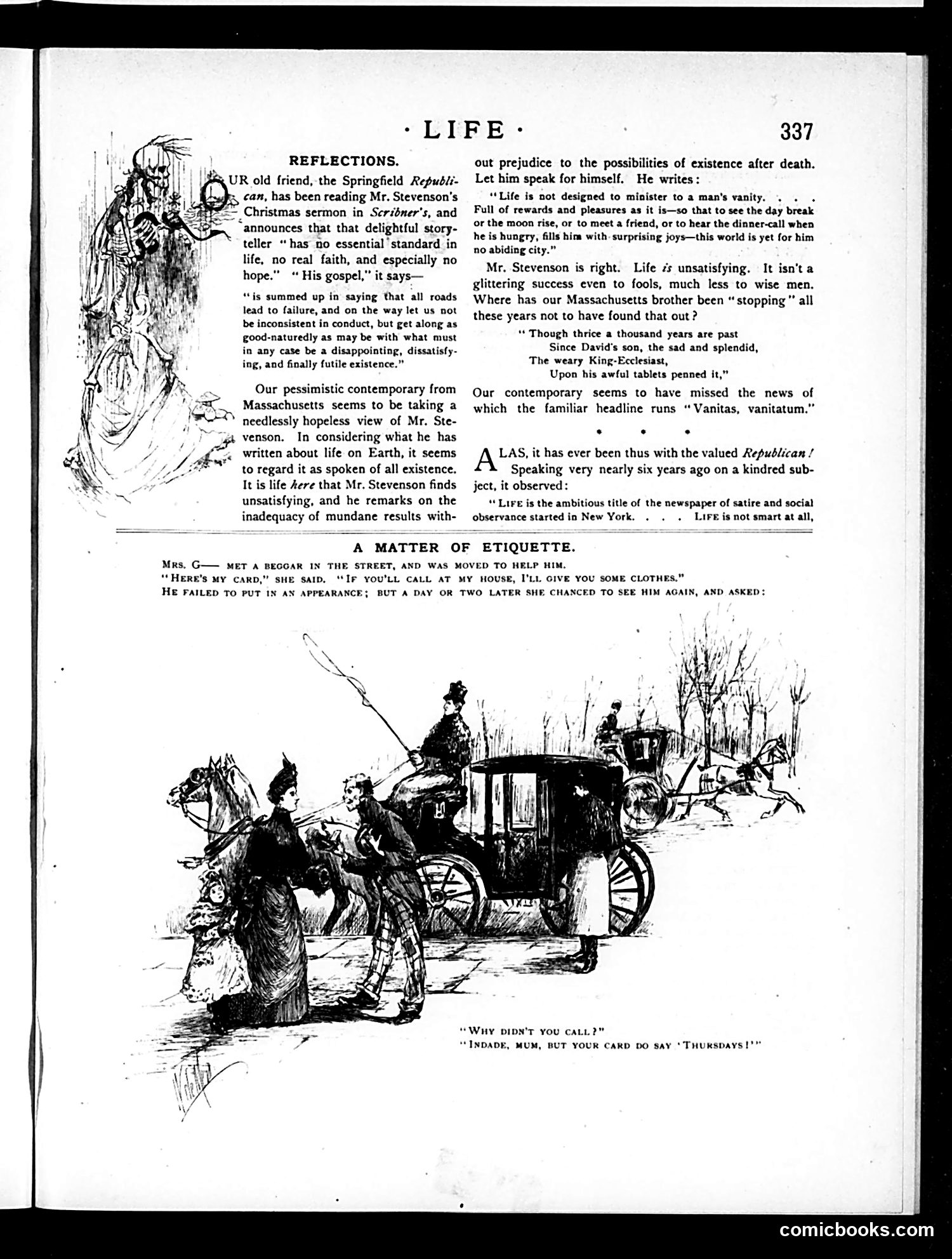
This cartoon satirizes upper-class hypocrisy and social pretension. A wealthy woman encounters a beggar and offers charity—but only on her terms, specified by her calling card for "Thursdays." When she later encounters the same beggar, he explains he didn't call because her card indicated only Thursday visits were acceptable. The joke mocks the woman's conditional "generosity": she frames charity as a formal social engagement with rigid etiquette rules, rather than genuine help. The beggar's respectful adherence to her stated conditions exposes the absurdity—he took her card as a literal appointment, treating her offer like a social visit rather than urgent assistance. The satire targets how wealthy people use social conventions to limit their obligations to the poor, turning charitable impulses into controlled, inconvenient formalities that ultimately serve the giver's convenience, not the recipient's need.
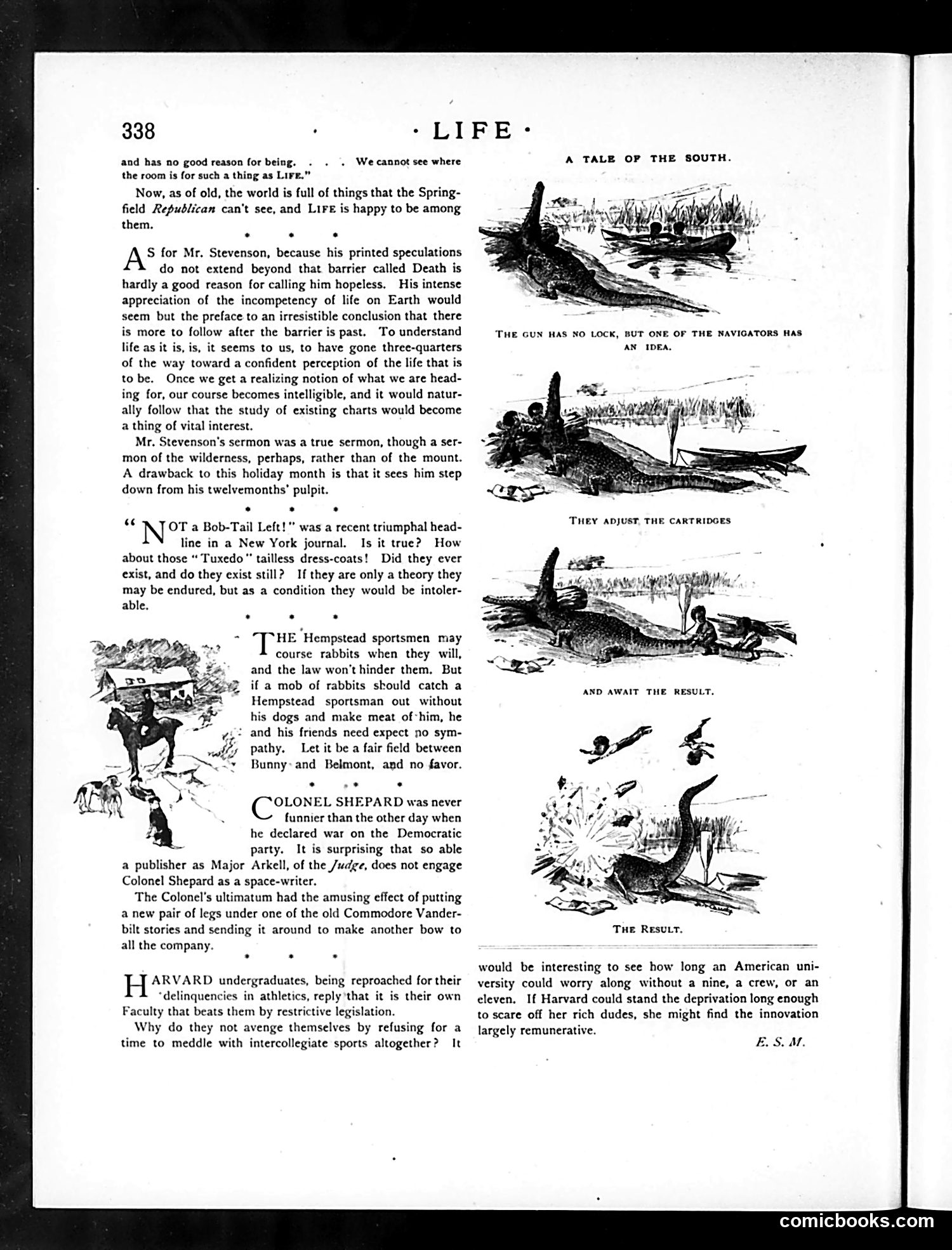
This page contains several brief satirical commentaries typical of Life magazine's format: **On Mr. Stevenson**: The magazine defends a clergyman (likely Robert Louis Stevenson, referenced earlier) against critics who dismiss his pessimistic views on earthly life, arguing that understanding life's limitations actually provides insight into what comes after death. **On Fashion Trends**: Life mocks a New York newspaper's triumphant headline claiming "bob-tails" are out, questioning whether tailless "Tuxedo" dress coats ever truly existed—satirizing fashion journalism's tendency to declare trends without evidence. **On Hempstead Hunting**: A humorous piece suggesting sportsmen who hunt rabbits without dogs shouldn't expect sympathy if rabbits turn the tables—advocating "fair play." **On Colonel Shepard**: Mocks a publisher's declaration of war against the Democratic Party as laughably recycled political theater. **On Harvard Athletics**: Suggests Harvard athletes should boycott sports entirely to pressure their restrictive Faculty—implying this might scare away wealthy students and prove universities' financial dependence on athletics. **The Southern Tale illustrations** appear unrelated editorial cartoon content.
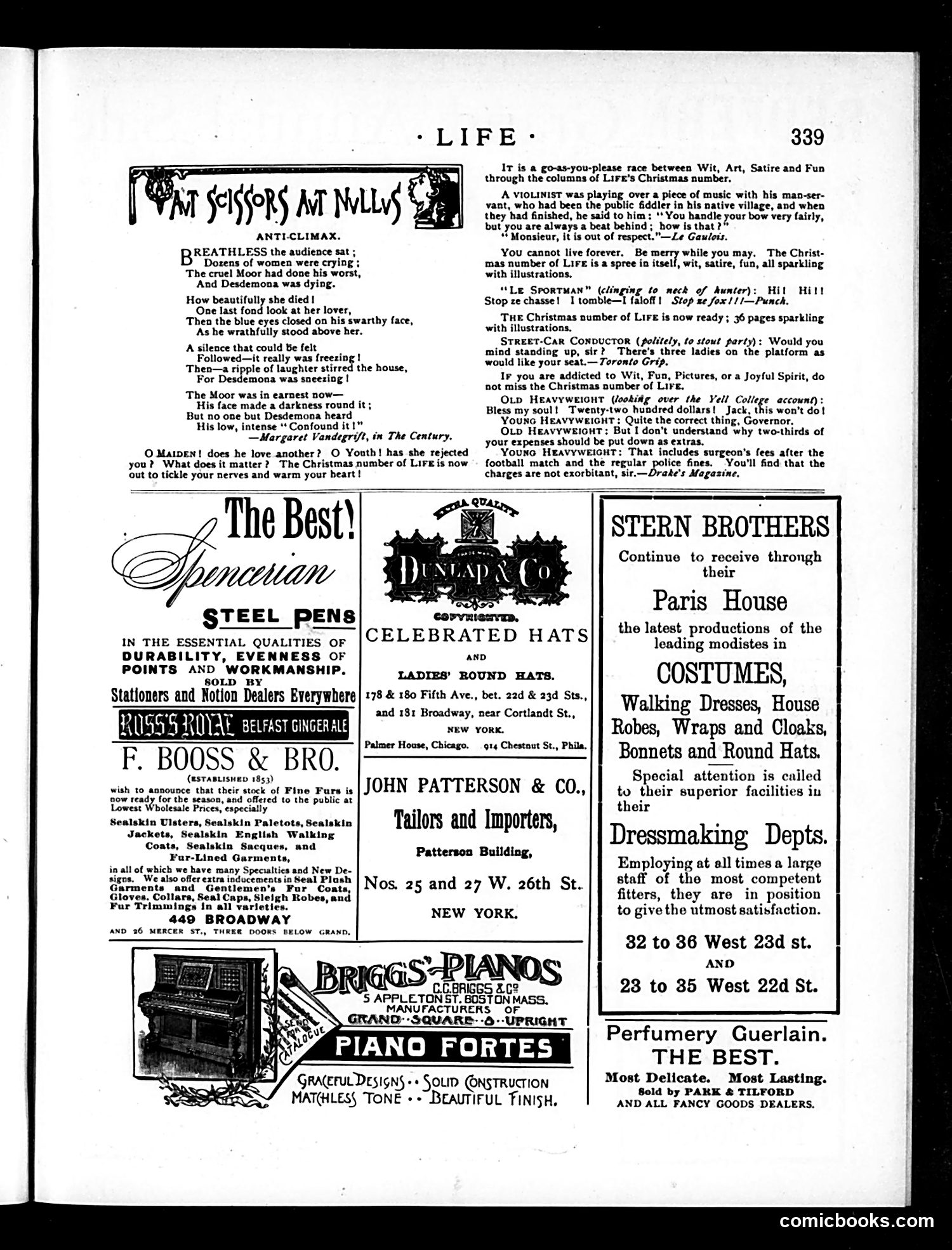
This is a humorous poem by Margaret Vandegrift satirizing theatrical melodrama. The setup: during a performance of Shakespeare's *Othello*, audiences sit in rapt attention as the "cruel Moor" stands over dying Desdemona in a tragic death scene. The joke's "anti-climax": Desdemona ruins the solemn moment by **sneezing**, breaking the theatrical illusion. The Moor's furious whispered "Confound it!" is funny precisely because his dramatic intensity now applies to an everyday bodily function rather than tragic passion. The satire mocks the overwrought emotionalism of Victorian melodrama—audiences' tears and intensity—deflated by a simple, undignified sneeze. It's a lighthearted jab at taking theatrical pretension too seriously. The page otherwise consists mainly of advertisements and other magazine jokes promoting Life's Christmas issue.
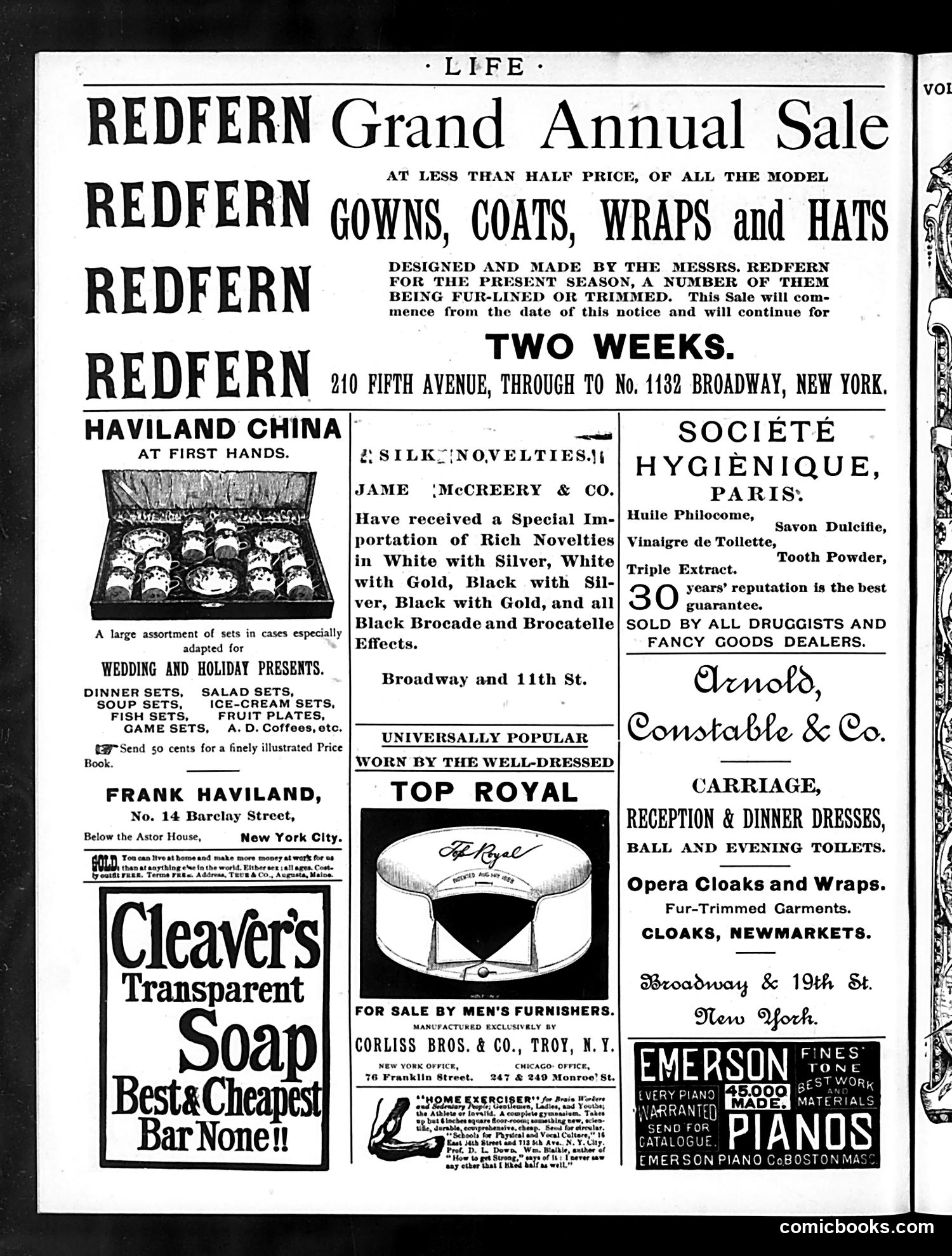
This is not a satirical cartoon page but rather a **advertisements section** from *Life* magazine. The page contains no political cartoons or social satire to analyze. The content consists of commercial ads for luxury goods typical of the late 19th/early 20th century: high-end fashion (Redfern gowns, Arnold Constable dresses), fine china (Haviland), silk novelties, French toiletries, pianos, and soap. These ads target wealthy urban consumers, particularly women interested in fashionable clothing and domestic goods. The "Top Royal" hat advertisement and references to "well-dressed" consumers reflect the period's emphasis on class signaling through consumption. The inclusion of French products (Société Hygiénique, Paris goods) suggests aspirational cosmopolitanism among American elites. No recognizable political figures or satirical commentary appear on this page.