
Life, 1888-12-13 · page 2 of 14
Life — December 13, 1888 — page 2: what you’re looking at
What you’re looking at
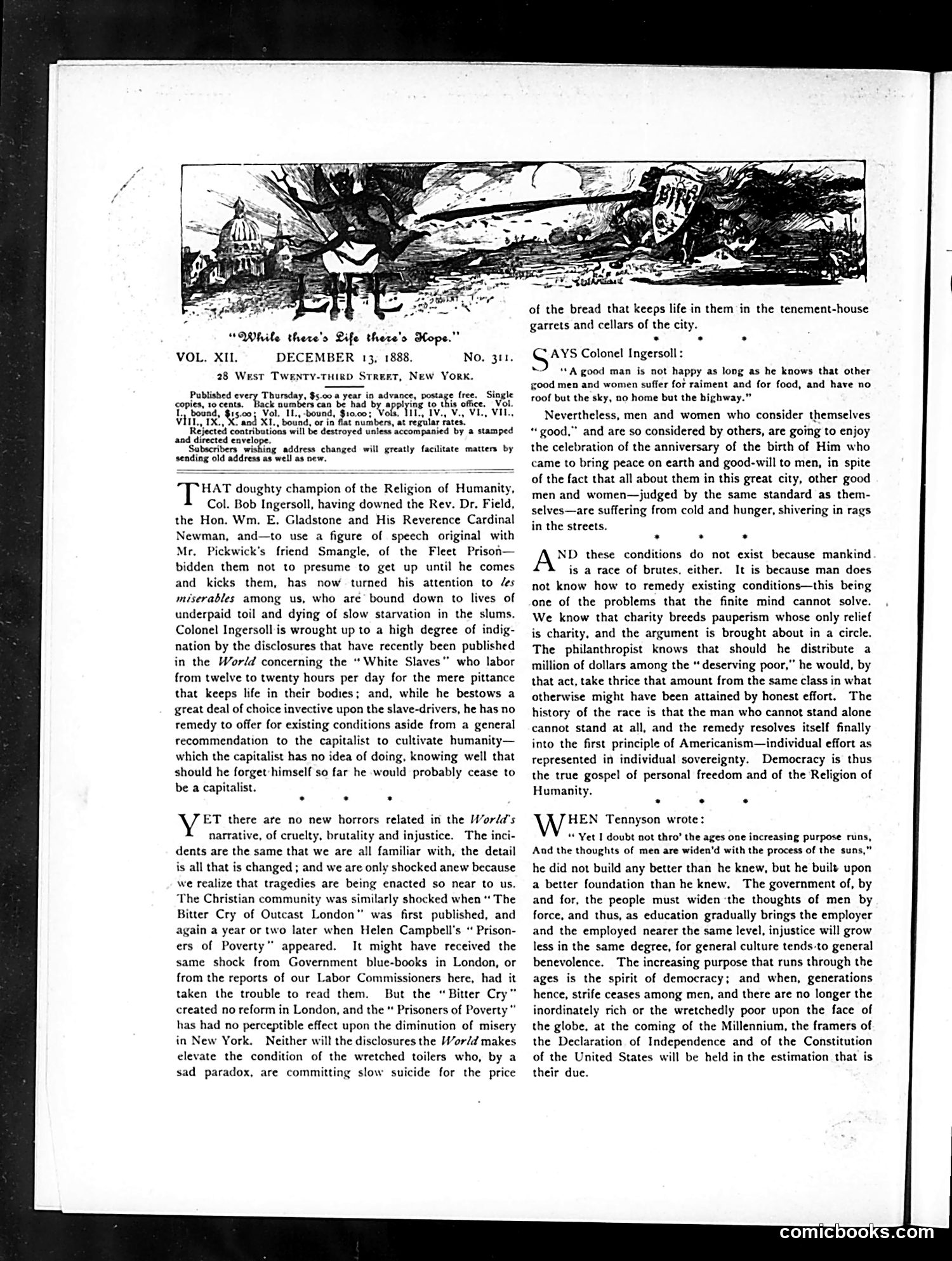
**The Cartoon:** The header illustration titled "While there's Life there's Hope" depicts a gnarled tree and landscape, likely symbolizing hardship or decay—a visual metaphor for the social conditions discussed below. **The Content:** This editorial page critiques Colonel Bob Ingersoll's response to Cardinal Newman and others regarding poverty. The article argues that Ingersoll, while championing "Religion of Humanity," offers no concrete solutions to working-class suffering—people laboring 12-20 hours daily in slums. The satire targets philanthropists and reformers who diagnose problems but propose no remedies. The author advocates for individual sovereignty and democracy as solutions, invoking Tennyson to argue that education and reducing inequality between rich and poor workers represents true progress toward the American ideals of the Declaration of Independence.
📄 Transcribed text from this page (OCR, searchable)
Machine-transcribed from the original scan — historical spelling and the odd misread are preserved.
“While there's Life there's Hope.” VOL. XII. DECEMBER 13, 1888. No. 311. 28 West TwenTy-THIRD Street, New York. Published every Thursday, $5.00 ¢ govies, xe cents. "Back aumbers can be had by applying to this ofce. Vt. E ; Vol. I., bound, $10.00; Vols. HIL., 1V., V., VIL, VIL. VIII, 1X!, X- and XI., bound, or in flat numbers, at regular rates. Rejected contributions will be destroyed unless accompanied by a stamped and directed envelope. Sabscribers wishing address changed will greatly facilitate matters by sending old address as well as new. year in advance, postage free. Single HAT doughty champion of the Religion of Humanity, Col. Bob Ingersoll, having downed the Rev. Dr. Field, the Hon. Wm. E, Gladstone and His Reverence Cardinal Newman, and—to use a figure of speech original with Mr. Pickwick’s friend Smangle, of the Fleet Prison— bidden them not to presume to get up until he comes and kicks them, has now turned his attention to ées miserables among us, who are’ bound down to lives of underpaid toil and dying of slow starvation in the slums. Colonel Ingersoll is wrought up to a high degree of indig- nation by the disclosures that have recently been published in the World concerning the “White Slaves" who labor from twelve to twenty hours per day for the mere pittance that keeps life in their bodies; and, while he bestows a great deal of choice invective upon the slave-drivers, he has no remedy to offer for existing conditions aside from a general recommendation to the capitalist to cultivate humanity— which the capitalist has no idea of doing, knowing well that should he forget himself so far he would probably cease to be a capitalist. . . . ET there are no new horrors related in the World's narrative, of cruelty, brutality and injustice. The inci- dents are the same that we are all familiar with, the detail is all that is changed ; and we are only shocked anew because we realize that tragedies are being enacted so near to us, The Christian community was similarly shocked when “ The Bitter Cry of Outcast London” was first published, and again a year or two later when Helen Campbell's “ Prison- ers of Poverty” appeared. It might have received the same shock from Government blue-books in London, or from the reports of our Labor Commissioners here, had it taken the trouble to read them. But the “Bitter Cry” created no reform in London, and the “ Prisoners of Poverty" has had no perceptible effect upon the diminution of misery in New York. Neither will the disclosures the Wor/d makes elevate the condition of the wretched toilers who, by a sad paradox, are committing slow suicide for the price of the bread that keeps life in them in the tenement-house garrets and cellars of the city. . . ~ AYS Colonel Ingersoll : ‘A good man is not happy as long as he knows that other good men and women suffer for raiment and for food, and have no roof but the sky, no home but the highway.” X Nevertheless, men and women who consider themselves “good,” and are so considered by others, are going to enjoy the celebration of the anniversary of the birth of Him who came to bring peace on earth and good-will to men, in spite of the fact that all about them in this great city, other good men and women—judged by the same standard as them- selves—are suffering from cold and hunger, shivering in rags in the streets. A D these conditions do not exist because mankind is a race of brutes, either. It is because man does not know how to remedy existing conditions—this being one of the problems that the finite mind cannot solve. We know that charity breeds pauperism whose only relief is charity, and the argument is brought about in a circle. The philanthropist knows that should he distribute a million of dollars among the “ deserving poor,” he would, by that act, take thrice that amount from the same class in what otherwise might have been attained by honest effort. The history of the race is that the man who cannot stand alone cannot stand at all, and the remedy resolves itself finally into the first principle of Americanism—individual effort as represented in individual sovereignty. Democracy is thus the true gospel of personal freedom and of the Religion of Humanity. . . . HEN Tennyson wrote: “Yet I doubt not thro’ the ages one increasing purpose runs, And the thoughts of men are widen'd with the process of the suns,” he did not build any better than he knew, but he built upon a better foundation than he knew. The government of, by and for, the people must widen ‘the thoughts of men by force, and thus, as education gradually brings the employer and the employed nearer the same level, injustice will grow less in the same degree, for general culture tends-to general benevolence. The increasing purpose that runs through the ages is the spirit of democracy; and when, generations hence, strife ceases among men, and there are no longer the inordinately rich or the wretchedly poor upon the face of the globe, at the coming of the Millennium, the framers of the Declaration of Independence and of the Constitution of the United States will be held in the estimation that is their due. comicbooks.com