
Life, 1888-12-13 · page 6 of 14
Life — December 13, 1888 — page 6: what you’re looking at
What you’re looking at
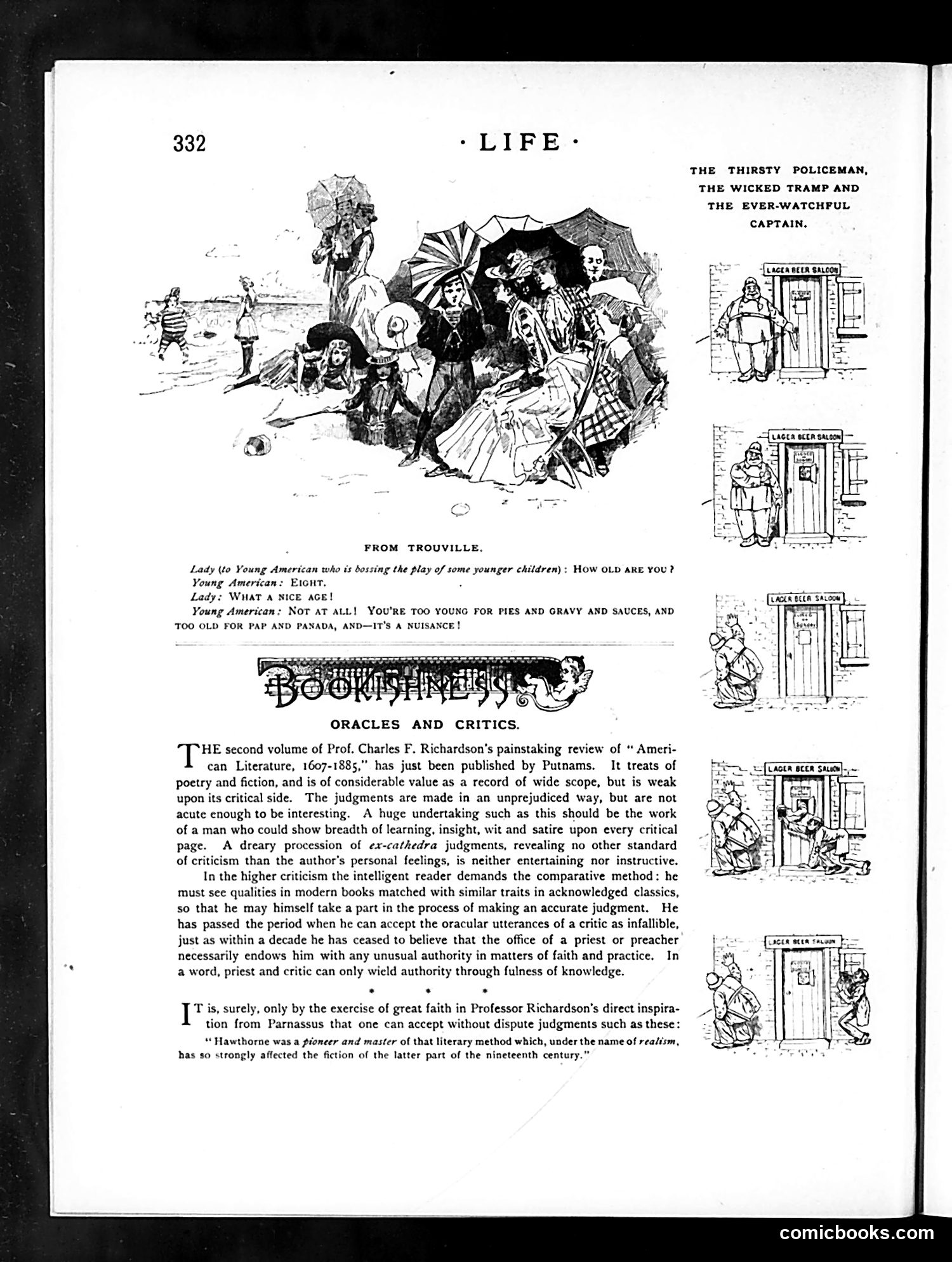
This page contains three distinct elements: 1. **Top cartoon ("From Trouville")**: A satirical scene showing a young American boy (age 8) encountering a fashionable lady at what appears to be a French seaside resort. The joke hinges on class and age: the boy innocently compliments her as "nice," but she sharply rebukes him, saying he's caught between childhood (too young for adult foods/interests) and adulthood (too old for childish ones)—essentially "a nuisance." It mocks both American informality abroad and rigid European class consciousness. 2. **"Books and Critics" section**: A lengthy literary review of Charles F. Richardson's second volume on American Literature (1607-1885). The critic dismisses Richardson's judgments as superficial and lacking genuine comparative analysis, arguing proper criticism requires deep knowledge, not mere pronouncement. 3. **Right side**: A series of small comic panels labeled "Lager Beer Saloon," likely depicting humorous bar scenes (details unclear from reproduction).
📄 Transcribed text from this page (OCR, searchable)
Machine-transcribed from the original scan — historical spelling and the odd misread are preserved.
FROM TROUVILLE. Lady (to Young American who is bossing the play of some younger children): HOW OLD ARE YOU? Young American: Etout. . Lady: Wuat A NICE ace! Young American: NOT AT ALL! YOU'RE TOO YOUNG FOR PIES AND GRAVY AND SAUCES, AND TOO OLD FOR PAP AND PANADA, AND—IT’S A NUISANCE! ORACLES AND CRITICS. HE second volume of Prof. Charles F. Richardson's painstaking review of “ Ameri- can Literature, 1607-1885," has just been published by Putnams. It treats of poetry and fiction, and is of considerable value as a record of wide scope, but is weak upon its critical side. The judgments are made in an unprejudiced way, but are not acute enough to be interesting. A huge undertaking such as this should be the work of a man who could show breadth of learning, insight, wit and satire upon every critical page. A dreary procession of ex-cathedra judgments, revealing no other standard of criticism than the author's personal feelings, is neither entertaining nor instructive. In the higher criticism the intelligent reader demands the comparative method: he must see qualities in modern books matched with similar traits in acknowledged classics, so that he may himself take a part in the process of making an accurate judgment. He has passed the period when he can accept the oracular utterances of a critic as infallible, just as within a decade he has ceased to believe that the office of a priest or preacher necessarily endows him with any unusual authority in matters of faith and practice. In a word, priest and critic can only wield authority through fulness of knowledge. . . . /* is, surely, only by the exercise of great faith in Professor Richardson's direct inspira- tion from Parnassus that one can accept without dispute judgments such as these: “Hawthorne was a pioneer and master of that literary method which, under the name of realism, has so strongly affected the fiction of the latter part of the nineteenth century.” THE THIRSTY POLICEMAN, THE WICKED TRAMP AND THE EVER-WATCHFUL A fie JAP CAPTAIN, comicbooks.com