
Life, 1888-12-13 · page 12 of 14
Life — December 13, 1888 — page 12: what you’re looking at
What you’re looking at
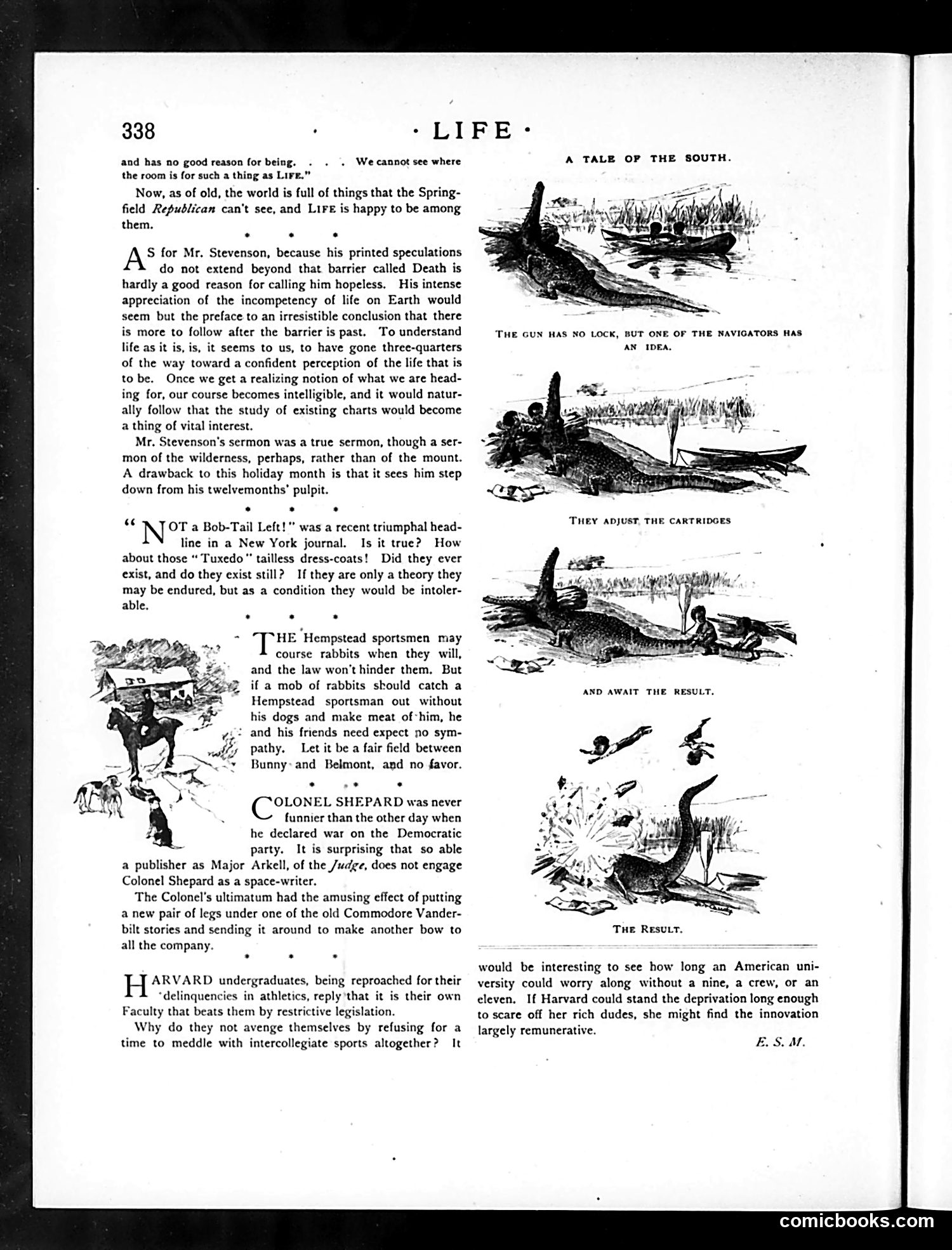
This page contains several brief satirical commentaries typical of Life magazine's format: **On Mr. Stevenson**: The magazine defends a clergyman (likely Robert Louis Stevenson, referenced earlier) against critics who dismiss his pessimistic views on earthly life, arguing that understanding life's limitations actually provides insight into what comes after death. **On Fashion Trends**: Life mocks a New York newspaper's triumphant headline claiming "bob-tails" are out, questioning whether tailless "Tuxedo" dress coats ever truly existed—satirizing fashion journalism's tendency to declare trends without evidence. **On Hempstead Hunting**: A humorous piece suggesting sportsmen who hunt rabbits without dogs shouldn't expect sympathy if rabbits turn the tables—advocating "fair play." **On Colonel Shepard**: Mocks a publisher's declaration of war against the Democratic Party as laughably recycled political theater. **On Harvard Athletics**: Suggests Harvard athletes should boycott sports entirely to pressure their restrictive Faculty—implying this might scare away wealthy students and prove universities' financial dependence on athletics. **The Southern Tale illustrations** appear unrelated editorial cartoon content.
📄 Transcribed text from this page (OCR, searchable)
Machine-transcribed from the original scan — historical spelling and the odd misread are preserved.
338 and has no good reason for being. the room is for such a thing as Lire.” Now, as of old, the world is full of things that the Spring- field Republican can't see, and Lire is happy to be among them. We cannot see where S for Mr. Stevenson, because his printed speculations do not extend beyond that barrier called Death is hardly a good reason for calling him hopeless. His intense appreciation of the incompetency of life on Earth would seem but the preface to an irresistible conclusion that there is more to follow after the barrier is past. To understand life as it is, is, it seems to us, to have gone three-quarters of the way toward a confident perception of the life that is to be. Once we get a realizing notion of what we are head- ing for, our course becomes intelligible, and it would natur- ally follow that the study of existing charts would become a thing of vital interest. Mr. Stevenson's sermon was a true sermon, though a ser- mon of the wilderness, perhaps, rather than of the mount. A drawback to this holiday month is that it sees him step down from his twelvemonths’ pulpit. se OT a Bob-Tail Left!’ was a recent triumphal head- line in a New York journal. Is it true? How about those “ Tuxedo" tailless dress-coats! Did they ever exist, and do they exist still? If they are only a theory they may be endured, but as a condition they would be intoler- able. . . . HE "Hempstead sportsmen may course rabbits when they will, and the law won't hinder them, But if a mob of rabbits should catch a Hempstead sportsman out without his dogs and make meat of-him, he : and his friends need expect no sym- pathy. Let it be a fair field between Bunny: and Belmont, and no favor. . -* . OLONEL SHEPARD was never funnier than the other day when he declared war on the Democratic party. It is surprising that so able a publisher as Major Arkell, of the /udge, does not engage Colonel Shepard as a space-writer. The Colonel's ultimatum had the amusing effect of putting a new pair of legs under one of the old Commodore Vander- bilt stories and sending it around to make another bow to all the company. ARVARD undergraduates, being reproached for their “delinquencies in athletics, reply that it is their own Faculty that beats them by restrictive legislation. Why do they not avenge themselves by refusing for a time to meddle with intercollegiate sports altogether? It > LIFE: A TALE OF THE SOUTH. ‘THE GUN HAS NO LOCK, BUT ONE OF THE NAVIGATORS HAS AN IDEA, Tue Resutt. would be interesting to see how long an American uni- versity could worry along without a nine, a crew, or an eleven. If Harvard could stand the deprivation long enough to scare off her rich dudes, she might find the innovation largely remunerative. Boe ELS. M. comicbooks.com