
A complete issue · 14 pages · 1888
Life — November 22, 1888
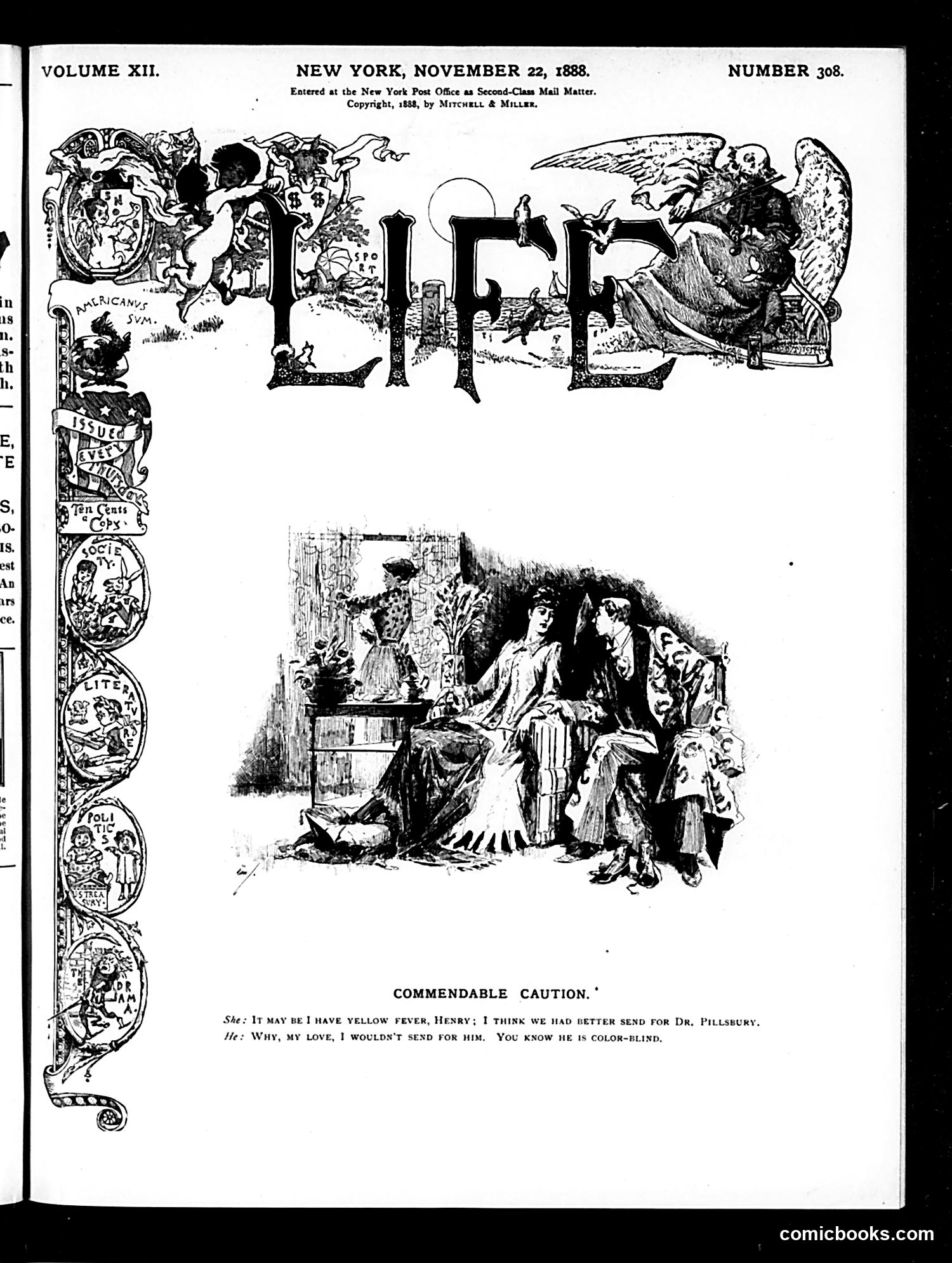
This cartoon satirizes a domestic scene where a woman concerned about yellow fever suggests calling Dr. Pillsbury, while her husband objects because Pillsbury is "color-blind." The humor relies on a cruel pun: the husband conflates the doctor's literal color-blindness (inability to distinguish colors) with an inability to recognize the yellow appearance associated with yellow fever—as if the doctor couldn't "see" the disease. This plays on period anxieties about yellow fever, which was a genuine public health threat in late 19th-century America. The joke mocks both the husband's absurd logic (why would color-blindness prevent medical competence?) and contemporary medical superstitions. The woman's response—calling his reasoning "commendable caution"—drips with sarcasm, highlighting how ridiculous his excuse is.
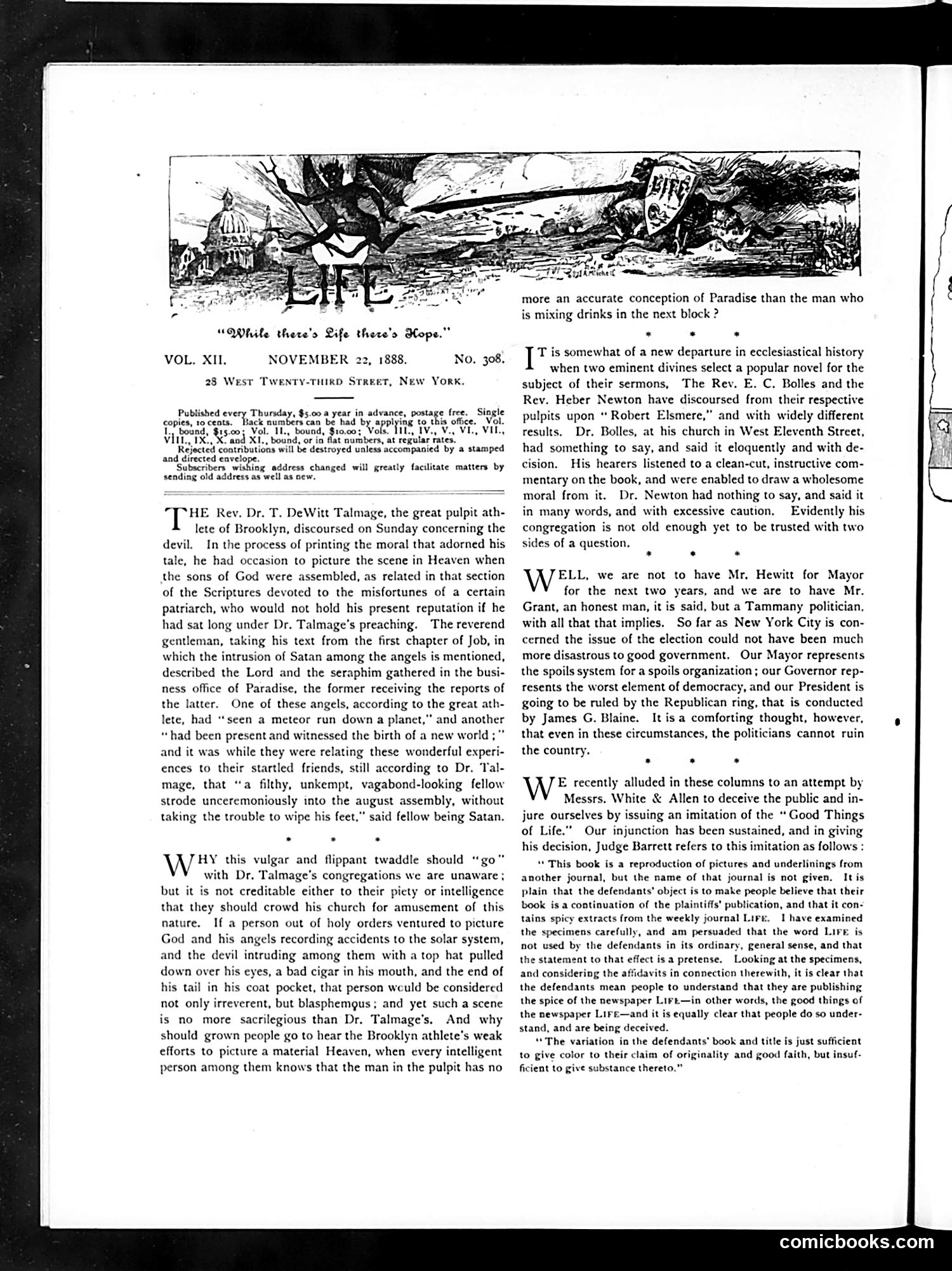
**Date & Publication**: Life, Vol. XII, No. 308, November 23, 1888 **Content**: This page contains editorial commentary rather than political cartoons. The small illustration at top appears to be decorative. **Main Topics Discussed**: 1. **Ecclesiastical controversy**: Rev. Dr. DeWitt Talmage (Brooklyn preacher) and Rev. E.C. Bolles used "Robert Elsmere" (a popular novel questioning religious faith) as sermon subjects, drawing criticism for mixing secular literature with theology. 2. **Political commentary**: Discussion of mayoral elections, criticism of the Republican party's control ("spoils system"), and references to James G. Blaine's political influence. 3. **"Good Things of Life" controversy**: Debate over whether a defendants' publication imitates Life magazine's format and content, with legal/ethical implications discussed. This is primarily opinion journalism rather than satirical cartooning.
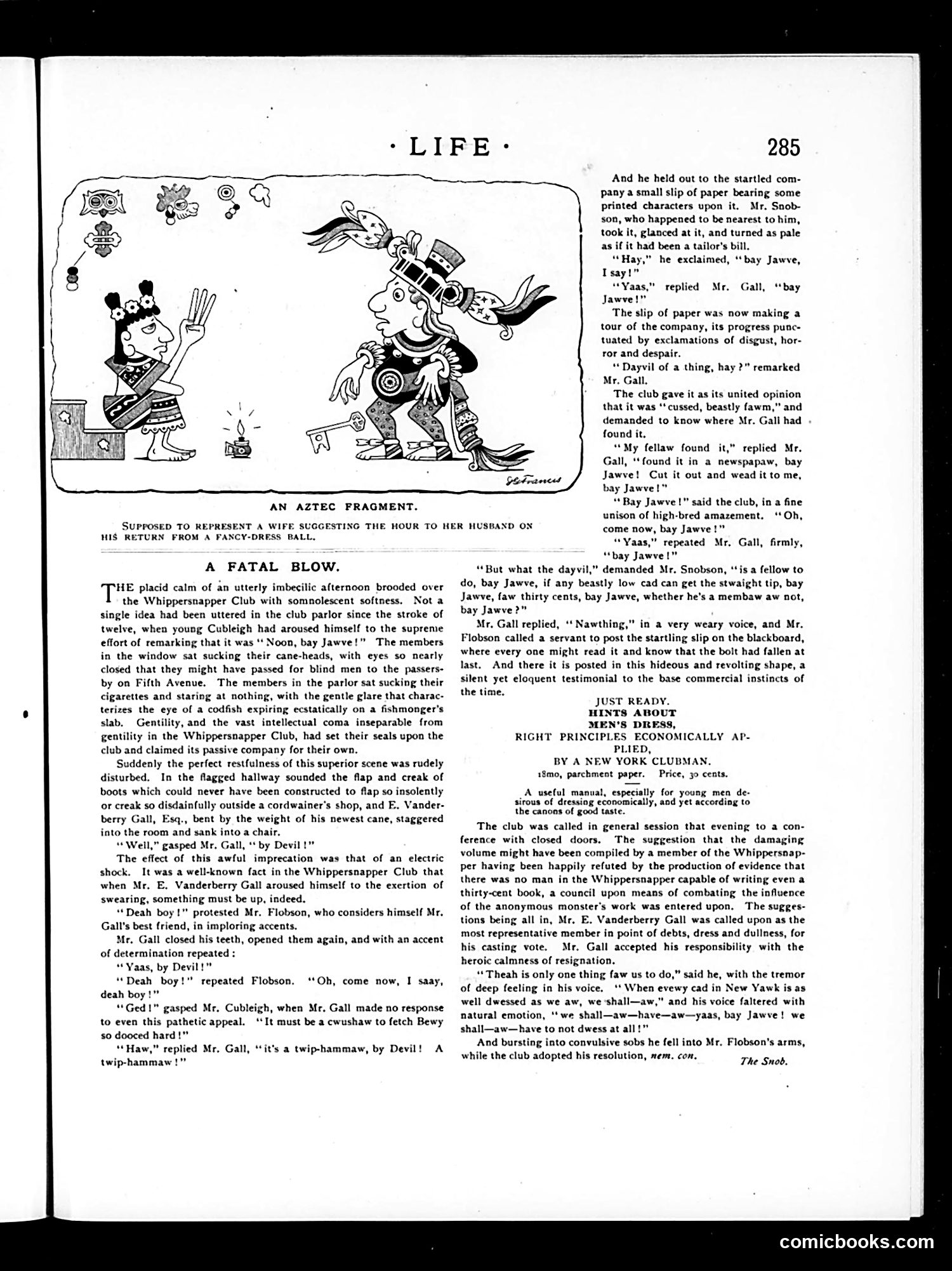
The cartoon depicts two figures in elaborate dress at what appears to be a fancy-dress ball. The left figure wears Aztec-inspired regalia; the right figure is elaborately costumed and ornate. The accompanying article "A Fatal Blow" mocks the Whippersapper Club's response to a scandal—a slip of paper bearing printed characters was found at their meeting. Club members debate its origin and authenticity in increasingly ridiculous fashion, with much theatrical outrage expressed through repeated exclamations like "bay Jawe!" The satire targets the pretentious, overwrought reactions of an exclusive social club to a minor incident, portraying its members as hysterical and absurdly dramatic over what amounts to trivial social gossip at a high-society gathering.
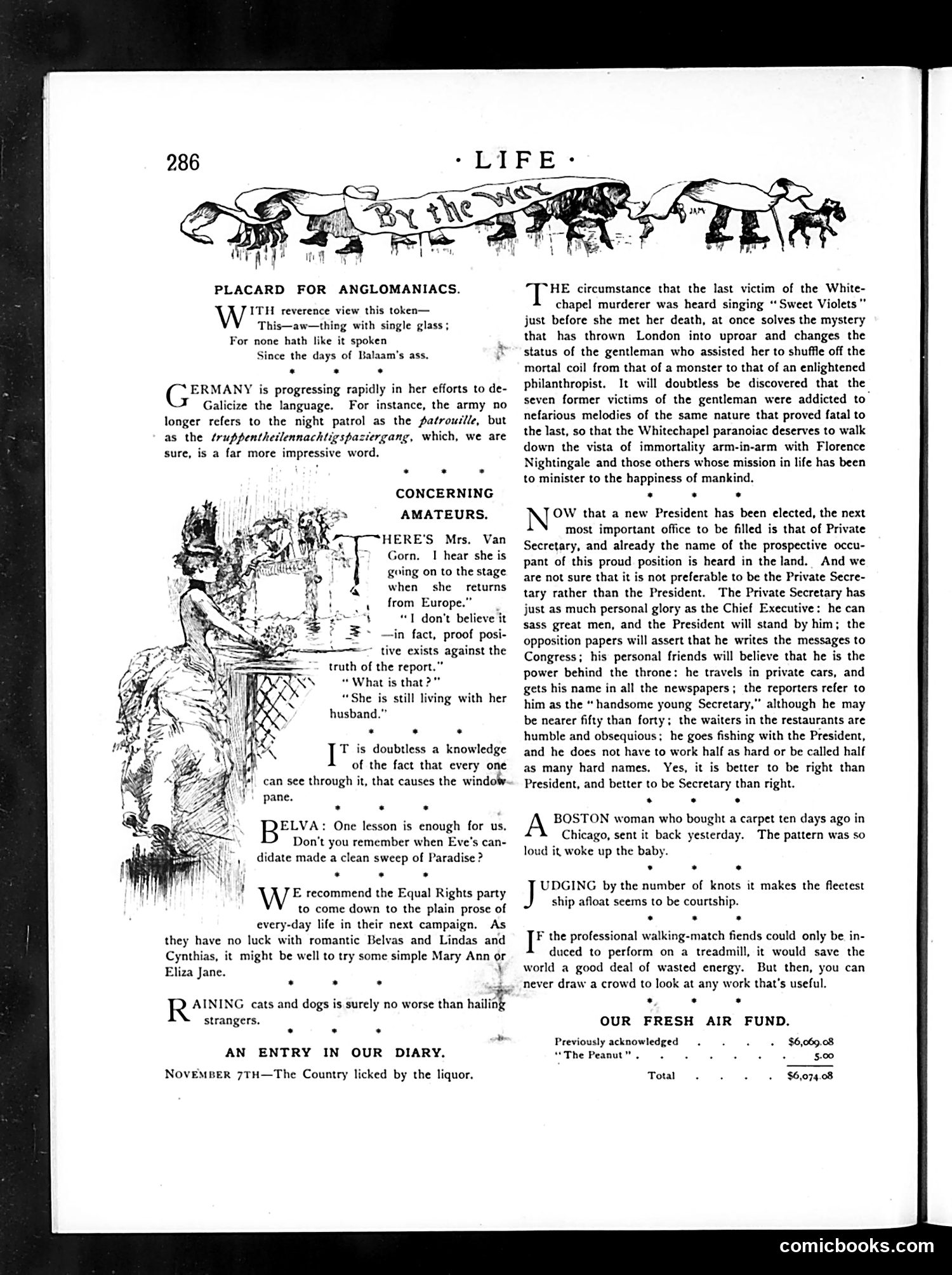
This page contains several satirical pieces and illustrations typical of early 20th-century Life magazine humor: **"Placard for Anglomaniacs"** mocks British affectation among Americans, suggesting reverence for English speech patterns. **"Concerning Amateurs"** features a sketch of Mrs. Van Gorp considering stage performance, with commentary on her domestic situation—satirizing aspiring amateur actresses. **Other brief items** include jokes about: Germany's language evolution, the newly-elected President's Private Secretary role (suggesting this position carries more actual power than the presidency), a Boston woman's carpet purchase, fleet maneuvers, and professional walking-match enthusiasts. The tone is light satirical humor addressing contemporary American social pretensions, gender roles, and political absurdities—typical of Life's genteel, middle-class readership commentary.
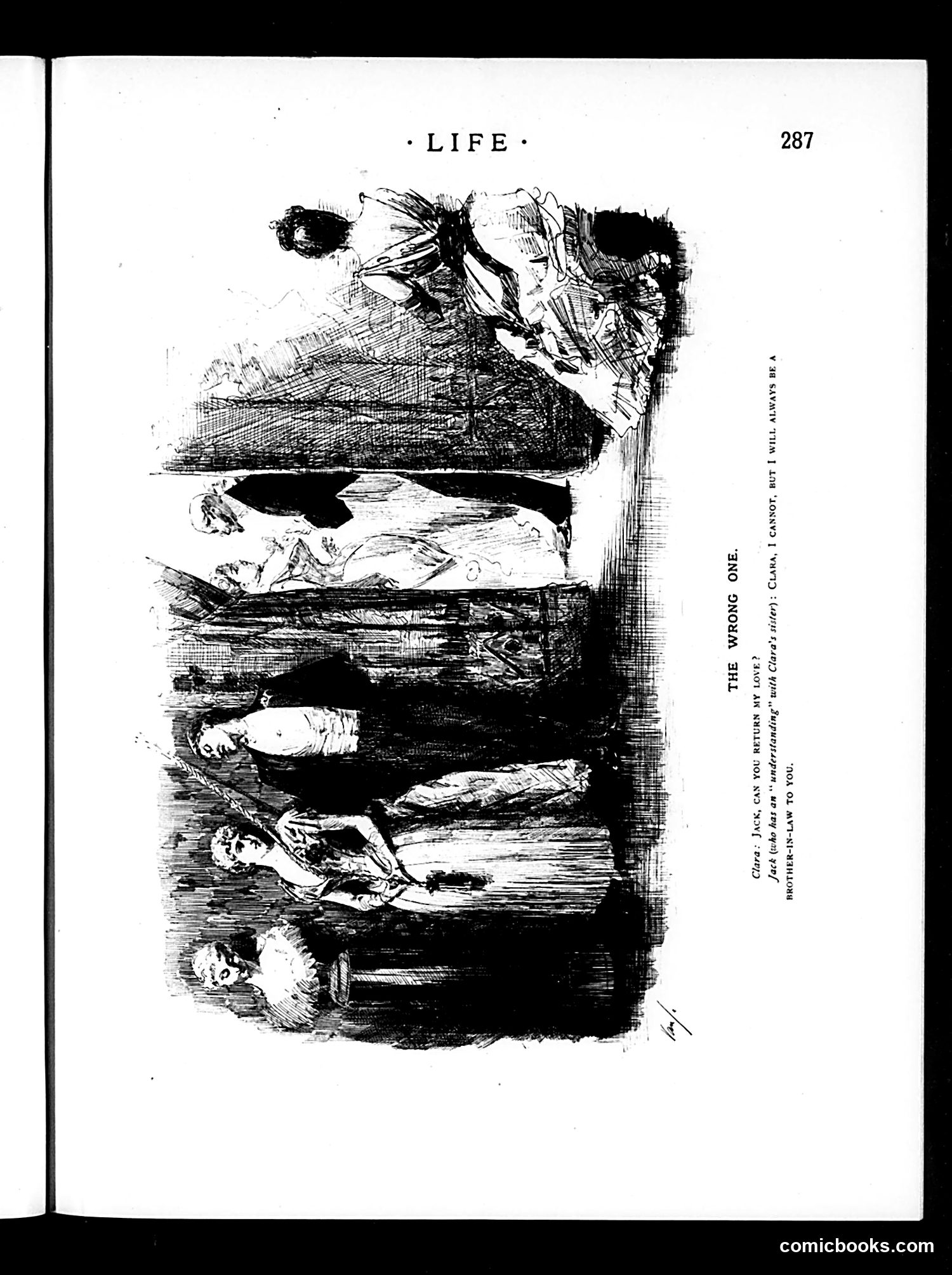
This political cartoon satirizes a mistaken identity or misguided action. The image shows multiple figures stacked or layered vertically, suggesting confusion about who the "right" target should be. The OCR'd caption reads: "Grace, I see on you with lust / Just for you I am condemned / Mark these [words] bent to you." Without clearer context about the specific date or historical figures depicted, the exact political reference is unclear. However, the title "The Wrong One" suggests the cartoon criticizes either: a misdirected accusation, blame placed on the wrong person, or a policy/action targeting the incorrect group. The stacked composition emphasizes how consequences or blame may fall incorrectly through a chain of individuals. The satirical point appears to be about injustice or misidentification in governance or social judgment.
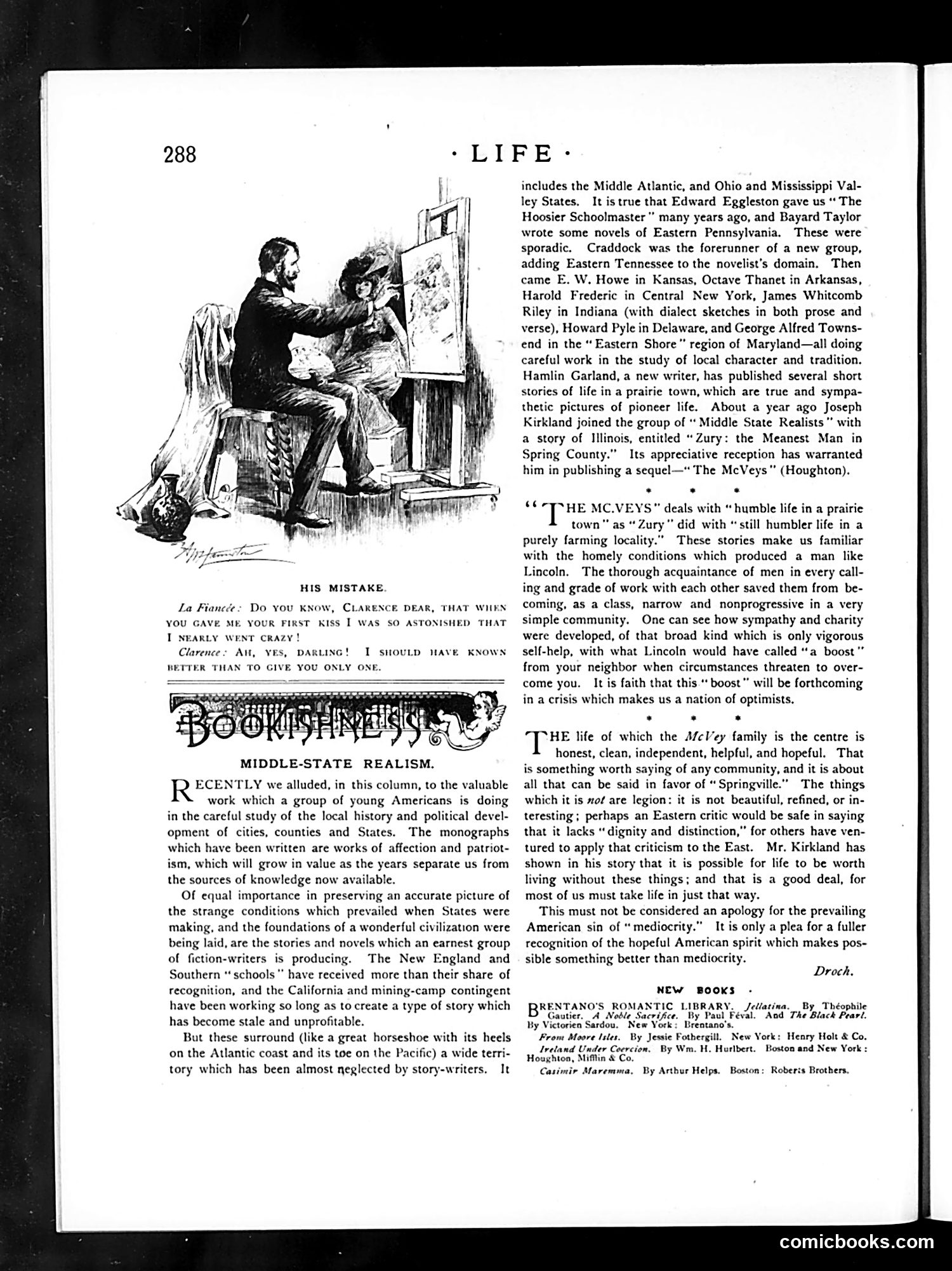
The page contains a literary discussion of "Middle-State Realism," a movement in American fiction focusing on regional stories from the Midwest and Middle Atlantic states. The cartoon titled "His Mistake" depicts a romantic scene where a man has apparently kissed a woman without permission, and she sarcastically scolds him, saying she should have known better than to let him kiss her only once. The joke plays on miscommunication and romantic misadventure—he thought a single kiss was inappropriate boldness, but her complaint suggests she wanted more. The accompanying text discusses how contemporary writers like Joseph Kirkland are documenting humble prairie life and small-town communities with sympathy and accuracy, positioning this regional realism as valuable American literature separate from the better-known Eastern and California literary traditions.
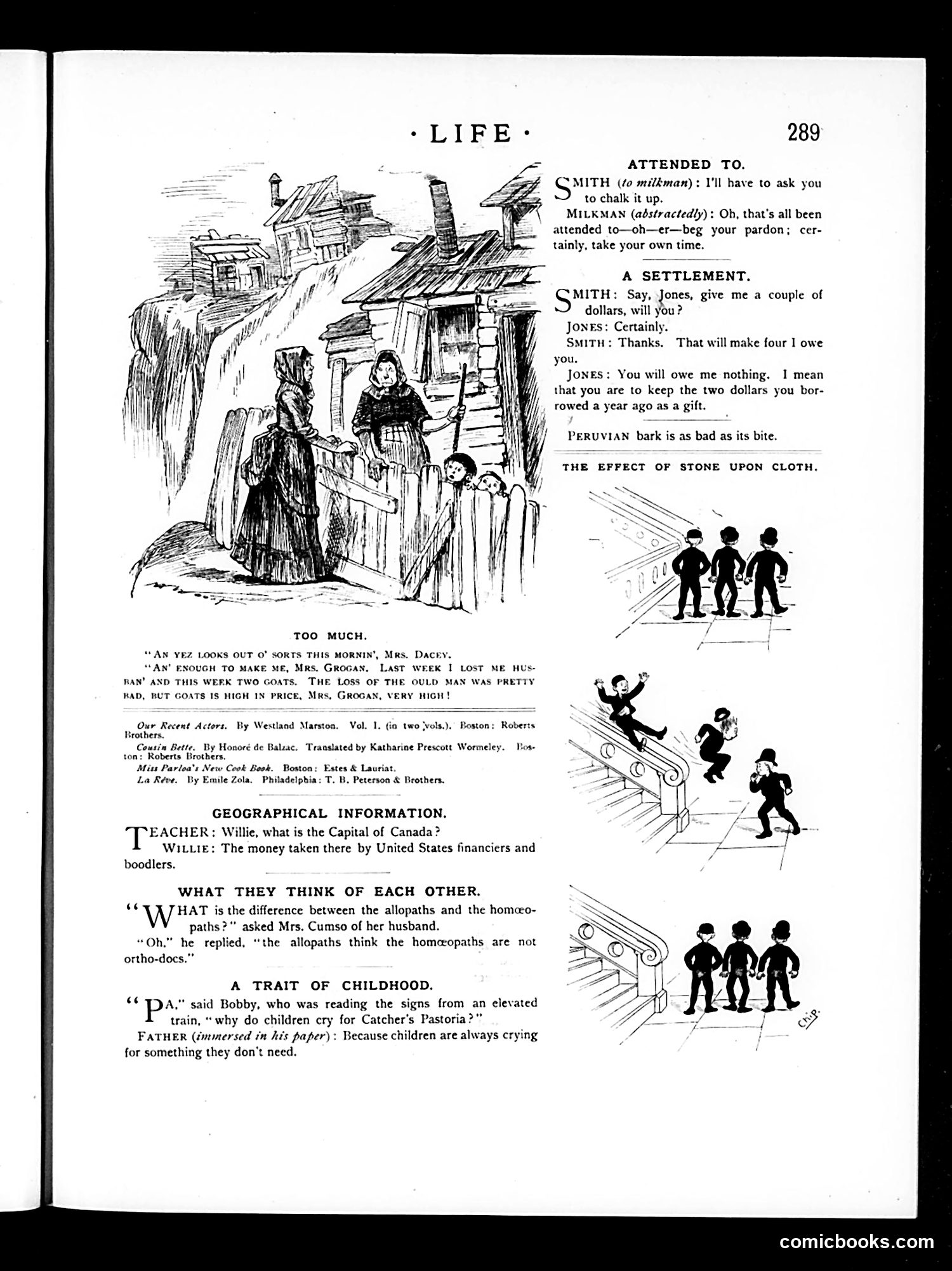
This page contains several unrelated satirical pieces typical of early Life magazine's format: **"Attended To"** mocks a milkman's complaint about unpaid debts—a working-class creditor problem. **"A Settlement"** presents a debt negotiation where Jones converts Smith's obligation into a gift, satirizing how debtors rationalize money owed. **"Too Much"** shows Mrs. Dacky complaining to Mrs. Grogan about losses—a husband and two coats—portraying the domestic frustrations of ordinary women. The remaining sections—"The Effect of Stone Upon Cloth," "Geographical Information," "What They Think of Each Other," and "A Trait of Childhood"—are brief humor pieces about various social observations, domestic dynamics, and children's behavior. The small illustrations accompanying these pieces are generic comic vignettes rather than political commentary. This page exemplifies Life's mid-period format: scattered domestic humor targeting middle-class anxieties.
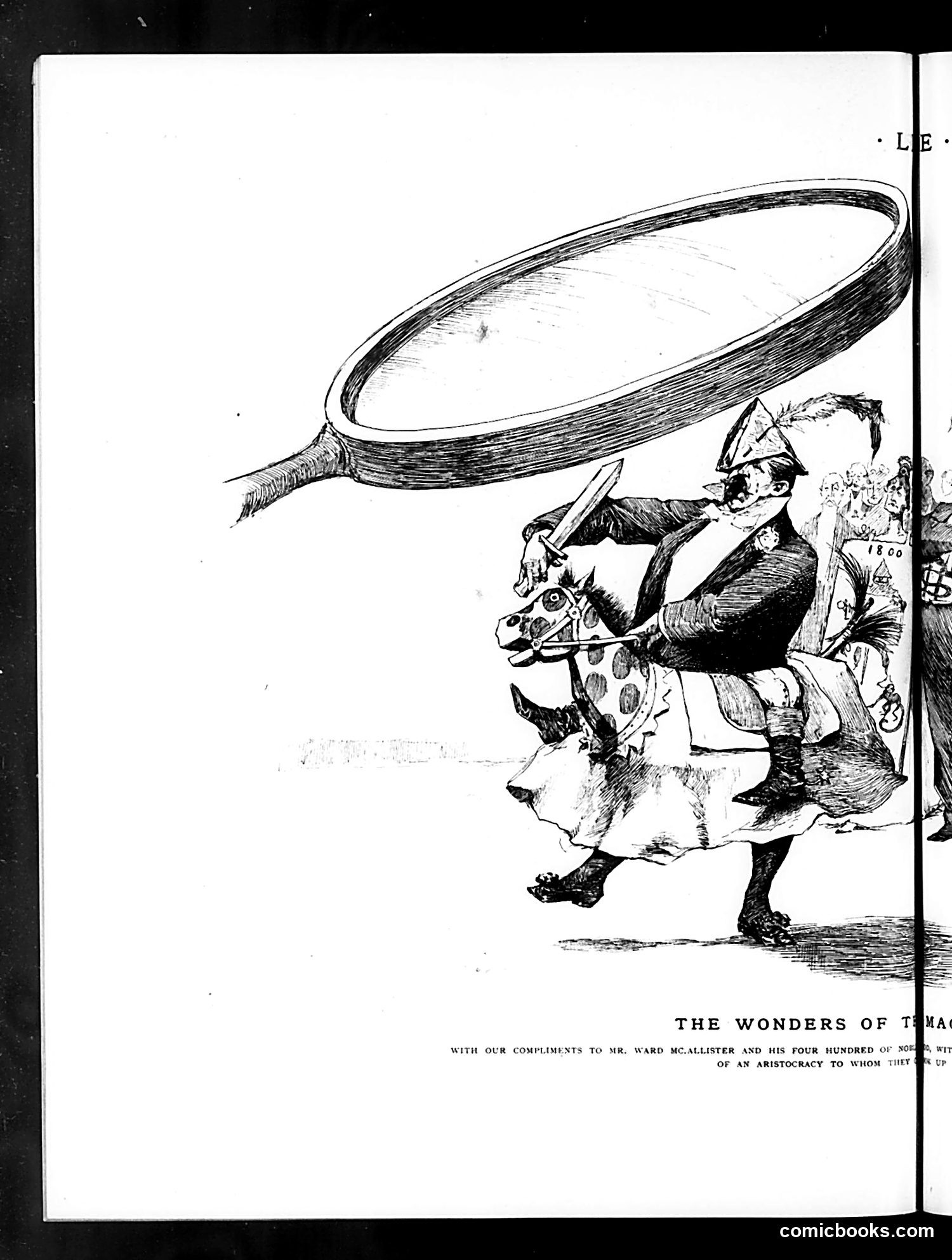
This is a title page or introduction featuring a satirical illustration titled "THE WONDERS OF T[---]" (text cut off). The cartoon depicts a figure on horseback wielding an enormous magnifying glass, suggesting microscopic examination or scrutiny. The rider appears to be a caricatured aristocrat or nobleman in formal dress. The text references "MR. WARD McALLISTER and his four hundred of [---]" and mentions "AN ARISTOCRACY TO WHOM THEY [---]" (portions obscured). Ward McAllister was a prominent New York society figure known for coining the term "The Four Hundred"—his exclusive list of elite New York families. This cartoon likely satirizes high society's obsessive self-examination and pretension, using the magnifying glass as a metaphor for aristocratic self-importance or the microscopic social hierarchies within the wealthy class.
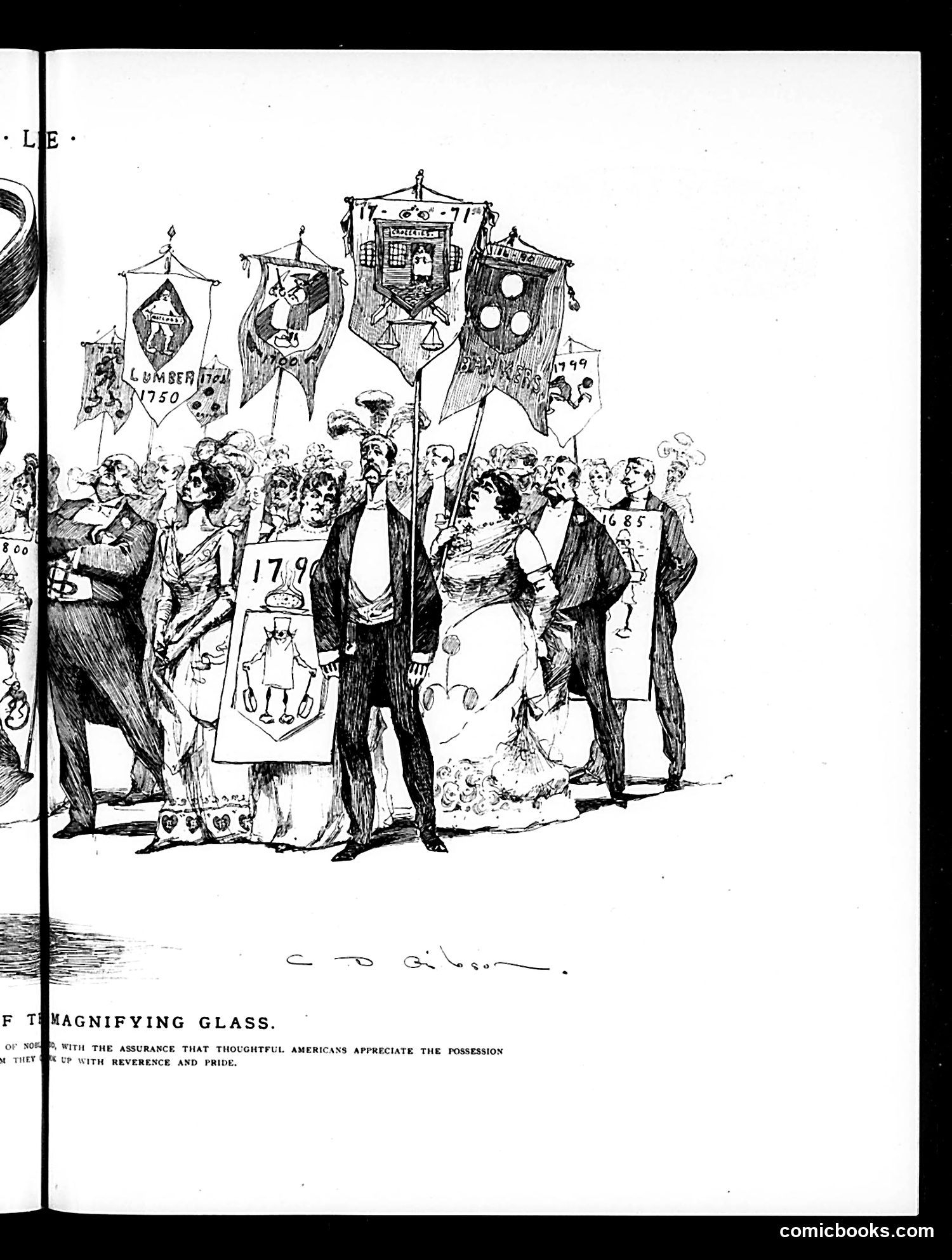
This cartoon satirizes American reverence for historical artifacts and founding documents. The scene depicts a crowd examining what appears to be early American relics—banners display dates like "1750," "1779," "1785," and "1799," referencing the Revolutionary War era. The magnifying glass serves as the cartoon's central metaphor: Americans are scrutinizing their national heritage with intense focus, treating historical possessions almost religiously. The caption states the satire explicitly: it mocks the assumption that "thoughtful Americans appreciate" such possessions "with reverence and pride." The cartoon appears to critique excessive patriotic nostalgia or the tendency to venerate America's past without critical examination—a common target of *Life* magazine's satirical commentary on American society and culture.
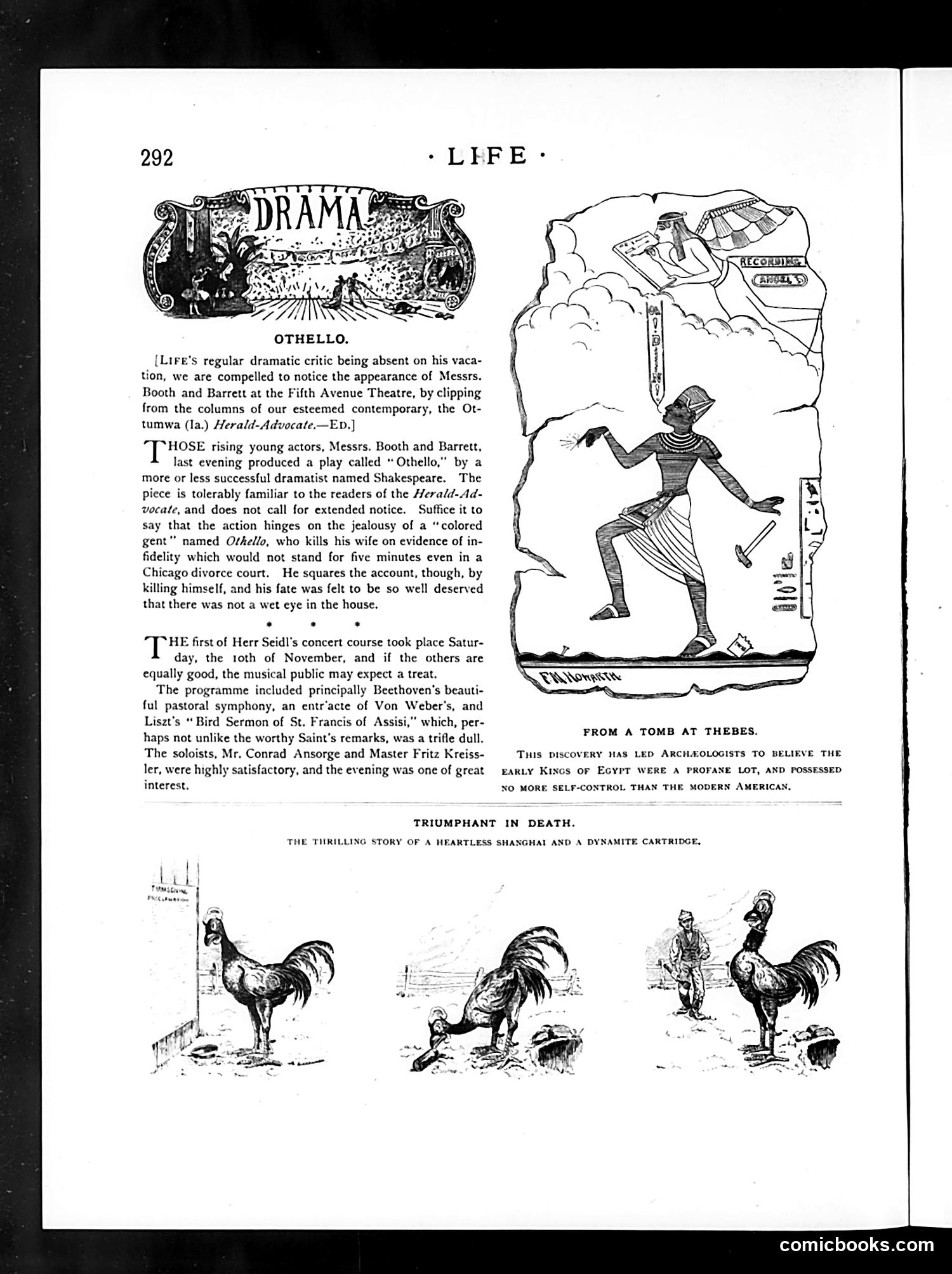
This page contains three distinct items: 1. **"Othello" Review**: A drama critique of a production by actors Booth and Barrett at the Fifth Avenue Theatre, discussing Shakespeare's play about a "colored gent" named Othello who kills his wife on false evidence of infidelity. The reviewer notes the plot's implausibility for contemporary divorce courts. 2. **Herr Seidl's Concert Course**: Brief notice of a musical program featuring Beethoven and other composers, with positive remarks about soloists. 3. **"Triumphant in Death"**: A humorous illustrated story (unclear without reading the full text) involving a Shanghai character and a "dynamite cartridge," depicted through sequential drawings of a rooster. The page represents typical Life magazine content: theatrical criticism, cultural events, and comic sketches for educated readers.
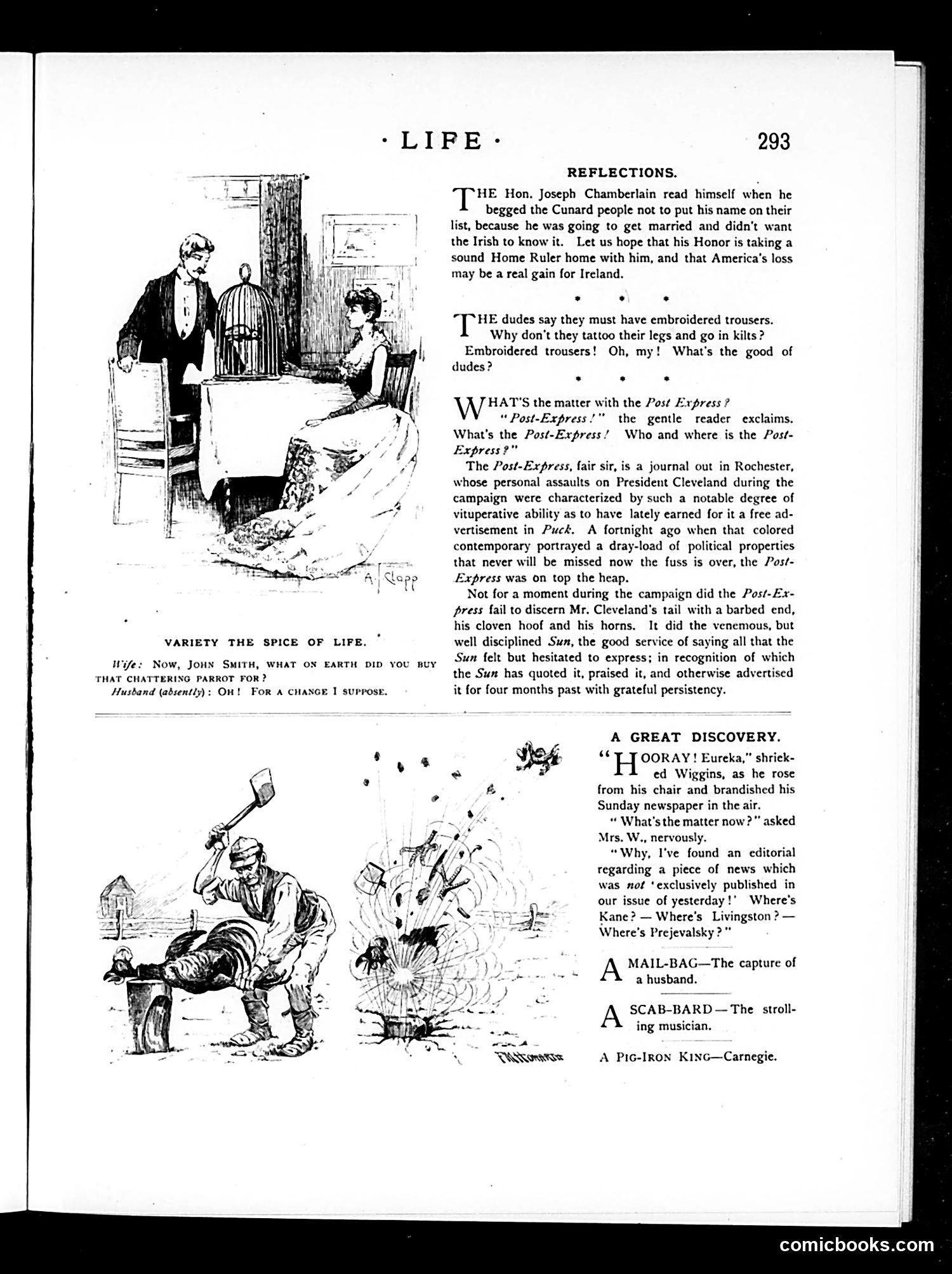
This page contains brief satirical "Reflections" and visual gags typical of *Life* magazine's humor. **"Reflections" section:** - **Joseph Chamberlain**: The Irish politician secretly getting married, hiding it from Irish constituents who might object - **Post-Express criticism**: A Rochester journal that viciously attacked President Cleveland during the campaign (depicting him with "tail," "cloven hoof," "horns"—demonic imagery), yet the *Sun* newspaper ironically praised it for expressing what *Sun* wouldn't say directly **Visual cartoon "Variety the Spice of Life"**: A domestic scene where a husband absently bought a chattering parrot "for a change"—mild marital humor. **"Great Discovery"**: Mr. Wiggins excited that a newspaper published exclusive news *not* already in yesterday's paper—mocking newspapers' obsession with claiming exclusive stories. **Wordplay definitions** at bottom are puns (mail-bag/capture of husband, scab-bard/musician, pig-iron king/Carnegie). The page exemplifies *Life*'s blend of political critique, social observation, and light domestic comedy aimed at educated readers.
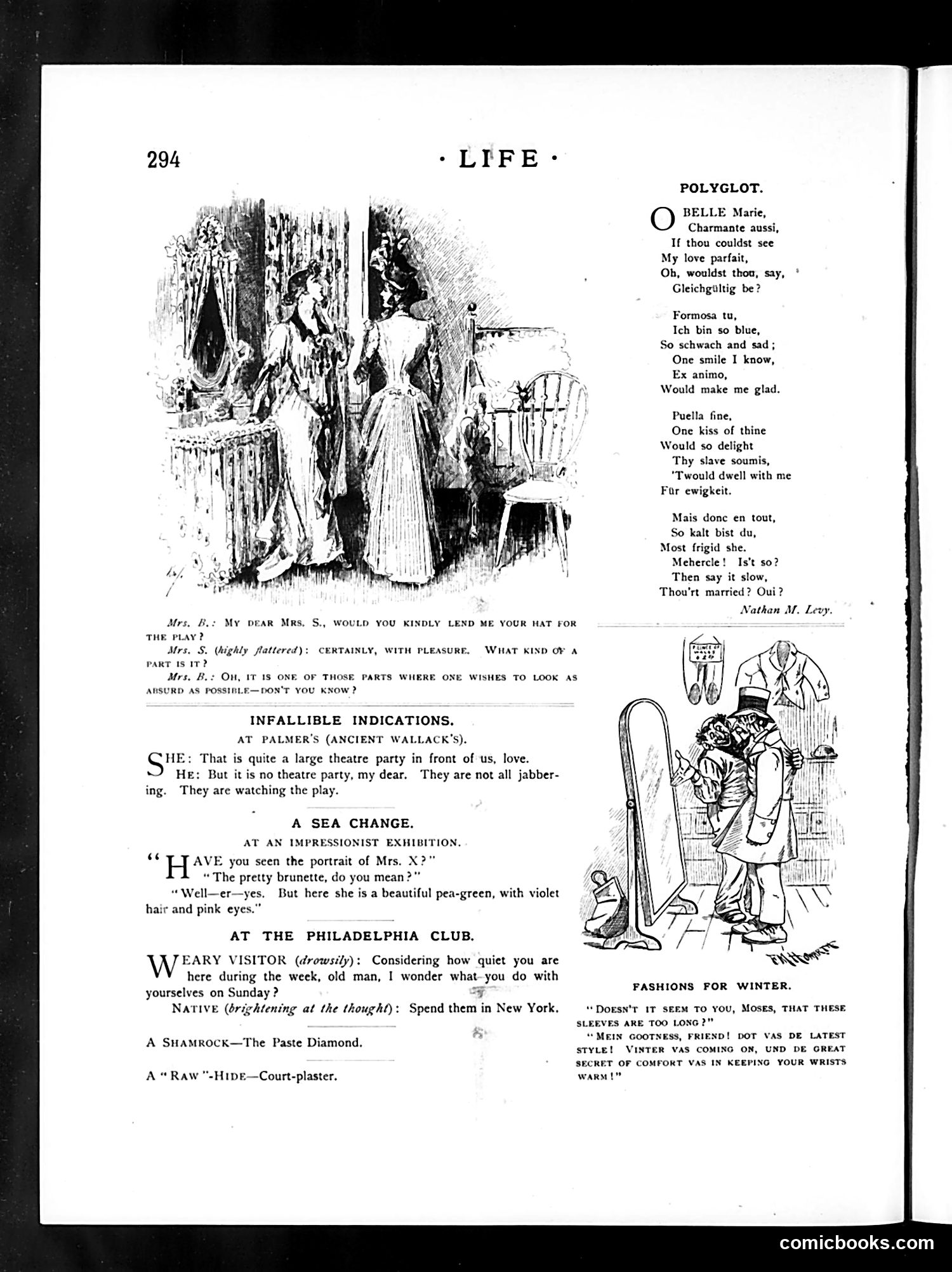
This page contains several brief comedic sketches typical of *Life* magazine's satirical style: **"Polyglot"** is a romantic poem mixing multiple languages (French, German, Latin, Italian) where a lovesick suitor pleads with "Belle Marie," only to discover she's already married—a joke about overwrought multilingual sentimentality. **The theatrical sketches** mock social pretension: one woman asks to borrow a hat for a stage role requiring the wearer to "look as absurd as possible"; another jokes that a "theatre party" at Palmer's Theatre isn't actually socializing—they're watching the play (implying theater attendance was often about being seen rather than engaging with the performance). **The impressionist exhibition joke** satirizes modernist art's distortions: a woman's portrait rendered in "pea-green" with "violet hair" is unrecognizable from the actual "pretty brunette." **Minor jokes** target club life and fashion, including a Yiddish-accented tailor defending long winter sleeves as the latest style. The overall tone mocks contemporary social affectation, artistic pretension, and fashion absurdity.
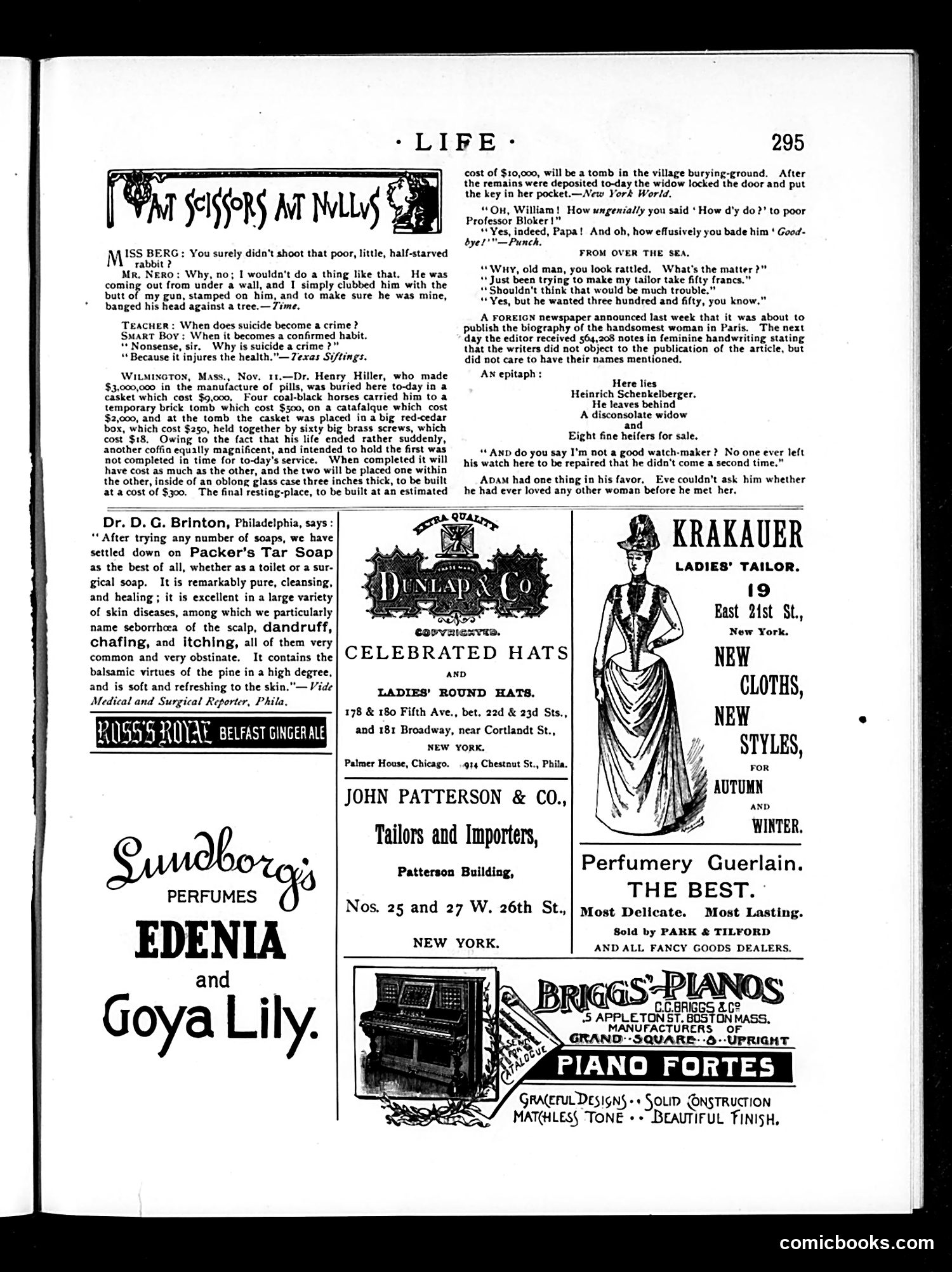
This page from *Life* magazine contains brief satirical anecdotes and period advertisements. The humor targets human behavior and social pretense: The opening cartoon depicts a man claiming he didn't shoot a rabbit—he merely clubbed, stomped, and bashed it to death, highlighting the absurdity of splitting hairs over semantics. Other jokes mock suicide rationalization, excessive wealth display (a pill manufacturer's $10,000+ funeral), social awkwardness, tailors' pricing, and marital dynamics. A foreign newspaper anecdote satirizes Parisian vanity: 564,000 women want to be featured as "the handsomest woman in Paris" but anonymously. The advertisements (Packer's Tar Soap, Sundborg's Perfumes, Krakauer's ladies' tailoring, Briggs Pianos) are typical late-19th-century placements. The page's humor reflects *Life*'s satirical tradition of lampooning middle-class pretension and human folly through brief, sharp observations.
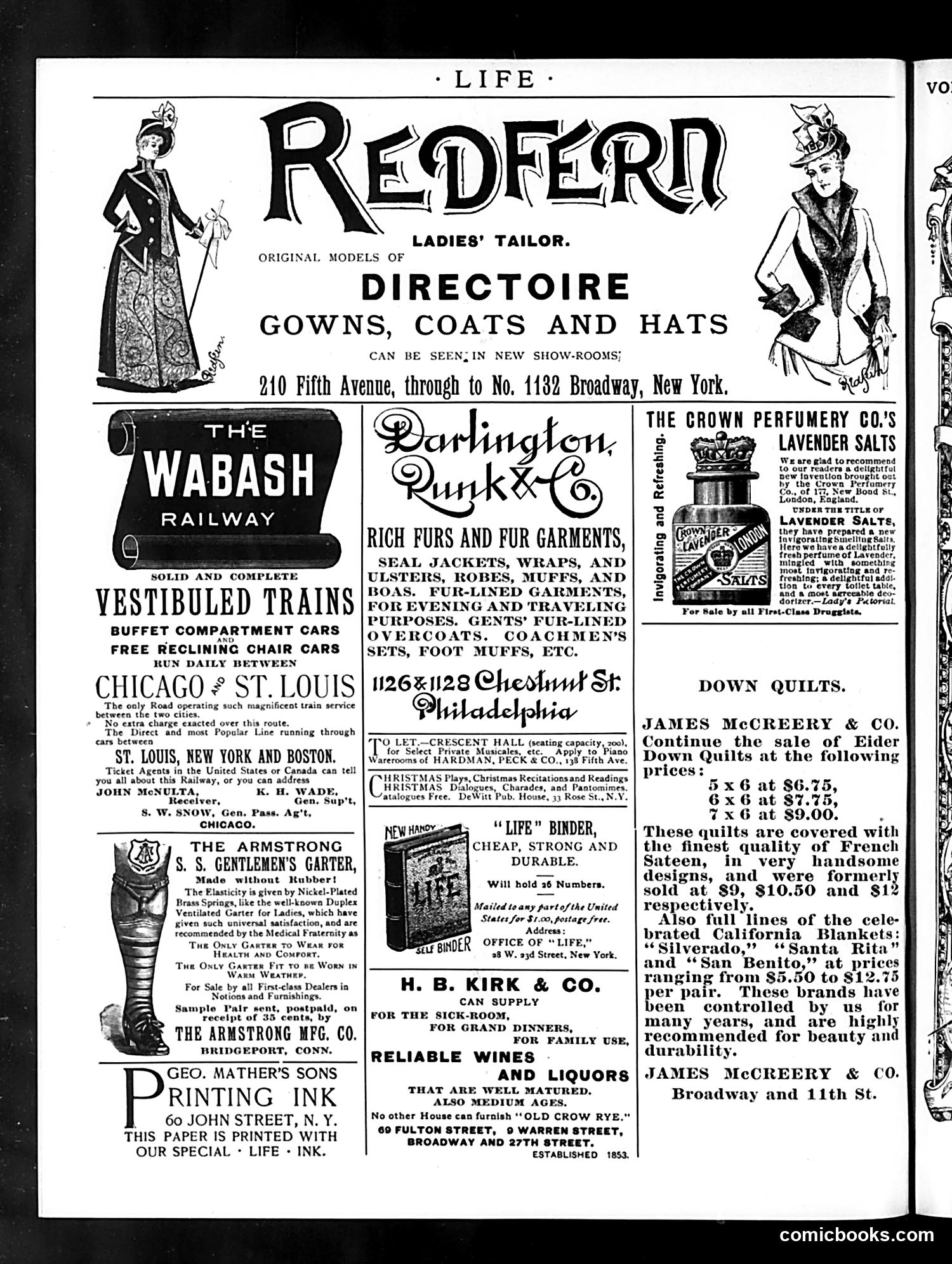
This page is **primarily advertising**, not editorial content or satire. It's a typical late 19th-century Life magazine advertisement section featuring luxury goods and services. The ads target wealthy consumers with products like: - **Redfern**: high-fashion "Directoire" gowns and coats (fashionable silhouette of the era) - **Wabash Railway**: luxury train service between major cities - **Darlington, Runk & Co.**: expensive furs and seal jackets - **James McCreery & Co.**: premium eider down quilts and California blankets - **H.B. Kirk & Co.**: aged wines and "Old Crow Rye" whiskey There is **no visible political cartoon** on this page. The only illustration is a garter advertisement showing a leg—straightforward product promotion. The page reflects the commercial focus of Life magazine during this period, which mixed satirical editorial content with extensive paid advertising to reach an affluent readership.