
Life, 1888-11-22 · page 6 of 14
Life — November 22, 1888 — page 6: what you’re looking at
What you’re looking at
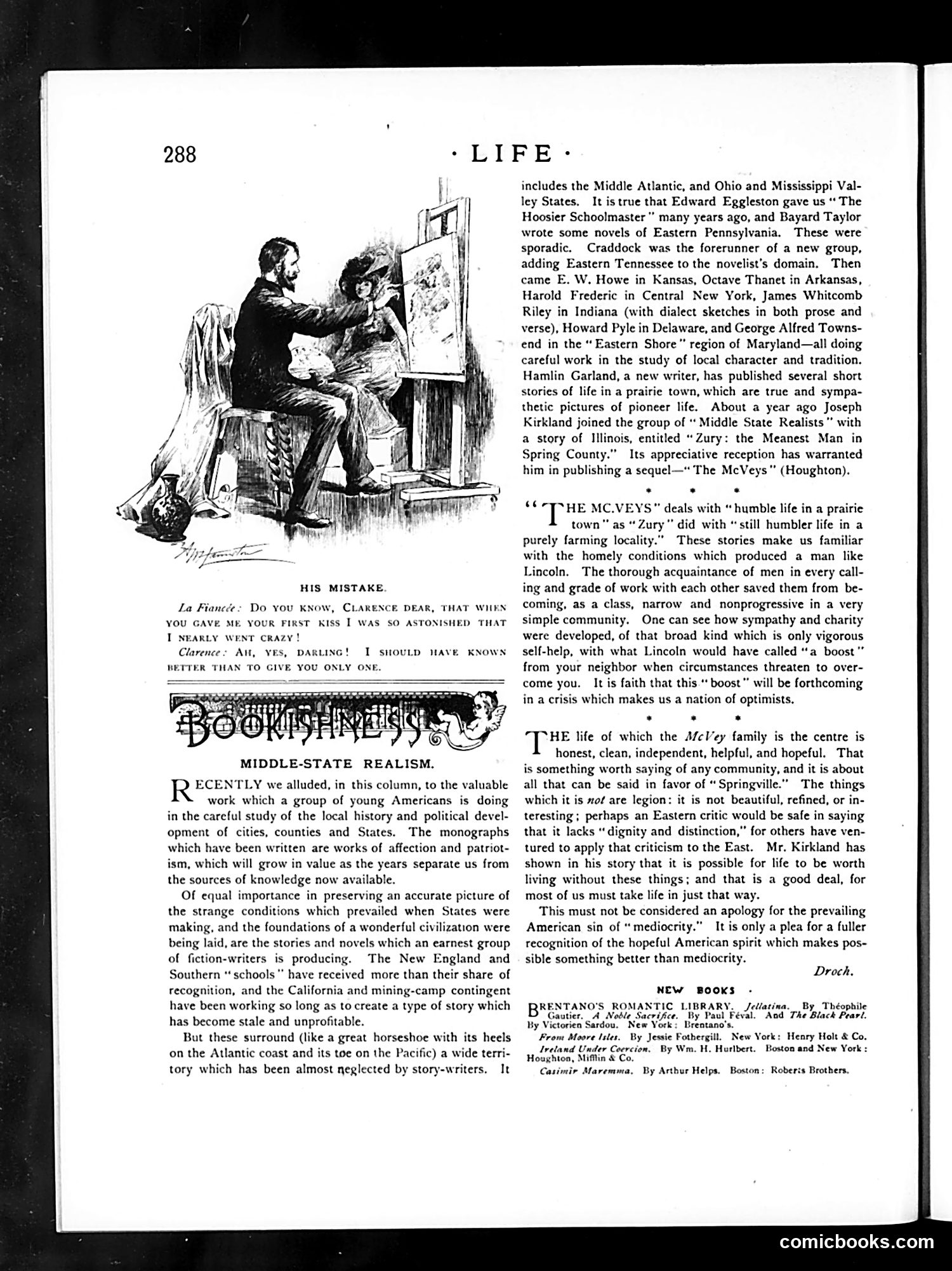
The page contains a literary discussion of "Middle-State Realism," a movement in American fiction focusing on regional stories from the Midwest and Middle Atlantic states. The cartoon titled "His Mistake" depicts a romantic scene where a man has apparently kissed a woman without permission, and she sarcastically scolds him, saying she should have known better than to let him kiss her only once. The joke plays on miscommunication and romantic misadventure—he thought a single kiss was inappropriate boldness, but her complaint suggests she wanted more. The accompanying text discusses how contemporary writers like Joseph Kirkland are documenting humble prairie life and small-town communities with sympathy and accuracy, positioning this regional realism as valuable American literature separate from the better-known Eastern and California literary traditions.
📄 Transcribed text from this page (OCR, searchable)
Machine-transcribed from the original scan — historical spelling and the odd misread are preserved.
- LIFE: HIS MISTAKE La Fiancee Do you know, CLARENCE DEAR, THAT WIEN YOU GAVE ME YOUR FIRST KISS I WAS SO ASTONISHED THAT T NEARLY WENT CRAZY! AH, YES, DARLING! I SHOULD HAVE KNOWN RETTER THAN TO GIVE YOU ONLY ONE. Clarence : MIDDLE-STATE REALISM. ECENTLY we alluded, in this column, to the valuable work which a group of young Americans is doing in the careful study of the local history and political devel- opment of cities, counties and States. The monographs which have been written are works of affection and patriot- ism, which will grow in value as the years separate us from the sources of knowledge now available. Of equal importance in preserving an accurate picture of the strange conditions which prevailed when States were making, and the foundations of a wonderful civilization were being laid, are the stories and novels which an earnest group of fiction-writers is producing. The New England and Southern “schools” have received more than their share of recognition, and the California and mining-camp contingent have been working so long as to create a type of story which has become stale and unprofitable. But these surround (like a great horseshoe with its heels on the Atlantic coast and its toe on the Pacific) a wide terri- tory which has been almost neglected by story-writers. It includes the Middle Atlantic, and Ohio and Mississippi Val- ley States, It is true that Edward Eggleston gave us “ The Hoosier Schoolmaster " many years ago, and Bayard Taylor wrote some novels of Eastern Pennsylvania. These were sporadic. Craddock was the forerunner of a new group, adding Eastern Tennessee to the novelist’s domain. Then came E. W. Howe in Kansas, Octave Thanet in Arkansas, Harold Frederic in Central New York, James Whitcomb Riley in Indiana (with dialect sketches in both prose and verse), Howard Pyle in Delaware, and George Alfred Towns- end in the “ Eastern Shore” region of Maryland—all doing careful work in the study of local character and tradition. Hamlin Garland, a new writer, has published several short stories of life in a prairie town, which are true and sympa- thetic pictures of pioneer life. About a year ago Joseph Kirkland joined the group of ‘ Middle State Realists” with a story of Illinois, entitled “Zury: the Meanest Man in Spring County.” Its appreciative reception has warranted him in publishing a sequel—“ The McVeys" (Houghton). . . . 6€ SHE MC.VEYS" deals with “humble life in a prairie town" as “ Zury” did with “still humbler life in a purely farming locality.” These stories make us familiar with the homely conditions which produced a man like Lincoln, The thorough acquaintance of men in every call- ing and grade of work with each other saved them from be- coming, as a class, narrow and nonprogressive in a very simple community. One can see how sympathy and charity were developed, of that broad kind which is only vigorous self-help, with what Lincoln would have called “a boost” from your neighbor when circumstances threaten to over- come you. It is faith that this “* boost” will be forthcoming in a crisis which makes us a nation of optimists. HE life of which the AfcVey family is the centre is honest, clean, independent, helpful, and hopeful. That is something worth saying of any community, and it is about all that can be said in favor of “ Springville.” The things which it is zof are legion: it is not beautiful, refined, or in- teresting; perhaps an Eastern critic would be safe in saying that it lacks “dignity and distinction,” for others have ven- tured to apply that criticism to the East. Mr. Kirkland has shown in his story that it is possible for life to be worth living without these things; and that is a good deal, for most of us must take life in just that way. ‘This must not be considered an apology for the prevailing American sin of “mediocrity.” It is only a plea for a fuller recognition of the hopeful American spirit which makes pos- sible something better than mediocrity. Droch. NEW BOOKS RENTANO'S ROMANTIC LIBRARY. Gautier. A Noble Sacrifice. By Paul By Victorien Sardou. New York: Brentano's. From Moore Isles, By Jessie Fothergill. New York: Henry Holt & Co. Ireland Under Coercion. By Wm. H. Hurlbert. Boston and New York : Houghton, Mifllin & Co. Casimir Maremma, Jellatina. By Théophile al. And The Black Peart. By Arthur Helps. Boston: Roberts Brothers. comicbooks.com