
Life, 1888-11-22 · page 2 of 14
Life — November 22, 1888 — page 2: what you’re looking at
What you’re looking at
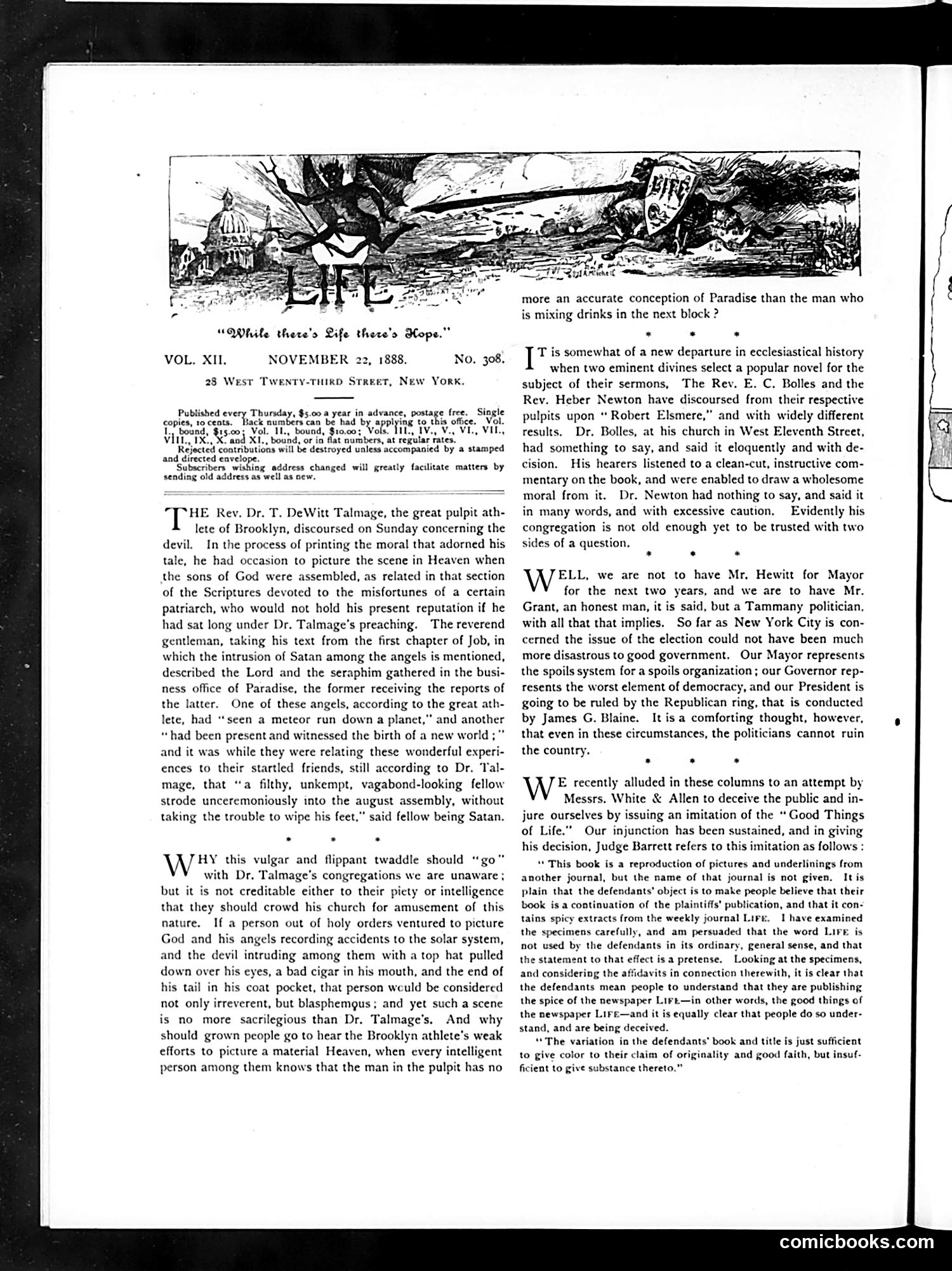
**Date & Publication**: Life, Vol. XII, No. 308, November 23, 1888 **Content**: This page contains editorial commentary rather than political cartoons. The small illustration at top appears to be decorative. **Main Topics Discussed**: 1. **Ecclesiastical controversy**: Rev. Dr. DeWitt Talmage (Brooklyn preacher) and Rev. E.C. Bolles used "Robert Elsmere" (a popular novel questioning religious faith) as sermon subjects, drawing criticism for mixing secular literature with theology. 2. **Political commentary**: Discussion of mayoral elections, criticism of the Republican party's control ("spoils system"), and references to James G. Blaine's political influence. 3. **"Good Things of Life" controversy**: Debate over whether a defendants' publication imitates Life magazine's format and content, with legal/ethical implications discussed. This is primarily opinion journalism rather than satirical cartooning.
📄 Transcribed text from this page (OCR, searchable)
Machine-transcribed from the original scan — historical spelling and the odd misread are preserved.
“While there's Life there's Hope.” VOL. XI. 28 West TweNTY-THIRD StREET, NOVEMBER 22, 1888. No, 308. New York. Published sre Thursday, $5.00 a year in advance, postage free. copies, ro cents. Hack numbers can be bad by applying to thi of 19.00; Vol. Il-, bound, $10.00; Vole tits 1V.y ‘and X1,, bound, or ia flat numbers, rece ancl ontributions will be destroyed unless accompanied by a stamped and directed enveloj Subscribers wishing address changed will greatly facilitate matters by sending old address as well as new. THE Rev. Dr. T. DeWitt Talmage, the great pulpit ath- lete of Brooklyn, discoursed on Sunday concerning the devil. In the process of printing the moral that adorned his tale, he had occasion to picture the scene in Heaven when the sons of God were assembled, as related in that section of the Scriptures devoted to the misfortunes of a certain patriarch, who would not hold his present reputation if he had sat long under Dr. Talmage’s preaching. The reverend gentleman, taking his text from the first chapter of Job, in which the intrusion of Satan among the angels is mentioned, described the Lord and the seraphim gathered in the busi- ness office of Paradise, the former receiving the reports of the latter. One of these angels, according to the great ath- lete, had “seen a meteor run down a planet,” and another “had been present and witnessed the birth of a new world ; and it was while they were relating these wonderful experi- ences to their startled friends, still according to Dr. ‘Tal- mage, that ‘a filthy, unkempt, vagabond-looking fellow strode unceremoniously into the august assembly, without taking the trouble to wipe his feet,” said fellow being Satan. J HY this vulgar and flippant twaddle should “go with Dr, Talmage’s congregations we are unaware ; but it is not creditable either to their piety or intelligence that they should crowd his church for amusement of this nature. If a person out of holy orders ventured to picture God and his angels recording accidents to the solar system, and the devil intruding among them with a top hat pulled down over his eyes, a bad cigar in his mouth, and the end of his tail in his coat pocket, that person weuld be considered not only irreverent, but blasphemous; and yet such a scene is no more sacrilegious than Dr. Talmage’s. And why should grown people go to hear the Brooklyn athlete's weak efforts to picture a material Heaven, when every intelligent person among them knows that the man in the pulpit has no more an accurate conception of Paradise than the man who is mixing drinks in the next block ? . * . T is somewhat of a new departure in ecclesiastical history when two eminent divines select a popular novel for the subject of their sermons, The Rev. E. C. Bolles and the Rev. Heber Newton have discoursed from their respective pulpits upon “ Robert Elsmere,” and with widely different results. Dr. Bolles, at his church in West Eleventh Street, had something to say, and said it eloquently and with de- cision. His hearers listened to a clean-cut, instructive com- mentary on the book, and were enabled to draw a wholesome moral from it. Dr. Newton had nothing to say, and said it in many words, and with excessive caution, congregation is not old enough yet to be trusted with two sides of a question. . . ELL, we are not to have Mr, Hewitt for Mayor for the next two years, and we are to have Mr. Grant, an honest man, it is said, but a Tammany politician, with all that that implies. So far as New York City is con- cerned the issue of the election could not have been much more disastrous to good government. Our Mayor represents the spoils system for a spoils organization ; our Governor rep- resents the worst element of democracy, and our President is going to be ruled by the Republican ring, that is conducted by James G. Blaine. It isa comforting thought, however, that even in these circumstances, the politicians cannot ruin the country, . . . E recently alluded in these columns to an attempt by Messrs. White & Allen to deceive the public and in- jure ourselves by issuing an imitation of the “Good Things of Life.” Our injunction has been sustained, and in giving his decision, Judge Barrett refers to this imitation as follows : “This book is a reproduction of pictures and underlinings from another journal, but the name of that journal is not given. It is plain that the defendants’ object is to make people believe that their book is a continuation of the plaintiffs’ publication, and that it con- tains spicy extracts from the weekly journal Lire. I have examined the specimens carefully, and am persuaded that the word Lire is not used by the defendants in its ordinary, general sense, and that the statement to that effect isa pretense. Looking at the specimens, and considering the affidavits in connection therewith, it is clear that the defendants mean people to understand that they are publishing the spice of the newspaper Lirt—in other words, the good things of the newspaper Lire—and it is equally clear that people do so under- stand, and are being deceived. “The variation in the defendants’ book and title is just sufficient to give color to their claim of originality and good faith, but insuf- ficient to give substance thereto. comicbooks.com