
A complete issue · 16 pages · 1888
Life — November 15, 1888
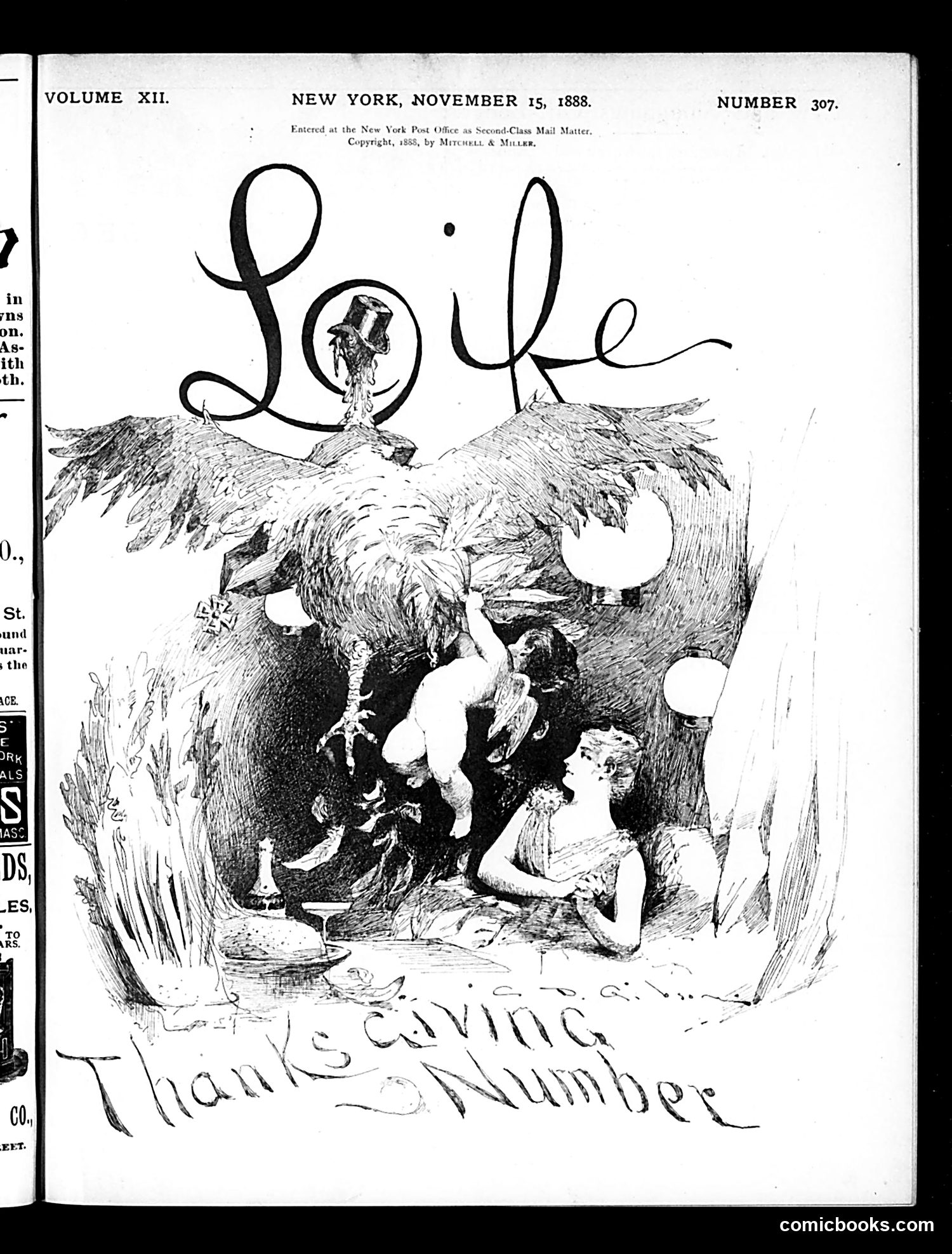
This appears to be a satirical cover for Life magazine's issue following the 1888 U.S. presidential election. The ornate script spelling "Life" dominates the top, while below shows a domestic scene with winged figures (possibly representing political forces or fate) hovering over a woman and child in what seems to be a modest home setting. The caption reads "Thanksgiving Number," suggesting commentary on post-election circumstances. The winged figures and theatrical composition suggest satirical commentary on how election results would affect American households and families. Without clearer identification of specific figures, the exact political targets remain uncertain, though the domestic setting emphasizes how electoral outcomes impacted ordinary citizens' lives.
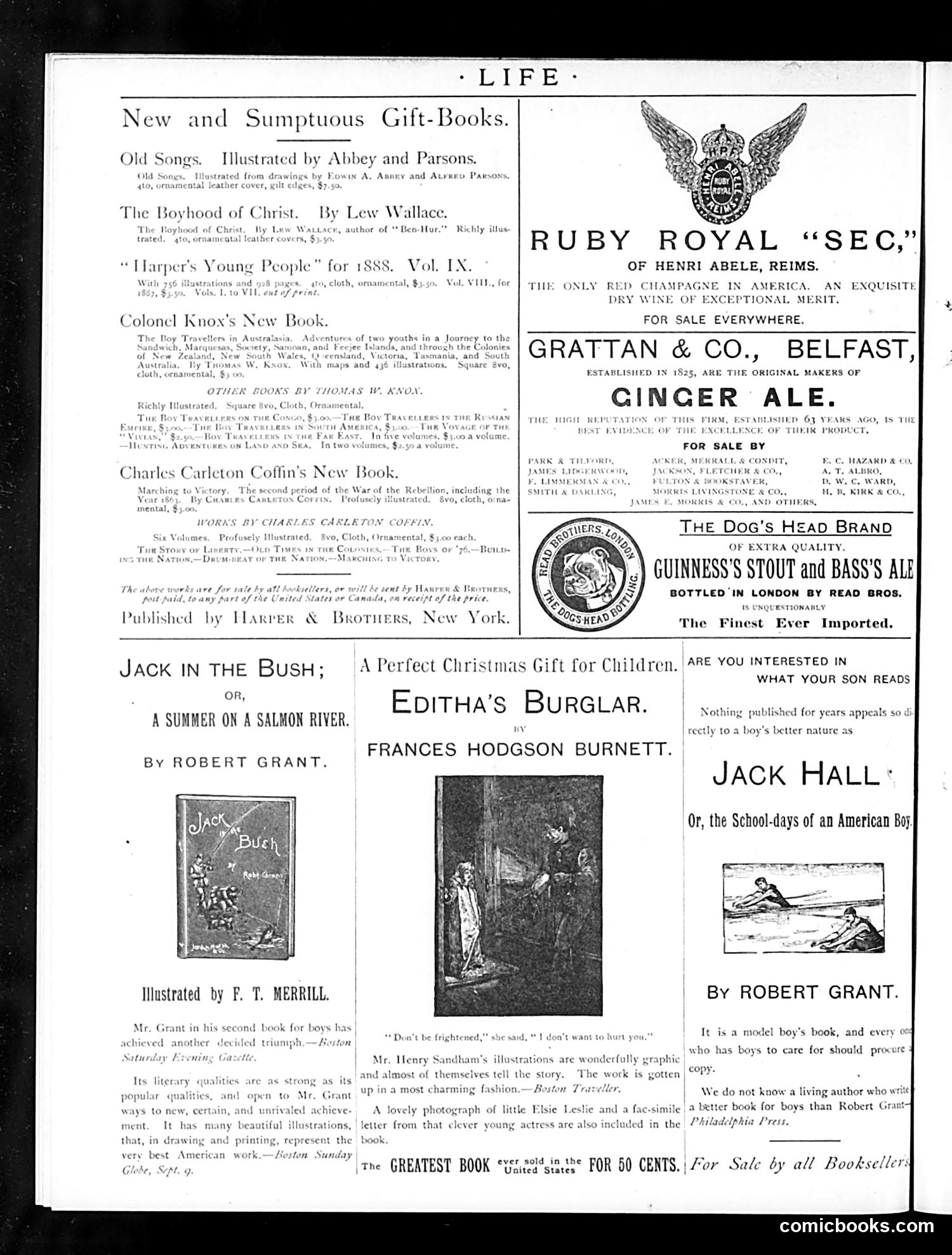
This page is primarily **advertising, not political satire**. It contains: 1. **Book advertisements** for gift books including works by Lew Wallace and Robert Grant 2. **Commercial product ads** for Ruby Royal Champagne, Grattan & Co. Ginger Ale (established 1825), and Guinness's Stout/Bass's Ale 3. **Children's book promotions**, notably "Jack Hall; Or, the School-days of an American Boy" by Robert Grant, described as "a model boy's book" The only potentially satirical element is the small illustration accompanying "Editha's Burglar" by Frances Hodgson Burnett, showing a confrontation scene. However, this appears to be a straightforward book illustration rather than political commentary. **Bottom line**: This is a commercial advertising page with no discernible political cartoons or social satire.
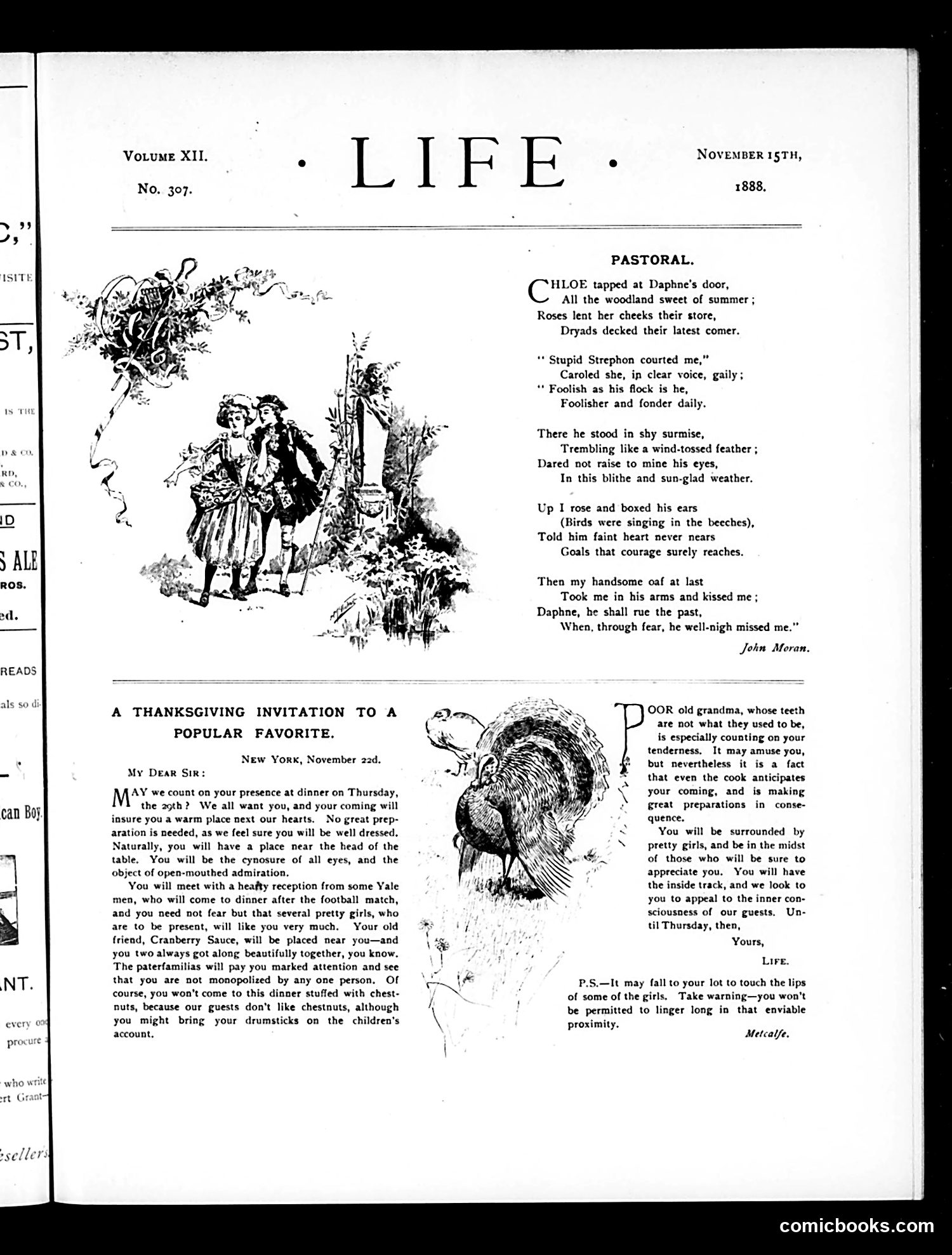
This page contains three distinct pieces: 1. **"Pastoral" (poem by John Moran)**: A romantic verse about a man named Strephon courting a woman named Chloe, with accompanying pastoral illustration showing a couple in a rural setting. 2. **"A Thanksgiving Invitation to a Popular Favorite"**: A humorous letter inviting someone to Thanksgiving dinner, with jokes about seating arrangements and mention of Yale football players attending. The tone is playful and gossipy. 3. **Turkey illustration with "Poor old grandma" text**: A greeting-style piece joking about an elderly grandmother's role hosting Thanksgiving, written by "Life" magazine itself. The page appears primarily devoted to Thanksgiving-themed entertainment rather than political satire. The humor is gentle and domestic, focusing on social customs, courtship, and holiday gatherings typical of 1880s upper-class American society.
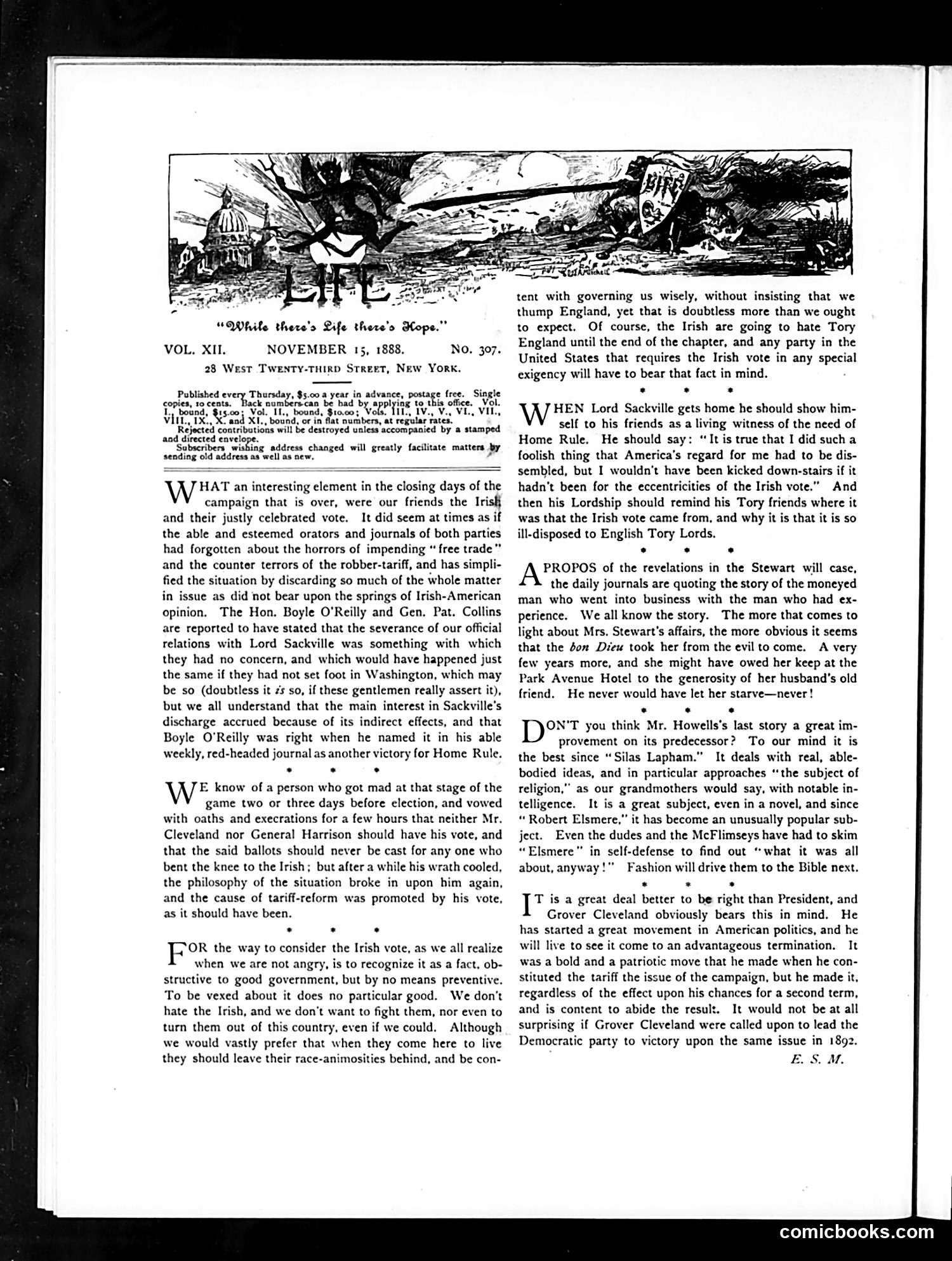
The masthead cartoon depicts allegorical figures in a landscape, though specific identities are unclear from the image alone. The text discusses the recent U.S. presidential campaign, referencing Irish-American voters and their concerns about England and "Home Rule" (Irish independence). The articles critique both major parties' appeals to Irish voters on tariff and foreign policy issues. Key figures mentioned include Lord Sackville (a British diplomat whose involvement in campaign affairs apparently angered Irish voters), Grover Cleveland (Democratic president), and General Harrison (likely Republican candidate). The satire targets how both parties cynically courted Irish-American voters while discussing substantive policy disagreements over tariffs and England relations. The tone suggests skepticism about politicians' sincere commitment to Irish concerns versus electoral calculation.
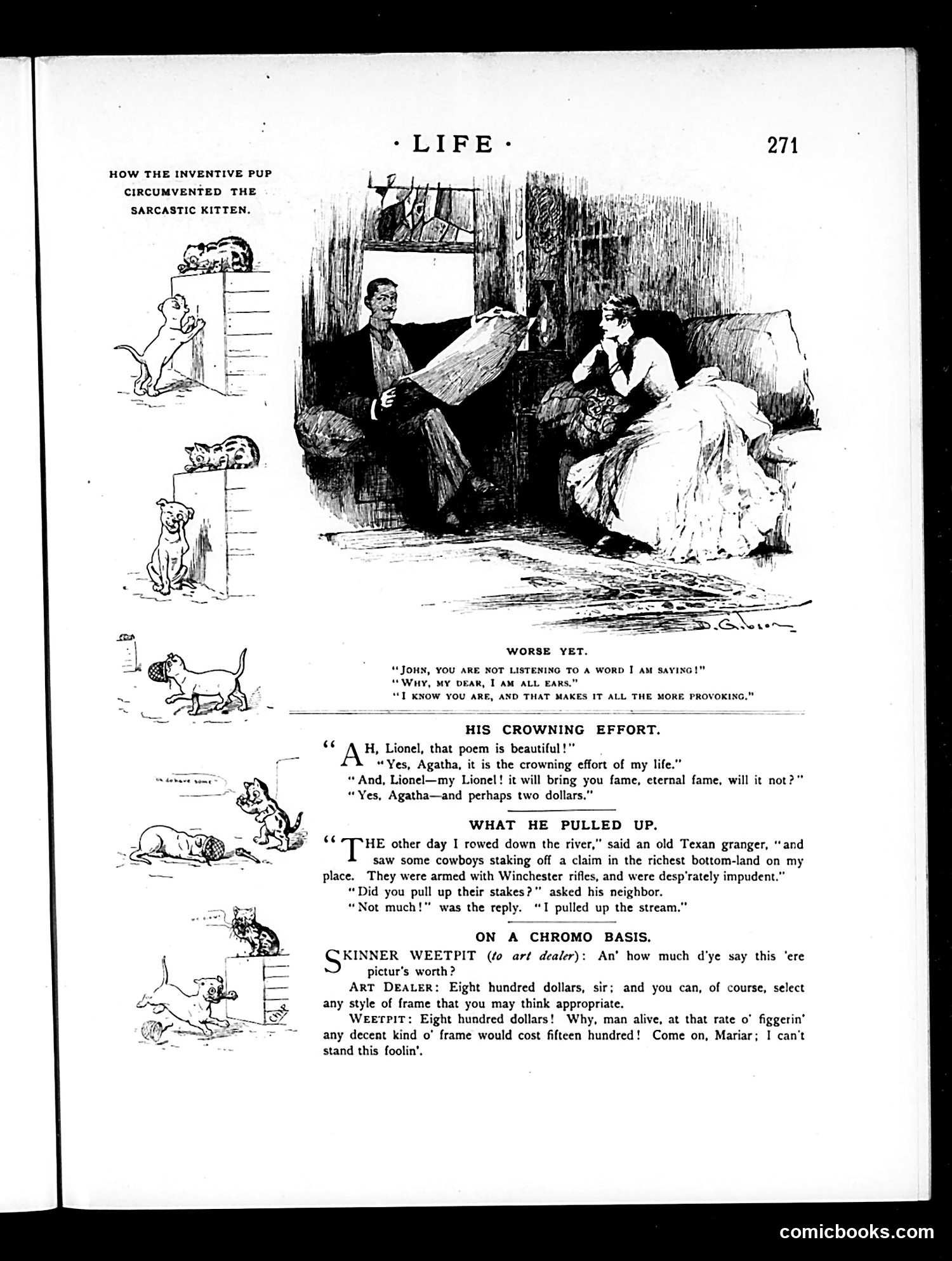
This page contains several humorous anecdotes and satirical sketches rather than political cartoons. The left side shows "How the Inventive Pup Outwitted the Sarcastic Kitten"—a series of small comic drawings depicting a dog's competitive interactions with a cat. The main content includes three brief comedic stories: "Worse Yet," "His Crowning Effort" (about a poet named Lionel seeking fame), "What He Pulled Up" (a Texas rancher anecdote), and "On a Chromo Basis" (a dialogue between an art dealer and a character named Skinner Weepit about picture frame pricing). The humor relies on wordplay and situational comedy rather than political reference. This appears typical of Life's early satirical approach—domestic humor and social observation rather than commentary on specific contemporary events.
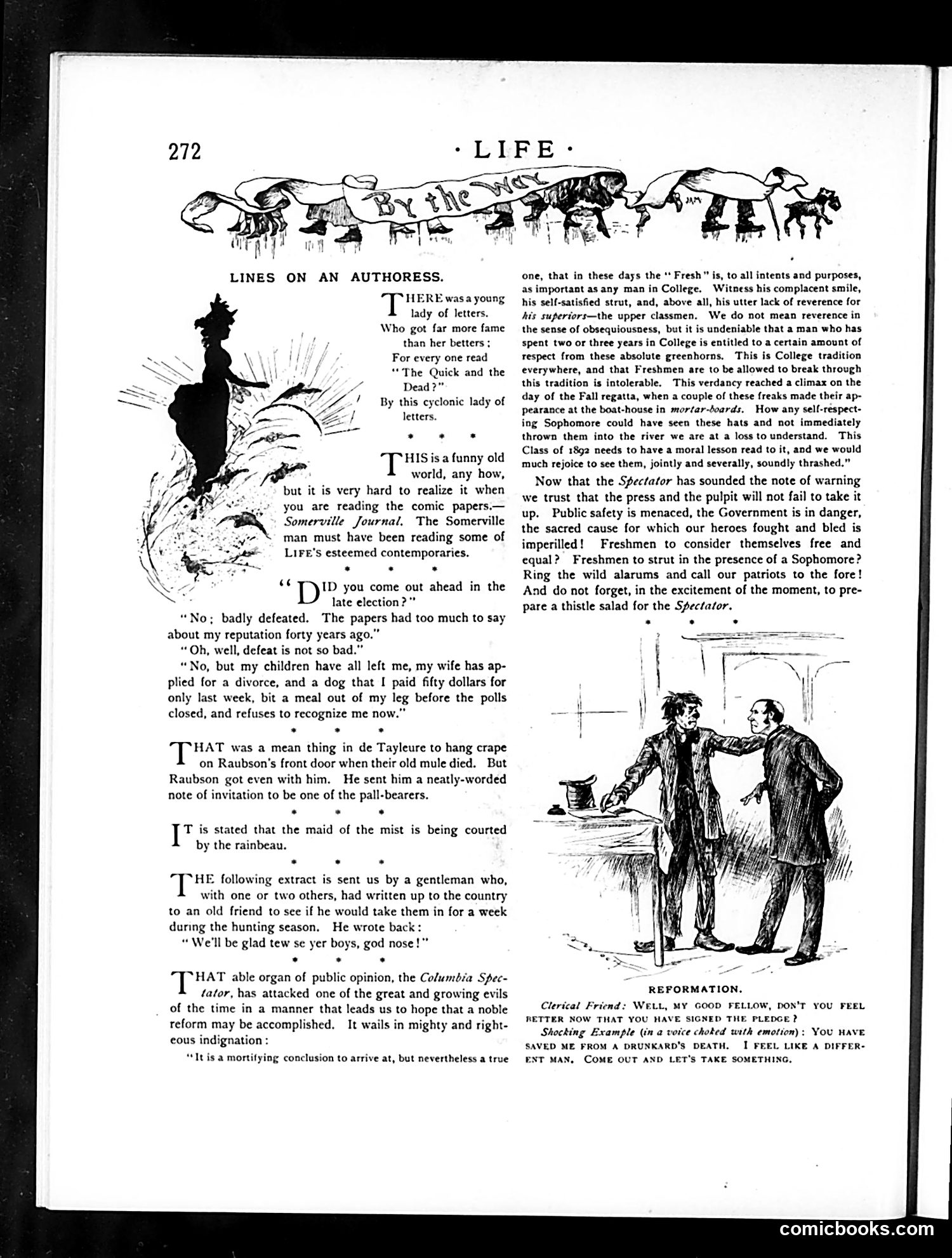
This page contains several satirical pieces about college life and social issues. The main section, "Lines on an Authoress," mocks a female letter-writer with an exaggerated illustration of a woman's face. The text ridicules her complaint about men, suggesting she lacks reverence for social superiors. A separate piece criticizes "Freshmen" at college for behaving too freely and disrespectfully toward upper-classmen, referencing a specific regatta incident where "Freshmen" allegedly disgraced themselves. The illustration shows two men in conversation, captioned "Reformation," with dialogue about signing a pledge to reform from drinking—a clear satire on temperance/prohibition advocacy movements of the era. The page reflects early 20th-century attitudes about gender, class hierarchy in education, and anti-temperance sentiment.
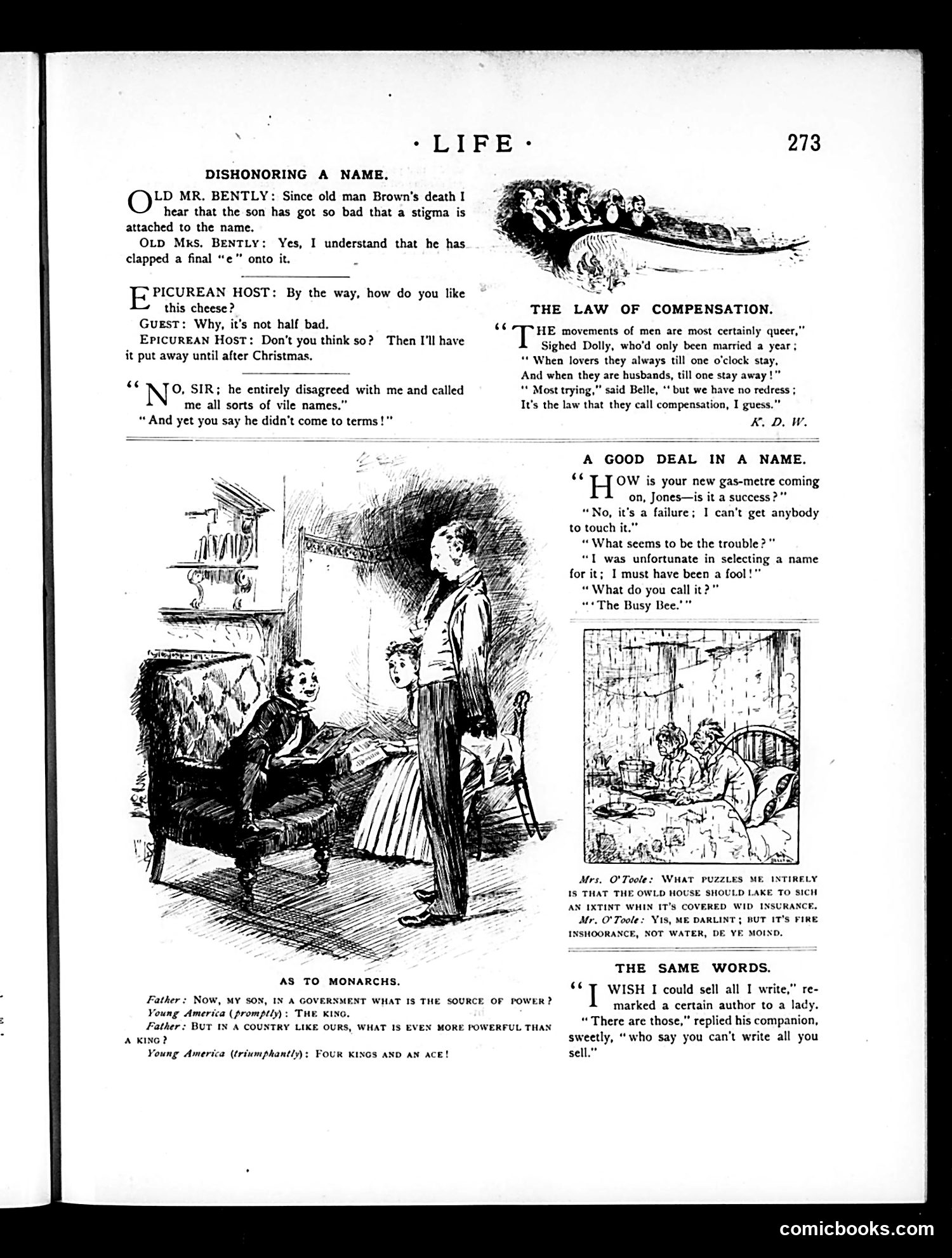
This page contains several brief humorous anecdotes and illustrations rather than political cartoons. **"Dishonoring a Name"** jokes about the stigma attached to the Brown surname after "old man Brown's death," with someone adding an "e" to distance themselves (presumably "Browne"). **"The Law of Compensation"** presents a short poem about romantic loss and consolation, attributed to K.D.W. **"A Good Deal in a Name"** depicts a conversation about a failed gas-meter product called "The Busy Bee"—a play on words suggesting the name itself caused the commercial failure. **"As to Monarchs"** is a witty exchange about governmental power. These are examples of Life's typical satirical humor: wordplay, social observation, and gentle mockery of everyday life rather than direct political commentary.
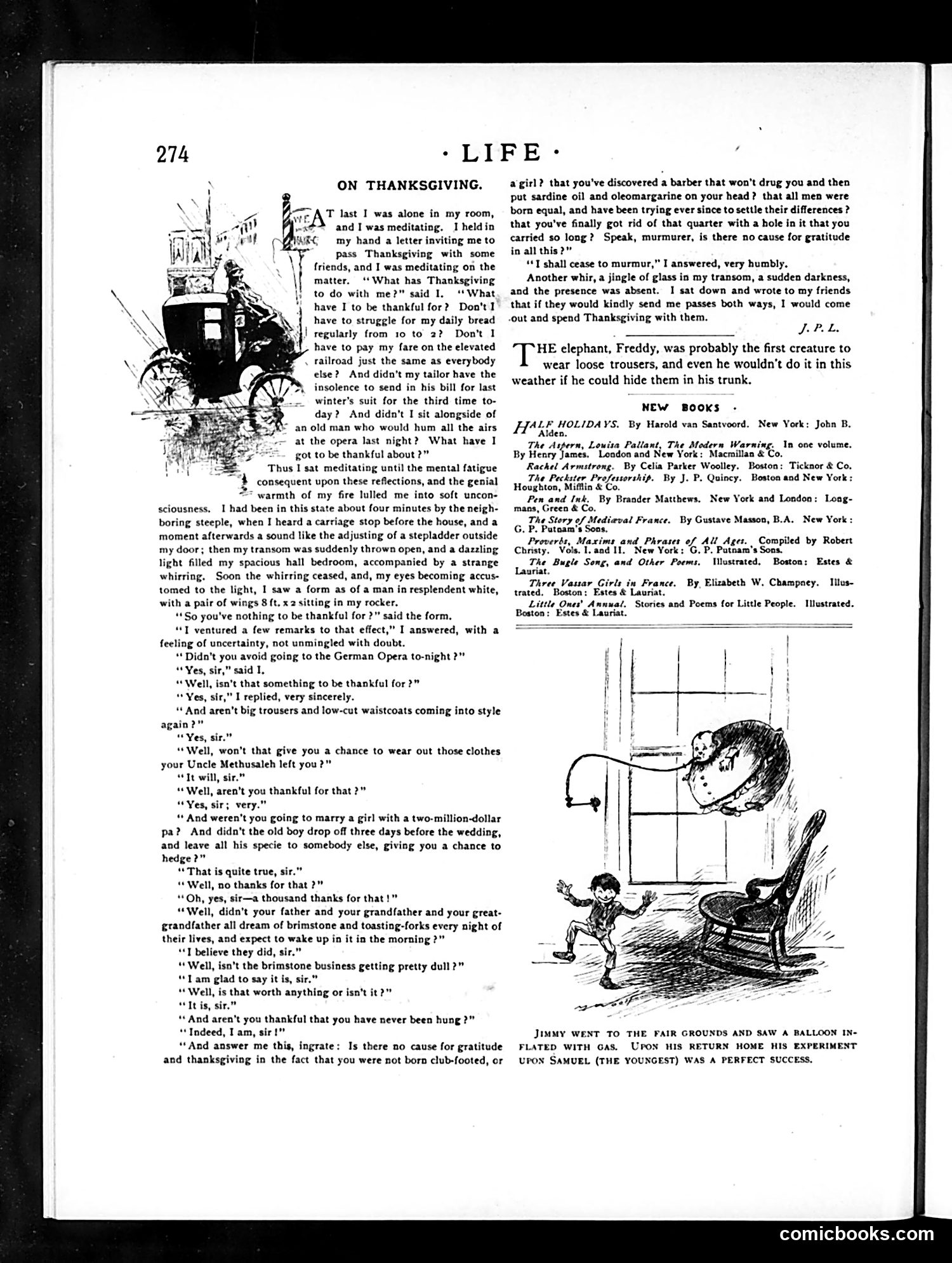
This page satirizes excessive gratitude and social hypocrisy. The left illustration shows a man meditating on what he should be thankful for—the text reveals he's ironically grateful for trivial or absurd things: a barber who drugs customers, sardine oil as hair product, loose-fitting trousers coming into fashion, inheriting an uncle's old clothes, and a father who didn't squander the family fortune. The dialogue mocks performative thanksgiving, with the narrator expressing doubt about genuine reasons for gratitude. The satire targets the artificial nature of holiday sentiment—people manufacturing thanks for unworthy circumstances or pure luck. The right cartoon shows a child's scientific experiment with a balloon, unrelated to the main text, illustrating Life magazine's mixed content approach.
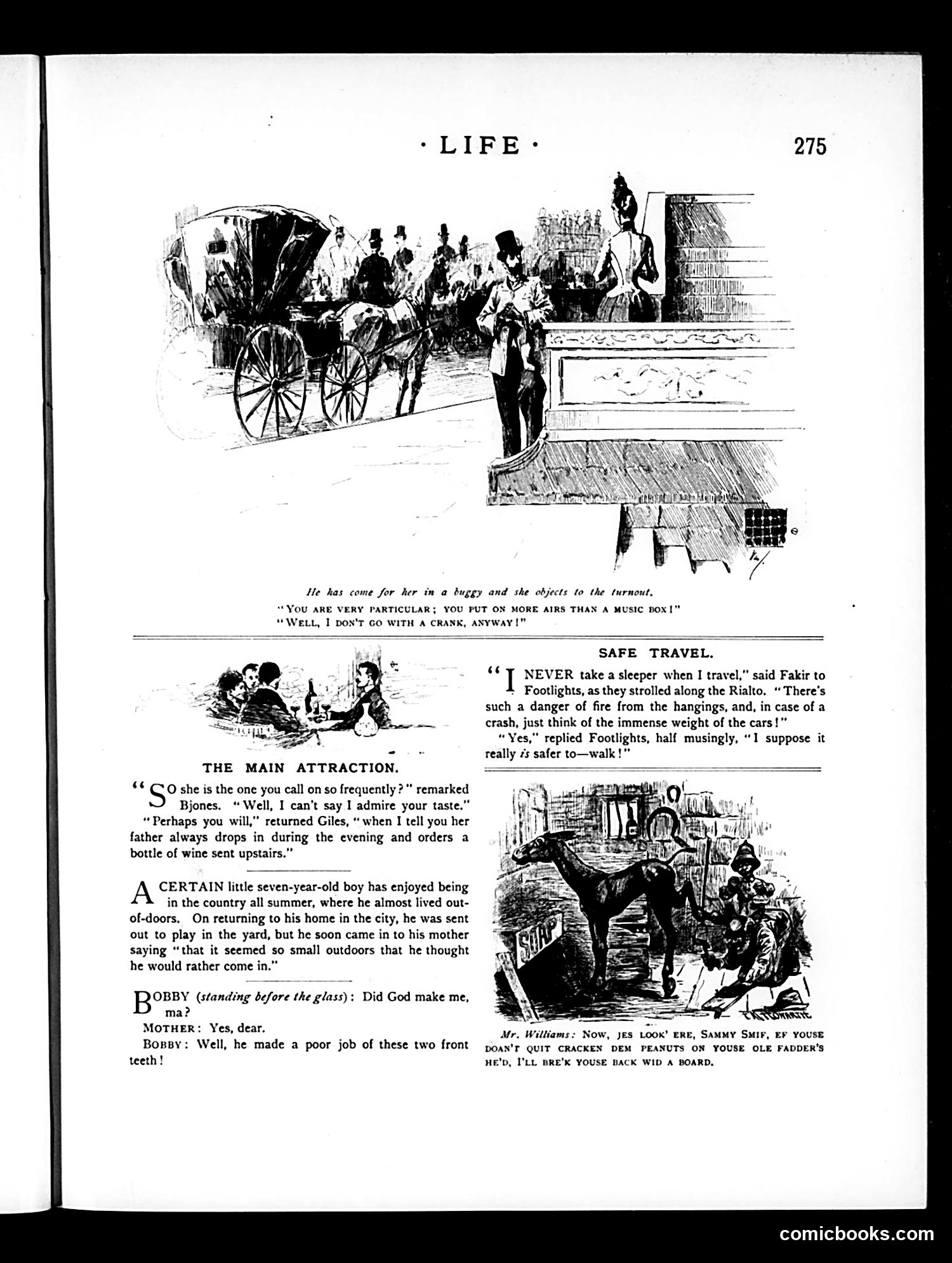
This page contains three separate humorous sketches satirizing early 20th-century social life: 1. **Top cartoon**: A woman arriving in an elaborate buggy, criticized for being "particular" and pretentious—the joke being her excessive airs don't match the modest venue. 2. **"The Main Attraction"**: A brief dialogue where Giles mentions dropping in on a woman (named perhaps by implication) frequently. The satire targets male social calling customs and women as objects of romantic pursuit. 3. **"Safe Travel"**: Fakir and Footlights debate train safety—poking fun at Victorian anxieties about new railway technology, with the absurdist punchline that walking is "safer." 4. **Bottom sketch**: A domestic scene mocking a child's theological naiveté about God's workmanship, specifically his teeth. The humor reflects period concerns: social pretension, courtship rituals, modern transportation fears, and innocent childhood observations.
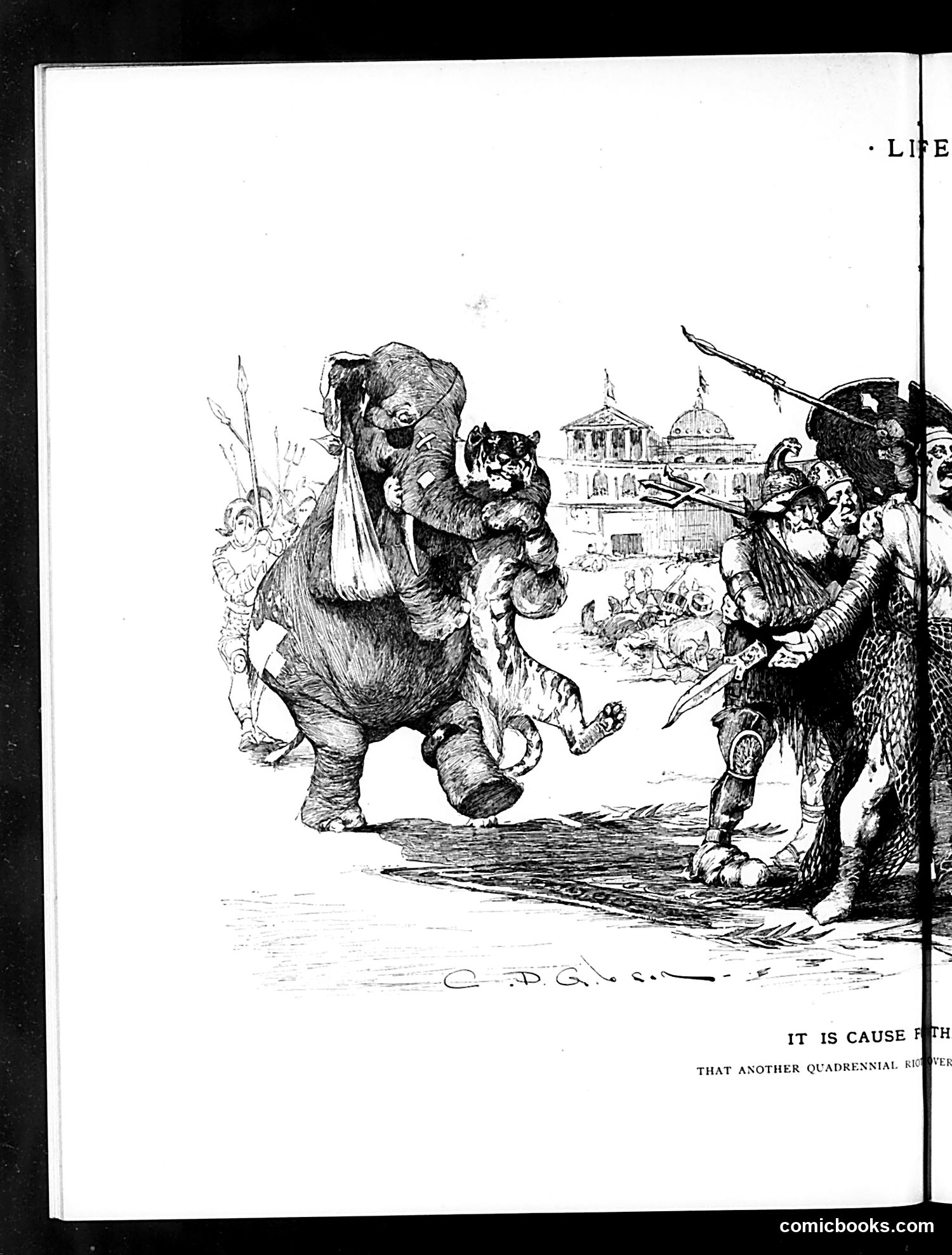
This appears to be a satirical illustration from *Life* magazine depicting an elephant—a symbol of the Republican Party—being led or paraded before what looks like military or political figures on the right. The elephant is portrayed as somewhat grotesque and oversized, suggesting criticism of Republican power or policies. The caption reads "IT IS CAUSE FOR [text cut off] THAT ANOTHER QUADRENNIAL KISSER" (likely referring to a presidential election cycle, as "quadrennial" refers to four-year periods). The architectural structures in the background suggest a government or institutional setting. The overall composition satirizes Republican political influence or an upcoming election, though the specific date and exact context remain unclear from the visible text alone.
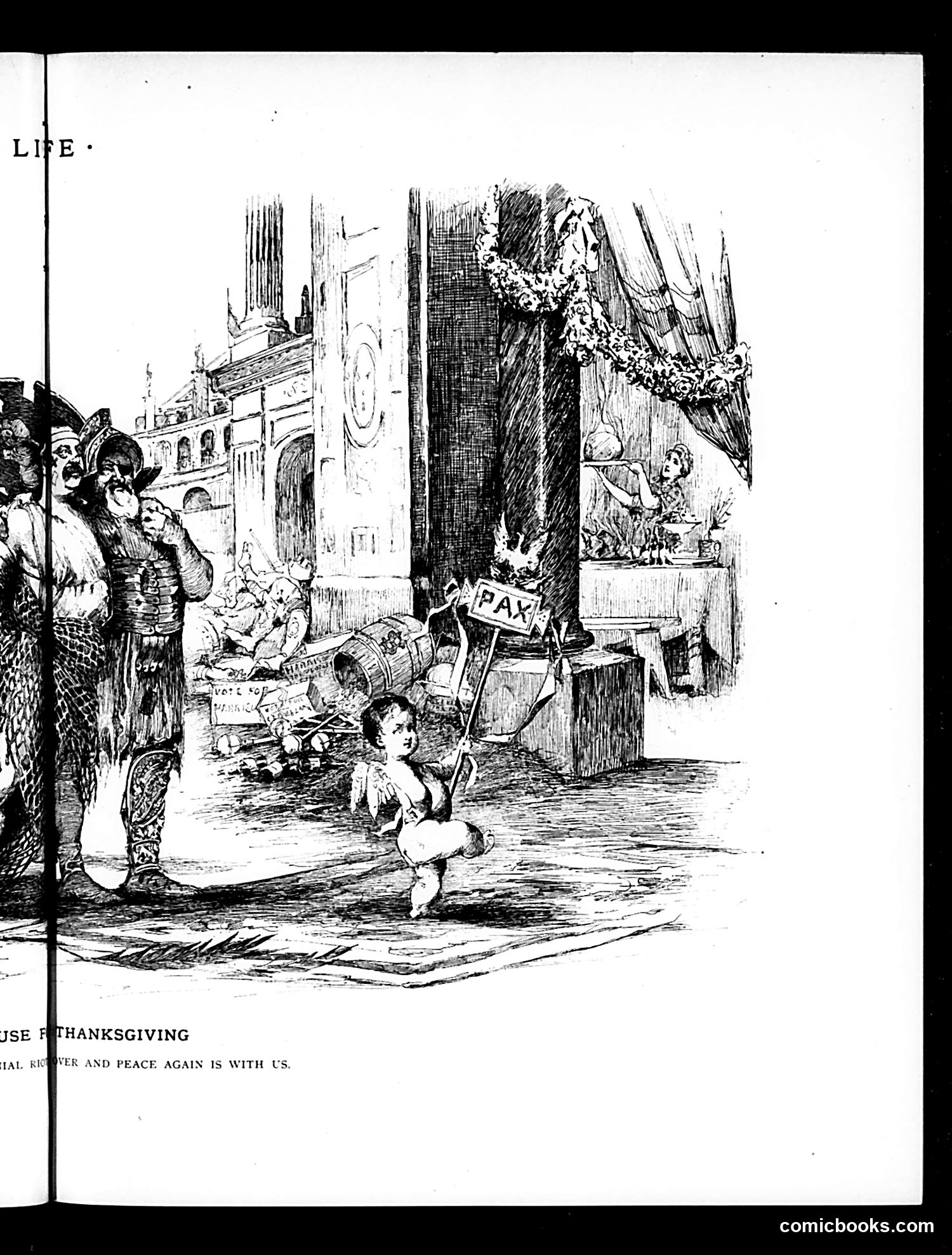
This appears to be a Thanksgiving-themed satirical illustration from *Life* magazine. The cartoon depicts a cherub or putti figure holding a sign reading "PAX" (Latin for peace) standing amid urban ruins and destruction. Barrels, debris, and wreckage scatter the ground. On the left, well-dressed civilians observe the scene. The caption references "Power and Peace Again is with Us," suggesting post-conflict reconciliation—likely following a war or major civil unrest. The juxtaposition of the innocent cherub symbol of peace amid urban devastation creates ironic commentary on the cost of conflict and the fragility of peace proclamations. The specific historical context—which war or conflict this references—is unclear from the image alone, but the tone is darkly satirical about celebrating peace.
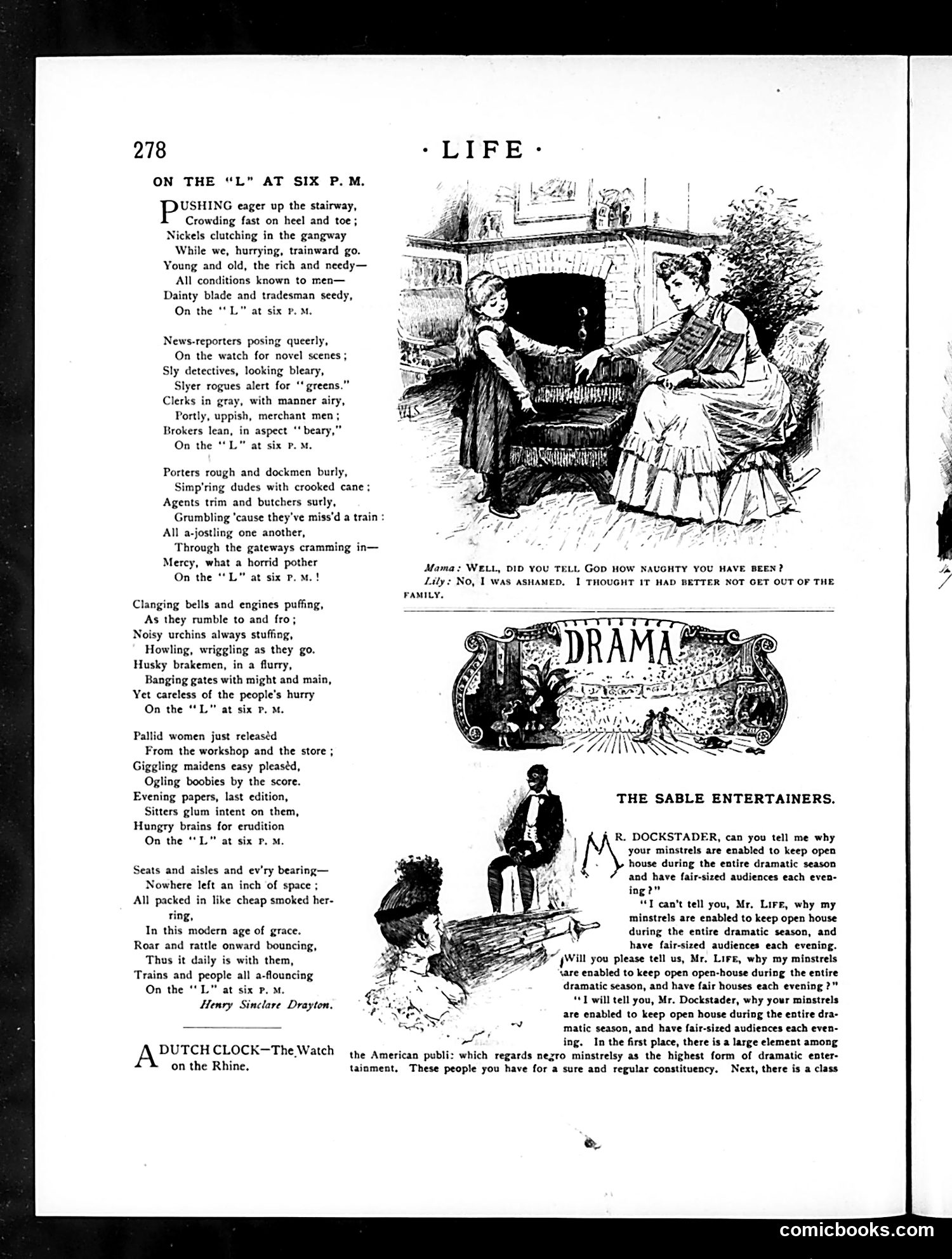
This Life magazine page contains social satire from the early 20th century: **"On the 'L' at Six P.M."** is a poem satirizing Chicago's elevated train system during rush hour. It mockingly catalogs the diverse crowd—reporters, detectives, clerks, porters, women factory workers—packed together in chaotic conditions, emphasizing the indignity and discomfort of modern urban transit. **The mother-daughter cartoon** jokes about a child's shame over misbehavior, with the child worried the scandal will become public knowledge—satirizing family propriety and social embarrassment. **"The Sable Entertainers"** discusses minstrel shows (a now-offensive form of entertainment featuring blackface performers). The conversation between "R. Dockstader" (likely referencing a real minstrel performer) and "Mr. Lirk" attempts to explain minstrelsy's popularity by citing white American audiences' appetite for this entertainment and their "sure and regular constituency." This reflects the era's casual racism regarding what was then mainstream entertainment.
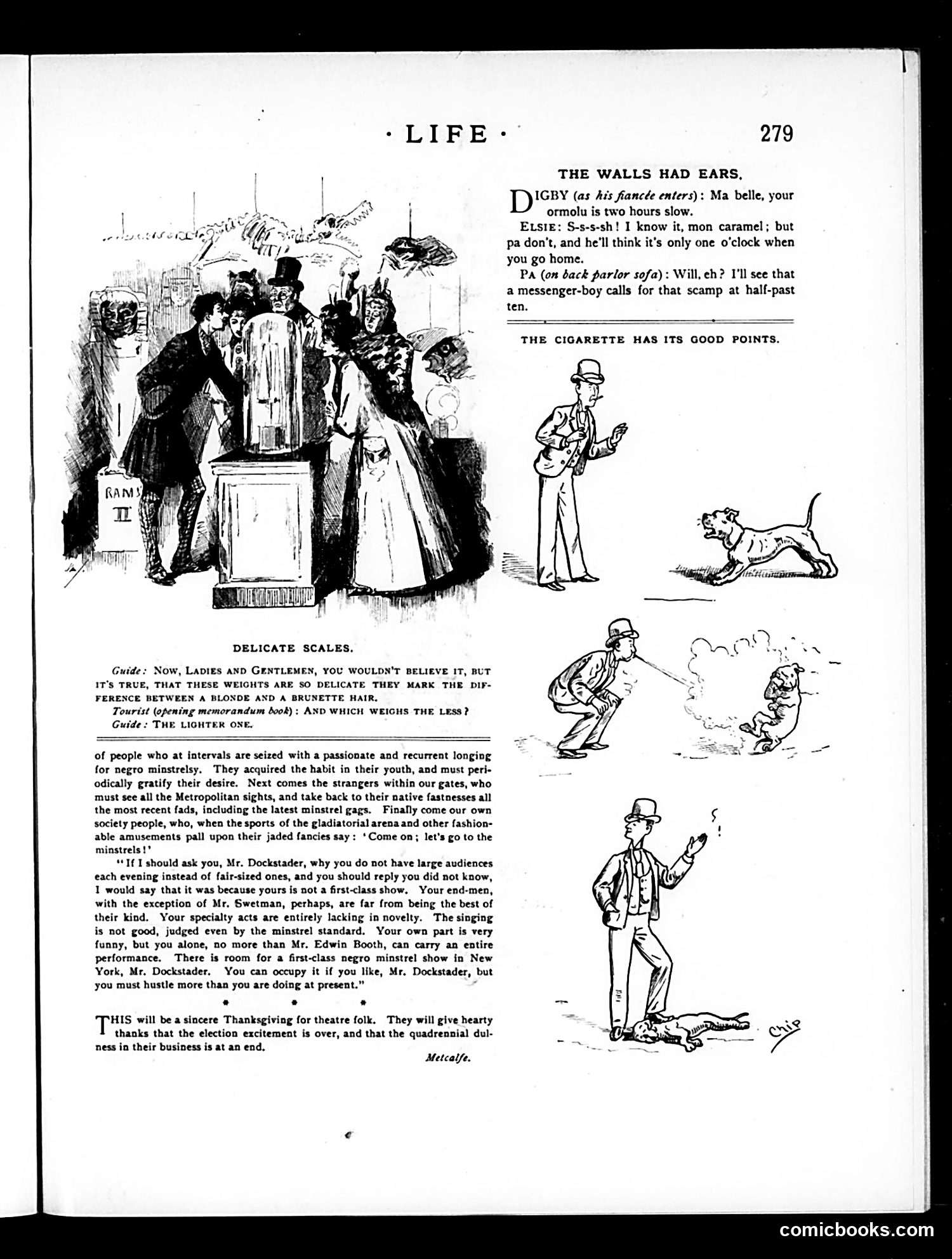
This page contains three satirical pieces reflecting early 20th-century American humor: **"Delicate Scales"** depicts a museum guide making a pun about weighing precision—the "lighter" object (a blonde hair versus brunette) "weighs the less," playing on "lighter/less." **The main text** criticizes minstrel show performer Lew Dockstader, naming him directly. The author argues his performances lack quality despite audience nostalgia for blackface minstrelsy. The passage reveals minstrelsy's popularity among different social classes seeking entertainment and fashionable entertainment fads. **"The Walls Had Ears"** is a brief romantic comedy: a young man (Digi) compliments his fiancée's clock being slow, implying she should delay him leaving. She agrees, hoping her father won't notice. But the father, eavesdropping from the next room, catches the scheme and plans to send a messenger-boy to interrupt at 10:30. **"The Cigarette Has Its Good Points"** shows cartoon vignettes of men smoking and interacting with a dog—apparently suggesting cigarettes' social benefits, likely tongue-in-cheek advertising or social commentary.
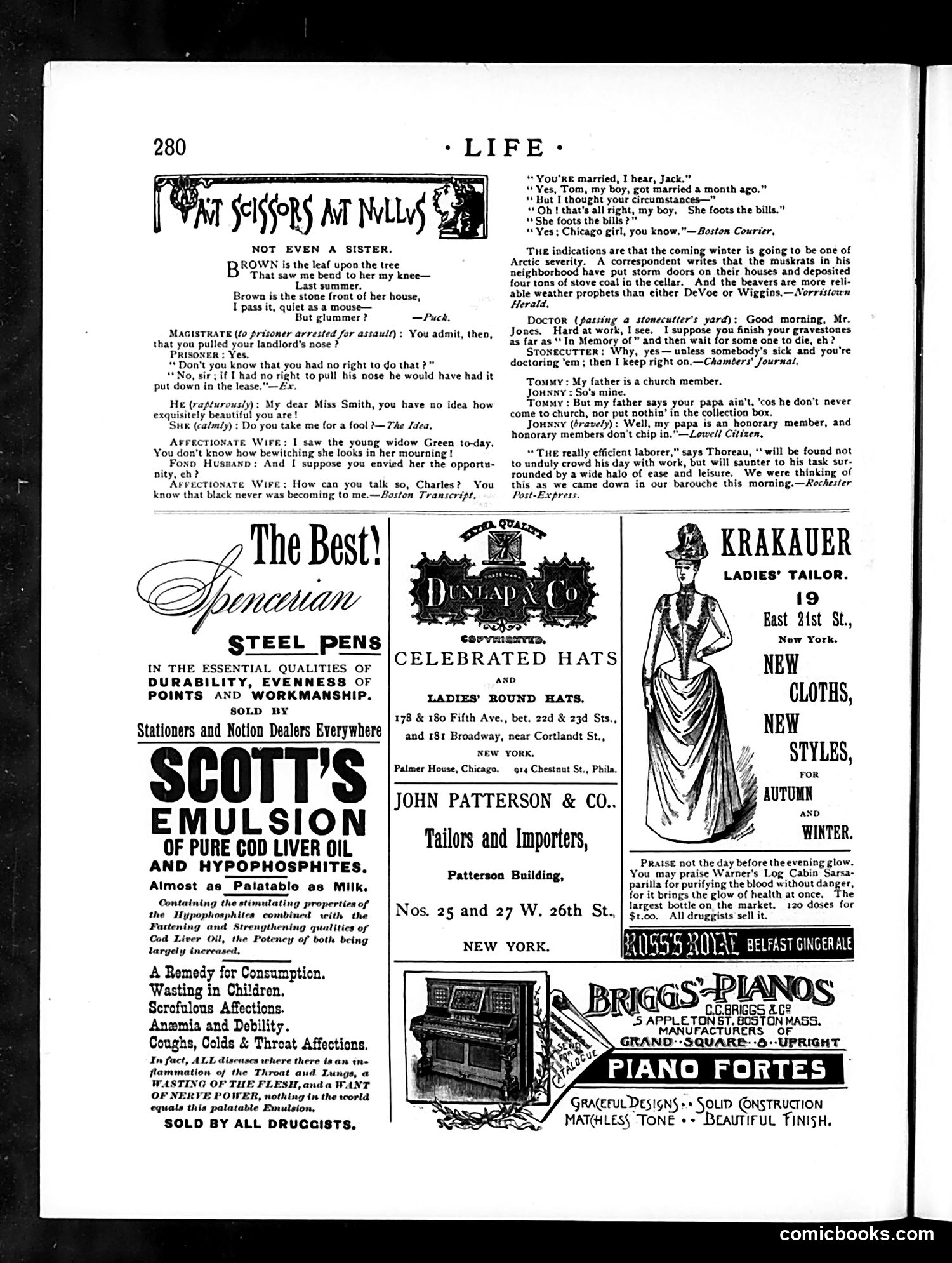
This page from *Life* magazine presents a collection of short comic pieces lampooning Victorian social conventions and human foibles. The humor targets: **Social pretense**: A woman praising a widow's mourning attire while admitting black doesn't suit her; a man claiming his wife "foots the bills" (suggesting financial dependence on a woman was considered unusual/amusing); children discussing church membership and donations. **Professional absurdity**: A magistrate's prisoner arguing a landlord should have specified "nose-pulling" restrictions in a lease; a doctor asking a stonecutter if he waits for deaths before completing gravestones. **Romantic excess**: A suitor's elaborate compliments met with blunt skepticism. The page is predominantly **advertising**—for steel pens, cod liver oil emulsion, hats, tailoring services, pianos, and patent medicines. These ads reveal period concerns: consumption treatment, children's health, and fashion-consciousness among the merchant class.
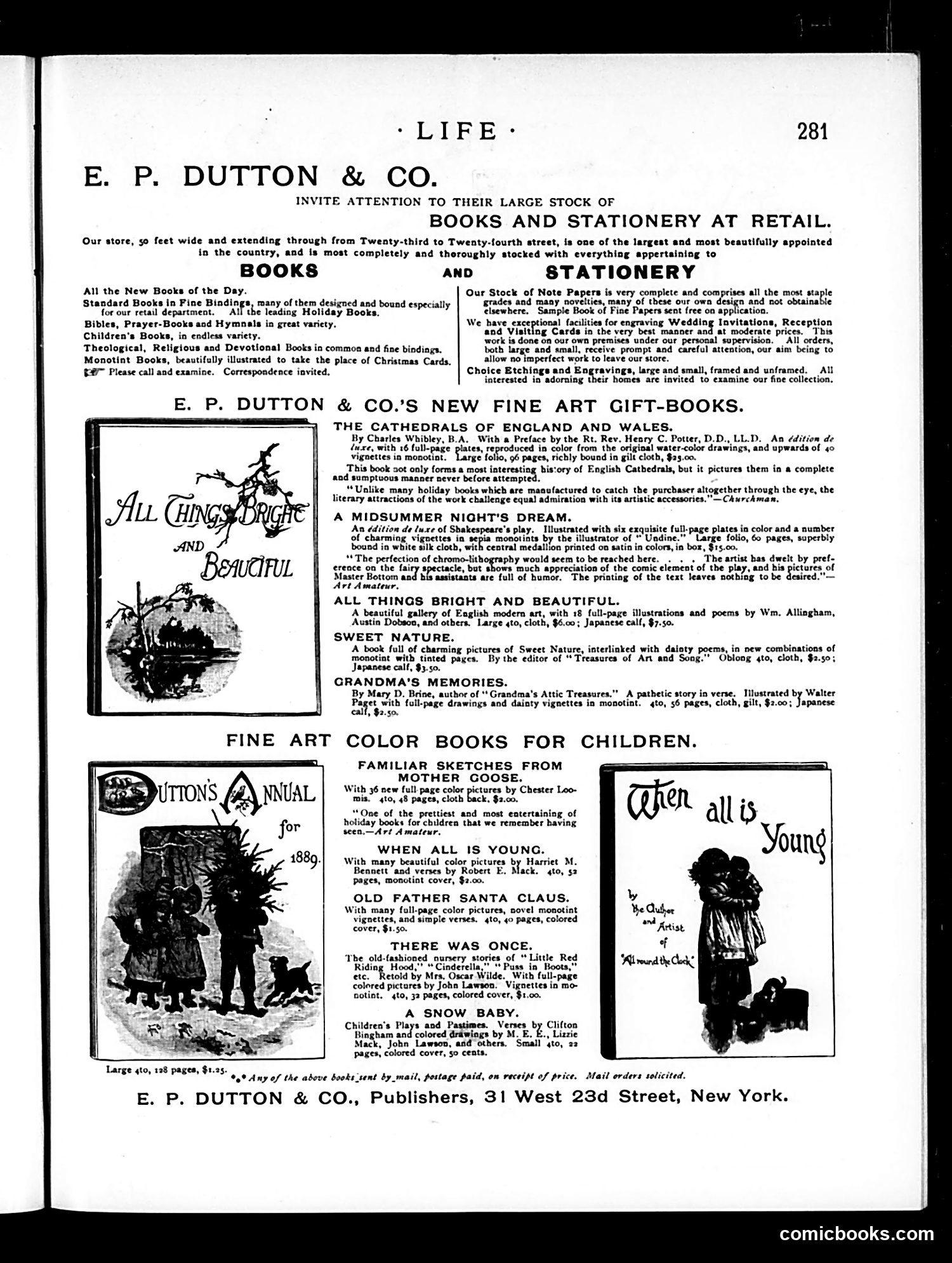
This is a **book publisher's advertisement**, not satire or political commentary. E. P. Dutton & Co. is promoting their retail bookstore and fine art gift books through a full-page ad in *Life* magazine. The page showcases luxury books popular in the late 19th century: illustrated editions of Shakespeare's *A Midsummer Night's Dream*, architectural books on English cathedrals, and children's color books. The ornate presentation and high prices ($23 for a cathedral book) indicate these were expensive luxury items for wealthy buyers. The left and right margins feature illustrations from children's books like *Dutton's Annual* and *When All Is Young*—examples of their colorful children's publications. There is no political satire here. This represents typical Victorian-era commercial publishing: fine binding, gilt cloth covers, chromolithographic color illustrations, and emphasis on aesthetic quality as premium products. The ad reflects the era's taste for ornamental book arts and gift-giving culture.
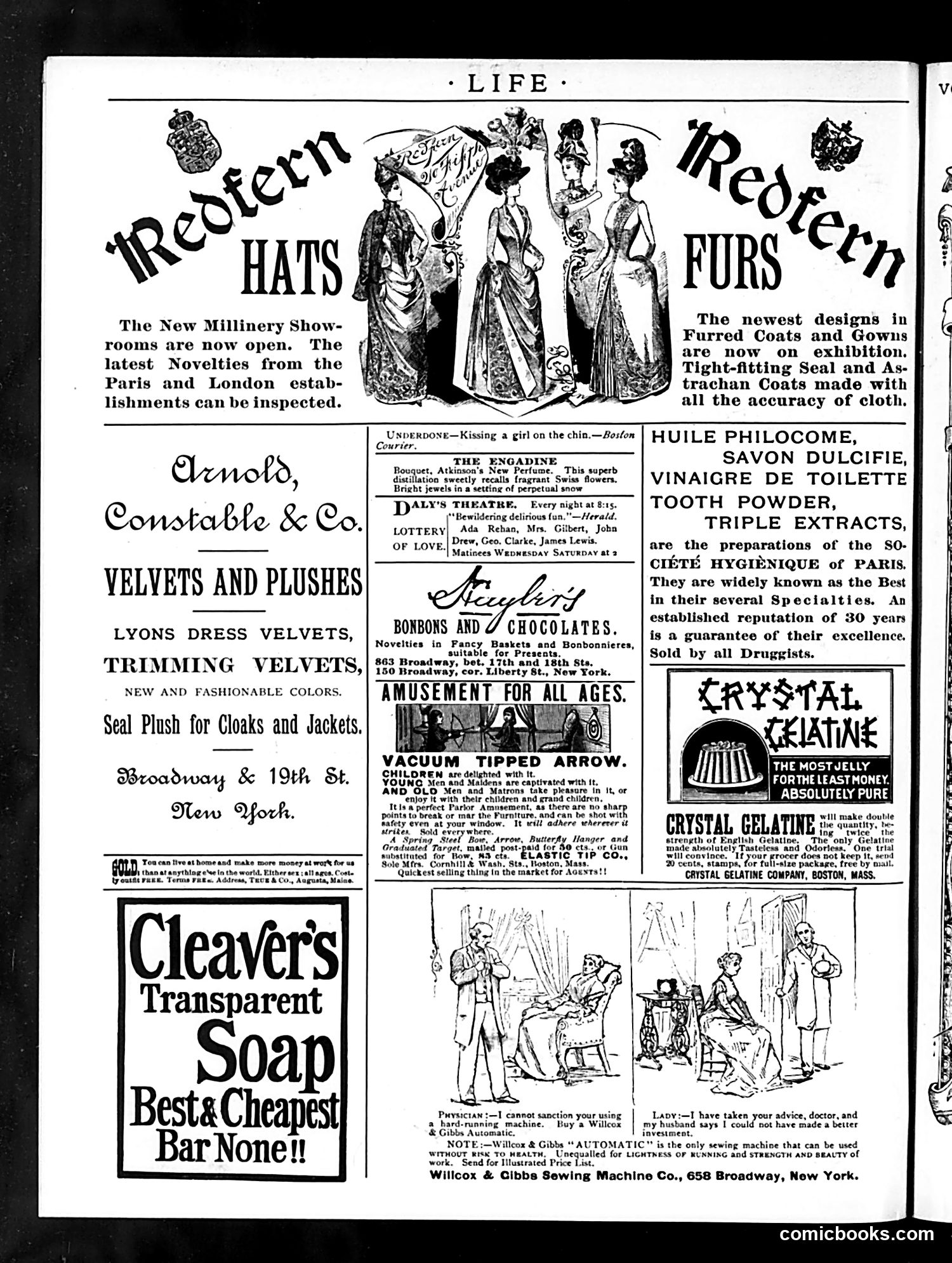
This is primarily an **advertising page** from Life magazine, not a political cartoon or satirical content. It showcases late 19th/early 20th-century consumer products and services. The page features fashion advertisements (Ironstern hats and furs, Arnold's velvets), luxury imported goods (French toiletries from the Société Hygiénique of Paris), and household products (Cleaver's soap, Crystal Gelatine, Willcox & Gibbs sewing machines). The only narrative content is a testimonial dialogue at bottom showing a **doctor recommending the "Automatic" sewing machine** to a patient concerned about health effects from hard-running machines. The woman reports her husband approved her purchase—reflecting the era's assumption that wives required spousal financial approval. The ads collectively target wealthy consumers with European goods and labor-saving devices, reflecting Gilded Age consumer culture and emerging awareness of health/ergonomic concerns in mechanized work.