
Life, 1888-11-15 · page 4 of 16
Life — November 15, 1888 — page 4: what you’re looking at
What you’re looking at
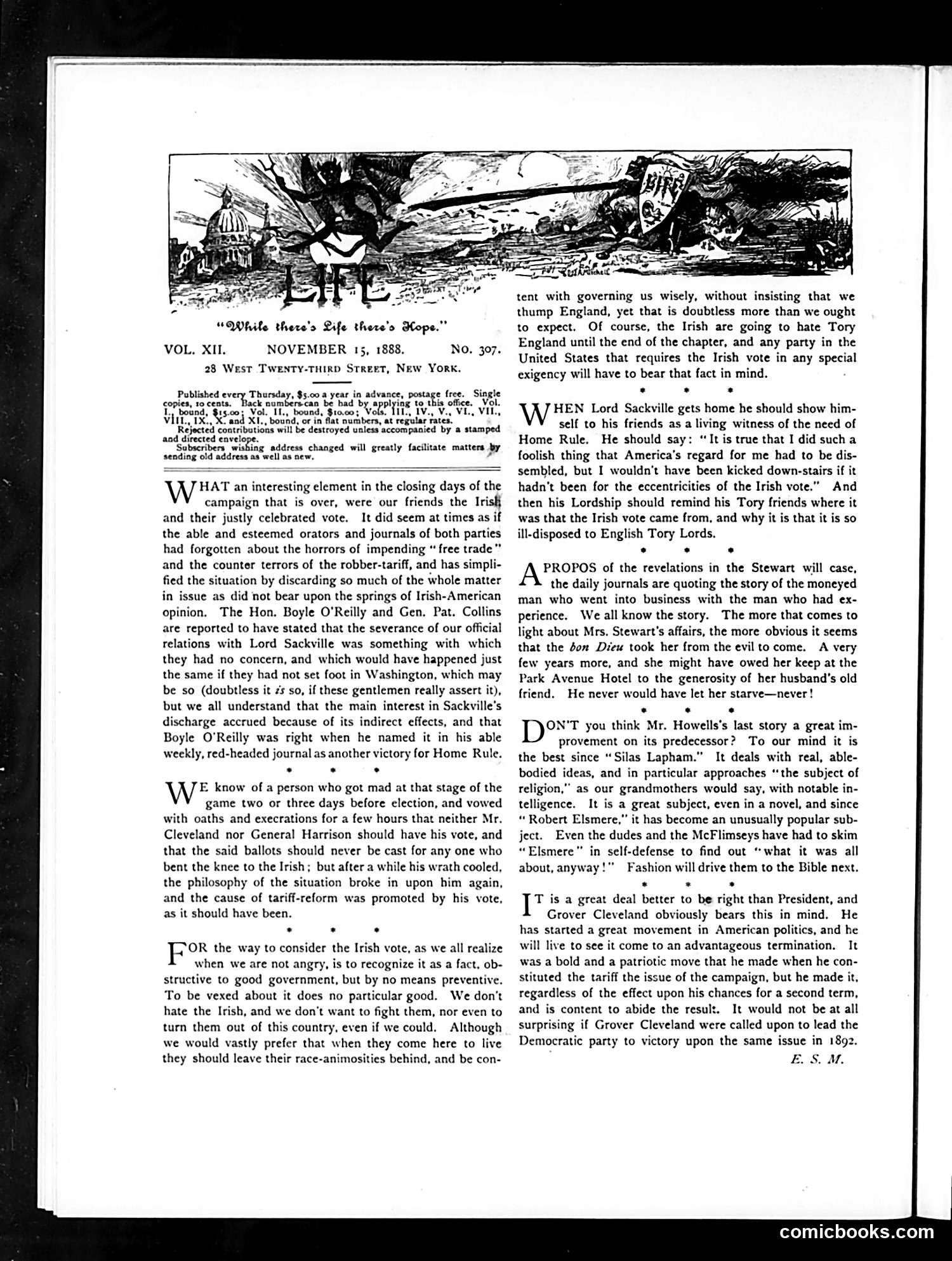
The masthead cartoon depicts allegorical figures in a landscape, though specific identities are unclear from the image alone. The text discusses the recent U.S. presidential campaign, referencing Irish-American voters and their concerns about England and "Home Rule" (Irish independence). The articles critique both major parties' appeals to Irish voters on tariff and foreign policy issues. Key figures mentioned include Lord Sackville (a British diplomat whose involvement in campaign affairs apparently angered Irish voters), Grover Cleveland (Democratic president), and General Harrison (likely Republican candidate). The satire targets how both parties cynically courted Irish-American voters while discussing substantive policy disagreements over tariffs and England relations. The tone suggests skepticism about politicians' sincere commitment to Irish concerns versus electoral calculation.
📄 Transcribed text from this page (OCR, searchable)
Machine-transcribed from the original scan — historical spelling and the odd misread are preserved.
“While there's Life there's Hope.” VOL, XII. NOVEMBER 15, 1888. No. 307. 28 West TWENTY-THIRD Street, New York. Published every Thursday, $5.00 a year in advance, postage free. | Single copies, ro cents. | Back nom is érecan be had by applying to this office. Vol. ound, $15.00; Vol. Il, bound, $10.00; Vole {its 1V., Vr Vi. VIL, VIE TX: 8osad Xb bocadror in dat autabers, at regular Fates. Rejected contributions will be destroyed unless accompanied by a stamped and directed envelope. Subscribers wishing address changed will greatly facilitate matters. by sending old address as well a new. HAT an interesting element in the closing days of the campaign that is over, were our friends the Irish and their justly celebrated vote. It did seem at times as if the able and esteemed orators and journals of both parties had forgotten about the horrors of impending “free trade" and the counter terrors of the robber-tariff, and has simpli- fied the situation by discarding so much of the whole matter in issue as did not bear upon the springs of Irish-American opinion, The Hon, Boyle O'Reilly and Gen. Pat. Collins are reported to have stated that the severance of our official relations with Lord Sackville was something with which they had no concern, and which would have happened just the same if they had not set foot in Washington, which may be so (doubtless it #s so, if these gentlemen really assert it), but we all understand that the main interest in Sackville’s discharge accrued because of its indirect effects, and that Boyle O'Reilly was right when he named it in his able weekly, red-headed journal as another victory for Home Rule. . . . E know of a person who got mad at that stage of the game two or three days before election, and vowed with oaths and execrations for a few hours that neither Mr. Cleveland nor General Harrison should have his vote, and that the said ballots should never be cast for any one who bent the knee to the Irish; but after a while his wrath cooled, the philosophy of the situation broke in upon him again, and the cause of tariff-reform was promoted by his vote, as it should have been. . . . OR the way to consider the Irish vote, as we all realize when we are not angry, is to recognize it as a fact, ob- structive to good government, but by no means preventive. To be vexed about it does no particular good. We don’t hate the Irish, and we don’t want to fight them, nor even to turn them out of this country, even if we could. Although we would vastly prefer that when they come here to live they should leave their race-animosities behind, and be con- tent with governing us wisely, without insisting that we thump England, yet that is doubtless more than we ought to expect. Of course, the Irish are going to hate Tory England until the end of the chapter, and any party in the United States that requires the Irish vote in any special exigency will have to bear that fact in mind. * . * HEN Lord Sackville gets home he should show him- self to his friends as a living witness of the need of Home Rule. He should say: “It is true that I did such a foolish thing that America’s regard for me had to be dis- sembled, but I wouldn't have been kicked down-stairs if it hadn't been for the eccentricities of the Irish vote.” And then his Lordship should remind his Tory friends where it was that the Irish vote came from, and why it is that it is so ill-disposed to English Tory Lords. . . . PROPOS of the revelations in the Stewart will case, the daily journals are quoting the story of the moneyed man who went into business with the man who had ex- perience. We all know the story. The more that comes to light about Mrs. Stewart's affairs, the more obvious it seems that the don Dieu took her from the evil to come. A very few years more, and she might have owed her keep at the Park Avenue Hotel to the generosity of her husband's old friend. He never would have let her starve—never! . . . [-pex= you think Mr. Howells’s last story a great im- provement on its predecessor? To our mind it is the best since “Silas Lapham.” It deals with real, able- bodied ideas, and in particular approaches “the subject of religion,” as our grandmothers would say, with notable in- telligence. It is a great subject, even in a novel, and since “ Robert Elsmere,” it has become an unusually popular sub- ject. Even the dudes and the McFlimseys have had to skim “Elsmere” in self-defense to find out “what it was all about, anyway!" Fashion will drive them to the Bible next. . * . T is a great deal better to be right than President, and Grover Cleveland obviously bears this in mind. He has started a great movement in American politics, and he will live to see it come to an advantageous termination. It was a bold and a patriotic move that he made when he con- stituted the tariff the issue of the campaign, but he made it, regardless of the effect upon his chances for a second term, and is content to abide the result. It would not be at all surprising if Grover Cleveland were called upon to lead the Democratic party to victory upon the same issue in a ings ELS. M. comicbooks.com