
A complete issue · 14 pages · 1888
Life — November 8, 1888
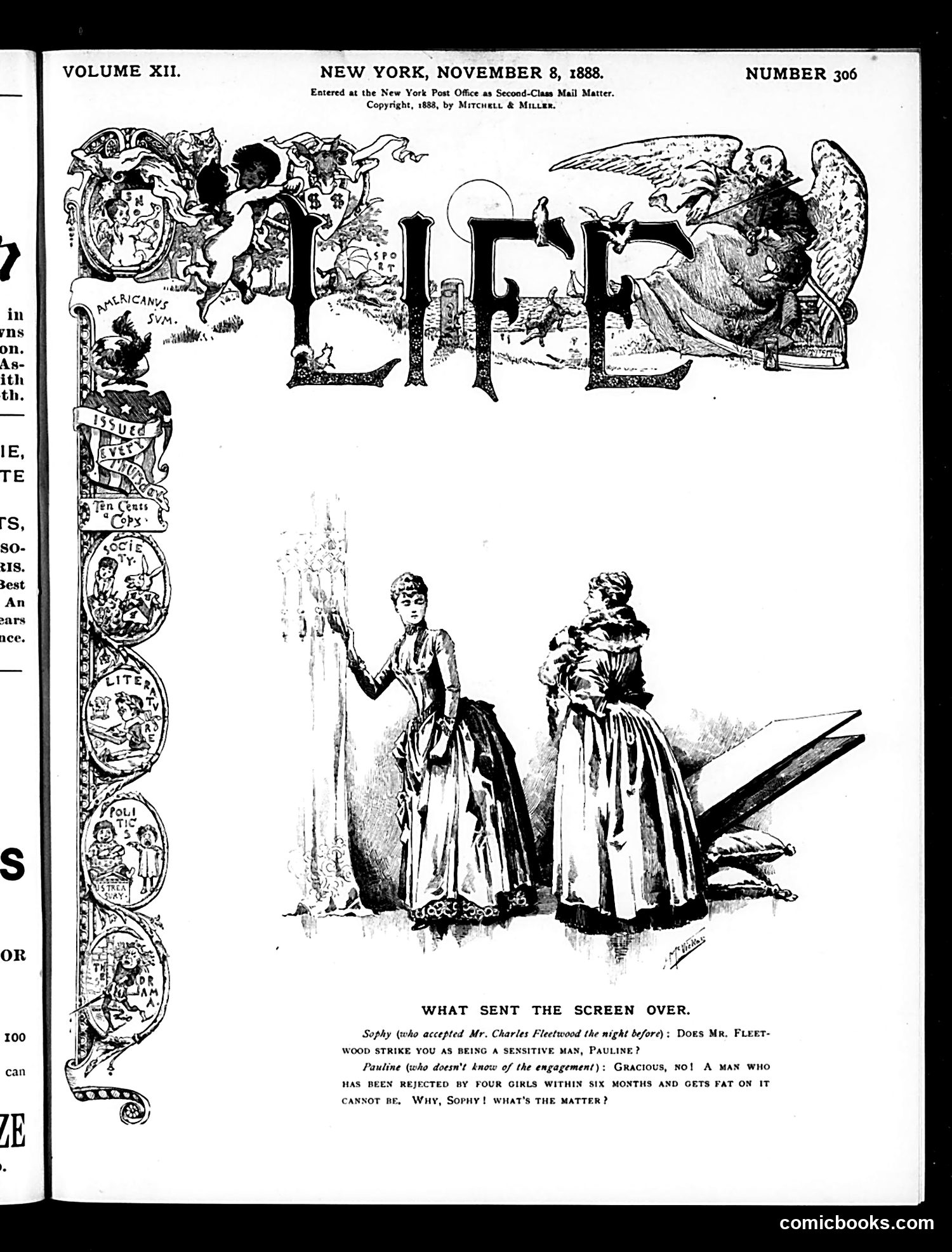
This Life magazine page from November 8, 1888 satirizes a romantic/social scandal involving named figures. The dialogue indicates: - **Sophy** has accepted a proposal from "Mr. Charles Fleetwood" the previous night - **Pauline** (who doesn't know about the engagement) is shocked - **Mr. Fleetwood** is accused of being a "sensitive man" who was rejected by four girls within six months, then pursued Sophy and "gets fat on it" The humor centers on a man's desperation and opportunism in courtship—he rebounds from repeated rejections to win over Sophy, whose acceptance apparently causes such emotional upheaval that it "sent the screen over" (knocked it down in shock). The satire mocks both masculine romantic persistence and the social drama surrounding engagements in 1880s society.
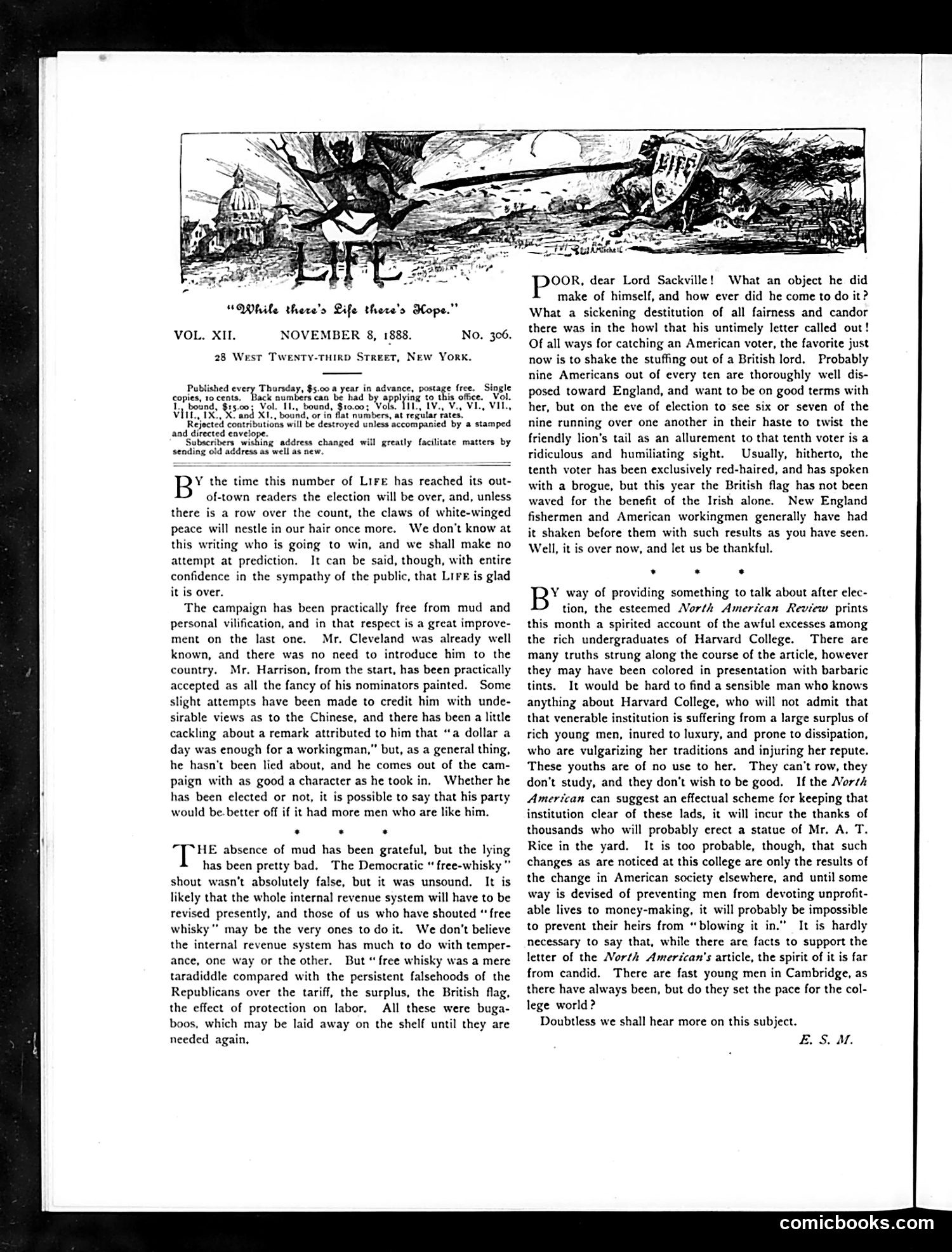
The masthead cartoon shows a figure labeled "Life" emerging from or associated with classical architectural elements (a dome, likely the Capitol). The editorial discusses the upcoming presidential election, mentioning Cleveland and Harrison as candidates. The tone is optimistic that Life magazine's campaign has been "practically free from mud and personal vilification," contrasting with typical mudslinging. The text criticizes Democratic "free-whisky" rhetoric as economically unsound and discusses Republican positions on tariffs, surplus, and labor protection. A secondary piece criticizes Harvard College for admitting wealthy undergraduates devoted to luxury and dissipation rather than education, suggesting this reflects broader American societal decline. The satire targets both political hypocrisy and elite institutional failures during the 1888 election cycle.
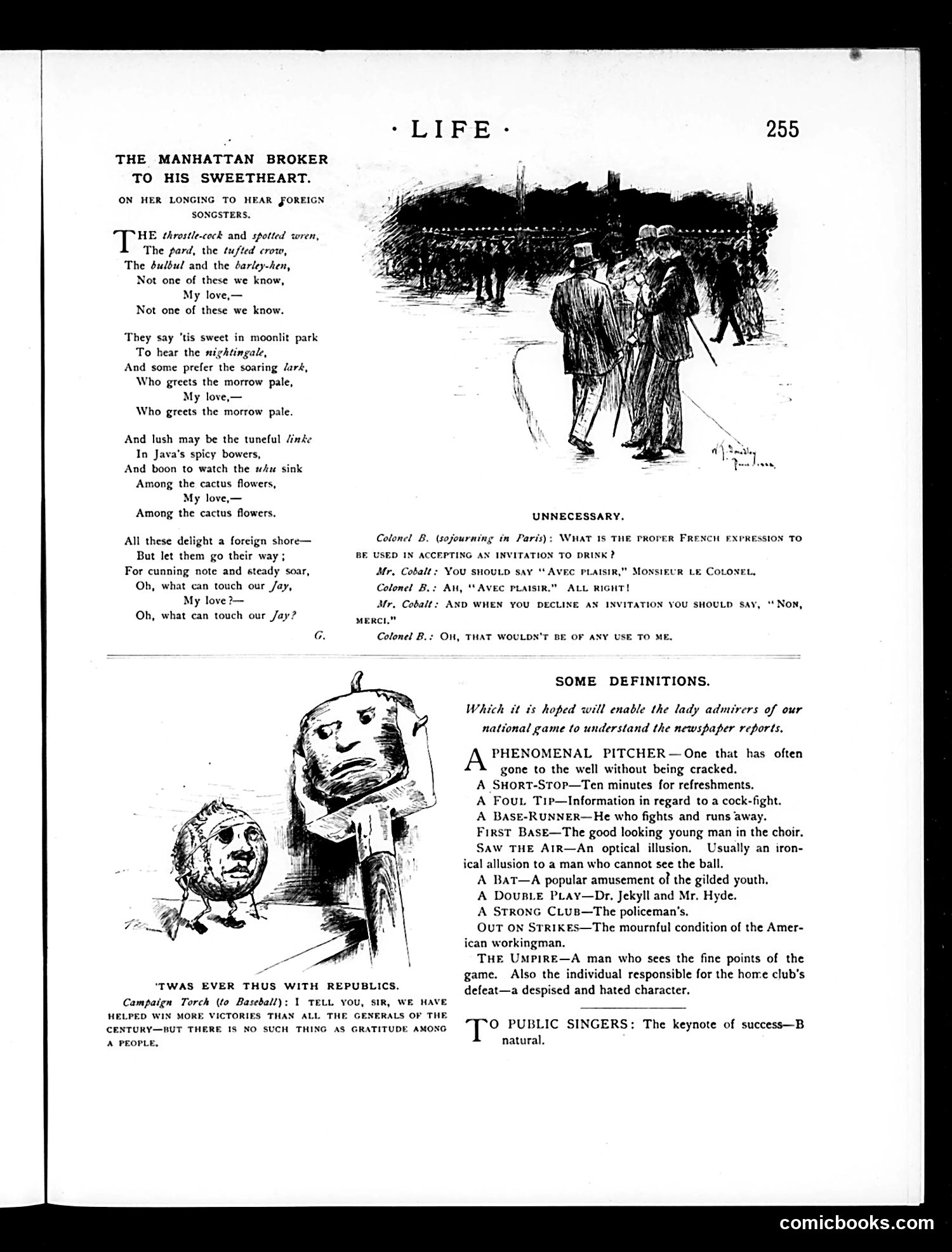
The page contains three distinct sections: 1. **"The Manhattan Broker to His Sweetheart"** — A romantic poem about longing to hear foreign songbirds, expressing that nothing compares to one's love. This appears to be sentimental verse without obvious political content. 2. **"Unnecessary"** — A brief dialogue joke about proper French expressions for accepting or declining dinner invitations, showing cultural humor about etiquette differences between Americans and the French. 3. **"Some Definitions"** — Baseball-related humor defining terms like "phenomenal pitcher," "short-stop," and "umpire" in witty, non-literal ways. The accompanying cartoon shows two figures (unclear who specifically) with commentary about a baseball campaign torch. The page primarily contains social satire and sporting humor rather than direct political commentary.
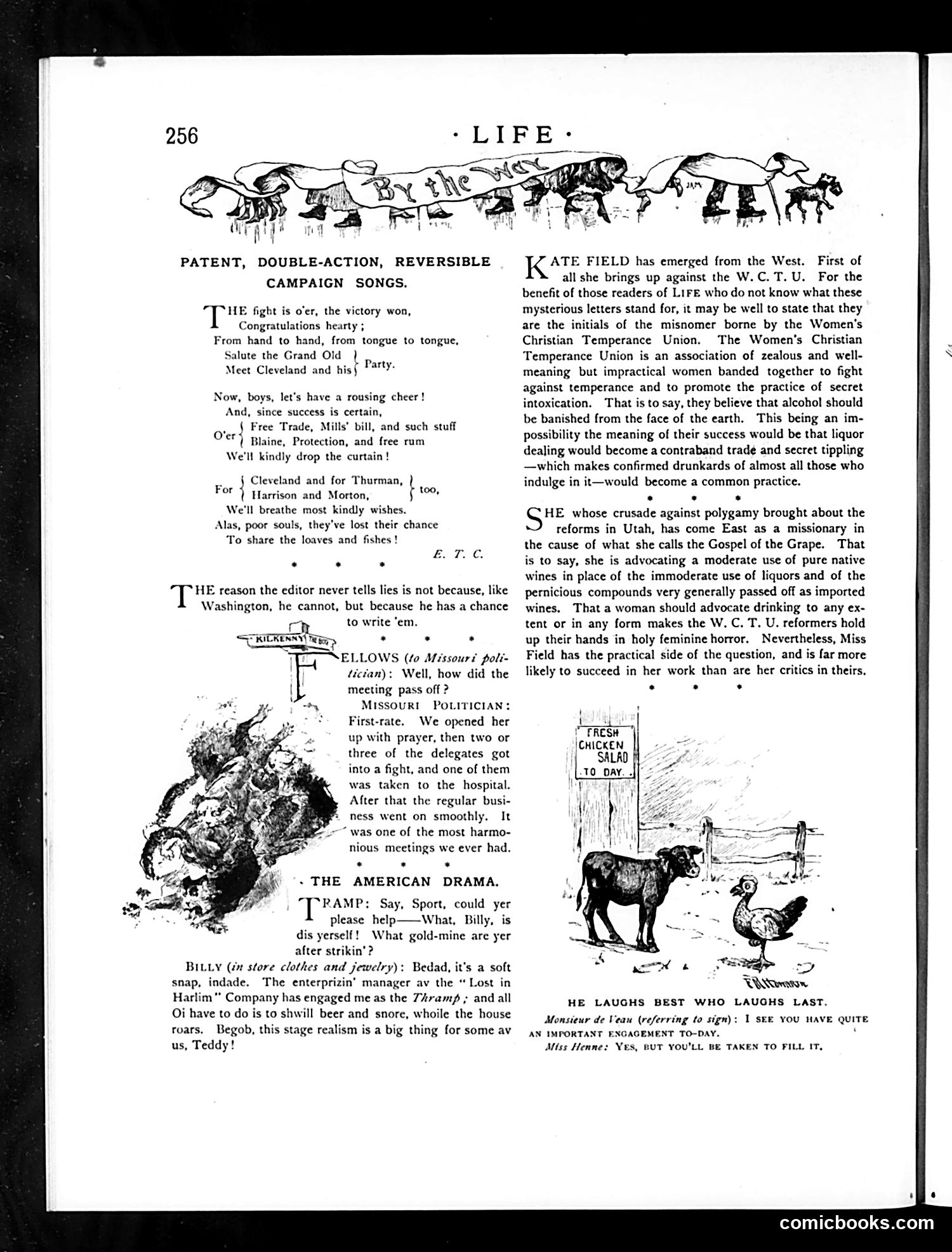
This page contains political satire about the 1884 U.S. presidential campaign between Cleveland and Blaine. The "Patent, Double-Action, Reversible Campaign Songs" mock how both candidates' supporters sing identical praise-songs with interchangeable lyrics—simply swapping names. The joke: campaign rhetoric is formulaic and hollow. The lower section discusses Kate Field's anti-polygamy crusade in Utah and her advocacy for moderate wine consumption as alternative to total prohibition—positioning her against the Women's Christian Temperance Union (W.C.T.U.). "The American Drama" section humorously recounts a chaotic political meeting where delegates literally fought, with one hospitalized. The sketch shows rural subjects commenting on an engagement announcement, providing social satire about domestic life.
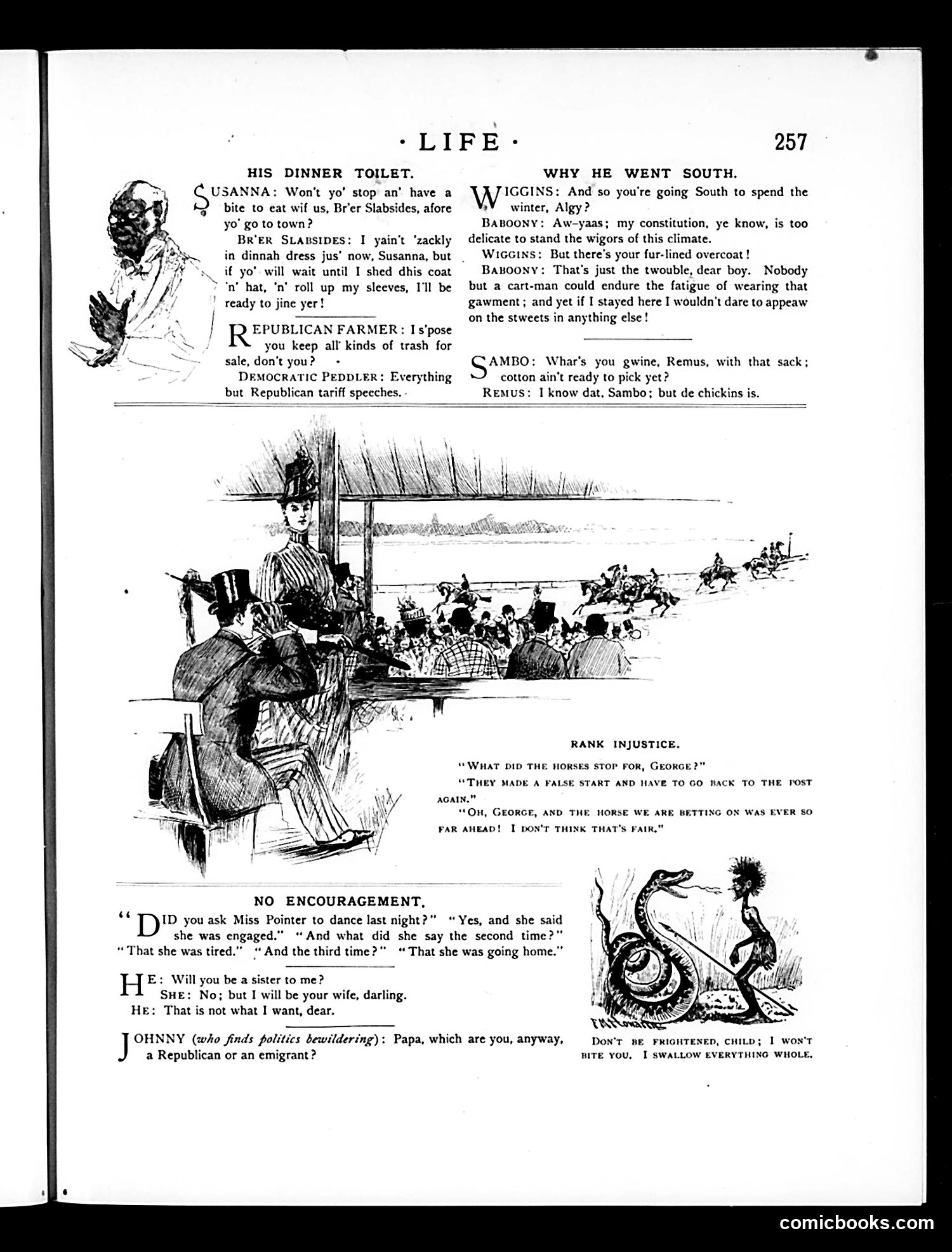
This page contains several brief satirical dialogues mocking American political and social attitudes circa early 1900s. **"His Dinner Toilet"** jokes about class pretension—a working-class man wants to look respectable for dinner despite shabby clothes. **"Why He Went South"** depicts a Southern gentleman (Baboony) explaining why he abandons his overcoat in winter rather than risk wearing it publicly—satirizing Southern pride and vanity. **"Rank Injustice"** mocks dishonest betting practices at horse races, showing spectators complaining about fixed outcomes. **"No Encouragement"** presents a romantic rejection, while the final joke portrays a child asking his father whether he's Republican or an emigrant—conflating political affiliation with outsider status, likely satirizing anti-immigrant sentiment or Republican party identity among certain demographics.
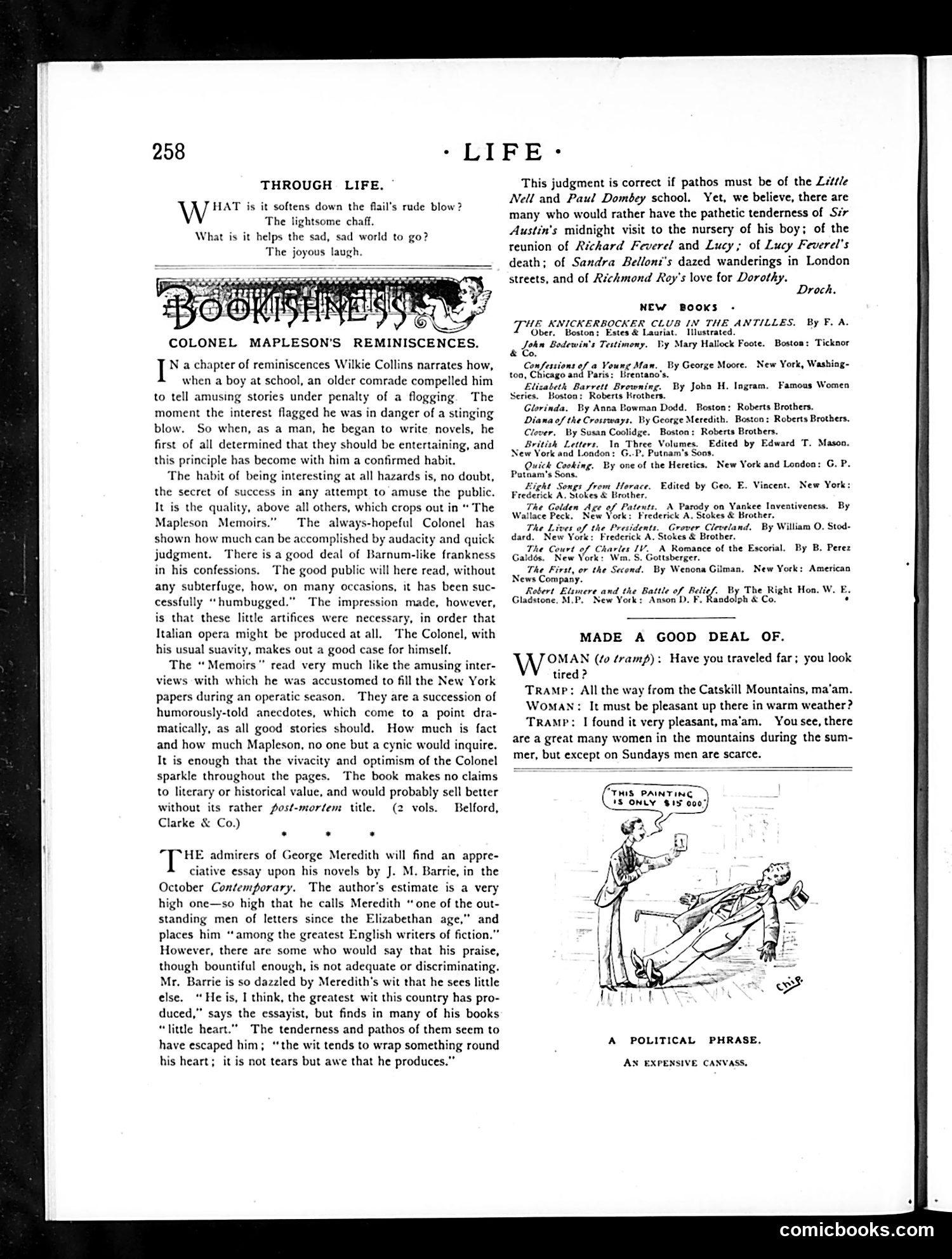
This page contains two distinct elements: **"Made a Good Deal Of"** — A brief dialogue joke featuring a tramp and woman discussing travel in the Catskill Mountains. The humor relies on the tramp's implication that women are scarce in the mountains except on Sundays (when men are available), suggesting loose morality. **"A Political Phrase"** — A cartoon showing a figure painting or writing something, with the caption "This painting is only $10 day." The illustration appears to mock either artistic pretension or political rhetoric about cost/value, though the specific reference is unclear from the image alone. The page also reviews literary works and Colonel Mapleton's reminiscences, but these are standard magazine content rather than satirical commentary. The cartoons employ the era's typical working-class humor and social observation characteristic of Life's satirical approach.
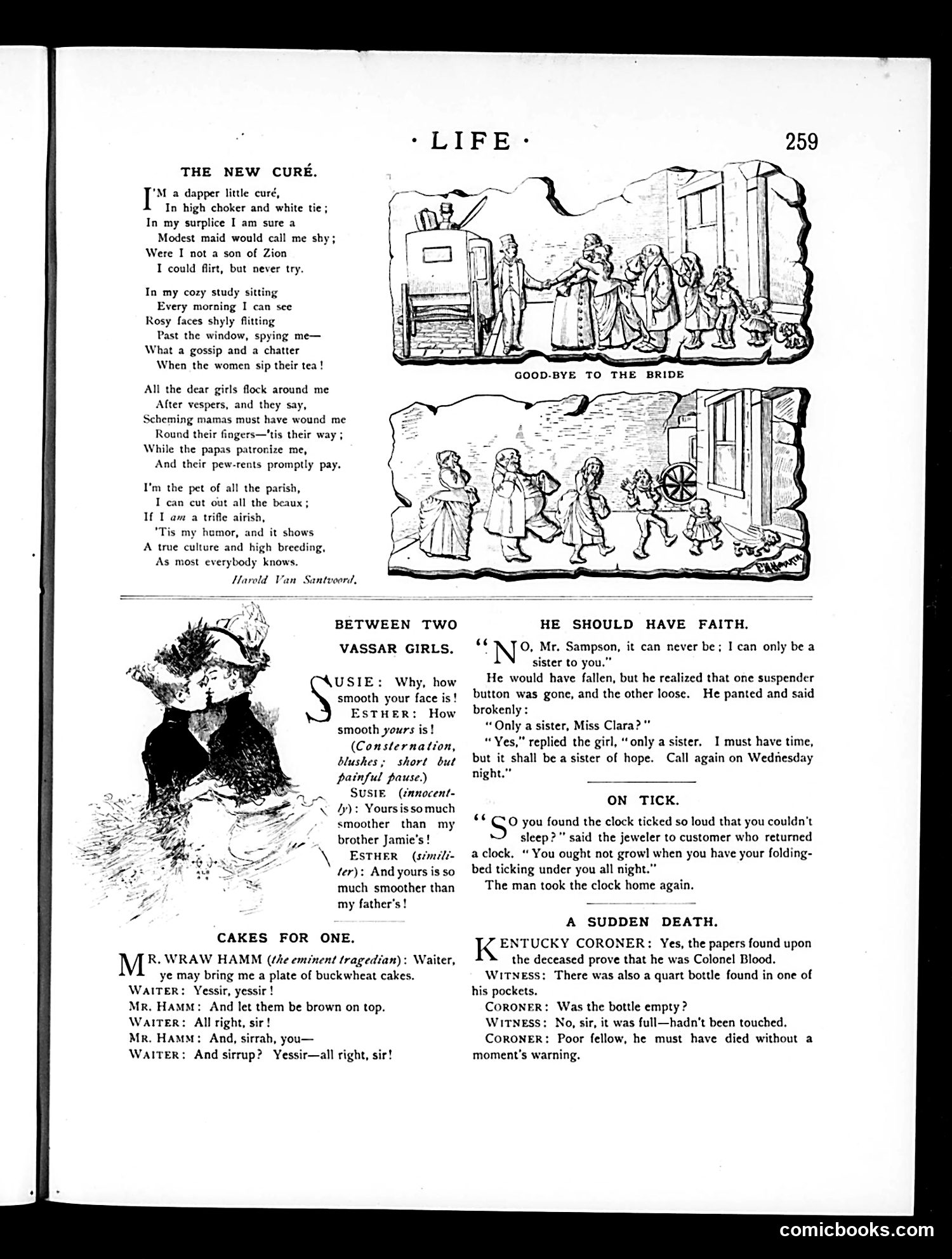
This page contains several humorous sketches and dialogues typical of early 20th-century satirical magazines: **"The New Curé"** is a poem about a fashionable young priest—a "dapper little cur" in fashionable dress—who gossips with society women rather than performing serious religious duties. The satire mocks clergy who prioritize high society over their pastoral responsibilities. The other sketches are brief comedic dialogues: "Between Two Vassar Girls" jokes about personal grooming, "Cakes for One" depicts a waiter's misunderstanding about food orders, "On Tick" puns on clock repair, and "A Sudden Death" presents a coroner's inquest with dark humor about a man dying from alcoholism. These are light, disconnected social comedies rather than political commentary.
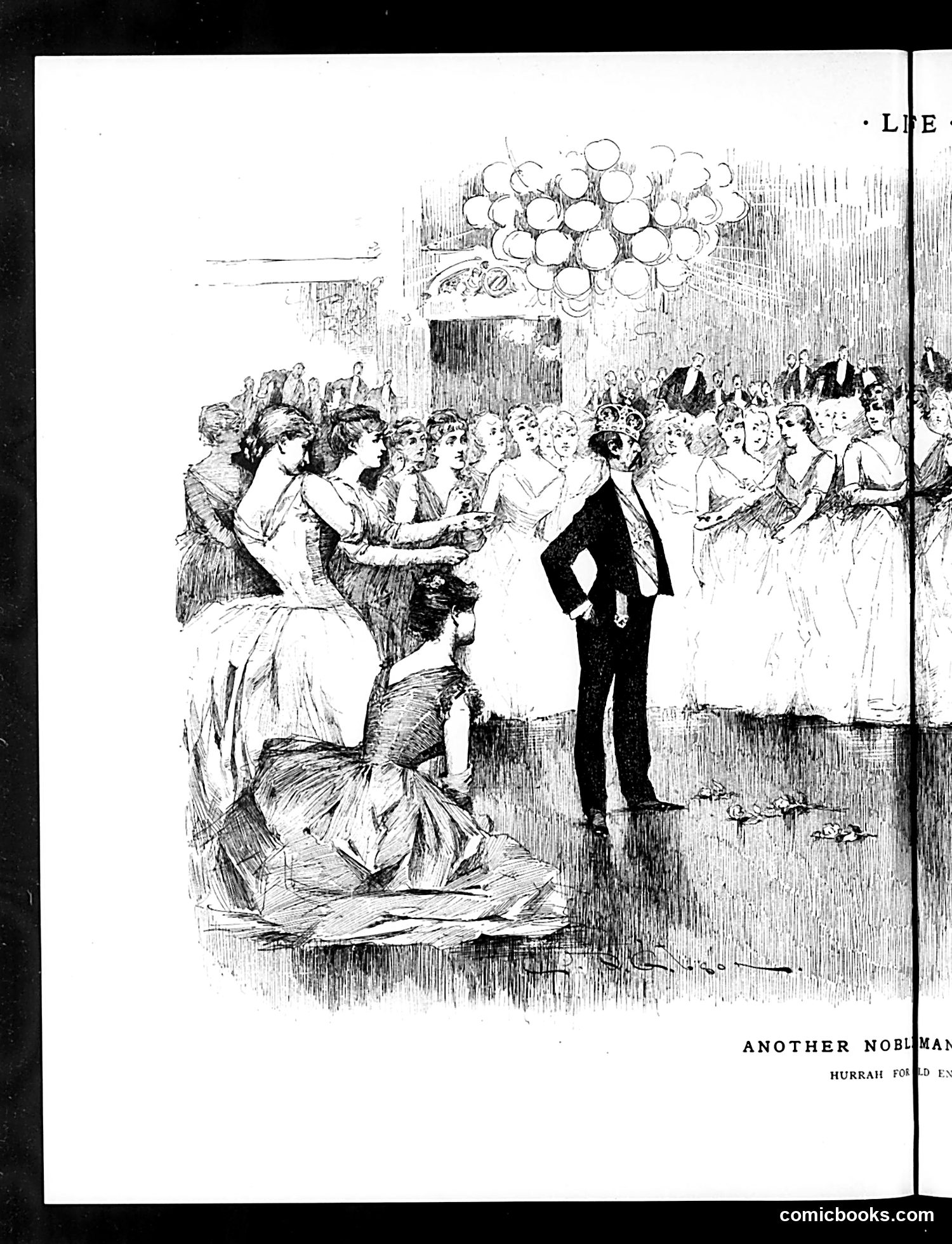
This satirical illustration depicts a formal ball or social gathering where a woman in an elaborate ball gown sits prominently in the foreground while a man in formal dress stands nearby. The text reads "ANOTHER NOBLEMAN" with "HURRAH FOR D EN—" (text cut off). The satire appears to target social pretension and the aristocratic affectations of American society. The woman's exaggerated posture and display suggest mockery of nouveau riche social climbing or the worship of European nobility titles. The incomplete exclamation suggests ironic enthusiasm for another "nobleman"—likely an American attempting to emulate or claiming European aristocratic status. The crowded ballroom background emphasizes this as commentary on Gilded Age American society's fascination with European nobility and titles.
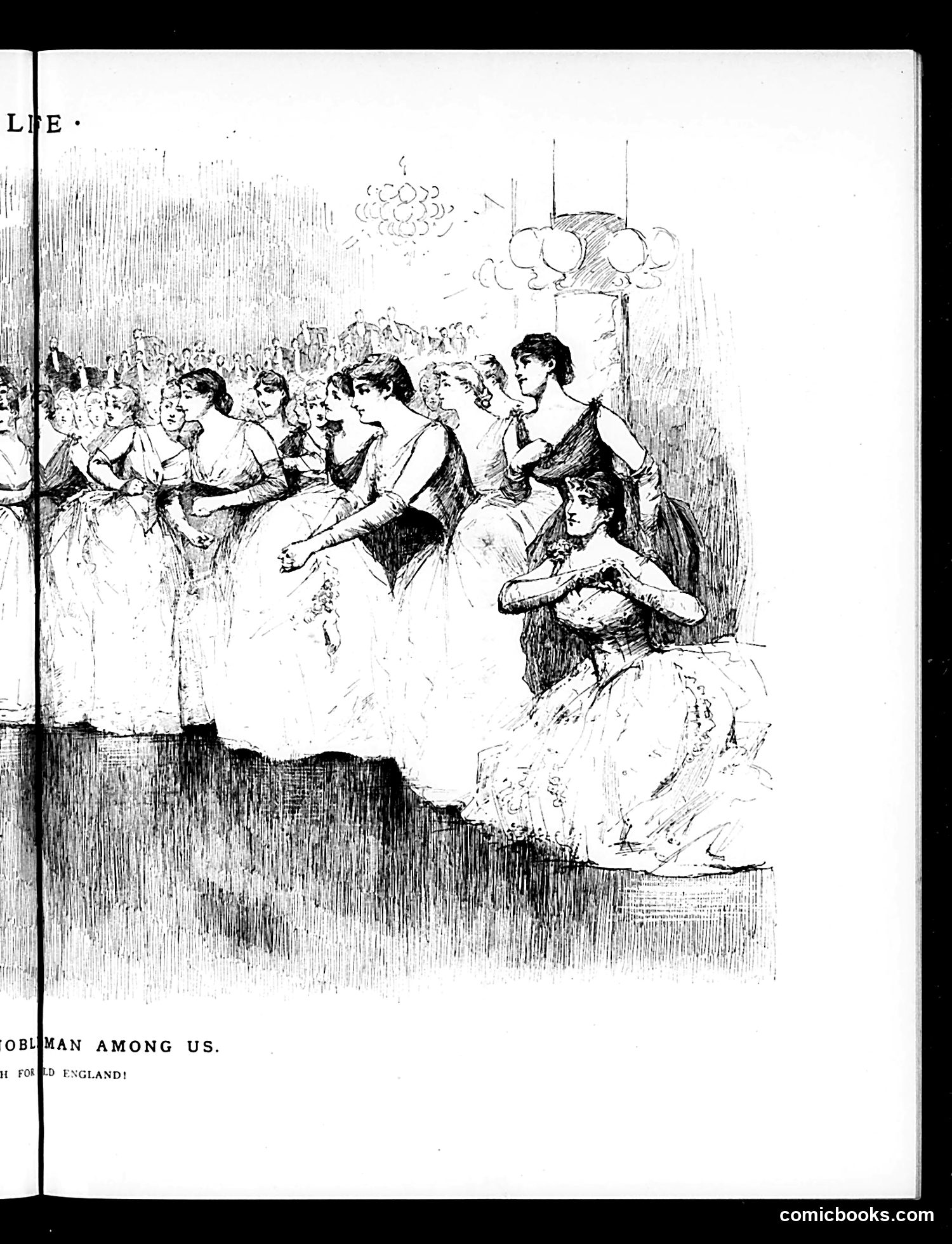
This satirical illustration depicts a social gathering of well-dressed women, with the caption "A Woman Among Us" and a subtitle reading "A Hope for Old England!" The cartoon appears to mock Victorian-era gender conventions and social anxieties about women's changing roles. The illustration shows women in fashionable dress at what looks like a formal event or salon. The satire likely comments on debates about women's independence, education, or social participation—issues that concerned British society during this period. The phrase "Hope for Old England" suggests the cartoon ironically presents women's social advancement or visibility as either something to celebrate or to fear, depending on the viewer's perspective. Without a specific date visible, the exact historical context remains unclear, though this reflects late 19th or early 20th-century gender politics discussions.
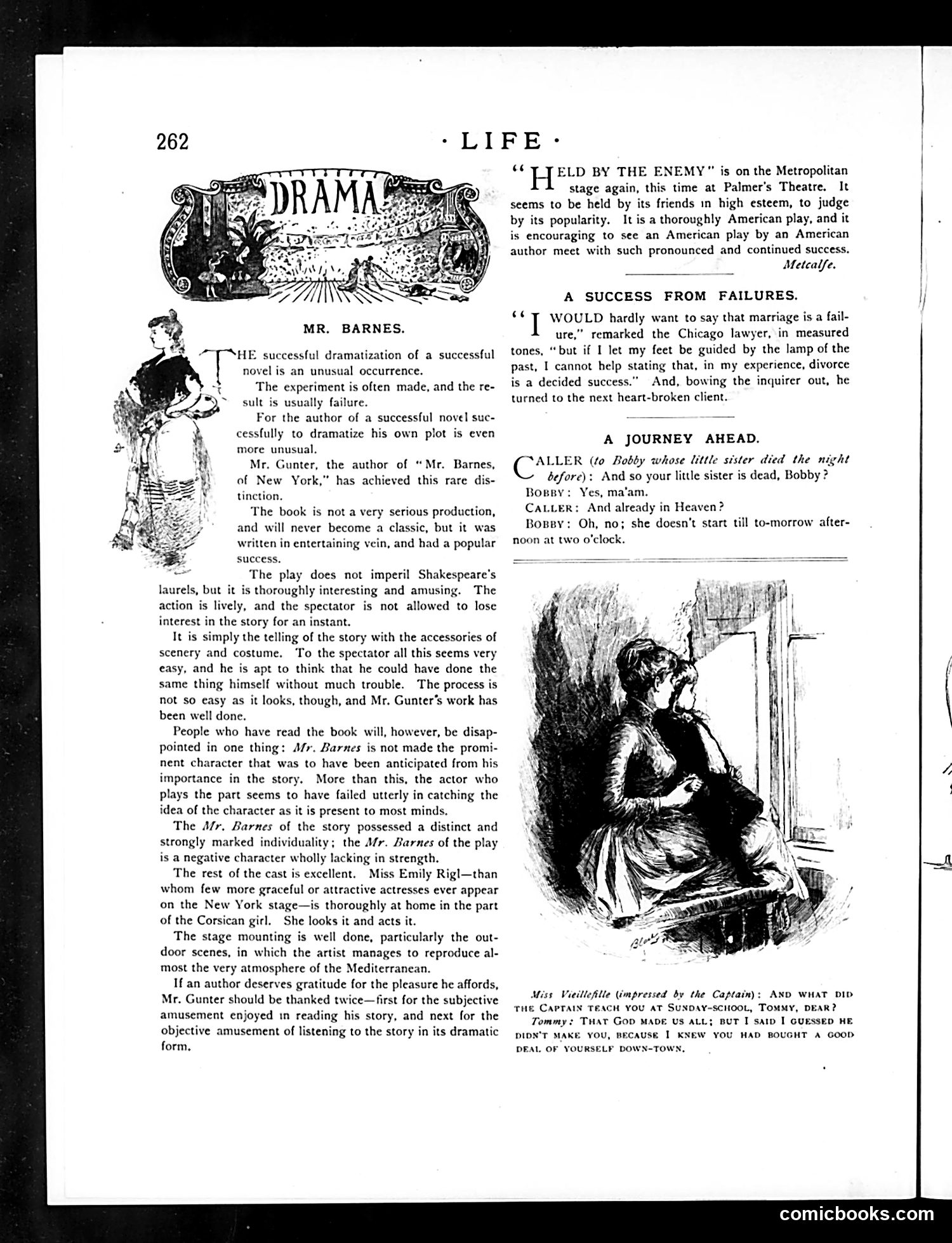
This page reviews dramatic adaptations, specifically focusing on "Mr. Barnes," a play based on a successful novel by an author from New York. The review critiques the dramatization, noting that while the book was entertaining, the stage adaptation fails to capture the main character effectively. The accompanying illustration shows a fashionably dressed woman in period costume, likely representing the theatrical production's visual appeal. The page includes a satirical dialogue snippet titled "A Journey Ahead" featuring characters named Caller, Bobby, and Tommy, with darkly humorous exchanges about death and afterlife—typical of Life magazine's mordant wit. The content exemplifies early 20th-century theatrical criticism combined with the magazine's characteristic irreverent humor about serious subjects.
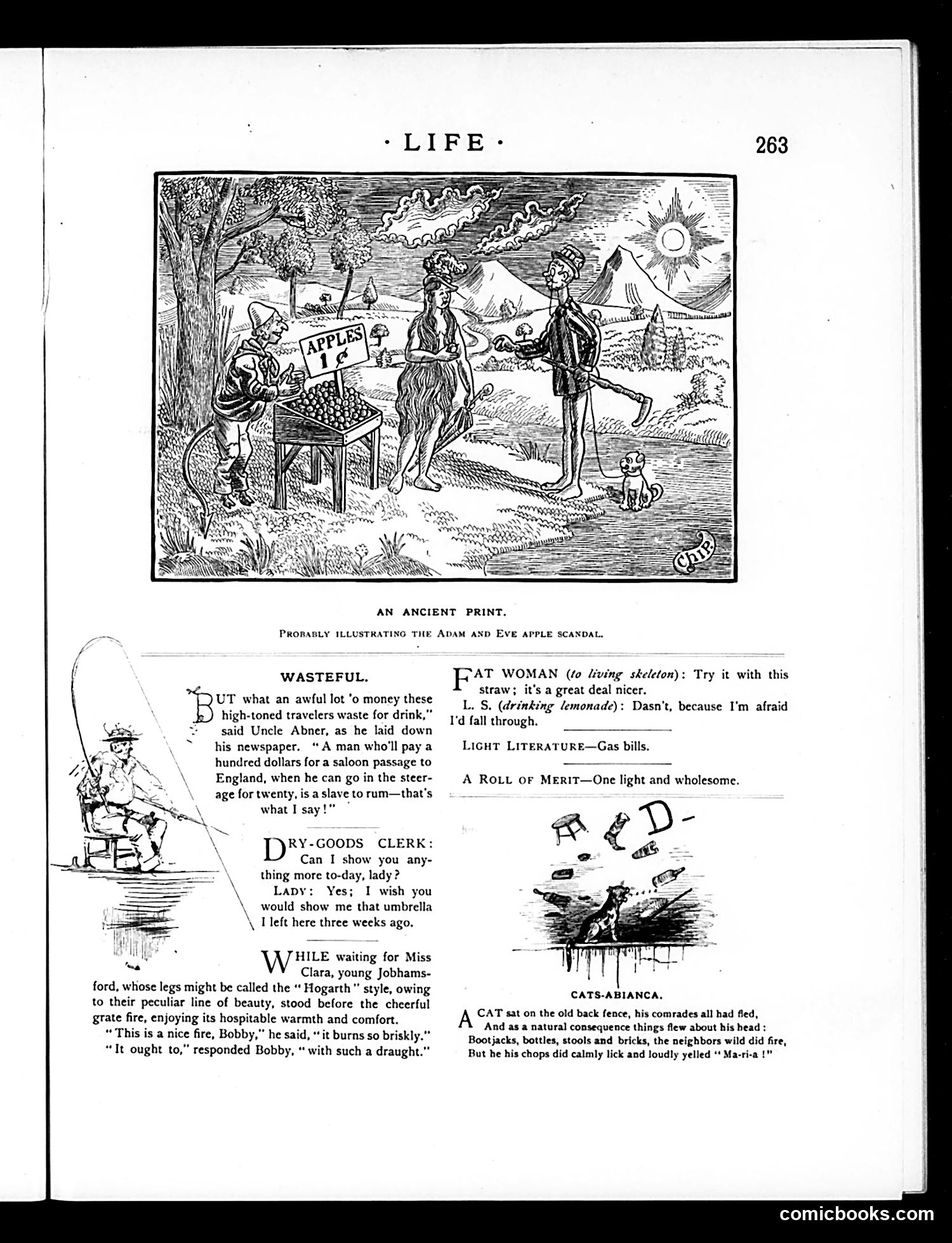
This page contains several brief satirical sketches mocking various social behaviors: **Top image**: "An Ancient Print" parodies religious art by depicting the Adam and Eve apple story as a social scandal, with period-dressed figures engaging in what appears to be illicit fruit commerce. **"Wasteful"**: Uncle Abner criticizes wealthy travelers who pay premium prices for first-class passage rather than economical steerage, calling such extravagance a "slave to rum" (drunkenness/vice). **"Dry-Goods Clerk"**: A customer complains that a clerk cannot locate an umbrella she left three weeks prior—mocking poor retail service. **"Cats-Abianca"**: A humorous poem about a cat indifferently ignoring chaos (flying objects, neighbors' chaos) while calmly eating, parodying the famous poem "Casabianca" about a boy who heroically stays at his post. The page satirizes consumer wastefulness, class pretension, commercial incompetence, and literary sentimentality through brief, pithy jokes typical of *Life* magazine's satirical format.
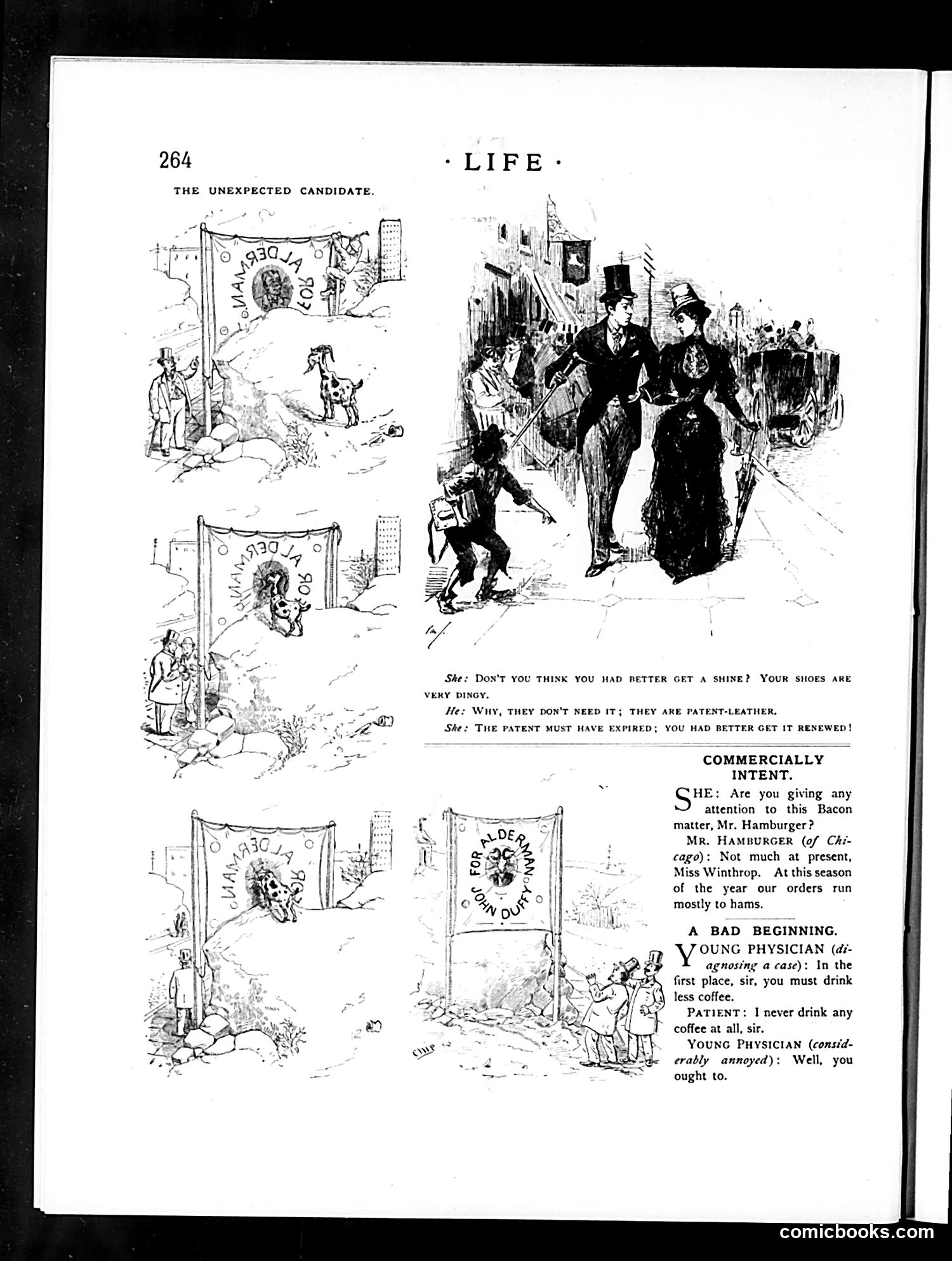
This page contains three separate satirical jokes typical of early 20th-century Life magazine humor: 1. **"The Unexpected Candidate"** (top): A visual gag about patent leather shoes. The woman suggests her companion needs a shoe shine because his shoes look dull. He claims patent leather doesn't need shining. She jokes that the patent (the legal protection) must have expired, so he should "renew it"—a pun on patent renewal and shoe maintenance. 2. **"Commercially Intent"** (middle): A butcher/meat merchant named Hamburger and a woman named Winthrop discuss bacon orders. The joke plays on the surname "Hamburger" (a meat product) and implies most meat sales in their business run to hams rather than bacon seasonally. 3. **"A Bad Beginning"** (bottom): A young doctor diagnoses a patient and prescribes less coffee. The patient replies he drinks none. The doctor, annoyed, insists "you ought to"—humor based on the absurdity of the physician's illogical prescription. All three are light, pun-based humor relying on wordplay and mild social observation rather than political commentary.
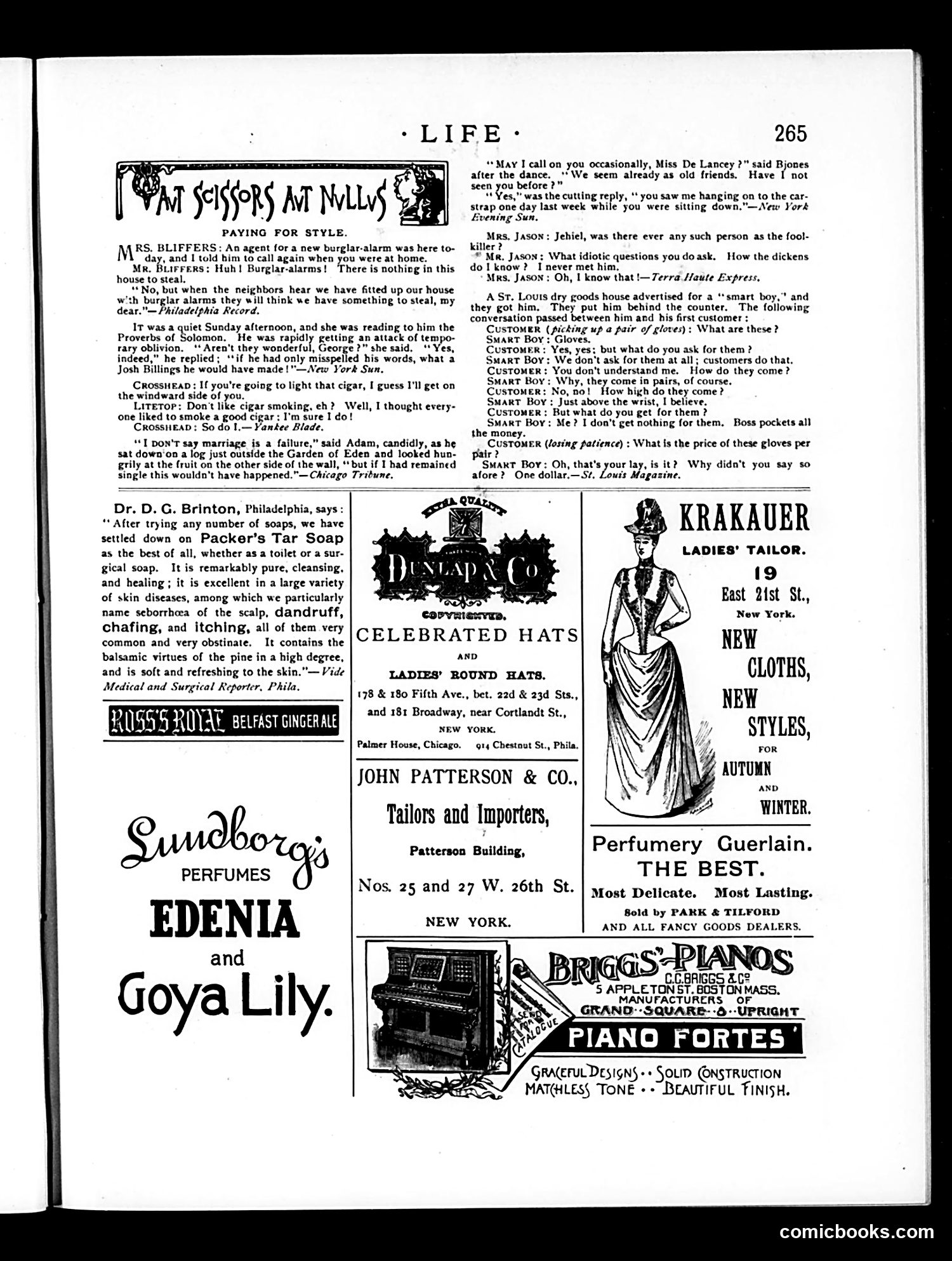
This page features a collection of brief humorous anecdotes rather than a political cartoon. The main satirical content includes: **"Paying for Style"**: A joke about the Bliffers family installing a burglar alarm not to prevent theft, but to convince neighbors they own valuables worth stealing—mocking conspicuous consumption and status anxiety among the wealthy. **Other anecdotes** poke fun at: - A woman reading Proverbs who bores her husband - A cigar smoker and non-smoker's conversation - Adam regretting marriage - A woman who saw a man "hanging on to the car-strap" (implying he's poor or common) - A comically literal "smart boy" employee who doesn't understand retail markup These are mild, domestic humor pieces targeting pretension, social climbing, and miscommunication—typical of Life magazine's early satirical style. The page is otherwise dominated by period advertisements for hats, pianos, perfume, and tailoring services.
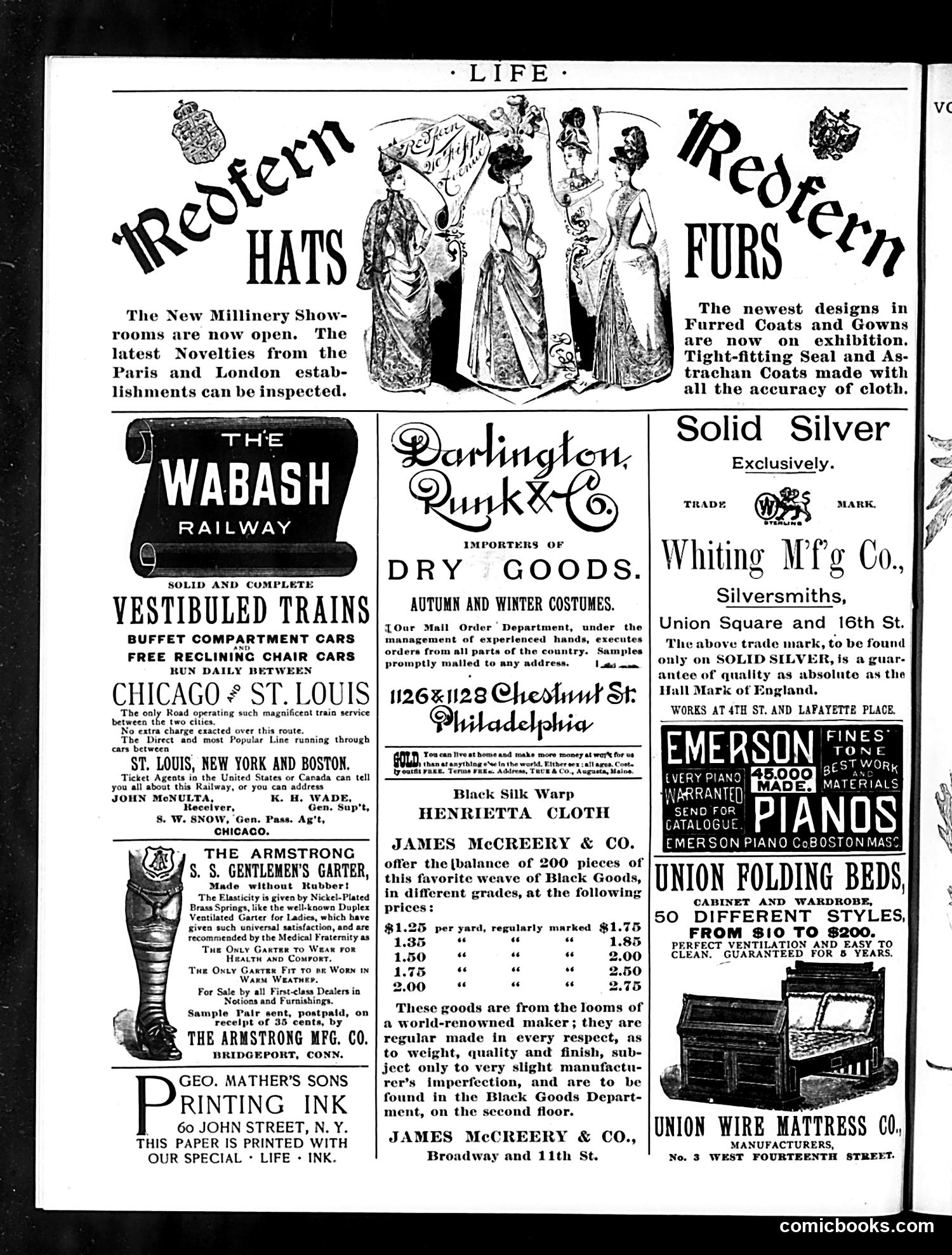
This page is primarily **advertising**, not satire or editorial content. It contains no political cartoons or social commentary requiring historical context. The top features decorative illustrations of women modeling **Redfern hats and furs**—fashionable millinery from Paris and London establishments newly on display. This reflects the era's emphasis on European fashion imports for wealthy consumers. The remainder consists of period advertisements for: - **The Wabash Railway** (vestibuled trains between Chicago and St. Louis) - **Darlington, Runk & Co.** (dry goods importers) - **Armstrong Garters** (elastic hosiery supports) - **James McCreery & Co.** (fabric and clothing retailer) - **Whiting Manufacturing** (solid silver goods) - **Emerson Pianos** - **Union Folding Beds and Wire Mattresses** All reflect late 19th-century consumer goods and services targeting middle to upper-class readers. The page demonstrates how *Life* magazine funded itself through paid advertisements alongside editorial content.