
Life, 1888-11-08 · page 6 of 14
Life — November 8, 1888 — page 6: what you’re looking at
What you’re looking at
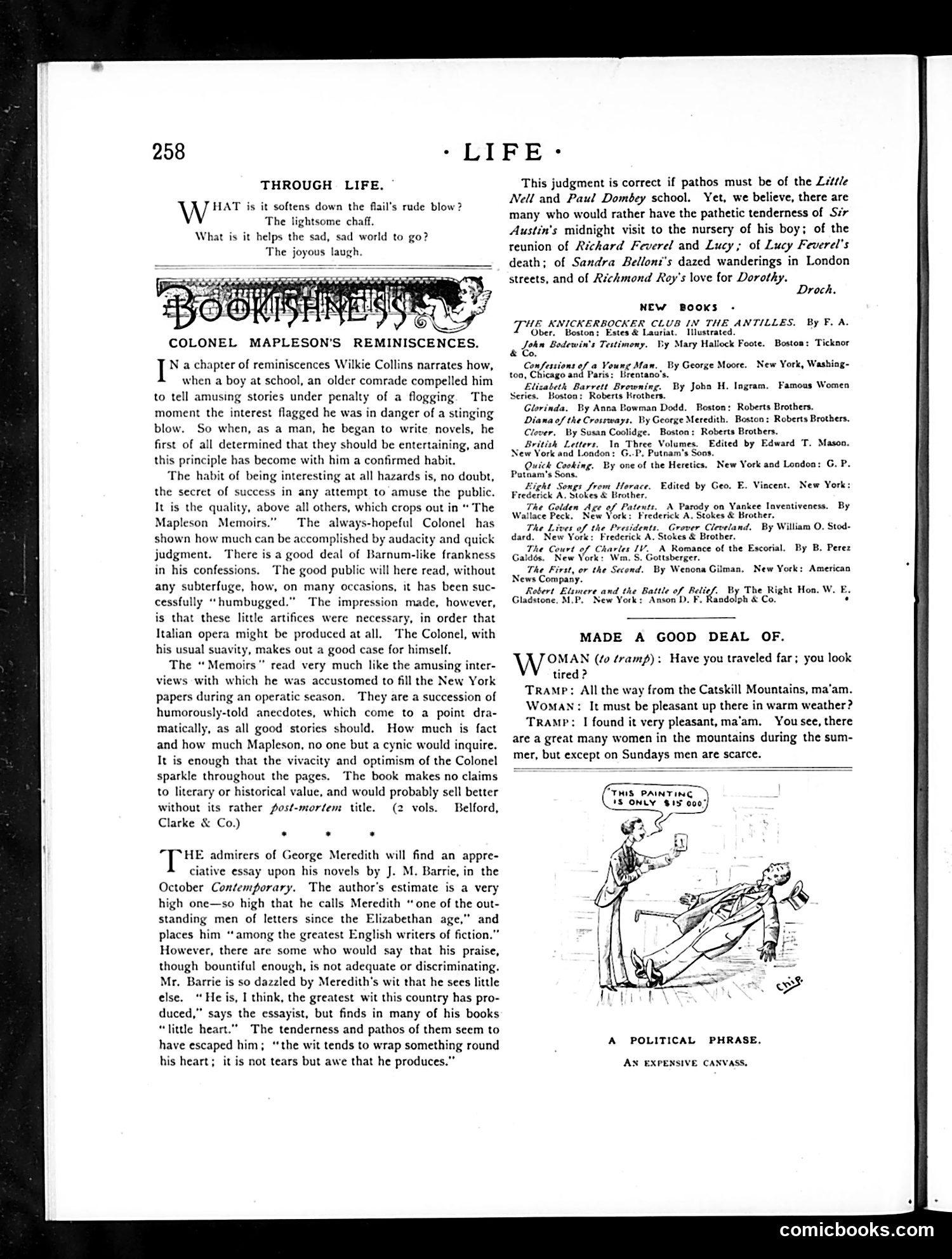
This page contains two distinct elements: **"Made a Good Deal Of"** — A brief dialogue joke featuring a tramp and woman discussing travel in the Catskill Mountains. The humor relies on the tramp's implication that women are scarce in the mountains except on Sundays (when men are available), suggesting loose morality. **"A Political Phrase"** — A cartoon showing a figure painting or writing something, with the caption "This painting is only $10 day." The illustration appears to mock either artistic pretension or political rhetoric about cost/value, though the specific reference is unclear from the image alone. The page also reviews literary works and Colonel Mapleton's reminiscences, but these are standard magazine content rather than satirical commentary. The cartoons employ the era's typical working-class humor and social observation characteristic of Life's satirical approach.
📄 Transcribed text from this page (OCR, searchable)
Machine-transcribed from the original scan — historical spelling and the odd misread are preserved.
258 THROUGH LIFE." Wet is it softens down the flail’s rude blow? The lightsome chaff. What is it helps the sad, sad world to go? The joyous laugh. COLONEL MAPLESON’S REMINISCENCES. N a chapter of reminiscences Wilkie Collins narrates how, when a boy at school, an older comrade compelled him to tell amusing stories under penalty of a flogging. The moment the interest flagged he was in danger of a stinging blow. So when, as a man, he began to write novels, he first of all determined that they should be entertaining, and this principle has become with him a confirmed habit. The habit of being interesting at all hazards is, no doubt, the secret of success in any attempt to amuse the public. It is the quality, above all others, which crops out in “ The Mapleson Memoirs.” The always-hopeful Colonel has shown how much can be accomplished by audacity and quick judgment. There is a good deal of Barnum-like frankness in his confessions. The good public will here read, without any subterfuge, how, on many occasions, it has been suc- cessfully “humbugged.” The impression made, however, is that these little artifices were necessary, in order that Italian opera might be produced at all. The Colonel, with his usual suavity, makes out a good case for himself. The “Memoirs” read very much like the amusing inter- views with which he was accustomed to fill the New York papers during an operatic season. They are a succession of humorously-told anecdotes, which come to a point dra- matically, as all good stories should. How much is fact and how much Mapleson, no one but a cynic would inquire. It is enough that the vivacity and optimism of the Colonel sparkle throughout the pages. The book makes no claims to literary or historical value, and would probably sell better without its rather post-mortem title. (2 vols. Belford, Clarke & Co.) . . . [TH admirers of George Meredith will find an appre- ciative essay upon his novels by J. M. Barrie, in the October Contemporary. The author's estimate is a very high one—so high that he calls Meredith “one of the out- standing men of letters since the Elizabethan age,” and places him “among the greatest English writers of fiction.” However, there are some who would say that his praise, though bountiful enough, is not adequate or discriminating. Mr. Barrie is so dazzled by Meredith's wit that he sees little else. “He is, I think, the greatest wit this country has pro- duced,” says the essayist, but finds in many of his books “little heart." The tenderness and pathos of them seem to have escaped him; “the wit tends to wrap something round his heart; it is not tears but awe that he produces.” > LIFE: This judgment is correct if pathos must be of the Léééle Nell and Paul Dombey school. Yet, we believe, there are many who would rather have the pathetic tenderness of Sir Austin's midnight visit to the nursery of his boy; of the reunion of Richard Feverel and Lucy; of Lucy Feverel's death; of Sandra Belloni’s dazed wanderings in London streets, and of Richmond Roy's love for Dorothy. Droch. NEW BooKs - THE KNICKERBOCKER CLUB IN THE ANTILLES. By F. A. Ober. Boston: Estes & Lauriat. Illustrated. Lehn Bedewin's Testimony. By Mary Hallock Foote, Boston: Ticknor & Co, Confessions of a Young too, Chicago and Paris: Bren’ . Elizabeth Barrett Browning. By Joba H. Ingram, Famous Women Series. Boston: Roberts Hrothers. Glorinda, By Anna Bowman Dodd. Boston: Roberts Brothers. Diana of the Crossways, By George Meredith. Boston: Roberts Brothers. Clover, By Susan Coolidge. Boston: Roberts Brothers. British Lettert, \n Three Volumes. Edited by Edward T. Masoo. New York and London: G.-P, Putnam's Soos. Quick Cooking. By one of the Heretics. Patnam's Sons. Eight Songs from Horace. ‘ick A. Stokes & Brother. The Golden Ace of Patents, Parody on Yankee laventiveness. By Wallace Peck, New York: Frederick A. Stokes & Broth The Lives of the Presidents. Grover Cleveland. By William O. Stod- dard, New York: Frederick A. Stokes & Brother. rhe Court of Charles IV, & Romance of the Escorial. Galdés. New York: Wm. ttsberger. The First, or the Second. By Wenona Gilman, News Company. Rotert Elsmere and the Battle of Belief. By The Right Hon. W oI . By George Moore. New York, Washing- s. New York and Londoa: G. P. Edited by Geo. E. Vincent. New York: By B. Perez New York: American Gladstone. M.P, New York: Anson D, F, Randolph & Co. MADE A GOOD DEAL OF. OMAN (fo tramp): Have you traveled far; you look tired ? TRAMP: All the way from the Catskill Mountains, ma’am. Woman: It must be pleasant up there in warm weather? TRAMP: I found it very pleasant, ma‘am. You see, there are a great many women in the mountains during the sum- mer, but except on Sundays men are scarce. <——>——— (Tws PANTING ) 4S ONLY $15 0007 A POLITICAL PHRASE, AN EXPENSIVE CANVASS, comicbooks.com