
Life, 1888-11-08 · page 2 of 14
Life — November 8, 1888 — page 2: what you’re looking at
What you’re looking at
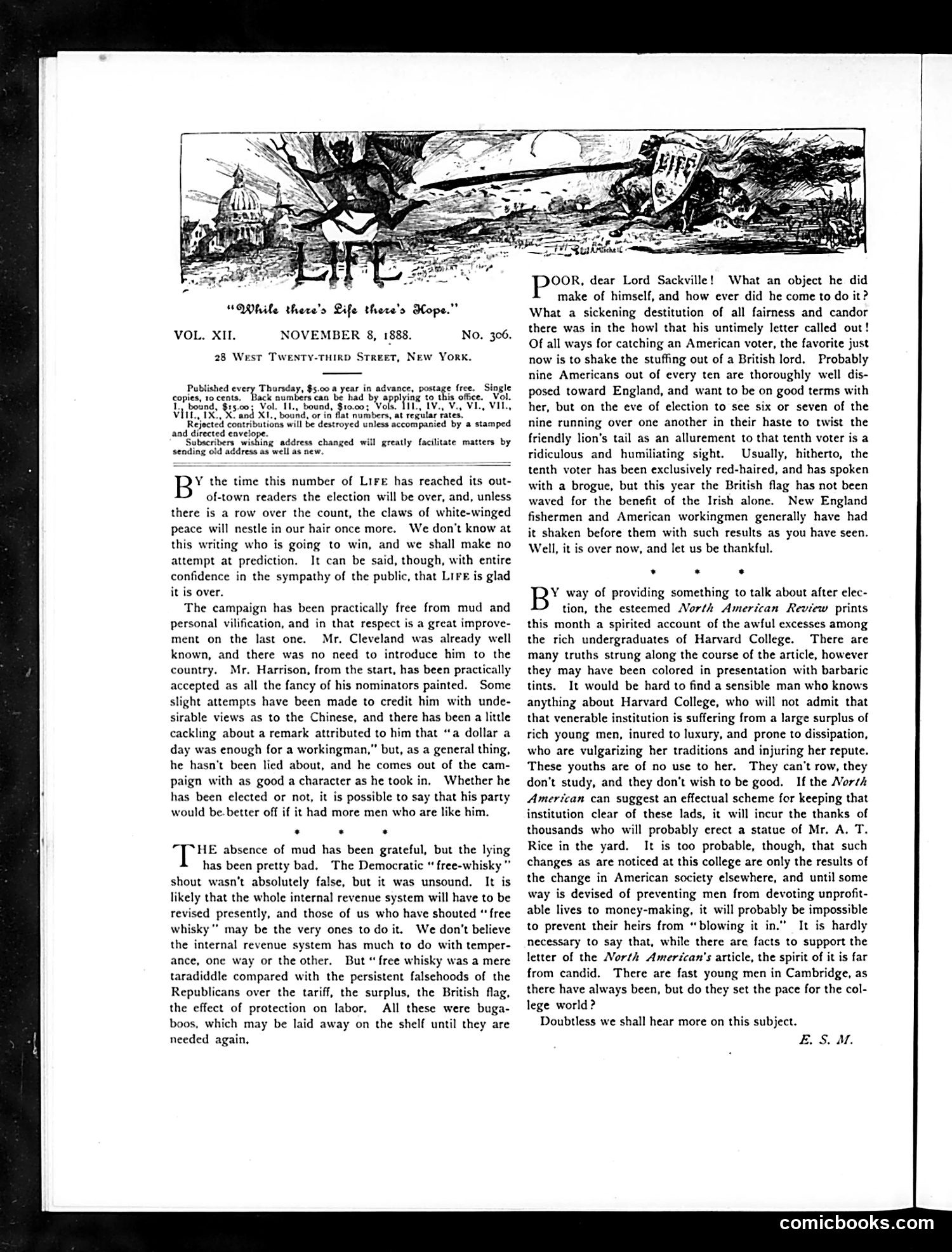
The masthead cartoon shows a figure labeled "Life" emerging from or associated with classical architectural elements (a dome, likely the Capitol). The editorial discusses the upcoming presidential election, mentioning Cleveland and Harrison as candidates. The tone is optimistic that Life magazine's campaign has been "practically free from mud and personal vilification," contrasting with typical mudslinging. The text criticizes Democratic "free-whisky" rhetoric as economically unsound and discusses Republican positions on tariffs, surplus, and labor protection. A secondary piece criticizes Harvard College for admitting wealthy undergraduates devoted to luxury and dissipation rather than education, suggesting this reflects broader American societal decline. The satire targets both political hypocrisy and elite institutional failures during the 1888 election cycle.
📄 Transcribed text from this page (OCR, searchable)
Machine-transcribed from the original scan — historical spelling and the odd misread are preserved.
“OMhile there's Life there's Hope.” VOL. XII. NOVEMBER 8, 1888. No. 306, 28 West Twenty-THIrp Street, New York. Published every Thursday, $5.00 a year in advance, postage free. Single copies, 10 cents. Back aumbers can be had by applying to this ofce. Vol. 1, bound, $15.00; Vol. II, bound, $10.00; Vols. IIL, 1V., V., VIL, VIL, VIIL, 1X), Xo and X1., boand, or in flat numbers, at regular rates. Rejected contributions will be destroyed unless accompanied by a stamped and directed envelope. Subscribers wishing address changed will greatly facilitate matters by sending old address as well as new. BY the time this number of LiFe has reached its out- of-town readers the election will be over, and, unless there is a row over the count, the claws of white-winged peace will nestle in our hair once more. We don’t know at this writing who is going to win, and we shall make no attempt at prediction. It can be said, though, with entire confidence in the sympathy of the public, that Lire is glad it is over. The campaign has been practically free from mud and personal vilification, and in that respect is a great improve- ment on the last one. Mr. Cleveland was already well known, and there was no need to introduce him to the country. Mr. Harrison, from the start, has been practically accepted as all the fancy of his nominators painted. Some slight attempts have been made to credit him with unde- sirable views as to the Chinese, and there has been a little cackling about a remark attributed to him that “a dollar a day was enough for a workingman,” but, as a general thing, he hasn't been lied about, and he comes out of the cam- paign with as good a character as he took in. Whether he has been elected or not, it is possible to say that his party would be. better off if it had more men who are like him. . . . ‘THE absence of mud has been grateful, but the lying has been pretty bad. The Democratic “ free-whisky ” shout wasn’t absolutely false, but it was unsound. It is likely that the whole internal revenue system will have to be revised presently, and those of us who have shouted “free whisky" may be the very ones to do it. We don't believe the internal revenue system has much to do with temper- ance, one way or the other. But “free whisky was a mere taradiddle compared with the persistent falsehoods of the Republicans over the tariff, the surplus, the British flag, the effect of protection on labor. All these were buga- boos, which may be laid away on the shelf until they are needed again, OOR, dear Lord Sackville! What an object he did make of himself, and how ever did he come to do it? What a sickening destitution of all fairness and candor there was in the howl that his untimely letter called out! Of all ways for catching an American voter, the favorite just now is to shake the stuffing out of a British lord. Probably nine Americans out of every ten are thoroughly well dis- posed toward England, and want to be on good terms with her, but on the eve of election to see six or seven of the nine running over one another in their haste to twist the friendly lion's tail as an allurement to that tenth voter is a ridiculous and humiliating sight. Usually, hitherto, the tenth voter has been exclusively red-haired, and has spoken with a brogue, but this year the British flag has not been waved for the benefit of the Irish alone. New England fishermen and American workingmen generally have had it shaken before them with such results as you have seen. Well, it is over now, and let us be thankful. . * . BY way of providing something to talk about after elec- tion, the esteemed North American Review prints this month a spirited account of the awful excesses among the rich undergraduates of Harvard College. There are many truths strung along the course of the article, however they may have been colored in presentation with barbaric tints. It would be hard to find a sensible man who knows anything about Harvard College, who will not admit that that venerable institution is suffering from a large surplus of rich young men, inured to luxury, and prone to dissipation, who are vulgarizing her traditions and injuring her repute. These youths are of no use to her. They can’t row, they don’t study, and they don’t wish to be good. If the North American can suggest an effectual scheme for keeping that institution clear of these lads, it will incur the thanks of thousands who will probably erect a statue of Mr. A. T. Rice in the yard. It is too probable, though, that such changes as are noticed at this college are only the results of the change in American society elsewhere, and until some way is devised of preventing men from devoting unprofit- able lives to money-making, it will probably be impossible to prevent their heirs from “blowing it in.” It is hardly necessary to say that, while there are facts to support the letter of the North American's article, the spirit of it is far from candid. There are fast young men in Cambridge, as there have always been, but do they set the pace for the col- lege world? Doubtless we shall hear more on this subject. ES. M. comicbooks.com