
A complete issue · 14 pages · 1888
Life — November 1, 1888
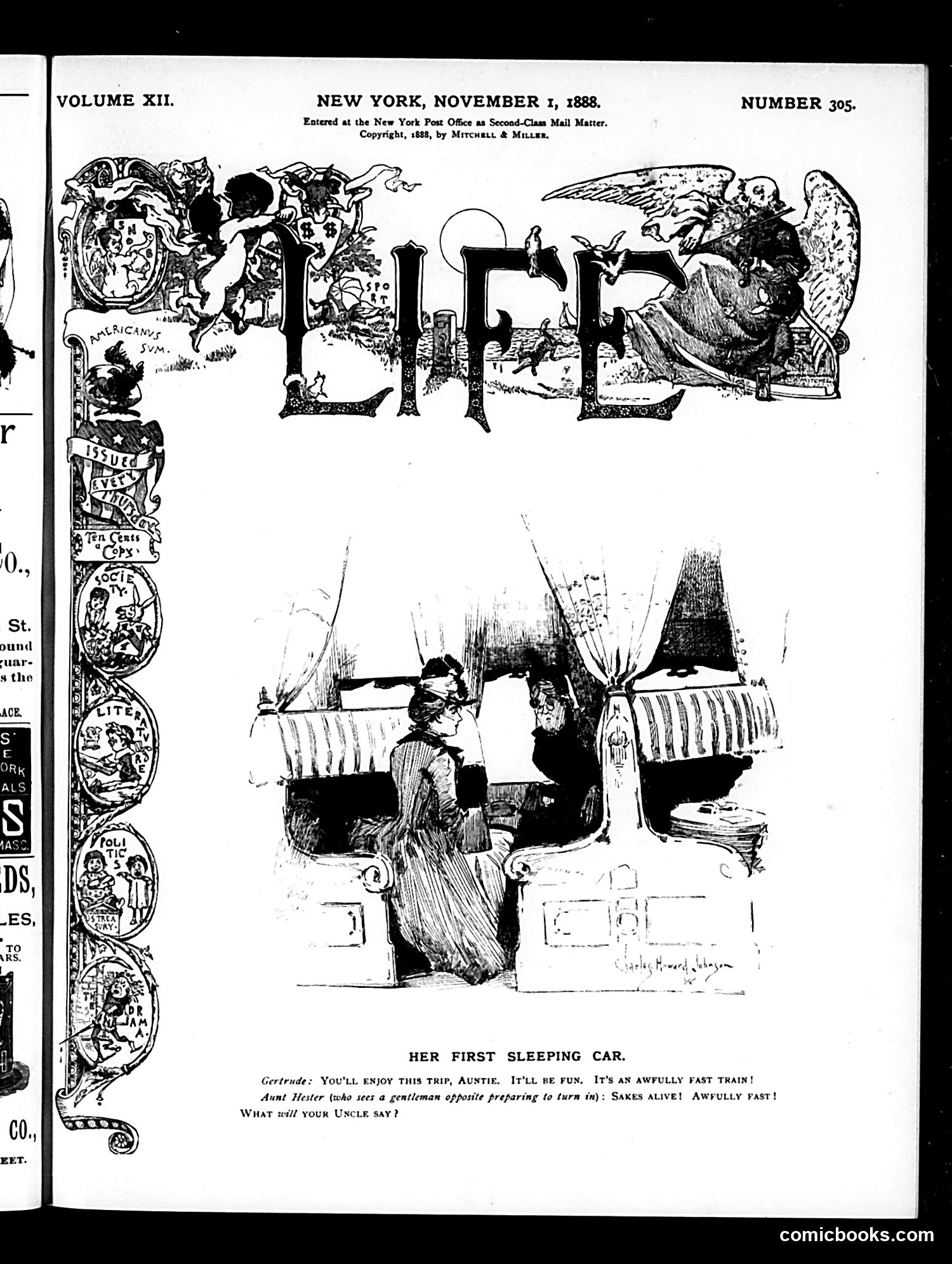
This cartoon satirizes a young woman's first experience traveling in a railroad sleeping car. The humor derives from the social awkwardness of the era: an unmarried woman sharing confined quarters with a male stranger (a gentleman "opposite"). The dialogue captures Victorian anxiety about propriety—Gertrude expects the trip to be "fun" and "awfully fast," while her chaperone Aunt Hester expresses shock at the scandalous proximity, worrying what "Uncle" will say about such impropriety. The cartoon mocks both the genuine safety concerns of the period and the exaggerated moral sensibilities surrounding unchaperoned mixed-gender interactions. The sleeping car arrangement, then novel, represented a conflict between modern convenience and Victorian social conventions about respectability.
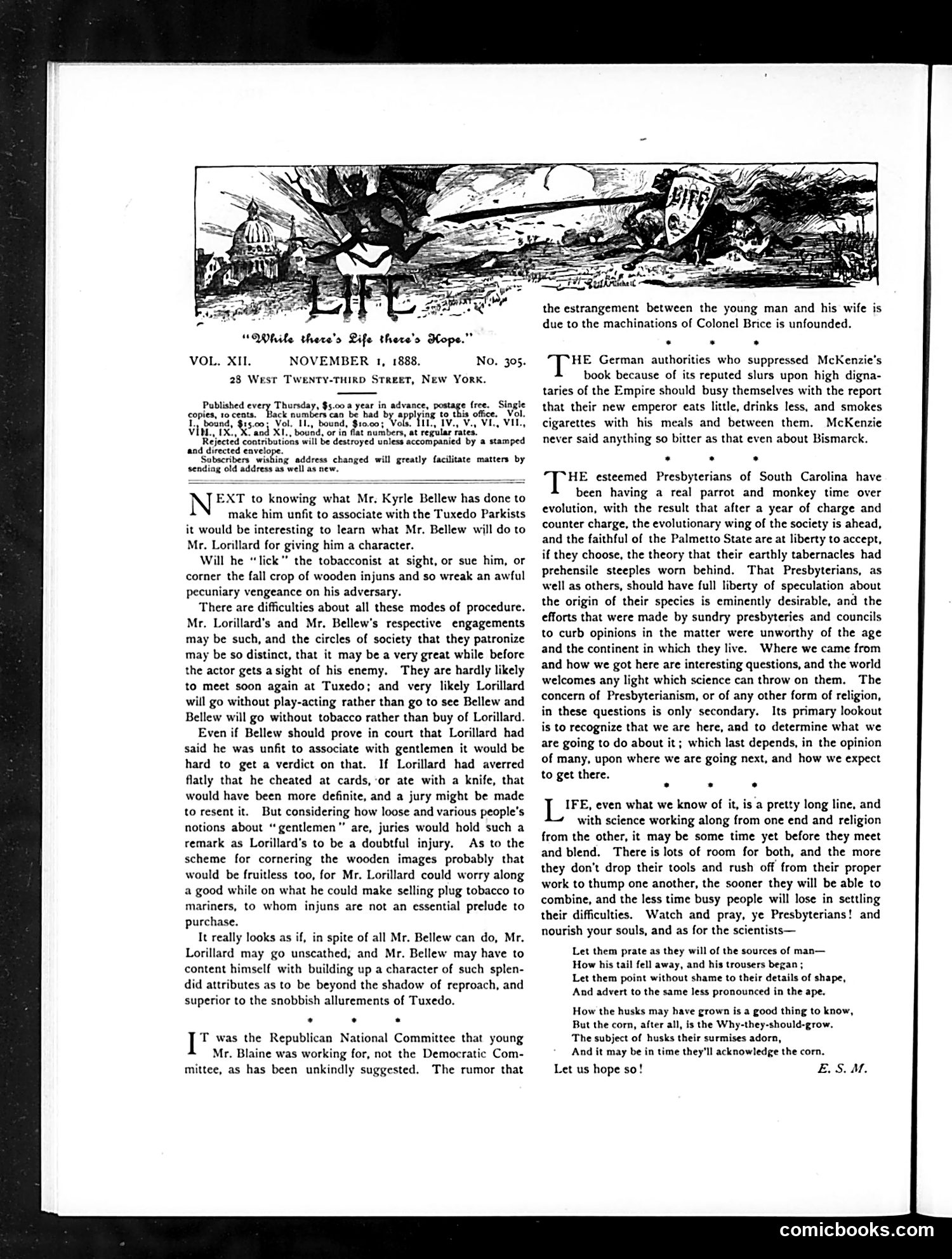
The masthead cartoon depicts a death figure or reaper looming over a landscape, likely symbolizing mortality or societal decay—a common allegorical device of the era. The text discusses scandals involving figures named Kyrle Bellew (an actor) and Lorillard, addressing questions of honor, character, and public association. The articles debate whether Bellew's engagement with the "Tuxedo Parkists" (wealthy Tuxedo Club members) compromises him, given Lorillard's alleged cheating at cards. Additional content addresses Presbyterian theological debates about evolution and species origins—reflecting late-19th-century tensions between religious doctrine and scientific theory. The final poem encourages Presbyterians to remain patient and hopeful rather than quarrel over evolutionary questions.
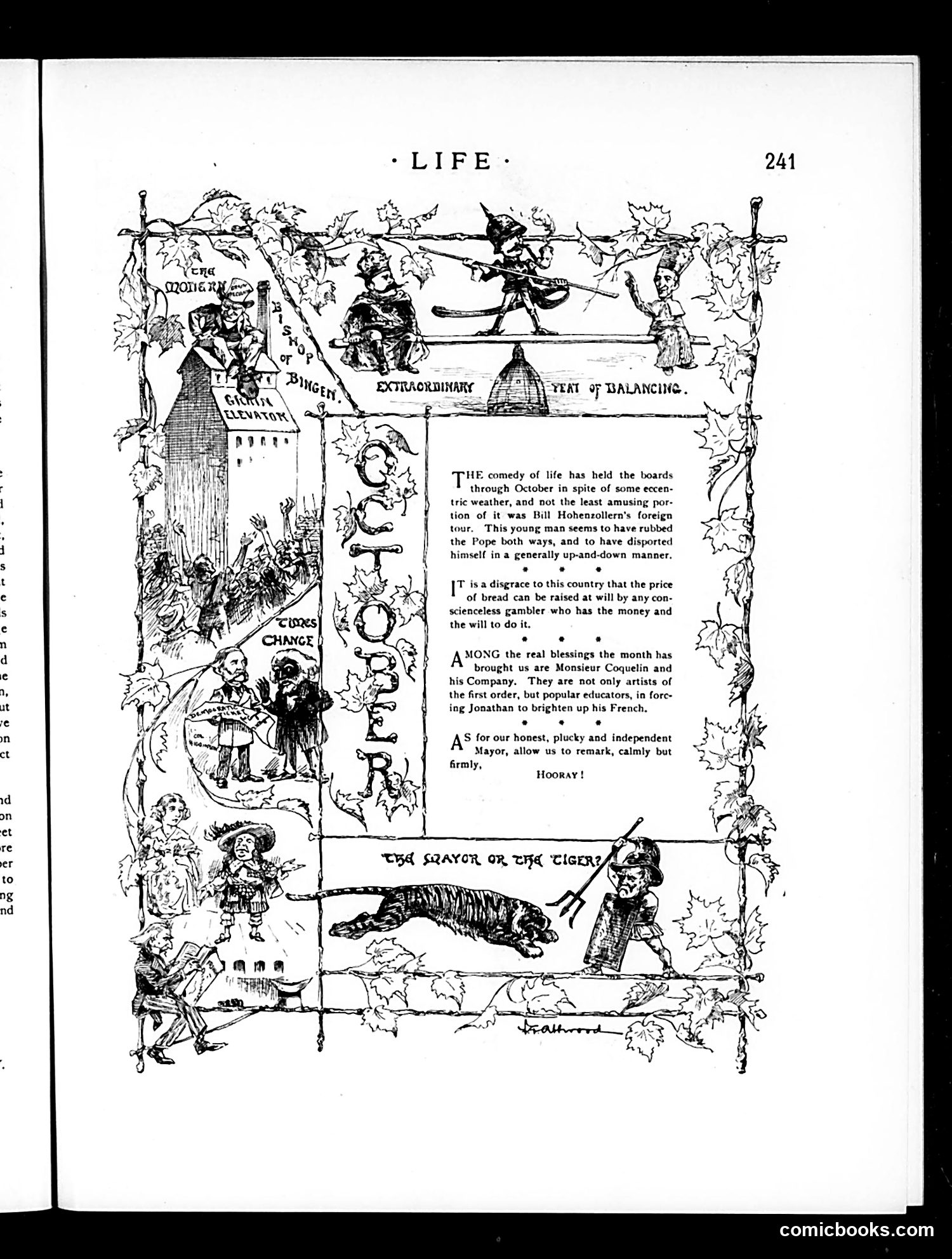
This page presents editorial commentary on current events wrapped in ornamental borders. The main text discusses "the comedy of life" and bread prices—apparently critiquing someone's (Bill Hohenroller's?) foreign economic policies. The illustration labeled "THE EXTRAORDINARY FEAT OF BALANCING" shows figures performing a dangerous acrobatic act, likely satirizing political instability or economic precariousness. Lower text praises Monsieur Coquelin and his theatrical company as "popular educators," and celebrates an "honest, plucky and independent Mayor." The bottom panel shows "TED SWAYOR OR THE TIGER"—a figure with what appears to be a tiger or large cat, though the specific reference is unclear without additional historical context. The overall tone suggests political and social satire typical of Life magazine's style.
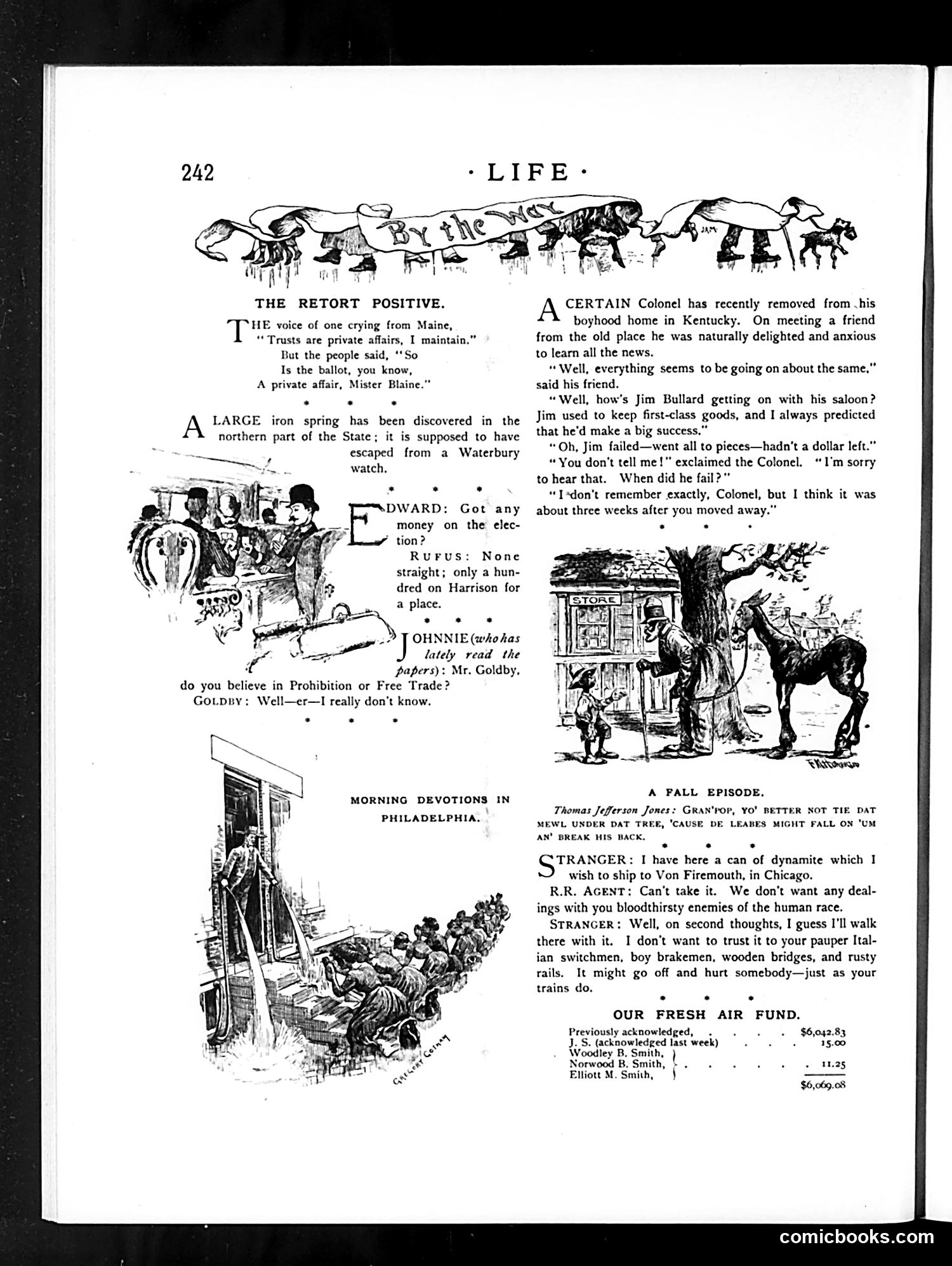
This page contains several brief satirical pieces typical of early 20th-century Life magazine humor: **"The Retort Positive"** mocks a Maine voice claiming "Trusts are private affairs," with the rejoinder that ballots determine such matters—likely referencing contemporary trust-busting political debates. **"Morning Devotions in Philadelphia"** shows a crowd gathered at a doorway, apparently satirizing religious or civic gatherings in that city. **"A Fall Episode"** presents a dialogue between a stranger attempting to ship dynamite and a railroad agent who refuses, citing safety concerns. This appears to satirize either anarchist threats or dangerous shipping practices of the era. **"Our Fresh Air Fund"** lists charitable donations, a recurring feature acknowledging reader contributions to social welfare programs. The humor relies on contemporary political and social anxieties familiar to Life's educated, urban readership.
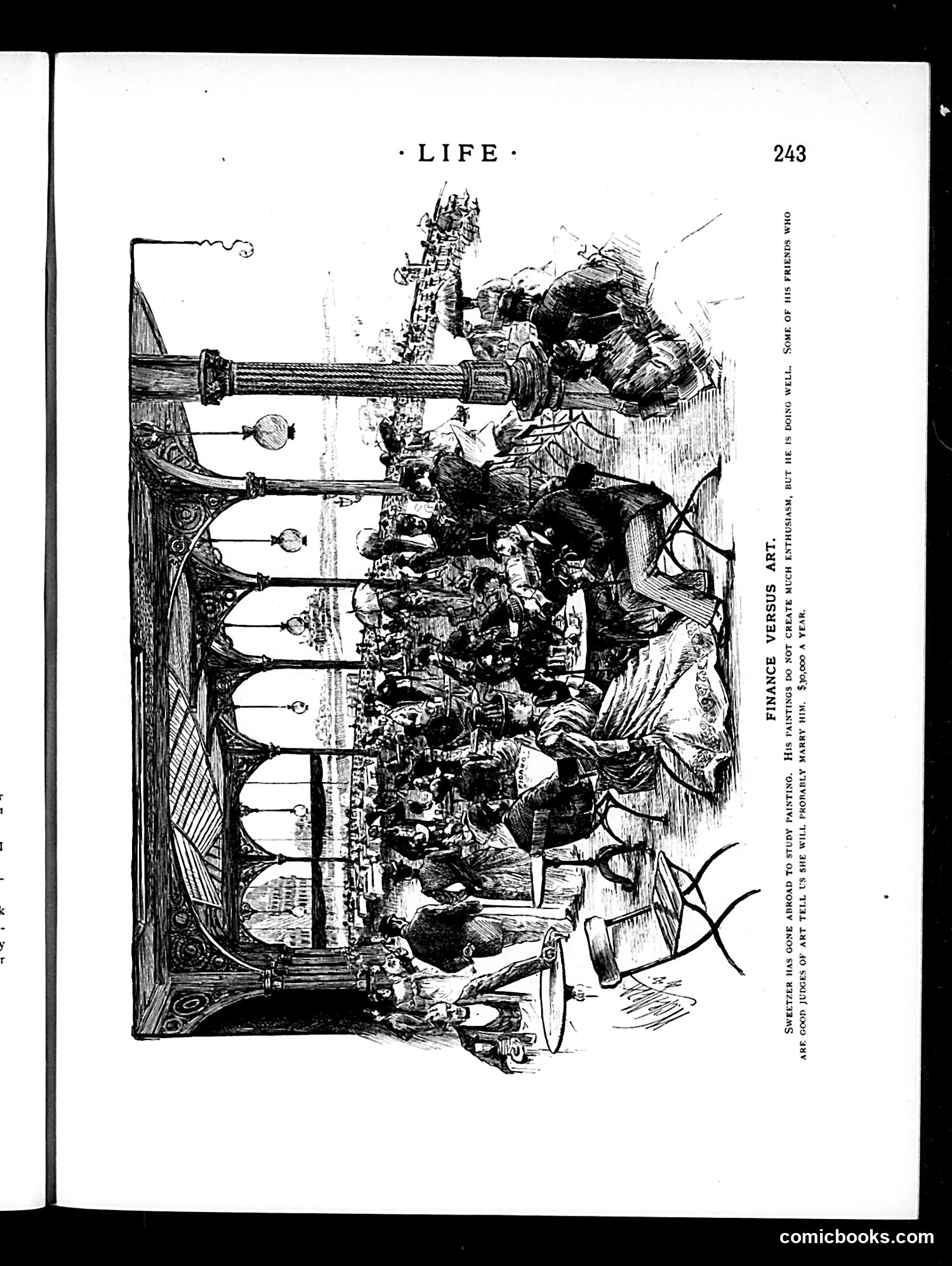
This satirical illustration depicts a conflict between financial interests and artistic pursuits. The image shows what appears to be an art studio or creative workspace being invaded or dominated by mechanical/financial machinery—represented by large industrial gears, pulleys, and mechanical apparatus on the left side. The composition suggests that commercial and financial concerns are literally crushing or overwhelming artistic endeavor. Multiple figures appear caught in or struggling against the machinery, while artistic tools and creations are displaced or threatened. The caption references "Finance Versus Art," making explicit the cartoon's critique: that industrial capitalism and profit-driven concerns were encroaching upon and potentially destroying authentic artistic expression in American culture—a common Progressive Era concern about commercialism's corrosive effects on creativity and culture.
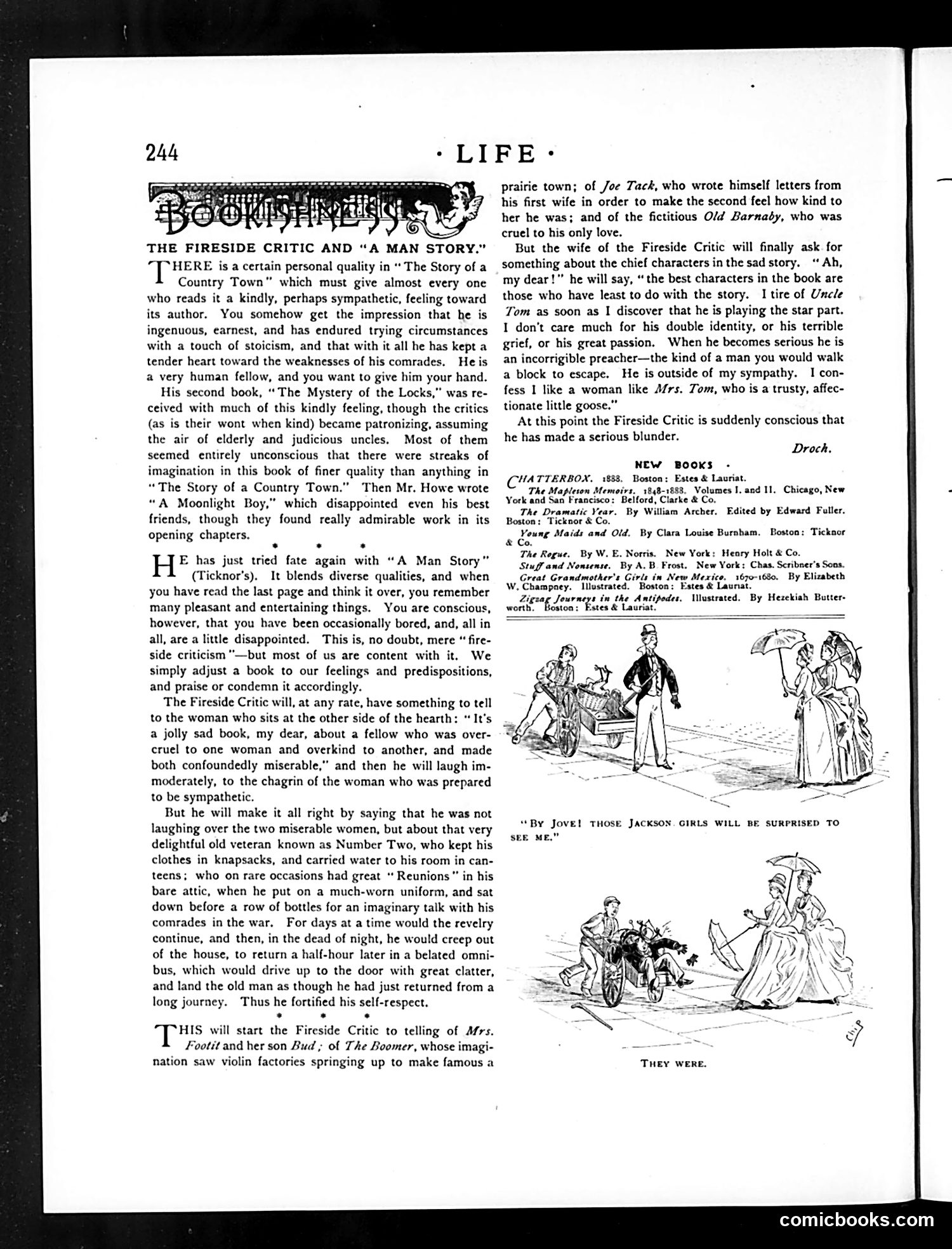
This page is primarily **literary criticism**, not political satire. The "Fireside Critic" column reviews recent books, particularly criticizing a work called "A Man Story" by Hutchins for being boring and predictable, despite blending pleasant qualities. The two small illustrations at the bottom appear to depict a humorous social scene—likely showing people on bicycles or in casual outdoor settings, with captions "By Jove! Those Jackson girls will be surprised to see me" and "They were." These seem to illustrate a joke about unexpected social encounters rather than political commentary. The page also lists new book releases from 1888, suggesting this is from Life's literary review section rather than its satirical cartoon section.
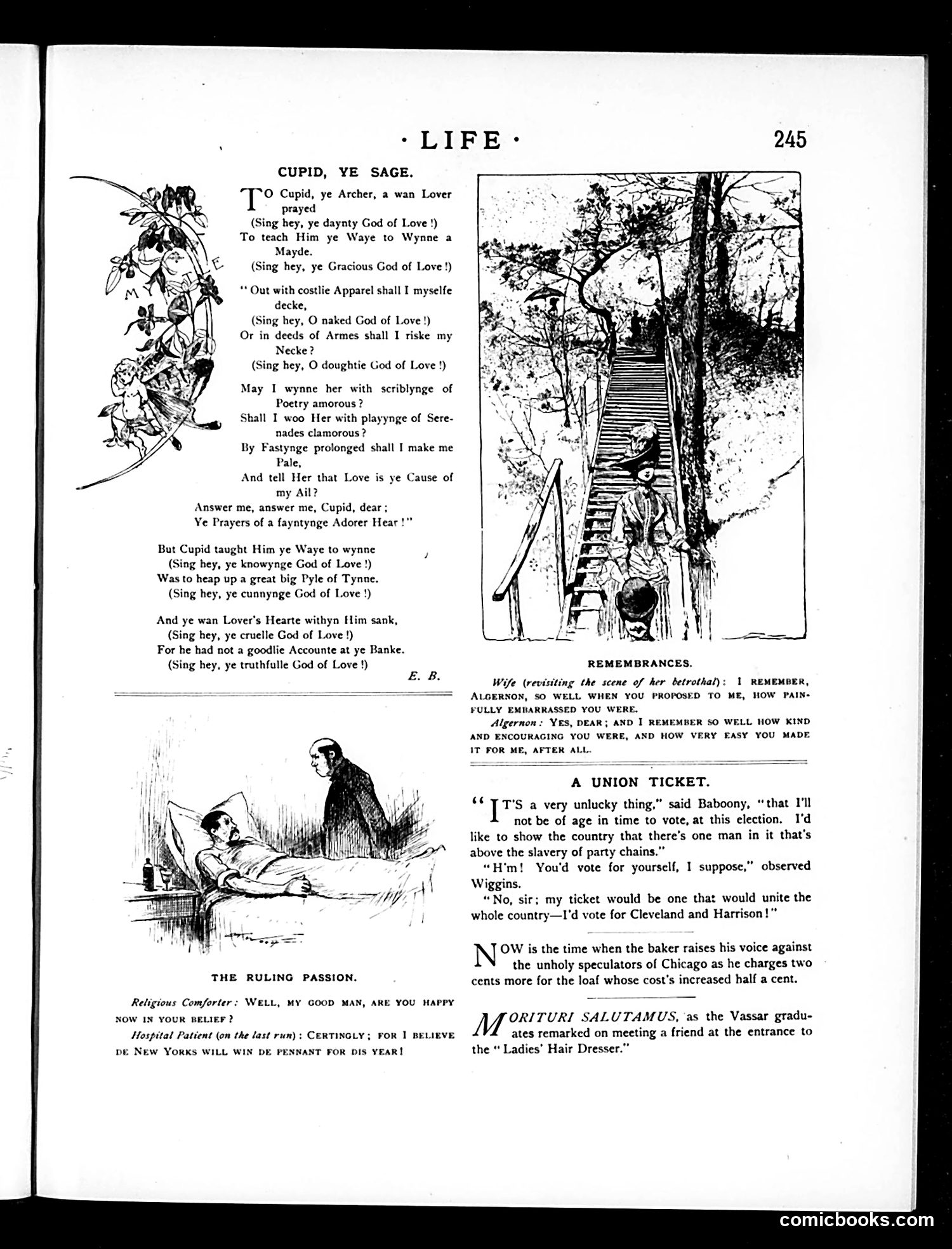
This *Life* magazine page contains three distinct pieces: 1. **"Cupid, Ye Sage"** — A poem (attributed E.B.) mocking romantic devotion through exaggerated, archaic language about love and wooing. 2. **"Remembrances"** — A brief dialogue about an embarrassing proposal, likely humorous domestic content. 3. **"A Union Ticket"** — Political satire about voting. A character named Baboon expresses frustration at being too young to vote, wanting a "union ticket" that would unite the country and allow him to vote for Cleveland and Harrison (likely referencing the 1888 or 1892 presidential election). 4. **"The Ruling Passion"** — A sketch showing two figures, with accompanying text about a hospital patient's optimism regarding New York's pennant prospects (baseball). The page emphasizes satirical commentary on American politics, romance, and popular culture.
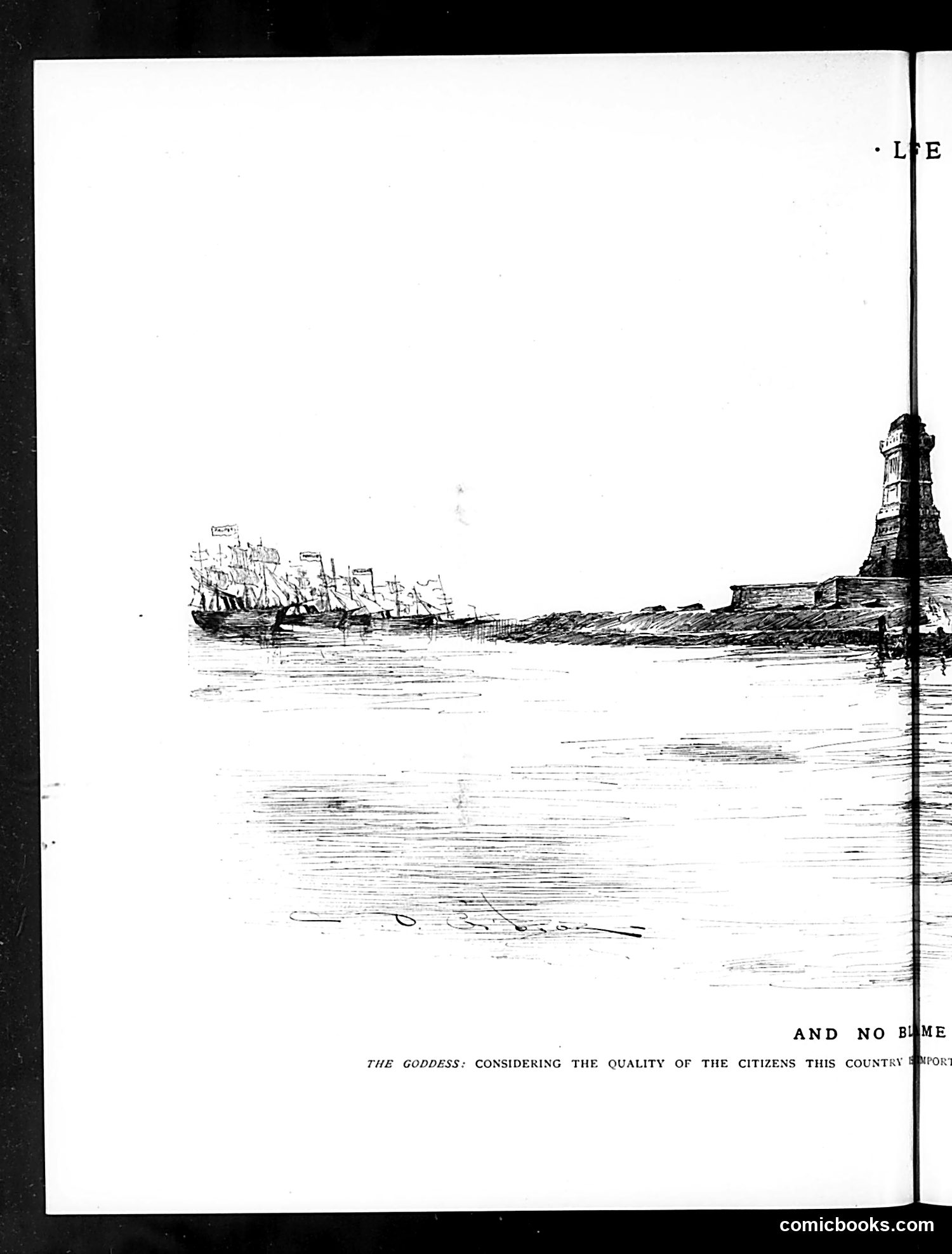
This page appears to be from a satirical magazine showing a maritime scene with a lighthouse on the right and what looks like a damaged or wrecked ship on the left in the water. The partially visible caption at the bottom reads "THE GODDESS: CONSIDERING THE QUALITY OF THE CITIZENS THIS COUNTRY... SUPPORT" and "AND NO BLAME." The reference to "the Goddess" likely invokes Lady Liberty or a similar national symbol. The satirical point seems to criticize the quality of the nation's citizens, suggesting they're unworthy of national protection or support—possibly commenting on social decay, poor governance, or public character. The wrecked ship may represent the nation itself in peril. However, without complete text or a clear date, the specific political target remains unclear.
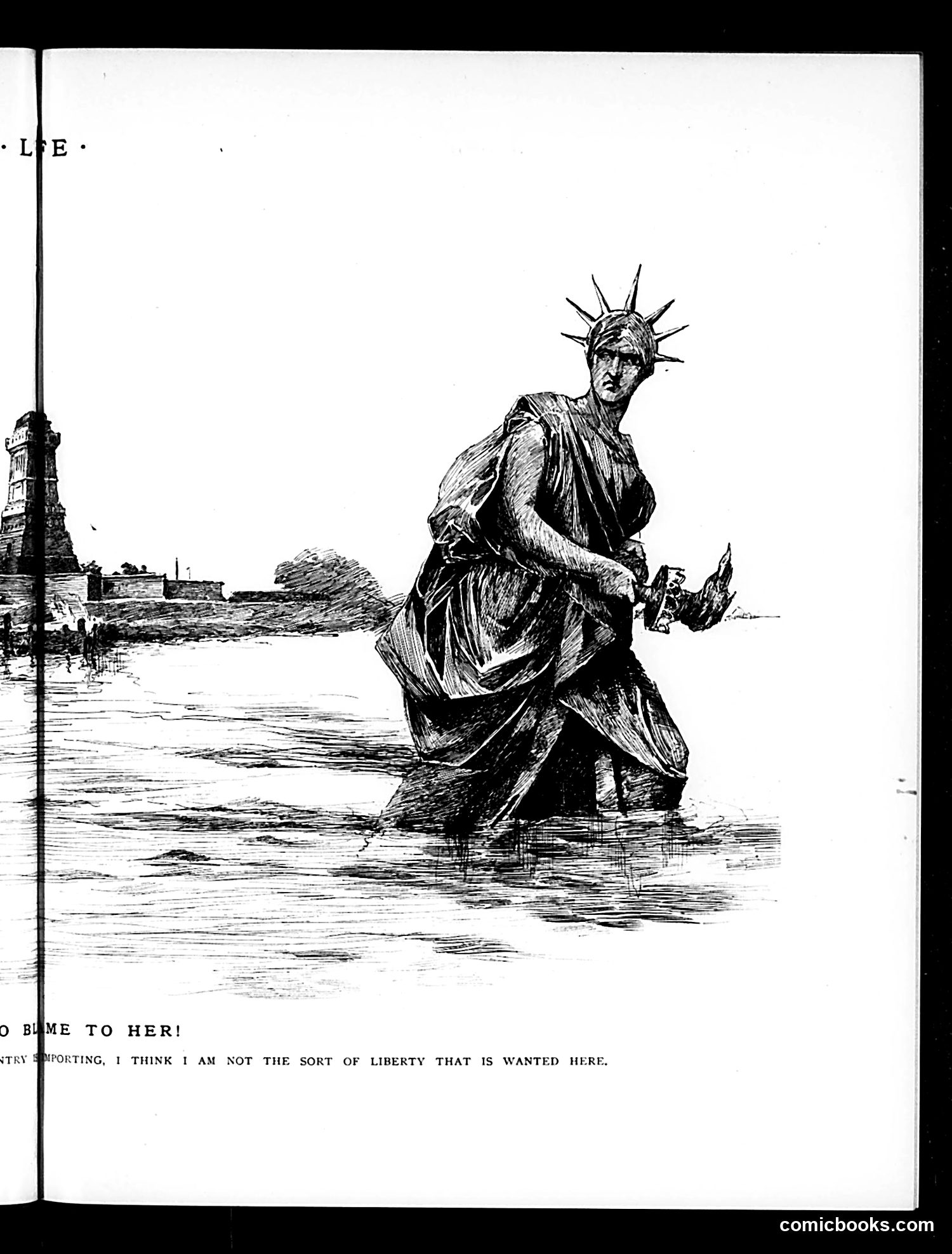
This political cartoon depicts the Statue of Liberty standing in water, appearing troubled or conflicted. The caption reads: "O BLAME TO HER! / ENTRY SUPPORTING, I THINK I AM NOT THE SORT OF LIBERTY THAT IS WANTED HERE." The cartoon satirizes restrictive immigration policy. Liberty—traditionally America's symbol of welcome—expresses dismay that the "liberty" being supported is not the kind that welcomes immigrants. The figure wading in water likely represents an immigrant attempting entry. The satire critiques the contradiction between America's founding ideals (symbolized by the Statue) and contemporary anti-immigration sentiment. By placing words of disappointment in Liberty's mouth, the cartoonist argues that restrictionist policies betray the nation's core values and identity. The cartoon appears to date from an era of significant immigration debates, though the specific historical moment is unclear from the image alone.
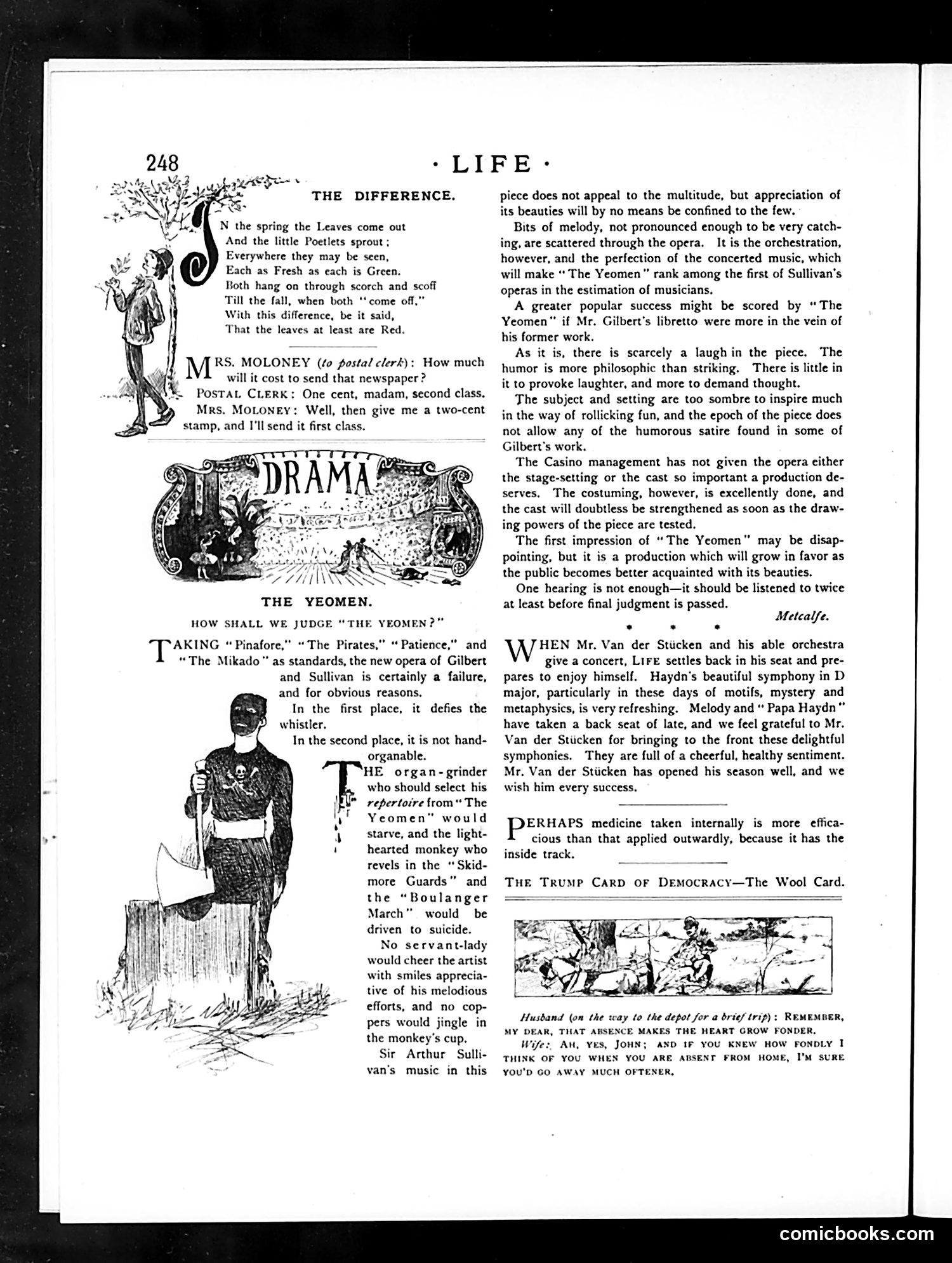
This page from *Life* magazine contains theater reviews and a small political cartoon titled "The Trump Card of Democracy—The Wool Card." The cartoon depicts a domestic scene where a husband (leaving for a brief trip) tells his wife to remember his absence will make her heart grow fonder. The wife responds that if he knew how fondly she'd think of him when absent, he'd go away much more often. The title's reference to "wool card" appears to be a pun suggesting the public is being "carded" or combed through (deceived) by political rhetoric about democracy. The specific political context or election this references is unclear from the image alone.
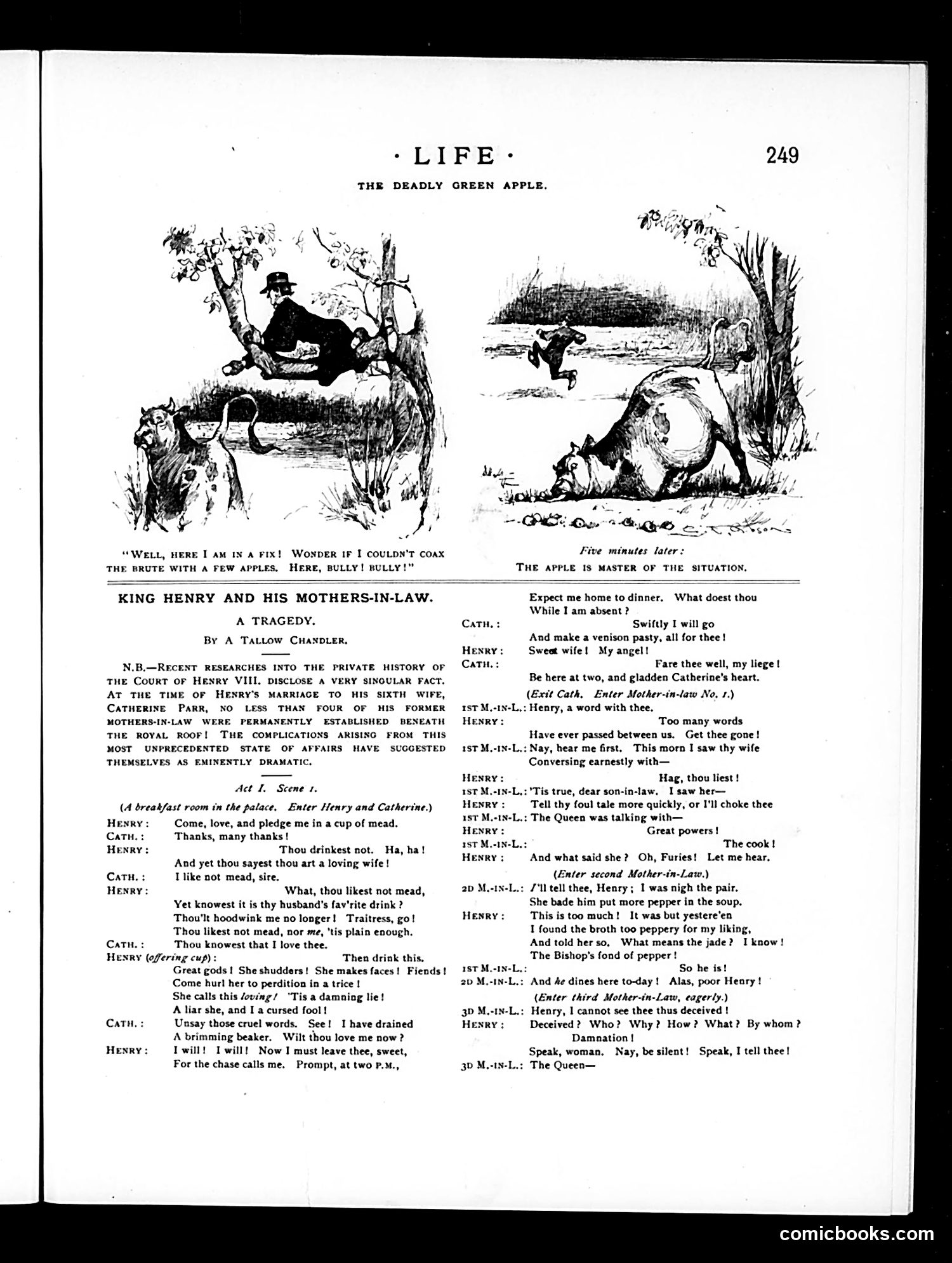
This page contains two satirical pieces. The top cartoon shows a man (likely representing someone in a predicament) trying to coax an aggressive dog with apples—a visual joke about attempted bribery or appeasement. The main content is a theatrical comedy sketch about King Henry VIII, exploiting the historical fact that when Henry married his sixth wife, Catherine Parr, four of his previous wives' mothers were living in the royal palace. The sketch satirizes this absurd domestic situation through melodramatic dialogue where Henry grows increasingly agitated as his various mothers-in-law deliver gossipy accusations about Catherine's alleged infidelity with the cook (based on pepper in soup). The satire mocks both Henry's volatile temperament and the chaotic royal household. It uses exaggerated Shakespearean-style language and Victorian theatrical conventions to ridicule a genuinely unusual historical circumstance, creating comedy from the collision of marital drama with multiple in-laws under one roof.
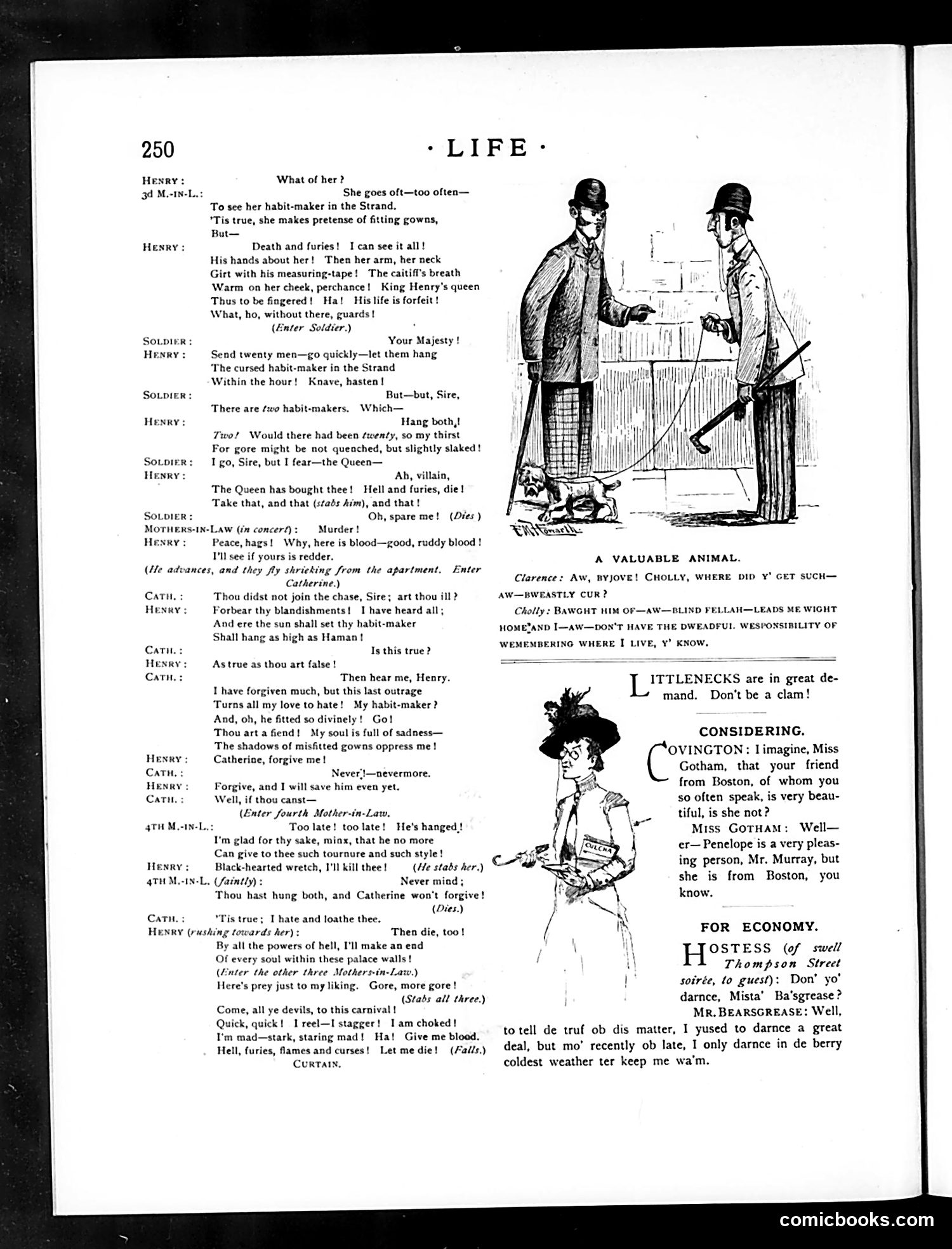
This page contains two distinct comic pieces: **Main Feature: A Shakespearean Parody** The lengthy dramatic scene parodies Shakespeare's *Henry VIII*, depicting King Henry in absurd jealous rage over Queen Catherine's visits to her dressmaker in the Strand (a London shopping street). Henry orders mass executions based on paranoid misunderstandings—killing not one but two habit-makers, then slaughtering everyone in the palace in an escalating frenzy. The satire mocks both overwrought Shakespearean tragedy and male jealousy over women's clothing expenses and time spent with dressmakers. **Two Shorter Humor Pieces Below:** 1. **"A Valuable Animal"**: Two society men discuss acquiring a dog from a blind man; the joke plays on affected upper-class speech patterns and the absurd logic that one needn't remember his home address since the dog can lead him there. 2. **"For Economy"**: An African American character explains he only dances in berry-cold weather—unclear social commentary, though the dialect humor was standard (if offensive) period comedy. The page targets class pretension and gender relations through theatrical exaggeration.
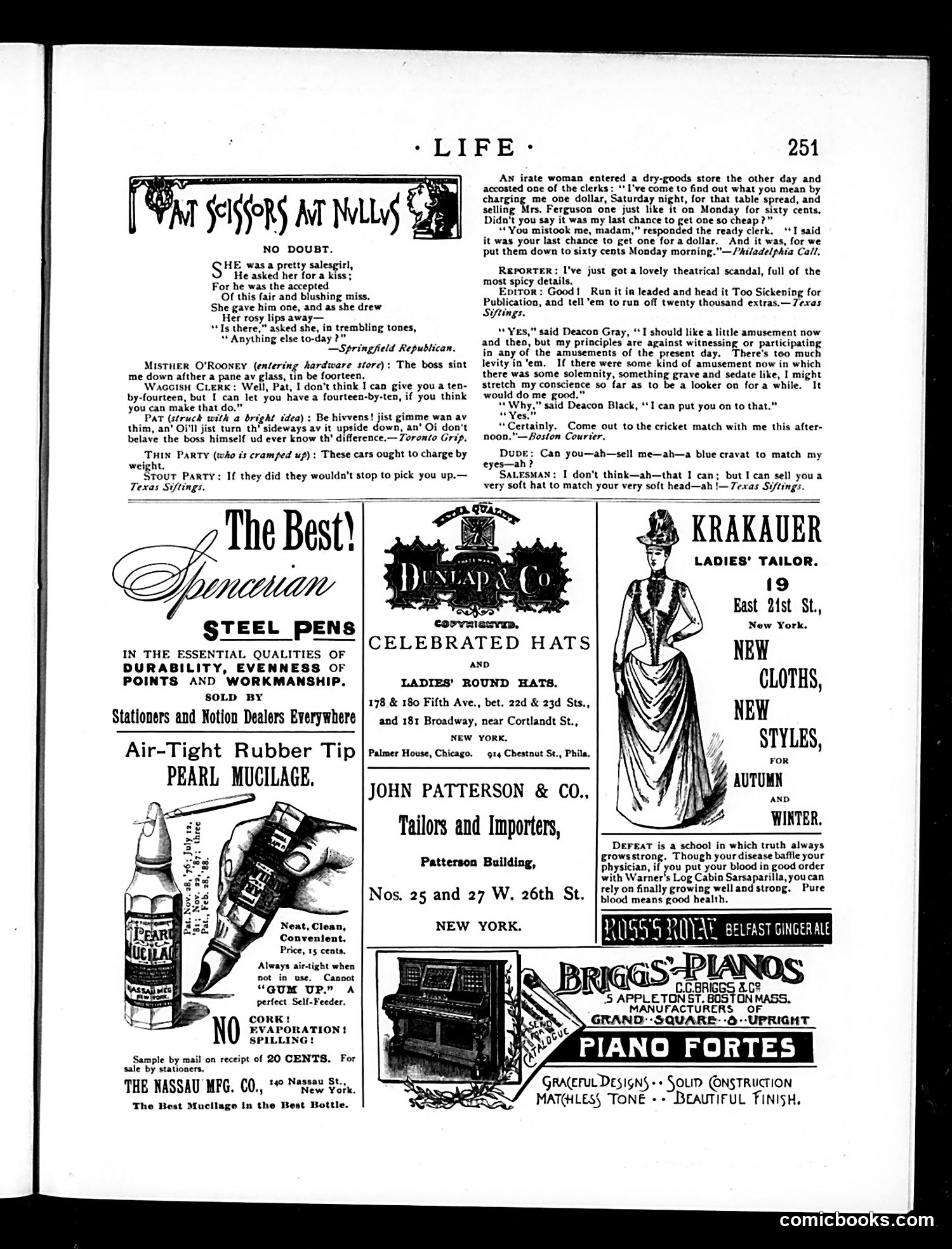
This page combines humorous short jokes with period advertisements. The jokes satirize everyday social situations through ethnic stereotypes and class commentary typical of 1890s American humor: **The cartoons/jokes mock:** - A salesgirl's transactional attitude ("Anything else to-day?") after a romantic kiss - Irish immigrant "Pat O'Rooney's" literal-minded problem-solving with glass panes - Overcrowded streetcars and class distinction (implying thin people deserve transport more than heavy ones) - A store clerk's deceptive pricing practices - A newspaper editor's hypocrisy (sensationalizing "too sickening" scandals) - A pious deacon's selective morality regarding entertainment - A man's implied dim-wittedness through a salesman's insult about his "soft head" **The advertisements** promote steel pens, hats, tailoring, mucilage, rubber tips, and patent medicines—typical consumer goods of the era. One medical ad uses "purity of blood" language reflecting period pseudoscience. The humor relies on class anxieties, ethnic caricature, and workplace/consumer interactions recognizable to contemporary readers.
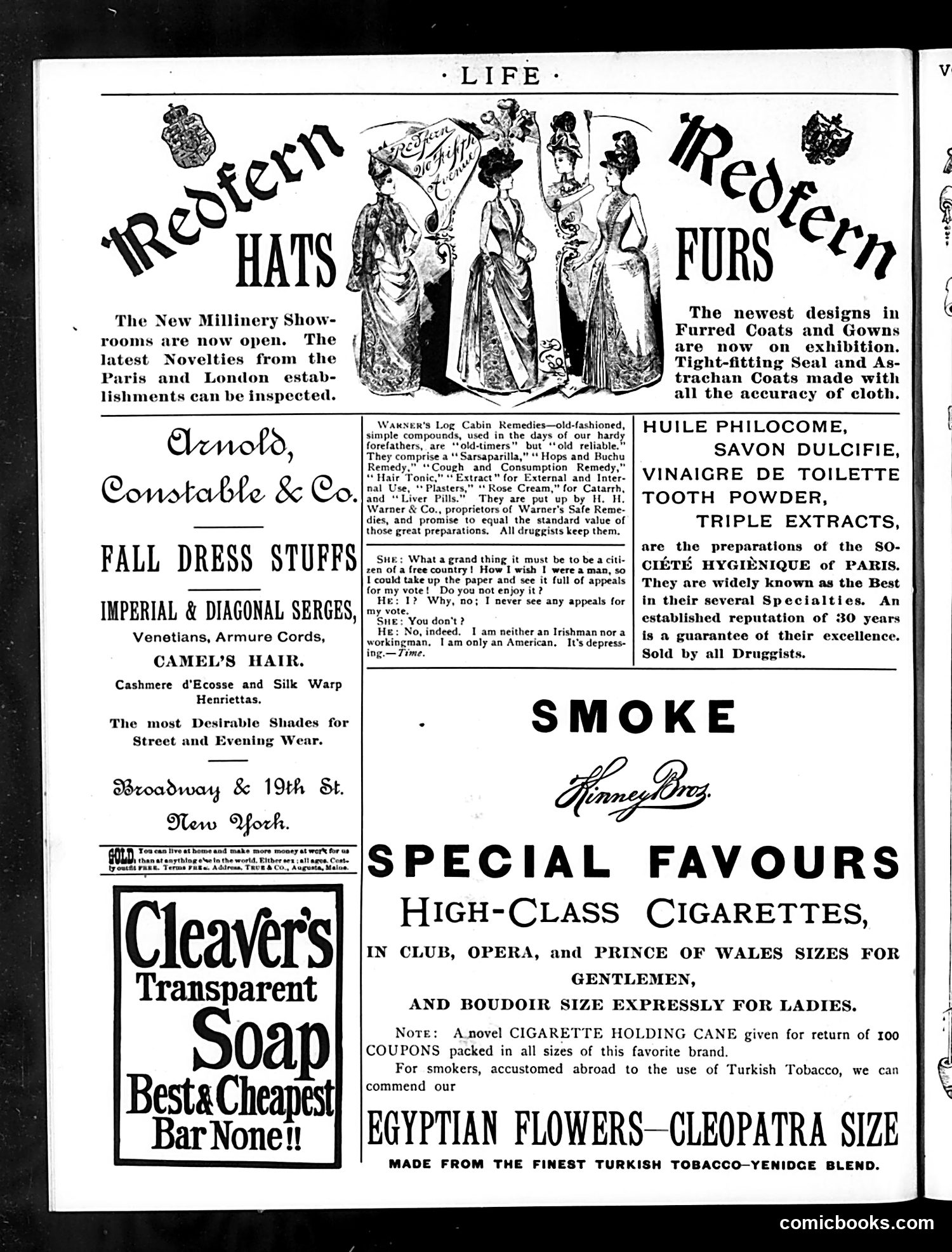
This is primarily an **advertising page** rather than a political cartoon. However, it includes one brief satirical dialogue titled "Smoke" that critiques American civic participation. The dialogue features a woman (Sue) expressing envy of men's voting rights and political engagement, asking a man (He) if he enjoys seeing election appeals in newspapers. His response is the joke's punchline: he's neither Irish nor a workingman, so he receives no political appeals—only "real" Americans (implying immigrants and laborers) get courted by politicians. He finds this "depressing," sarcastically suggesting that native-born American citizens are politically irrelevant compared to immigrant voting blocs. This reflects early 20th-century anxieties about **immigrant political power** and the gendered nature of voting rights (women couldn't vote federally until 1920). The remainder consists of period advertisements for hats, furs, fabrics, soaps, and cigarettes typical of upscale Life magazine readership.