
Life, 1888-11-01 · page 6 of 14
Life — November 1, 1888 — page 6: what you’re looking at
What you’re looking at
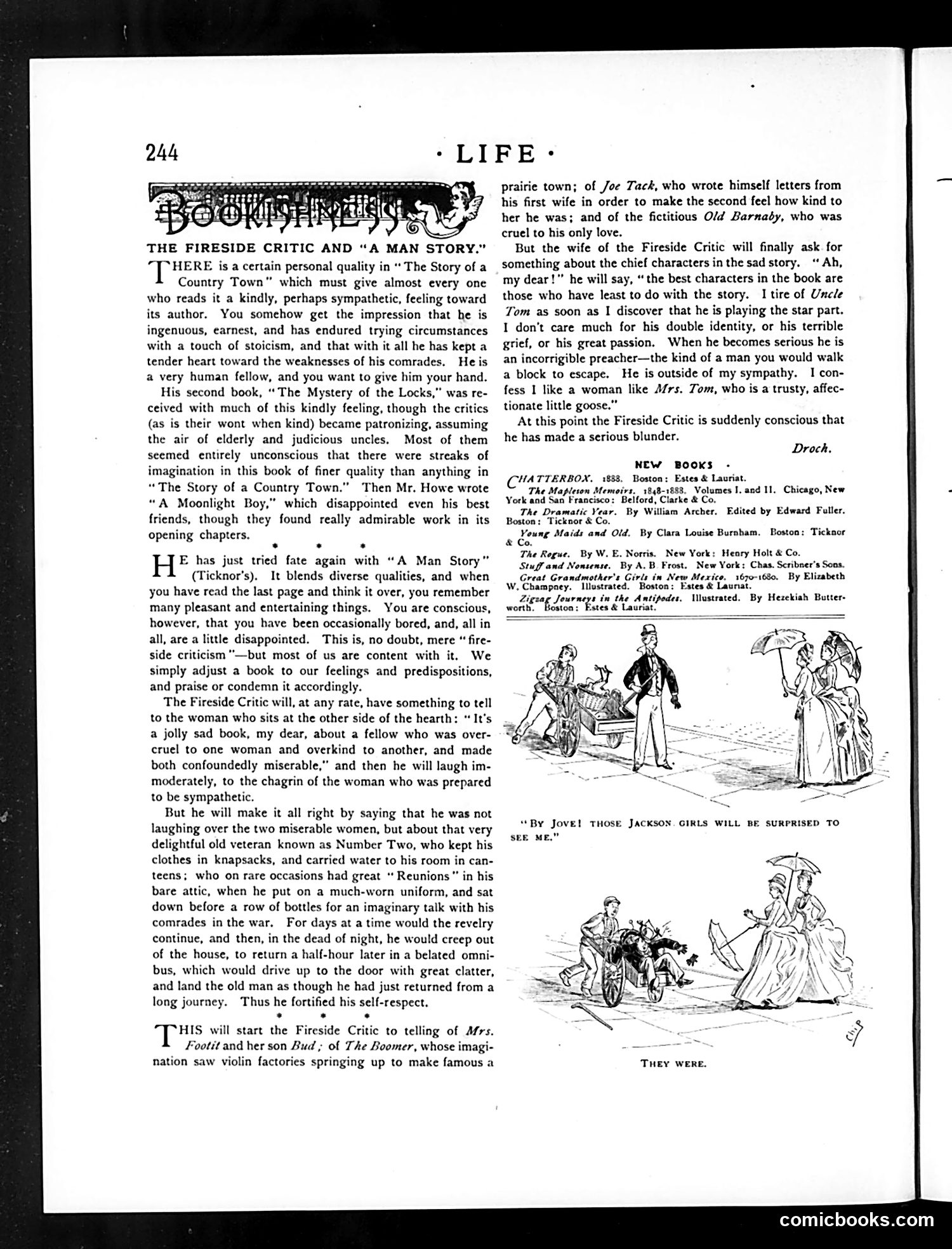
This page is primarily **literary criticism**, not political satire. The "Fireside Critic" column reviews recent books, particularly criticizing a work called "A Man Story" by Hutchins for being boring and predictable, despite blending pleasant qualities. The two small illustrations at the bottom appear to depict a humorous social scene—likely showing people on bicycles or in casual outdoor settings, with captions "By Jove! Those Jackson girls will be surprised to see me" and "They were." These seem to illustrate a joke about unexpected social encounters rather than political commentary. The page also lists new book releases from 1888, suggesting this is from Life's literary review section rather than its satirical cartoon section.
📄 Transcribed text from this page (OCR, searchable)
Machine-transcribed from the original scan — historical spelling and the odd misread are preserved.
* LIFE: sii y THE FIRESIDE CRITIC AND “A MAN STORY.” “[ HERE is a certain personal quality in ‘* The Story of a Country Town” which must give almost every one who reads it a kindly, perhaps sympathetic, feeling toward its author. You somehow get the impression that he is ingenuous, earnest, and has endured trying circumstances with a touch of stoicism, and that with it all he has kept a tender heart toward the weaknesses of his comrades. He is a very human fellow, and you want to give him your hand. His second book, ‘The Mystery of the Locks,” was re- ceived with much of this kindly feeling, though the critics (as is their wont when kind) became patronizing, assuming the air of elderly and judicious uncles. Most of them seemed entirely unconscious that there were streaks of imagination in this book of finer quality than anything in “The Story of a Country Town.” Then Mr. Howe wrote “A Moonlight Boy,” which disappointed even his best friends, though they found really admirable work in its opening chapters. . . E has just tried fate again with “A Man Story” (Ticknor's). It blends diverse qualities, and when you have read the last page and think it over, you remember many pleasant and entertaining things. You are conscious, however, that you have been occasionally bored, and, all in all, are a little disappointed. This is, no doubt, mere “ fire- side criticism “—but most of us are content with it. We simply adjust a book to our feelings and predispositions, and praise or condemn it accordingly. The Fireside Critic will, at any rate, have something to tell to the woman who sits at the other side of the hearth: “ It’s a jolly sad book, my dear, about a fellow who was over- cruel to one woman and overkind to another, and made both confoundedly miserable,” and then he will laugh im- moderately, to the chagrin of the woman who was prepared to be sympathetic. But he will make it all right by saying that he was not laughing over the two miserable women, but about that very delightful old veteran known as Number Two, who kept his clothes in knapsacks, and carried water to his room in can- teens; who on rare occasions had great “ Reunions” in his bare attic, when he put on a much-worn uniform, and sat down before a row of bottles for an imaginary talk with his comrades in the war. For days at a time would the revelry continue, and then, in the dead of night, he would creep out of the house, to return a half-hour later in a belated omni- bus, which would drive up to the door with great clatter, and land the old man as though he had just returned from a long journey. Thus he fortified his self-respect. . . . THs will start the Fireside Critic to telling of Afrs. Footit and her son Bud ; of The Boomer, whose imagi- nation saw violin factories springing up to make famous a prairie town; of Joe Tack, who wrote himself letters from his first wife in order to make the second feel how kind to her he was; and of the fictitious O/d Barnaby, who was cruel to his only love. But the wife of the Fireside Critic will finally ask for something about the chief characters in the sad story. “Ah, my dear!" he will say, “the best characters in the book are those who have least to do with the story. I tire of Uncle Tom as soon as I discover that he is playing the star part. I don’t care much for his double identity, or his terrible grief, or his great passion. When he becomes serious he is an incorrigible preacher—the kind of a man you would walk a block to escape. He is outside of my sympathy. I con- fess I like a woman like Mrs. Tom, who is a trusty, affec- tionate little goose.” At this point the Fireside Critic is suddenly conscious that he has made a serious blunder. Drock. NEW BOOKS - CHATTERBOX, 1838. Boston: Estes & Lacriat. The Mapleton Memoirs. 1848-1888. Volumes I. and 11, Chicago, New York and San Francisco: Beiford, Clarke & Co. The Dramatic Year. By William Archer. Boston: Ticknor & Co. Young Maids and Old. By Clara Louise Burnham. Boston: Ticknor & Co. The Rogue. By W. E. Norvis. Stuff and Nonsense, Edited by Edward Fuller. New York: Henry Holt & Co. By A. B Frost. New York: Chas. Scribner's Sons. Great Grandmother's Girls in New Mexico. 1670-1680. By Elizabeth W. Champney. Illustrated. Boston: Estes & Launat. Zigeag Journeys in the Antipodes. Mlustrated. By Hezekiah Butter- work “Boston: Fates & Lauriat. “By Jovel THOSE JACKSON. GIRLS WILL BE SURPRISED TO SEE ME," ‘THey were. comicbooks.com