
Life, 1888-11-01 · page 2 of 14
Life — November 1, 1888 — page 2: what you’re looking at
What you’re looking at
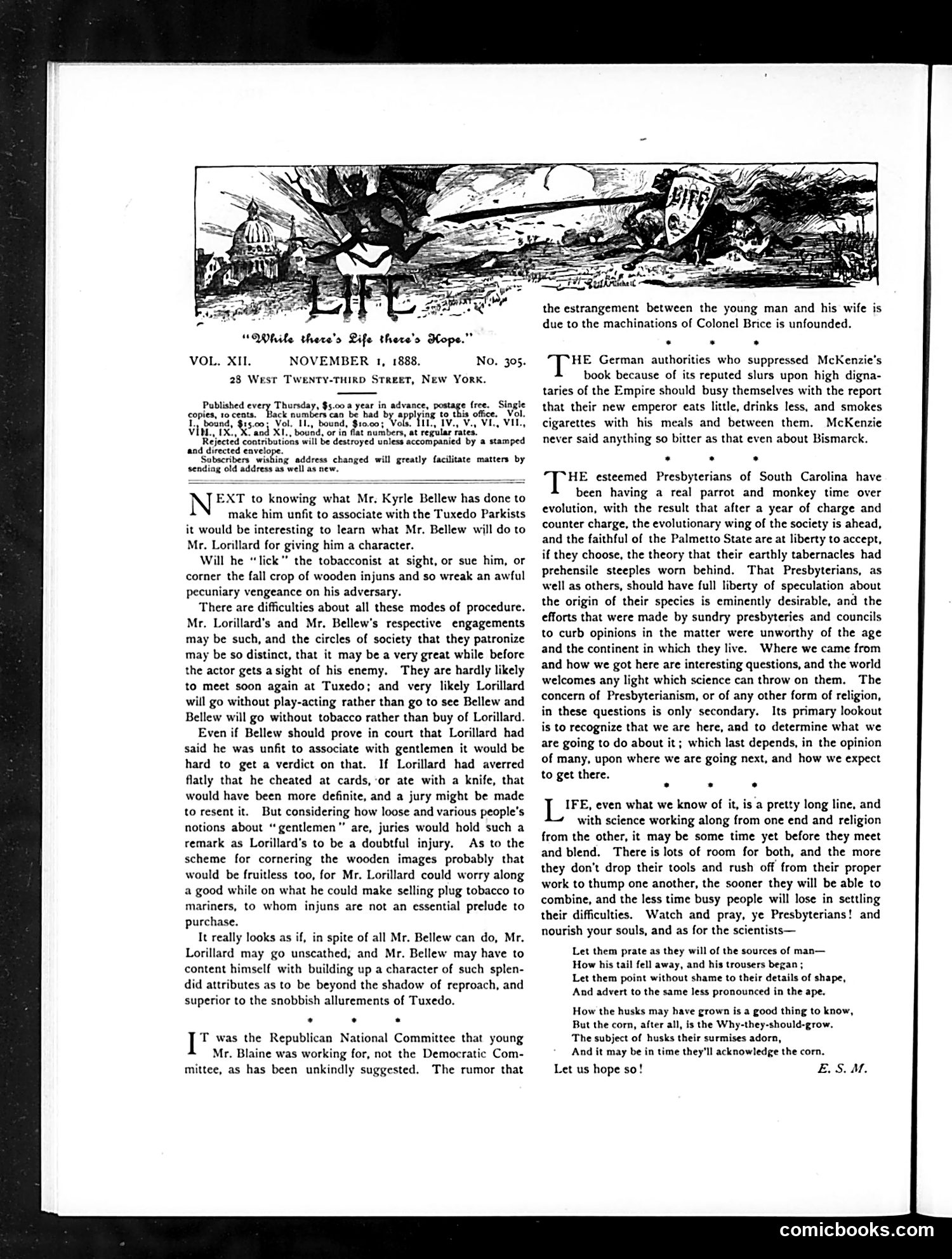
The masthead cartoon depicts a death figure or reaper looming over a landscape, likely symbolizing mortality or societal decay—a common allegorical device of the era. The text discusses scandals involving figures named Kyrle Bellew (an actor) and Lorillard, addressing questions of honor, character, and public association. The articles debate whether Bellew's engagement with the "Tuxedo Parkists" (wealthy Tuxedo Club members) compromises him, given Lorillard's alleged cheating at cards. Additional content addresses Presbyterian theological debates about evolution and species origins—reflecting late-19th-century tensions between religious doctrine and scientific theory. The final poem encourages Presbyterians to remain patient and hopeful rather than quarrel over evolutionary questions.
📄 Transcribed text from this page (OCR, searchable)
Machine-transcribed from the original scan — historical spelling and the odd misread are preserved.
“OP@hile there's Life there's Hope.” OL. XI. NOVEMBER 1, 1888. No. 305. 28 West Twenty-THIRD Street, New York. Published every Thursday, $5.00 a year in advance, ¢ (ree. Single ck numbers can be had by pln to this office. Vol. Yeh les pound, $10.00; Vol IV., V., Vi, VIL, ‘nd, or in flat numbers, at regular rates. Rejected gos ey Ey will be destroyed unless accompanied by a stamped and directed envelo) bscribers wishing address changed will greatly facilitate matters by sending old address as well as new. N XT to knowing what Mr. Kyrle Bellew has done to make him unfit to associate with the Tuxedo Parkists it would be interesting to learn what Mr. Bellew will do to Mr. Lorillard for giving him a character. Will he “lick” the tobacconist at sight, or sue him, or corner the fall crop of wooden injuns and so wreak an awful pecuniary vengeance on his adversary. There are difficulties about all these modes of procedure. Mr. Lorillard’s and Mr. Bellew's respective engagements may be such, and the circles of society that they patronize may be so distinct, that it may be a very great while before the actor gets asight of his enemy. They are hardly likely to meet soon again at Tuxedo; and very likely Lorillard will go without play-acting rather than go to see Bellew and Bellew will go without tobacco rather than buy of Lorillard. Even if Bellew should prove in court that Lorillard had said he was unfit to associate with gentlemen it would be hard to get a verdict on that. If Lorillard had averred flatly that he cheated at cards, -or ate with a knife, that would have been more definite, and a jury might be made to resent it. But considering how loose and various people's notions about “gentlemen” are, juries would hold such a remark as Lorillard’s to be a doubtful injury. As to the scheme for cornering the wooden images probably that would be fruitless too, for Mr. Lorillard could worry along a good while on what he could make selling plug tobacco to mariners, to whom injuns are not an essential prelude to purchase. It really looks as if, in spite of all Mr. Bellew can do, Mr. Lorillard may go unscathed, and Mr. Bellew may have to content himself with building up a character of such splen- did attributes as to be beyond the shadow of reproach, and superior to the snobbish allurements of Tuxedo. . . . [E- was the Republican National Committee that young Mr. Blaine was working for, not the Democratic Com- mittee, as has been unkindly suggested. The rumor that the estrangement between the young man and his wife is due to the machinations of Colonel Brice is unfounded. . . . HE German authorities who suppressed McKenzie’s book because of its reputed slurs upon high digna- taries of the Empire should busy themselves with the report that their new emperor eats little, drinks less, and smokes cigarettes with his meals and between them. McKenzie never said anything so bitter as that even about Bismarck. HE esteemed Presbyterians of South Carolina have been having a real parrot and monkey time over evolution, with the result that after a year of charge and counter charge, the evolutionary wing of the society is ahead, and the faithful of the Palmetto State are at liberty to accept, if they choose, the theory that their earthly tabernacles had prehensile steeples worn behind. That Presbyterians, as well as others, should have full liberty of speculation about the origin of their species is eminently desirable, and the efforts that were made by sundry presbyteries and councils to curb opinions in the matter were unworthy of the age and the continent in which they live. Where we came from and how we got here are interesting questions, and the world welcomes any light which science can throw on them. The concern of Presbyterianism, or of any other form of religion, in these questions is only secondary. Its primary lookout is to recognize that we are here, and to determine what we are going to do about it; which last depends, in the opinion of many, upon where we are going next, and how we expect to get there. * * . IFE, even what we know of it, is a pretty long line, and with science working along from one end and religion from the other, it may be some time yet before they meet and blend. There is lots of room for both, and the more they don’t drop their tools and rush off from their proper work to thump one another, the sooner they will be able to combine, and the less time busy people will lose in settling their difficulties. Watch and pray, ye Presbyterians! and nourish your souls, and as for the scientists— Let them prate as they will of the sources of man— How his tail fell away, and his trousers began ; Let them point without shame to their details of shape, And advert to the same less pronounced in the ape. How the husks may have grown is a good thing to know, But the corn, after all, is the Why-they-should-grow. ‘The subject of husks their surmises adorn, And it may be in time they'll acknowledge the corn. Let us hope so! E.S. M. comicbooks.com