
A complete issue · 14 pages · 1888
Life — October 4, 1888
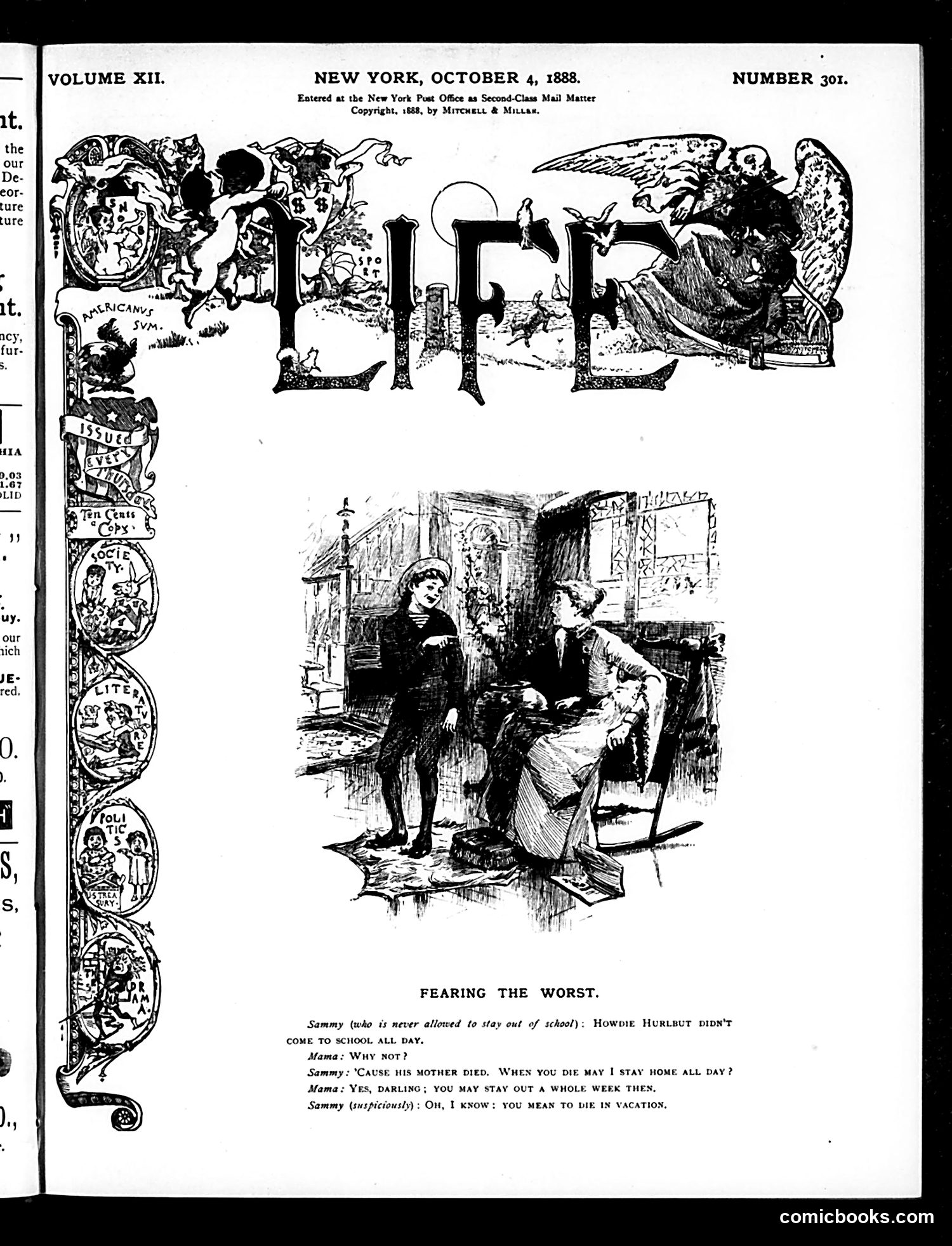
This cartoon satirizes childhood logic and parental anxiety. A boy named Sammy refuses to attend school, claiming his classmate Howie Hurlbut hasn't come all day. When his mother asks why this matters, Sammy reasons that since Howie's mother died, Howie may stay home permanently—and if his own mother dies, he too could stay home indefinitely. His mother points out he'd still have to attend school during vacation weeks. The humor lies in Sammy's darkly morbid reasoning: he's essentially wishing for his mother's death as a loophole to escape school obligations. The satirical target is childhood selfishness and the absurd logic children employ to avoid responsibilities, presented with Victorian-era sensibilities about mortality.
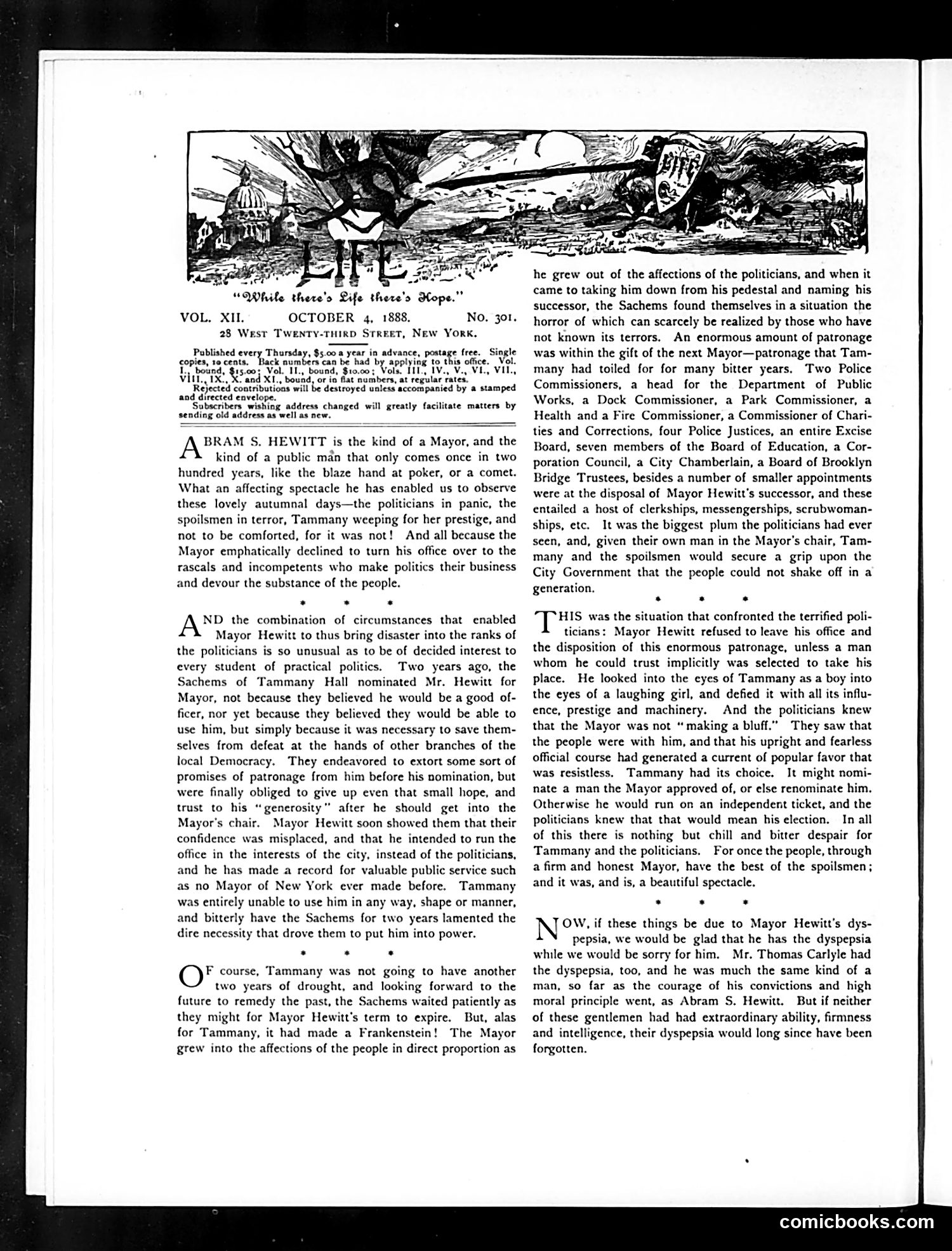
**The Cartoon:** The masthead image depicts a chaotic urban scene with a large figure looming over a cityscape, titled "While there's Life there's Hope." **The Article's Context:** The text discusses Mayor Abram S. Hewitt of New York, describing a political crisis. Tammany Hall (the Democratic political machine) nominated Hewitt for mayor not because they believed he'd be a good leader, but to save their organization from electoral defeat. However, Hewitt proved independent and uncontrollable, resisting Tammany's patronage demands and refusing to fill positions with their preferred candidates. **The Satire:** The piece mocks the politicians' miscalculation—they created a "Frankenstein" by elevating Hewitt, who used his position to thwart rather than serve their interests, demonstrating that even corrupt political machines can lose control of their chosen candidates.
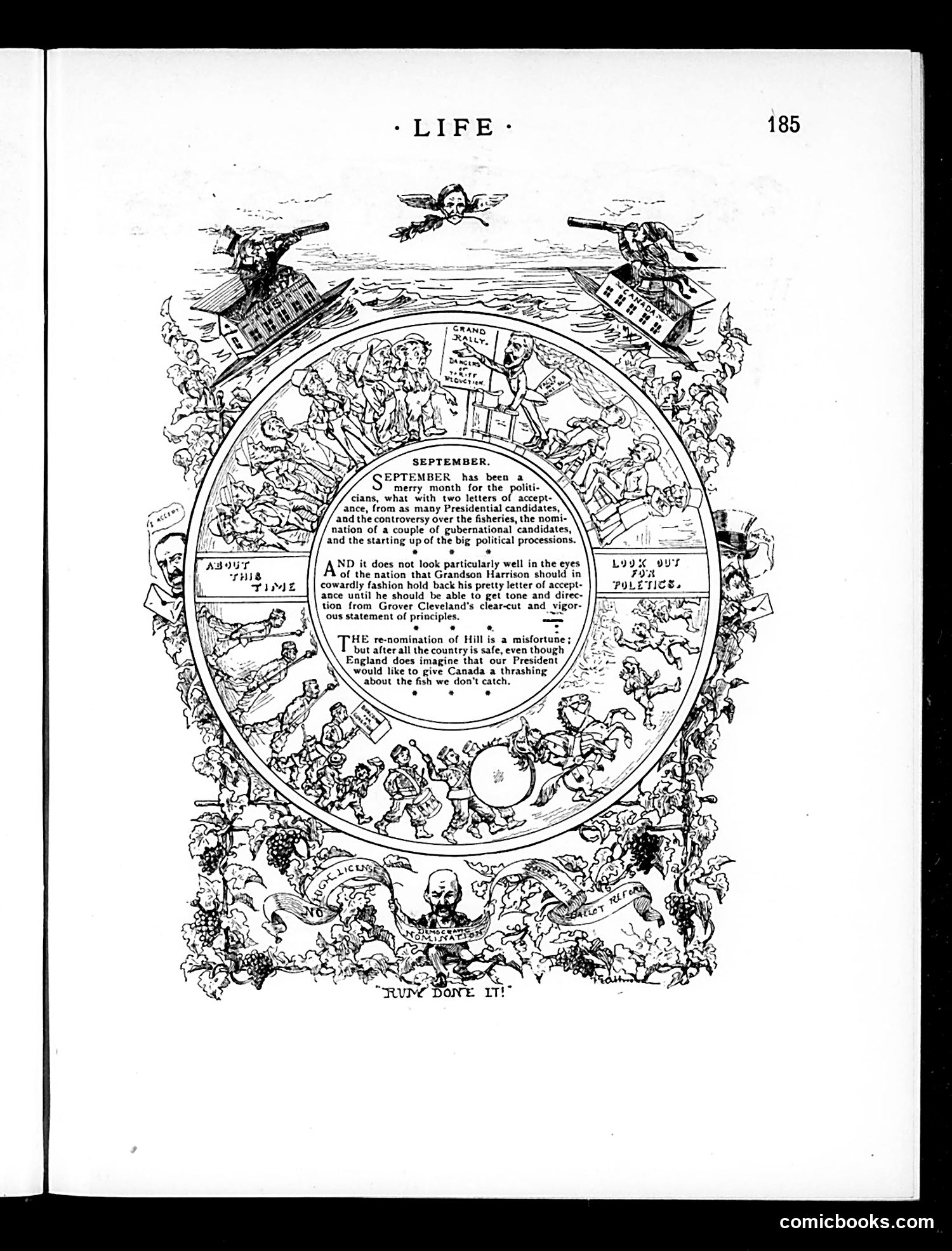
This satirical illustration comments on the 1888 U.S. presidential election. The circular diagram labeled "SEPTEMBER" depicts political chaos—candidates, controversies over tariffs, and nomination disputes surrounding the major parties' candidates. The text critiques Benjamin Harrison's nomination, suggesting his lack of political clarity is problematic. It also mocks the re-nomination of James G. Blaine as unfortunate but acceptable given national stability. The sarcastic fish metaphor ("the fish we don't catch") suggests politicians make promises they won't keep. The elaborate border contains period satirical imagery—figures representing various political factions and concerns swirl around the central commentary. The cherubs firing cannons at top represent the contentious nature of campaign season.
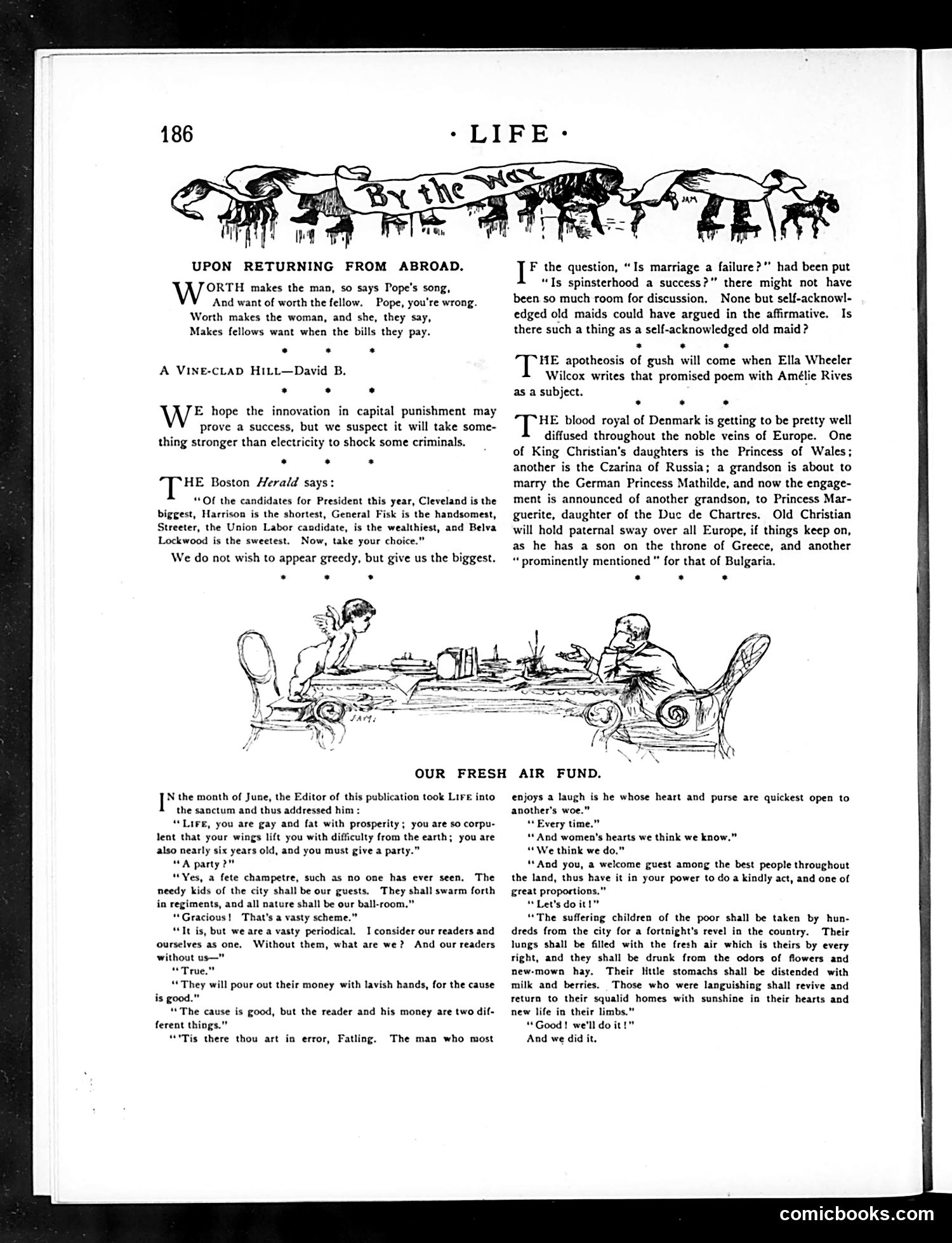
This page contains several satirical commentary pieces rather than a single cartoon: **"Upon Returning from Abroad"** mocks the phrase "worth makes the man," suggesting money determines social value. **The Boston Herald excerpt** humorously catalogs President Cleveland's physical attributes—claiming he's simultaneously the "biggest," "handsomest," "strongest," and "sweetest"—satirizing excessive presidential praise and political flattery. **"Our Fresh Air Fund"** describes a charitable initiative sending poor city children to the countryside for health. The dialogue humorously captures both philanthropic earnestness and the somewhat patronizing Victorian attitude toward poor relief, mixing genuine compassion with class-conscious sentimentality. The illustration shows two figures dining, likely representing different social classes, reinforcing themes of wealth and charitable duty throughout the page.
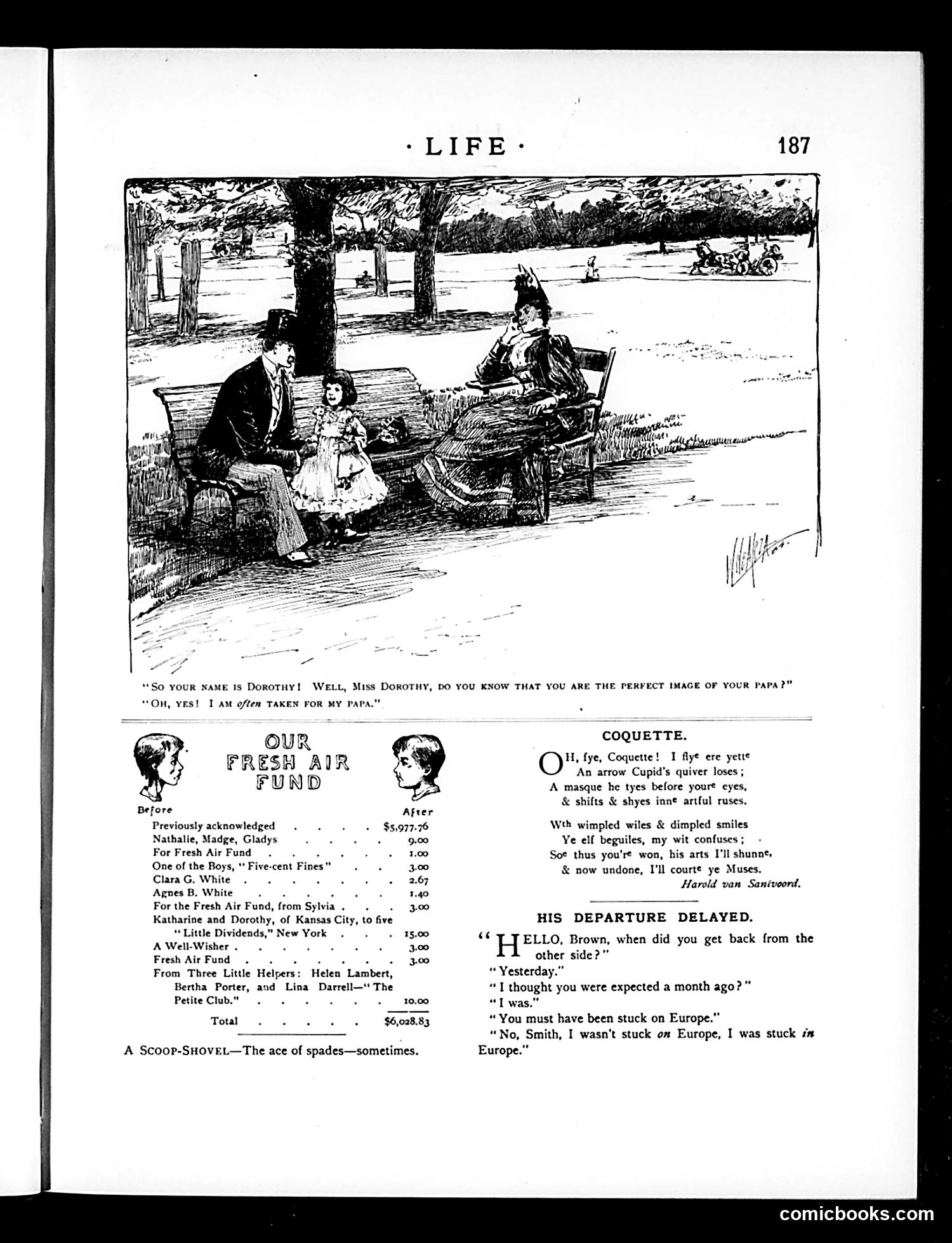
The main illustration depicts a park scene where a man and woman sit on a bench with a small child between them. The caption reads: "So your name is Dorothy! Well, Miss Dorothy, do you know that you are the perfect image of your papa?" to which the child replies, "Oh, yes! I am *often* taken for my papa." The joke plays on a common social assumption—that children resemble their parents—but the child's emphasis on being "*often*" mistaken suggests the woman may not be the child's biological mother, implying an affair or illicit relationship. This satirizes Victorian-era social pretense and hypocrisy around family legitimacy. The page also contains "Our Fresh Air Fund," a charitable fundraising list, and unrelated humorous pieces about travel delays and romantic verse.
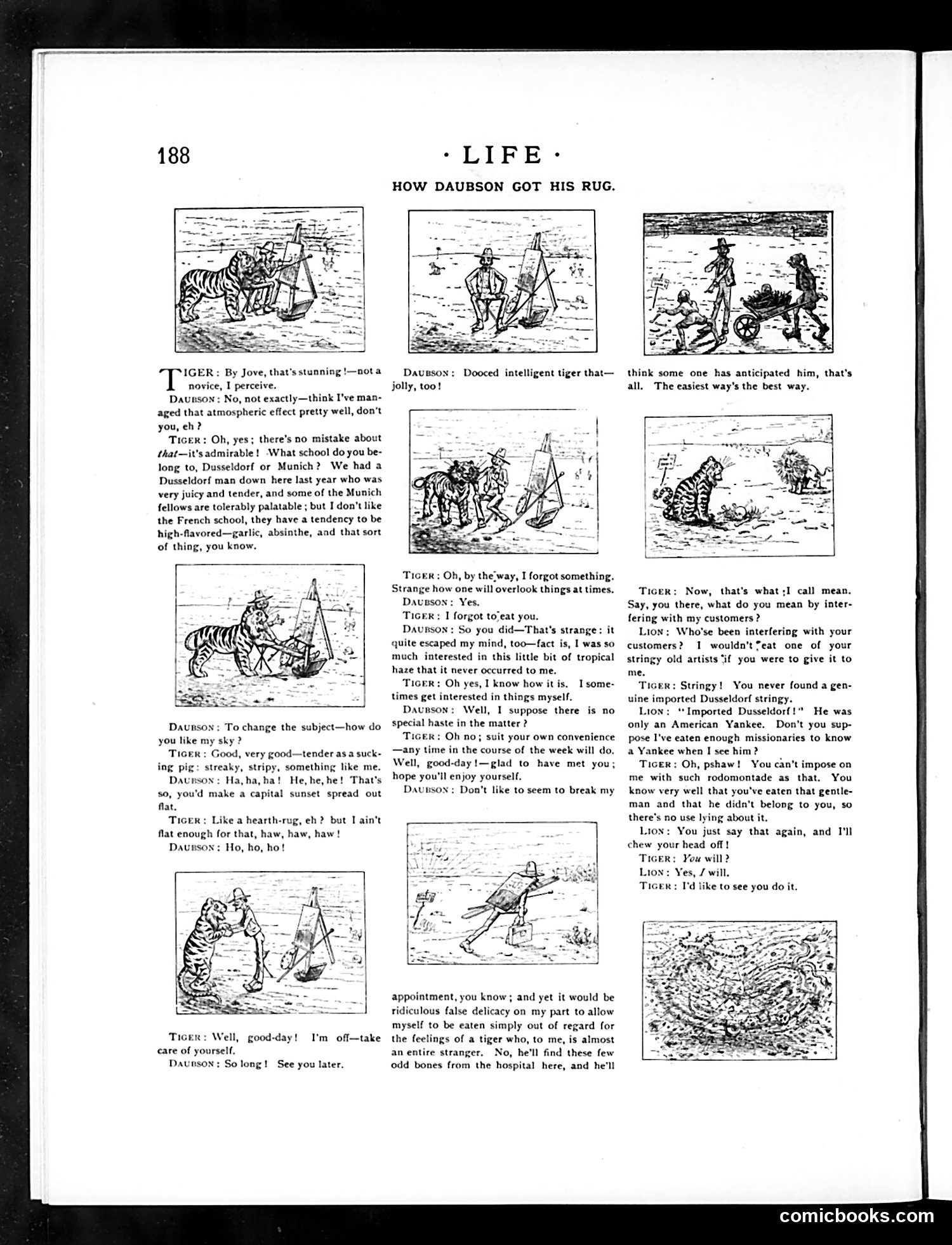
This satirical comic strip depicts a conversation between a Tiger and a character named Daubson, apparently concerning how Daubson acquired a rug. The Tiger initially praises what it assumes is a fine imported rug, but Daubson reveals he obtained it through questionable means—specifically by eating a missionary and obtaining the rug from a hospital. The humor relies on dark satire about colonial attitudes toward indigenous peoples and missionaries. The Tiger expresses mock horror at Daubson's behavior while simultaneously making derogatory comments about missionaries and suggesting the victim "didn't belong" to civilized society. The strip satirizes European colonial hypocrisy—condemning cannibalism while dismissing the humanity of both indigenous people and religious workers. The specific historical references remain unclear without additional context about who "Daubson" represents.
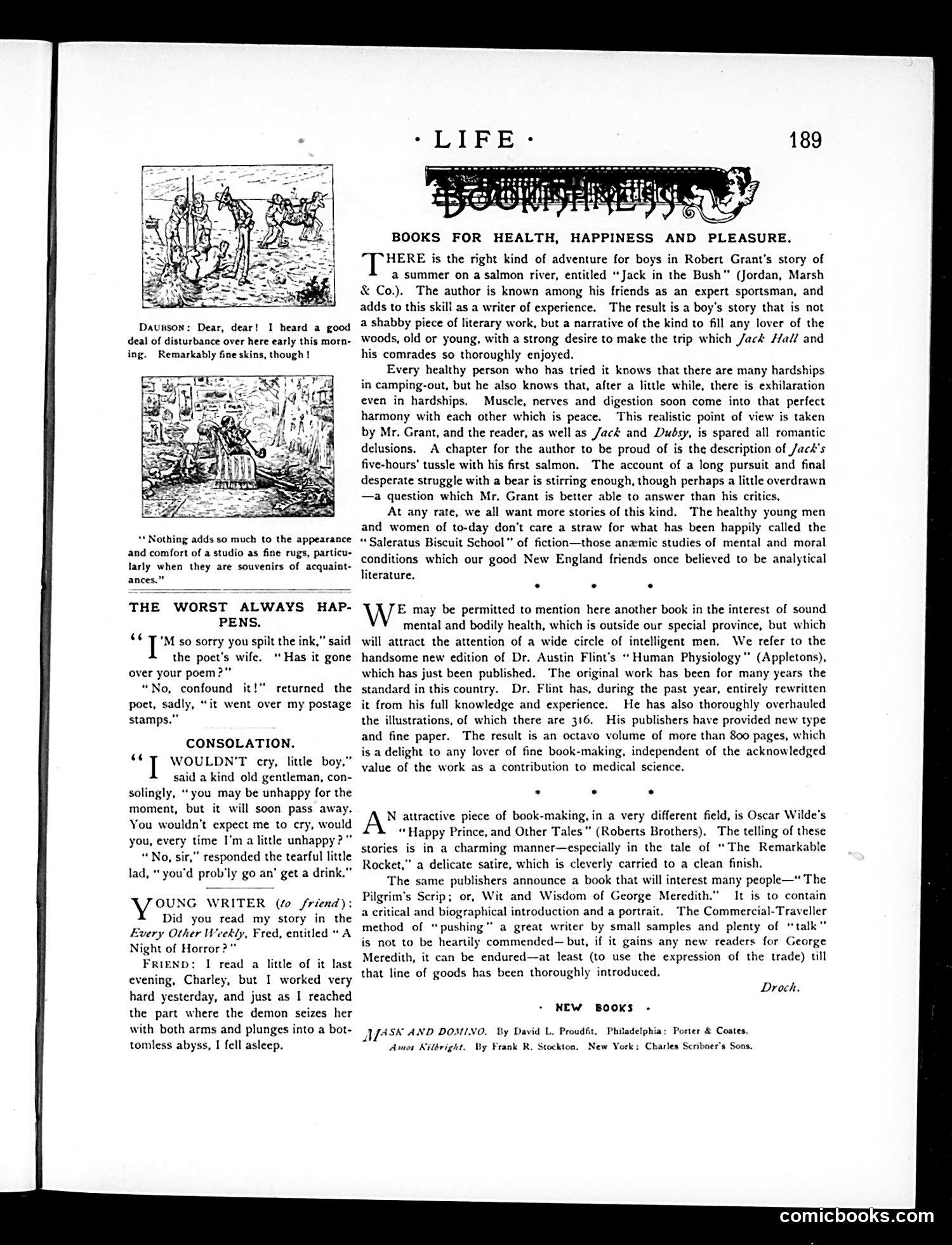
This page contains three separate anecdotal humor sections rather than political cartoons: 1. **"The Worst Always Happens"** — A brief dialogue between a poet and someone who spilled ink on his work, poking fun at the poet's vanity and bad luck. 2. **"Consolation"** — A comforting conversation between an adult and unhappy child, using gentle humor about life's temporary disappointments. 3. **"Young Writer (to friend)"** — A humorous account of a writer's exhausting day, culminating in a comedic twist about falling asleep during a supernatural moment. The page is primarily literary humor—short comic anecdotes rather than visual satire. The accompanying illustrated vignettes support these text-based jokes. There's no apparent political content; instead, the humor targets relatable everyday situations: artistic mishaps, childhood sadness, and writer's fatigue.
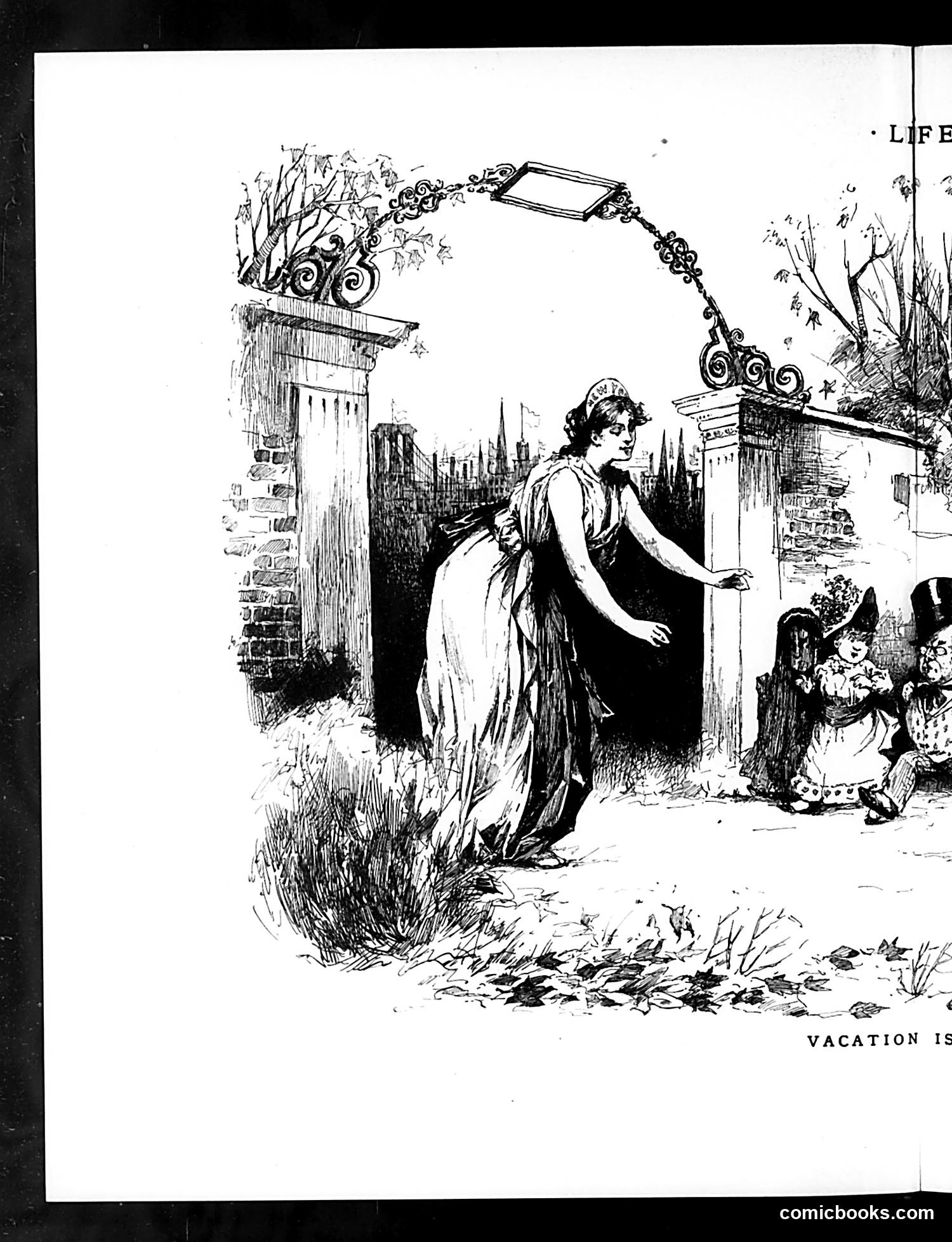
This appears to be an illustration from Life magazine depicting a classical or allegorical scene. A woman in flowing robes stands at an ornate gate or threshold, gesturing outward with a welcoming motion. The classical architectural elements—decorative urns with scrollwork and pillars—suggest an idealized, timeless setting rather than a contemporary scene. The partial text visible at bottom reads "VACATION IS," suggesting this is commentary on vacation or leisure time. The woman's pose and the classical setting suggest she may personify "Vacation" itself, inviting the viewer to enter a realm of rest and pleasure. Without seeing the complete caption or context, the specific satirical point remains unclear, though it likely comments on vacation culture or idealized leisure through classical allegory.
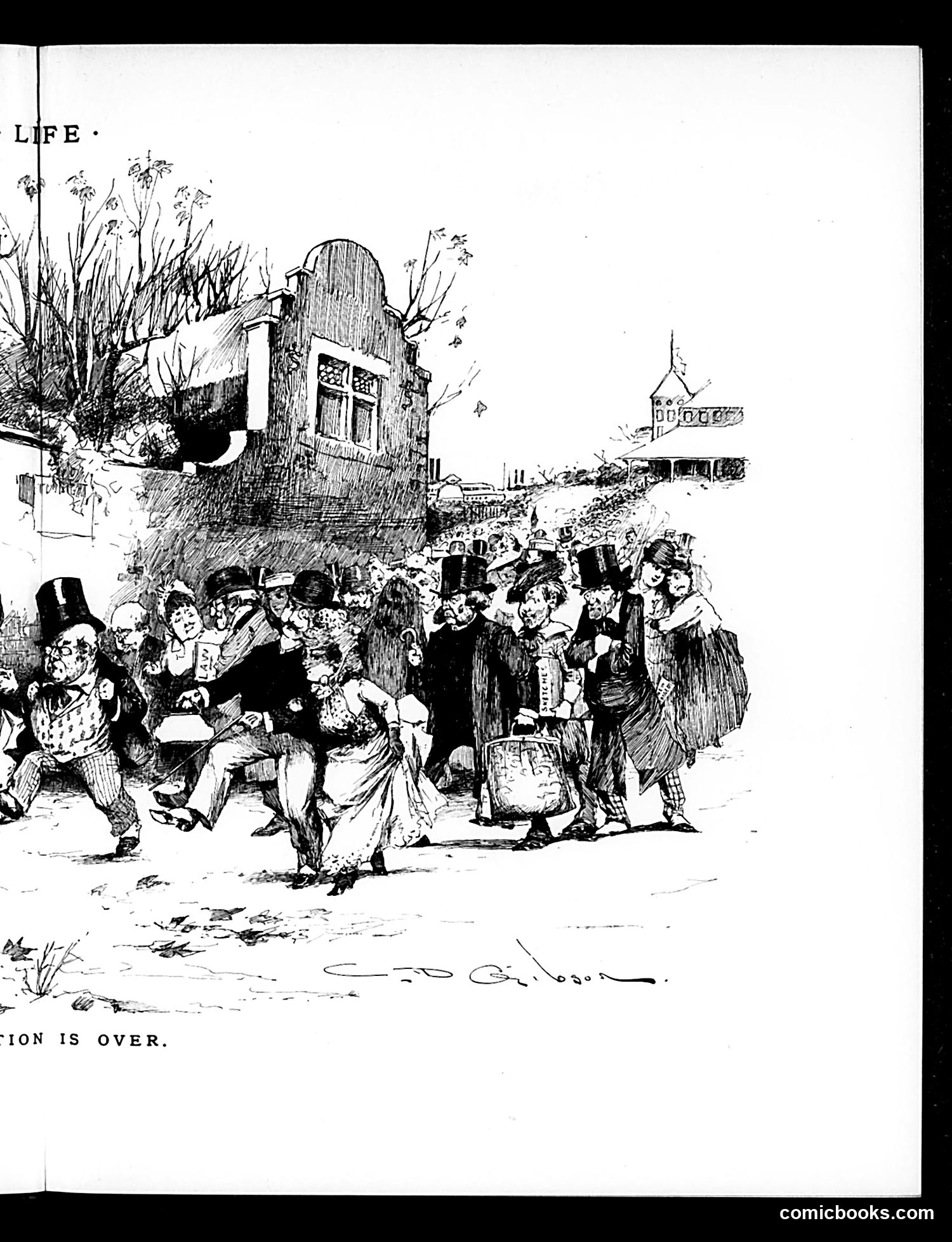
This appears to be a satirical illustration from *Life* magazine titled "LIFE" with partial text reading "TION IS OVER" (likely "VACATION IS OVER" or similar). The image depicts a large hollow tree-house or structure serving as a gathering point for numerous well-dressed figures wearing top hats and formal Victorian/Edwardian clothing. They appear to be returning from some seasonal activity, possibly summer vacation or retreat. The satire likely mocks the urban wealthy class returning to city life after leisure time away. The crowded, undignified scramble of formally-dressed individuals emerging from or gathering at the structure suggests commentary on upper-class pretension—the contrast between their refined appearance and their chaotic, almost desperate gathering. Without the complete title visible, the precise target remains unclear, but this appears social satire aimed at wealthy society and their seasonal habits.
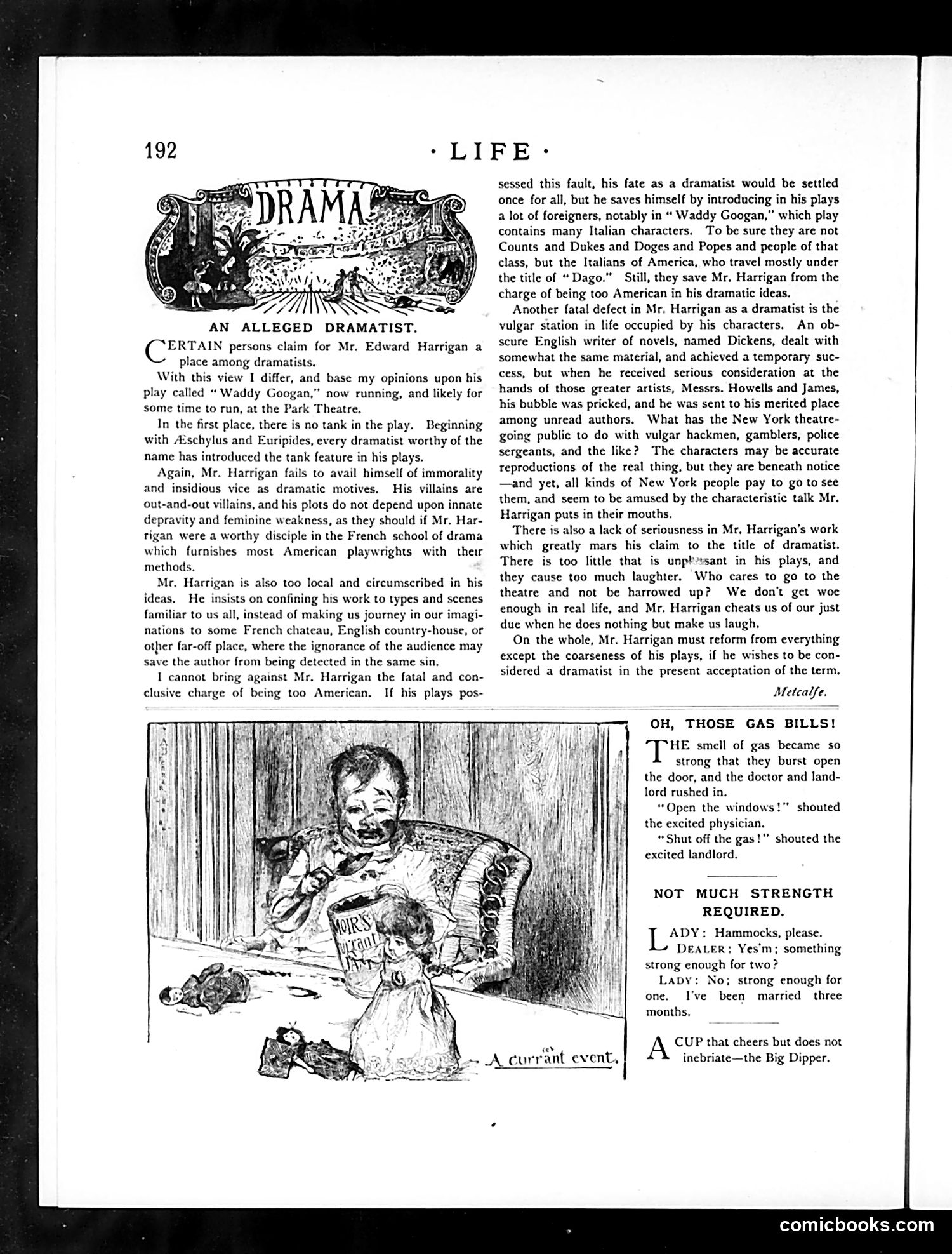
The main content critiques playwright Edward Harrigan. The article argues his plays lack sophistication—they feature stock characters (villains, foreigners, Italian-Americans stereotyped as "Dagos"), rely too heavily on crude humor and dialect comedy, and depict lower-class New York types (sergeants, nurses, etc.) without serious dramatic purpose. The critic contends Harrigan confines himself to familiar local scenes rather than imaginative storytelling, and that his work prioritizes laughs over genuine theatrical merit. The cartoon illustrates a domestic emergency—a gas leak. A woman and child panic while a man (presumably the father/homeowner) remains oblivious or unconcerned, captioned "A currant event." This satirizes contemporary anxieties about domestic safety hazards like gas leaks, which were genuine household dangers of the era.
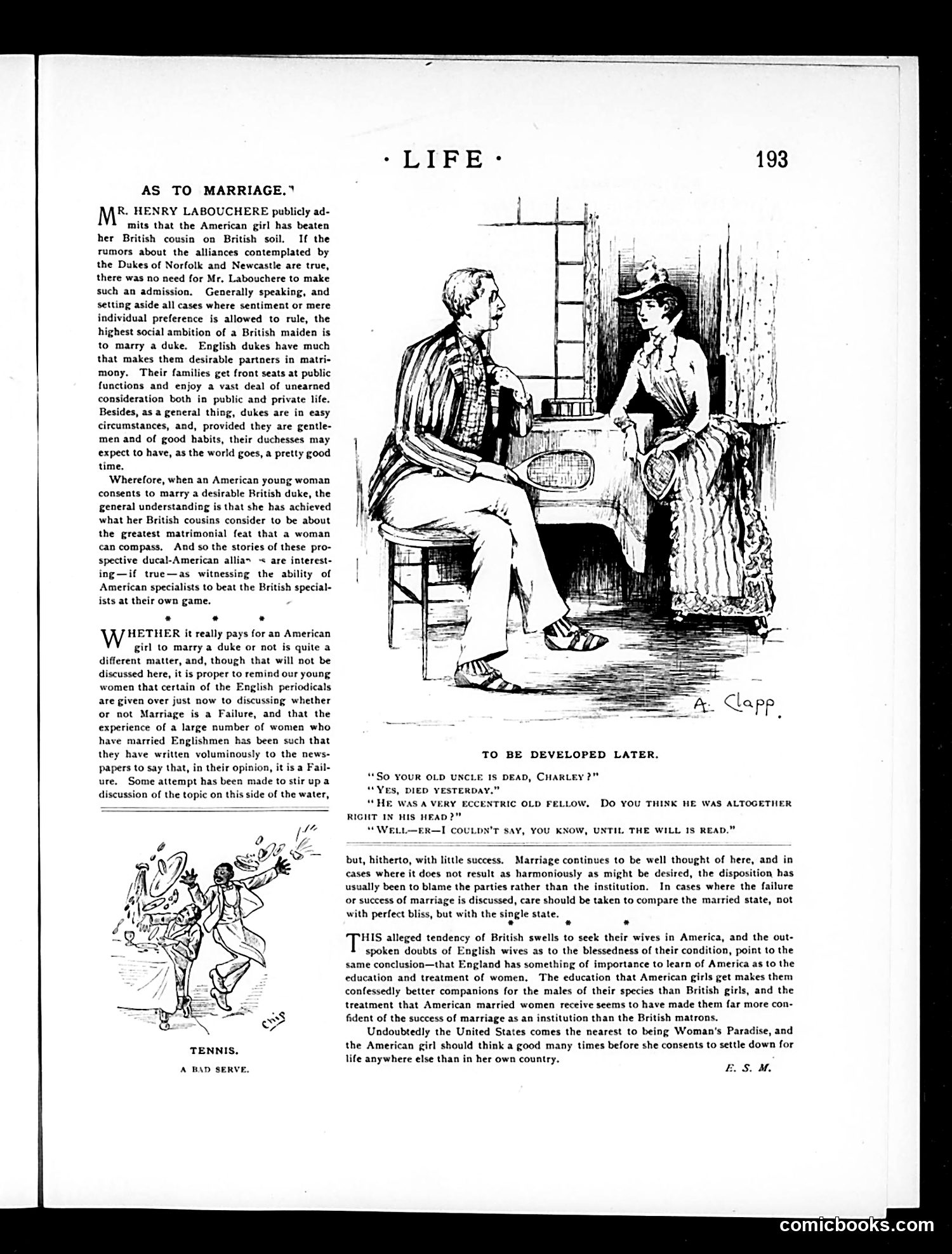
This *Life* magazine page discusses American girls marrying British aristocrats, particularly dukes. The article argues that American women have "beaten" their British cousins at the marriage game—securing advantageous matches that British women aspire to. The **main cartoon** (top right) depicts a man and woman in conversation, likely representing a potential match between an American girl and British nobleman. The **"Tennis" cartoon** (bottom left) shows a chaotic serve, captioned "A Bad Serve"—a visual pun on social missteps. The **dialogue cartoon** (middle) shows two men discussing an uncle's death, with the punchline that one won't know if the uncle was "altogether right in his head" until reading the will—satirizing how inheritance expectations shape family sentiment. **The satire's point**: American women's superior education makes them better wives than British women. The article argues American girls should think carefully before leaving "Woman's Paradise" (America) for British marriages.
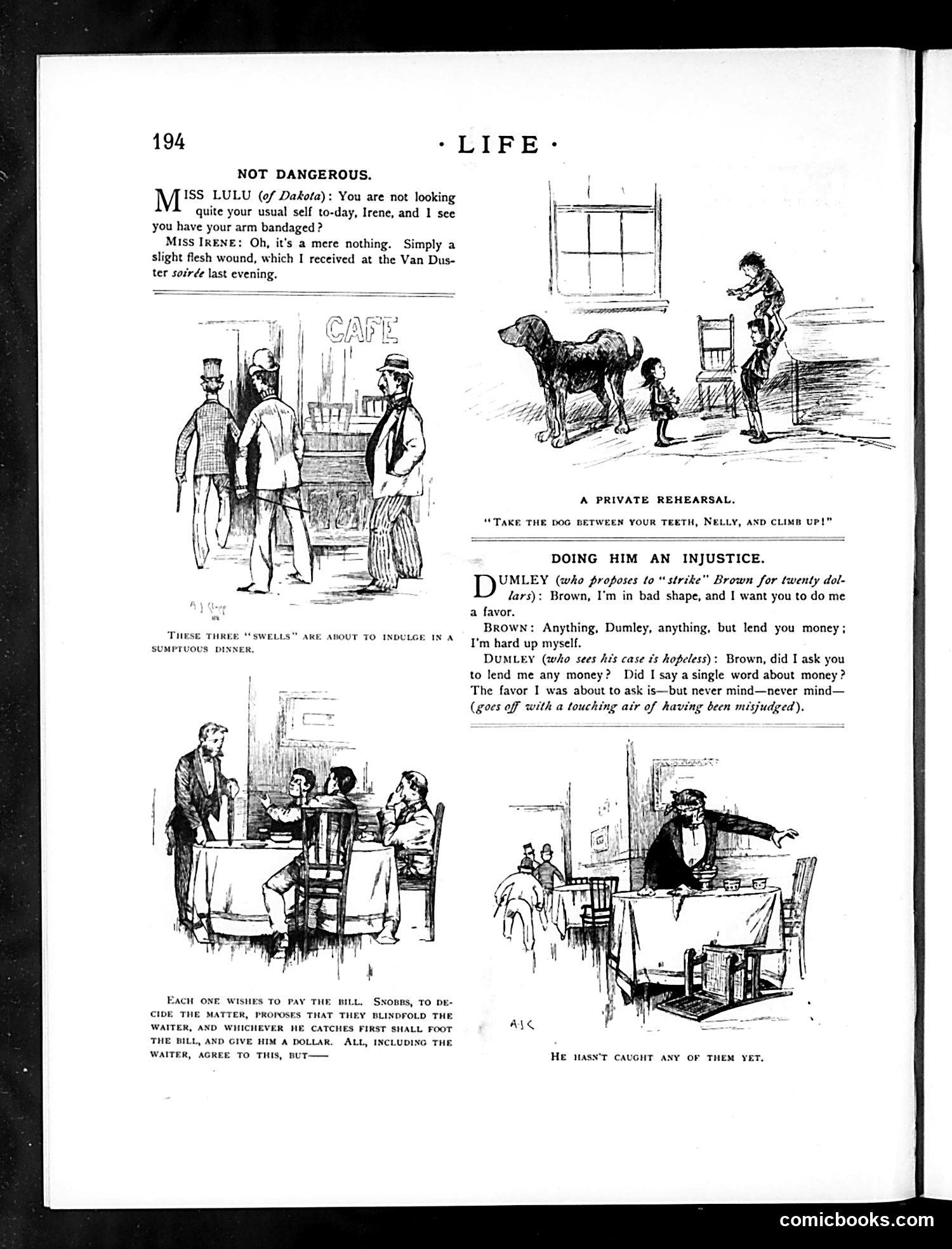
This page contains three unrelated satirical sketches typical of *Life* magazine's social humor: 1. **"Not Dangerous"**: A young woman casually mentions receiving a "flesh wound" at a social gathering (a "Van Duster soirée"), treating a serious injury as trivial gossip. The satire mocks upper-class women's casual attitudes toward violence or danger at fashionable events. 2. **"A Private Rehearsal"**: Children perform dangerous stunts (a dog in mouth, climbing) under adult instruction, satirizing negligent or reckless parenting among the wealthy. 3. **"Doing Him an Injustice"**: A man approaches for a favor, assumes he'll be asked for money (and preemptively refuses), then departs feeling wronged—satirizing the anxious social pretense and self-pity of the upper classes. 4. **Bottom sketch**: Three wealthy men play a game where a blindfolded waiter must catch one of them to receive payment for dinner. The joke: the waiter can't catch any, suggesting the privileged evade obligation. Overall, the page satirizes upper-class irresponsibility, hypocrisy, and avoidance of consequences.
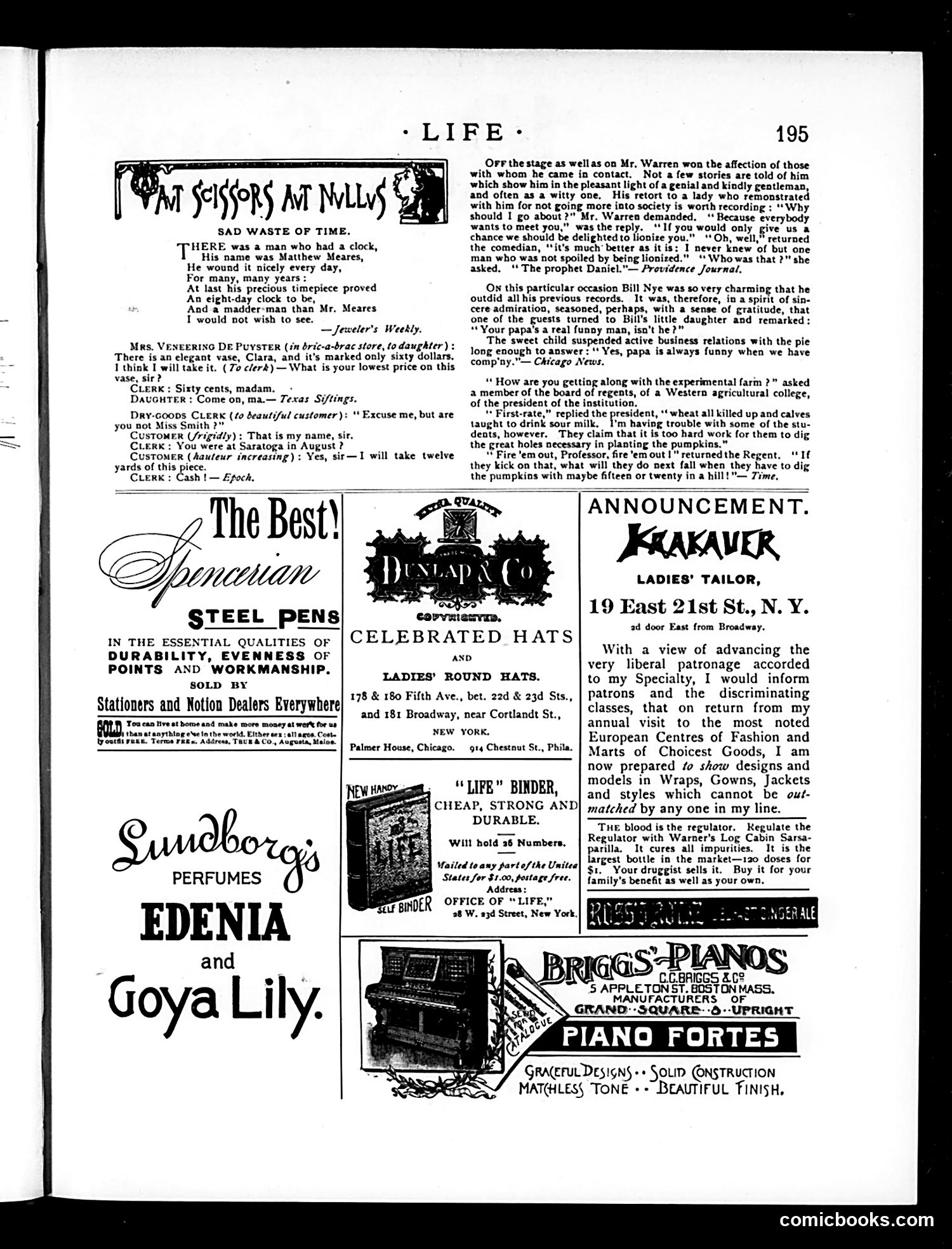
This page primarily contains **humorous short jokes** rather than political cartoons, reflecting late 19th-century American humor. The opening piece, "Scissors at Nulls," mocks a man obsessed with a clock he believes winds itself every eight days—satirizing pointless, time-wasting habits. Subsequent jokes target **social pretension and hypocrisy**: a snobbish woman haggling over a vase's price after initially claiming wealth; a clerk recognizing a customer from Saratoga (an elite resort), implying she's not as refined as she pretends; and a child's innocent comment that her father is "funny when we have comp'ny"—exposing adult performative behavior. The agricultural college joke mocks incompetent administrators and lazy students with absurdist humor about experimental failures. The page is mostly **advertisements** (pens, hats, perfumes, pianos, tailoring services), which dominated Life magazine issues. The satire targets **middle and upper-class American affectations**—pretense, social climbing, and vanity—common targets of late-Victorian humor.
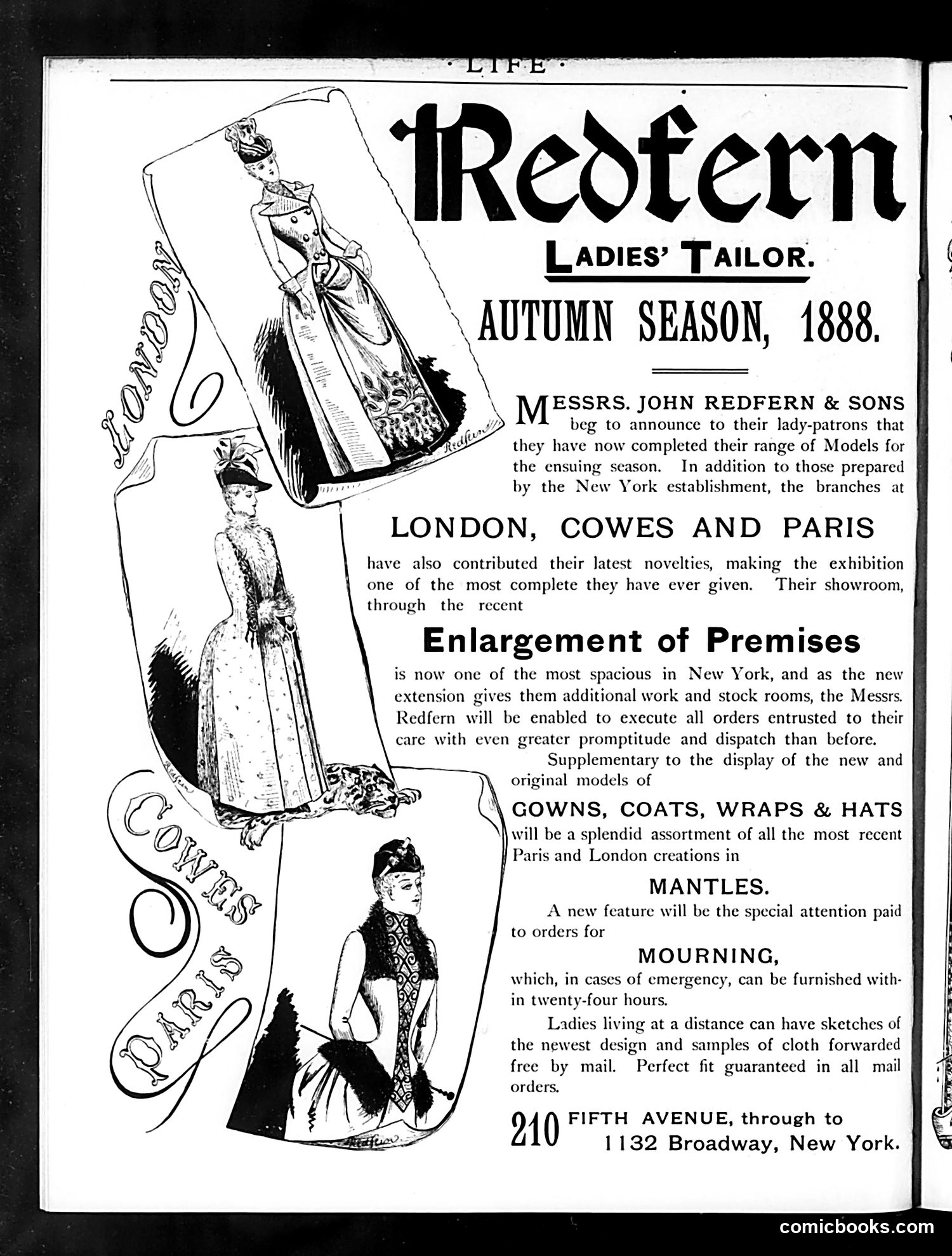
This is primarily a **fashion advertisement**, not satire or political commentary. It's a full-page ad for Redfern, a high-end ladies' tailor operating in 1888. The page features three illustrated fashion figures in elegant period dress (showing the "London," "Cowes," and "Paris" styles mentioned in the text) alongside promotional copy. The company announces their expanded New York showroom and boasts of contributions from their international branches in London, Cowes, and Paris. Notable for modern readers: the ad emphasizes **mourning wear** as a "new feature" available within twenty-four hours—reflecting the Victorian era's elaborate mourning clothing requirements. The promise of mail-order service with "perfect fit guaranteed" was innovative for the period. The decorative border labels ("London," "Cowes," "Paris") establish this as aspirational fashion tied to European sophistication. This is purely commercial messaging aimed at wealthy New York women, not editorial content or satire.