
Life, 1888-10-04 · page 10 of 14
Life — October 4, 1888 — page 10: what you’re looking at
What you’re looking at
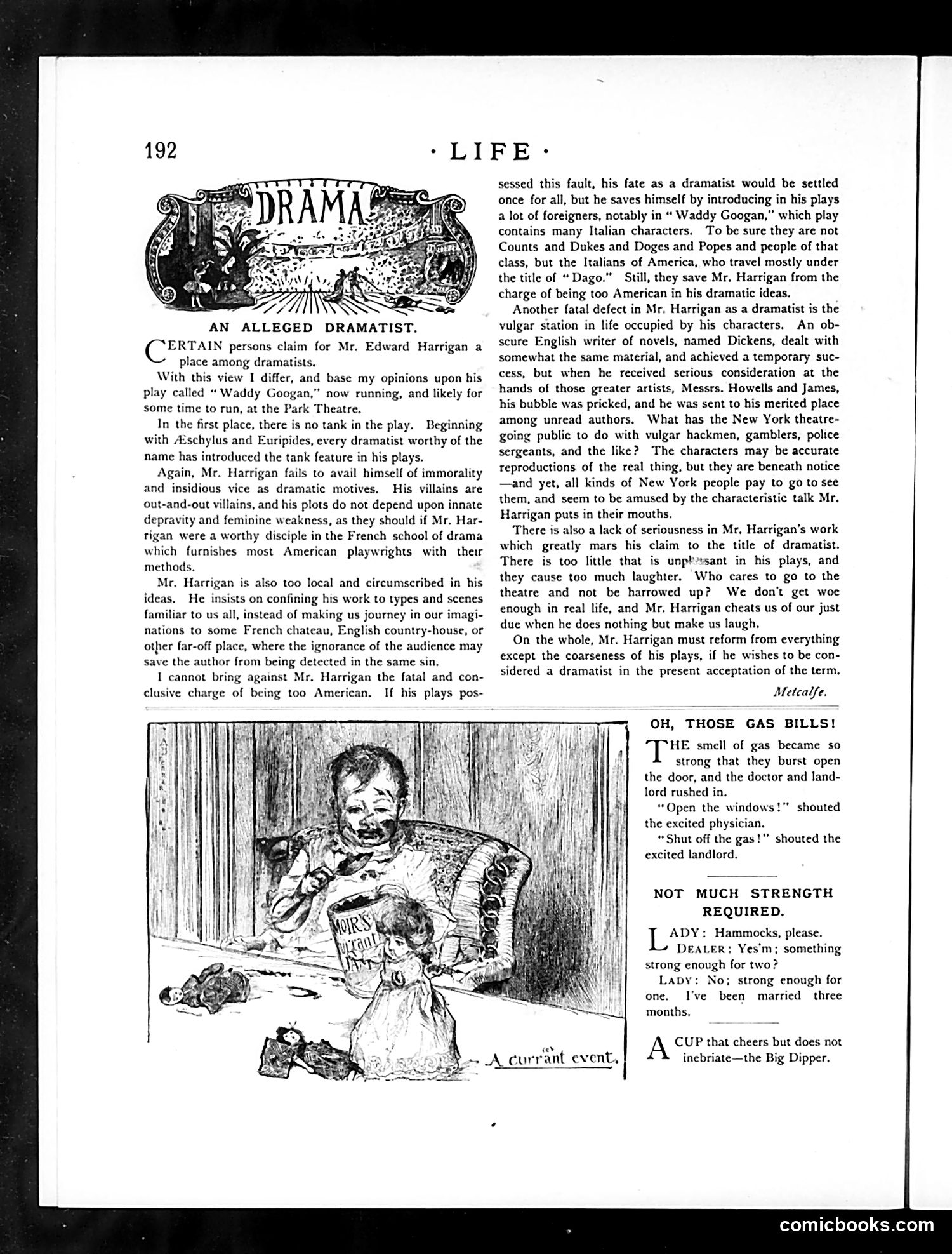
The main content critiques playwright Edward Harrigan. The article argues his plays lack sophistication—they feature stock characters (villains, foreigners, Italian-Americans stereotyped as "Dagos"), rely too heavily on crude humor and dialect comedy, and depict lower-class New York types (sergeants, nurses, etc.) without serious dramatic purpose. The critic contends Harrigan confines himself to familiar local scenes rather than imaginative storytelling, and that his work prioritizes laughs over genuine theatrical merit. The cartoon illustrates a domestic emergency—a gas leak. A woman and child panic while a man (presumably the father/homeowner) remains oblivious or unconcerned, captioned "A currant event." This satirizes contemporary anxieties about domestic safety hazards like gas leaks, which were genuine household dangers of the era.
📄 Transcribed text from this page (OCR, searchable)
Machine-transcribed from the original scan — historical spelling and the odd misread are preserved.
- LIFE: AN ALLEGED DRAMATIST. CERTAIN persons claim for Mr. Edward Harrigan a place among dramatists. With this view I differ, and base my opinions upon his play called “ Waddy Googan,” now running, and likely for some time to run, at the Park Theatre. In the first place, there is no tank in the play. Beginning with Aischylus and Euripides, every dramatist worthy of the name has introduced the tank feature in his plays. Again, Mr. Harrigan fails to avail himself of immorality and insidious vice as dramatic motives. His villains are out-and-out villains, and his plots do not depend upon innate depravity and feminine weakness, as they should if Mr. Har- Tigan were a worthy disciple in the French school of drama which furnishes most American playwrights with their methods. Mr. Harrigan is also too local and circumscribed in his ideas. He insists on confining his work to types and scenes familiar to us all, instead of making us journey in our imagi- nations to some French chateau, English country-house, or other far-off place, where the ignorance of the audience may save the author from being detected in the same sin. I cannot bring against Mr. Harrigan the fatal and con- clusive charge of being too American. If his plays pos- sessed this fault, his fate as a dramatist would be settled once for all, but he saves himself by introducing in his plays a lot of foreigners, notably in “ Waddy Googan,” which play contains many Italian characters. To be sure they are not Counts and Dukes and Doges and Popes and people of that class, but the Italians of America, who travel mostly under the title of “ Dago.” Still, they save Mr. Harrigan from the charge of being too American in his dramatic ideas. Another fatal defect in Mr. Harrigan as a dramatist is the vulgar station in life occupied by his characters. An ob- scure English writer of novels, named Dickens, dealt with somewhat the same material, and achieved a temporary suc- cess, but when he received serious consideration at the hands of those greater artists, Messrs. Howells and James, his bubble was pricked, and he was sent to his merited place among unread authors. What has the New York theatre- going public to do with vulgar hackmen, gamblers, police sergeants, and the like? The characters may be accurate reproductions of the real thing, but they are beneath notice —and yet, all kinds of New York people pay to go to see them, and seem to be amused by the characteristic talk Mr. Harrigan puts in their mouths. There is also a lack of seriousness in Mr. Harrigan’s work which greatly mars his claim to the title of dramatist. There is too little that is unp!sant in his plays, and they cause too much laughter. Who cares to go to the theatre and not be harrowed up? We don’t get woe enough in real life, and Mr. Harrigan cheats us of our just due when he does nothing but make us laugh. On the whole, Mr. Harrigan must reform from everything except the coarseness of his plays, if he wishes to be con- sidered a dramatist in the present acceptation of the term. Metcalfe. OH, THOSE GAS BILLS! HE smell of gas became so strong that they burst open the door, and the doctor and land- lord rushed in. “Open the windows!” shouted the excited physician. “Shut off the gas!" shouted the excited landlord. NOT MUCH STRENGTH REQUIRED. [AR Hammocks, please. DEALER: Yes'm; something strong enough for two? Lapy: No; strong enough for one. I've been married three months, CUP that cheers but does not inebriate—the Big Dipper. comicbooks.com