
Life, 1888-10-04 · page 2 of 14
Life — October 4, 1888 — page 2: what you’re looking at
What you’re looking at
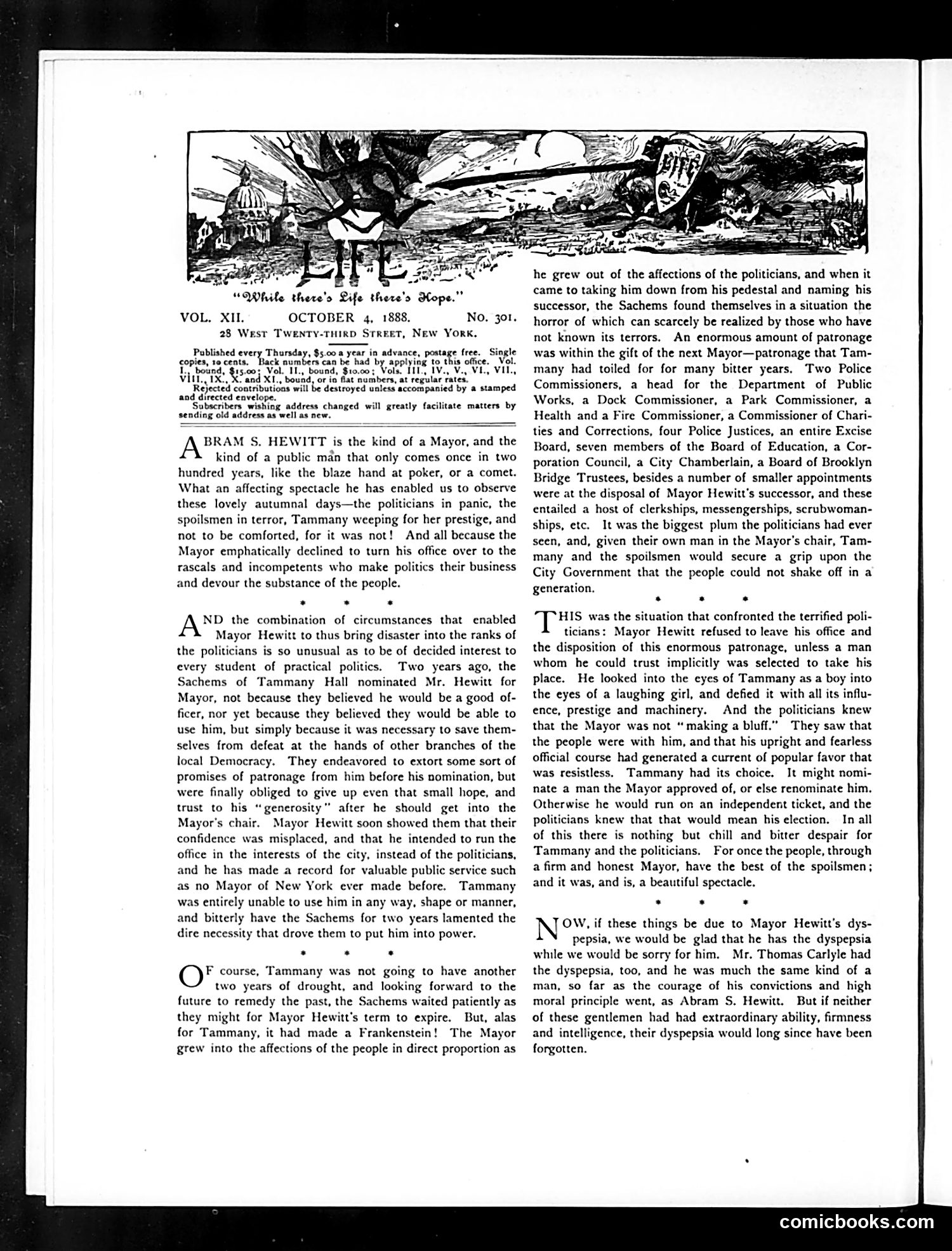
**The Cartoon:** The masthead image depicts a chaotic urban scene with a large figure looming over a cityscape, titled "While there's Life there's Hope." **The Article's Context:** The text discusses Mayor Abram S. Hewitt of New York, describing a political crisis. Tammany Hall (the Democratic political machine) nominated Hewitt for mayor not because they believed he'd be a good leader, but to save their organization from electoral defeat. However, Hewitt proved independent and uncontrollable, resisting Tammany's patronage demands and refusing to fill positions with their preferred candidates. **The Satire:** The piece mocks the politicians' miscalculation—they created a "Frankenstein" by elevating Hewitt, who used his position to thwart rather than serve their interests, demonstrating that even corrupt political machines can lose control of their chosen candidates.
📄 Transcribed text from this page (OCR, searchable)
Machine-transcribed from the original scan — historical spelling and the odd misread are preserved.
= 2" “While there's Life there's Hope.” VOL, XII. OCTOBER 4, 1888, No, 301. 28 West Twenty-THIRD Street, New York, Published eve: Single copies, re ceats. "Back numbers can be had by applying to this ofice. Vol. 1, bound, Sus.c0; Vol. 11, bound, Sro.co;, Vols. IIL, IVa. Viv Viv Wily Vitl., 1X!, Xvand XI., bound, or ia flat numbers, at regular rates. Rejected contributions will be destroyed unless accompanied by a stamped and directed envelope. Subscribers wishing address changed will greatly facilitate matters by sending old address as well as new. Thursday, $5.00 year in advance, postage free. BRAM S. HEWITT is the kind of a Mayor, and the kind of a public man that only comes once in two hundred years, like the blaze hand at poker, or a comet. What an affecting spectacle he has enabled us to observe these lovely autumnal days—the politicians in panic, the spoilsmen in terror, Tammany weeping for her prestige, and not to be comforted, for it was not! And all because the Mayor emphatically declined to turn his office over to the rascals and incompetents who make politics their business and devour the substance of the people. ND the combination of circumstances that enabled Mayor Hewitt to thus bring disaster into the ranks of the politicians is so unusual as to be of decided interest to every student of practical politics. Two years ago, the Sachems of Tammany Hall nominated Mr. Hewitt for Mayor, not because they believed he would be a good of- ficer, nor yet because they believed they would be able to use him, but simply because it was necessary to save them- selves from defeat at the hands of other branches of the local Democracy. They endeavored to extort some sort of promises of patronage from him before his nomination, but were finally obliged to give up even that small hope, and trust to his “generosity” after he should get into the Mayor's chair. Mayor Hewitt soon showed them that their confidence was misplaced, and that he intended to run the office in the interests of the city, instead of the politicians, and he has made a record for valuable public service such as no Mayor of New York ever made before. Tammany was entirely unable to use him in any way, shape or manner, and bitterly have the Sachems for two years lamented the dire necessity that drove them to put him into power. . . . F course, Tammany was not going to have another two years of drought, and looking forward to the future to remedy the past, the Sachems waited patiently as they might for Mayor Hewitt’s term to expire. But, alas for Tammany, it had made a Frankenstein! The Mayor grew into the affections of the people in direct proportion as he grew out of the affections of the politicians, and when it came to taking him down from his pedestal and naming his successor, the Sachems found themselves in a situation the horror of which can scarcely be realized by those who have not known its terrors. An enormous amount of patronage was within the gift of the next Mayor—patronage that Tam- many had toiled for for many bitter years. Two Police Commissioners, a head for the Department of Public Works, a Dock Commissioner, a Park Commissioner, a Health and a Fire Commissioner, a Commissioner of Chari- ties and Corrections, four Police Justices, an entire Excise Board, seven members of the Board of Education, a Cor- poration Council, a City Chamberlain, a Board of Brooklyn Bridge Trustees, besides a number of smaller appointments were at the disposal of Mayor Hewitt's successor, and these entailed a host of clerkships, messengerships, scrubwoman- ships, etc. It was the biggest plum the politicians had ever seen, and, given their own man in the Mayor's chair, Tam- many and the spoilsmen would secure a grip upon the City Government that the people could not shake off in a generation. . . . THs was the situation that confronted the terrified poli- ticians: Mayor Hewitt refused to leave his office and the disposition of this enormous patronage, unless a man whom he could trust implicitly was selected to take his place. He looked into the eyes of Tammany as a boy into the eyes of a laughing girl, and defied it with all its influ- ence, prestige and machinery. And the politicians knew that the Mayor was not “ making a bluff.” They saw that the people were with him, and that his upright and fearless official course had generated a current of popular favor that was resistless, Tammany had its choice. It might nomi- nate a man the Mayor approved of, or else renominate him. Otherwise he would run on an independent ticket, and the politicians knew that that would mean his election. In all of this there is nothing but chill and bitter despair for Tammany and the politicians. For once the people, through a firm and honest Mayor, have the best of the spoilsmen; and it was, and is, a beautiful spectacle. No: if these things be due to Mayor Hewitt’s dys- pepsia, we would be glad that he has the dyspepsia while we would be sorry for him. Mr. Thomas Carlyle had the dyspepsia, too, and he was much the same kind of a man, so far as the courage of his convictions and high moral principle went, as Abram S. Hewitt. But if neither of these gentlemen had had extraordinary ability, firmness and intelligence, their dyspepsia would long since have been forgotten. comicbooks.com