
Life, 1888-10-04 · page 4 of 14
Life — October 4, 1888 — page 4: what you’re looking at
What you’re looking at
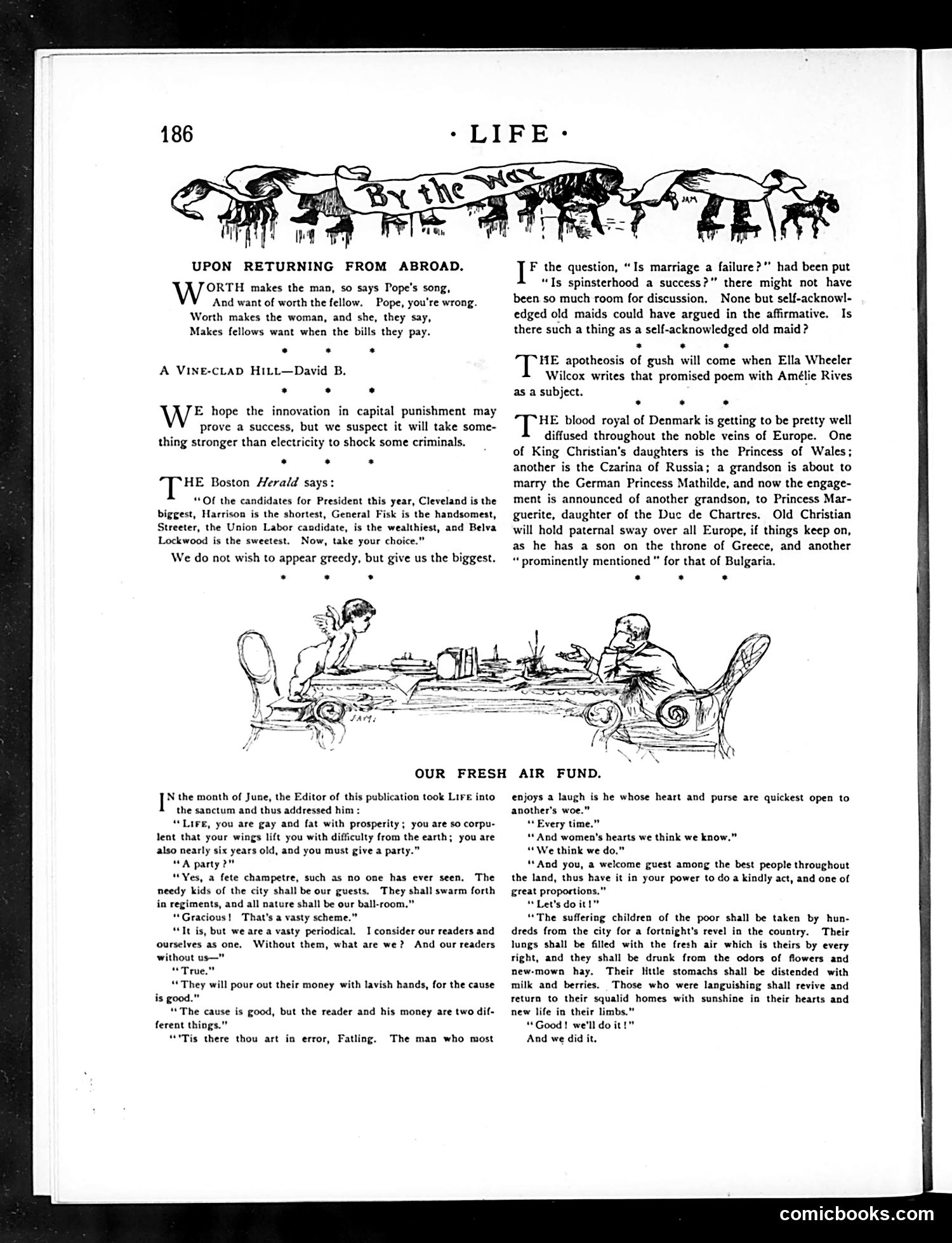
This page contains several satirical commentary pieces rather than a single cartoon: **"Upon Returning from Abroad"** mocks the phrase "worth makes the man," suggesting money determines social value. **The Boston Herald excerpt** humorously catalogs President Cleveland's physical attributes—claiming he's simultaneously the "biggest," "handsomest," "strongest," and "sweetest"—satirizing excessive presidential praise and political flattery. **"Our Fresh Air Fund"** describes a charitable initiative sending poor city children to the countryside for health. The dialogue humorously captures both philanthropic earnestness and the somewhat patronizing Victorian attitude toward poor relief, mixing genuine compassion with class-conscious sentimentality. The illustration shows two figures dining, likely representing different social classes, reinforcing themes of wealth and charitable duty throughout the page.
📄 Transcribed text from this page (OCR, searchable)
Machine-transcribed from the original scan — historical spelling and the odd misread are preserved.
UPON RETURNING FROM ABROAD. ORTH makes the man, so says Pope's song, And want of worth the fellow. Pope, you're wrong. Worth makes the woman, and she, they say, Makes fellows want when the bills they pay. . . . A VINE-CLAD HILL—David B. . . . E hope the innovation in capital punishment may prove a success, but we suspect it will take some- thing stronger than electricity to shock some criminals. . . . HE Boston Herald says: “Of the candidates for President this year, Cleveland is the biggest, Harrison is the shortest, General Fisk is the handsomest, Streeter, the Union Labor candidate, is the wealthiest, and Belva Lockwood is the sweetest. Now, take your choice.” We do not wish to appear greedy, but give us the biggest. F the question, “Is marriage a failure?” had been put “Is spinsterhood a success?” there might not have been so much room for discussion. None but self-acknowl- edged old maids could have argued in the affirmative. Is there such a thing as a self-acknowledged old maid? . . . THe apotheosis of gush will come when Ella Wheeler Wilcox writes that promised poem with Amélie Rives as a subject. . * . “[ blood royal of Denmark is getting to be pretty well diffused throughout the noble veins of Europe. One of King Christian’s daughters is the Princess of Wales; another is the Czarina of Russia; a grandson is about to marry the German Princess Mathilde, and now the engage- ment is announced of another grandson, to Princess Mar- guerite, daughter of the Duc de Chartres. Old Christian will hold paternal sway over all Europe, if things keep on, as he has a son on the throne of Greece, and another “prominently mentioned ” for that of Bulgaria. . OUR FRESH AIR FUND. [ N the month of June, the Editor of this publication took Lire into the sanctum and thus addressed him : “Lire, you are gay and fat with prosperity; you are so corpu- lent that your wings lift you with difficulty from the earth; you are also nearly six years old, and you must give a party.” “A party 2" “Yes, a fete champetre, such as no one has ever seen. The needy kids of the city shall be our guests. They shall swarm forth in regiments, and all nature shall be our ball-room.” “Gracious! That's a vasty scheme.” “It is, but we area vasty periodical. I consider our readers and ourselves as one, Without them, what are we? And our readers without us—" “True” “They will pour out their money with lavish hands, for the cause is good.” “The cause is good, but the reader and his money are two dif- ferent things.” “"Tis there thou art in error, Fatling. The man who most enjoys a laugh is he whose heart and purse are quickest open to another's woe.” And women's hearts we think we know,” We think we do.” “And you, a welcome guest among the best people throughout the land, thus have it in your power to do a kindly act, and one of great proportions.” ** Let's do it!” “The suffering children of the poor shall be taken by hun- dreds from the city for a fortnight’s revel in the country. Their lungs shall be filled with the fresh air which is theirs by every right, and they shall be drunk from the odors of flowers and new-mown hay. Their little stomachs shall be distended with milk and berries. Those who were languishing shall revive and return to their squalid homes with sunshine in their hearts and new life in their limbs.” “Good ! we'll do it!” And we did it. comicbooks.com