
A complete issue · 14 pages · 1888
Life — September 20, 1888
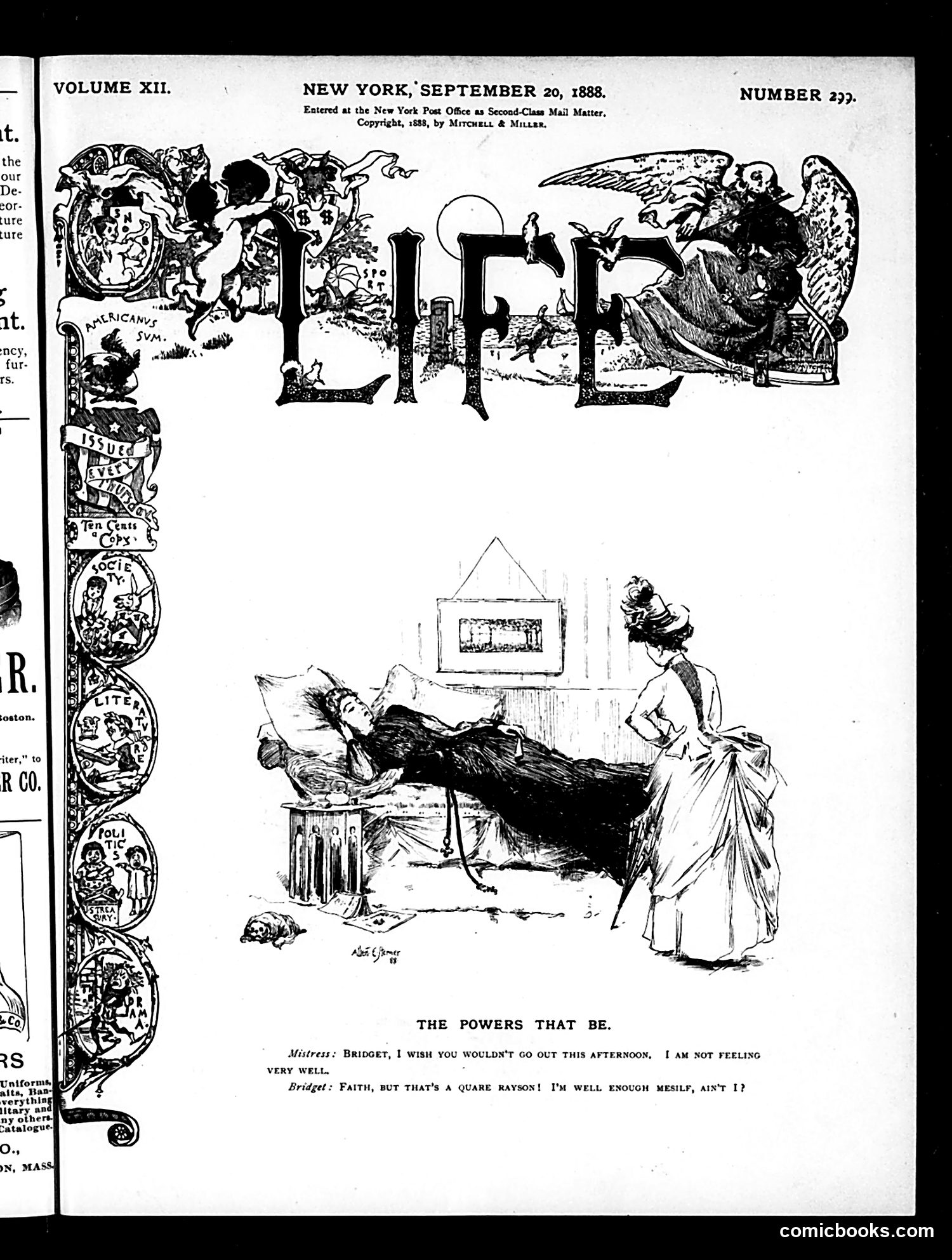
This cartoon satirizes the dynamics of upper-class marriage through a domestic scene. A woman (the "mistress") reclines on a bed, claiming illness to avoid going out. Her husband responds with skepticism, suggesting she's well enough and merely making excuses. The title "The Powers That Be" ironically refers to who truly holds authority in the marriage—implying the wife controls the household through manipulation of her health or mood, a common Victorian satirical trope. The cartoon mocks both the wife's feigned ailments and the husband's resigned acceptance of her authority despite his apparent masculine status. This reflects 1880s anxieties about gender roles and domestic power dynamics in middle- to upper-class households.
The page satirizes **Levi P. Morton**, the Republican Vice-Presidential candidate, who failed to respond to a jury summons and was fined for delinquency. The article criticizes Morton's negligence, arguing that wealthy, prominent citizens have a civic duty to serve on juries regardless of their status—that shirking jury duty undermines democratic government. The satire targets the hypocrisy of someone seeking high office while avoiding fundamental civic responsibilities. The piece suggests Morton's dereliction reveals he doesn't understand that proper governance depends on *all* citizens, especially prominent ones, fulfilling their obligations rather than purchasing exemptions. The cartoon header (depicting a landscape with classical elements) provides visual framing for this critique of elite entitlement.
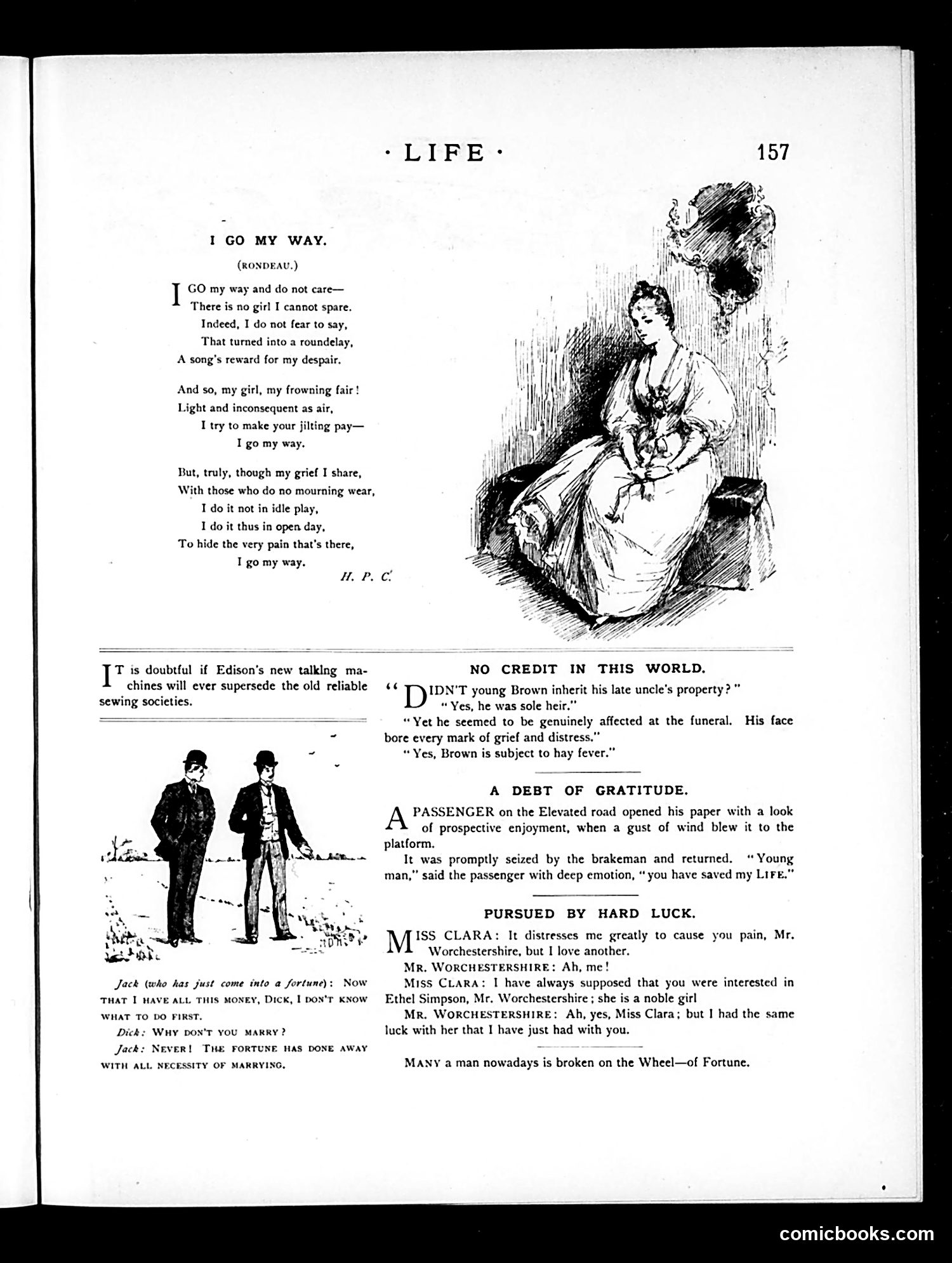
This page contains several brief satirical pieces rather than a single coherent cartoon: **"I Go My Way"** presents a poem by Rondeau (author unclear) about romantic indifference—a woman dismissing a suitor's advances while hiding her pain. **"No Credit in This World"** jokes about young Brown inheriting his uncle's property despite appearing grief-stricken at the funeral, with a reference to Brown being "subject to hay fever." **"A Debt of Gratitude"** recounts an anecdote where a passenger thanks a young man for saving his life after retrieving his wind-blown newspaper from an elevated train platform. **"Pursued by Hard Luck"** depicts dialogue between Miss Clara and Mr. Worcestershire discussing romantic rivals and fortune. The bottom note about the "Wheel of Fortune" suggests broader commentary on economic instability. The illustrations are period-appropriate etchings typical of early 20th-century Life magazine humor.
This page contains satirical commentary and poetry rather than political cartoons. The main pieces critique social customs and gender expectations: **"The Truth of the Matter"** presents a poem about a woman rejecting a suitor's advances—likely satirizing Victorian courtship conventions and female agency. **"Young Man, Strike Out"** quotes Rev. Dr. T. DeWitt Talmage advising against violence, apparently responding to contemporary social conflict. The **"Our Fresh Air Fund"** section includes a children's anecdote about urban-rural cultural differences, followed by a charitable fundraising list totaling $5,827.64 from various organizations. The page appears primarily focused on social satire and charitable fundraising rather than partisan politics. Without additional context about the publication date, specific identities remain unclear.
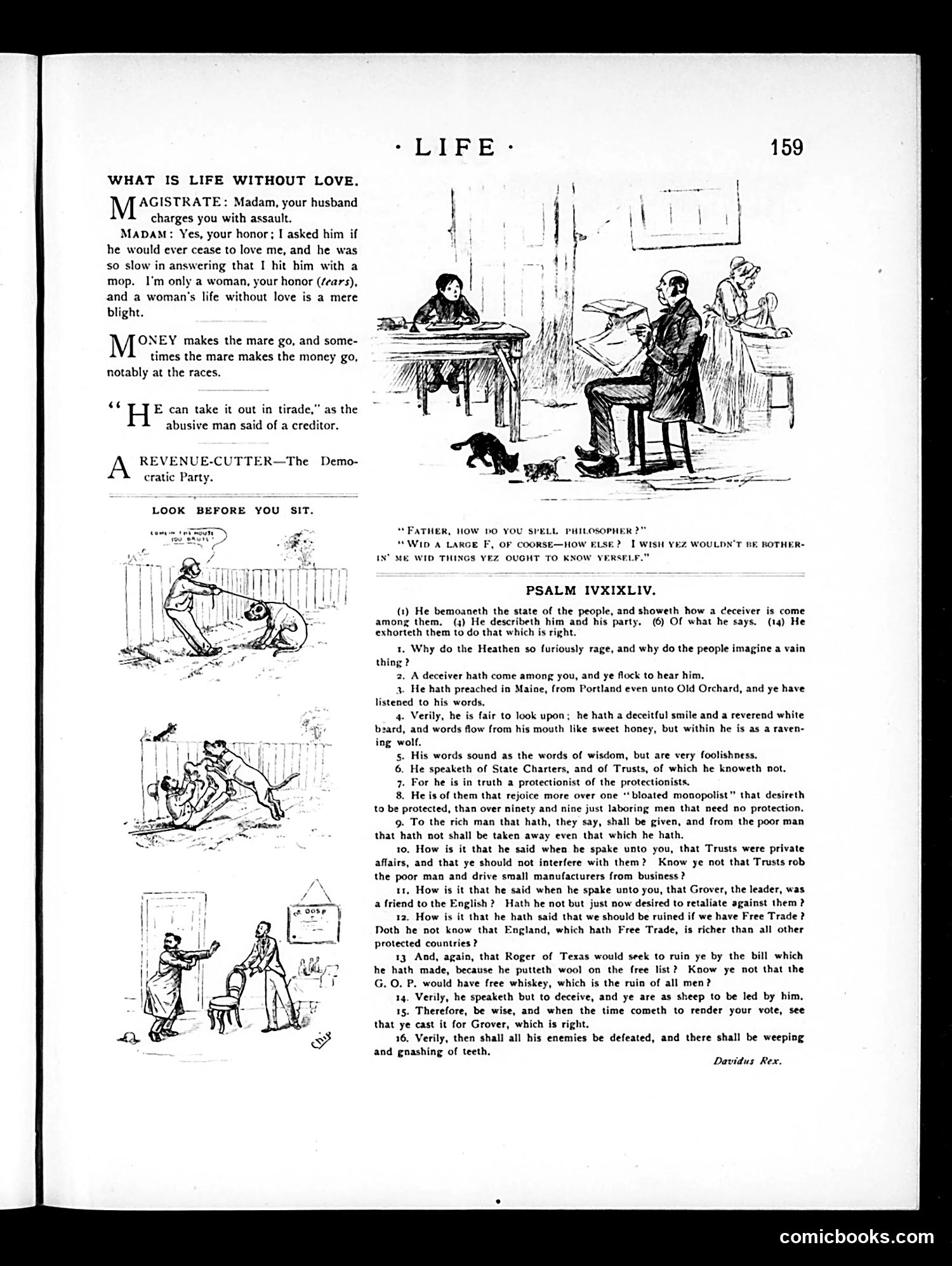
This page contains satirical commentary on late 19th-century American politics, specifically attacking Democratic Party figures and policies. **"A Revenue-Cutter"** mocks the Democratic Party as corrupt tax collectors. **"Look Before You Sit"** shows three sequential cartoons of a man being repeatedly pranked with a chair—likely satirizing gullibility or foolishness, possibly targeting a specific political figure or voter base. **"Psalm IVXIXLIV"** is a lengthy biblical parody criticizing a political deceiver ("Roger of Texas" appears mentioned) who misleads the public. The text attacks Free Trade policy, protectionism debates, and accuses Democrats of deception regarding tariffs and trade—core political disputes of this era. The piece advocates voting for Grover Cleveland's opponent, suggesting this predates or follows one of his administrations.
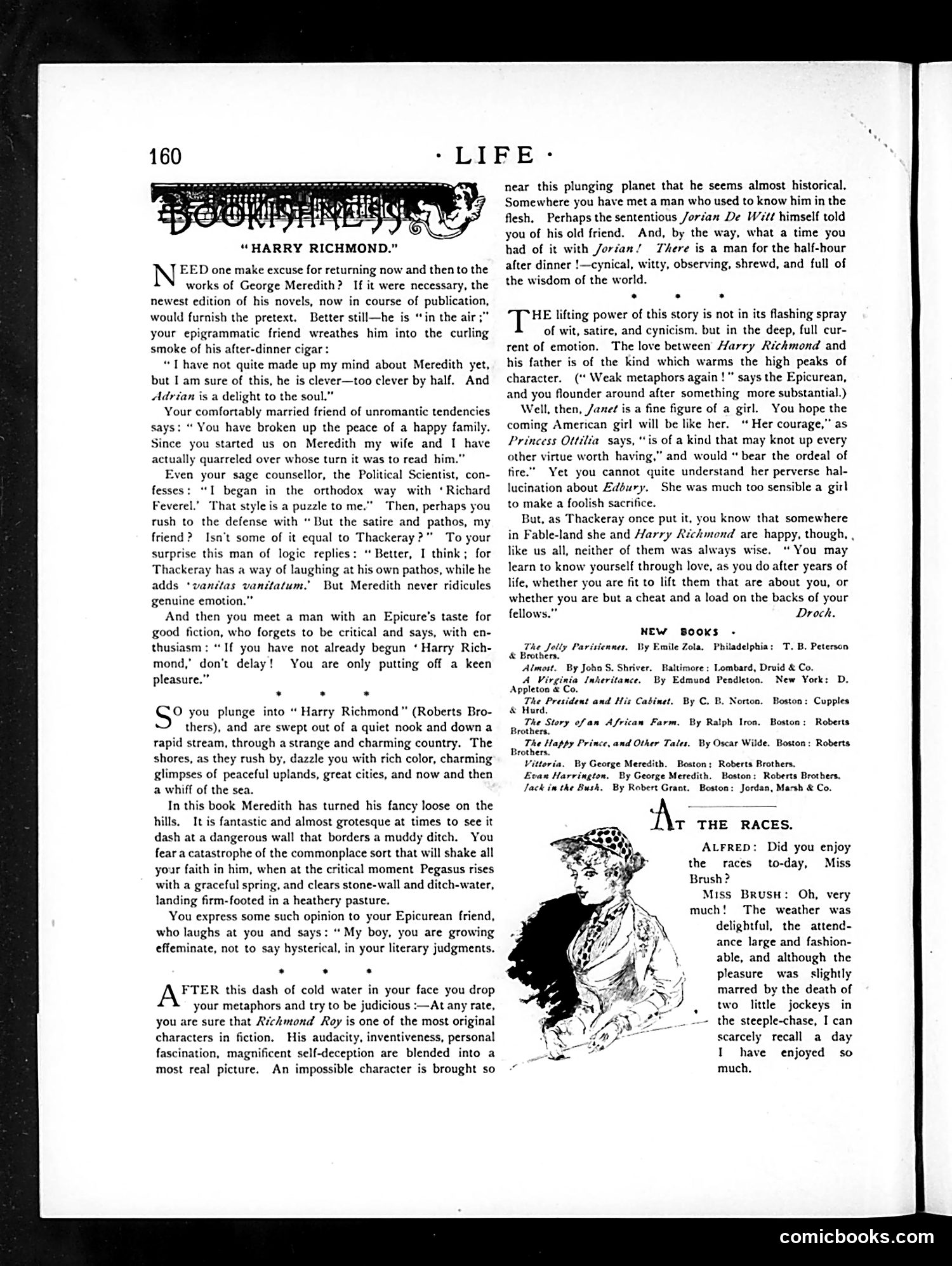
This small cartoon depicts two women at a horse race. One woman (labeled "Miss Brush") tells her companion "Alfred" that she enjoyed the races despite the weather and large crowd. However, she notes the pleasure was "slightly marred by the death of one little jockeys in the steeplechase." The satire targets casual upper-class indifference to serious harm. Miss Brush dismisses a fatal accident as a minor inconvenience to her entertainment—a dark commentary on how wealthy spectators could view human tragedy as merely a footnote to their leisure activities. The cartoon mocks callous social attitudes rather than targeting a specific political figure, using everyday conversation to expose moral blind spots in Gilded Age society.
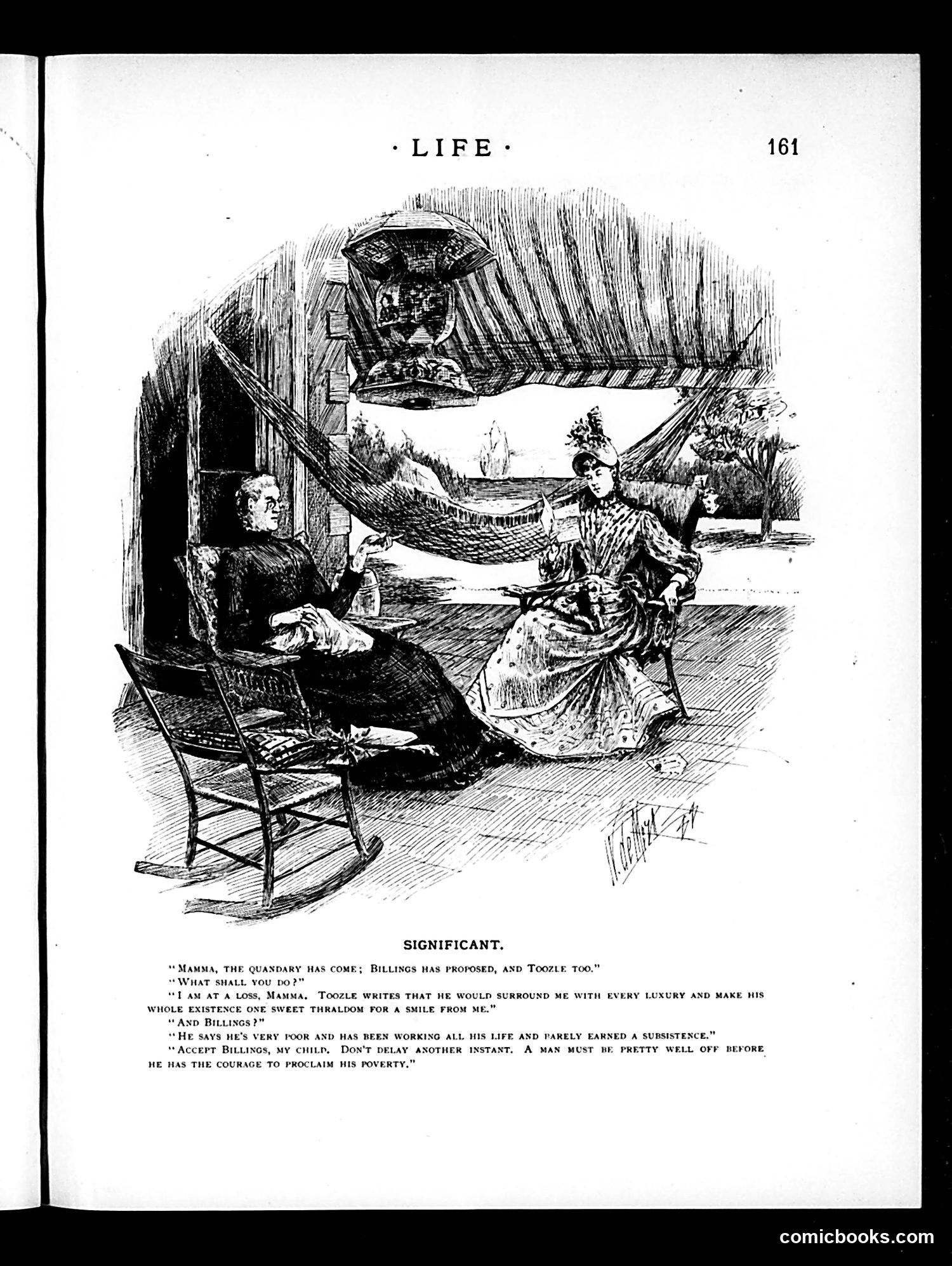
This cartoon satirizes a woman's dilemma regarding marriage proposals. The scene shows a mother with a daughter receiving competing proposals from two suitors: Toozle and Billings. The satire hinges on the mother's pragmatic advice: accept Billings despite his poverty because "a man must be pretty well off before he has the courage to proclaim his poverty." The joke suggests that Billings's willingness to admit financial struggle demonstrates admirable honesty and character—qualities the mother values over Toozle's offers of luxury. The cartoon critiques both Victorian marriage customs (where economic status determined suitability) and the superficiality of materialistic suitors. It advocates for valuing moral character and honesty in choosing a husband over mere wealth, reflecting period debates about women's agency in marriage decisions.
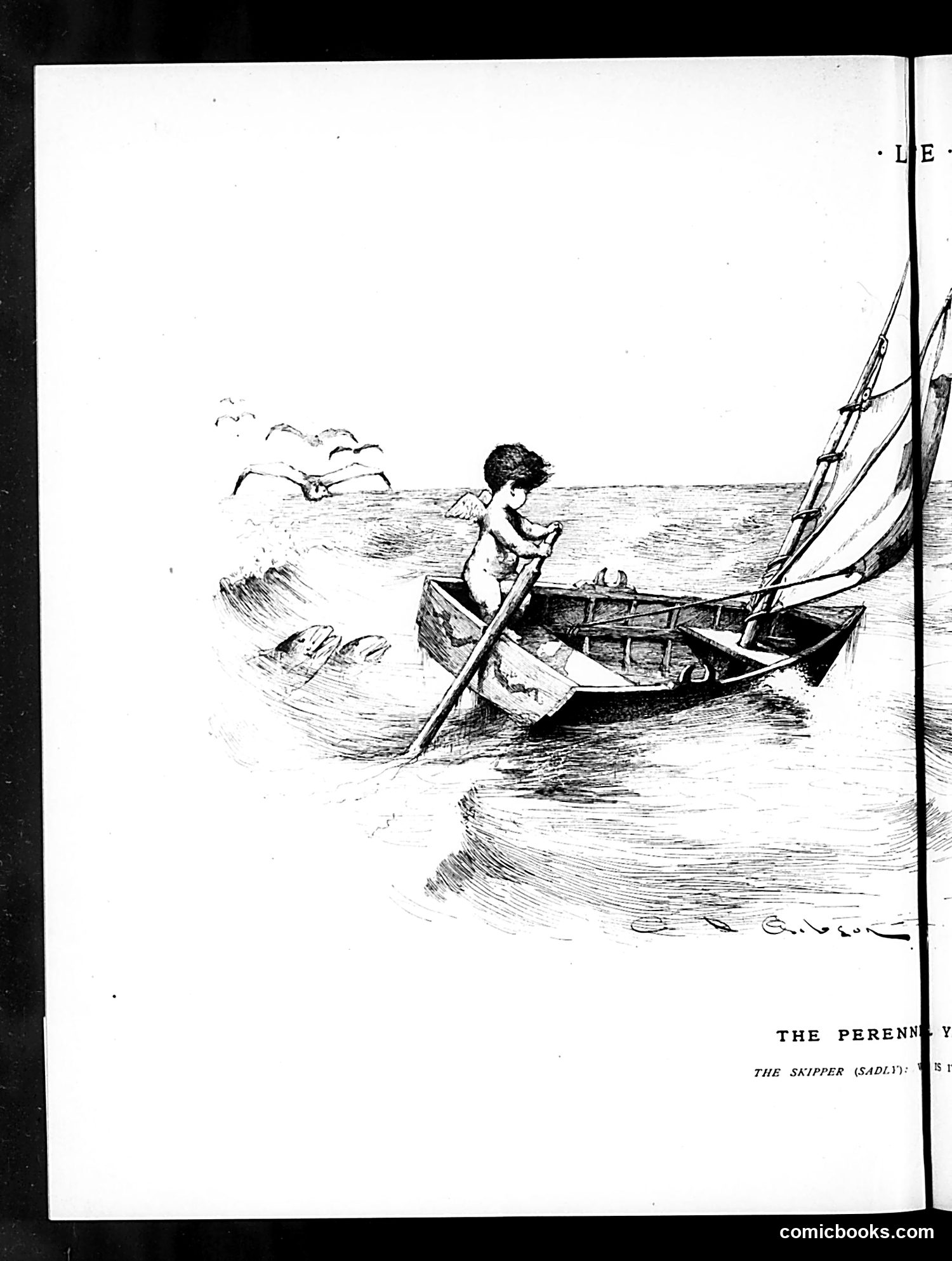
This is an ink sketch titled "The Skipper (Sadly)" from *Life* magazine's "The Perennial" section. The image depicts a solitary figure in a small boat on water, wielding an oar or pole. The figure appears shirtless or minimally clothed, and the overall tone—conveyed through the melancholic posture and the subtitle "(Sadly)"—suggests pathos or disappointment. Without additional context from surrounding text or date information visible on this page, the specific satire remains unclear. It could reference a failing boat captain, disappointed sailor, or potentially a commentary on maritime labor or fishing. The artistic style and "Perennial" designation suggest it may be a recurring satirical feature, but the exact social or political reference is not determinable from the image alone.
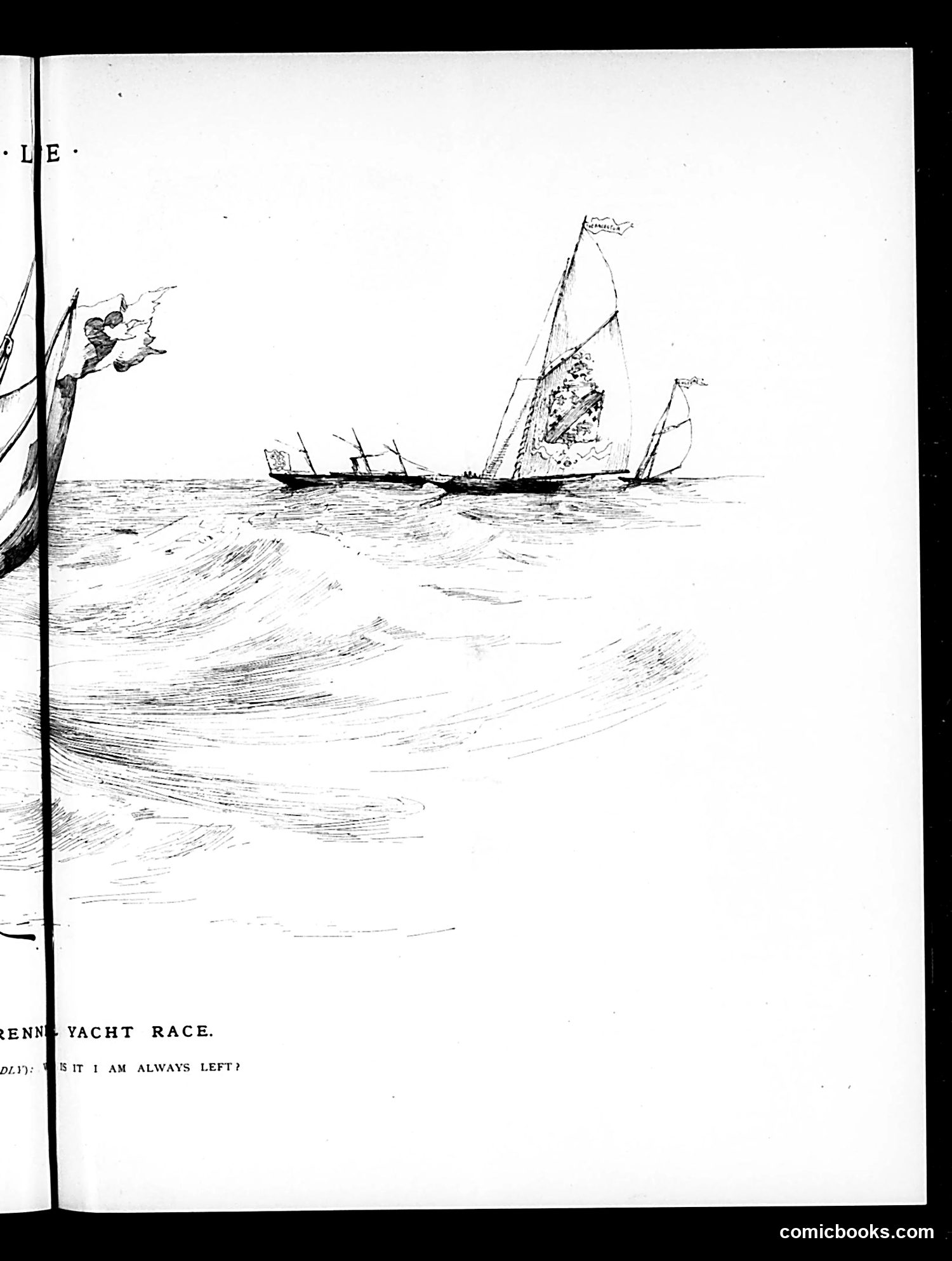
This page shows a sketch titled "RENNE YACHT RACE" with the caption "IS IT I AM ALWAYS LEFT?" The image depicts several sailing vessels on rough water, with one prominent yacht in the center featuring distinctive patterned sails. The caption's phrasing—"Is it I am always left?"—suggests satire about being left behind or excluded from competition. Without additional context, the specific identity of "Renne" and which yacht or competitor is being mocked remains unclear. However, the cartoon appears to mock a particular yacht racer or nation's sailing entry, implying they consistently lose races or fail to compete effectively. The rough seas and the positioning of vessels suggest commentary on competitive disadvantage or poor performance.
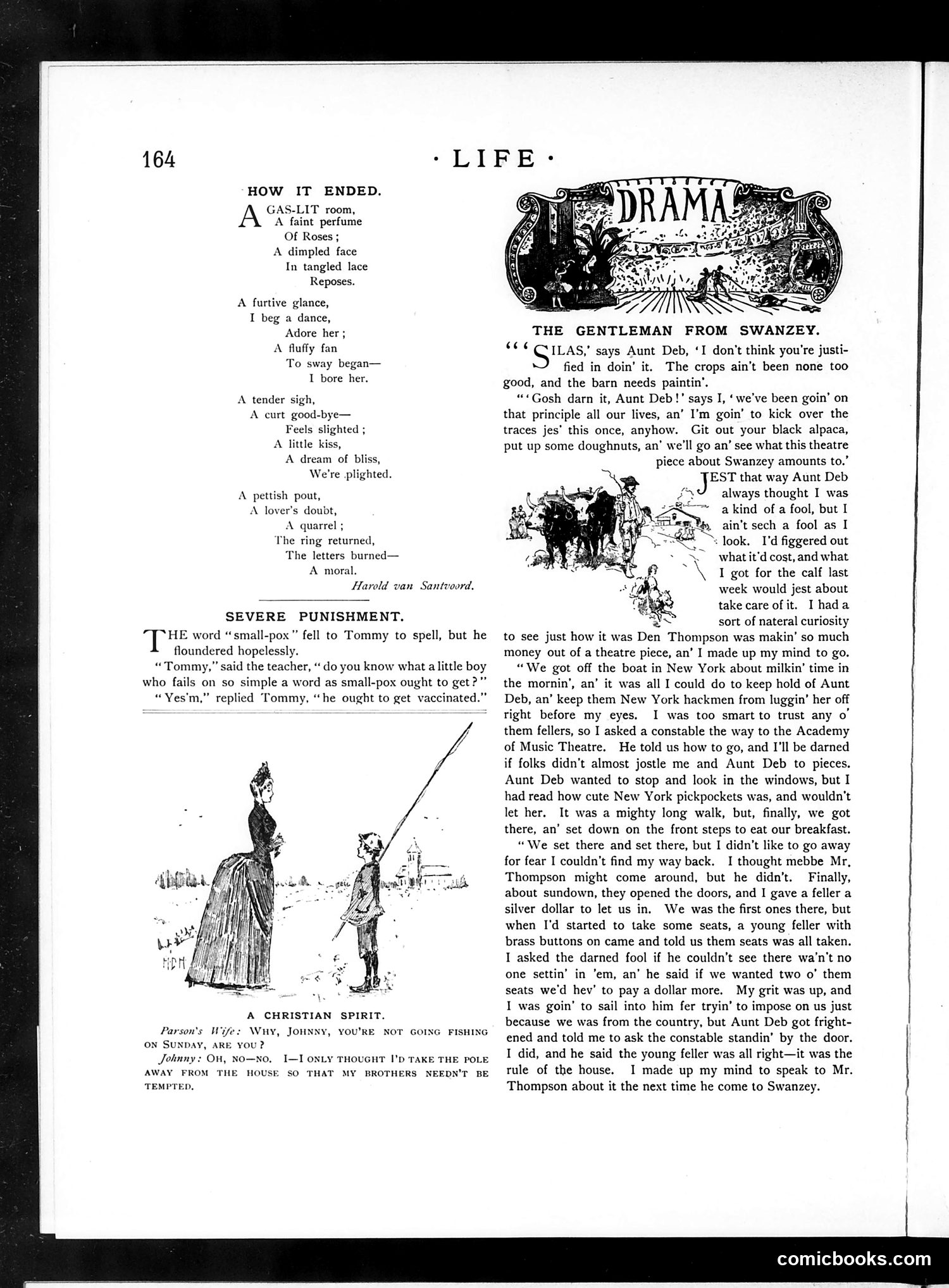
This page contains two distinct sections: **Left side:** A poem titled "How It Ended" by Harold van Santvoord, followed by a section called "Severe Punishment" depicting a schoolmaster scolding a boy named Tommy about contracting smallpox. The accompanying illustration shows the teacher pointing at the child—a commentary on Victorian-era school discipline and medical concerns of the period. **Right side:** A drama section titled "The Gentleman from Swanzey" featuring a narrative about attending a theater performance in New York. The text humorously describes confusion about seating and costs at the Academy of Music Theatre, with illustrations showing period characters and a horse-drawn carriage—satirizing urban theater-going customs and tourist experiences in New York City. The overall tone is lighthearted social commentary on American life and manners.
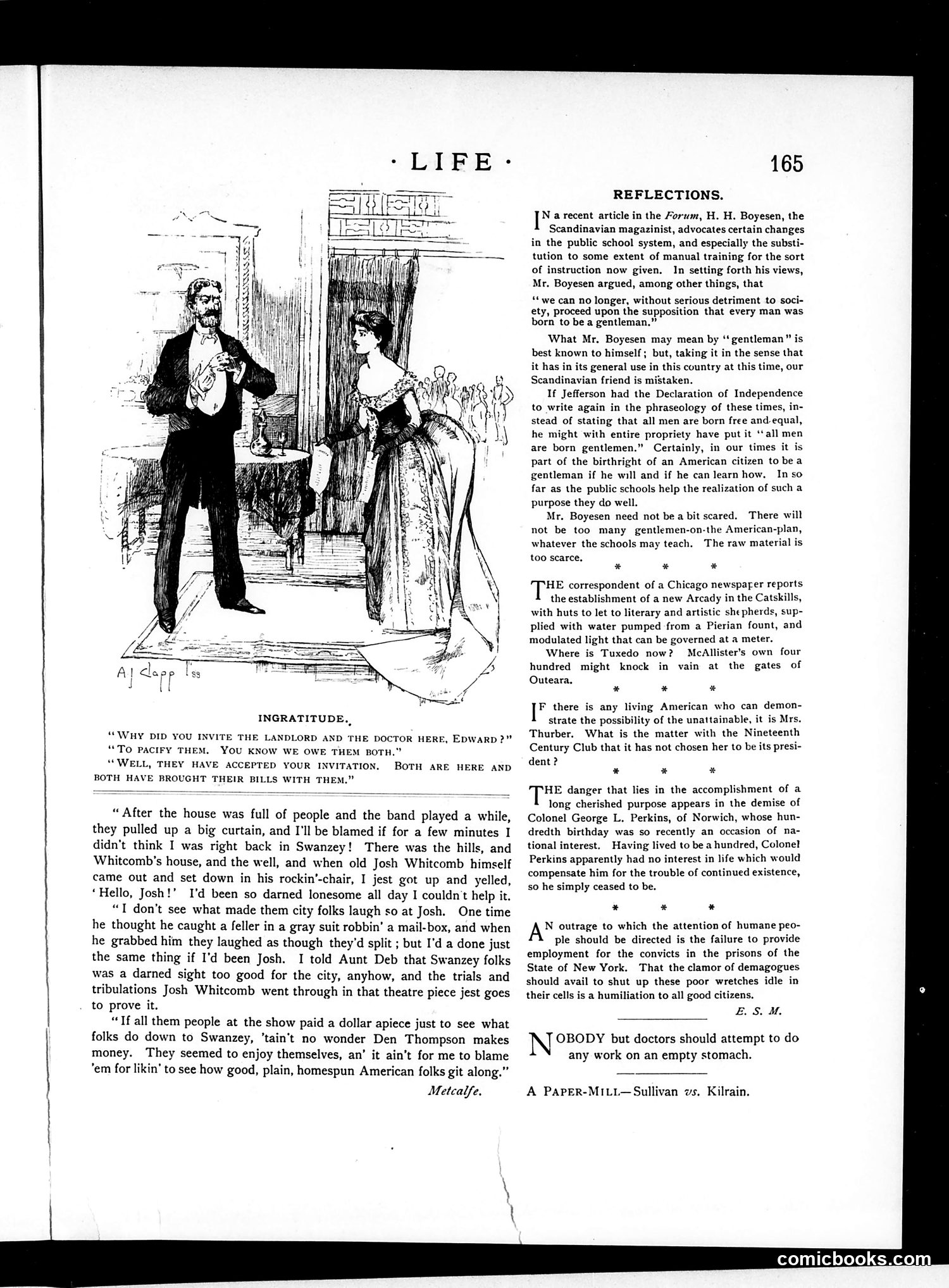
## The Main Cartoon: "Ingratitude" The illustration depicts a man inviting his landlord and doctor to a party, ostensibly to "pacify them"—but they arrive with their bills in hand. The joke is straightforward social satire: the host's attempt to win goodwill through hospitality backfires when his creditors use the occasion to present their demands. ## The Prose Story Below The narrative is a humorous anecdote about attending a theatrical production (likely referencing Denman Thompson's popular play "Joshua Whitcomb"). A rural audience member finds himself homesick watching the rural characters, while city audiences laugh at the "quaint" behavior of simple country folk. The writer defends rural Americans' dignity against urban condescension, arguing their apparent simplicity doesn't reflect inferiority—it simply reflects different lifestyles. ## Context for Modern Readers Both pieces satirize class tensions of the era: the financial precarity of ordinary people (creditors pursuing debtors) and cultural snobbery (urban audiences treating rural life as entertainment/comedy). The satire mocks both the financially desperate and the urban elite's condescension.
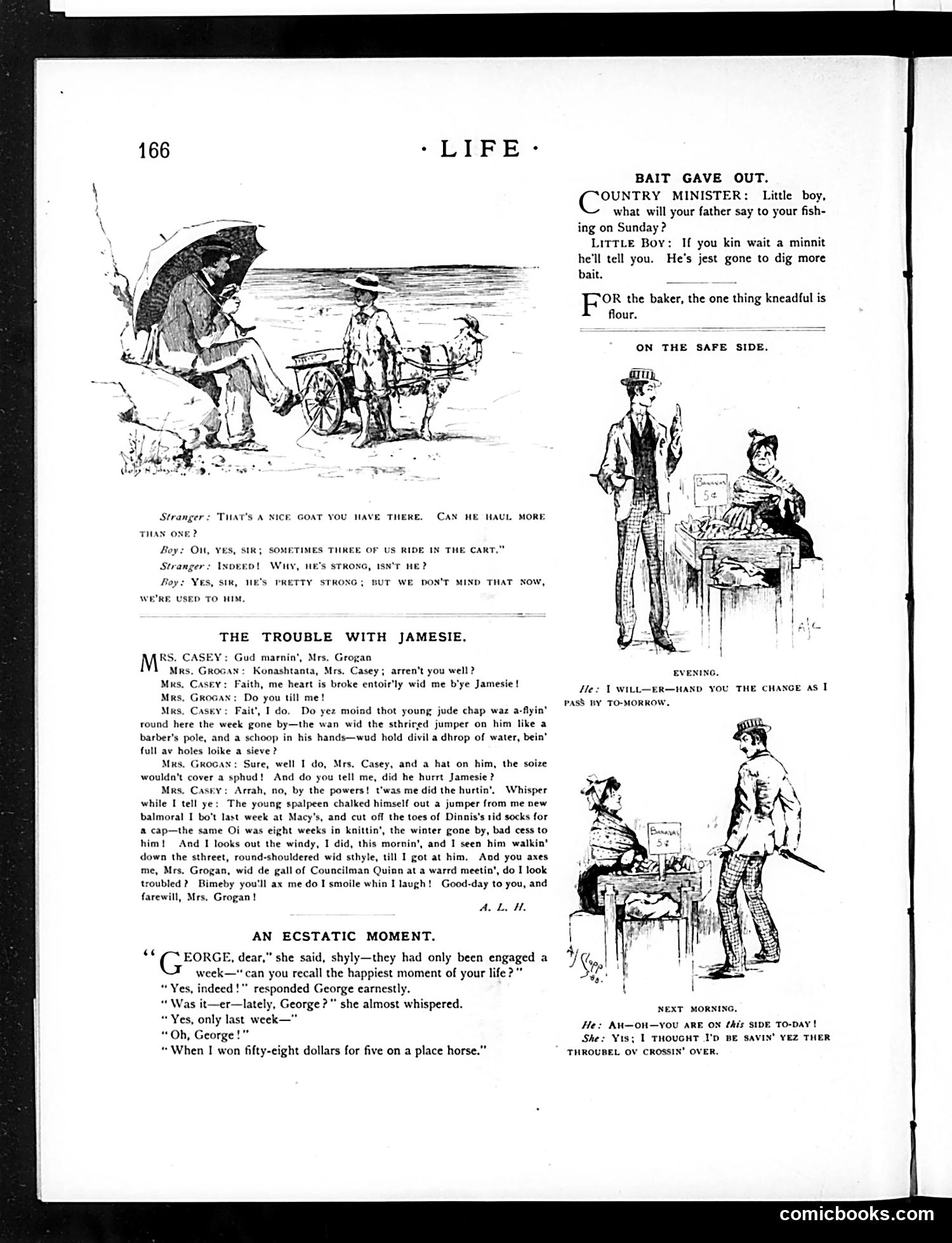
This page contains several unrelated comic sketches typical of early 20th-century American humor magazines: **"Bait Gave Out"**: A minister confronts a boy fishing on Sunday (violating religious observance). The boy's father has gone to "dig more bait"—a clever deflection suggesting the father prioritizes fishing over religious duty. **"The Trouble with Jamesie"**: Uses exaggerated Irish dialect and working-class characters (Mrs. Casey, Mrs. Grogan) discussing a troublemaking boy who has destroyed household items. The humor relies on phonetic Irish speech patterns common in period humor, often considered stereotypical today. **"An Ecstatic Moment"**: Satirizes male materialism—a newly engaged man's happiest memory isn't romantic but winning money betting on horses, disappointing his fiancée. **"On the Safe Side"**: A couple uses avoidance of effort as excuse for avoiding each other. These sketches represent typical Life magazine humor: domestic situations, working-class Irish stereotypes, and satirical commentary on human nature and social behavior.
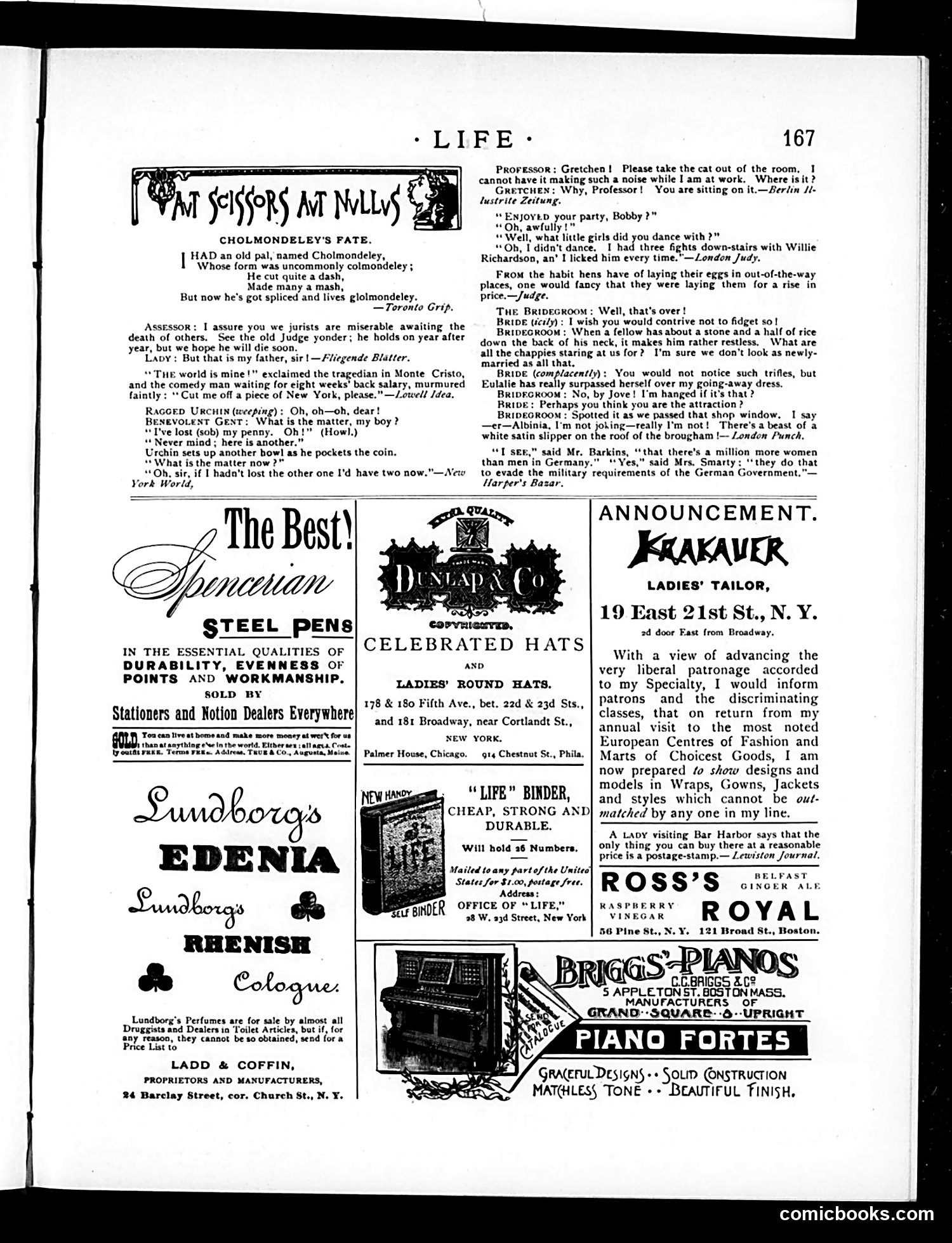
This page from *Life* magazine (circa 1880s) presents humorous short jokes and satirical vignettes rather than political cartoons. The content reflects Victorian-era social comedy: **"Cholmondeley's Fate"** mocks a wealthy socialite ("uncommonly colmondeley") who loses his glamorous lifestyle upon marriage—a common satirical target of the era. The wordplay forcing "Cholmondeley" into every line is characteristic of period light verse. The other brief jokes lampoon: - **Judicial callousness**: Lawyers waiting for judges to die for advancement - **Greed**: A child's ungrateful reaction to charity - **Gender relations**: A bridegroom's wedding complaints; a newlywed's focus on fashion over her husband - **Military matters**: A joke about German women supposedly outnumbering men to avoid military conscription The **advertisements** (steel pens, pianos, ladies' tailoring) reflect the magazine's intended educated, middle-class readership. The satire assumes readers' familiarity with genteel society conventions, making light of marriage, class anxiety, and contemporary politics through witty exaggeration.
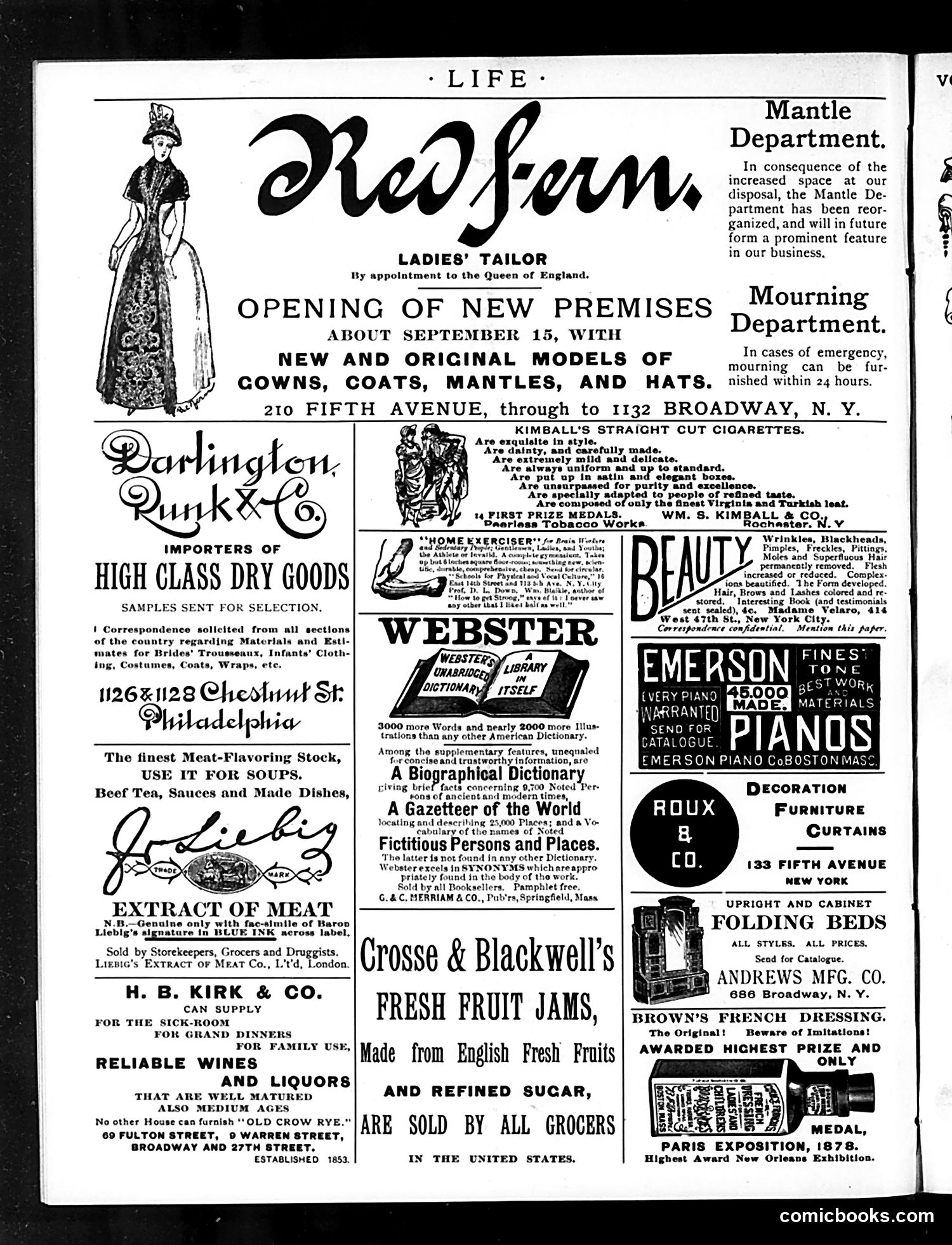
This page is **primarily advertising**, not a political cartoon. It's a commercial layout from an American satirical magazine featuring luxury goods and services circa the 1870s-1880s. The advertisements reveal period social priorities: a high-end ladies' tailor "by appointment to the Queen of England," specialized mourning departments (reflecting Victorian death culture), Liebig's Extract of Meat, fine wines, cigarettes, and cosmetic services promising to remove "Superfluous Hair" and develop "The Form." Notable is the **mourning department's promise of 24-hour service**—suggesting death was frequent enough to require rapid response. The cosmetic ads targeting women's appearance reflect Victorian beauty standards emphasizing pale skin and specific body shapes. The Webster's Dictionary advertisement claims superiority over competitors, typical of period marketing competition. There are **no visible political cartoons** on this page—it's a straightforward commercial publication reflecting Gilded Age consumer culture and social anxieties around class, mourning practices, and feminine beauty standards.