
Life, 1888-09-20 · page 2 of 14
Life — September 20, 1888 — page 2: what you’re looking at
What you’re looking at
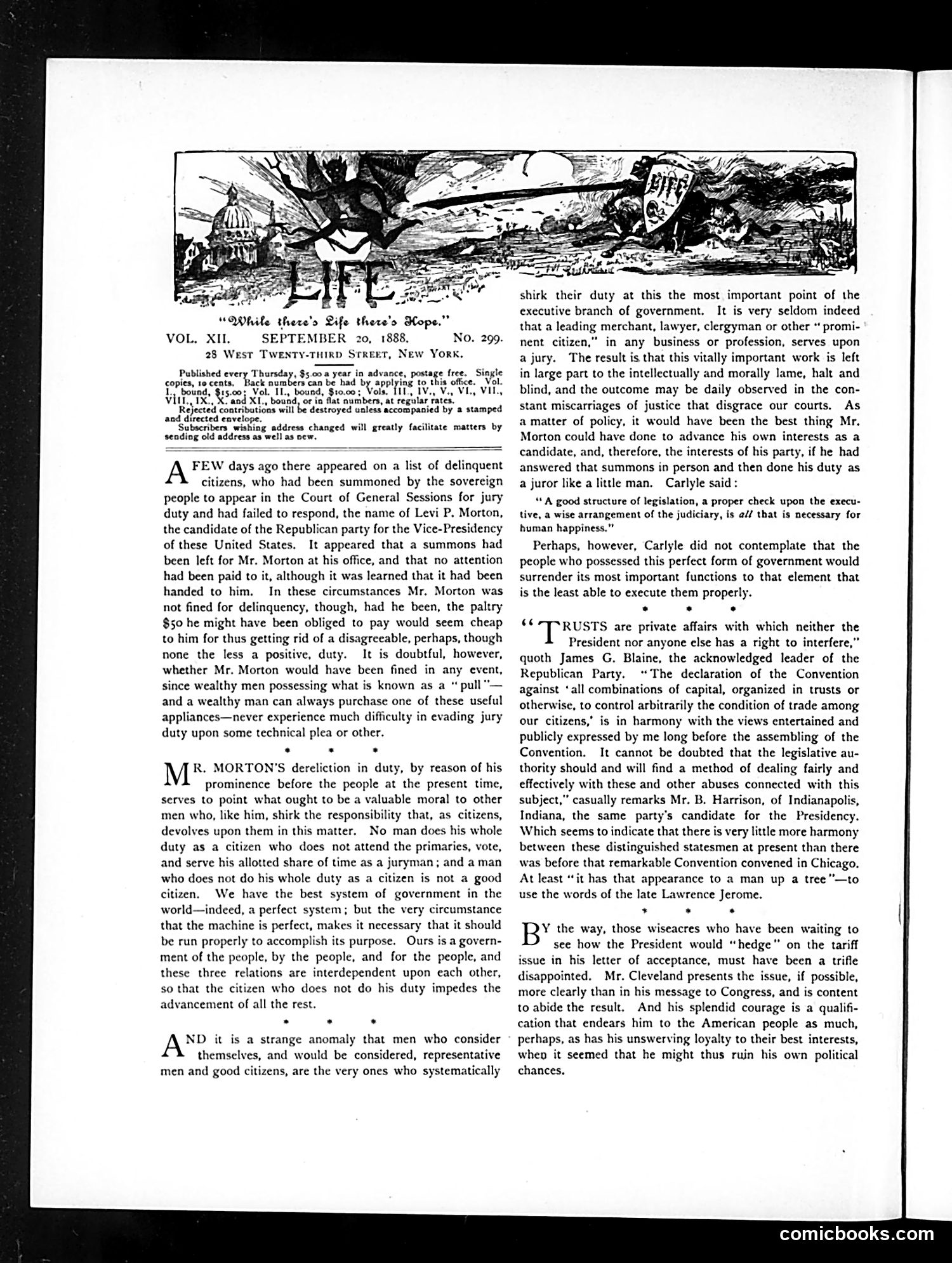
The page satirizes **Levi P. Morton**, the Republican Vice-Presidential candidate, who failed to respond to a jury summons and was fined for delinquency. The article criticizes Morton's negligence, arguing that wealthy, prominent citizens have a civic duty to serve on juries regardless of their status—that shirking jury duty undermines democratic government. The satire targets the hypocrisy of someone seeking high office while avoiding fundamental civic responsibilities. The piece suggests Morton's dereliction reveals he doesn't understand that proper governance depends on *all* citizens, especially prominent ones, fulfilling their obligations rather than purchasing exemptions. The cartoon header (depicting a landscape with classical elements) provides visual framing for this critique of elite entitlement.
📄 Transcribed text from this page (OCR, searchable)
Machine-transcribed from the original scan — historical spelling and the odd misread are preserved.
“While there's Rife there's Hope.” XII, SEPTEMBER 20, 1888. No. 299. 28 West TWENTY-THIRD STR New York. VOL, Published every Thursday, $5.00 year in advance, postage free. Single copies, 1g cents, Hack momber can be had Ri apriying to this ofice. Nol. bound, $15.00; Vol. II., bound, $10.00 ; IV., Va. Vi, VIL, vitt., <td XI, boubd, or ia flat oa at regular rates, Rejected contributions will be destroyed unless accompanied by a stamped and directed envelope. Subscribers wishing address changed will greatly facilitate matters by sending old address as well as pew. FEW days ago there appeared on a list of delinquent citizens, who had been summoned by the sovereign people to appear in the Court of General Sessions for jury duty and had failed to respond, the name of Levi P. Morton, the candidate of the Republican party for the Vice-Presidency of these United States. It appeared that a summons had been left for Mr. Morton at his office, and that no attention had been paid to it, although it was learned that it had been handed to him. In these circumstances Mr. Morton was not fined for delinquency, though, had he been, the paltry $50 he might have been obliged to pay would seem cheap to him for thus getting rid of a disagreeable, perhaps, though none the less a positive, duty. It is doubtful, however, whether Mr. Morton would have been fined in any event, since wealthy men possessing what is known as a “ pull “— and a wealthy man can always purchase one of these useful appliances—never experience much difficulty in evading jury duty upon some technical plea or other. . . . R, MORTON'S dereliction in duty, by reason of his prominence before the people at the present time, serves to point what ought to be a valuable moral to other men who, like him, shirk the responsibility that, as citizens, devolves upon them in this matter. No man does his whole duty as a citizen who does not attend the primaries, vote, and serve his allotted share of time as a juryman; and a man who does not do his whole duty as a citizen is not a good citizen. We have the best system of government in the world—indeed, a perfect system; but the very circumstance that the machine is perfect, makes it necessary that it should be run properly to accomplish its purpose. Ours is a govern- ment of the people, by the people, and for the people, and these three relations are interdependent upon each other, so that the citizen who does not do his duty impedes the advancement of all the rest. . . . ND it is a strange anomaly that men who consider themselves, and would be considered, representative men and good citizens, are the very ones who systematically shirk their duty at this the most important point of the executive branch of government. It is very seldom indeed that a leading merchant, lawyer, clergyman or other “ promi- nent citizen,” in any business or profession, serves upon a jury. The result is that this vitally important work is left in large part to the intellectually and morally lame, halt and blind, and the outcome may be daily observed in the con- stant miscarriages of justice that disgrace our courts. As a matter of policy, it would have been the best thing Mr. Morton could have done to advance his own interests as a candidate, and, therefore, the interests of his party, if he had answered that summons in person and then done his duty as a juror like a little man. Carlyle said: “A good structure of legislation, a proper check upon the execu- tive, a wise arrangement of the judiciary, is a// that is necessary for human happiness.” Perhaps, however, Carlyle did not contemplate that the people who possessed this perfect form of government would surrender its most important functions to that element that is the least able to execute them properly. . . . RUSTS are private affairs with which neither the President nor anyone else has a right to interfere,” quoth James G. Blaine, the acknowledged leader of the Republican Party, ‘The declaration of the Convention against ‘all combinations of capital, organized in trusts or otherwise, to control arbitrarily the condition of trade among our citizens,’ is in harmony with the views entertained and publicly expressed by me long before the assembling of the Convention. It cannot be doubted that the legislative au- thority should and will find a method of dealing fairly and effectively with these and other abuses connected with this subject,” casually remarks Mr. B. Harrison, of Indianapolis, Indiana, the same party's candidate for the Presidency. Which seems to indicate that there is very little more harmony between these distinguished statesmen at present than there was before that remarkable Convention convened in Chicago. At least “it has that appearance to a man up a tree"—to use the words of the late Lawrence Jerome. + . . BY the way, those wiseacres who have been waiting to see how the President would “hedge” on the tariff issue in his letter of acceptance, must have been a trifle disappointed. Mr. Cleveland presents the issue, if possible, more clearly than in his message to Congress, and is content to abide the result. And his splendid courage is a qualifi- cation that endears him to the American people as much, perhaps, as has his unswerving loyalty to their best interests, when it seemed that he might thus ruin his own political chances, comicbooks.com