
Life, 1888-09-20 · page 11 of 14
Life — September 20, 1888 — page 11: what you’re looking at
What you’re looking at
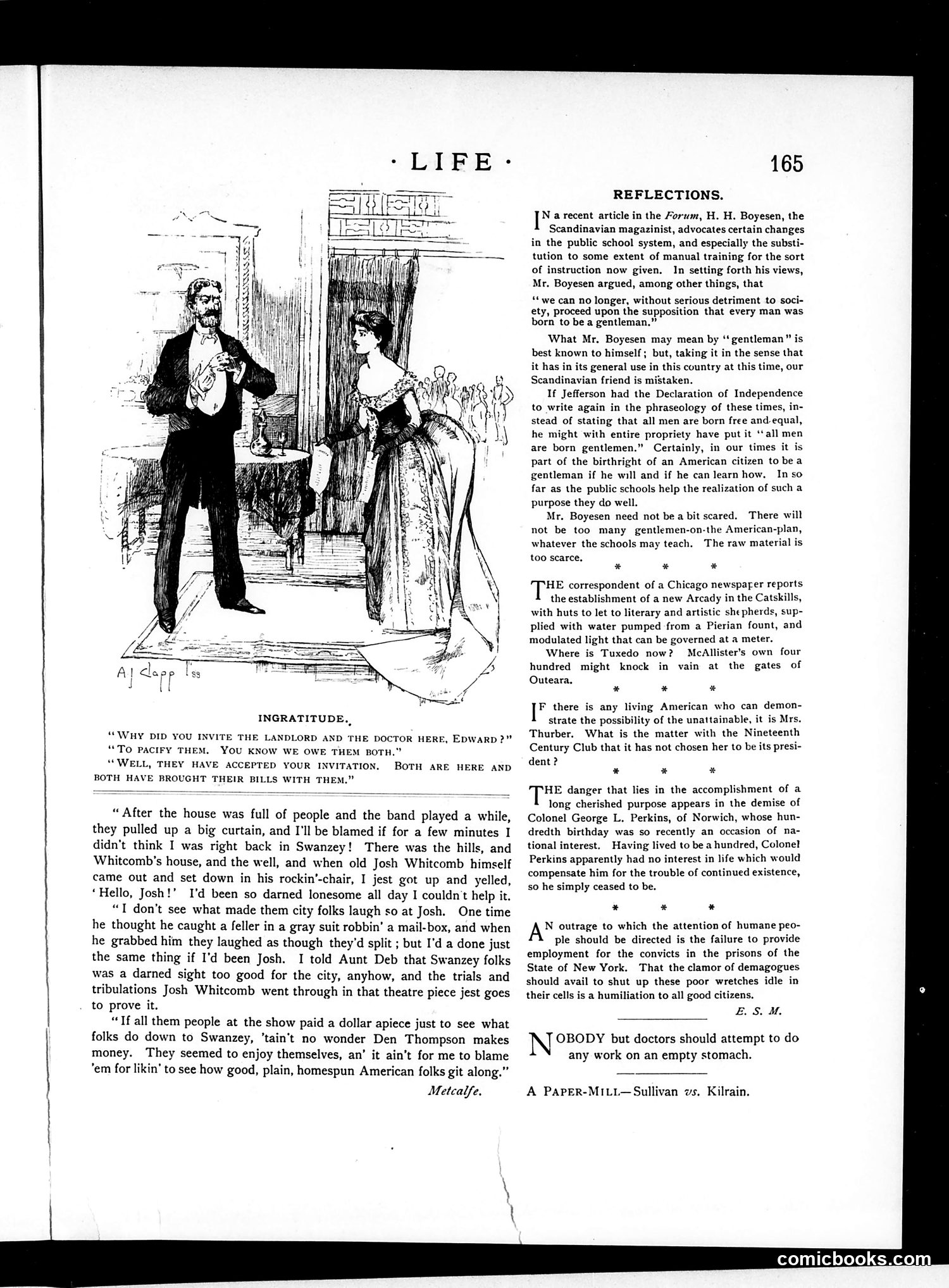
## The Main Cartoon: "Ingratitude" The illustration depicts a man inviting his landlord and doctor to a party, ostensibly to "pacify them"—but they arrive with their bills in hand. The joke is straightforward social satire: the host's attempt to win goodwill through hospitality backfires when his creditors use the occasion to present their demands. ## The Prose Story Below The narrative is a humorous anecdote about attending a theatrical production (likely referencing Denman Thompson's popular play "Joshua Whitcomb"). A rural audience member finds himself homesick watching the rural characters, while city audiences laugh at the "quaint" behavior of simple country folk. The writer defends rural Americans' dignity against urban condescension, arguing their apparent simplicity doesn't reflect inferiority—it simply reflects different lifestyles. ## Context for Modern Readers Both pieces satirize class tensions of the era: the financial precarity of ordinary people (creditors pursuing debtors) and cultural snobbery (urban audiences treating rural life as entertainment/comedy). The satire mocks both the financially desperate and the urban elite's condescension.
📄 Transcribed text from this page (OCR, searchable)
Machine-transcribed from the original scan — historical spelling and the odd misread are preserved.
INGRATITUDE., “WHY DID YOU INVITE THE LANDLORD AND THE DOCTOR HERE, EDWARD?” “TO PACIFY THEM. YOU KNOW WE OWE THEM BOTH.” “WELL, THEY HAVE ACCEPTED YOUR INVITATION, BOTH ARE HERE AND BOTH HAVE BROUGHT THEIR BILLS WITH THEM.” “After the house was full of people and the band played a while, they pulled up a big curtain, and I'll be blamed if for a few minutes I didn't think I was right back in Swanzey! There was the hills, and Whitcomb’s house, and the well, and when old Josh Whitcomb himself came out and set down in his rockin’-chair, I jest got up and yelled, ‘Hello, Josh!’ I'd been so darned lonesome all day I couldn't help it. “TI don’t see what made them city folks laugh so at Josh. One time he thought he caught a feller in a gray suit robbin’ a mail-box, and when he grabbed him they laughed as though they'd split ; but I'd a done just the same thing if I'd been Josh. I told Aunt Deb that Swanzey folks | was a darned sight too good for the city, anyhow, and the trials and tribulations Josh Whitcomb went through in that theatre piece jest goes to prove it. “Tf all them people at the show paid a dollar apiece just to see what folks do down to Swanzey, ‘taint no wonder Den Thompson makes money. They seemed to enjoy themselves, an’ it ain’t for me to blame ‘em for likin’ to see how good, plain, homespun American folks git along.” Metcalfe. 165 REFLECTIONS. 1%. a recent article in the Forum, H. H. Boyesen, the Scandinavian magazinist, advocates certain changes in the public school system, and especially the substi- tution to some extent of manual training for the sort of instruction now given. In setting forth his views, Mr. Boyesen argued, among other things, that “«we can no longer, without serious detriment to soci- ety, proceed upon the supposition that every man was born to be a gentleman.” ‘What Mr. Boyesen may mean by “gentleman” is best known to himself; but, taking it in the sense that it has in its general use in this country at this time, our Scandinavian friend is mistaken. If Jefferson had the Declaration of Independence to write again in the phraseology of these times, in- stead of stating that all men are born free and-equal, he might with entire propriety have put it ‘all men are born gentlemen.” Certainly, in our times it is part of the birthright of an American citizen to bea gentleman if he will and if he can learn how, In so far as the public schools help the realization of such a purpose they do well. Mr. Boyesen need not be a bit scared. There will not be too many gentlemen-on-the American-plan, whatever the schools may teach. The raw material is too scarce, * * HE correspondent of a Chicago newsparer reports the establishment of a new Arcady in the Catskills, with huts to let to literary and artistic shepherds, sup- plied with water pumped from a Pierian fount, and modulated light that can be governed at a meter. Where is Tuxedo now? McAllister’s own four hundred might knock in vain at the gates of Outeara, * * * F there is any living American who can demon- strate the possibility of the unattainable, it is Mrs. Thurber. What is the matter with the Nineteenth Century Club that it has not chosen her to be its presi- dent? * * * PRE danger that lies in the accomplishment of a long cherished purpose appears in the demise of Colonel George L, Perkins, of Norwich, whose hun- dredth birthday was so recently an occasion of na- tional interest. Having lived to be a hundred, Colonel Perkins apparently had no interest in life which would compensate him for the trouble of continued existence, so he simply ceased to be. * * * A’ outrage to which the attention of humane peo- ple should be directed is the failure to provide employment for the convicts in the prisons of the State of New York. That the clamor of demagogues should avail to shut up these poor wretches idle in their cells is a humiliation to all good citizens. E. S. M. N OBODY but doctors should attempt to do any work on an empty stomach. A PAPER-MILL— ‘Sullivan vs. Kilrain. comicbooks.com