
Life, 1888-09-20 · page 6 of 14
Life — September 20, 1888 — page 6: what you’re looking at
What you’re looking at
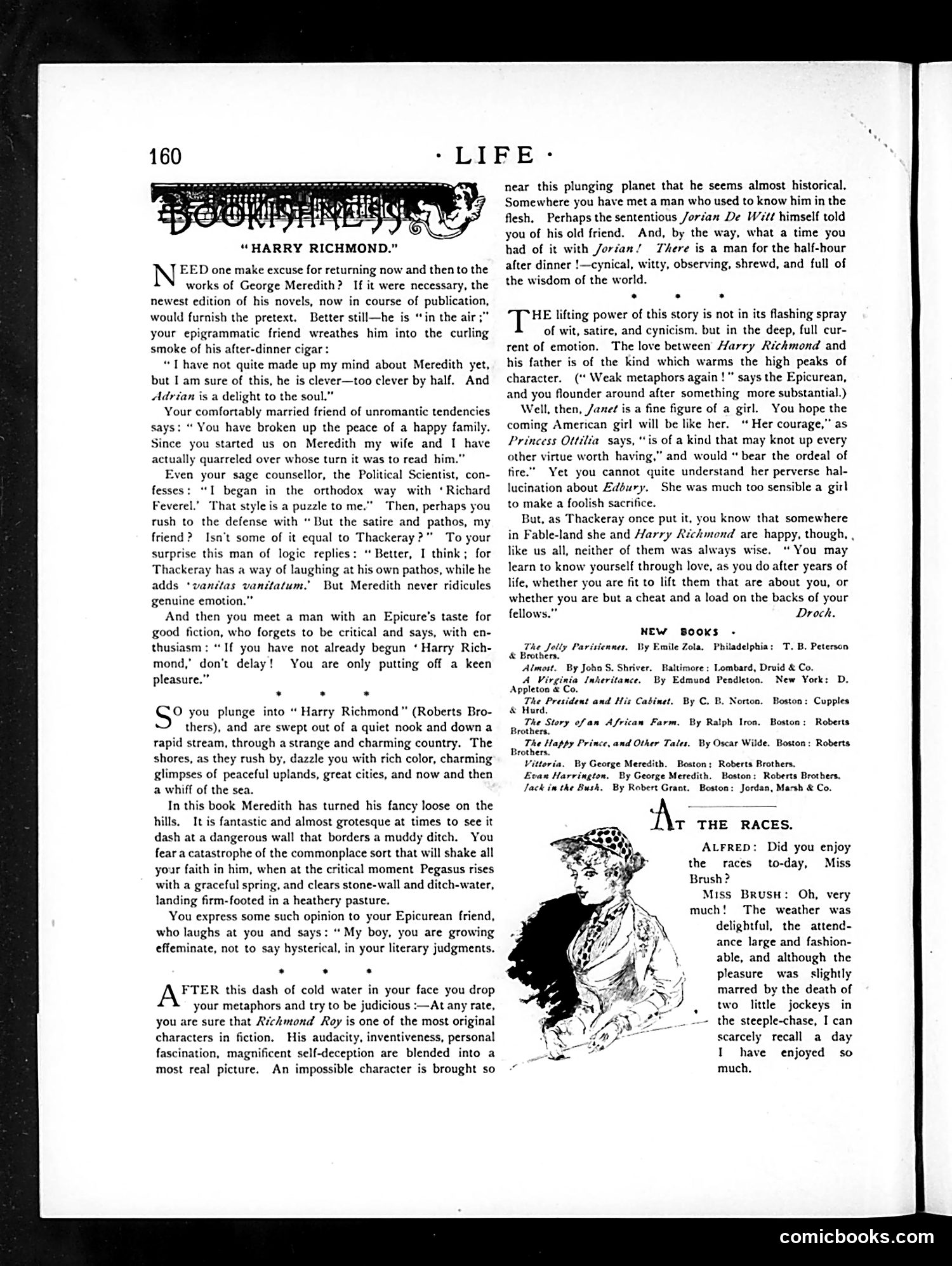
This small cartoon depicts two women at a horse race. One woman (labeled "Miss Brush") tells her companion "Alfred" that she enjoyed the races despite the weather and large crowd. However, she notes the pleasure was "slightly marred by the death of one little jockeys in the steeplechase." The satire targets casual upper-class indifference to serious harm. Miss Brush dismisses a fatal accident as a minor inconvenience to her entertainment—a dark commentary on how wealthy spectators could view human tragedy as merely a footnote to their leisure activities. The cartoon mocks callous social attitudes rather than targeting a specific political figure, using everyday conversation to expose moral blind spots in Gilded Age society.
📄 Transcribed text from this page (OCR, searchable)
Machine-transcribed from the original scan — historical spelling and the odd misread are preserved.
- LIFE: “HARRY RICHMOND.” N EED one make excuse for returning now and then to the works of George Meredith? If it were necessary, the newest edition of his novels, now in course of publication, would furnish the pretext. Better still—he is ‘in the air your epigrammatic friend wreathes him into the curling smoke of his after-dinner cigar: “T have not quite made up my mind about Meredith yet, but I am sure of this, he is clever—too clever by half. And Adrian is a delight to the soul.” Your comfortably married friend of unromantic tendencies says: “ You have broken up the peace of a happy family. Since you started us on Meredith my wife and I have actually quarreled over whose turn it was to read him.” en your sage counsellor, the Political Scientist, con- fesses: “I began in the orthodox way with ‘Richard Feverel.’ That style is a puzzle to me.” ‘Then, perhaps you tush to the defense with “But the satire and pathos, my friend? Isn't some of it equal to Thackeray?" To your surprise this man of logic replies: “ Better, I think; for Thackeray has a way of laughing at his own pathos, while he adds ‘vanitas vanitatum.’ But Meredith never ridicules genuine emotion.” And then you meet a man with an Epicure’s taste for good fiction, who forgets to be critical and says, with en- thusiasm: “If you have not already begun ‘ Harry Rich- mond,’ don’t delay! You are only putting off a keen pleasure.” . . . O you plunge into “ Harry Richmond" (Roberts Bro- thers), and are swept out of a quiet nook and down a rapid stream, through a strange and charming country. The shores, as they rush by, dazzle you with rich color, charming glimpses of peaceful uplands, great cities, and now and then a whiff of the sea. In this book Meredith has turned his fancy loose on the hills. It is fantastic and almost grotesque at times to see it dash at a dangerous wall that borders a muddy ditch. You fear a catastrophe of the commonplace sort that will shake all your faith in him, when at the critical moment Pegasus rises with a graceful spring, and clears stone-wall and ditch-water, landing firm-footed in a heathery pasture. You express some such opinion to your Epicurean friend, who laughs at you and say: My boy, you are growing effeminate, not to say hysterical, in your literary judgments. . . . FTER this dash of cold water in your face you drop your metaphors and try to be judicious :—At any rate, you are sure that Richmond Roy is one of the most original characters in fiction. His audacity, inventiveness, personal fascination, magnificent self-deception are blended into a most real picture. An impossible character is brought so near this plunging planet that he seems almost historical. Somewhere you have met a man who used to know him in the flesh, Perhaps the sententious /orian De Witt himself told you of his old friend. And, by the way, what a time you had of it with Jor‘an/! There is a man for the half-hour after dinner !—cynical, witty, observing, shrewd, and full of the wisdom of the world. . . . = lifting power of this story is not in its flashing spray of wit, satire, and cynicism, but in the deep, full cur- rent of emotion. The love between Harry Richmond and his father is of the kind which warms the high peaks of character. (‘* Weak metaphors again !" says the Epi and you flounder around after something more substantial.) Well, then, Jane? is a fine figure of a girl. You hope the coming American girl will be like her. ‘ Her courage,” as Princess Oltilia says, “is of a kind that may knot up every * and would “ bear the ordeal of Yet you cannot quite understand her perverse hal- She was much too sensible a girl other virtue worth having,’ fire.” lucination about Edéury. to make a foolish sacrifice. But, as Thackeray once put it, you know that somewhere in Fable-land she and Harry Richmond are happy, though, , like us all, neither of them was always wise. “ You may learn to know yourself through love, as you do after years of life, whether you are fit to lift them that are about you, or whether you are but a cheat and a load on the backs of your fellows.” Droch. NEW By Emile Zola, BooKs - The Jolly Parisiennes, Philadelphia : & Brothers. Almost. By Joho S. Shriver. A Virginia Inheritance. Appleton & Co. The President and His Cabinet. & Hurd, The Story ofan African Farm. By Ralph Iron. Brothers. The Happy Prince, and Other Tales, By Oscar Wilde. Boston: Roberts Brothers. Vittoria. By George Meredith. Boston: Roberts Brothers. Evan Harrington. By George Meredith. Boston: Roberts Brothers, Jack in the Bush, By Robert Grant. Boston: Jordan, Marsh & Co. ‘Ar THE RACES. ALFRED: Did you enjoy the races to-day, Miss Brush ? Miss Brusu: Oh, very much! The weather was delightful, the attend- ance large and fashion- able, and although the pleasure was slightly marred by the death of two little jockeys in the steeple-chase, I can scarcely recall a day I have enjoyed so much, T. B. Peterson Baltimore : Lombard, Druid & Co. By Edmund Pendleton. New York: D. By C. B. Norton. Boston: Cupples Boston: Roberts comicbooks.com