
A complete issue · 14 pages · 1888
Life — August 9, 1888
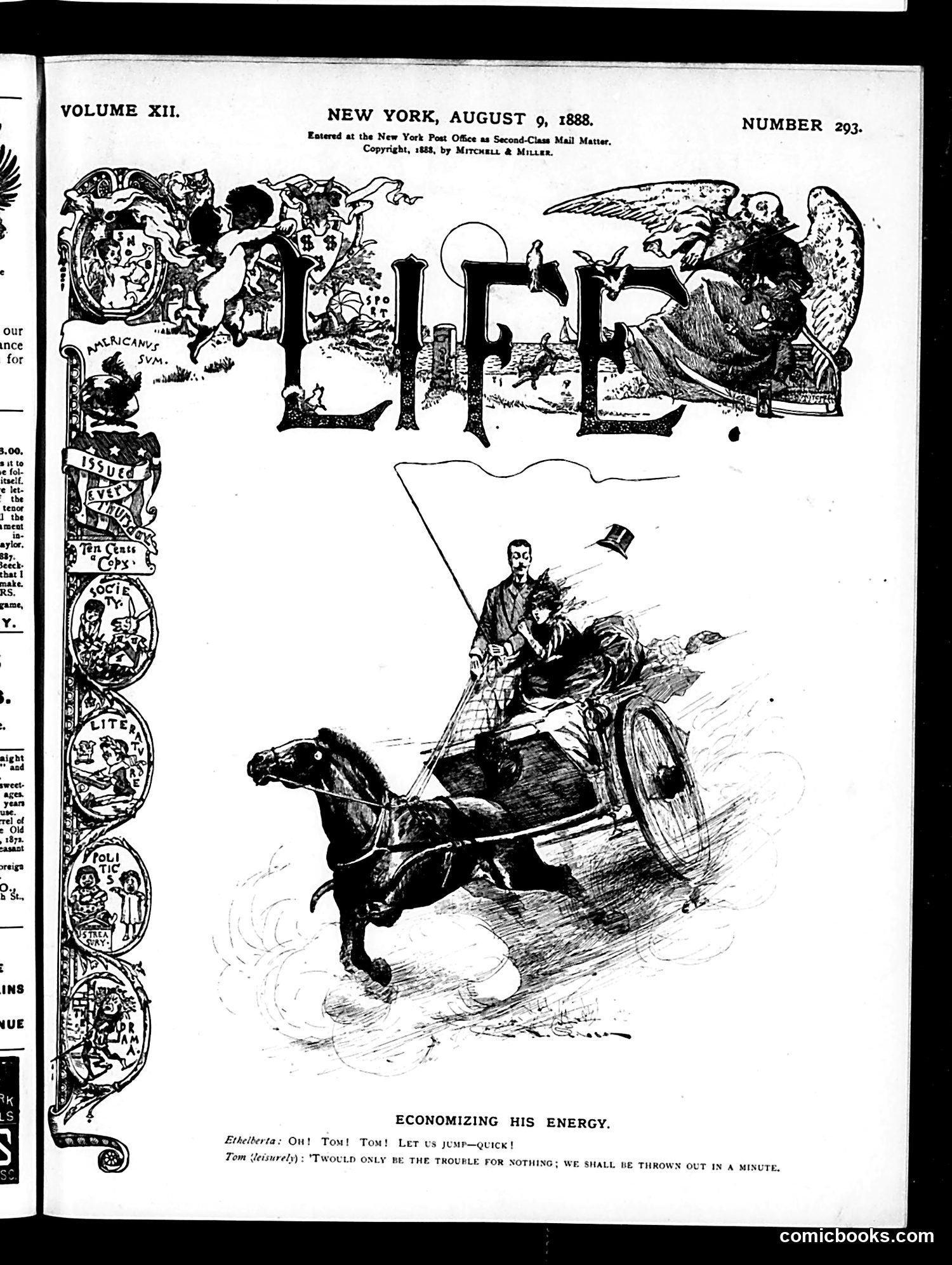
This cartoon satirizes someone (identity unclear from the image alone) who claims to conserve energy but behaves recklessly. The main illustration shows a man in a cart being pulled by a horse at dangerous speed, while he waves a flag. A companion shouts a warning. The caption reads: "Oh! Tom! Tom! Let us jump—quick!" with Tom's response: "Would only be the trouble for nothing; we shall be thrown's out in a minute." The joke mocks false economy—the figure avoids the "trouble" of jumping to safety, yet faces imminent disaster anyway. It's likely political satire about a public figure's flawed logic or misguided priorities, though the specific target remains unclear without additional context.
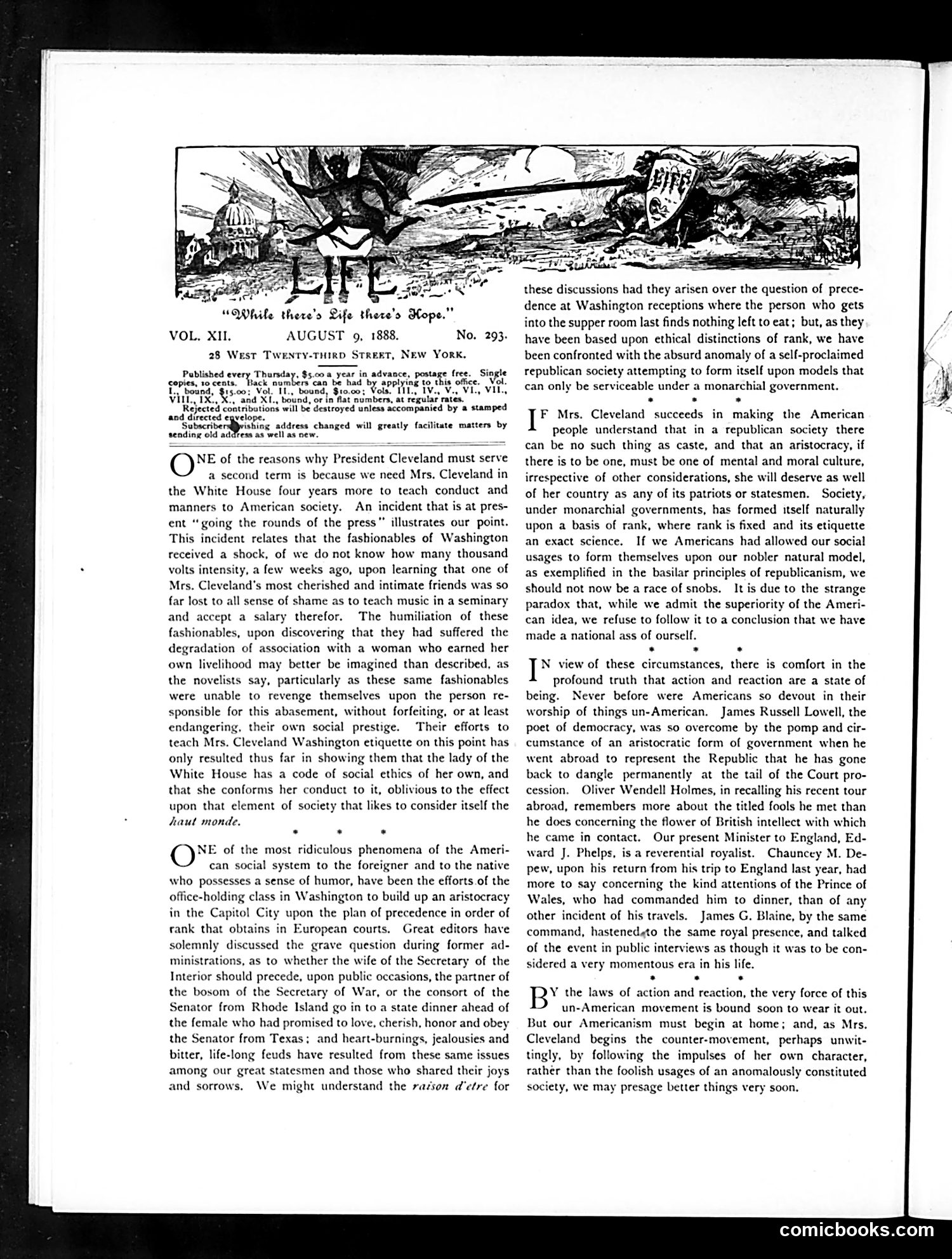
The masthead illustration shows "While there's Life there's Hope" — a landscape with classical and allegorical elements. The article discusses President Cleveland's need for a second term, centering on **Mrs. Cleveland's role in teaching American social conduct and manners**. The text criticizes Washington's emerging aristocratic pretensions, particularly regarding social precedence at official functions. The satire targets the contradiction in a republican society attempting to establish formal class hierarchies based on rank — exactly what the nation's founders rejected. References to incidents where prominent figures (including diplomats and senators) clashed over seating arrangements illustrate how absurdly un-American such status-consciousness had become. The piece mocks this "un-American" behavior while praising Mrs. Cleveland for promoting republican equality over aristocratic pretense.
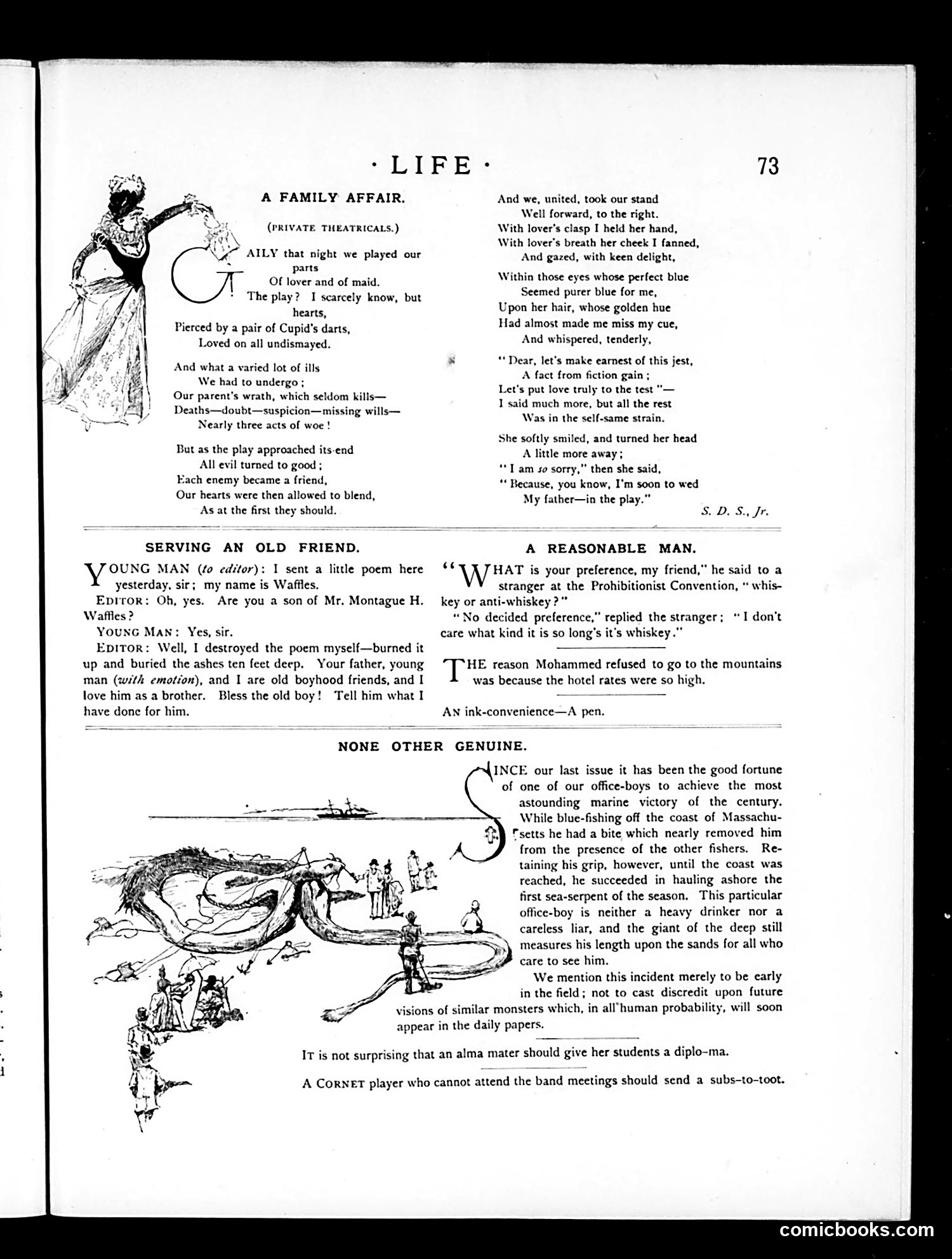
This page contains literary and humorous content rather than political cartoons. The main items include: **"A Family Affair"** — A poem about amateur theatrical performances where lovers play romantic roles, blurring fiction and reality. **"Serving an Old Friend"** — A brief editor-contributor exchange about destroying a submitted poem, presented as affectionate ribbing. **"A Reasonable Man"** — A joke about whiskey preferences at a Prohibition Convention, satirizing the temperance movement's inconsistency. **"None Other Genuine"** — An article celebrating an office boy's catch of a large sea-serpent off Massachusetts, accompanied by a detailed illustration. The piece satirizes tall tales and exaggeration in newspapers, humorously suggesting similar "monsters" will soon appear in daily papers. The page's humor targets theatrical pretension, literary gatekeeping, Prohibition hypocrisy, and sensationalist journalism.
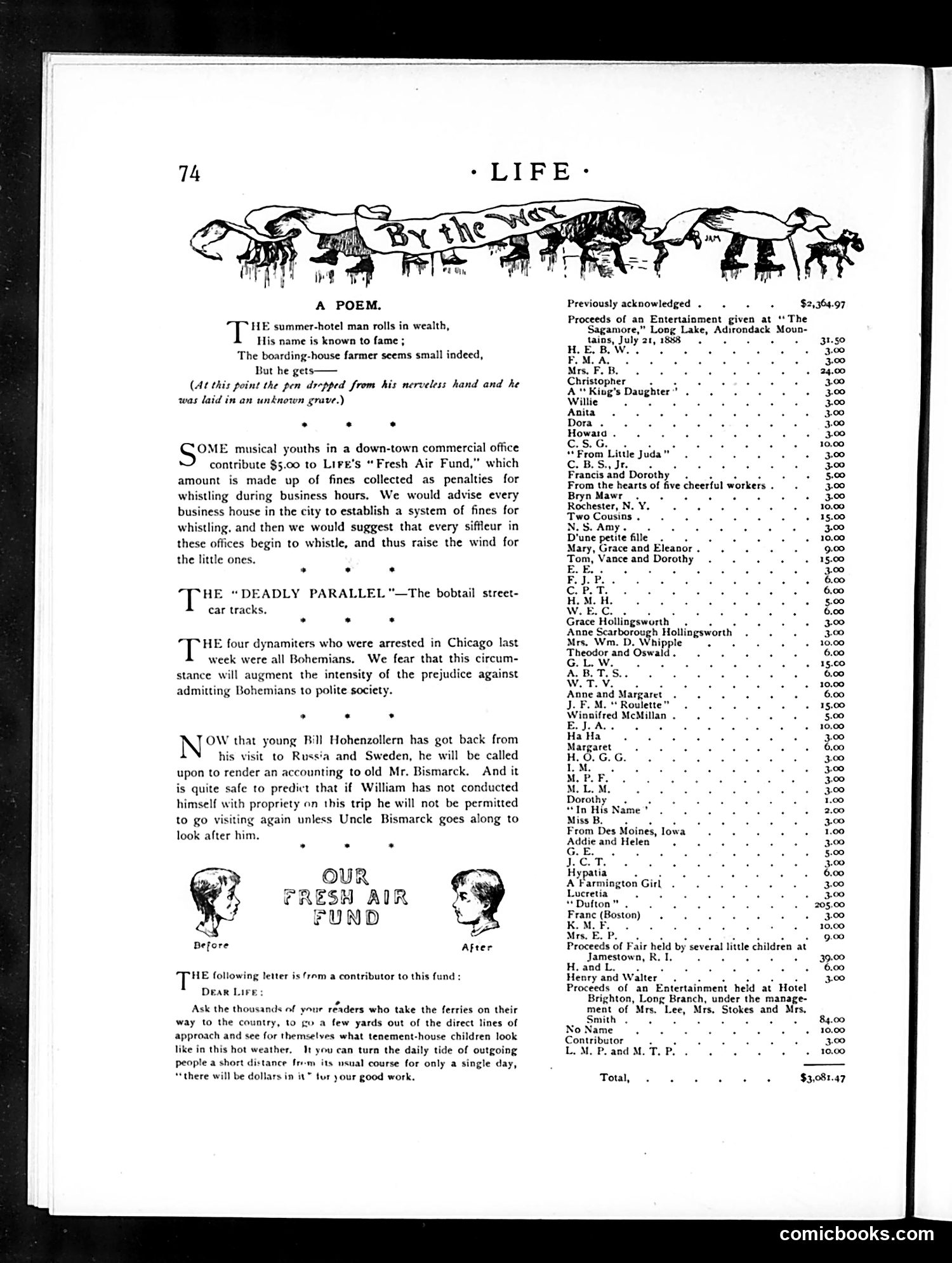
This page contains satirical poems and commentary typical of *Life* magazine's social criticism. "A Poem" mocks a wealthy man dependent on handouts despite his riches. "The Deadly Parallel" appears to reference bobtail streetcar tracks—likely contemporary urban infrastructure debate. "The Four Dynamiters" references the arrest of four men in Chicago, noting the incident will inflame prejudice against bohemians in police society—suggesting anarchist or radical associations were controversial at this time. The final item jokes about Bill Hohenzollern (German royalty) visiting Russia and Sweden, warning he'll need "Uncle Bismarck" as a chaperone—satirizing German political dependence on Bismarck's authority. The majority of the page lists donations to the "Fresh Air Fund," a charitable cause for sending city children to the countryside.
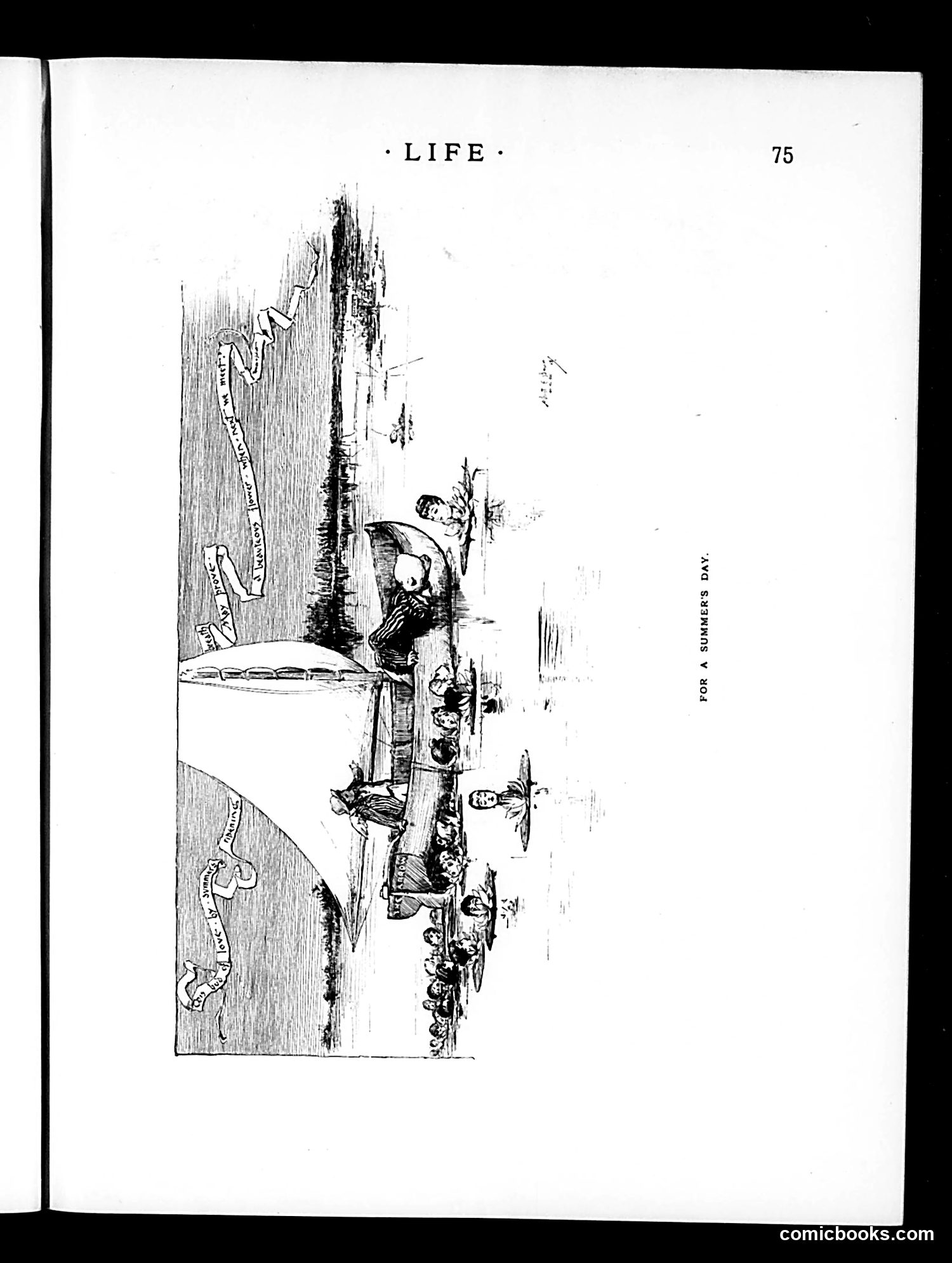
I can see this is page 75 from Life magazine with the header "FOR A SUMMER'S DAY" printed vertically on the right side. The image appears to be a satirical illustration turned sideways, depicting what looks like a crowded beach or seaside scene with multiple figures engaged in various activities. However, I cannot make out the specific details clearly enough to identify particular figures, caricatures, or political/social references with confidence. The engraving style and the summer setting suggest this is likely social satire about leisure activities or beach culture, but without clearer visibility of individual elements or accompanying text explaining the cartoon, I cannot reliably identify what specific people, events, or points of satire are being referenced. To provide accurate historical context, I would need either a clearer image or additional caption text.
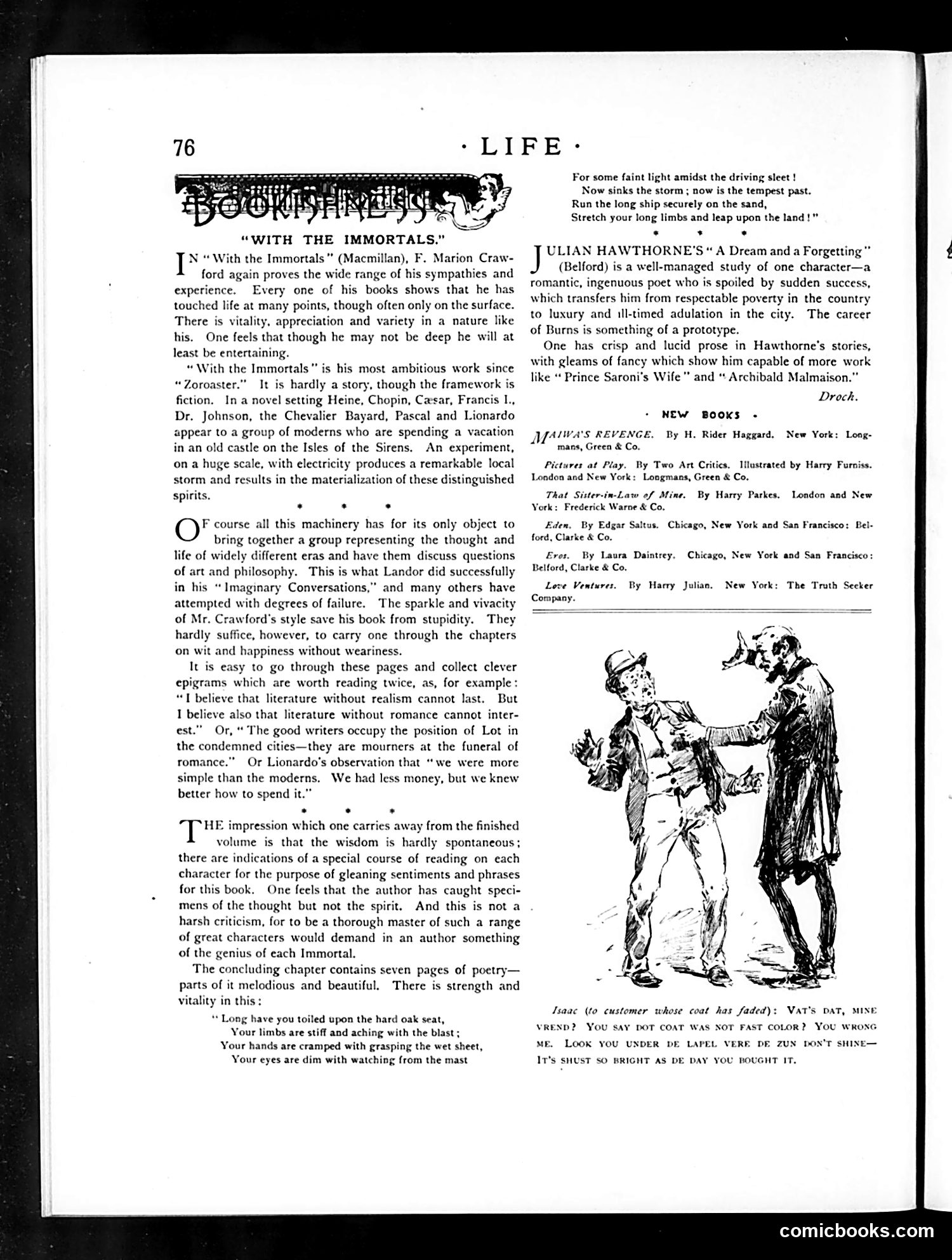
This page primarily contains a literary review of F. Marion Crawford's "With the Immortals," discussing the author's ambitious novel featuring historical figures like Chopin, Caesar, and Francis I gathered at a castle. The review analyzes Crawford's conversational style and philosophical approach. The illustration depicts two men in what appears to be a humorous exchange about a coat. The caption indicates one man (Isaac) is a customer questioning the other about a coat's authenticity, with dialogue about whether the coat was "fast color" and if it's "shut so bright as the day you bought it." This appears to be a visual joke about product quality or merchant honesty—a common satirical target—though the specific reference remains unclear without additional context.
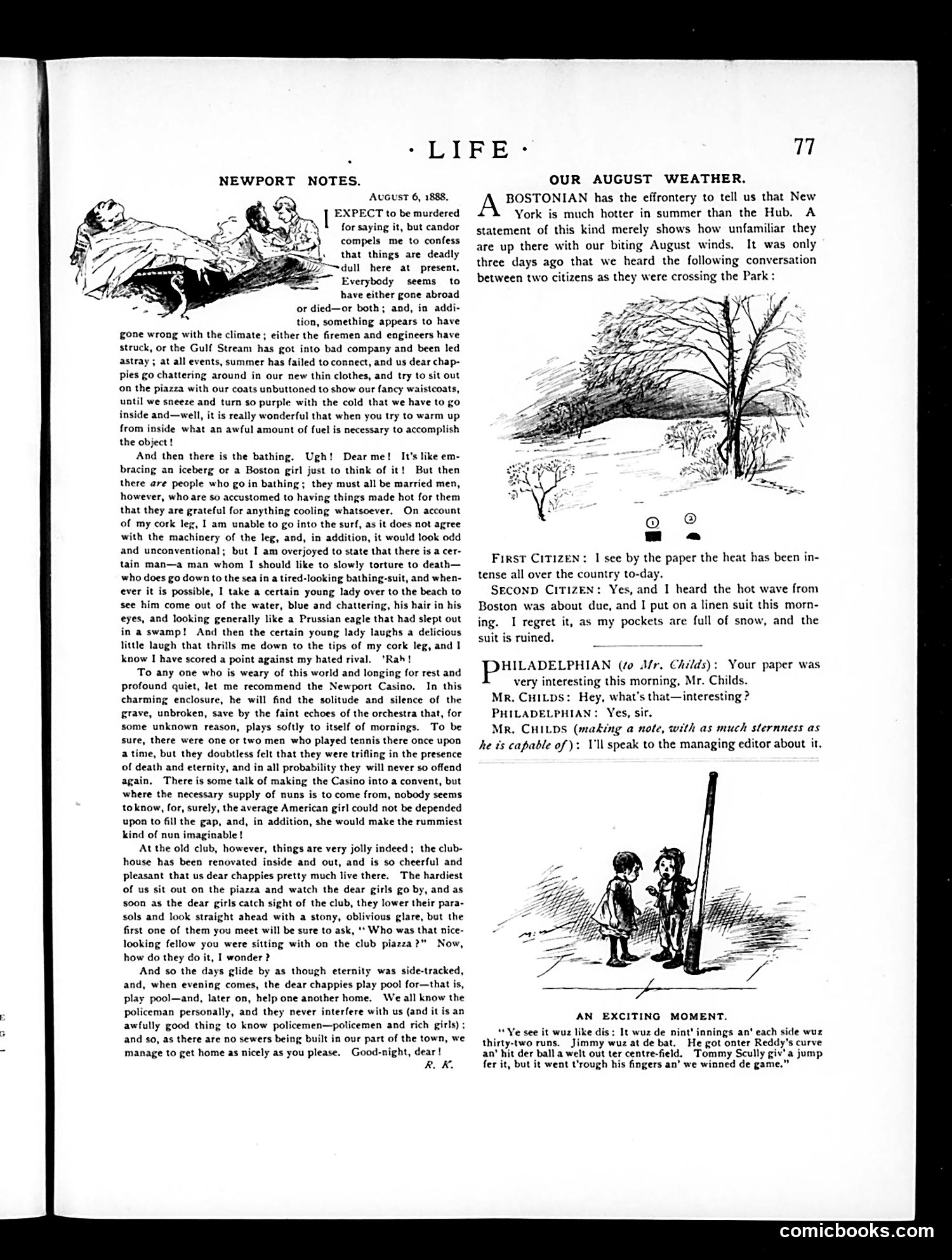
This page contains three distinct satirical pieces: **"Newport Notes"** critiques the summer resort's social scene—particularly complaints about heat and bathing among the wealthy elite. The satire targets their excessive concern with comfort and their reliance on servants (nuns are jokingly suggested as solution). **"Our August Weather"** mocks a Boston newspaper's claim that New York has worse summer weather. The dialogue between two citizens references an intense heat wave and the absurdity of wearing heavy clothing in such conditions. **"An Exciting Moment"** is a baseball cartoon showing children playing, with dialogue about a dramatic play (Jimmy at bat, Reddy's curve pitch, Tommy Scully making a jump catch). This depicts casual street baseball among working-class youth—sharply contrasting with the wealthy Newport material above. The page juxtaposes upper-class leisure complaints against ordinary recreation, typical of Life's social satire.
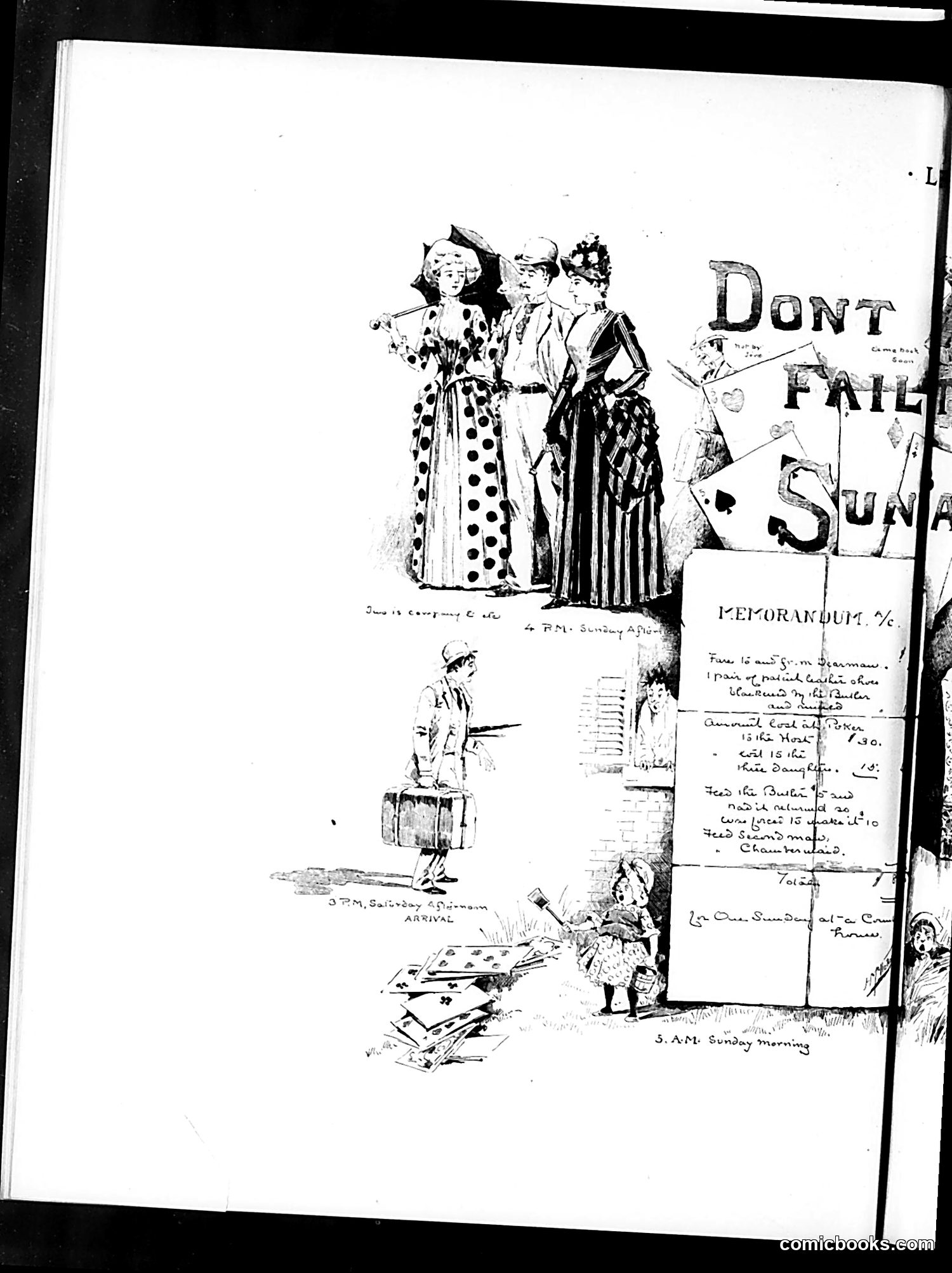
This appears to be a satirical Life magazine page mocking Sunday activities and social expectations. The main illustration shows three well-dressed women at the top, with accompanying sketches below depicting various weekend scenarios. The "Don't Fail Sunday" headline and accompanying memorandum suggest satirical commentary on upper-class Sunday obligations—likely social calls, church attendance, or entertainment commitments that were expected of respectable people, particularly women. The sketches show a man arriving with luggage ("3 P.M. Saturday Afternoon ARRIVAL") and a child, suggesting domestic complications. The tone appears to mock the rigid social schedules and expectations placed on people to maintain proper Sunday activities, poking fun at both the pretentiousness of these obligations and their actual disruption by real-life circumstances.
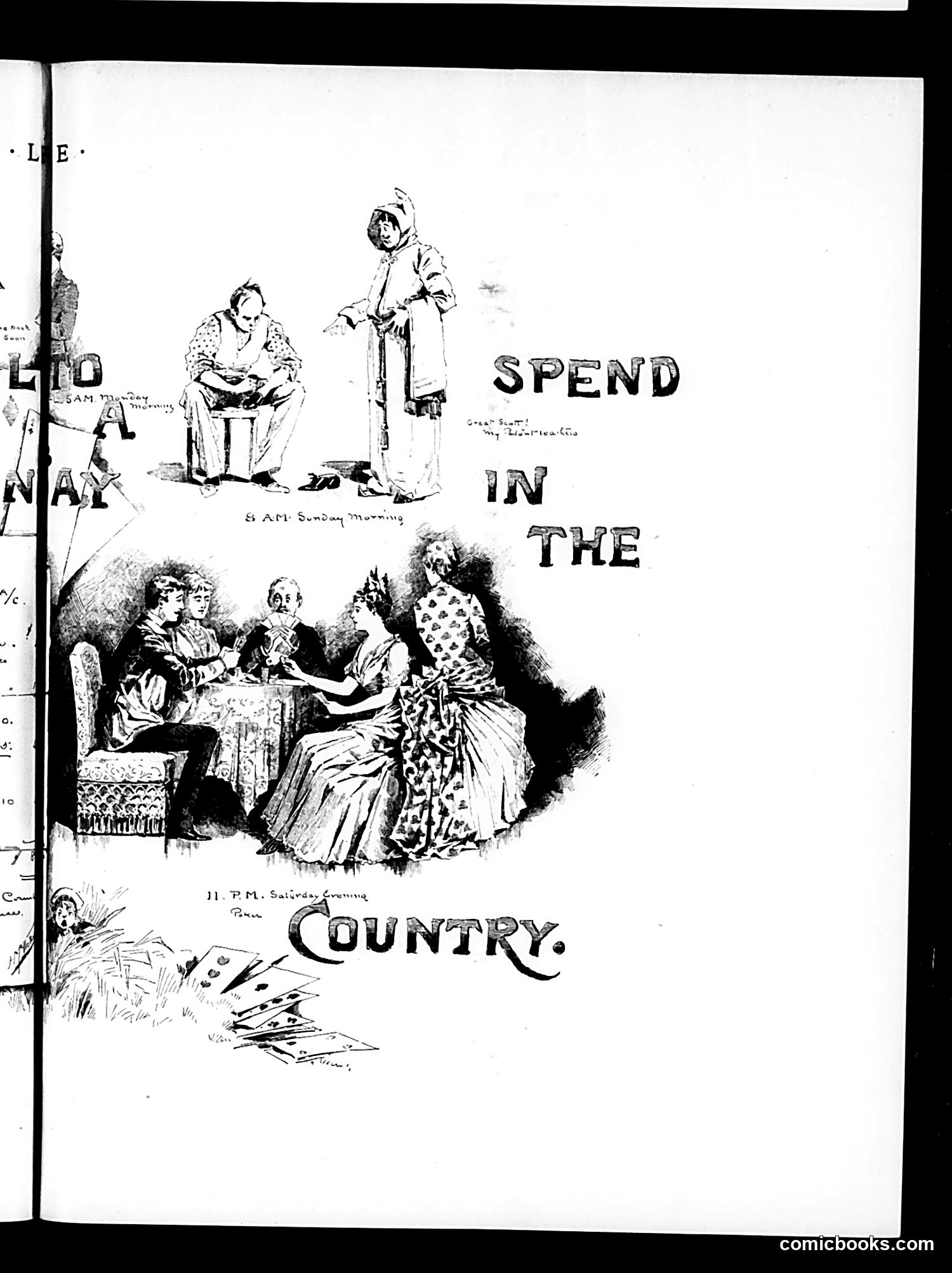
This appears to be a satirical illustration from *Life* magazine contrasting rural and urban lifestyles. The page shows two scenes: **Top**: Working-class country women in simple dress, appearing to labor or manage household tasks on a "Saturday Morning." **Bottom**: Wealthy urban socialites at leisure, dining and socializing in an elegant interior setting on a "Saturday Evening." The title "Spend in the Country" suggests ironic commentary on leisure and consumption patterns—contrasting those with money (city dwellers enjoying entertainment and dining) against rural laborers with little leisure time. The satire critiques class divisions and the disparate ways different social strata spend their time and resources, likely reflecting late 19th or early 20th-century American social anxieties about urbanization and economic inequality.
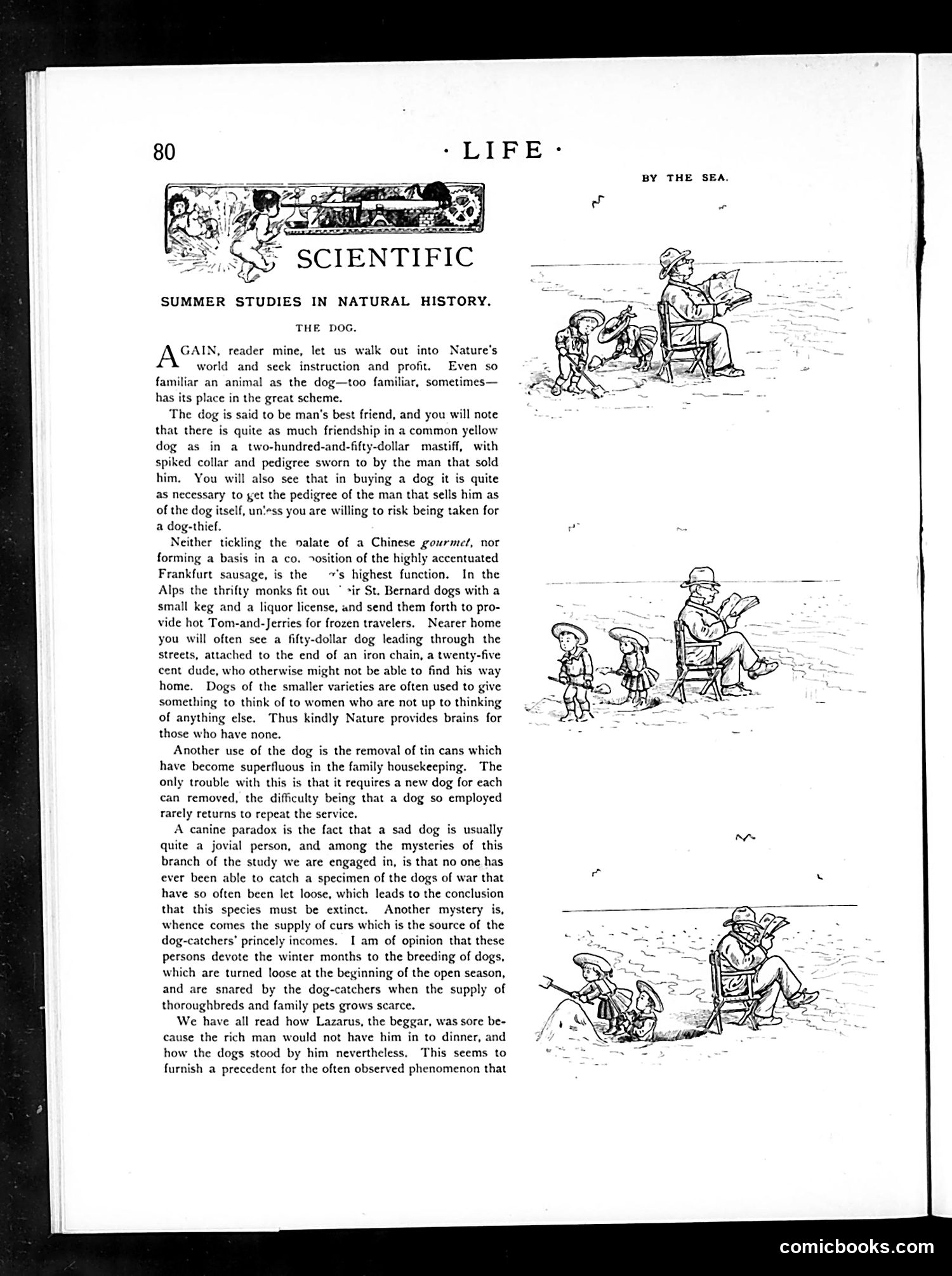
This page contains an article titled "Scientific Summer Studies in Natural History: The Dog," accompanied by three illustrations showing people at the seaside observing dogs. The text is a humorous essay about dogs' practical and social roles—as companions, pest control (removing tin cans), and subjects of winter breeding operations. It includes satirical observations about human behavior: the irony that sad dogs are jovial, the phenomenon of stray "dogs of war," and the wealthy man (Lazarus reference) whose dogs remained loyal despite his poverty. The accompanying seaside illustrations appear to be visual commentary on leisure observation—showing adults and children at the beach apparently studying dogs' behavior, supporting the article's tone of treating dog observation as a quasi-scientific summer activity. The humor lies in the mock-scientific framing of ordinary dog behavior and the social commentary on human-canine relationships.
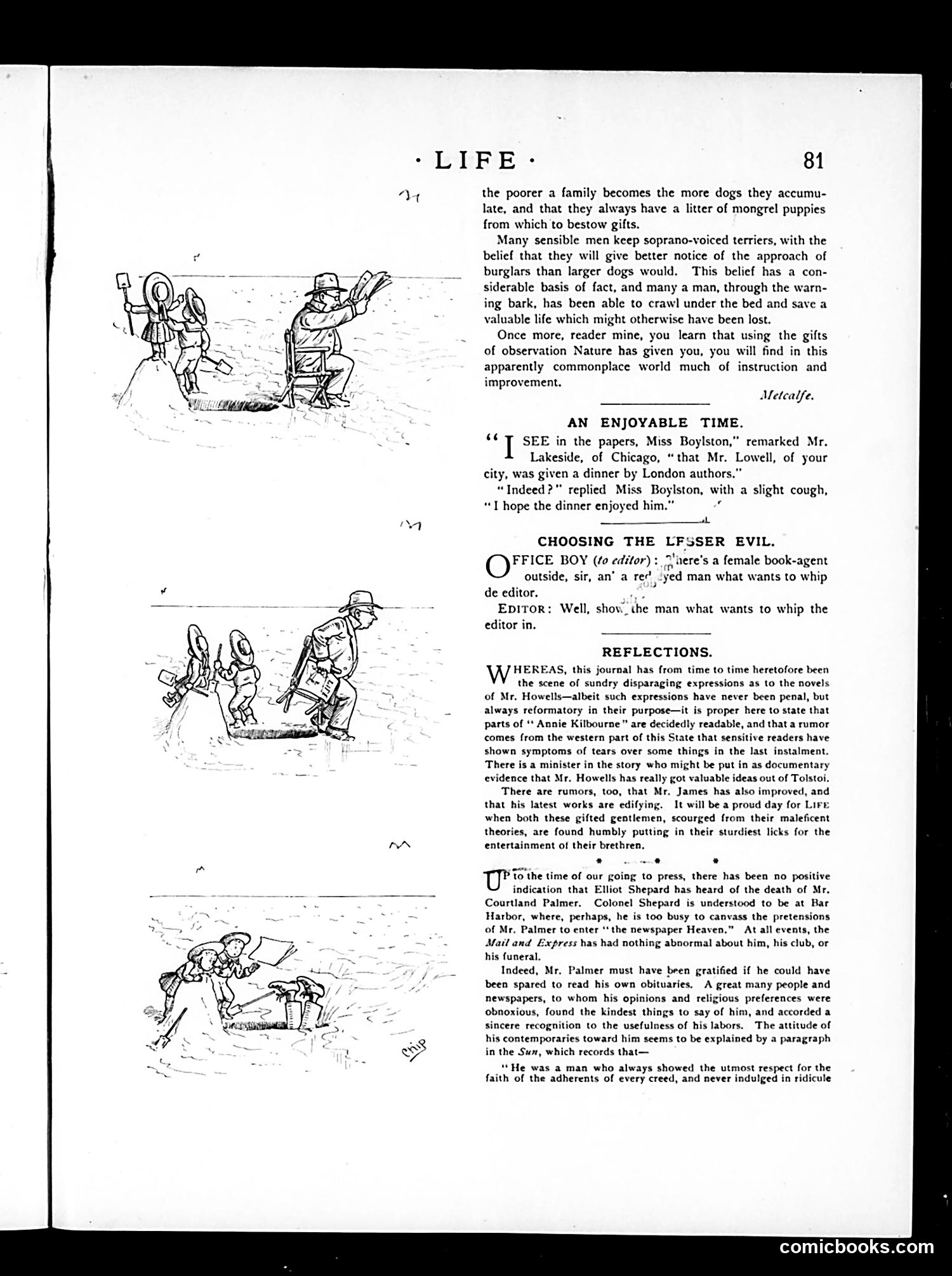
This page contains three separate humorous items: **The illustrated cartoons** (three sketches by what appears to be Metcalfe) depict dogs and their owners in various situations—illustrating the accompanying text about dogs as burglar alarms and their prevalence among poorer families. **"An Enjoyable Time"** is a brief joke about Mr. Lowell of Chicago being honored with a dinner by London authors. Miss Boylston's reply—"I hope the dinner enjoyed him"—is a witty play on words suggesting the dinner was remarkable enough to have its own experience. **"Choosing the Lesser Evil"** is an editor's joke: when given a choice between a female book-agent or a red-haired man wanting to whip him, the editor chooses the violent threat as preferable. **"Reflections"** offers editorial commentary praising recent works by William Dean Howells and Henry James (major American novelists), and includes remarks on Courtland Palmer's recent death, noting his interfaith tolerance. The page demonstrates *Life*'s mix of light humor, literary criticism, and social observation typical of 1880s-90s satirical journalism.
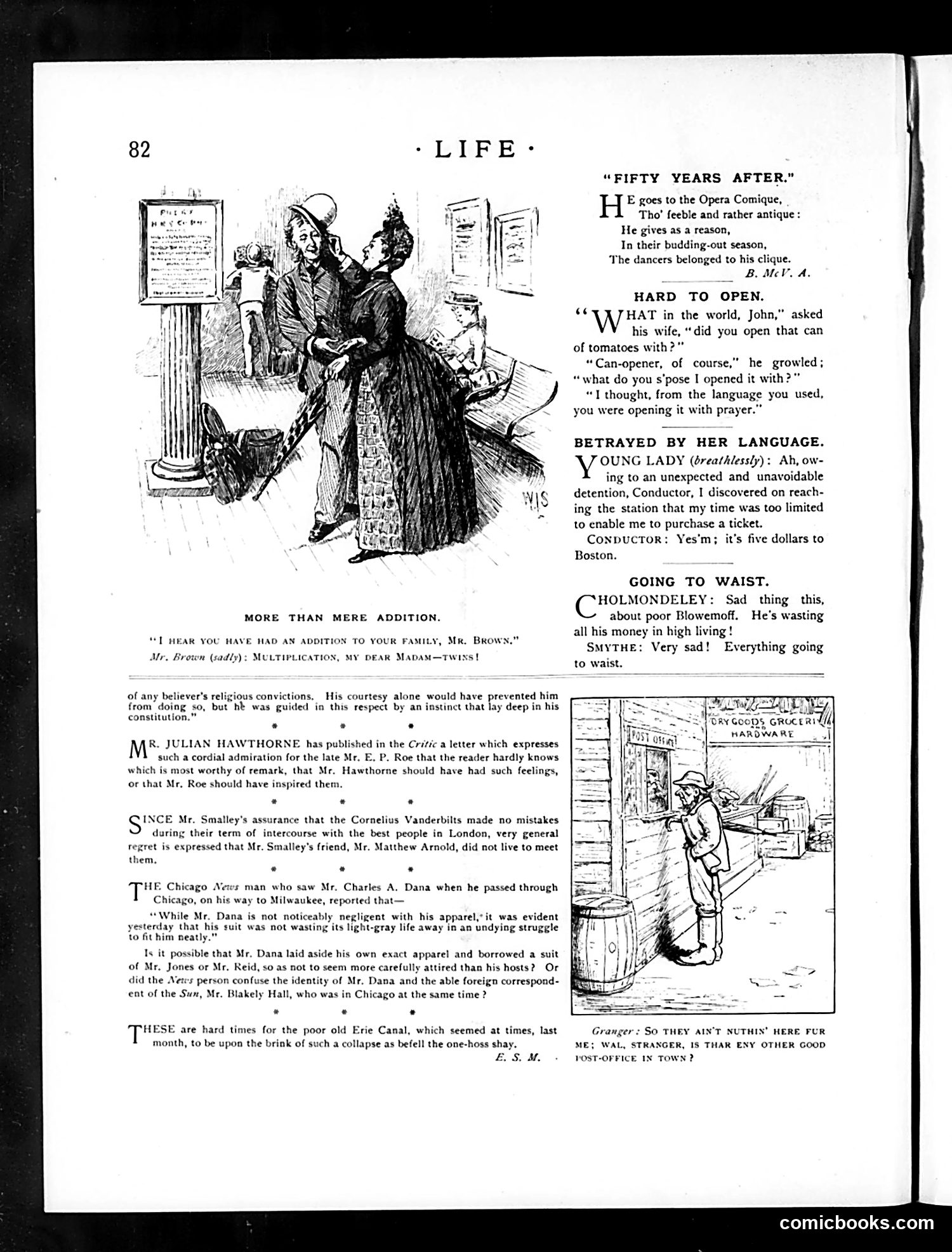
This page from *Life* contains multiple short satirical jokes typical of the magazine's humor style: **"More Than Mere Addition"**: A pun mocking Mr. Brown's large family—he corrects a neighbor's congratulations by saying it's "multiplication, not addition," suggesting rapid, excessive childbearing. **"Hard to Open"**: A domestic joke where a wife sarcastically suggests her husband used prayer rather than a can-opener, implying his profane language while opening tomatoes was prayer-like in intensity. **"Betrayed by Her Language"**: A young woman tries to speak formally to excuse arriving late for a train ticket, but her elaborate, pretentious language ("breathlessly") ironically reveals her lower-class status to the conductor, who demands payment anyway. **"Going to Waist"**: A pun on "waste"—gossip about a man named Blowemoff squandering money on luxurious living. **Bottom cartoon**: A rural man asks a postal clerk if there's another post office in town, suggesting incompetence or dissatisfaction with current service. These represent *Life*'s characteristic blend of wordplay, class commentary, and domestic situations.
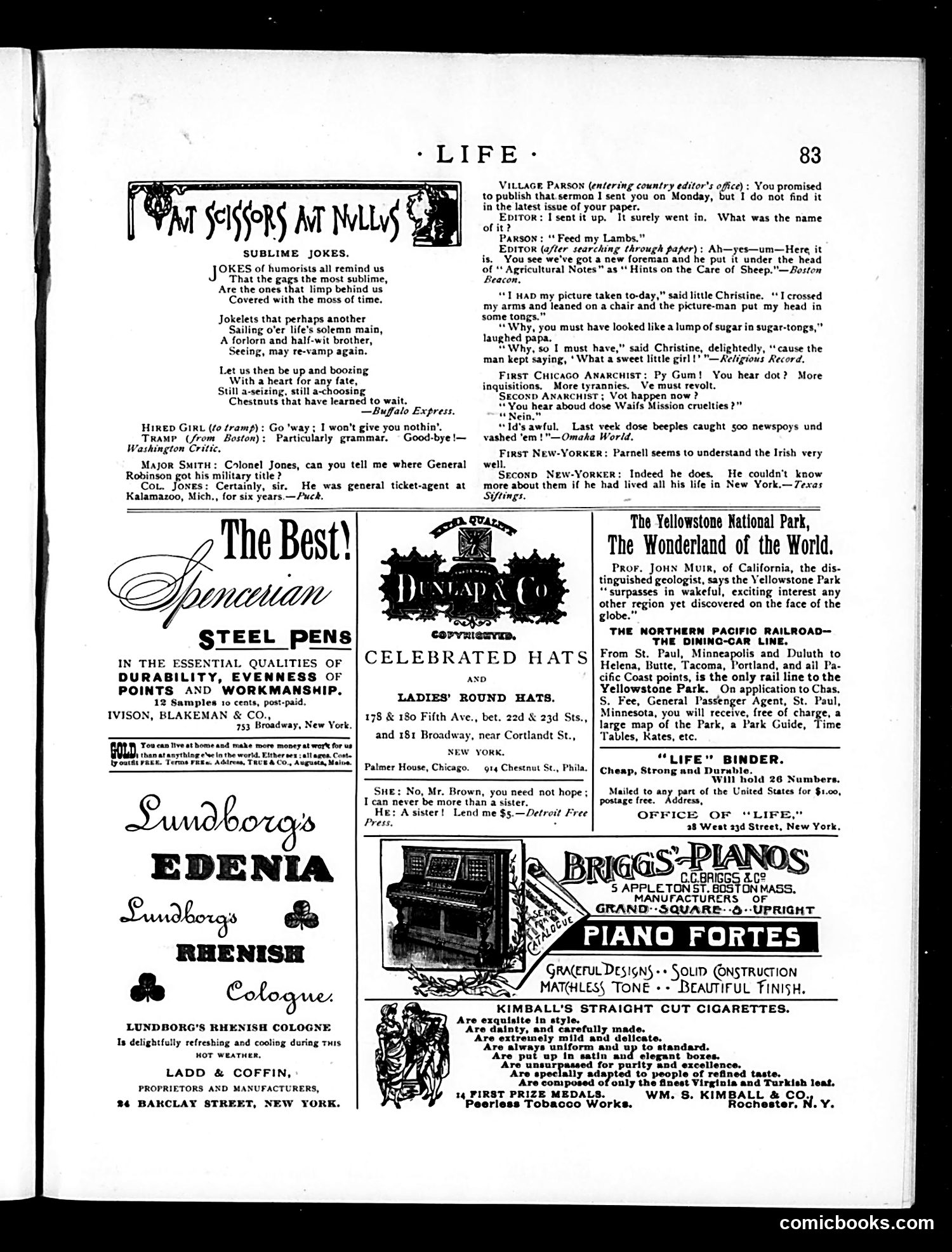
This page contains several short comic anecdotes satirizing contemporary American figures and social situations: **The Village Parson joke** mocks a country newspaper editor who mistakenly publishes the parson's sermon "Feed my Lambs" under agricultural notes as sheep-care advice—satirizing careless editorial work and rural incompetence. **The Chicago Anarchists dialogue** ridicules anarchist rhetoric. The caricatured anarchists (depicted with exaggerated accents: "Py Gum!" "Vot happen") are outraged about imagined tyrannies, then furious that street children were *bathed* by a charitable mission—absurdly treating cleanliness as oppression. This mocks anarchists as hypocritical complainers. **The Parnell joke** suggests Irish-American politician Charles Stewart Parnell understands Ireland so well he might as well live in New York—satirizing how Irish immigrants retained cultural insularity in America. The remaining content consists primarily of period advertisements (steel pens, cologne, hats, pianos, cigarettes) with minimal satirical content. The page is largely commercial.
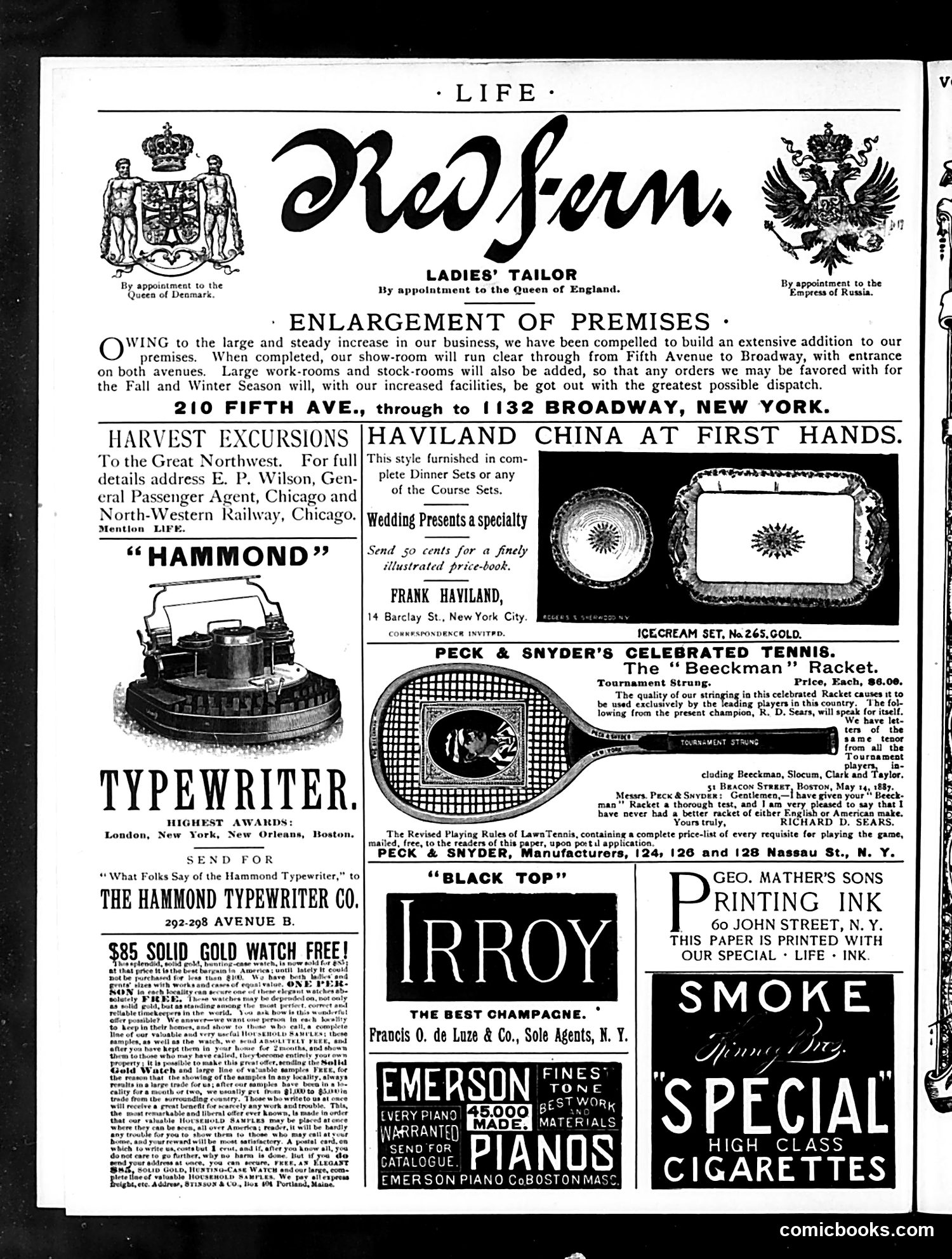
This is **not a political cartoon page**, but rather a standard advertisements section from *Life* magazine. The page consists entirely of commercial advertisements for various products and services typical of the late 19th century. Notable ads include: - **Red Fern**: A ladies' tailor business with royal appointments (Denmark, England, Russia), announcing expansion from Fifth Avenue to Broadway in New York - **Hammond Typewriter**: Promoting their machine with testimonials - **Haviland China**: Fine dishware at first-hand prices - **Peck & Snyder**: Tennis rackets, with endorsement from champion Richard D. Sears - **Emerson Pianos**, **Arrowy Champagne**, **Geo. Mather's Sons Printing Ink**, and **Smoke Special Cigarettes** The ads reflect contemporary consumer culture and commercial interests rather than satire or political commentary. This represents *Life*'s revenue model during this period—advertising subsidized editorial content.