
Life, 1888-08-09 · page 6 of 14
Life — August 9, 1888 — page 6: what you’re looking at
What you’re looking at
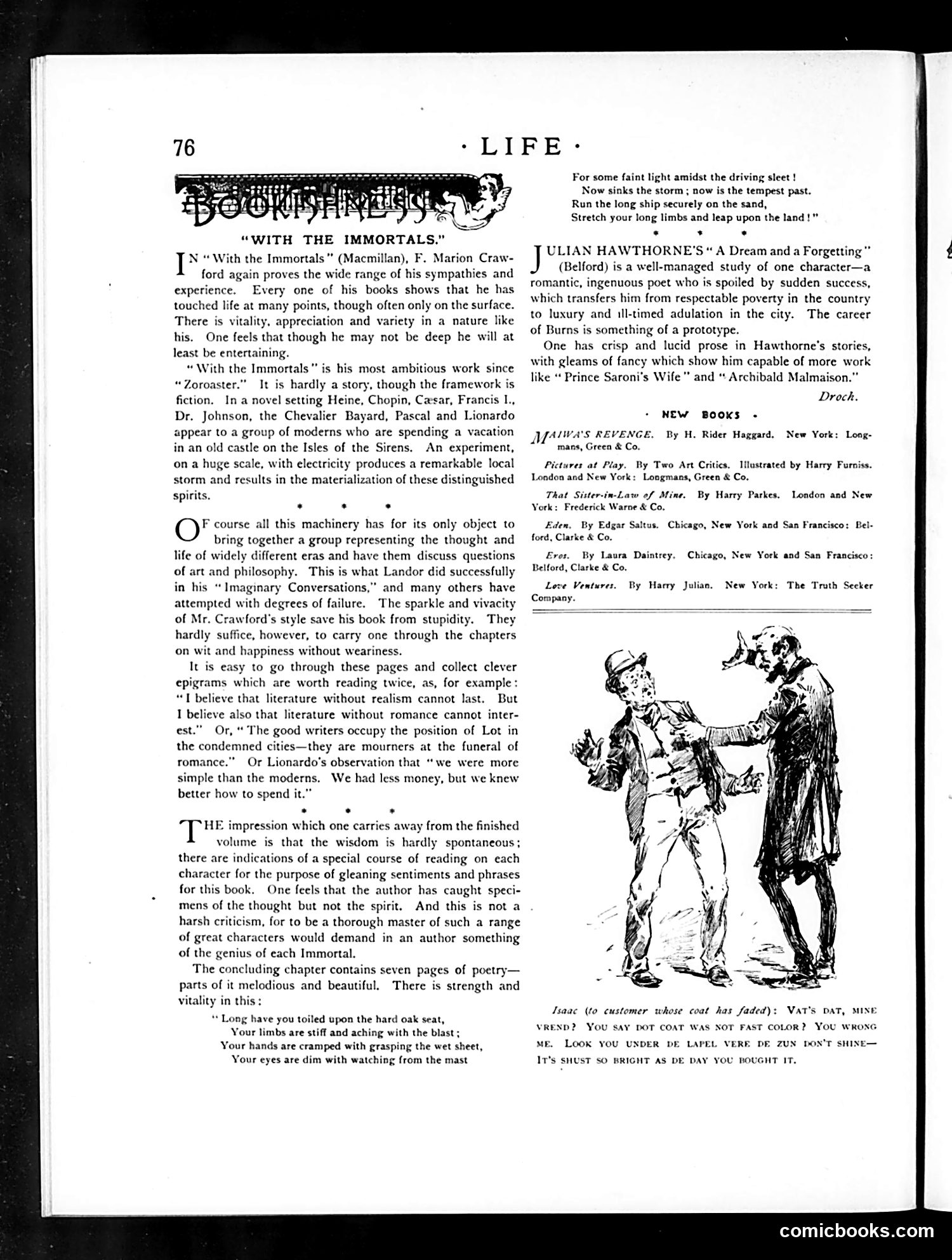
This page primarily contains a literary review of F. Marion Crawford's "With the Immortals," discussing the author's ambitious novel featuring historical figures like Chopin, Caesar, and Francis I gathered at a castle. The review analyzes Crawford's conversational style and philosophical approach. The illustration depicts two men in what appears to be a humorous exchange about a coat. The caption indicates one man (Isaac) is a customer questioning the other about a coat's authenticity, with dialogue about whether the coat was "fast color" and if it's "shut so bright as the day you bought it." This appears to be a visual joke about product quality or merchant honesty—a common satirical target—though the specific reference remains unclear without additional context.
📄 Transcribed text from this page (OCR, searchable)
Machine-transcribed from the original scan — historical spelling and the odd misread are preserved.
*- LIFE: if N “With the Immortals" (Macmillan), F. Marion Craw- ford again proves the wide range of his sympathies and experience. Every one of his books shows that he has touched life at many points, though often only on the surface. There is vitality, appreciation and variety in a nature like his. One feels that though he may not be deep he will at least be entertaining. “With the Immortals” is his most ambitious work since “Zoroaster.” It is hardly a story, though the framework is fiction. In a novel setting Heine, Chopin, Cxsar, Francis 1., Dr. Johnson, the Chevalier Bayard, Pascal and Lionardo appear to a group of moderns who are spending a vacation in an old castle on the Isles of the Sirens. An experiment, on a huge scale, with electricity produces a remarkable local storm and results in the materialization of these distinguished spirits. . . . F course all this machinery has for its only object to bring together a group representing the thought and life of widely different eras and have them discuss questions of art and philosophy. This is what Landor did successfully in his “Imaginary Conversations,” and many others have attempted with degrees of failure. The sparkle and vivacity of Mr. Crawford's style save his book from stupidity. They hardly suffice, however, to carry one through the chapters on wit and happiness without weariness. It is easy to go through these pages and collect clever epigrams which are worth reading twice, as, for example: “I believe that literature without realism cannot last. But I believe also that literature without romance cannot inter- he good writers occupy the position of Lot in the condemned cities—they are mourners at the funeral of romance.” Or Lionardo’s observation that “we were more simple than the moderns. We had less money, but we knew better how to spend it.” . . * HE impression which one carries away from the finished volume is that the wisdom is hardly spontaneous; there are indications of a special course of reading on each character for the purpose of gleaning sentiments and phrases for this book. One feels that the author has caught speci- mens of the thought but not the spirit. And this is not a harsh criticism, for to be a thorough master of such a range of great characters would demand in an author something of the genius of each Immortal. The concluding chapter contains seven pages of poetry— parts of it melodious and beautiful. There is strength and vitality in this : * Long have you toiled upon the hard oak seat, Your limbs are stiff and aching with the blast ; Your hands are cramped with grasping the wet sheet, Your eyes are dim with watching from the mast For some faint light amidst the driving sleet ! Now sinks the storm ; now is the tempest past. Run the long ship securely on the sand, Stretch your long limbs and leap upon the land!" . * . ULIAN HAWTHORNE'S “ A Dream and a Forgetting” (Belford) is a well-managed study of one character—a romantic, ingenuous poet who is spoiled by sudden success, which transfers him from respectable poverty in the country to luxury and ill-timed adulation in the city. of Burns is something of a prototype. One has crisp and lucid prose in Hawthorne's stories, with gleams of fancy which show him capable of more work like “ Prince Saroni’s Wife” and ‘ Archibald Malmaison.” Droch. The career NEW BOOKS - MAINWA'S REVENGE, By H. Rider Haggard, mans, Green & Co. New York: Long- Pictures at Play. By Two Art Critics. Itlustrated by Harry Furniss. London and New York: Longmans, Green & Co. That Sisterin-Law of Mine. York: Frederick Warne & Co. By Harry Parkes. London and New Eden, By Edgar Saltus. ford, Clarke & Co. Eres. By Laura Daintrey. Belford, Clarke & Co. Chicago, New York and San Francisco: Bel- Chicago, New York and San Francisco: Love Ventures. By Harry Julian. New York: The Truth Seeker Isaac (to customer whose coat has faded): VREND? VAT’S DAT, MINE YOU SAY DOT COAT WAS NOT FAST COLOR? YOU WRONG ME. LOOK YOU UNDER DE LAPEL VERE DE ZUN DON'T SHINE— It’s SHUST SO BRIGHT AS DE DAY YOU POUGHT IT. comicbooks.com