
Life, 1888-08-09 · page 10 of 14
Life — August 9, 1888 — page 10: what you’re looking at
What you’re looking at
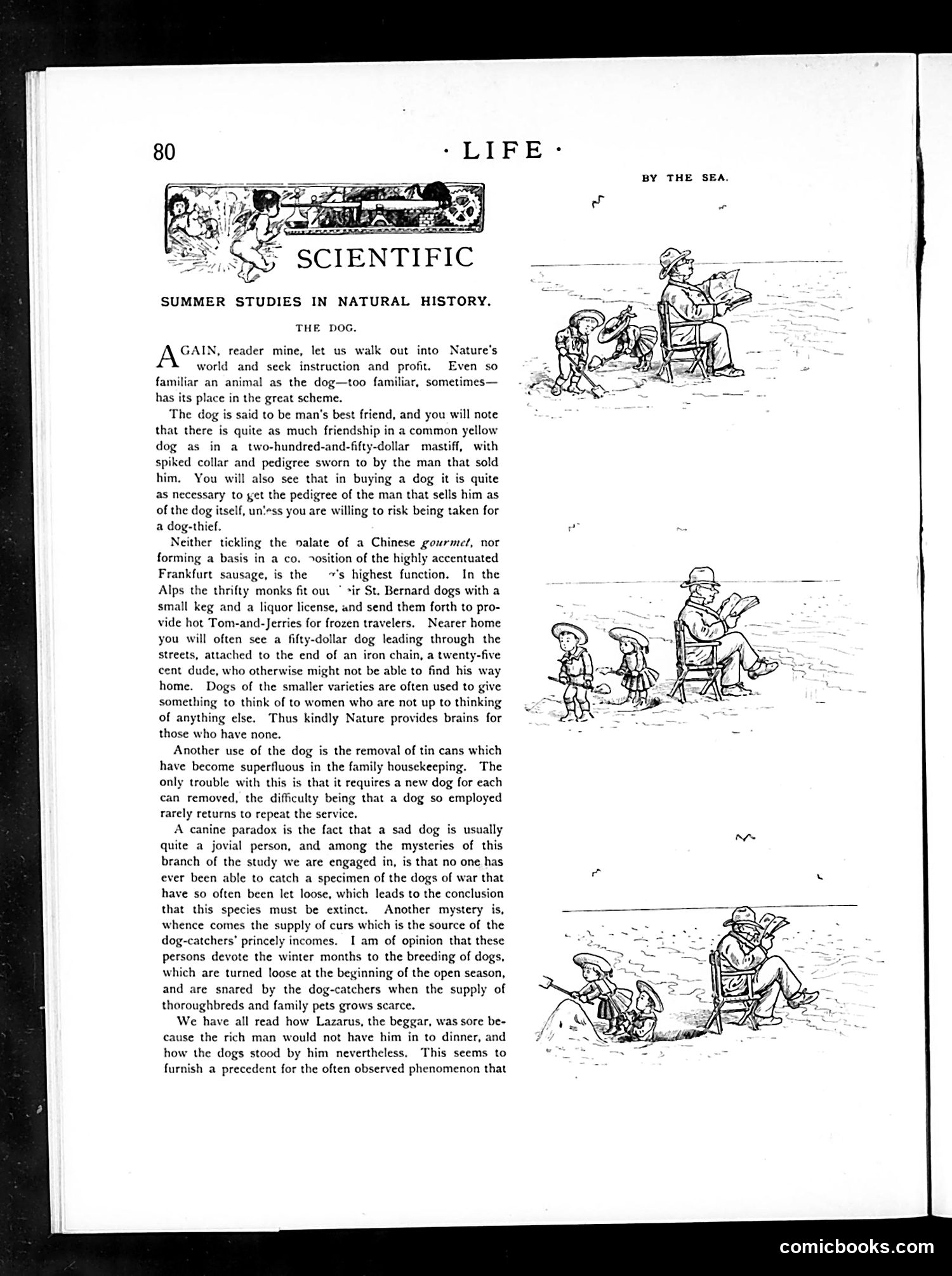
This page contains an article titled "Scientific Summer Studies in Natural History: The Dog," accompanied by three illustrations showing people at the seaside observing dogs. The text is a humorous essay about dogs' practical and social roles—as companions, pest control (removing tin cans), and subjects of winter breeding operations. It includes satirical observations about human behavior: the irony that sad dogs are jovial, the phenomenon of stray "dogs of war," and the wealthy man (Lazarus reference) whose dogs remained loyal despite his poverty. The accompanying seaside illustrations appear to be visual commentary on leisure observation—showing adults and children at the beach apparently studying dogs' behavior, supporting the article's tone of treating dog observation as a quasi-scientific summer activity. The humor lies in the mock-scientific framing of ordinary dog behavior and the social commentary on human-canine relationships.
📄 Transcribed text from this page (OCR, searchable)
Machine-transcribed from the original scan — historical spelling and the odd misread are preserved.
SUMMER STUDIES IN NATURAL HISTORY. THE DOG. AIN, reader mine, let us walk out into Nature's world and seek instruction and profit. Even so familiar an animal as the dog—too familiar, sometimes— has its place in the great scheme. The dog is said to be man’s best friend, and you will note that there is quite as much friendship in a common yellow dog as in a two-hundred-and-fifty-dollar mastiff, with spiked collar and pedigree sworn to by the man that sold him. You will also see that in buying a dog it is quite as necessary to yet the pedigree of the man that sells him as of the dog itself, un‘+ss you are willing to risk being taken for a dog-thief. Neither tickling the valate of a Chinese gourmet, nor forming a basis in a co. >osition of the highly accentuated Frankfurt sausage, is the v's highest function. In the Alps the thrifty monks fit our ° sir St. Bernard dogs with a small keg and a liquor license, and send them forth to pro- vide hot Tom-and-Jerries for frozen travelers. Nearer home you will often see a fifty-dollar dog leading through the Streets, attached to the end of an iron chain, a twenty-five cent dude, who otherwise might not be able to find his way home. Dogs of the smaller varieties are often used to give something to think of to women who are not up to thinking of anything else. Thus kindly Nature provides brains for those who have none. Another use of the dog is the removal of tin cans which have become superfluous in the family housekeeping. The only trouble with this is that it requires a new dog for each can removed, the difficulty being that a dog so employed rarely returns to repeat the service. A canine paradox is the fact that a sad dog is usually quite a jovial person, and among the mysteries of this branch of the study we are engaged in, is that no one has ever been able to catch a specimen of the dogs of war that have so often been let loose, which leads to the conclusion that this species must be extinct. Another mystery is, whence comes the supply of curs which is the source of the dog-catchers’ princely incomes. I am of opinion that these persons devote the winter months to the breeding of dogs, which are turned loose at the beginning of the open season, and are snared by the dog-catchers when the supply of thoroughbreds and family pets grows scarce. We have all read how Lazarus, the beggar, was sore be- cause the rich man would not have him in to dinner, and how the dogs stood by him nevertheless. This seems to furnish a precedent for the often observed phenomenon that BY THE SEA. comicbooks.com