
Life, 1888-08-09 · page 2 of 14
Life — August 9, 1888 — page 2: what you’re looking at
What you’re looking at
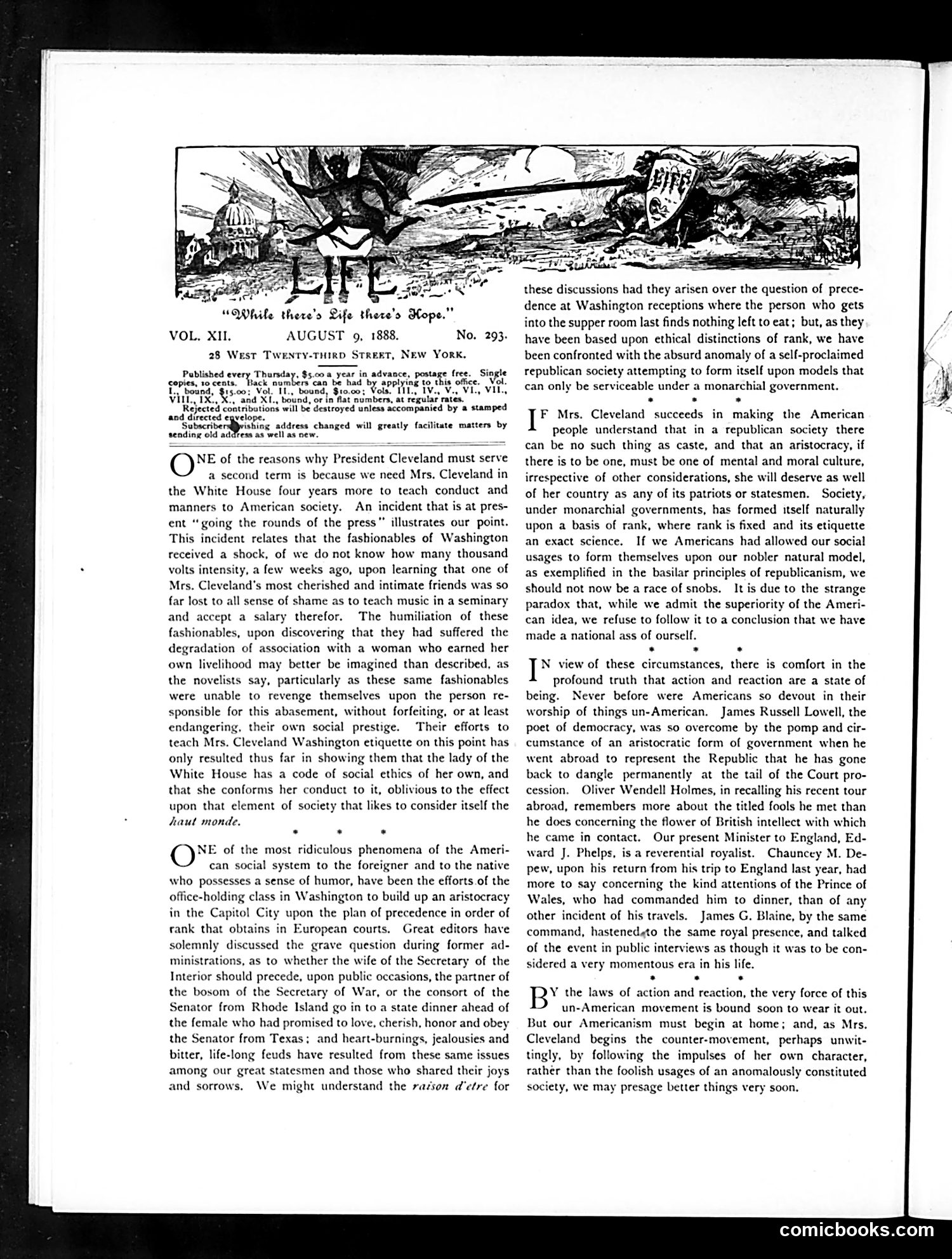
The masthead illustration shows "While there's Life there's Hope" — a landscape with classical and allegorical elements. The article discusses President Cleveland's need for a second term, centering on **Mrs. Cleveland's role in teaching American social conduct and manners**. The text criticizes Washington's emerging aristocratic pretensions, particularly regarding social precedence at official functions. The satire targets the contradiction in a republican society attempting to establish formal class hierarchies based on rank — exactly what the nation's founders rejected. References to incidents where prominent figures (including diplomats and senators) clashed over seating arrangements illustrate how absurdly un-American such status-consciousness had become. The piece mocks this "un-American" behavior while praising Mrs. Cleveland for promoting republican equality over aristocratic pretense.
📄 Transcribed text from this page (OCR, searchable)
Machine-transcribed from the original scan — historical spelling and the odd misread are preserved.
VOL, XII. AUGUST 9, 1888. 28 West Twenty-THirp Street, N. No. 293. Ww YORK, Published every Thursday, $5.00 a year in advance, postage free. | Single copies, 19 cents. Tack numbers can be had by applying to this offce. Vol. 1. boand, $15.00: Vol. I1., bound, $10.00; Vols. IIL, 1V., Vi. Vi, VIL. VIIL, 1X, X.) and X1., bound, or In flat numbers, at regular rates. Rejected contributions will be destroyed unless accompanied by a stamped and directed egvelope. Subscribers@rishing address changed will greatly facilitate matters by tending old address as well as new. NE of the reasons why President Cleveland must serve a second term is because we need Mrs. Cleveland in the White House four years more to teach conduct and manners to American society. An incident that is at pres- ent “going the rounds of the press" illustrates our point. This incident relates that the fashionables of Washington received a shock, of we do not know how many thousand volts intensity, a few weeks ago, upon learning that one of Mrs. Cleveland's most cherished and intimate friends was so far lost to all sense of shame as to teach music in a seminary and accept a salary therefor. The humiliation of these fashionables, upon discovering that they had suffered the degradation of association with a woman who earned her own livelihood may better be imagined than described, as the novelists say, particularly as these same fashionables were unable to revenge themselves upon the person re- sponsible for this abasement, without forfeiting, or at least endangering, their own social prestige. Their efforts to teach Mrs. Cleveland Washington etiquette on this point has only resulted thus far in showing them that the lady of the White House has a code of social ethics of her own, and that she conforms her conduct to it, oblivious to the effect upon that element of society that likes to consider itself the haut monde. . * . O* = of the most ridiculous phenomena of the Ameri- can social system to the foreigner and to the native who possesses a sense of humor, have been the efforts.of the office-holding class in Washington to build up an aristocracy in the Capitol City upon the plan of precedence in order of rank that obtains in European courts. Great editors have solemnly discussed the grave question during former ad- ministrations, as to whether the wife of the Secretary of the Interior should precede, upon public occasions, the partner of the bosom of the Secretary of War, or the consort of the Senator from Rhode Island go in to a state dinner ahead of the female who had promised to love, cherish, honor and obey the Senator from Texas id heart-burnings, jealousies and bitter, life-long feuds have resulted from these same issues among our great statesmen and those who shared their joys and sorrows. We might understand the razson d'etre for these discussions had they arisen over the question of prece- dence at Washington receptions where the person who gets into the supper room last finds nothing left to eat; but, as they have been based upon ethical distinctions of rank, we have been confronted with the absurd anomaly of a self-proclaimed republican society attempting to form itself upon models that can only be serviceable under a monarchial government. F Mrs. Cleveland succeeds in making the American people understand that in a republican society there can be no such thing as caste, and that an aristocracy, if there is to be one, must be one of mental and moral culture, irrespective of other considerations, she will deserve as well of her country as any of its patriots or statesmen. Society, under monarchial governments, has formed itself naturally upon a basis of rank, where rank is fixed and its etiquette an exact science. If we Americans had allowed our social usages to form themselves upon our nobler natural model, as exemplified in the basilar principles of republicanism, we should not now be a race of snobs. It is due to the strange paradox that, while we admit the superiority of the Ameri- can idea, we refuse to follow it to a conclusion that we have made a national ass of ourself. . . . [* view of these circumstances, there is comfort in the profound truth that action and reaction are a state of being. Never before were Americans so devout in their worship of things un-American. James Russell Lowell, the poet of democracy, was so overcome by the pomp and cir- cumstance of an aristocratic form of government when he went abroad to represent the Republic that he has gone back to dangle permanently at the tail of the Court pro- cession. Oliver Wendell Holmes, in recalling his recent tour abroad, remembers more about the titled fools he met than he does concerning the flower of British intellect with which he came in contact. Our present Minister to England, Ed- ward J. Phelps, is a reverential royalist. Chauncey M. De- pew, upon his return from his trip to England last year, had more to say concerning the kind attentions of the Prince of Wales, who had commanded him to dinner, than of any other incident of his travels. James G. Blaine, by the same command, hastenedato the same royal presence, and talked of the event in public interviews as though it was to be con- sidered a very momentous era in his life. . . . B the laws of action and reaction, the very force of this un-American movement is bound soon to wear it out. But our Americanism must begin at home; and, as Mrs. Cleveland begins the counter-movement, perhaps unwit- tingly, by following the impulses of her own character, rather than the foolish usages of an anomalously constituted society, we may presage better things very soon, comicbooks.com