
A complete issue · 14 pages · 1888
Life — July 26, 1888
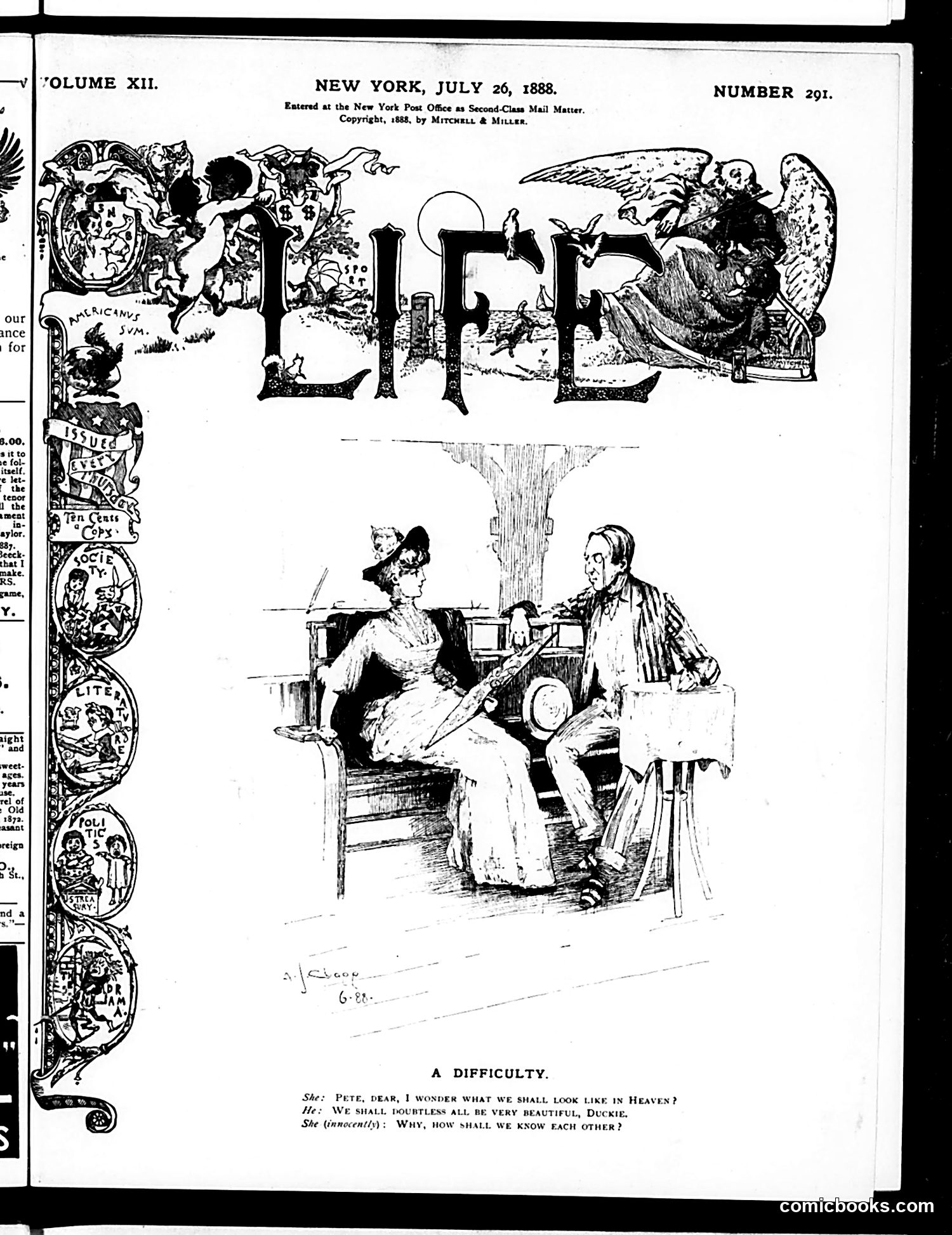
**The Main Cartoon: "A Difficulty"** This satirical piece depicts a couple discussing theological concerns about marriage and the afterlife. The woman asks her husband Pete what they'll look like in Heaven, to which he responds they'll "doubtless all be very beautiful." She then poses the awkward question: "Why, how shall we know each other?" **The Satire's Point** The humor plays on Victorian marriage anxieties and religious doctrine. If everyone becomes beautiful and unrecognizable in Heaven, husbands and wives won't be able to identify each other—a comedic commentary on both the uncertainty of spousal recognition and perhaps underlying marital tensions. It mocks both religious platitudes and the disconnect between earthly marriage bonds and heavenly existence. The elaborate decorative border and "LIFE" masthead confirm this as the satirical magazine's humor section.
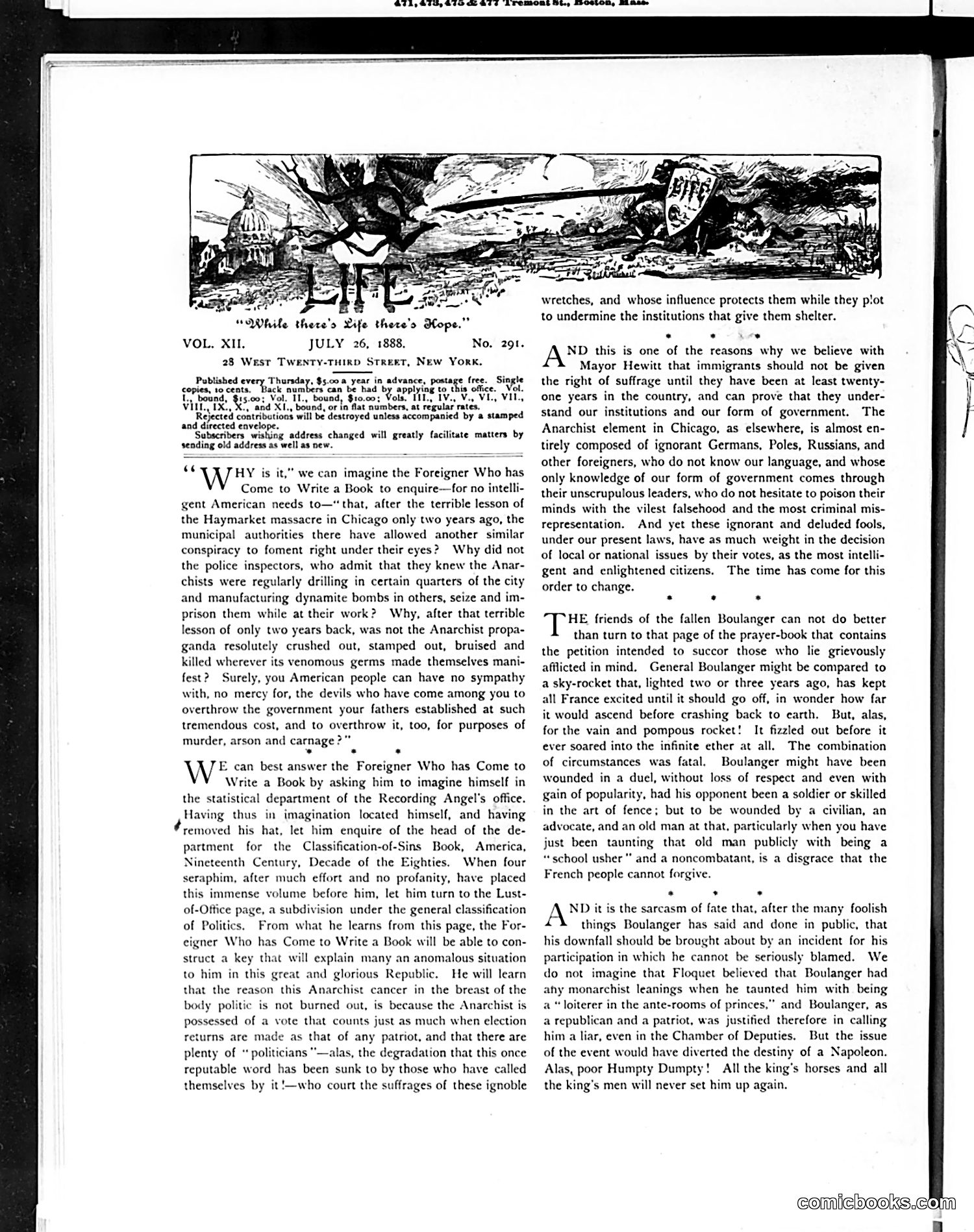
The page features editorial text attacking immigrants and anarchists rather than a traditional cartoon. The banner illustration shows a figure emerging from what appears to be a bomb or explosive device with the caption "Why there's a spy there's a 'Dope.'" The articles argue against giving voting rights to immigrants, specifically targeting anarchists in Chicago. The writers claim foreign-born radicals—described as ignorant Germans, Poles, and Russians—spread dangerous false propaganda that undermines American institutions. The text also mocks General Boulanger, a French political figure, comparing his failed political ambitions to a malfunctioning rocket. The overall message reflects 1880s American nativist anxiety about immigration and radical political movements, particularly in the wake of labor unrest and anarchist activities.
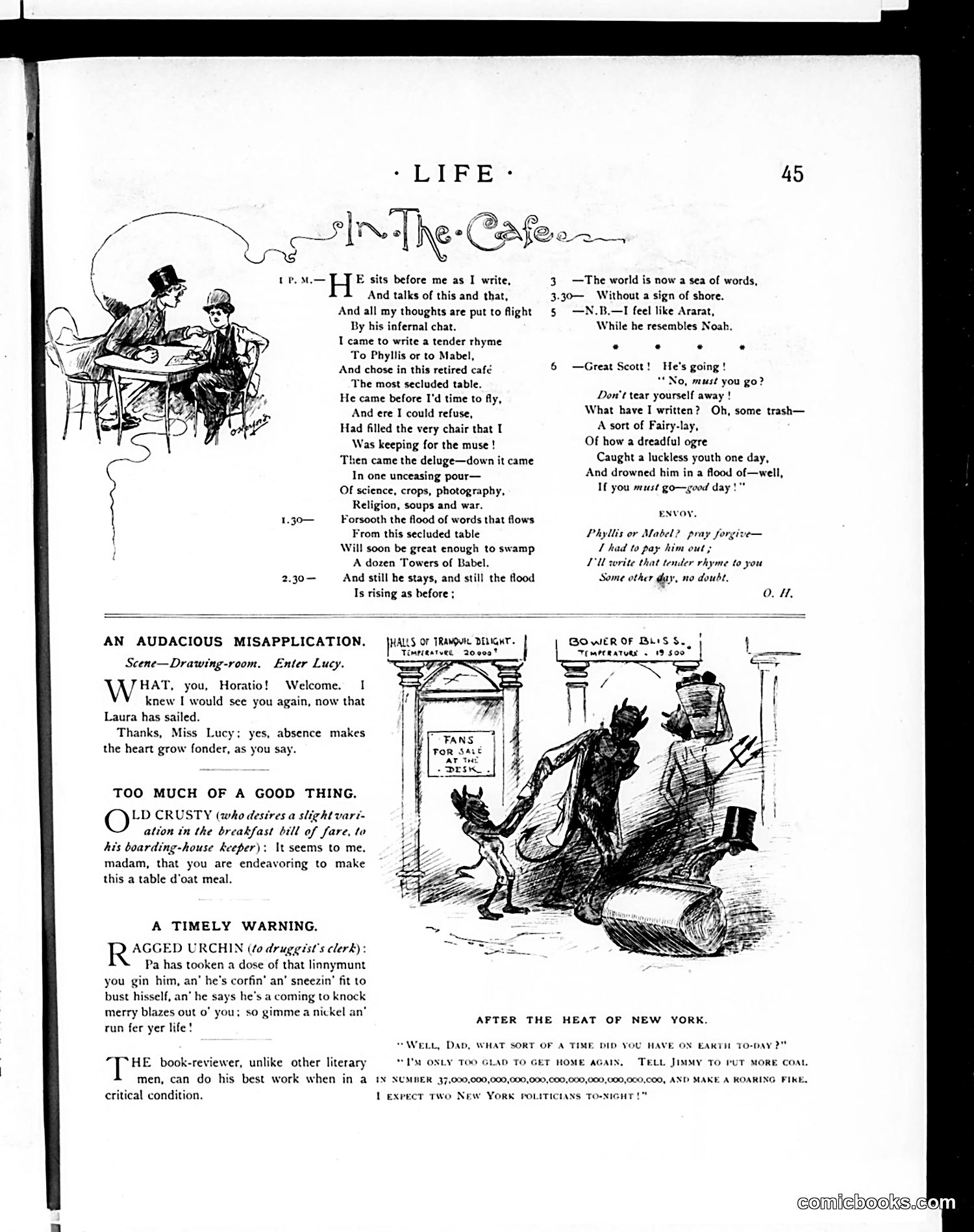
**"In the Cafe"** (top): A poem satirizing a writer's complaint that an uninvited visitor interrupts his creative work at a café table. The piece mocks the writer's pretension—he came seeking solitude to compose "tender rhyme" for romantic interests, but instead endures conversation about current events (science, crops, religion, war). The joke critiques both self-important writers and the impossibility of finding peaceful retreat in social spaces. **"After the Heat of New York"** (bottom cartoon): A dog appears exhausted in New York summer heat, with someone mentioning "two New York politicians" and making a roaring fire. This likely satirizes political corruption or incompetence as metaphorically overheated and destructive—typical of Life's commentary on contemporary urban politics, though the specific politicians referenced are unclear without additional context.
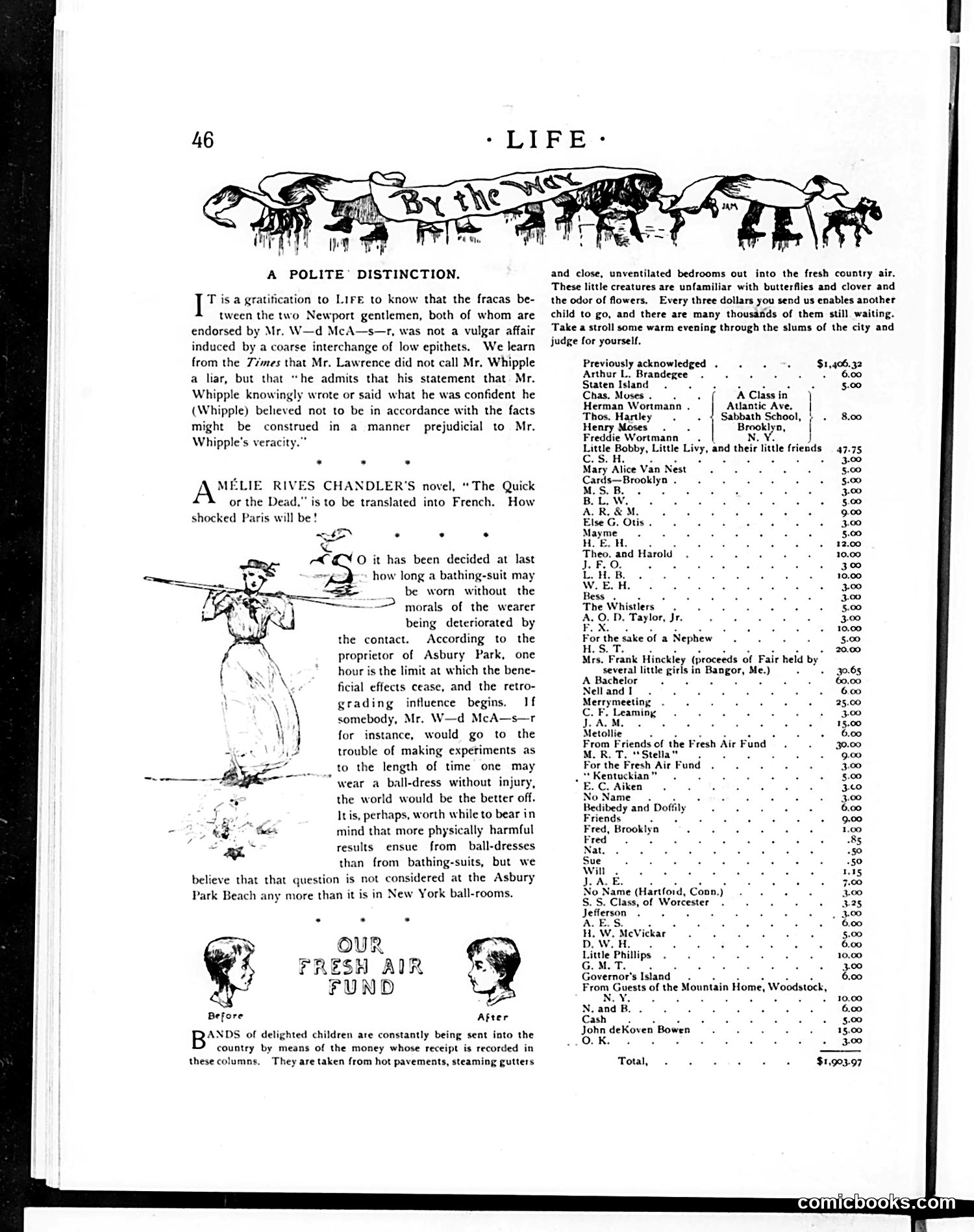
This page contains three distinct sections: **"A Polite Distinction"** discusses a disagreement between two Newport gentlemen regarding Mr. Lawrence's public statement about Mr. Whipple. The piece suggests Lawrence didn't fully call Whipple a liar, but admits the facts contradict Whipple's version—a humorous commentary on polite evasion and social hypocrisy among the wealthy elite. **"Our Fresh Air Fund"** section describes sending delighted children from urban slums to the countryside. The accompanying illustration shows "Before" and "After" figures—likely depicting improvements in children's health and cleanliness from fresh air exposure. The right side lists donors and amounts to the Fresh Air Fund charity. The overall tone satirizes upper-class social conventions and promotes philanthropic causes.
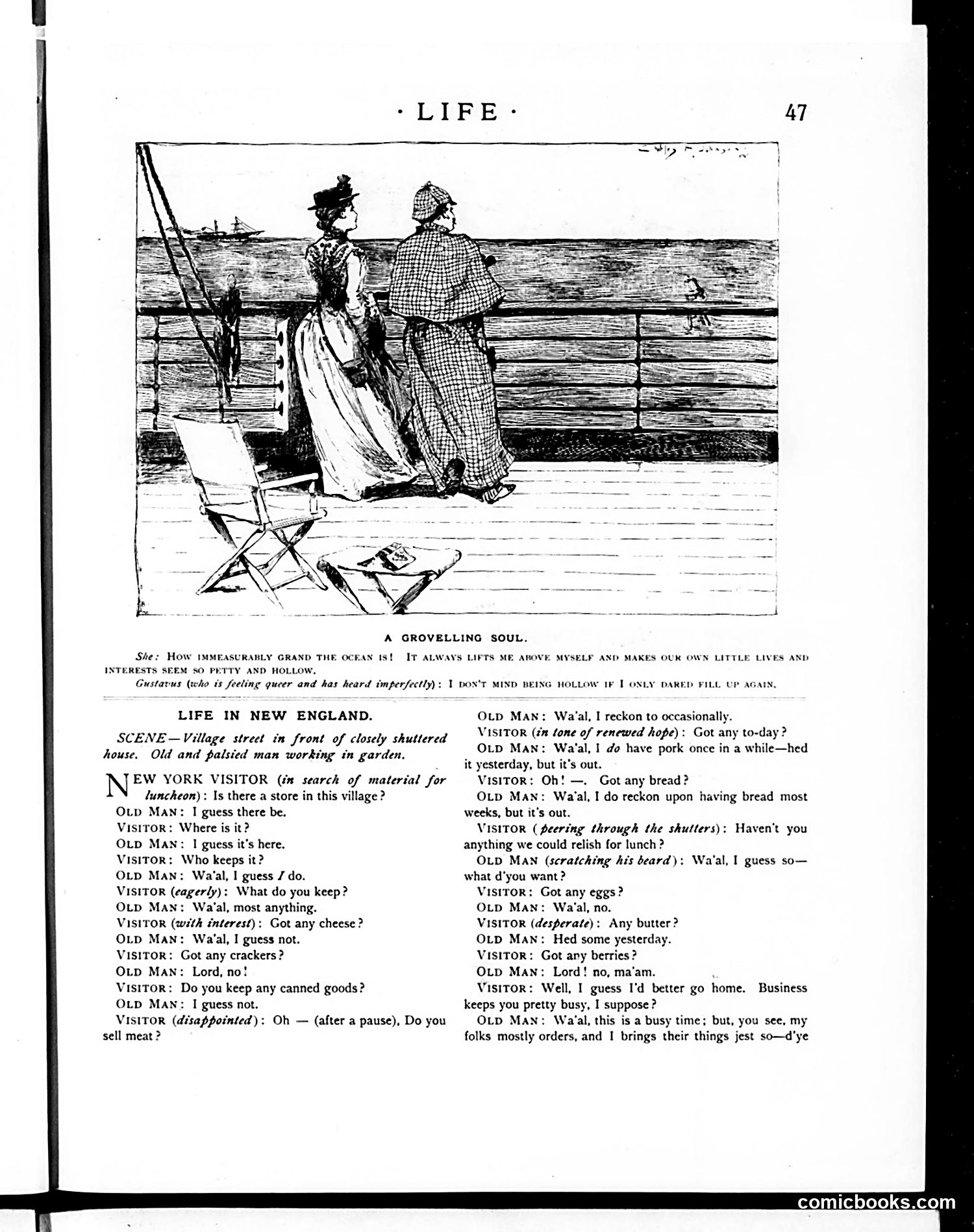
This page contains two satirical sketches about New England life and attitudes. **"A Grovelling Soul"** (top illustration) depicts a woman at a seaside resort expressing wonder at the ocean's grandeur, while a man dismissively replies he doesn't mind being "hollow" if only he could feel full again—satirizing masculine emotional emptiness and materialism masquerading as pragmatism. **"Life in New England"** (bottom) presents a comedic dialogue between a New York visitor and a taciturn old man. The humor derives from the visitor's increasingly desperate attempts to engage the old man in conversation about supplies and services—all met with minimalist, evasive responses ("Wa'al, I guess so"). This mockingly stereotypes New England Yankees as famously laconic, unwelcoming, and commercially reluctant—a common comedic trope of the era.
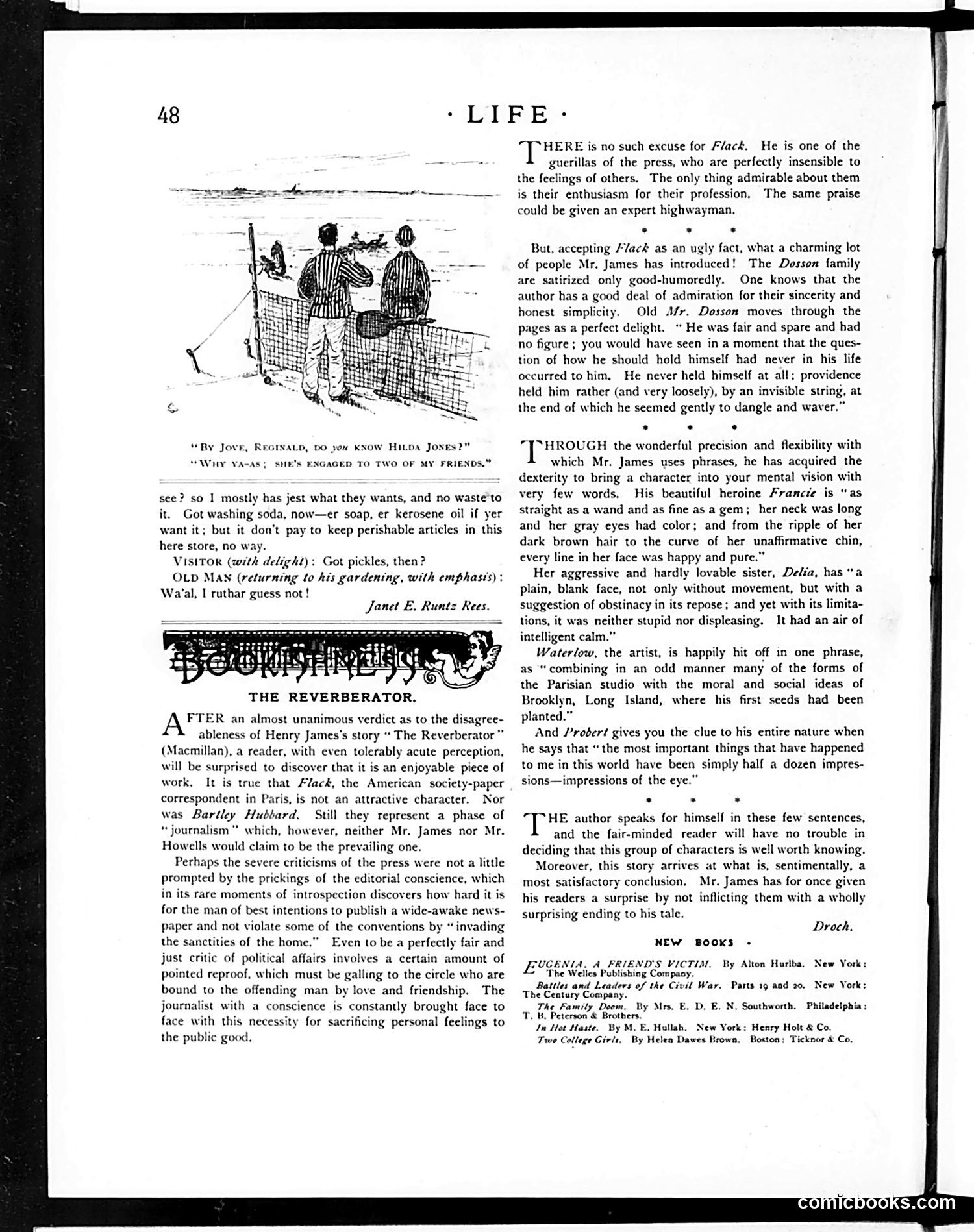
The main cartoon depicts three figures at a fence, with a caption asking "By Jove, Reginald, do you know Hilda Jones?" The joke appears to involve social recognition or class distinctions—the figures' formal dress and the fence setting suggest a commentary on upper-class society and exclusivity. Below is a section titled "THE REVERBERATOR" reviewing Henry James's story "The Reverberator." The text critiques the story's characters, particularly the American journalist Flack, for lacking moral sensitivity. The review praises James's nuanced characterization while noting the story satirizes American journalism's invasion of privacy and violations of social conventions—a concern about press ethics and sensationalism relevant to the early 1900s publication period.
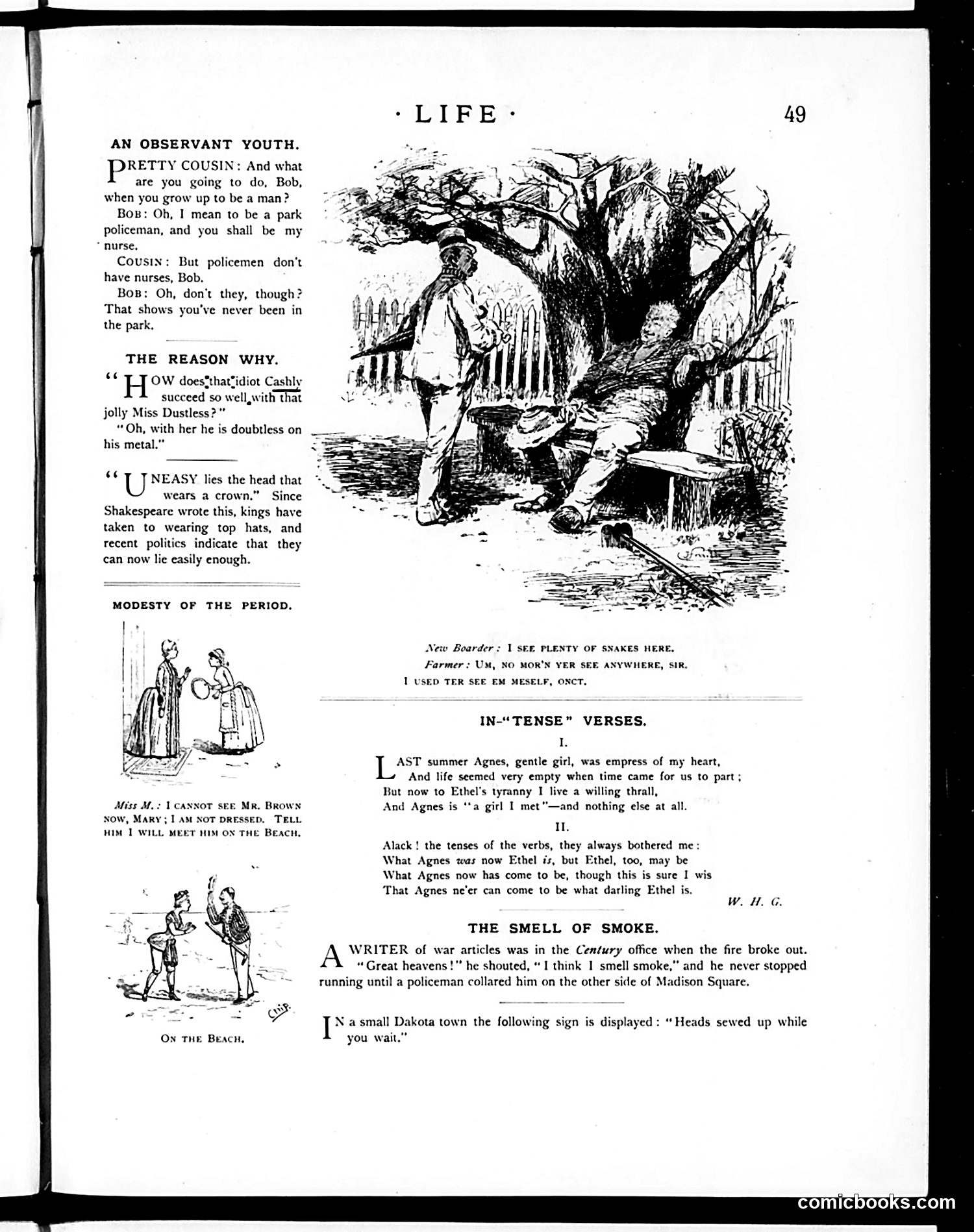
This page contains several humor pieces typical of early Life magazine's satirical style: **"An Observant Youth"** mocks a boy's logical response to his cousin's suggestion he become a park policeman—he notes policemen don't have nurses, so he'd rather be a park instead. **"The Reason Why"** appears to reference contemporary political figures or social types (Cashly and "Miss Daciless") in a brief joke about social advancement. **"Modesty of the Period"** shows two cartoon vignettes depicting women's beach behavior and dress—satirizing Victorian-era social conventions around female modesty and public appearance. The verses and anecdotes below offer additional period humor about romance, military matters, and small-town Americana, reflecting Life's blend of social commentary and lighthearted entertainment typical of the early 20th century.
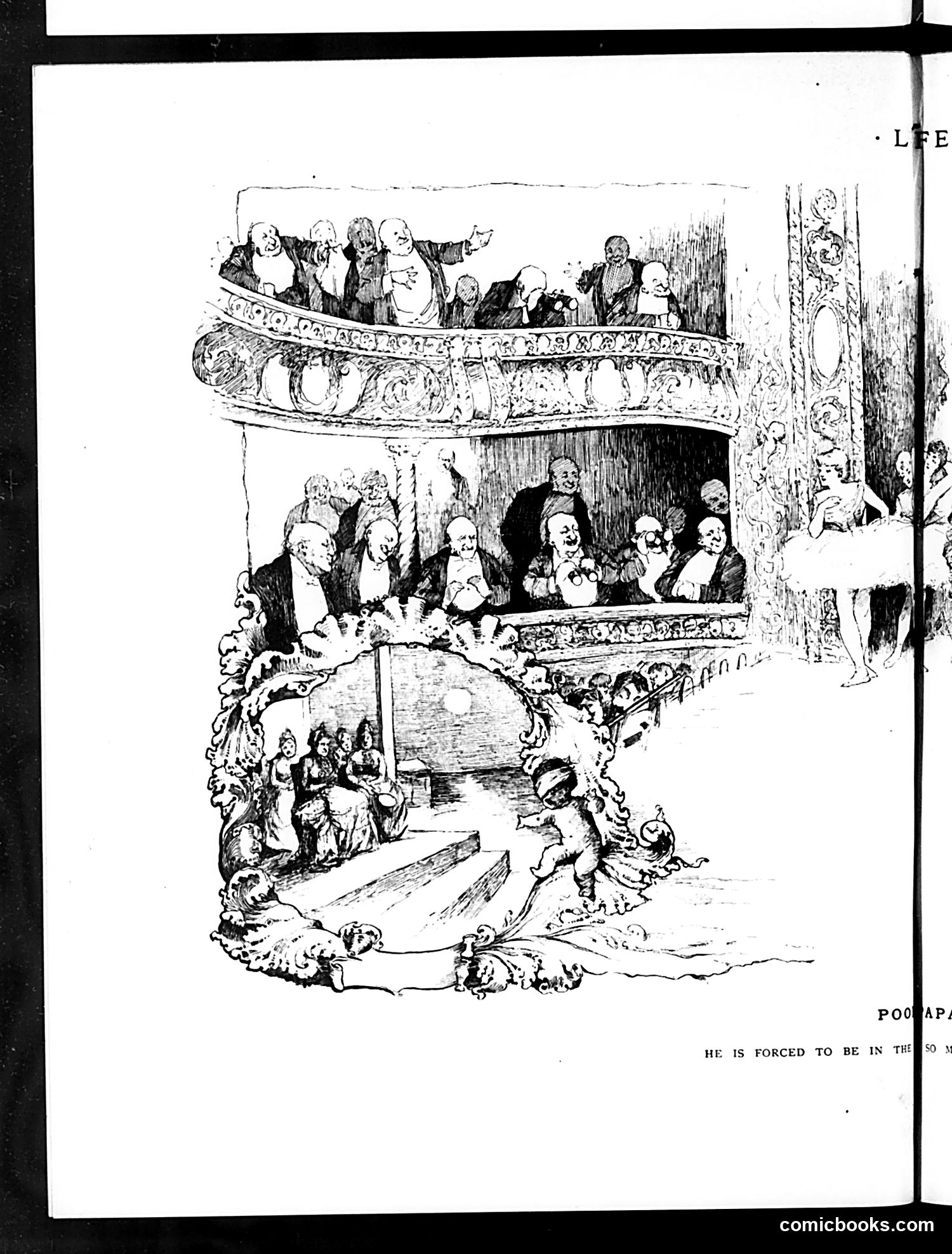
This is a satirical illustration from *Life* magazine showing a multi-tiered opera house or theater filled with spectators. The visible caption reads "HE IS FORCED TO BE IN THE" (text cuts off), suggesting commentary on someone compelled into a public situation. The drawing depicts wealthy, well-dressed patrons occupying the ornate balconies and boxes—a typical Victorian-era theater scene. The elaborate decorative elements and crowded seating suggest social hierarchy, with the upper classes prominently displayed. Without the complete caption or additional context, the exact political target is unclear. However, the satire likely critiques either: forced public appearances by political figures, involuntary social obligation, or the pretense and spectacle of high society. The "forced" language suggests criticism of compulsion rather than voluntary participation.
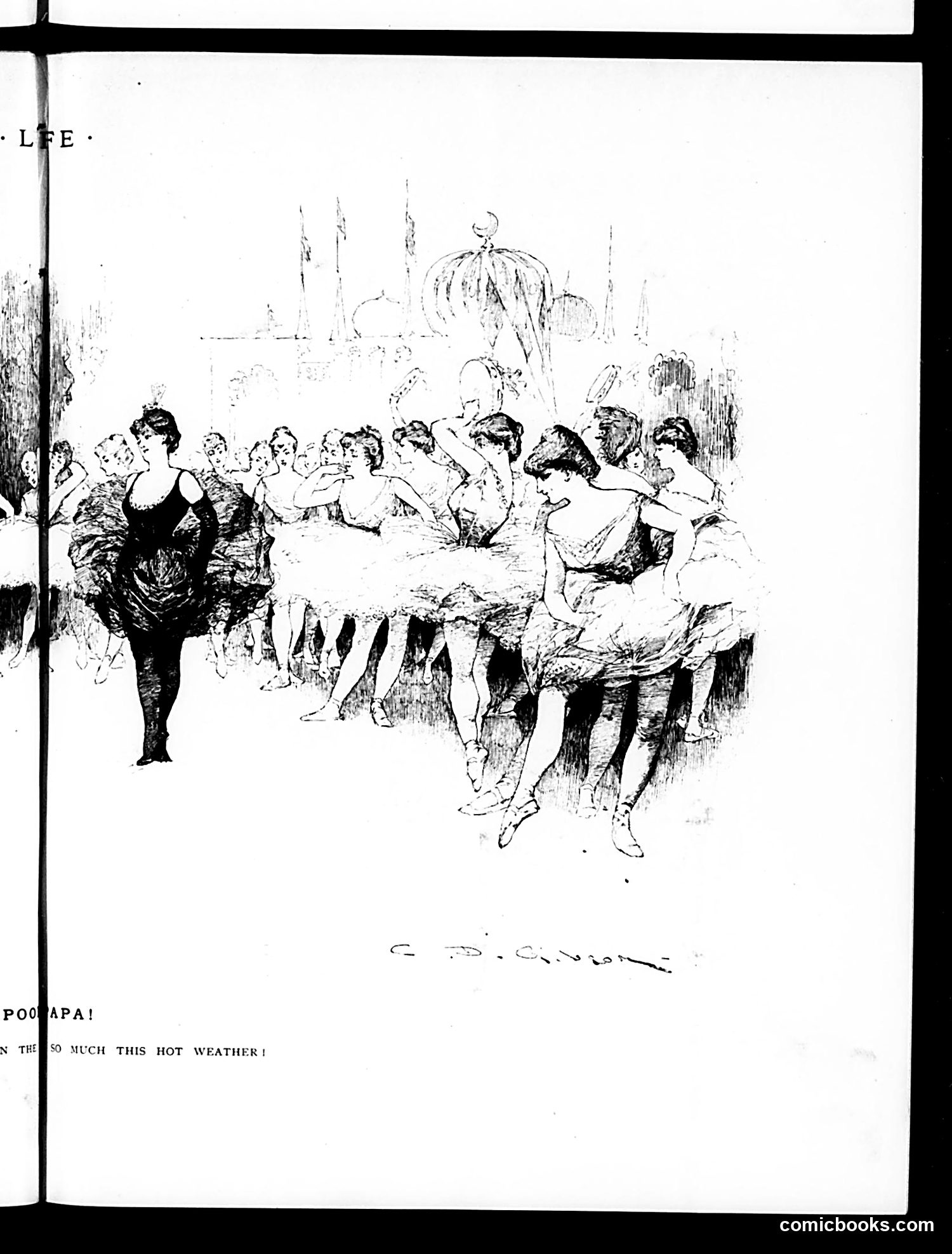
This is a satirical illustration from *Life* magazine showing a social scene during hot weather. The caption reads "POOR PAPA! IN THIS SO MUCH THIS HOT WEATHER!" (the OCR appears garbled, likely reading "POOR PAPA! IN ALL THIS SO MUCH HOT WEATHER!"). The cartoon depicts a group of fashionably-dressed women gathered around a table, apparently at leisure or recreation. One man (presumably "Papa") enters on the left, fully clothed and appearing uncomfortable. The satire mocks the gender disparity in how heat was managed—women wore lighter, more revealing summer clothing while men remained formally dressed in heavy suits and layers, making them miserable in hot weather. This reflects early-20th-century social commentary on restrictive male fashion conventions versus the relative freedom women enjoyed (or were beginning to enjoy) in summer dress.
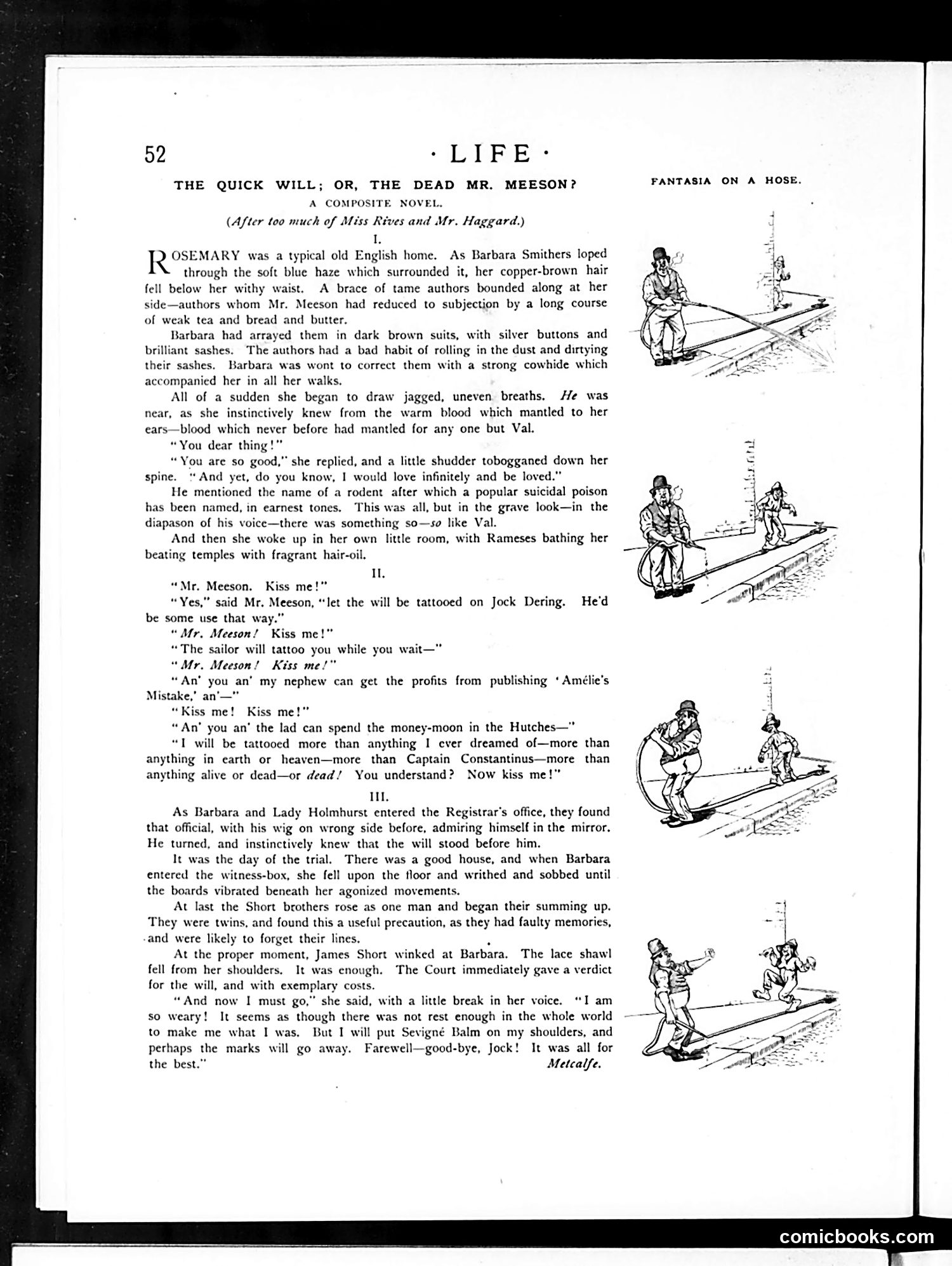
This page from *Life* magazine presents a satirical composite novel titled "The Quick Will; Or, The Dead Mr. Meeson?" — a parody subtitle referencing popular Victorian novels by H. Rider Haggard and other prolific authors of the era. The text mocks melodramatic Victorian fiction through exaggerated plot elements: a dying woman, dramatic deathbed scenes, romantic declarations, and legal complications over a will. The repeated exclamations "Kiss me!" and references to tattoos, sailor adventures, and poison are overwrought tropes typical of sensationalist literature. The accompanying sketches on the right appear to depict comic scenes of physical farce — possibly showing characters in awkward or comedic situations — complementing the satirical text's mockery of overwrought romantic and mystery plots prevalent in late 19th-century popular literature.
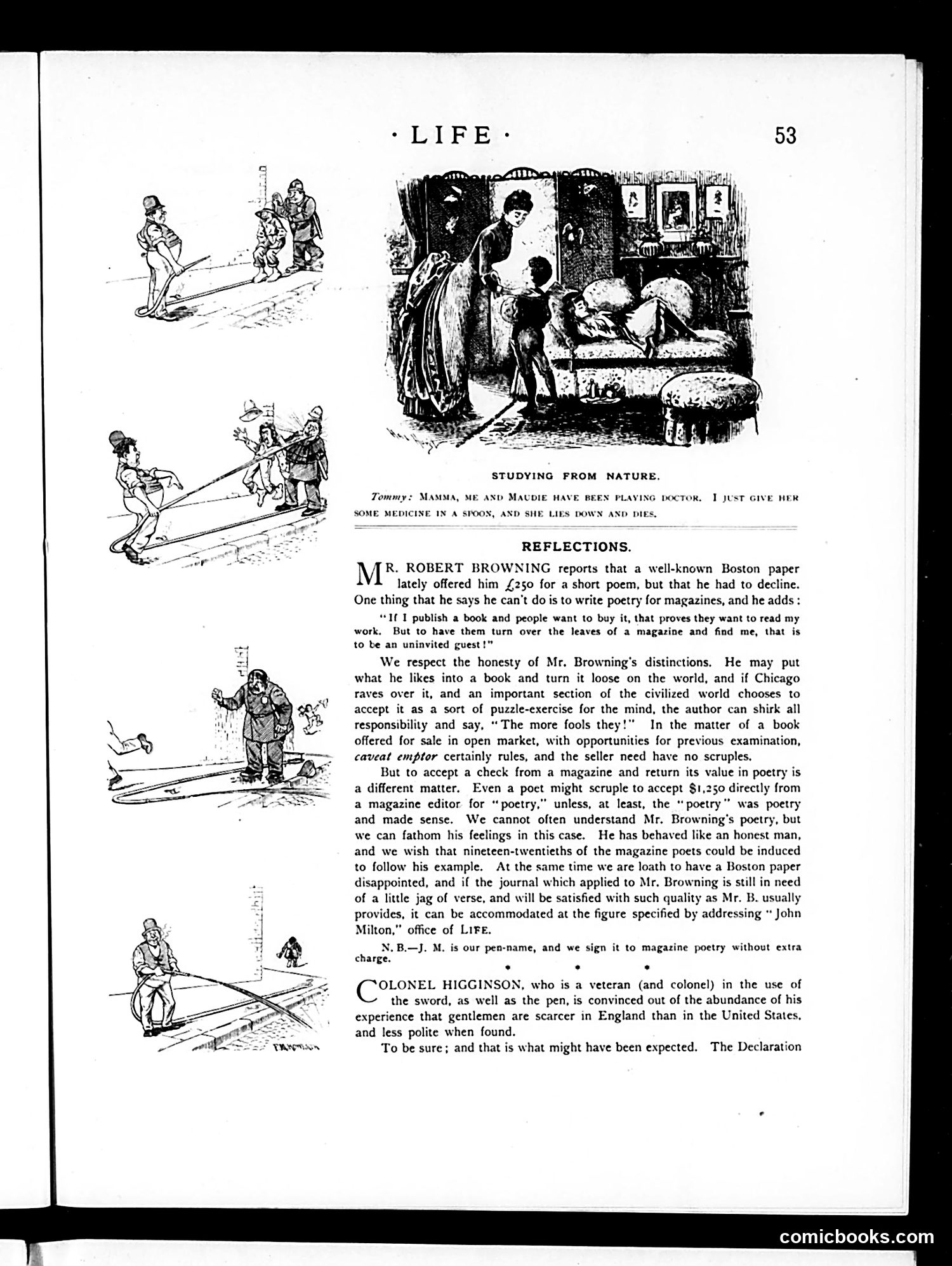
The page contains two distinct items: **"Studying from Nature"** (top): A humorous caption about children playing doctor. Tommy tells his mother he and Maudie have been "playing doctor," and he gave the patient "medicine in a spoon, and she lies down and dies." The joke plays on innocent childhood role-play with darkly comedic results—the "patient" dies from the treatment. **"Reflections"** (main text): Commentary on poet Robert Browning's refusal of £250 from a Boston newspaper for a poem, citing that magazine publication feels like being "an uninvited guest." Life's editors respect his integrity but sarcastically offer their own pen-name "John Milton" to fill the gap, implying magazine poetry is often mediocre work unworthy of serious poets. The piece critiques both Browning's pretension and magazine poets' general lack of quality. A brief note on Colonel Higginson follows, noting his observation that English gentlemen are scarcer and less polite than American ones.
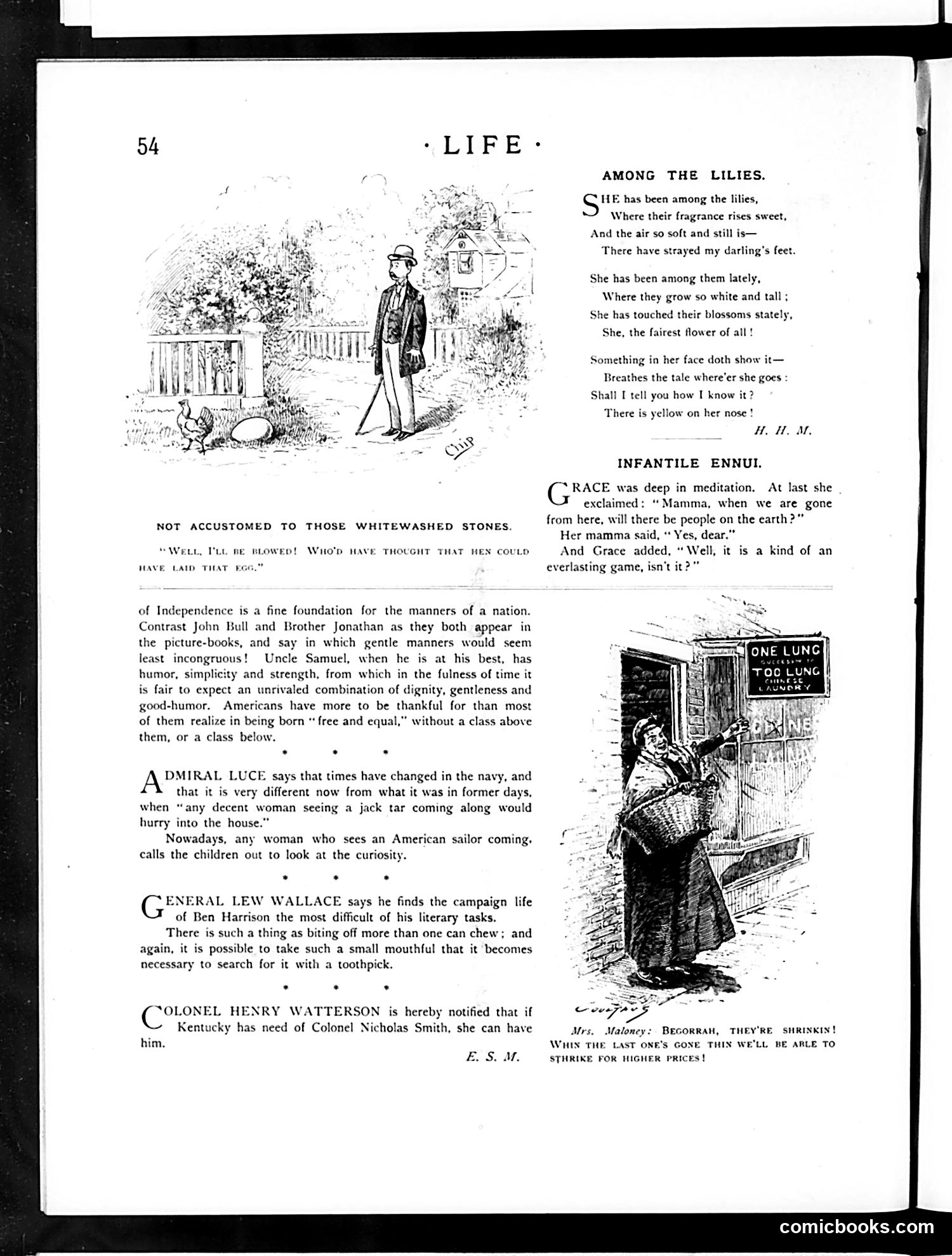
This page contains multiple satirical items typical of 19th-century American humor magazines: **"Among the Lilies"** is a sentimental poem mocking romantic verse—the punchline reveals the beloved has yellow pollen on her nose, deflating the flowery language. **"Infantile Ennui"** presents a child's philosophical observation about eternal human existence as tedious repetition—satire of precocious children and philosophical pretension. **"Not Accustomed to Those Whitewashed Stones"** appears to be a brief joke about eggs, possibly referencing American farm life or British/American cultural differences (John Bull vs. "Brother Jonathan"—period personifications of Britain and America). The text block discusses American character—contrasting John Bull (Britain) favorably with Uncle Samuel (America), praising American egalitarianism and humor. **Other brief items** mock Admiral Luce on changing naval customs, General Lew Wallace's difficulty writing Ben Harrison's biography, and include personal notices about Colonel Watterson and Colonel Nicholas Smith. The **lower cartoon** shows Mrs. Maloney anticipating shrinking immigrant workers will allow striking for higher wages—commentary on labor exploitation and Irish immigration.
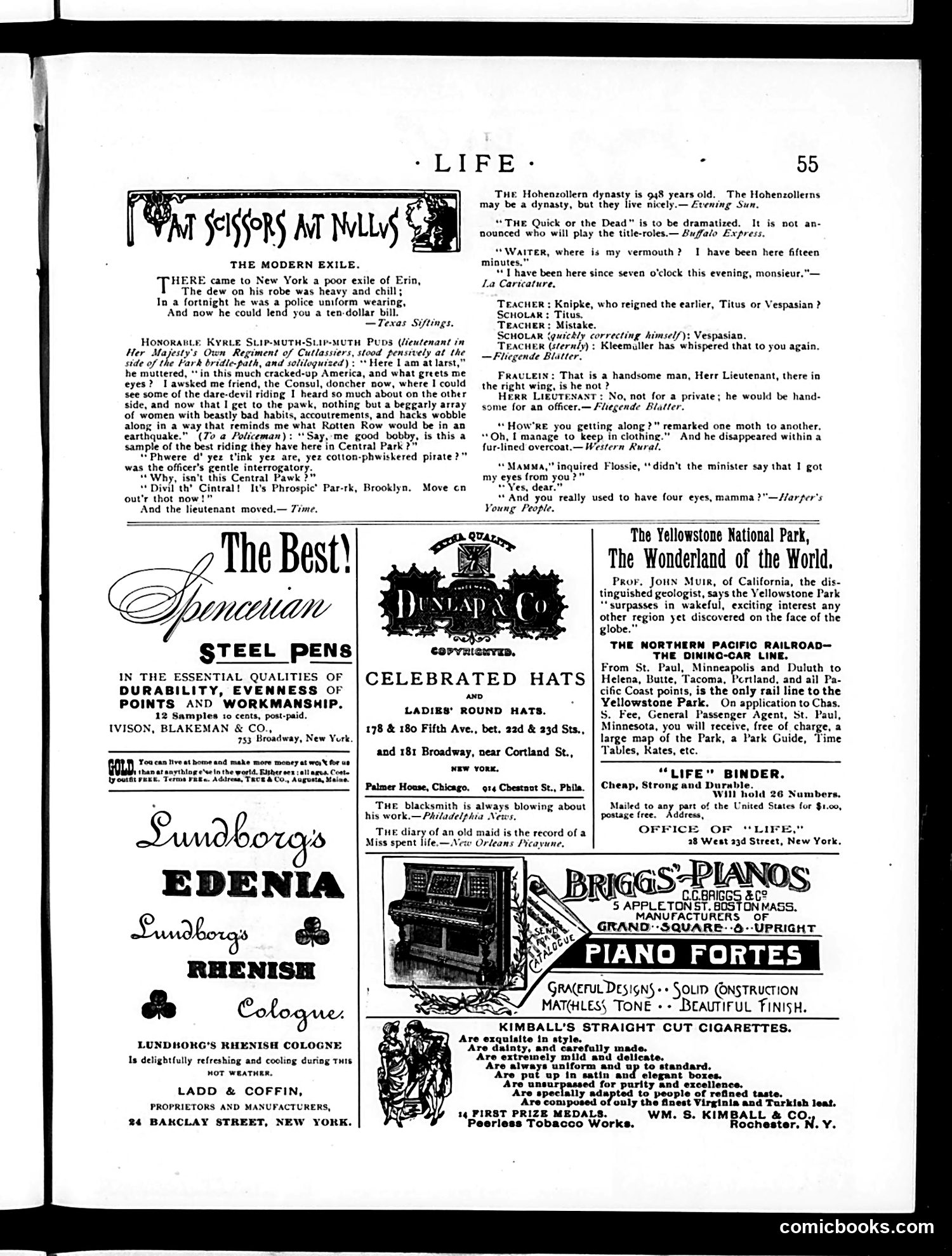
The main cartoon mocks Irish immigrants arriving in America. A poor Irish exile arrives in New York and within two weeks becomes a police officer—then quickly gets wealthy enough to lend money. The satire suggests that Irish police were acquiring wealth suspiciously fast, implying corruption or graft. A secondary comedic segment shows a snobbish British military officer ("Kyrle Slip-muth-Slip-muth Puds") visiting Central Park in Brooklyn, complaining about the poor horsemanship of American riders. He's mocked by an Irish policeman who tells him he's in the wrong park entirely—satirizing both British condescension and Irish working-class wit. The page is primarily advertisements otherwise, with notices for steel pens, hats, cologne, and pianos typical of 1880s American commerce.
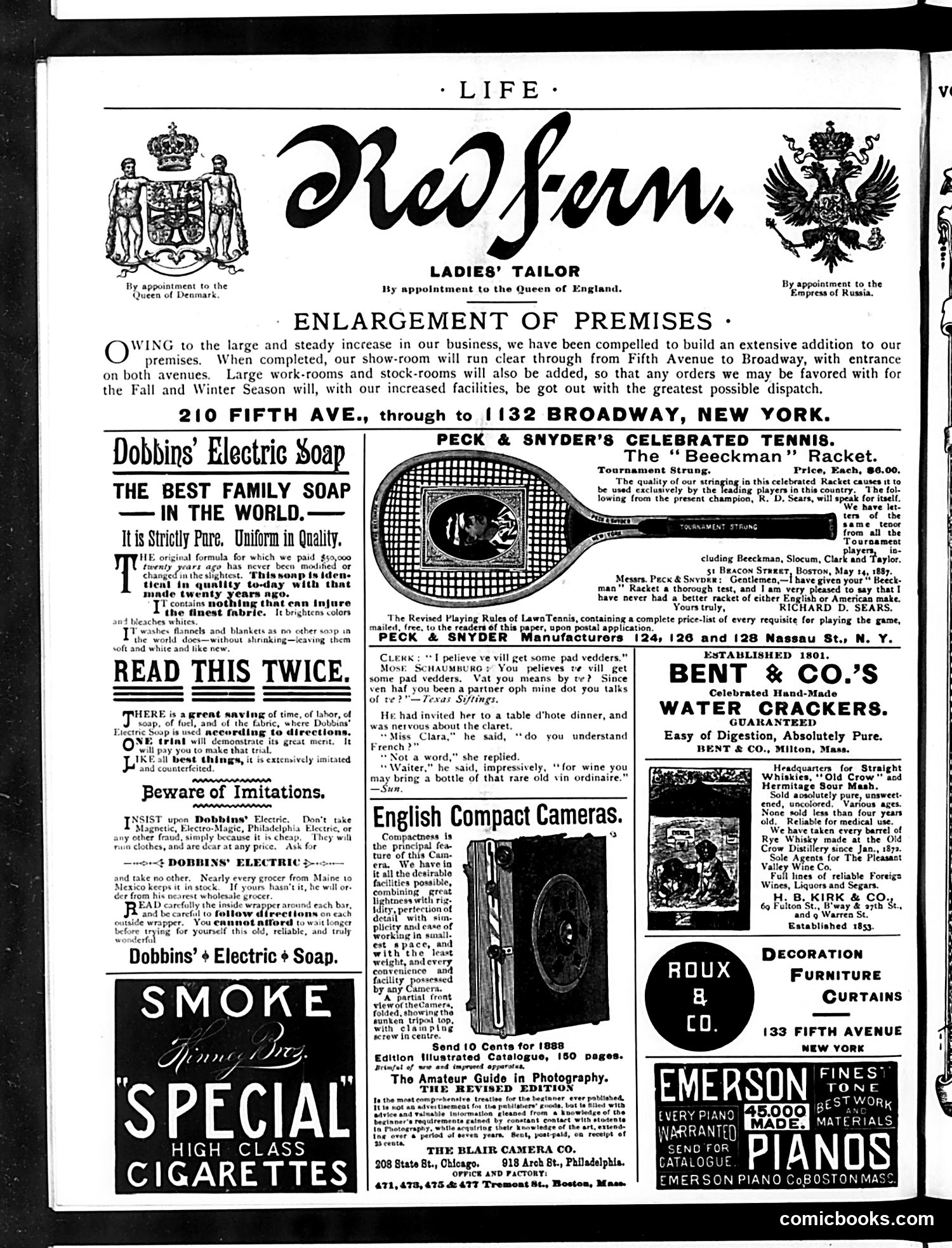
This page is primarily **advertising**, not political satire. It features advertisements for various consumer products popular in late 19th-century America, centered around a ladies' tailor business expansion announcement. The main content describes Red Fern, a ladies' tailor with royal patronage (appointed to the Queen of England and Empress of Russia), announcing enlarged premises on Fifth Avenue and Broadway in New York. Surrounding this are period product advertisements including Dobbins' Electric Soap, Peck & Snyder tennis equipment, English cameras, water crackers, pianos, and whiskey. Small comic snippets appear—including jokes about German immigrants ("ved vedders") and French language misunderstandings—typical of late-Victorian-era humor that often relied on ethnic stereotypes. The page reflects Gilded Age consumer culture and advertising conventions rather than political commentary.