
Life, 1888-07-26 · page 6 of 14
Life — July 26, 1888 — page 6: what you’re looking at
What you’re looking at
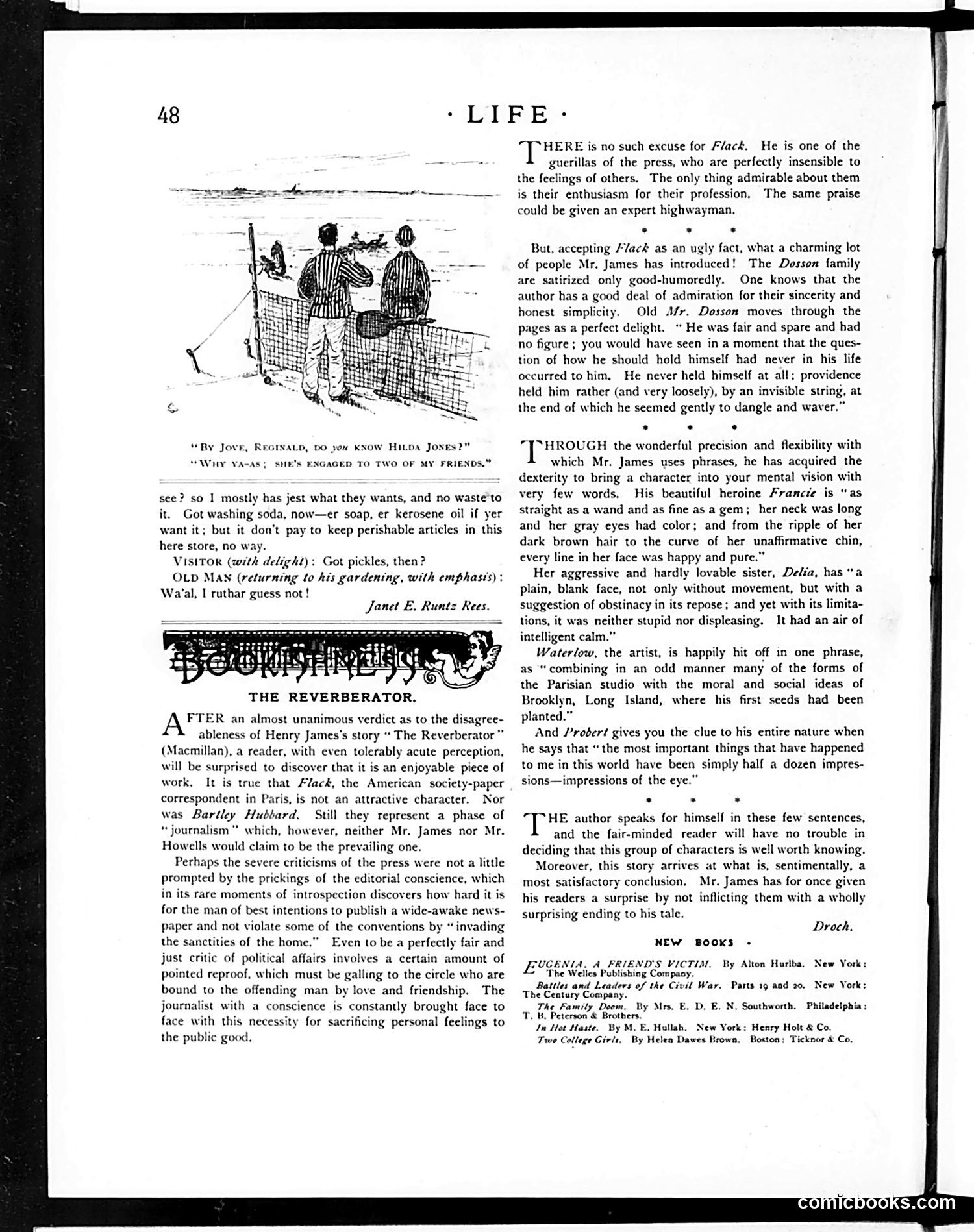
The main cartoon depicts three figures at a fence, with a caption asking "By Jove, Reginald, do you know Hilda Jones?" The joke appears to involve social recognition or class distinctions—the figures' formal dress and the fence setting suggest a commentary on upper-class society and exclusivity. Below is a section titled "THE REVERBERATOR" reviewing Henry James's story "The Reverberator." The text critiques the story's characters, particularly the American journalist Flack, for lacking moral sensitivity. The review praises James's nuanced characterization while noting the story satirizes American journalism's invasion of privacy and violations of social conventions—a concern about press ethics and sensationalism relevant to the early 1900s publication period.
📄 Transcribed text from this page (OCR, searchable)
Machine-transcribed from the original scan — historical spelling and the odd misread are preserved.
- LIFE: 4 “By Jove, Rec MAWHY VArAS; LD, DO you KNOW HILDA Jones?” SHE'S ENGAGED TO TWO OF MY FRIENDS,” see? so 1 mostly has jest what they wants, and no waste'to it. Got washing soda, now—er soap, er kerosene oil if yer want it; but it don’t pay to keep perishable articles in this here store, no way. VISITOR (with delight): Got pickles, then? OLD MAN (returning to hi's gardening, with emphasis): Wa'al, I ruthar guess not! Janet E. Runtz Rees. THE REVERBERATOR,. FTER an almost unanimous verdict as to the disagree- ableness of Henry James's story “ The Reverberator” (Macmillan), a reader, with even tolerably acute perception, will be surprised to discover that it is an enjoyable piece of work. It is true that Flack, the American society-paper correspondent in Paris, is not an attractive character. Nor was Bartley Hubbard. Still they represent a phase of “journalism” which, however, neither Mr. James nor Mr. Howells would claim to be the prevailing one. Perhaps the severe criticisms of the press were not a little prompted by the prickings of the editorial conscience, which in its rare moments of introspection discovers how hard it is for the man of best intentions to publish a wide-awake news- paper and not violate some of the conventions by “invading the sanctities of the home.” Even to be a perfectly fair and just critic of political affairs involves a certain amount of pointed reproof, which must be galling to the circle who are bound to the offending man by love and friendship. The journalist with a conscience is constantly brought face to face with this necessity for sacrificing personal feelings to the public good. HERE is no such excuse for Flack. He is one of the guerillas of the press, who are perfectly insensible to the feelings of others. The only thing admirable about them is their enthusiasm for their profession. The same praise could be given an expert highwayman, . . . But, accepting /Vack as an ugly fact, what a charming lot of people Mr. James has introduced! The Dosson family are satirized only good-humoredly. One knows that the author has a good deal of admiration for their sincerity and honest simplicity. Old 3/r. Dosson moves through the pages as a perfect delight. “ He was fair and spare and had no figure ; you would have seen in a moment that the ques- tion of how he should hold himself had never in his life occurred to him. He never held himself at all; providence held him rather (and very loosely), by an invisible string, at the end of which he seemed gently to dangle and waver.” * . . App mouer the wonderful precision and flexibility with which Mr. James uses phrases, he has acquired the dexterity to bring a character into your mental vision with very few words. His beautiful heroine Francie is “as straight as a wand and as fine as a gem;_ her neck was long and her gray eyes had color; and from the ripple of her dark brown hair to the curve of her unaffirmative chin, every line in her face was happy and pure.” Her aggressive and hardly lovable sister, Dedéa, has “a plain, blank face, not only without movement, but with a suggestion of obstinacy in its repose ; and yet with its limita- tions, it was neither stupid nor displeasing. It had an air of intelligent calm.” Waterlow, the artist, is happily hit off in one phrase, as “combining in an odd manner many of the forms of the Parisian studio with the moral and social ideas of Brooklyn, Long Island, where his first seeds had been planted. And Probert gives you the clue to his entire nature when he says that “the most important things that have happened to me in this world have been simply half a dozen impres- sions—impressions of the eye.” . * . HE author speaks for himself in these few sentences, and the fair-minded reader will have no trouble in deciding that this group of characters is well worth knowing. Moreover, this story arrives at what is, sentimentally, a most satisfactory conclusion. Mr. James has for once given his readers a surprise by not inflicting them with a wholly surprising ending to his tale. Droch. NEW BooKS - UGENIA. A FRIEND'S VICTIM. The Weiles Publishing Company. Battles and Leaders of the Civit War. ‘The Century Company. The Family Doom. By Mrs. E. D. E. T. B. Peterson & Brothers. Jn Hot Haste. By M.E. Hullah, New York: Henry Holt & Co. Twe College Girls, By Helen Dawes Brown. Boston: Ticknor & Co, By Alton Huriba, New York: Parts 19 and 20. New Vork: N. Southworth. Philadelphia :