
Life, 1888-07-26 · page 12 of 14
Life — July 26, 1888 — page 12: what you’re looking at
What you’re looking at
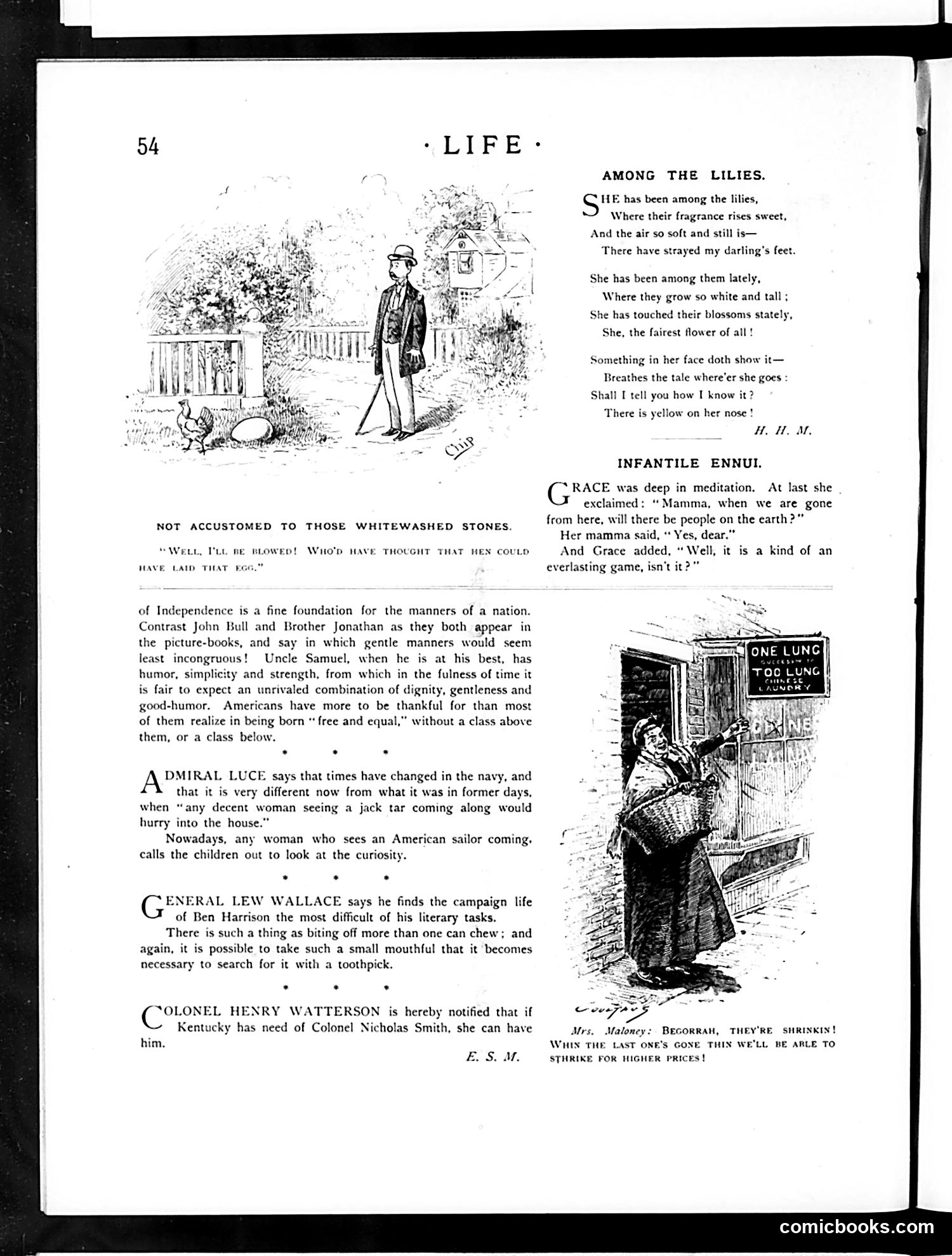
This page contains multiple satirical items typical of 19th-century American humor magazines: **"Among the Lilies"** is a sentimental poem mocking romantic verse—the punchline reveals the beloved has yellow pollen on her nose, deflating the flowery language. **"Infantile Ennui"** presents a child's philosophical observation about eternal human existence as tedious repetition—satire of precocious children and philosophical pretension. **"Not Accustomed to Those Whitewashed Stones"** appears to be a brief joke about eggs, possibly referencing American farm life or British/American cultural differences (John Bull vs. "Brother Jonathan"—period personifications of Britain and America). The text block discusses American character—contrasting John Bull (Britain) favorably with Uncle Samuel (America), praising American egalitarianism and humor. **Other brief items** mock Admiral Luce on changing naval customs, General Lew Wallace's difficulty writing Ben Harrison's biography, and include personal notices about Colonel Watterson and Colonel Nicholas Smith. The **lower cartoon** shows Mrs. Maloney anticipating shrinking immigrant workers will allow striking for higher wages—commentary on labor exploitation and Irish immigration.
📄 Transcribed text from this page (OCR, searchable)
Machine-transcribed from the original scan — historical spelling and the odd misread are preserved.
NOT ACCUSTOMED TO THOSE WHITEWASHED STONES. “Wet, Lt ne BLOowED! Wito'p HAVE THOUGHT THAT HEN COULD HAVE LAID THAT BG! of Independence is a fine foundation for the manners of a nation. Contrast John Bull and Brother Jonathan as they both appear in the picture-books, and say in which gentle manners would seem least incongruous! Uncle Samuel, when he is at his best, has humor, simplicity and strength, from which in the fulness of time it is fair to expect an unrivaled combination of dignity, gentleness and good-humor. Americans have more to be thankful for than most of them realize in being born “free and equal,” without a class above them, or a class below. . . . DMIRAL LUCE says that times have changed in the navy, and that it is very different now from what it was in former days, when “any decent woman seeing a jack tar coming along would hurry into the house.” Nowadays, any woman who sees an American sailor coming. calls the children out to look at the curiosity. G !NERAL LEW WALLACE says he finds the campaign life of Ben Harrison the most difficult of his literary tasks. There is such a thing as biting off more than one can chew; and again, it is possible to take such a small mouthful that it becomes necessary to search for it with a toothpick. . . . “OLONEL HENRY WATTERSON is hereby notified that if Kentucky has need of Colonel Nicholas Smith, she can have him. ELS. M. AMONG THE LILIES. HE has been among the lilies, Where their fragrance rises sweet, And the air so soft and still is— There have strayed my darling’s feet. She has been among them lately, Where they grow so white and tall ; She has touched their blossoms stately, She, the fairest flower of all ! Something in her face doth show it— Breathes the tale where’er she goes : Shall [ tell you how I know it? There is yellow on her nose ! HH M. INFANTILE ENNUI. RACE was deep in meditation. At last she exclaimed: “Mamma, when we are gone from here, will there be people on the earth?” Her mamma said, “* Yes, dear.” And Grace added, “Well, it is a kind of an everlasting game, isn’t it?” Mrs, Maloney: BEGORRAM, THEY'RE SHRINKIN! WHIN THE LAST ONE'S GONE THIN WE'LL BE ARLE TO STHRIKE FOR HIGHER PRICES! comicbooks.com