
Life, 1888-07-26 · page 2 of 14
Life — July 26, 1888 — page 2: what you’re looking at
What you’re looking at
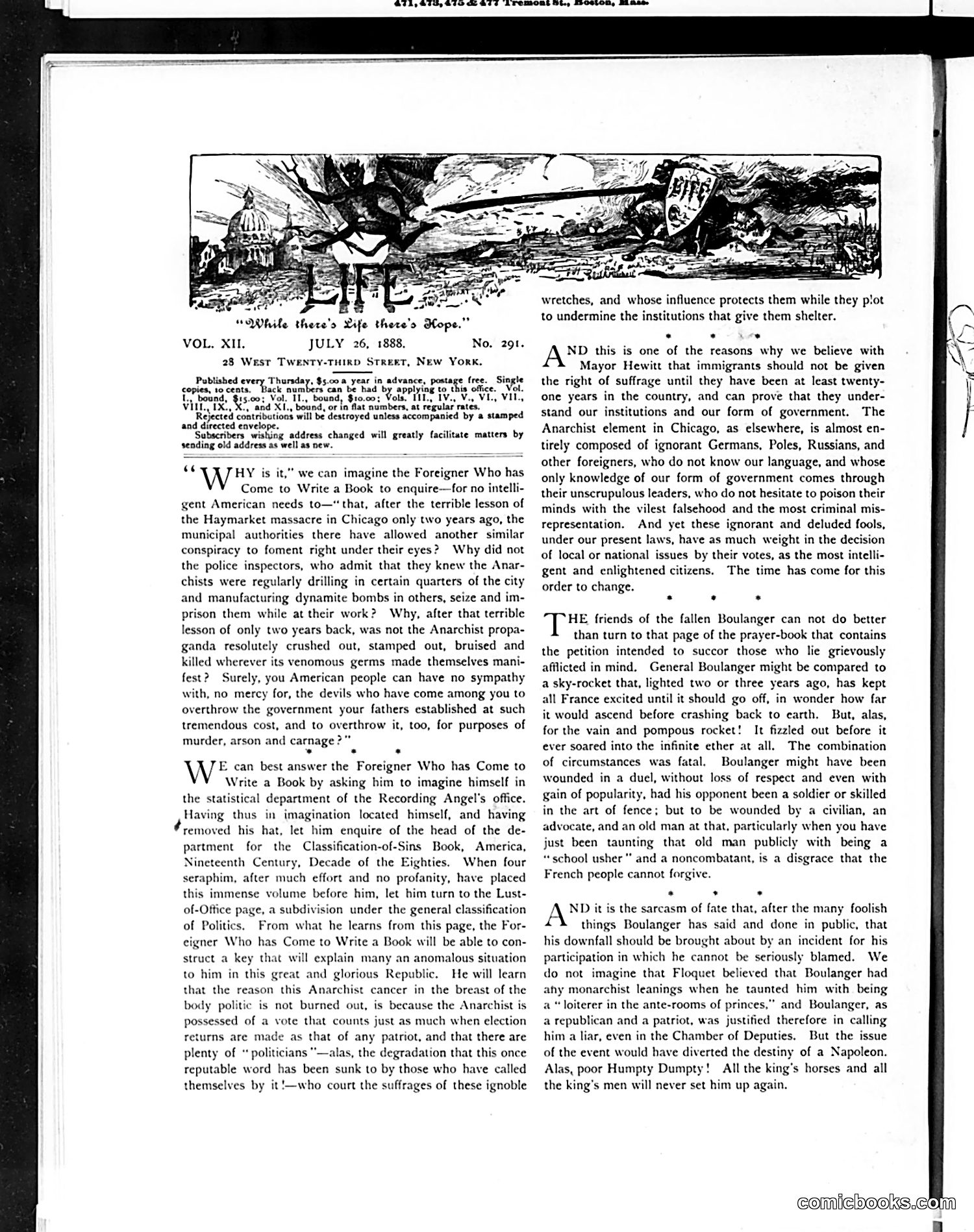
The page features editorial text attacking immigrants and anarchists rather than a traditional cartoon. The banner illustration shows a figure emerging from what appears to be a bomb or explosive device with the caption "Why there's a spy there's a 'Dope.'" The articles argue against giving voting rights to immigrants, specifically targeting anarchists in Chicago. The writers claim foreign-born radicals—described as ignorant Germans, Poles, and Russians—spread dangerous false propaganda that undermines American institutions. The text also mocks General Boulanger, a French political figure, comparing his failed political ambitions to a malfunctioning rocket. The overall message reflects 1880s American nativist anxiety about immigration and radical political movements, particularly in the wake of labor unrest and anarchist activities.
📄 Transcribed text from this page (OCR, searchable)
Machine-transcribed from the original scan — historical spelling and the odd misread are preserved.
Othe “While there's 2ife there's Hope.” VOL. XII. JULY 26, 1888, No. 291. 28 West Twenty-THikp Street, New York. Published every Thursda) soa year year in advance, postage free. Fagen soceats, Back numl in be had by applying ie this office. bound, $15.00; Vol. II., me an $10.00; Vols. IIl., Vs Vi. xX, and XI. bound, or in flat numbers, at paNes rates. Rejected contributions will be destroyed unless accompanied by a stamped and directed envelope. Subscribers wishing address changed will greatly facilitate matters by sending old address as well as new. Single ol. vil, “e HY is it,” we can imagine the Foreigner Who has Come to Write a Book to enquire—for no intelli- gent American needs to—* that, after the terrible lesson of the Haymarket massacre in Chicago only two years ago, the municipal authorities there have allowed another similar conspiracy to foment right under their eyes? Why did not the police inspectors, who admit that they knew the Anar- chists were regularly drilling in certain quarters of the city and manufacturing dynamite bombs in others, seize and im- prison them while at their work? Why, after that terrible lesson of only two years back, was not the Anarchist propa- ganda resolutely crushed out, stamped out, bruised and killed wherever its venomous germs made themselves mani- fest? Surely, you American people can have no sympathy with, no mercy for, the devils who have come among you to overthrow the government your fathers established at such tremendous cost, and to overthrow it, too, for purposes of murder, arson and carnage ? . . . W* can best answer the Foreigner Who has Come to Write a Book by asking him to imagine himself in the statistical department of the Recording Angel's office. Having thus in imagination located himself, and having removed his hat, let him enquire of the head of the de- partment for the Classification-of-Sins Book, America, Nineteenth Century, Decade of the Eighties. When four seraphim, after much effort and no profanity, have placed this immense volume before him, let him turn to the Lust- of-Office page, a subdivision under the general classification of Poli From what he learns from this page, the For- eigner Who has Come to Write a Book will be able to con- struct a key that will explain many an anomalous situation to him in this great and glorious Republic. He will learn that the reason this Anarchist cancer in the breast of the body politic is not burned out, is because the Anarchist is possessed of a vote that counts just as much when election returns are made as that of any patriot, and that there are plenty of “politicians "—alas, the degradation that this once reputable word has been sunk to by those who have called themselves by it!—who court the suffrages of these ignoble SON SESS ace aeenem wretches, and whose influence protects them while they plot to undermine the institutions that give them shelter. . . . ND this is one of the reasons why we believe with Mayor Hewitt that immigrants should not be given the right of suffrage until they have been at least twenty- one years in the country, and can prove that they under- stand our institutions and our form of government. The Anarchist element in Chicago, as elsewhere, is almost en- tirely composed of ignorant Germans, Poles, Russians, and other foreigners, who do not know our language, and whose only knowledge of our form of government comes through their unscrupulous leaders, who do not hesitate to poison their minds with the vilest falsehood and the most criminal mis- representation. And yet these ignorant and deluded fools, under our present laws, have as much weight in the decision of local or national issues by their votes, as the most intelli- gent and enlightened citizens. The time has come for this order to change. . . HE friends of the fallen Boulanger can not do better than turn to that page of the prayer-book that contains the petition intended to succor those who lie grievously afflicted in mind, General Boulanger might be compared to a sky-rocket that, lighted two or three years ago, has kept all France excited until it should go off, in wonder how far it would ascend before crashing back to earth. But, alas, for the vain and pompous rocket! It fizzled out before it ever soared into the infinite ether at all. The combination of circumstances was fatal. Boulanger might have been wounded in a duel, without loss of respect and even with gain of popularity, had his opponent been a soldier or skilled in the art of fence; but to be wounded by a civilian, an advocate, and an old man at that, particularly when you have just been taunting that old man publicly with being a “school usher" and a noncombatant, is a disgrace that the French people cannot forgiv ND it is the sarcasm of fate that, after the many foolish things Boulanger has said and done in public, that his downfall should be brought about by an incident for his participation in which he cannot be seriously blamed. We do not imagine that Floquet believed that Boulanger had ahy monarchist leanings when he taunted him with being loiterer in the ante-rooms of princes,” and Boulanger, as a republican and a patriot, was justified therefore in calling him a liar, even in the Chamber of Deputies. But the issue of the event would have diverted the destiny of a Napoleon. Alas, poor Humpty Dumpty! All the king’s horses and all the king’s men will never set him up again. comichooks.