
A complete issue · 16 pages · 1888
Life — June 7, 1888
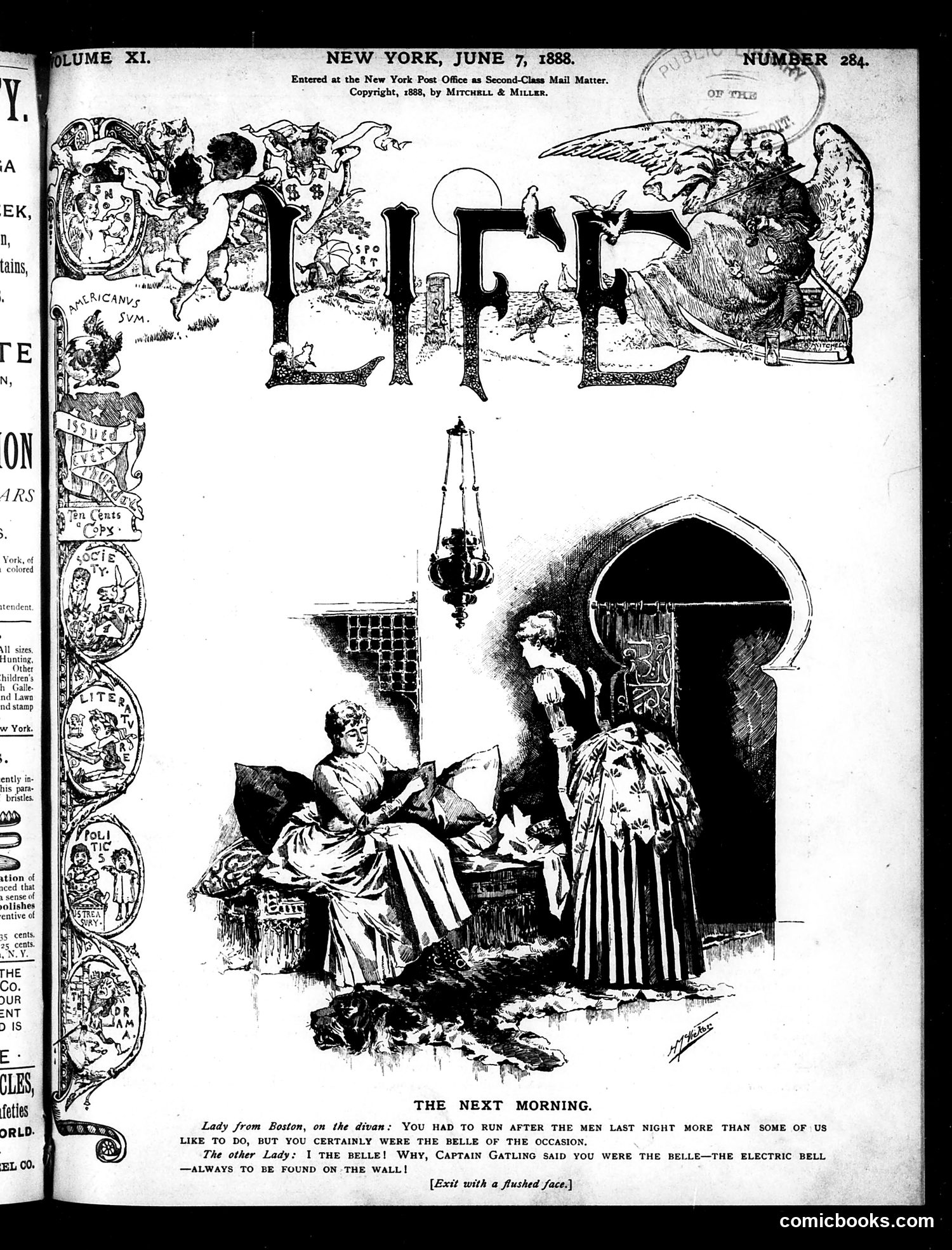
This satirical cartoon depicts a domestic scene with two women confronting each other. The caption reveals a joke about an "electric bell" — a newfangled technology of the 1880s. A visiting lady from Boston claims she "had to run after the men last night more than some of us like to do," complimenting the hostess as "the belle of the occasion." The other woman corrects her, saying Captain Gatling told her she was "the belle — the *electric* bell — always to be found on the wall." The humor plays on the double meaning of "belle" (a beautiful woman) versus "bell" (the device). It's a gentle jab at the hostess, suggesting she was as immobile and wall-bound as an electric bell during the evening's social gathering—essentially a wallflower, despite her hosting duties.
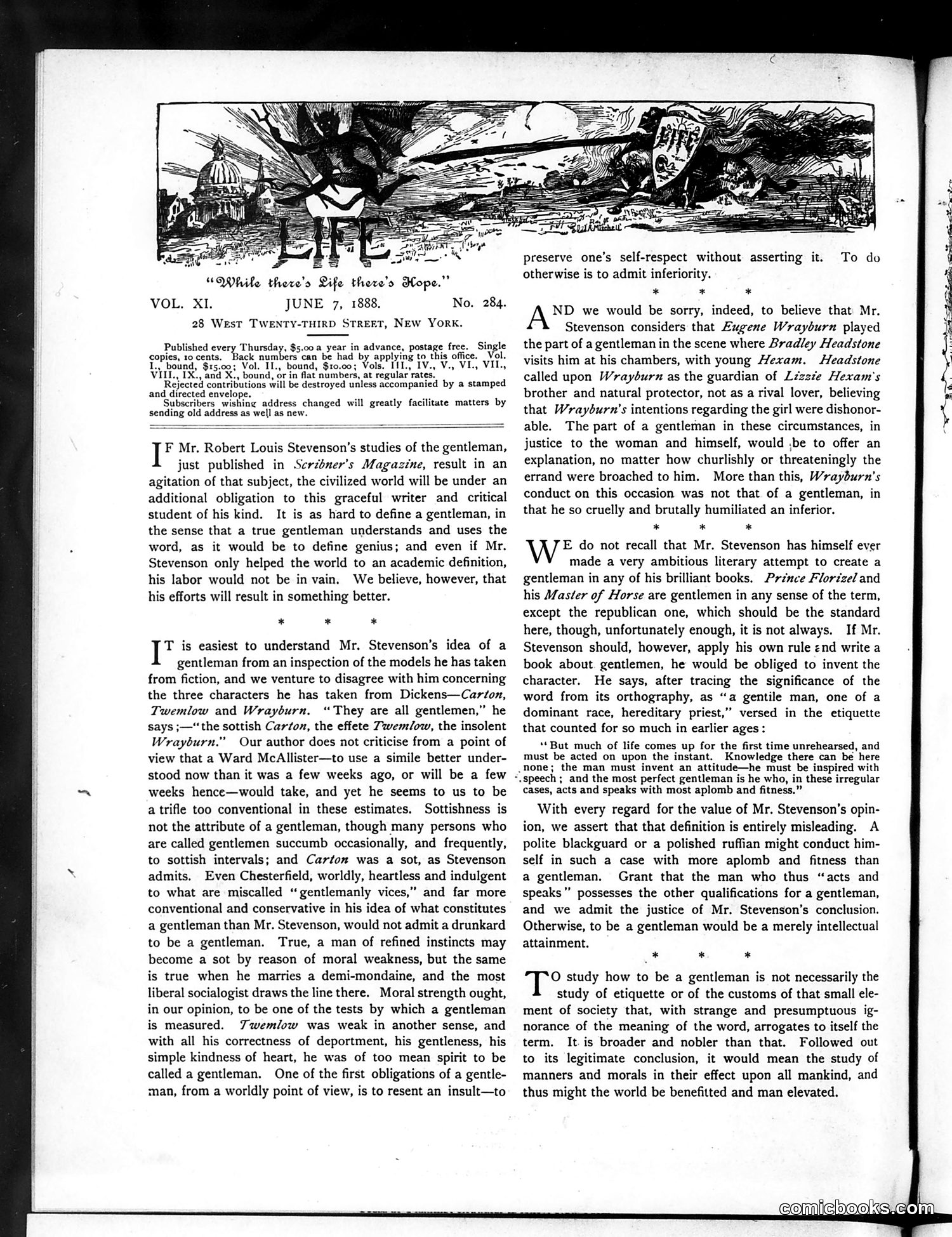
The masthead illustration depicts a dramatic scene with classical and contemporary elements—a domed building (likely St. Paul's Cathedral, London), a shipwreck, and turbulent skies, all rendered in expressive woodcut style. The article discusses Robert Louis Stevenson's literary treatment of "gentlemen" in his fiction, particularly examining characters like Bradley Headstone (*Our Mutual Friend*) and Wrayburn. The satire critiques Stevenson's definition of gentlemanly conduct, arguing that true gentlemanliness requires more than intellectual refinement—it demands moral strength, dignity, and the ability to resent insult. The piece suggests Stevenson's working-class or morally compromised characters fail this standard, satirizing both the author's social assumptions and Victorian definitions of class virtue.
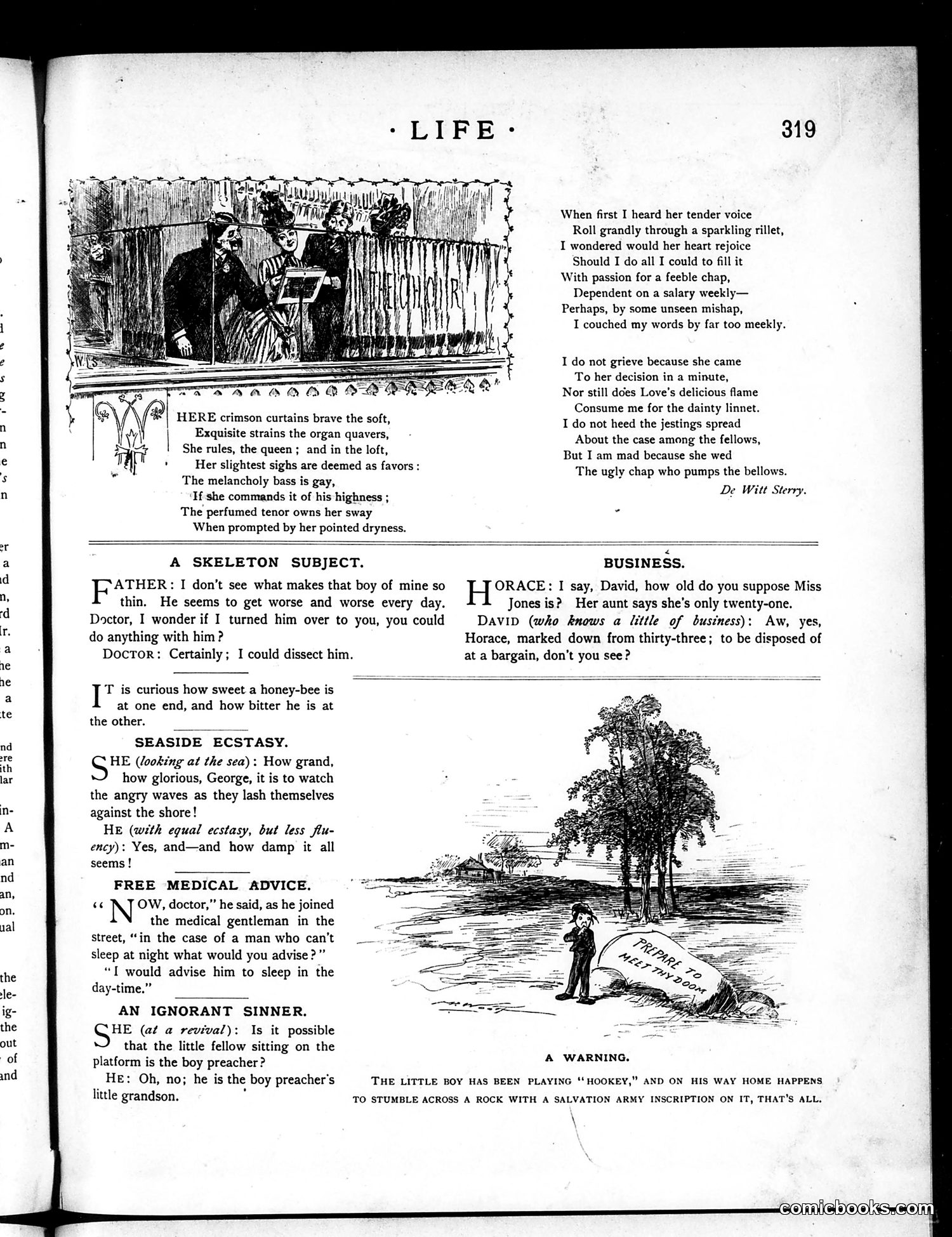
This page contains humorous sketches and short comedic pieces typical of early Life magazine's satirical format. The content includes: **"A Skeleton Subject"**: A dialogue between a father and doctor about the father's thin son, using the "skeleton" metaphor for an extremely skinny person—a common Victorian-era joke about malnutrition or poor health. **"Seaside Ecstasy"**: A man and woman observe ocean waves with exaggerated romantic language, satirizing sentimental seaside romance literature. **"Free Medical Advice"** and **"An Ignorant Sinner"**: Brief comedic vignettes about social situations. **"A Warning"** (illustration): Shows a figure near a rock marked "Salvation Army," satirizing the organization in a way now obscure. The page demonstrates Life's satirical approach to everyday social conventions and contemporary institutions through light humor rather than sharp political commentary.
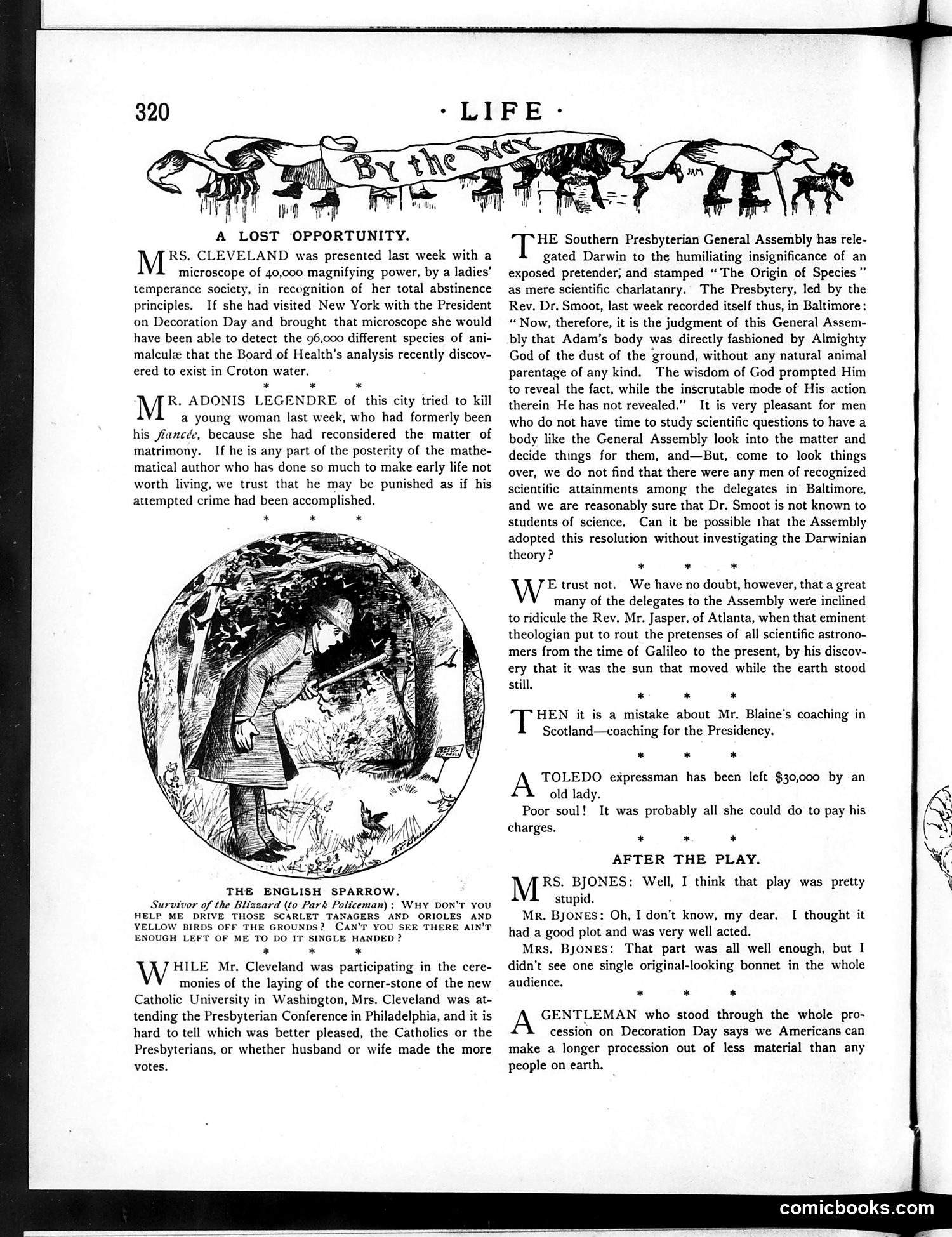
The main cartoon depicts a man in Victorian dress standing inside what appears to be a cave or hollow structure, looking distressed. The title "THE ENGLISH SPARROW" references the caption below, which identifies him as "Survivor of the Blizzard (a Park Policeman)." The satire mocks the English sparrow (house sparrow) population in American parks, which had become an invasive pest by this era. The cartoon appears to joke that the birds are so numerous and aggressive that a park policeman has been driven to shelter in a cave to escape them—suggesting the sparrow problem had reached absurd, overwhelming proportions in urban areas. This reflects genuine 19th-century American frustration with the unintended consequences of introducing this European species.
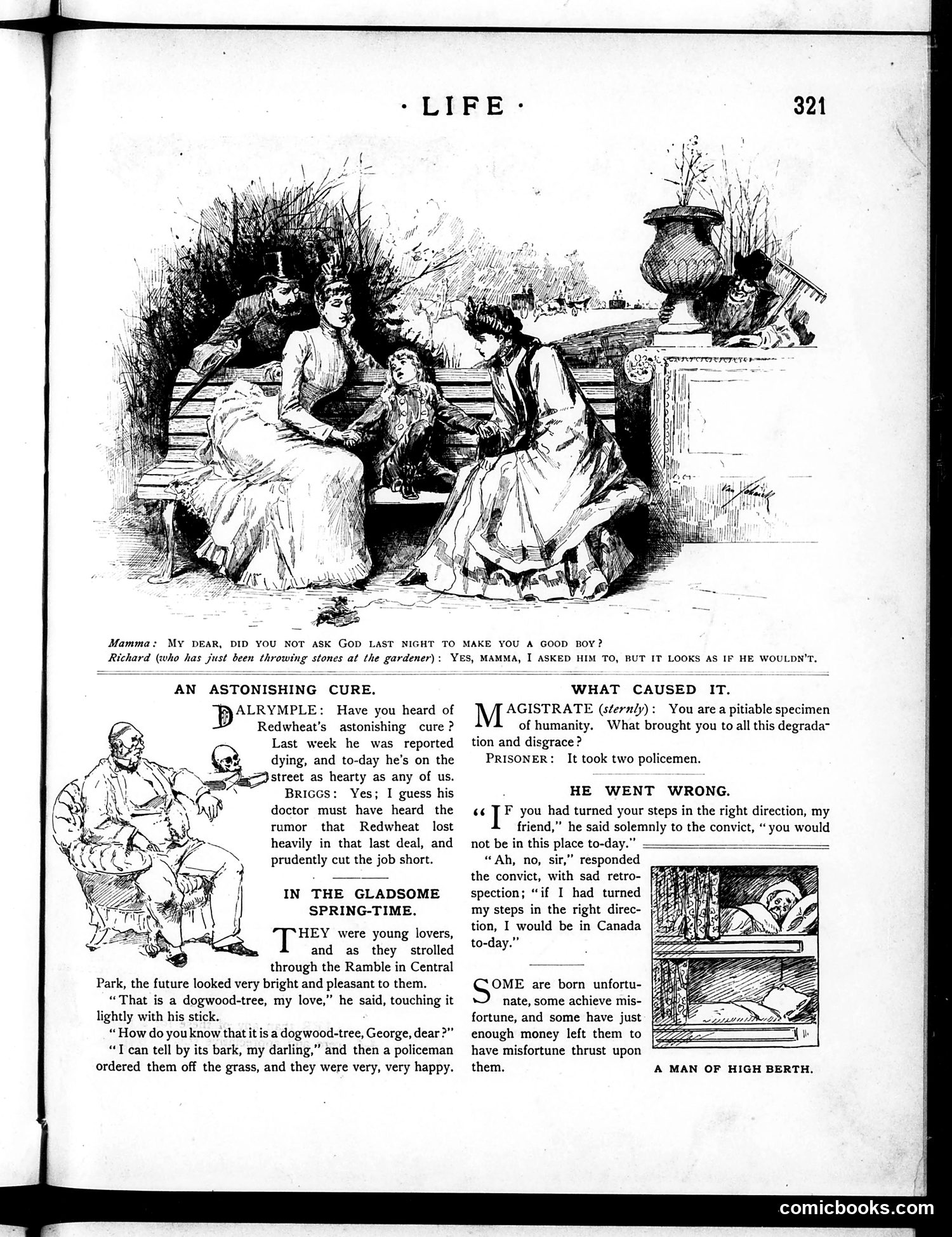
This page contains three separate satirical items typical of Life's humor: 1. **Top illustration**: A domestic scene where a mother asks her son Richard if he prayed to be good; he admits asking God to make him "not get caught." It's gentle satire on childhood hypocrisy. 2. **"An Astonishing Cure"**: A doctor anecdote where Dalrymple and Briggs discuss a patient (Redwheat) who recovered remarkably after his doctor heard he'd lost heavily in a business deal. The joke: financial loss motivated recovery better than medicine. 3. **"In the Gladsome Spring-Time"**: A romantic vignette about young lovers strolling through Central Park, interrupted by police ordering them off the grass—satirizing how authorities intrude on innocent pleasure. The page reflects turn-of-century American middle-class humor emphasizing irony and gentle social commentary.
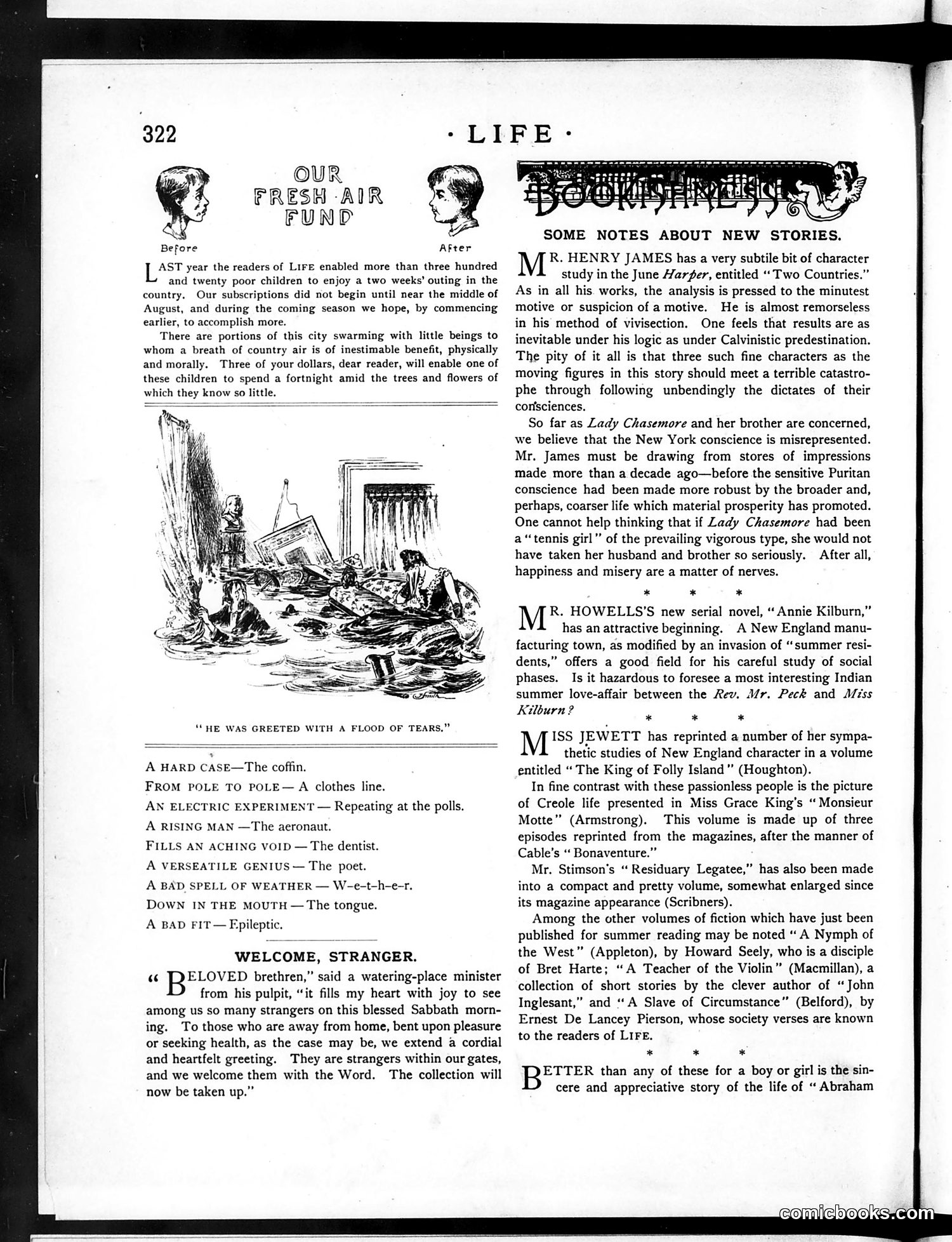
This page contains literary criticism rather than political satire. The main content discusses Henry James's story "Two Countries," praising his subtle character analysis while noting his deterministic worldview makes characters seem trapped by circumstance. The critic suggests James may be drawing on outdated impressions of New York society from over a decade prior. The page also reviews other contemporary fiction: H.G. Wells's "Annie Kilburn," Miss Jewett's New England stories, and works by Simson and others. The illustration at left shows figures in what appears to be an impoverished urban setting—likely illustrating themes of hardship discussed in the Fresh Air Fund section at top, which describes providing country outings for poor city children. The small definitions at bottom are humorous wordplay rather than satire.
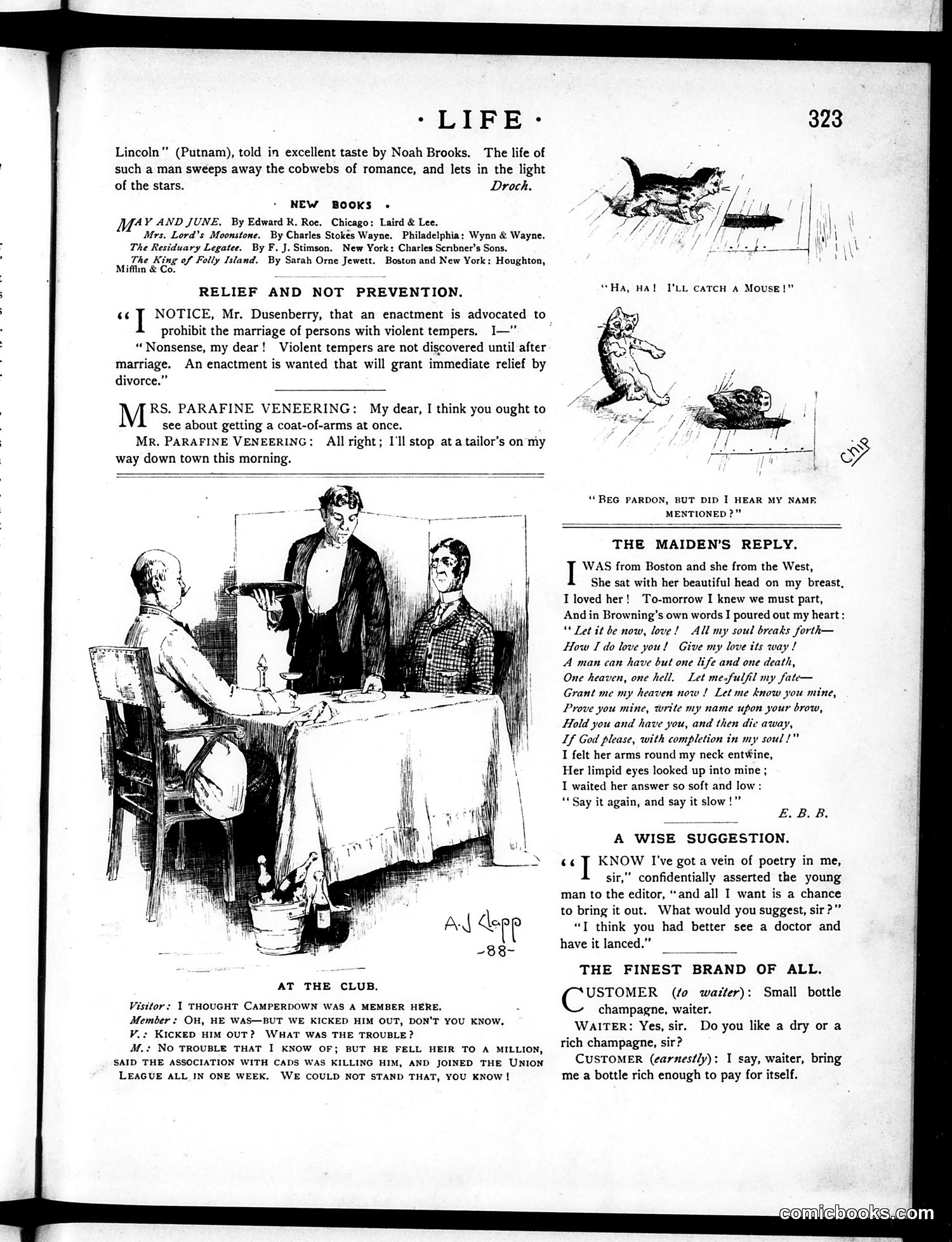
This page contains several satirical vignettes typical of Life magazine's humor: **"Relief and Not Prevention"** mocks proposed marriage legislation. The joke contrasts a man advocating laws to prevent violent-tempered marriages with a woman noting temperament only becomes apparent after marriage—making prevention impossible. The satire targets legislative overreach on personal matters. **"At the Club"** depicts a visitor surprised to learn a member was recently kicked out and later rejoined. The humor stems from the contradiction: he inherited wealth, making the association simultaneously reject and accept him—satirizing how money overrides principle in exclusive clubs. The remaining pieces are shorter humorous anecdotes and a dialogue about champagne. The overall page reflects early-20th-century satirical commentary on class, marriage, and social hypocrisy among the affluent.
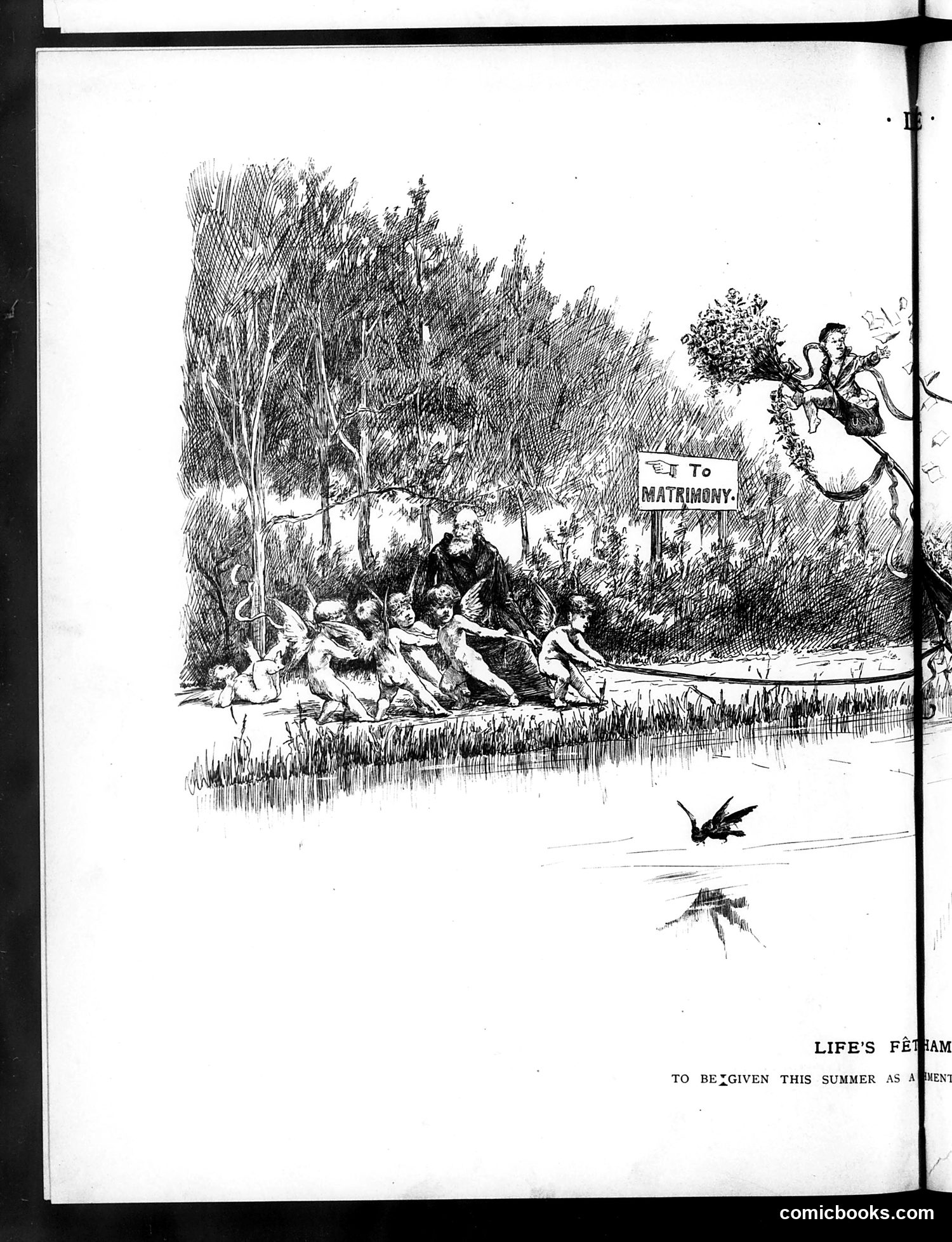
This illustration satirizes the institution of matrimony using a riverside scene. A man in dark clothing is surrounded by several cherub-like figures (Cupids) pulling at him from different directions, while a sign reading "TO MATRIMONY" points toward the densely wooded area ahead. A figure in the upper right flies away carrying what appears to be a plant or wreath. The satire depicts marriage as an inescapable force—the cherubs represent romantic/amorous pressure literally dragging the reluctant male figure toward the matrimonial destination. The dense forest symbolizes the unknown depths of married life awaiting him. The accompanying text fragment mentions "LIFE'S FETRAM" and references something "TO BE GIVEN THIS SUMMER AS A[...]" suggesting this is part of a broader editorial commentary on marriage, likely from an early 20th-century *Life* magazine.
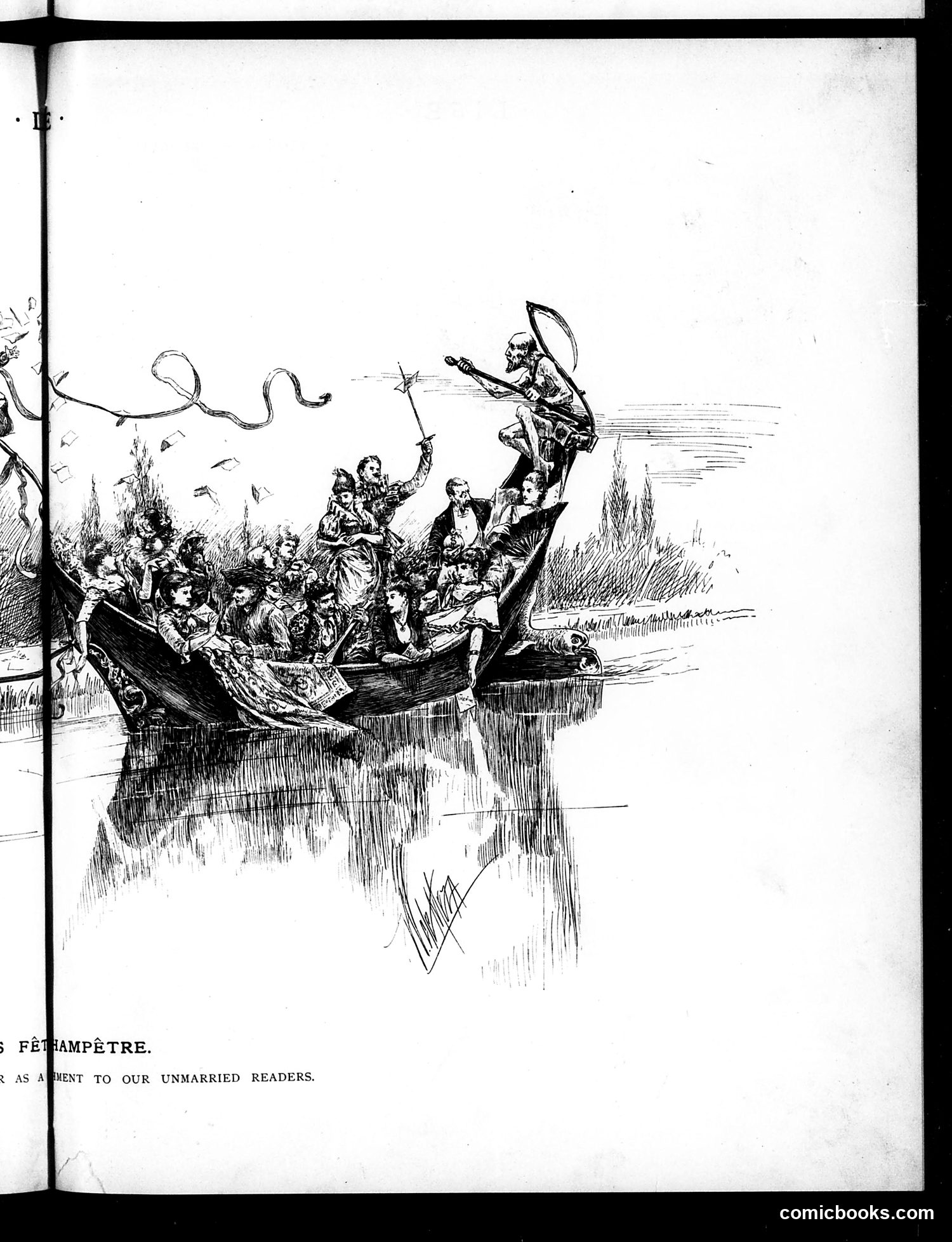
This is a satirical illustration depicting a gondola in Venice filled with numerous passengers. The text reference mentions "FÊTEMPÊTRE" (likely "FÊTE TEMPÊTE" - a festival or storm) and references "UNMARRIED READERS." The cartoon appears to be social satire about courtship or romantic entanglements, suggesting the gondola represents a romantic or social situation. The crowded boat with many figures—some appearing to be couples or mixed company—likely mocks the chaos of romantic pursuits or social mixing. The specific historical or political references remain unclear without additional context. The style and composition suggest this is commentary on Victorian-era social customs, possibly satirizing how unmarried people navigated social gatherings or romantic conventions of the period. The artist's signature appears in the lower left corner.
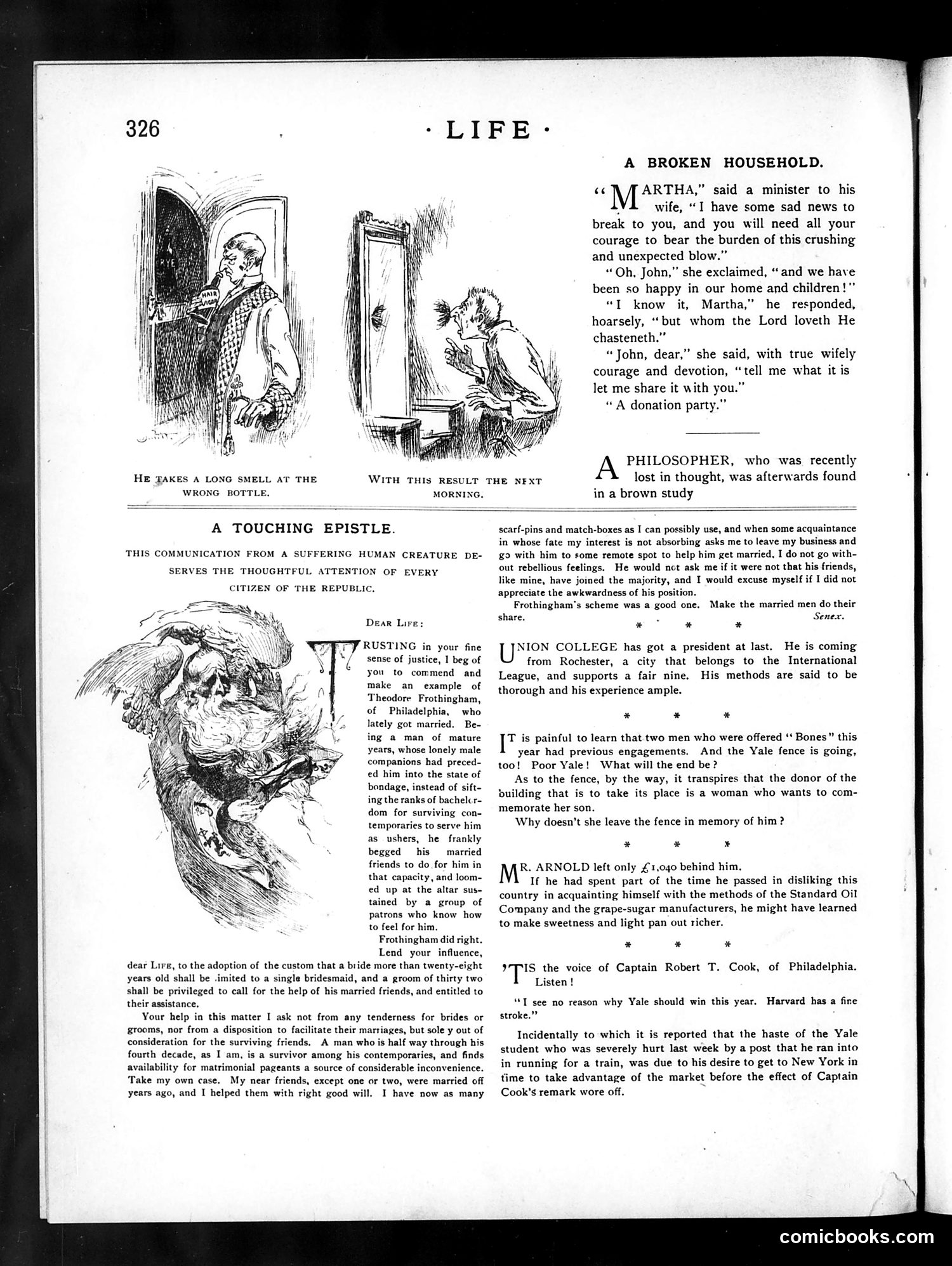
This page contains three separate satirical pieces: 1. **"A Broken Household"** (top): A minister delivers bad news to a wife about her husband. The satire appears to mock domestic discord and religious platitudes about suffering. 2. **"A Touching Epistle"** (center): Features an illustration of a disheveled man. The accompanying letter discusses a "sufferer" seeking advice about a lonely male companion and questions about bachelor customs versus marriage. The satire seems to critique Victorian social conventions around marriage and bachelorhood. 3. **Various brief commentary pieces** (bottom right): Include references to Union College's new president, Yale sports rivalries, and Captain Robert T. Cook's boating incident in Philadelphia. These appear to be society gossip and institutional humor typical of Life's satirical coverage. The overall tone is genteel mockery of upper-class social situations and conventions.
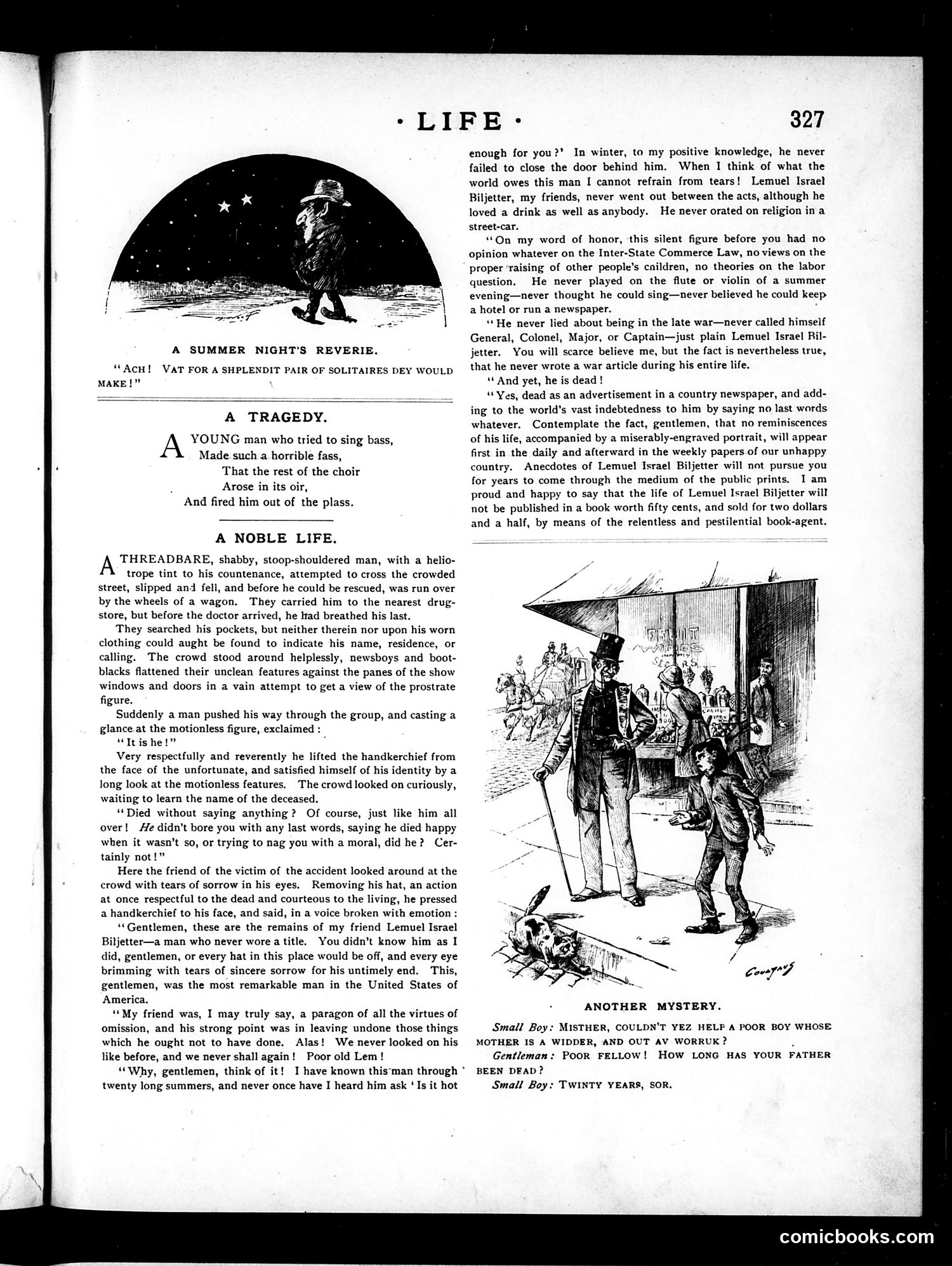
This page contains three pieces of humor, with the main focus on "A Noble Life," a mock eulogy for Lemuel Israel Biljetter. The satire targets American social pretension and annoying public behavior of the era. Biljetter's "remarkable" qualities are entirely *negative*—he never complained about weather, never gossiped about the Interstate Commerce Law, never played musical instruments badly, never exaggerated war service, never self-aggrandized with military titles. The speaker praises him effusively for doing *nothing* noteworthy. This mocks contemporary Americans' tendency toward boastfulness, unsolicited opinions, and public nuisance-making. The joke: a man's greatest virtue is absolute passivity and silence. The extended eulogy treating this non-achievement as exceptional satirizes how readily people offer grandiose tributes and how little substance often underlies them. The other pieces—"A Tragedy" (bad singer fired from choir) and "A Summer Night's Reverie" (Yiddish-accented figure eyeing jewelry)—are brief comic verses unrelated to the main satire.
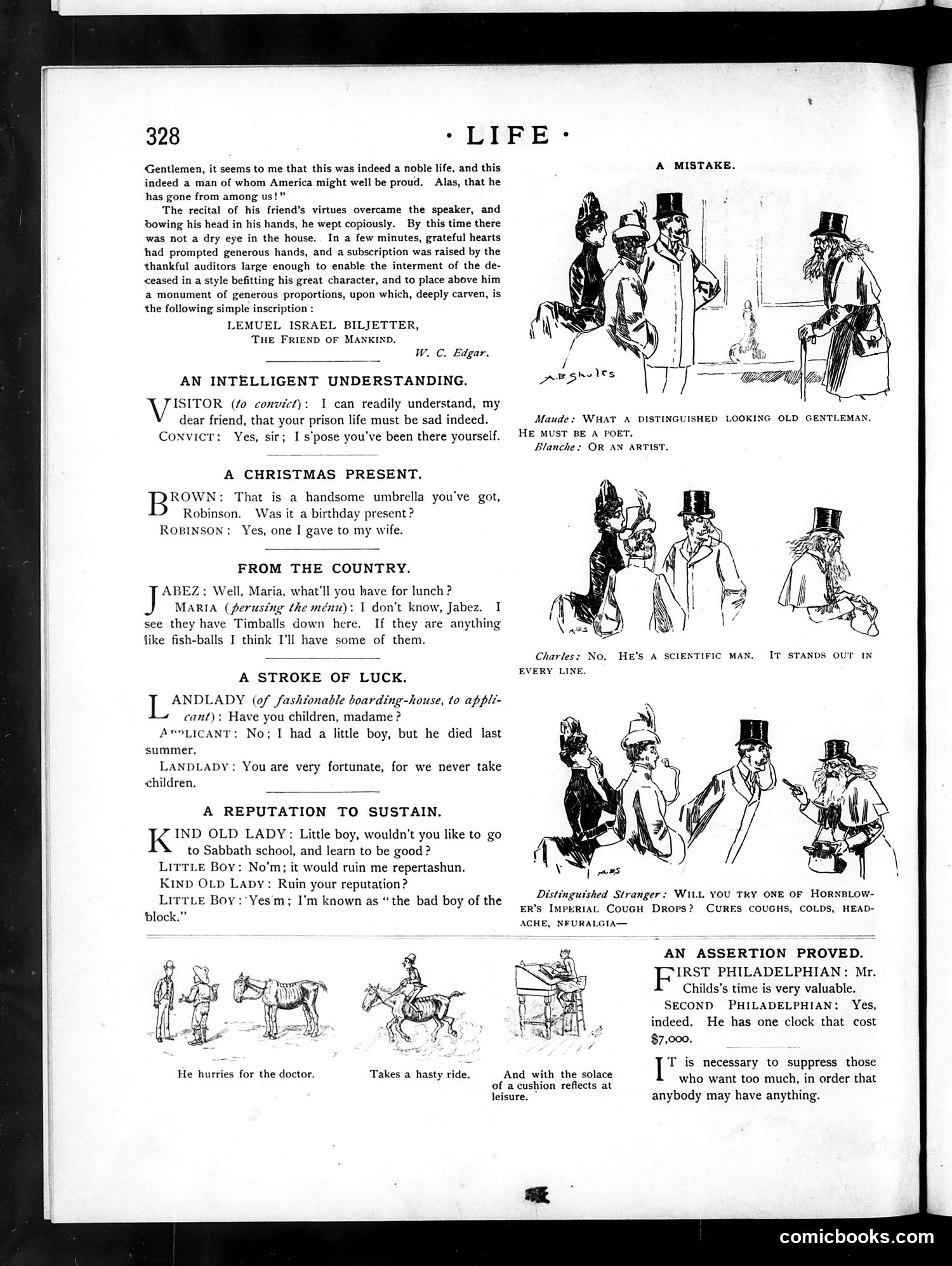
This page from *Life* contains multiple short humor sketches satirizing American social pretense and hypocrisy: **"A Mistake"** depicts two well-dressed women mistaking a distinguished gentleman for a poet or artist—the joke being their superficial class assumptions. **"An Intelligent Understanding"** shows a prison visitor claiming he's "supposed" the convict was imprisoned, implying the visitor himself is imprisoned—self-incriminating irony. **"A Christmas Present"** jokes on marital gift-giving: Robinson gave his wife an umbrella as a birthday gift, suggesting either stinginess or marital tension. **"From the Country"** mocks rural ignorance: Maria confuses "timbales" (a drum or cooking dish) with "fish-balls." **"A Stroke of Luck"** darkly satirizes landlady callousness—she considers losing a child fortunate because boarding houses reject families with children. **"A Reputation to Sustain"** shows a boy resistant to Sunday school because his reputation as "the bad boy of the block" requires maintaining his image. The final sketches mock Philadelphia materialism and economic inequality. Throughout, the humor targets Victorian hypocrisy, class pretension, and human absurdity.
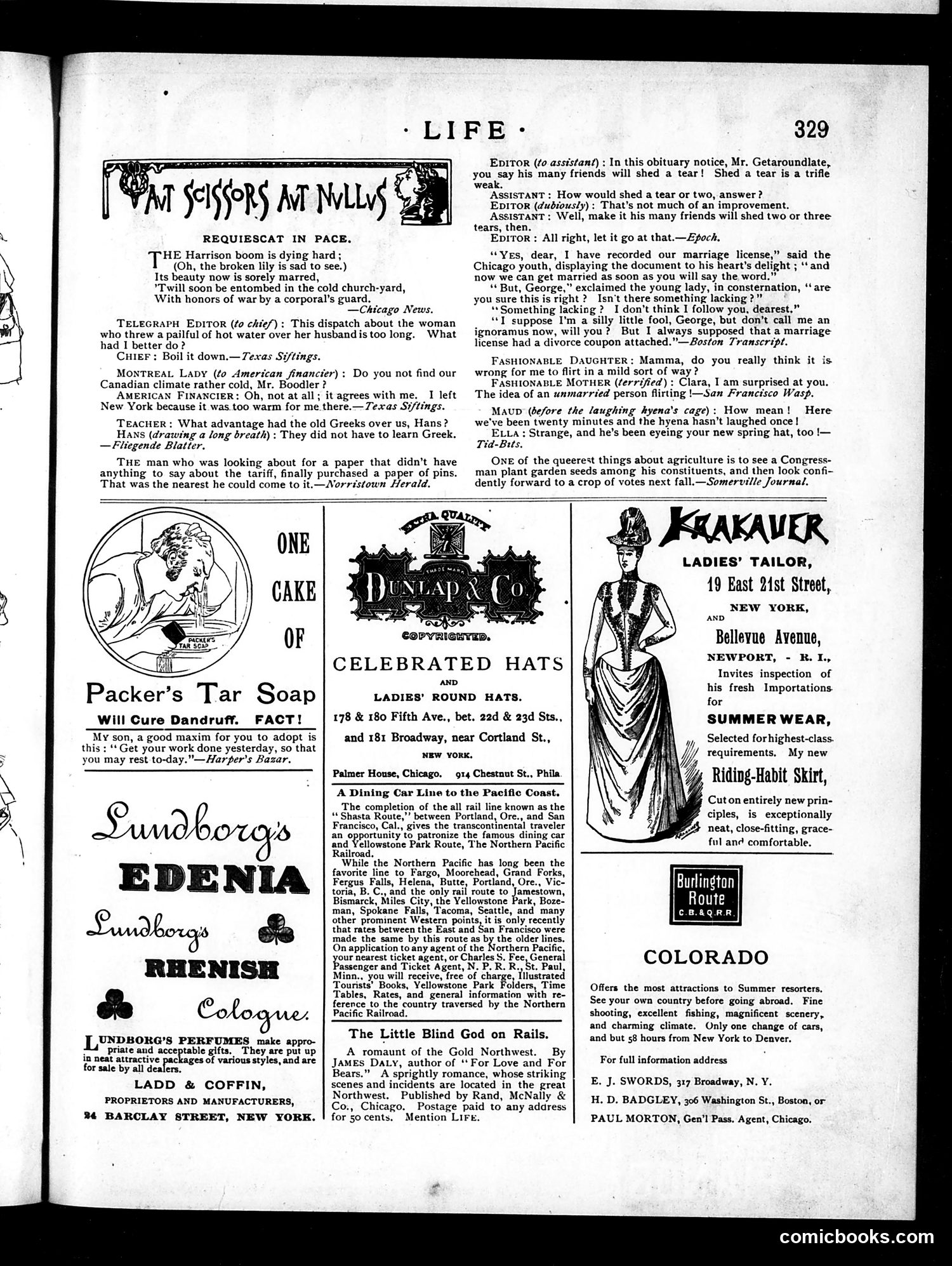
This is primarily an **advertising page** from Life magazine's satirical section. The top contains several short humor pieces rather than political cartoons, most poking fun at mundane situations: - **"Requiescat in Peace"** addresses the dying Harrison boom (likely the presidential campaign of William Henry Harrison), comparing it to a funeral - Various jokes mock newspaper editors, tariff debates, marriage bureaucracy, and flirting etiquette - One piece **satirizes congressmen** as agricultural con artists—they plant metaphorical seeds among constituents expecting to harvest votes, suggesting cynical campaigning The page is dominated by **period advertisements**: Dunlap hats, Lindborg's perfumes, Packer's Tar Soap, Krakauer ladies' tailoring, and railroad promotions. The humor is gentle workplace/domestic satire typical of Life's era, not hard-hitting political commentary. The Harrison reference appears to be the only direct political content, treating electoral politics as another mundane topic for light ridicule.
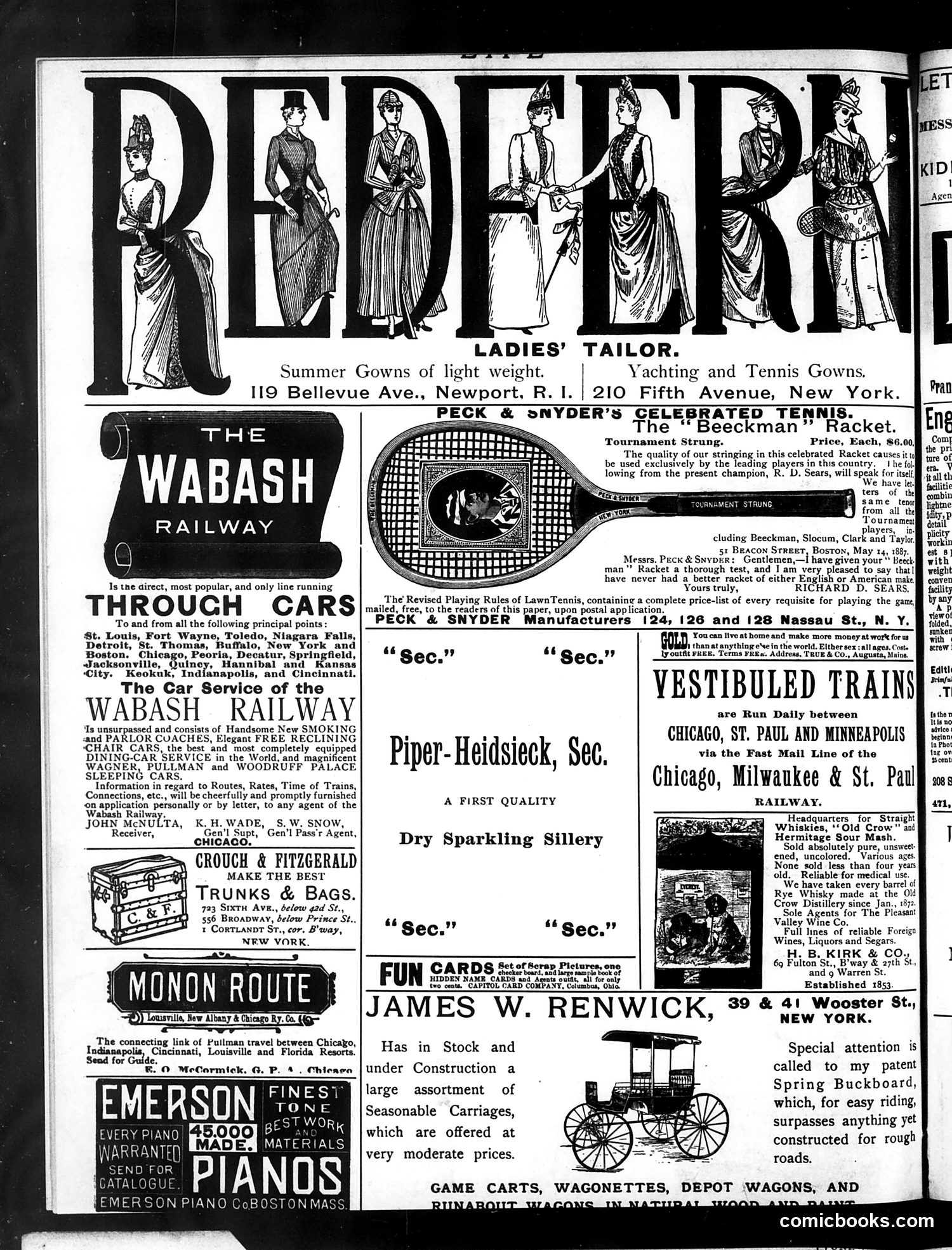
This page is **primarily advertising**, not satirical political content. It's from an era when *Life* magazine mixed editorial material with paid advertisements. The large decorative header spelling "PEDDERY" uses illustrated female figures in period dress to frame fashion and lifestyle advertisements—a common Victorian design technique. The businesses advertised reflect 1880s leisure-class concerns: ladies' tailors, railway travel (the Wabash Railway prominently featured), sporting goods (tennis rackets by Peck & Snyder, endorsed by champion R.D. Sears), luxury items (champagne, whiskey), and transportation (carriages, trunks). **The social context**: This targets wealthy readers with disposable income for travel, fashionable clothing, and leisure pursuits like tennis and yachting. The "Beeckman Racket" advertisement even includes a celebrity endorsement from the current tennis champion—an early example of sports marketing. There is no discernible political satire or cartoon here; it's a commercial page reflecting Gilded Age consumer culture.
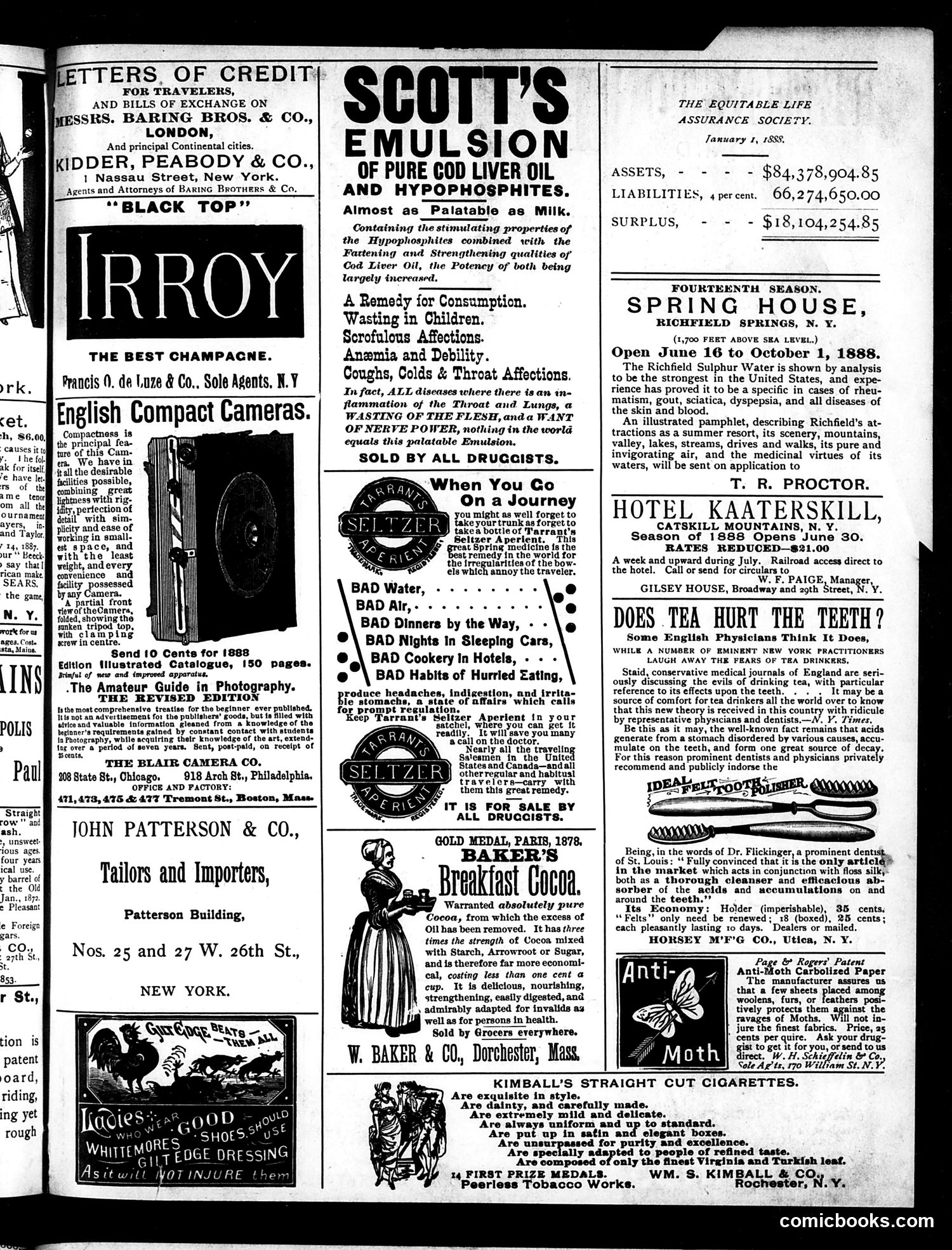
This page is primarily advertisements, not editorial content or satire. The main items include: **Scott's Emulsion** (prominently featured): A patent medicine combining cod liver oil and hypophosphites, marketed as a cure-all for consumption, wasting, scrofulous conditions, and throat ailments. Like most 1880s remedies, such claims would be unsubstantiated by modern standards. **Other ads** include Tarrant's Seltzer Aperient (a travel laxative), Baker's Breakfast Cocoa, and Kimball's Cigars—all typical commercial advertisements. **One illustrated ad** (bottom left) shows "Ladies' Good Shoes" with text emphasizing they won't "injure them"—reflecting contemporary concerns about footwear. The page represents *Life* magazine's advertising content from January 1888, reflecting the era's patent medicine marketing and consumer products. There is no political cartoon or satire visible here.
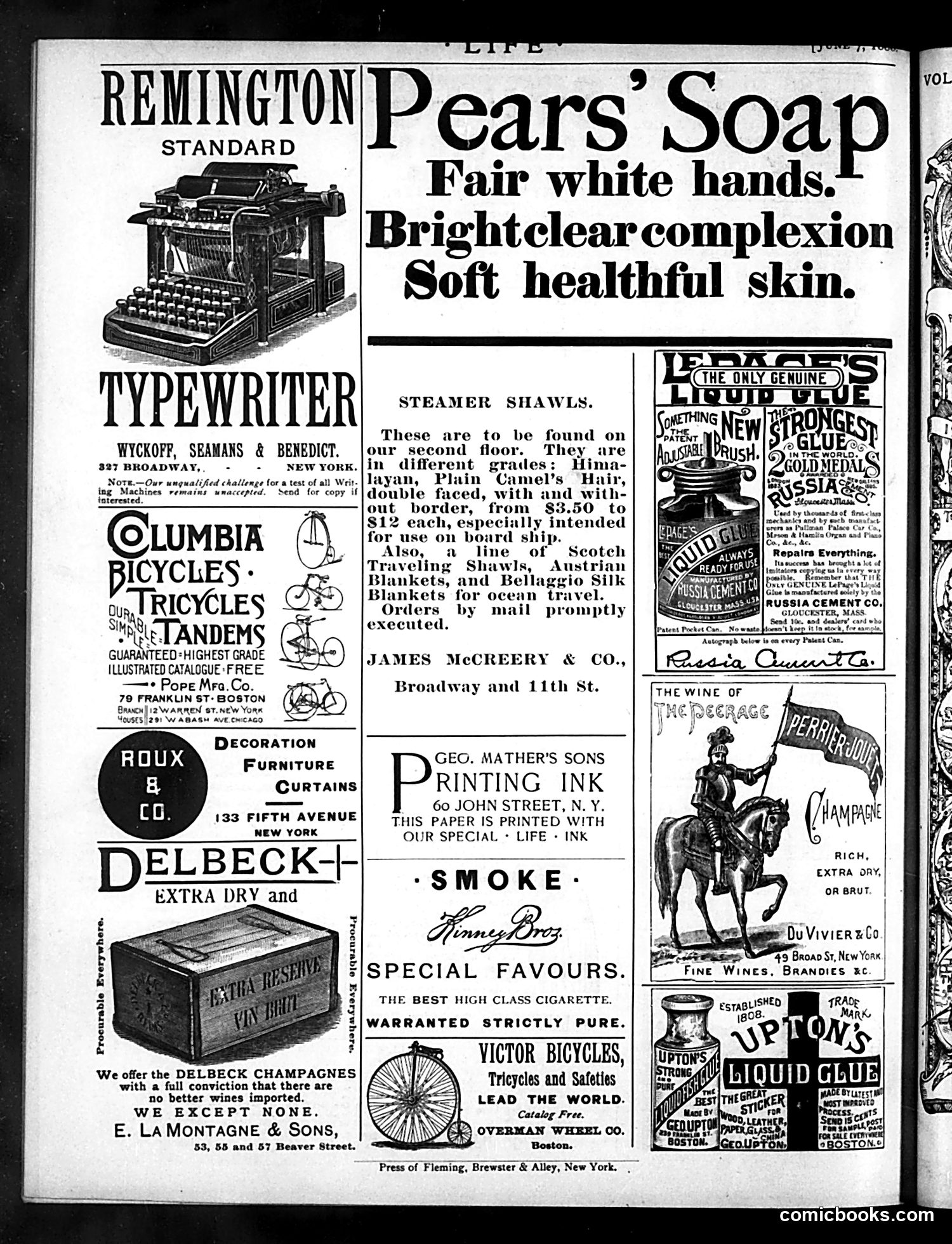
This is primarily an **advertising page** from Life magazine, not a satirical cartoon page. It contains roughly a dozen period product advertisements typical of the late 19th century. Notable ads include: - **Remington Typewriter** (top left): promoting their writing machines with a challenge to competitors - **Columbia Bicycles**: advertising bicycles, tricycles, and tandems - **Pears' Soap** (top right): using language about "fair white hands" and "bright clear complexion" that reflects period beauty standards - **Delbeck Champagne** and **Perrier-Jouet Smoke Champagne**: luxury beverages - **Victor Bicycles**: claiming to "lead the world" - **Various other products**: including Upton's Liquid Glue, Russia Cement, and champagne The page shows **no political satire or editorial cartoons**—it's a straightforward commercial product showcase, illustrative of 1890s American consumer marketing and the products considered desirable among wealthy readers.