
Life, 1888-06-07 · page 6 of 16
Life — June 7, 1888 — page 6: what you’re looking at
What you’re looking at
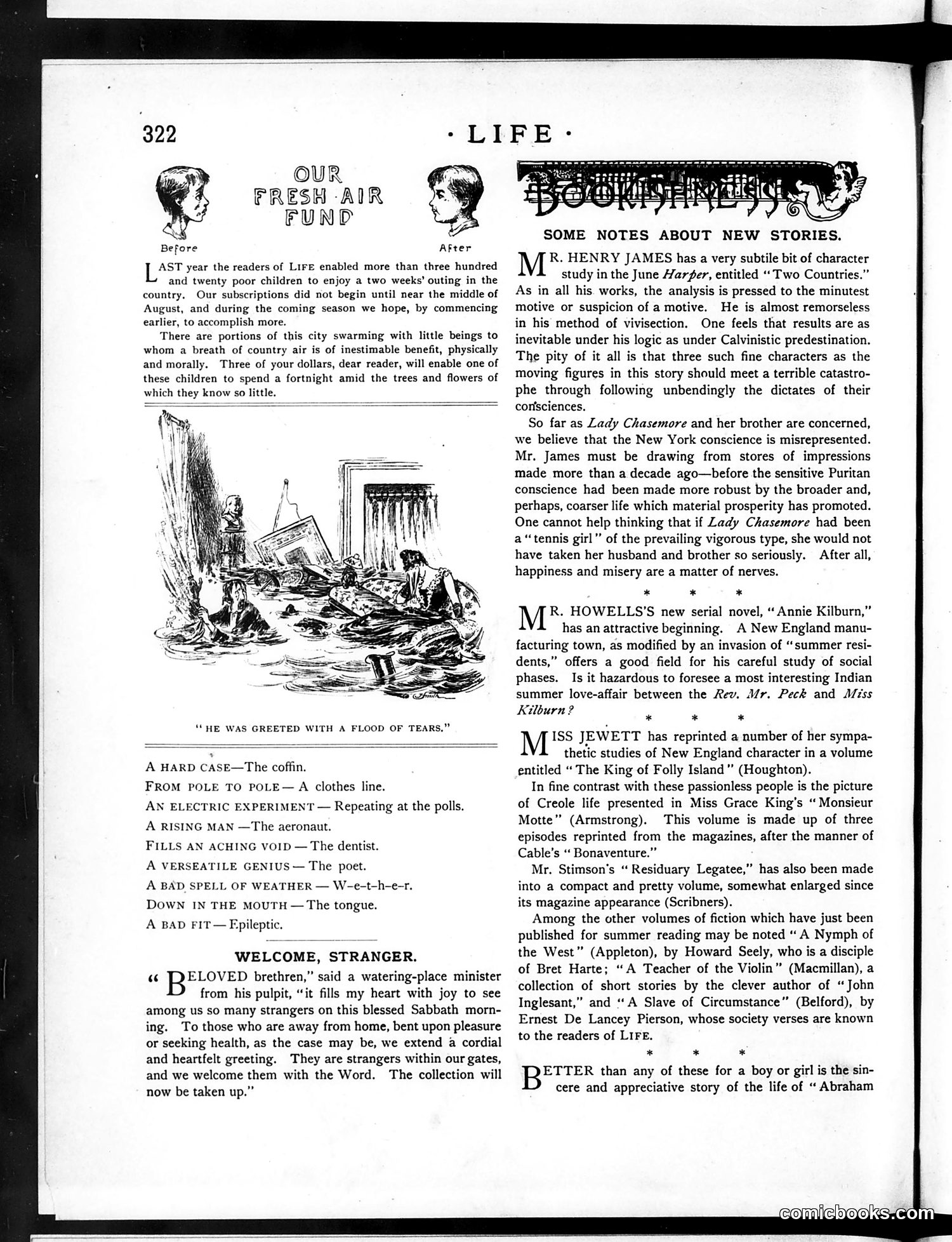
This page contains literary criticism rather than political satire. The main content discusses Henry James's story "Two Countries," praising his subtle character analysis while noting his deterministic worldview makes characters seem trapped by circumstance. The critic suggests James may be drawing on outdated impressions of New York society from over a decade prior. The page also reviews other contemporary fiction: H.G. Wells's "Annie Kilburn," Miss Jewett's New England stories, and works by Simson and others. The illustration at left shows figures in what appears to be an impoverished urban setting—likely illustrating themes of hardship discussed in the Fresh Air Fund section at top, which describes providing country outings for poor city children. The small definitions at bottom are humorous wordplay rather than satire.
📄 Transcribed text from this page (OCR, searchable)
Machine-transcribed from the original scan — historical spelling and the odd misread are preserved.
OUR FRESH AIR FUND Before After LAS year the readers of Lire enabled more than three hundred and twenty poor children to enjoy a two weeks’ outing in the country. Our subscriptions did not begin until near the middle of August, and during the coming season we hope, by commencing earlier, to accomplish more. There are portions of this city swarming with little beings to whom a breath of country air is of inestimable benefit, physically and morally. Three of your dollars, dear reader, will enable one of these children to spend a fortnight amid the trees and flowers of which they know so little. ‘HE WAS GREETED WITH A FLOOD OF TEARS.” A HARD CASE—The coffin. FROM POLE TO POLE— A clothes line. AN ELECTRIC EXPERIMENT — Repeating at the polls. A RISING MAN —The aeronaut. FILLS AN ACHING VOID — The dentist. A VERSEATILE GENIUS — The poet. A BAD SPELL OF WEATHER — W-e-t-h-e-r. DOWN IN THE MOUTH — The tongue. A BAD FIT— Fpileptic, WELCOME, STRANGER. “ ELOVED brethren,” said a watering-place minister from his pulpit, “it fills my heart with joy to see among us so many strangers on this blessed Sabbath morn- ing. To those who are away from home, bent upon pleasure or seeking health, as the case may be, we extend a cordial and heartfelt greeting. They are strangers within our gates, and we welcome them with the Word. The collection will now be taken up.” SOME NOTES ABOUT NEW STORIES. R. HENRY JAMES has a very subtile bit of charact: study in the June Harer, entitled “Two Countri As in all his. works, the analysis is pressed to the minutest motive or suspicion of a motive. He is almost remorseless in his method of vivisection. One feels that results are as inevitable under his logic as under Calvinistic predestination. The pity of it all is that three such fine characters as the moving figures in this story should meet a terrible catastro- phe through following unbendingly the dictates of their corisciences. So far as Lady Chasemore and her brother are concerned, we believe that the New York conscience is misrepresented. Mr. James must be drawing from stores of impressions made more than a decade ago—before the sensitive Puritan conscience had been made more robust by the broader and, perhaps, coarser life which material prosperity has promoted. One cannot help thinking that if Lady Chasemore had been a“tennis girl” of the prevailing vigorous type, she would not have taken her husband and brother so seriously. After all, happiness and misery are a matter of nerves. * * * R. HOWELLS'S new serial novel, “ Annie Kilburn,” has an attractive beginning. A New England manu- facturing town, as modified by an invasion of “summer resi- dents,” offers a good field for his careful study of social phases. Is it hazardous to foresee a most interesting Indian summer love-affair between the Rev. Mr. Peck and Miss Kilburn? Ps * i M ISS JEWETT has reprinted a number of her sympa- thetic studies of New England character in a volume entitled “ The King of Folly Island” (Houghton). In fine contrast with these passionless people is the picture of Creole life presented in Miss Grace King’s “Monsieur Motte” (Armstrong). This volume is made up of three episodes reprinted from the magazines, after the manner of Cable’s “ Bonaventure.” Mr. Stimson’s “ Residuary Legatee,” has also been made into a compact and pretty volume, somewhat enlarged since its magazine appearance (Scribners). Among the other volumes of fiction which have just been published for summer reading may be noted “A Nymph of the West” (Appleton), by Howard Seely, who is a disciple of Bret Harte; “A Teacher of the Violin” (Macmillan), a collection of short stories by the clever author of “John Inglesant,” and “A Slave of Circumstance” (Belford), by Ernest De Lancey Pierson, whose society verses are known to the readers of LIFE. * * * ETTER than any of these for a boy or girl is the sin- cere and appreciative story of the life of “ Abraham