
Life, 1888-06-07 · page 11 of 16
Life — June 7, 1888 — page 11: what you’re looking at
What you’re looking at
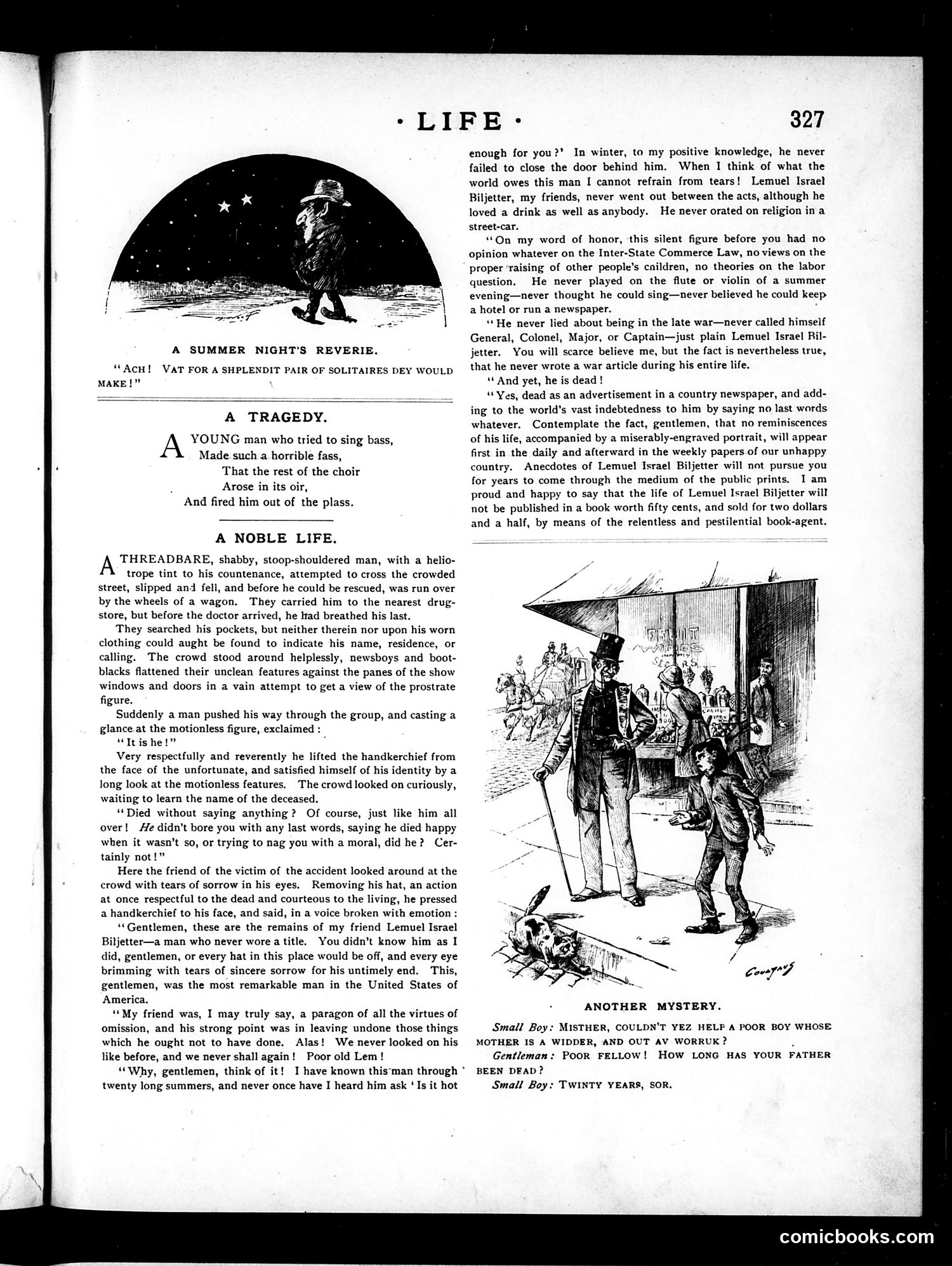
This page contains three pieces of humor, with the main focus on "A Noble Life," a mock eulogy for Lemuel Israel Biljetter. The satire targets American social pretension and annoying public behavior of the era. Biljetter's "remarkable" qualities are entirely *negative*—he never complained about weather, never gossiped about the Interstate Commerce Law, never played musical instruments badly, never exaggerated war service, never self-aggrandized with military titles. The speaker praises him effusively for doing *nothing* noteworthy. This mocks contemporary Americans' tendency toward boastfulness, unsolicited opinions, and public nuisance-making. The joke: a man's greatest virtue is absolute passivity and silence. The extended eulogy treating this non-achievement as exceptional satirizes how readily people offer grandiose tributes and how little substance often underlies them. The other pieces—"A Tragedy" (bad singer fired from choir) and "A Summer Night's Reverie" (Yiddish-accented figure eyeing jewelry)—are brief comic verses unrelated to the main satire.
📄 Transcribed text from this page (OCR, searchable)
Machine-transcribed from the original scan — historical spelling and the odd misread are preserved.
LIFE: A SUMMER NIGHT'S REVERIE. ““ACH! VAT FOR A SHPLENDIT PAIR OF SOLITAIRES DEY WOULD MAKE!” A TRAGEDY. YOUNG man who tried to sing bass, Made such a horrible fass, That the rest of the choir Arose in its oir, And fired him out of the plass. A NOBLE LIFE. A THREADBARE, shabby, stoop-shouldered man, with a helio- trope tint to his countenance, attempted to cross the crowded street, slipped and fell, and before he could be rescued, was run over by the wheels of a wagon. They carried him to the nearest drug- store, but before the doctor arrived, he had breathed his last. They searched his pockets, but neither therein nor upon his worn clothing could aught be found to indicate his name, residence, or calling. The crowd stood around helplessly, newsboys and boot- blacks flattened their unclean features against the panes of the show windows and doors in a vain attempt to get a view of the prostrate figure. Suddenly a man pushed his way through the group, and casting a glance at the motionless figure, exclaimed : “Ttishe!” . Very respectfully and reverently he lifted the handkerchief from the face of the unfortunate, and satisfied himself of his identity by a long look at the motionless features. The crowd looked on curiously, waiting to learn the name of the deceased. “Died without saying anything? Of course, just like him all over! He didn’t bore you with any last words, saying he died happy when it wasn’t so, or trying to nag you with a moral, did he? Cer- tainly not!” Here the friend of the victim of the accident looked around at the crowd with tears of sorrow in his eyes. Removing his hat, an action at once respectful to the dead and courteous to the living, he pressed a handkerchief to his face, and said, in a voice broken with emotion : ‘Gentlemen, these are the remains of my friend Lemuel Israel Biljetter—a man who never wore a title. You didn’t know him as I did, gentlemen, or every hat in this place would be off, and every eye brimming with tears of sincere sorrow for his untimely end. This, gentlemen, was the most remarkable man in the United States of America. “My friend was, I may truly say, a paragon of all the virtues of omission, and his strong point was in leaving undone those things which he ought not to have done. Alas! We never looked on his like before, and we never shall again! Poor old Lem! “Why, gentlemen, think of it! twenty long summers, and never once have I heard him ask ‘Is it hot I have known this‘man through * 327 enough for you?’ In winter, to my positive knowledge, he never failed to close the door behind him. When I think of what the world owes this man [ cannot refrain from tears! Lemuel Israel Biljetter, my friends, never went out between the acts, although he loved a drink as well as anybody. He never orated on religion in a street-car. “(On my word of honor, ‘this silent figure before you had no opinion whatever on the Inter-State Commerce Law, no views on the proper ‘raising of other people's cnildren, no theories on the labor question, He never played on the flute or violin of a summer evening—never thought he could sing—never believed he could keep a hotel or run a newspaper. . “He never lied about being in the late war—never called himself General, Colonel, Major, or Captain—just plain Lemuel Israel Bil- jetter. You will scarce believe me, but the fact is nevertheless true, that he never wrote a war article during his entire life. “And yet, he is dead! “Yes, dead as an advertisement in a country newspaper, and add- ing to the world's vast indebtedness to him by saying no last words whatever. Contemplate the fact, gentlemen, that no reminiscences of his life, accompanied by a miserably-engraved portrait, will appear first in the daily and afterward in the weekly papers.of our unhappy country. Anecdotes of Lemuel Israel Biljetter will not pursue you for years to come through the medium of the public prints. I am proud and happy to say that the life of Lemuel Israel Biljetter will not be published in a book worth fifty cents, and sold for two dollars and a half, by means of the relentless and pestilential book-agent. ANOTHER MYSTERY. Small Boy: MISTHER, COULDN'T YEZ HELF A POOR BOY WHOSE MOTHER IS A WIDDER, AND OUT AV WORRUK? “ Gentleman: POOR FELLOW! HOW LONG HAS YOUR FATHER BEEN DEAD? Small Boy: TWINTY YEARS, SOR. comicbooks.com