
Life, 1888-06-07 · page 2 of 16
Life — June 7, 1888 — page 2: what you’re looking at
What you’re looking at
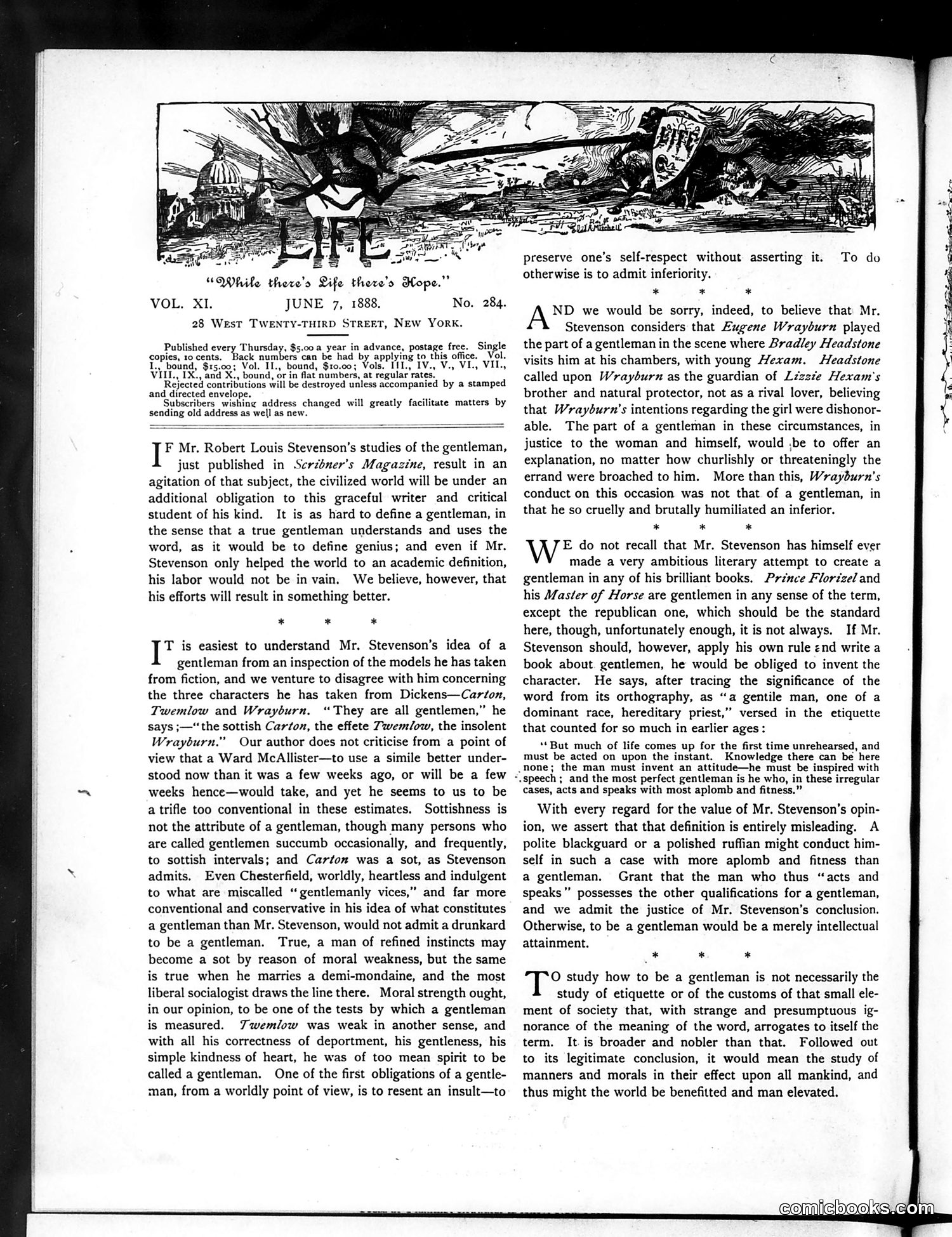
The masthead illustration depicts a dramatic scene with classical and contemporary elements—a domed building (likely St. Paul's Cathedral, London), a shipwreck, and turbulent skies, all rendered in expressive woodcut style. The article discusses Robert Louis Stevenson's literary treatment of "gentlemen" in his fiction, particularly examining characters like Bradley Headstone (*Our Mutual Friend*) and Wrayburn. The satire critiques Stevenson's definition of gentlemanly conduct, arguing that true gentlemanliness requires more than intellectual refinement—it demands moral strength, dignity, and the ability to resent insult. The piece suggests Stevenson's working-class or morally compromised characters fail this standard, satirizing both the author's social assumptions and Victorian definitions of class virtue.
📄 Transcribed text from this page (OCR, searchable)
Machine-transcribed from the original scan — historical spelling and the odd misread are preserved.
Rion ssi ae “While there's Life there's Hope.” VOL. XI. JUNE 7, 1888, 28 WeEsT TWENTY-THIRD STREET, NEW York. No. 284. Published every Thursday, $5.00 a year in advance, postage free. Single copies, ro cents. Back numbers can be had by applying to this office. Vol. I., bound, $15.00; Vol. II., bound, $10.00; Vols. TII., 1V., V., VI, VIL, VIIL., IX., and X., bound, or in flat numbers, at regular rates. Rejected contributions will be destroyed unless accompanied by a stamped and directed envelope. Subscribers wishing address changed will greatly facilitate matters by sending old address as well as new. F Mr. Robert Louis Stevenson's studies of the gentleman, just published in Scrzbner’s Magazine, result in an agitation of that subject, the civilized world will be under an additional obligation to this graceful writer and critical student of his kind. It is as hard to define a gentleman, in the sense that a true gentleman understands and uses the word, as it would be to define genius; and even if Mr. Stevenson only helped the world to an academic definition, his labor would not be in vain. We believe, however, that his efforts will result in something better. * * * T is easiest to understand Mr. Stevenson’s idea of a gentleman from an inspection of the models he has taken from fiction, and we venture to disagree with him concerning the three characters he has taken from Dickens—Carton, Twemlow and Wrayburn, “They are all gentlemen,” he says ;—“‘the sottish Carton, the effete Twem/ow, the insolent Wraydurn.” Our author does not criticise from a point of view that a Ward McAllister—to use a simile better under- stood now than it was a few weeks ago, or will be a few weeks hence—would take, and yet he seems to us to be a trifle too conventional in these estimates. Sottishness is not the attribute of a gentleman, though many persons who are called gentlemen succumb occasionally, and frequently, to sottish intervals; and Carton was a sot, as Stevenson admits. Even Chesterfield, worldly, heartless and indulgent to what are miscalled “gentlemanly vices,” and far more conventional and conservative in his idea of what constitutes a gentleman than Mr. Stevenson, would not admit a drunkard to be a gentleman. True, a man of refined instincts may become a sot by reason of moral weakness, but the same is true when he marries a demi-mondaine, and the most liberal socialogist draws the line there. Moral strength ought, in our opinion, to be one of the tests by which a gentleman is measured. Zzem/ow was weak in another sense, and with all his correctness of deportment, his gentleness, his simple kindness of heart, he was of too mean spirit to be called a gentleman. One of the first obligations of a gentle- man, from a worldly point of view, is to resent an insult—to preserve one’s self-respect without asserting it. To do otherwise is to admit inferiority. * * * ND we would be sorry, indeed, to believe that Mr. Stevenson considers that Exgene Wrayburn played the part of a gentleman in the scene where Bradley Headstone visits him at his chambers, with young Hexam. Headstone called upon Wrayéurn as the guardian of Lizzze Hexam's brother and natural protector, not as a rival lover, believing that Wraydurn's intentions regarding the girl were dishonor- able. The part of a gentleman in these circumstances, in justice to the woman and himself, would ,be to offer an explanation, no matter how churlishly or threateningly the errand were broached to him. More than this, Wrayburn's conduct on this occasion was not that of a gentleman, in that he so cruelly and brutally humiliated an inferior. * * * E do not recall that Mr. Stevenson has himself ever made a very ambitious literary attempt to create a gentleman in any of his brilliant books. Prince Flortzel and his Master of Horse are gentlemen in any sense of the term, except the republican one, which should be the standard here, though, unfortunately enough, it is not always. If Mr. Stevenson should, however, apply his own rule end write a book about. gentlemen, he would be obliged to invent the character. He says, after tracing the significance of the word from its orthography, as “a gentile man, one of a dominant race, hereditary priest,” versed in the etiquette that counted for so much in earlier ages: “*But much of life comes up for the first time unrehearsed, and must be acted on upon the instant. Knowledge there can be here none; the man must invent an attitude—he must be inspired with “speech ; and the most perfect gentleman is he who, in these irregular cases, acts and speaks with most aplomb and fitness.” With every regard for the value of Mr. Stevenson's opin- ion, we assert that that definition is entirely misleading. A polite blackguard or a polished ruffian might conduct him- self in such a case with more aplomb and fitness than a gentleman. Grant that the man who thus “acts and speaks” possesses the other qualifications for a gentleman, and we admit the justice of Mr. Stevenson’s conclusion. Otherwise, to be a gentleman would be a merely intellectual attainment. * * * O study how to be a gentleman is not necessarily the study of etiquette or of the customs of that small ele- ment of society that, with strange and presumptuous ig- norance of the meaning of the word, arrogates to itself the term. It. is broader and nobler than that. Followed out to its legitimate conclusion, it would mean the study of manners and morals in their effect upon all mankind, and thus might the world be benefitted and man elevated.