
A complete issue · 18 pages · 1888
Life — April 19, 1888
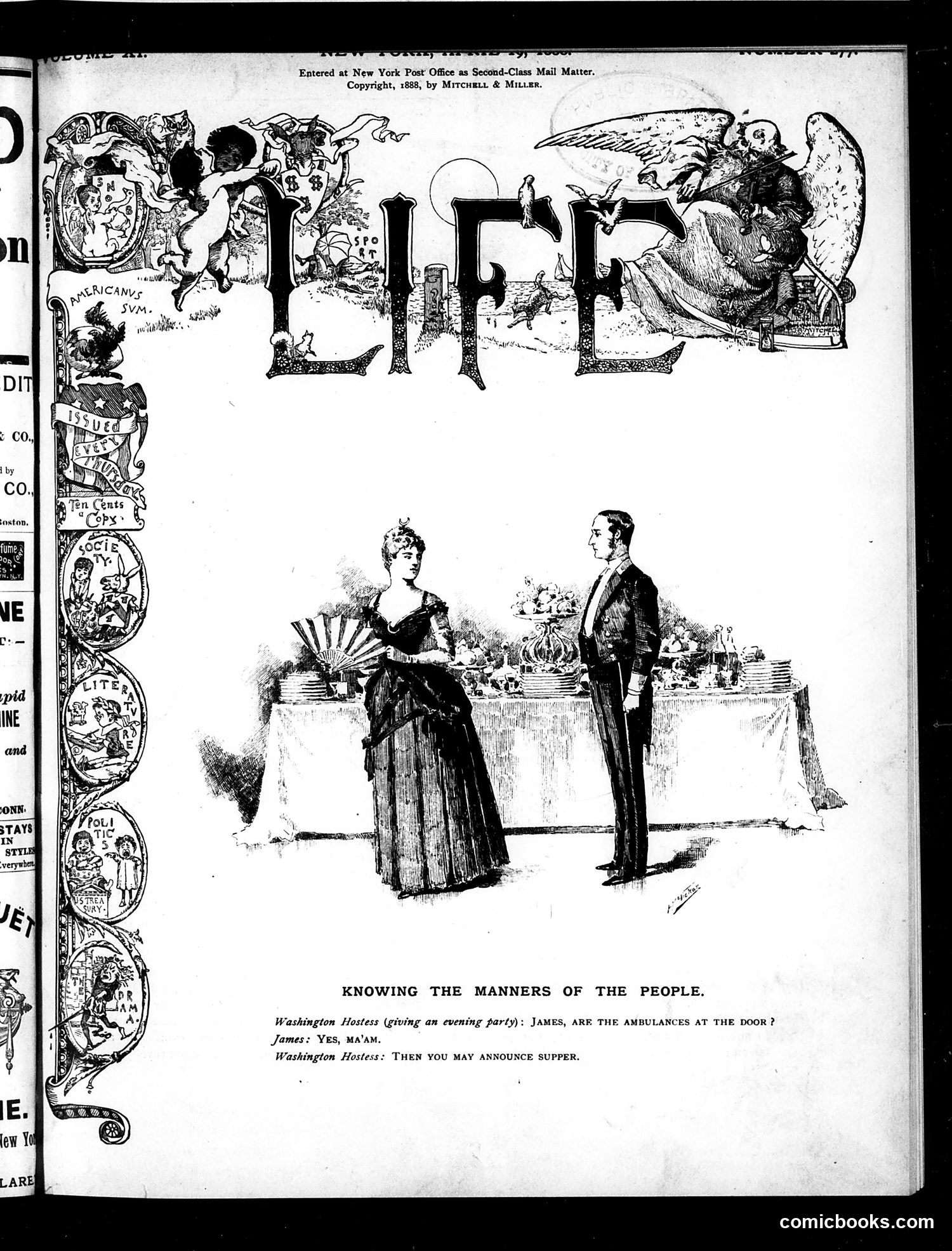
This satirical cartoon mocks proper etiquette among Washington's social elite. A hostess asks her servant James whether the ambulances have arrived at the door, then instructs him to announce supper only once they're positioned outside. The joke targets the pretensions of Washington society: the hostess is so concerned with *appearing* proper and fashionable that she treats potential medical emergencies (guests fainting or collapsing, apparently a common occurrence at formal dinners) as merely another detail of party management. The satire suggests that Washington's upper classes prioritize surface-level social conventions over genuine care for guests' wellbeing. The absurdity—casually coordinating ambulances like table decorations—exposes the hollow nature of rigid etiquette and social climbing in the nation's capital.
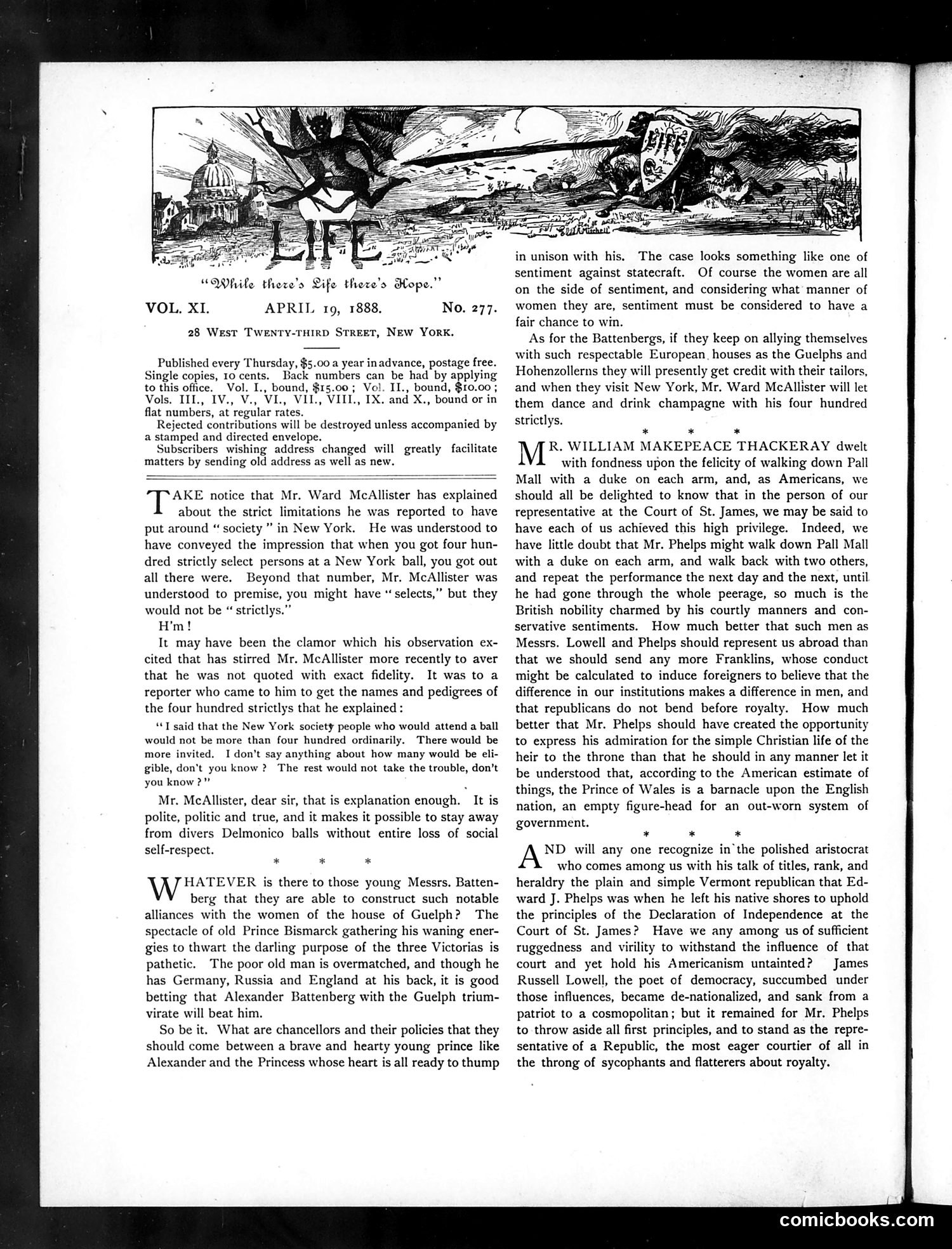
The masthead cartoon depicts **Death** (skeleton with scythe) surveying a battlefield landscape with a domed building (possibly the Capitol), satirizing mortality and national strife. The text discusses **Mr. Ward McAllister** and New York high society's strict exclusivity. McAllister allegedly claimed that only "four hundred" people qualified for elite society balls. The article mocks his pretentiousness, noting that calling attendees "selects" rather than "strictlys" doesn't change the arbitrary gatekeeping. Later passages critique **Mr. Phelps** (apparently a diplomat) for excessive deference to European nobility and royalty while representing American republican values abroad. The satire suggests he's abandoned democratic principles to curry favor with European aristocrats—betraying American ideals for cosmopolitan snobbery. The overall tone ridicules both American social climbing and compromised patriotism.
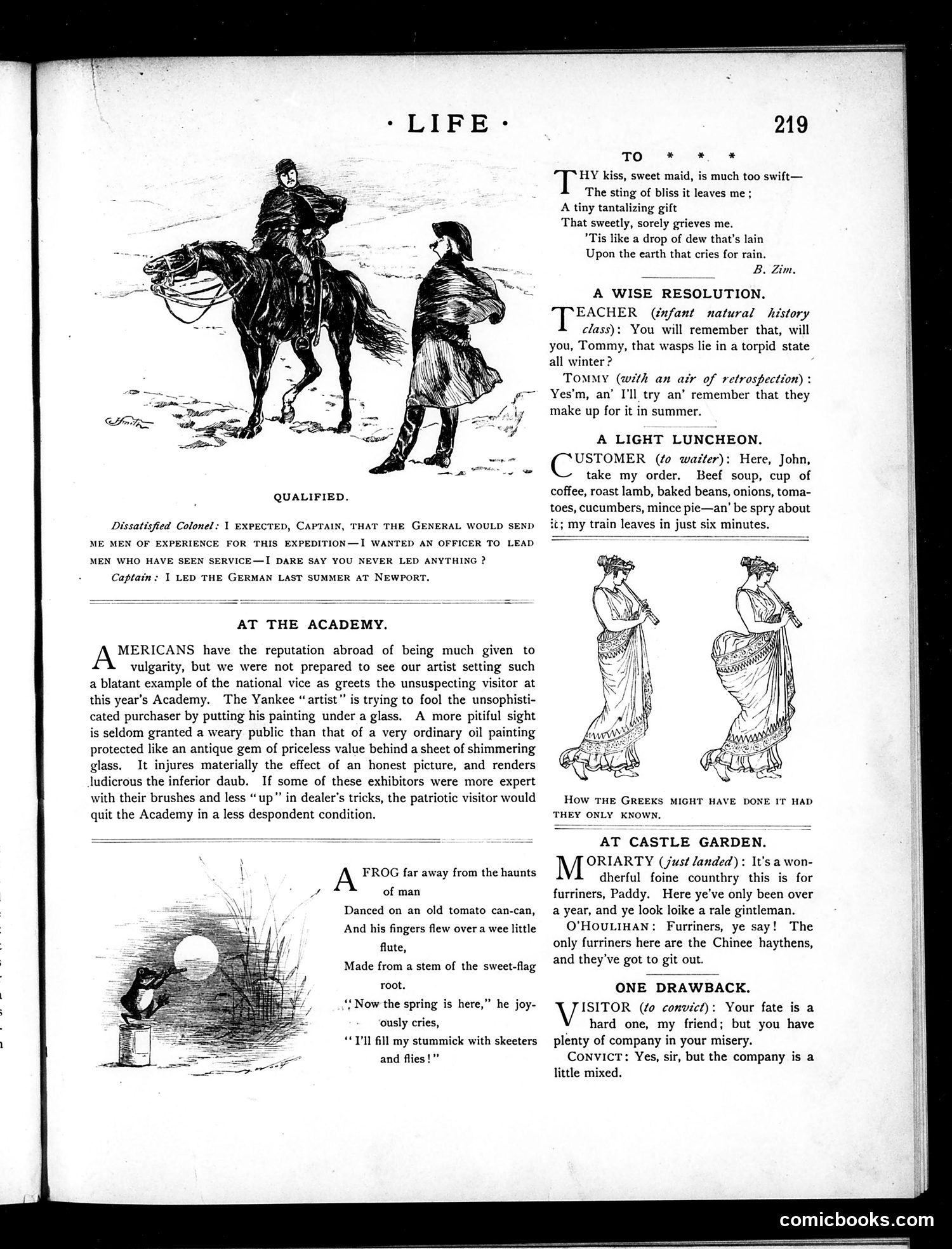
This page from *Life* magazine contains several unrelated satirical pieces: **"Qualified"** mocks military incompetence through a dialogue between a dissatisfied Colonel and a Captain. The Colonel wanted experienced officers for an expedition; the Captain admits he only led "the German last summer at Newport"—suggesting Newport was a minor social event, not actual military service. The satire targets officers with purely social credentials rather than genuine combat experience. **"At the Academy"** criticizes American artists exhibiting at the Academy for passing off mediocre work as masterpieces—specifically calling out a "Yankee artist" attempting to deceive buyers by displaying paintings under glass to make them appear valuable. It's a commentary on artistic fraud and American cultural pretension. The remaining pieces are lighter social humor and poetry.
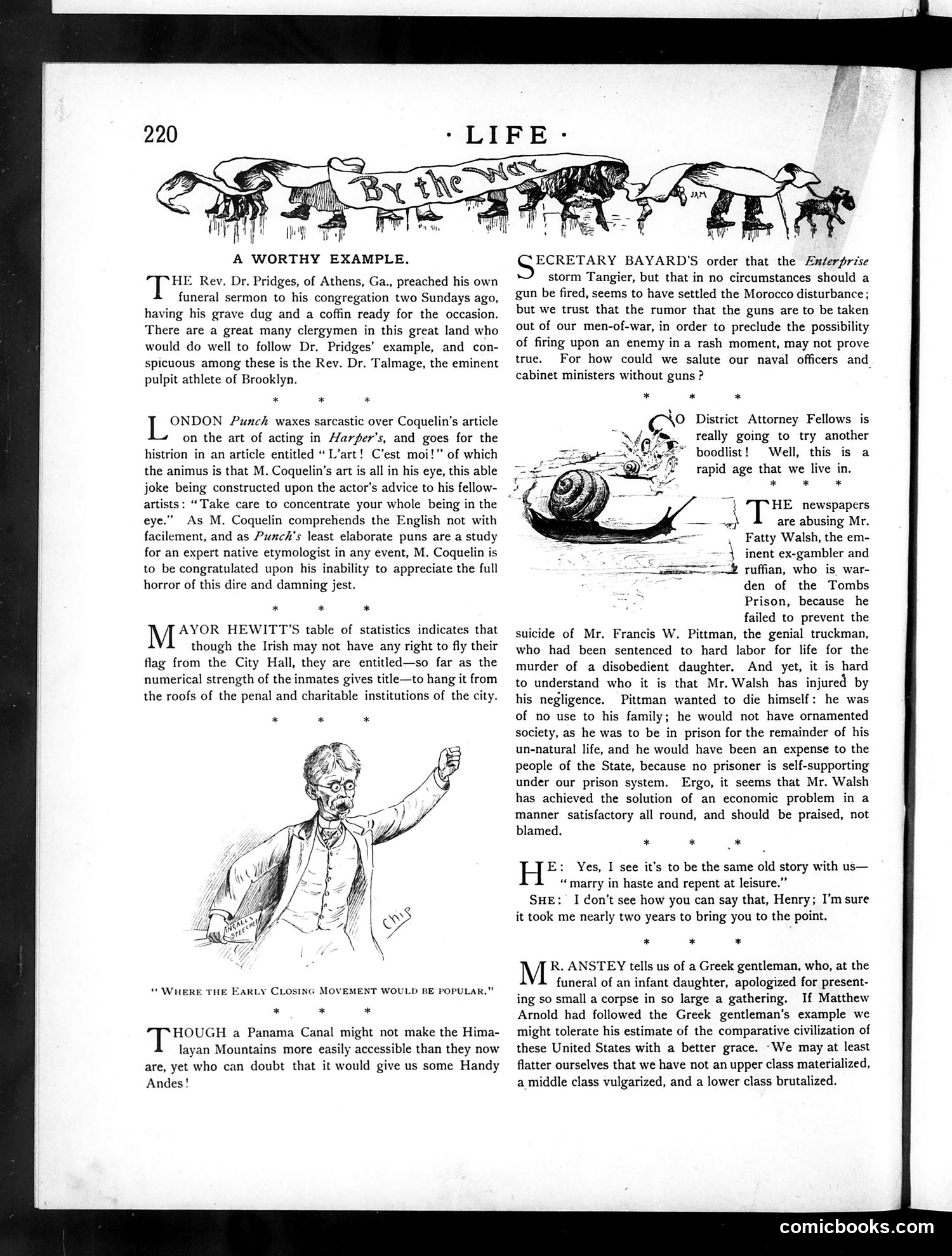
This page contains several satirical commentary pieces typical of Life's format: **"A Worthy Example"** mocks clergy who preach about death while avoiding it themselves—contrasting Rev. Bridget's funeral sermon with his own preparations to avoid dying. **The Mayor Hewitt section** satirizes Irish political representation in New York City, suggesting the Irish lack legitimate authority to "fly their flag" despite comprising much of the city's population. **"Where the Early Closing Movement Would Be Popular"** (cartoon of a gesturing man) appears to reference labor disputes over store hours, though the specific context is unclear. The remaining pieces discuss various social issues—prison conditions, funeral customs among Greek immigrants, and class materialism in America—presented with Life's characteristic dry wit and moral observation about American society.
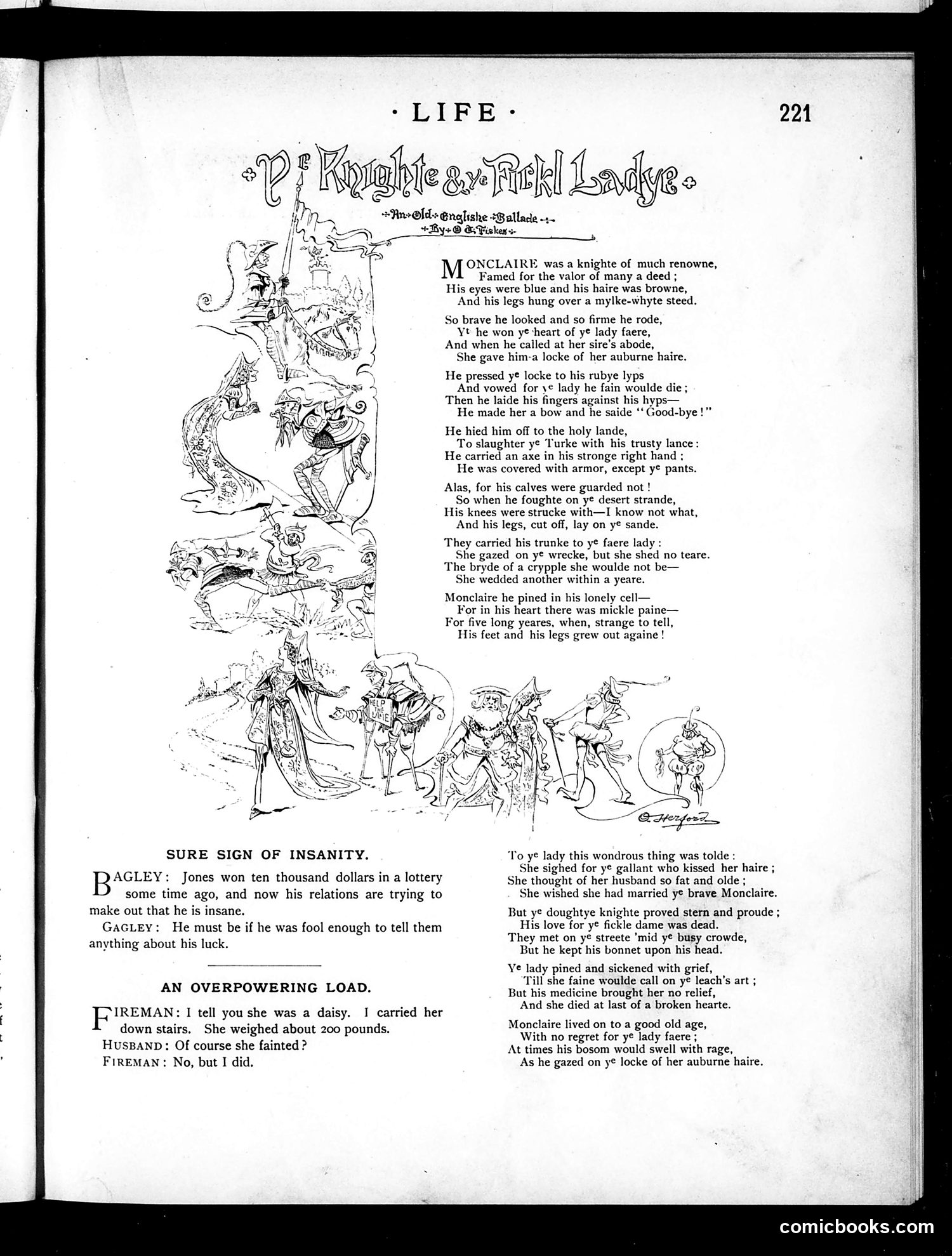
This page presents an old English ballad about a knight named Monclaire and his tragic romance. The illustrated narrative (top) depicts a medieval tale where Monclaire loses his legs in battle while fighting Turks, yet his lady love eventually marries another within a year—though she grieves his memory. Below are two brief humorous anecdotes ("Sure Sign of Insanity" and "An Overpowering Load") that appear unrelated to the ballad. These are simple joke sections typical of Life magazine's satirical format. The page functions primarily as literary/entertainment content rather than political satire. The ballad's romantic tragedy and the accompanying jokes represent Life's mix of classical references and everyday humor aimed at educated readers.
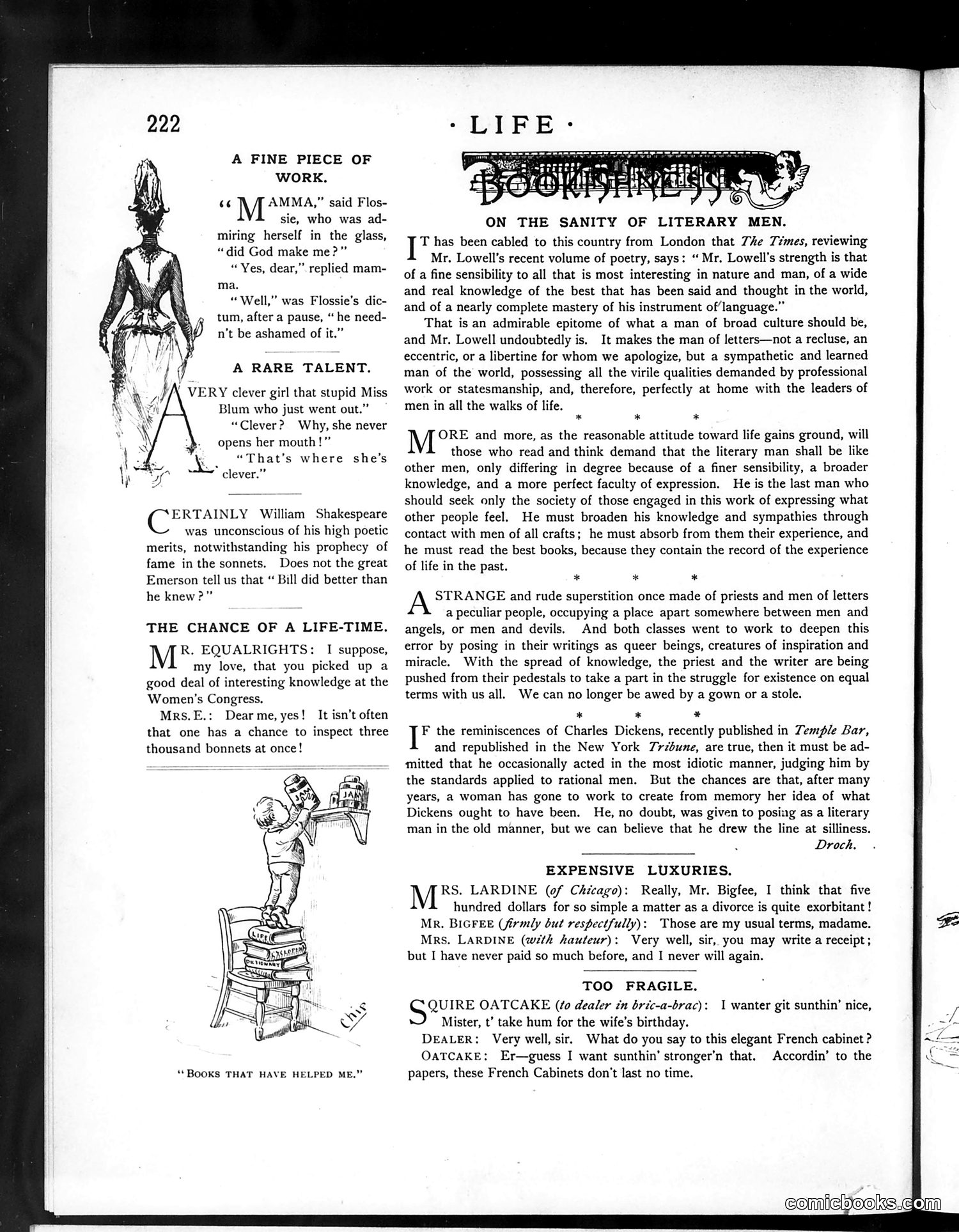
This page contains several short humorous sketches rather than political cartoons: **"A Fine Piece of Work"**: A dialogue joking that Flossie admires herself in a mirror, asking if God made her. The humor relies on vanity. **"A Rare Talent"**: A brief joke about a stupid girl named Miss Blum, with wordplay suggesting she's "clever" because she's absent-minded. **"The Chance of a Lifetime"**: Mr. Equalrights boasts to Mrs. E. about inspecting "three thousand bonnets at once" at the Women's Congress—satirizing women's suffrage activism or women's rights conventions. **Illustrations** include a decorative female figure and a cherub on stacked books labeled "Books that have helped me." The remaining content comprises brief comic dialogues about expensive divorces and fragile furniture—general domestic humor typical of early-20th-century satirical magazines.
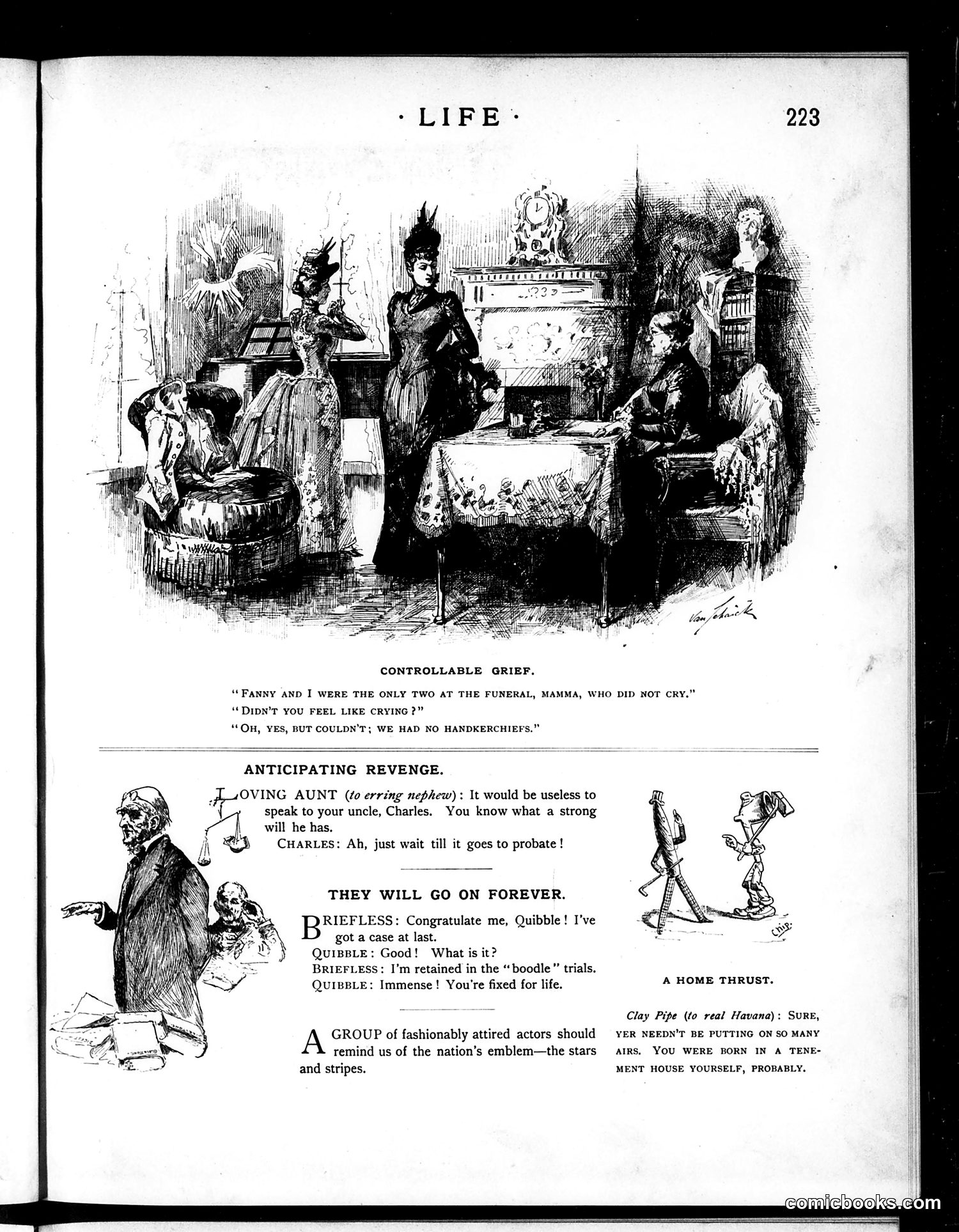
This page contains three separate satirical items from an early 20th-century Life magazine: **"Controllable Grief"** depicts a funeral scene where two women explain they didn't cry because they lacked handkerchiefs—a joke about Victorian propriety prioritizing appearance over genuine emotion. **"Anticipating Revenge"** mocks a legal case where a man named Quibble boasts about being retained in "boodle" (bribery) trials, suggesting he's repeatedly involved in corrupt legal proceedings. **"They Will Go On Forever"** and **"A Home Thrust"** are brief satirical quips about actors and social pretension, likely contemporary references now obscure. The cartoons collectively ridicule Victorian affectation, legal corruption, and social hypocrisy through witty dialogue and caricature—typical of Life's satirical approach during this era.
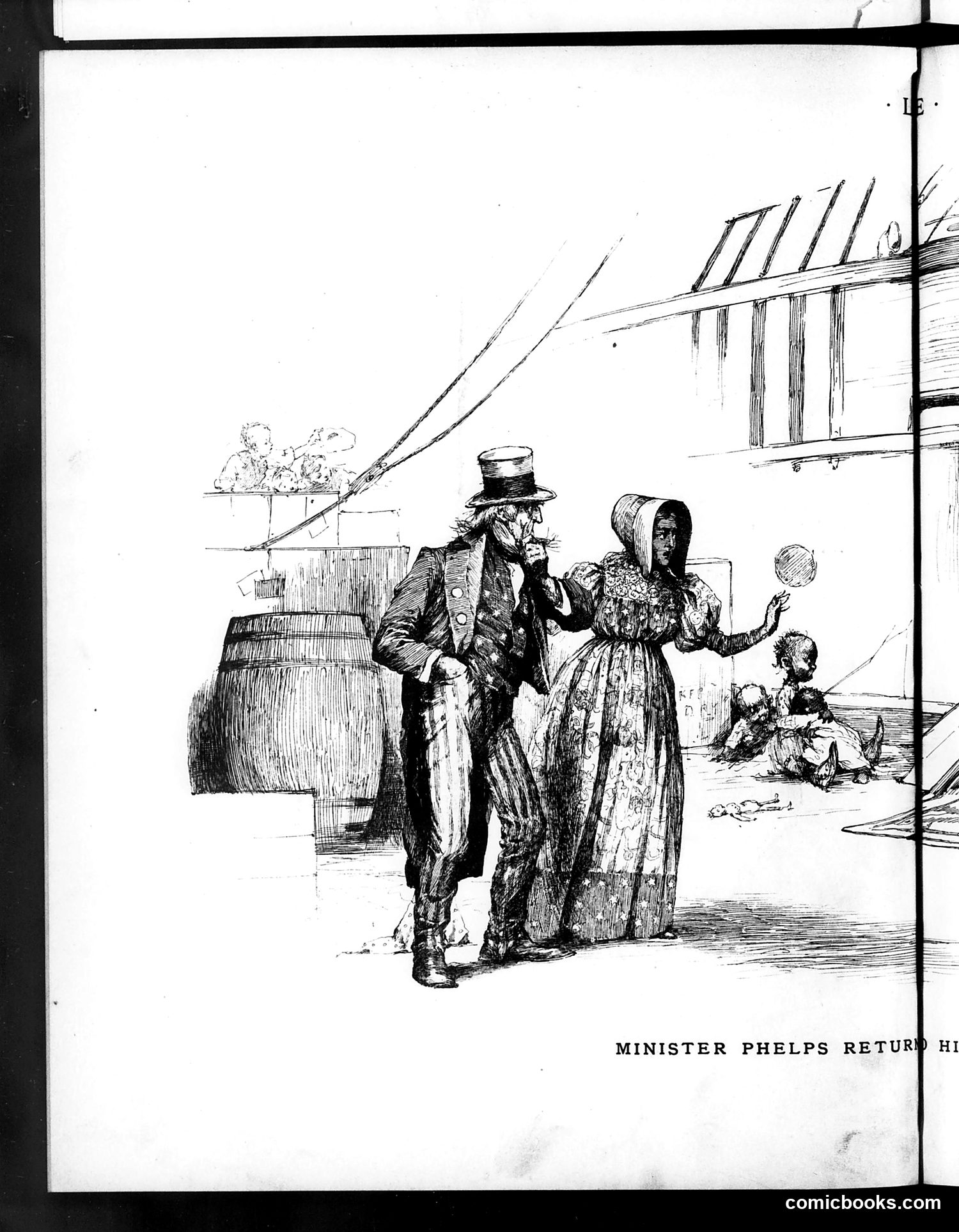
The caption reads "MINISTER PHELPS RETURN HI[ME]" (text is cut off). This depicts what appears to be Minister Phelps arriving by ship, greeted by a woman and children on the dock. The man wears a top hat and formal coat; the woman wears a bonnet and long dress typical of the 19th century. Without the complete caption and publication date visible, I cannot definitively identify which Minister Phelps this references or the specific political context of his return. The cartoon appears to satirize a diplomatic or political figure's homecoming, likely from an international posting. The domestic scene—with family awaiting his arrival—suggests the satire may concern the contrast between public duty and private life, or commentary on his tenure abroad. More context would be needed for precise interpretation.
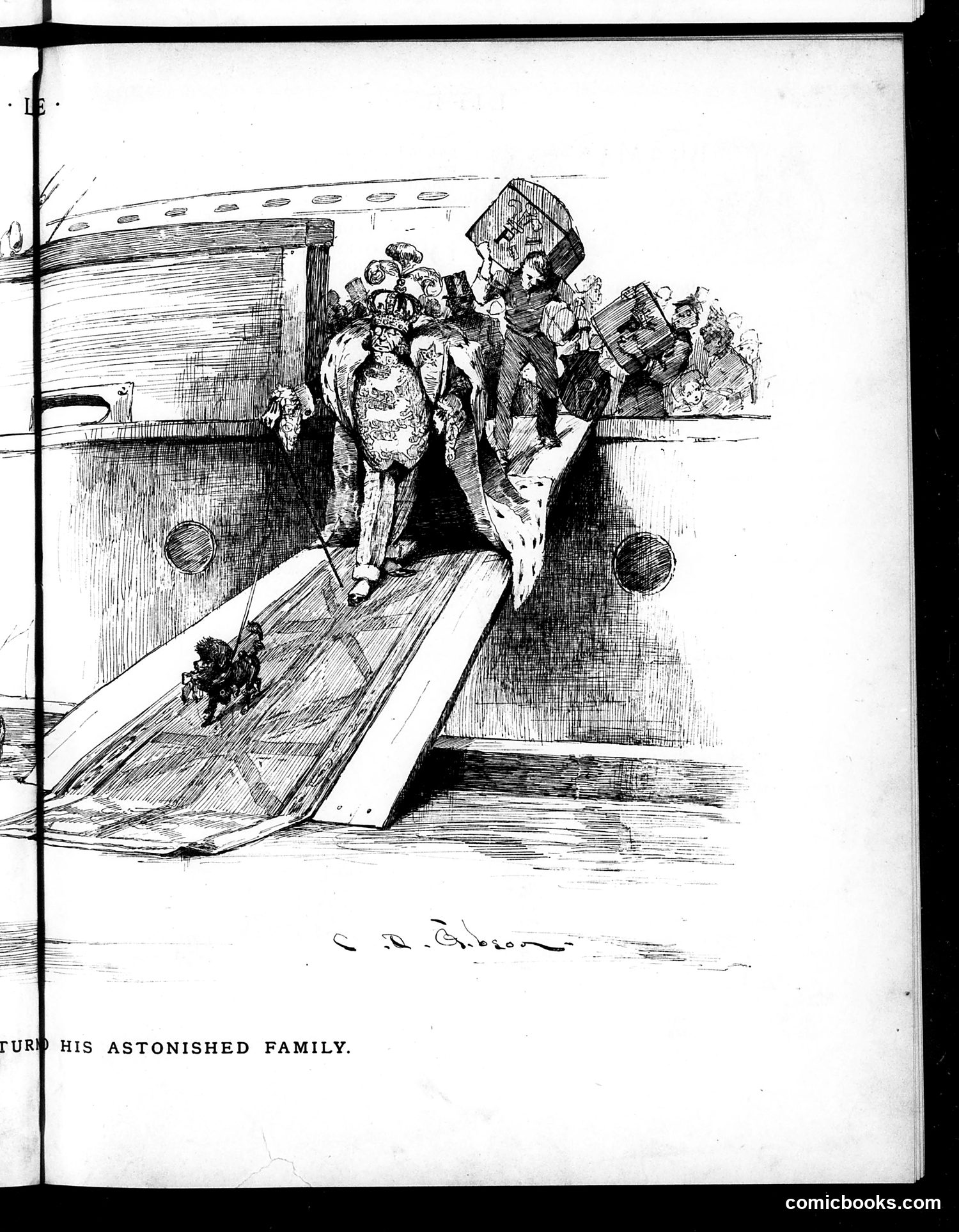
This appears to be a satirical cartoon from Life magazine showing a wealthy, rotund figure emerging from what looks like a ship or vessel, descending a gangway while surrounded by numerous family members and attendants carrying luggage and belongings. The caption reads "TURN HIS ASTONISHED FAMILY" (though the first word is partially cut off). The satire likely mocks a wealthy businessman or financier returning home with his extended family after foreign travel, suggesting either the excess of his entourage, the ostentatious display of wealth, or perhaps criticism of his business practices. The figure's prominent belly and elaborate dress suggest wealth and excess. The crowded, chaotic scene emphasizes the size of his retinue, which appears to be the point of the joke—mocking conspicuous consumption or familial parasitism among the wealthy.
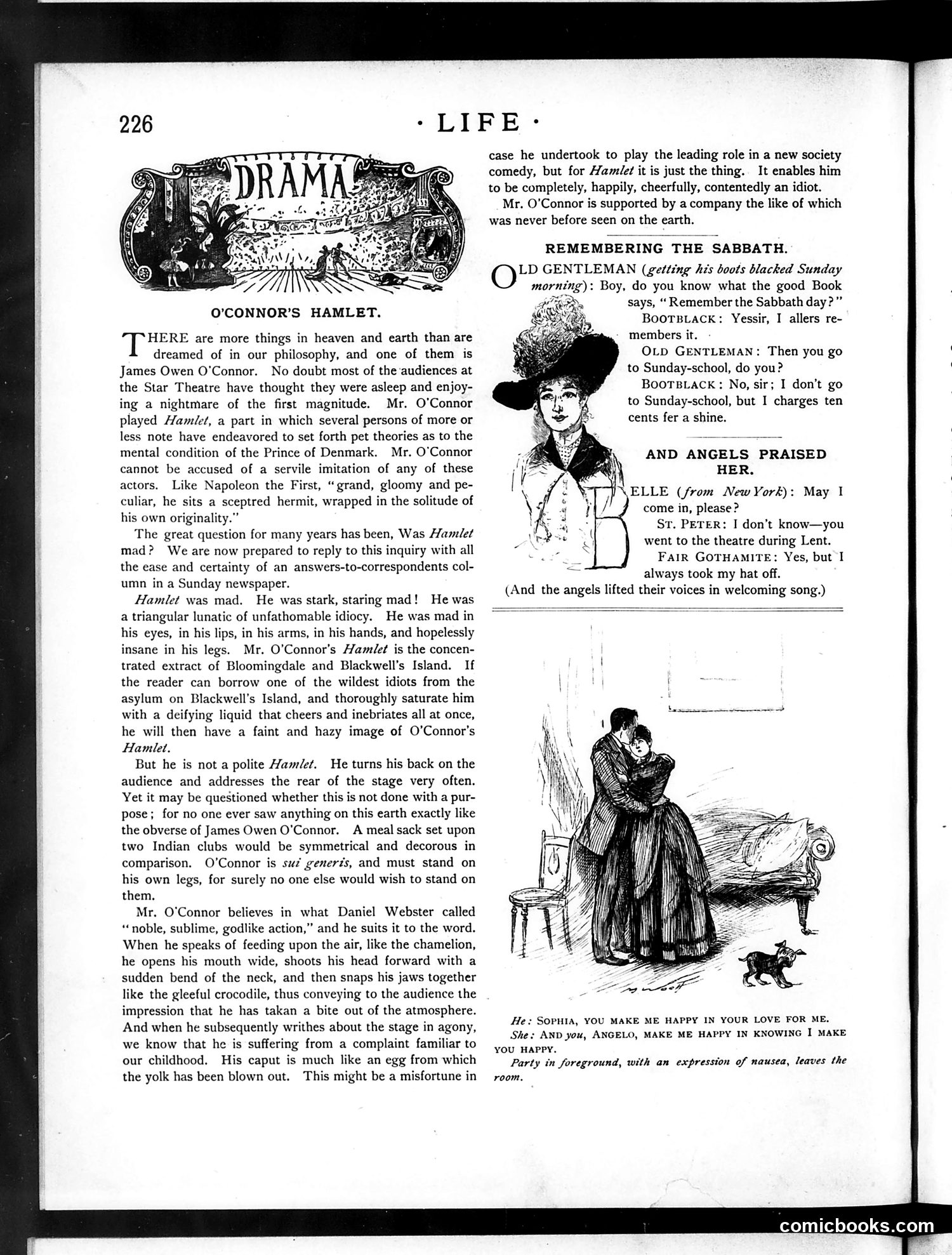
This page discusses James Owen O'Connor's theatrical performance as Hamlet. The text humorously describes O'Connor's eccentric interpretation: he plays the role as "mad" in an extreme, physical way—described as "a triangular lunatic of unfathomable idiocy" who is "mad in his eyes, in his hips, in his arms, in his hands, and hopelessly insane in his legs." The critique suggests O'Connor turns his back on audiences, addresses the rear of the stage, and employs exaggerated physical comedy. The satire mocks both his unconventional staging choices and what the writer considers his misguided theatrical philosophy, suggesting his interpretation prioritizes spectacle and peculiar physicality over the psychological depth Shakespeare's character demands.
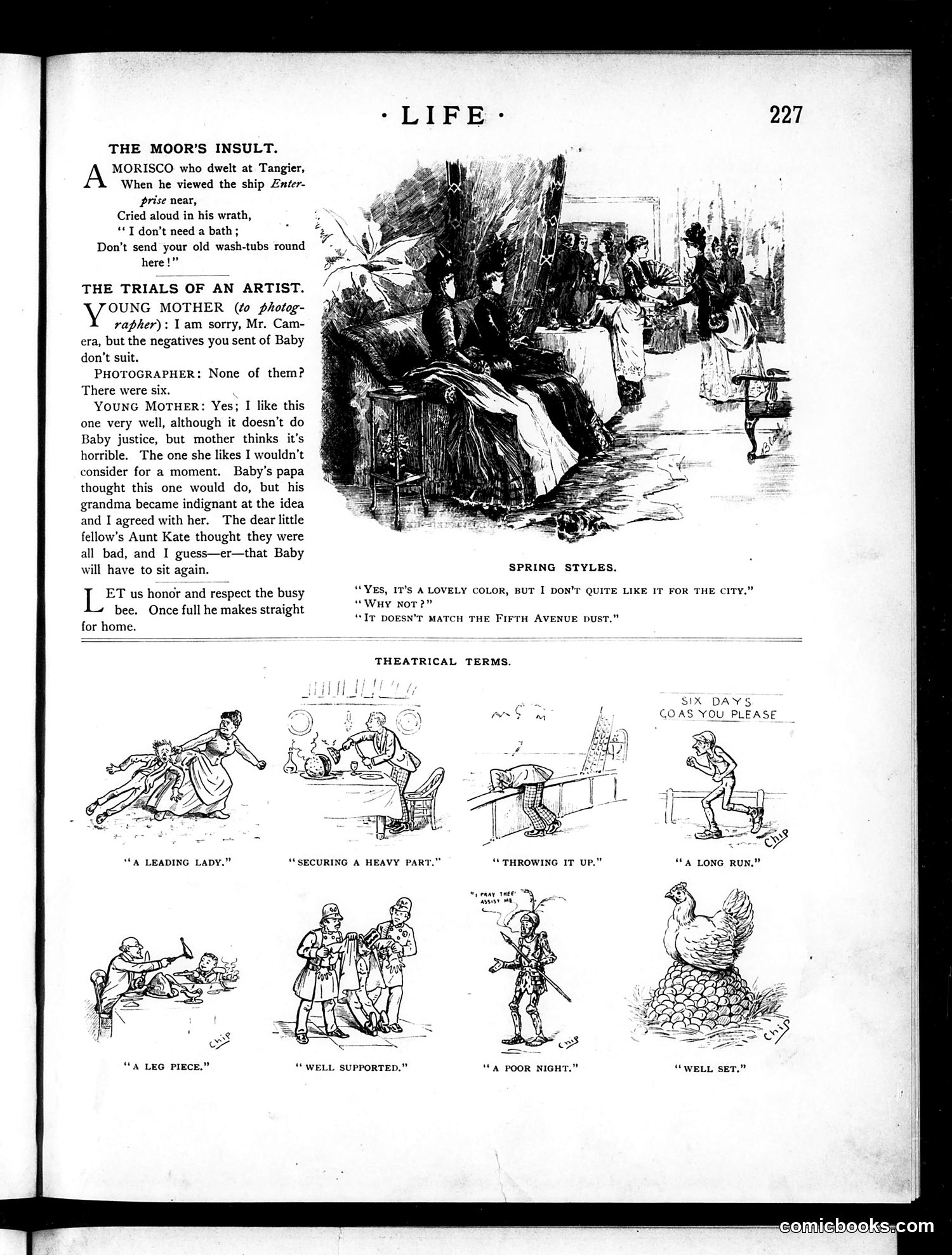
This page contains three unrelated satirical pieces typical of Life's humor: **"The Moor's Insult"**: A humorous poem mocking a Moroccan ("Morisco") who rejects being offered a bath, playing on ethnic stereotypes about cleanliness common in early 20th-century American humor. **"The Trials of an Artist"**: Satirizes the difficulty photographers faced pleasing families with baby portraits. Every family member (mother, grandmother, father, aunt) has conflicting opinions, forcing multiple retakes—commentary on both family dynamics and the commercial photography business. **"Spring Styles"** and **"Theatrical Terms"**: Light social satire. The fashion piece jokes about Fifth Avenue dust ruining clothing colors. The theatrical section uses humorous drawings illustrating stage terminology—"a leading lady," "securing a heavy part," "throwing it up," etc.—parodying theatrical jargon and the physical comedy of stage acting. All are gentle, domestic humor targeting contemporary American social life rather than political commentary.
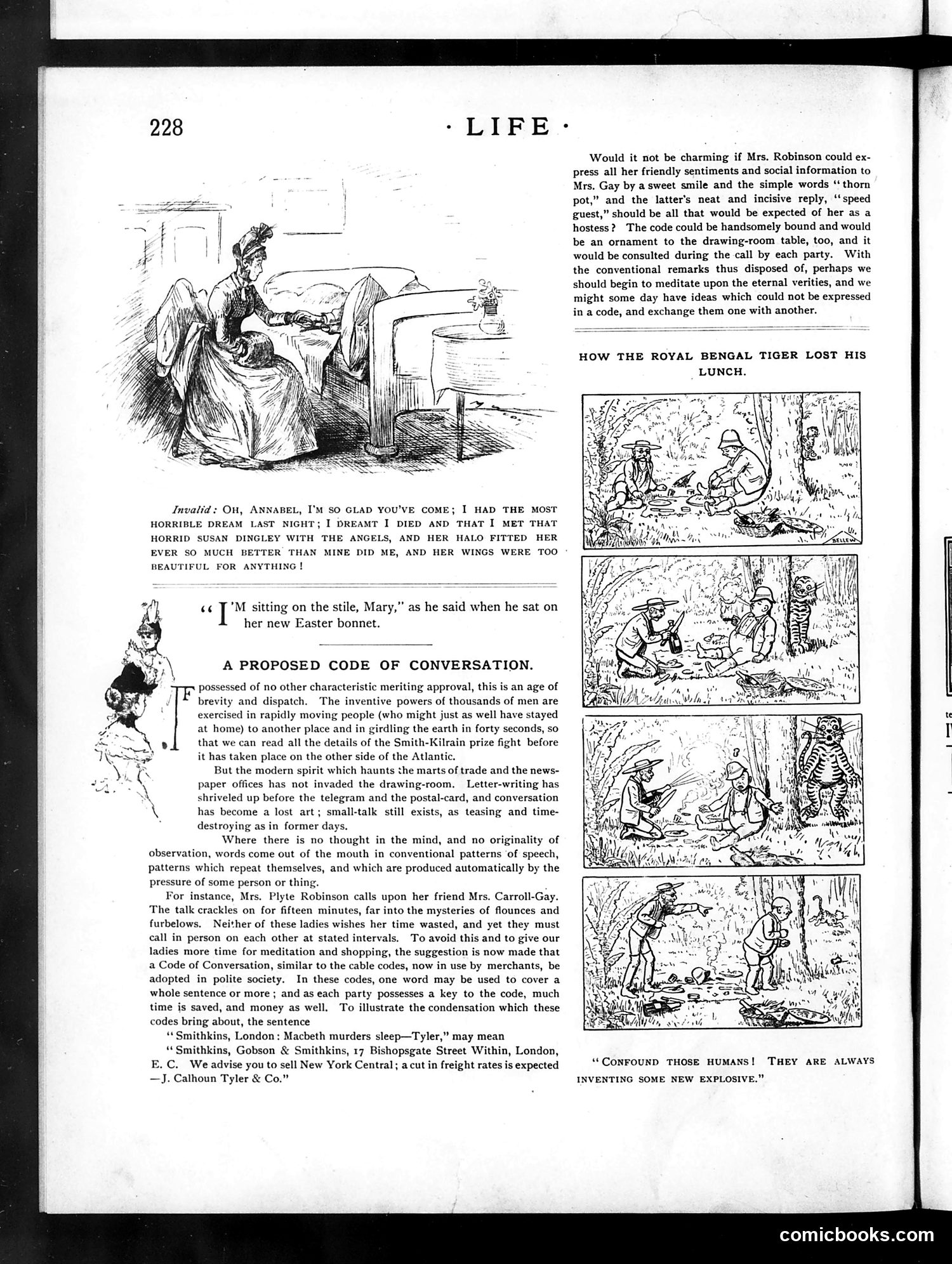
This page contains two satirical pieces mocking modern society's obsession with efficiency and brevity. **"A Proposed Code of Conversation"** ridicules upper-class women's drawing-room visits—tedious social obligations featuring empty small talk about fashion ("flounces and furbelows"). The author sarcastically proposes adopting merchant telegraph codes so ladies could exchange pre-written phrases like "thorn pot" instead of conversing, freeing time for "meditation and shopping." The satire targets the hollowness of Victorian social convention and the era's worship of speed and brevity (enabled by telegraphy and rapid transportation). **"How the Royal Bengal Tiger Lost His Lunch"** is a comic strip (content unclear from text alone) featuring a tiger observing human activity, apparently mocking human inventiveness and violence through the animal's perspective. Both pieces reflect *Life* magazine's typical satirical stance: critiquing modern society's superficiality, mechanization, and displacement of genuine human connection by technological efficiency.
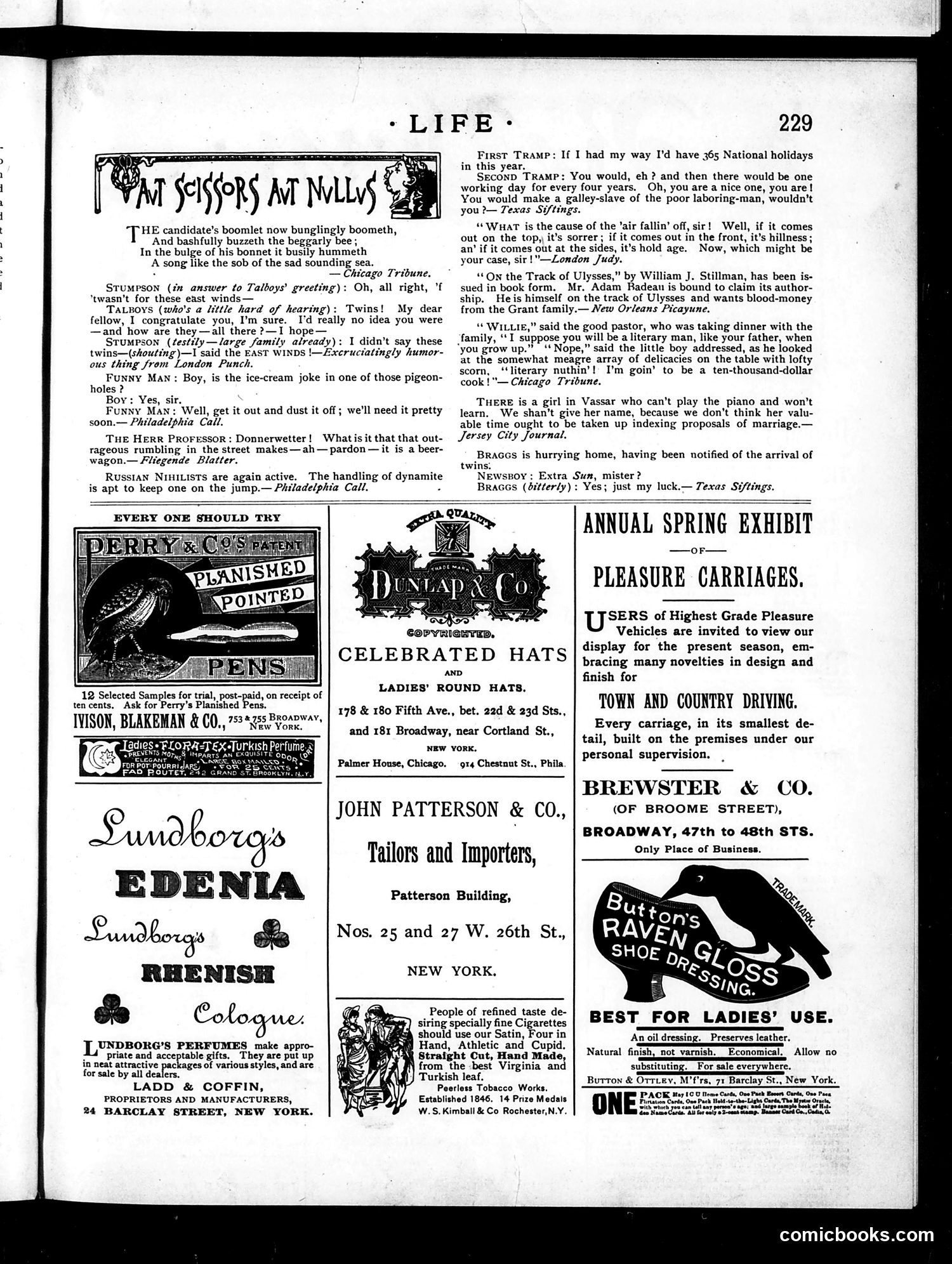
This page is primarily **advertising** mixed with brief satirical **jokes** reprinted from other publications. The cartoons are minimal—mostly text-based humor. The jokes mock contemporary absurdities: a man mishearing "east winds" as "twins," leading to congratulations; a comedian recycling old material; a beer wagon causing a professor to swear in German. A notable quip concerns Adam Badeau claiming authorship of William J. Stillman's book on Ulysses, while pursuing financial claims against the Grant family—apparently a real literary scandal. The political/social satire is light: Russian nihilists handling dynamite (referencing anarchist violence); a boy rejecting "literary" ambitions to become a wealthy cook; and a Vassar girl refusing piano lessons because courtship proposals waste her time—gentle mockery of education and gender expectations. The bulk of the page comprises period advertisements for hats, perfumes, carriages, pens, and shoe polish—typical of *Life's* revenue model.
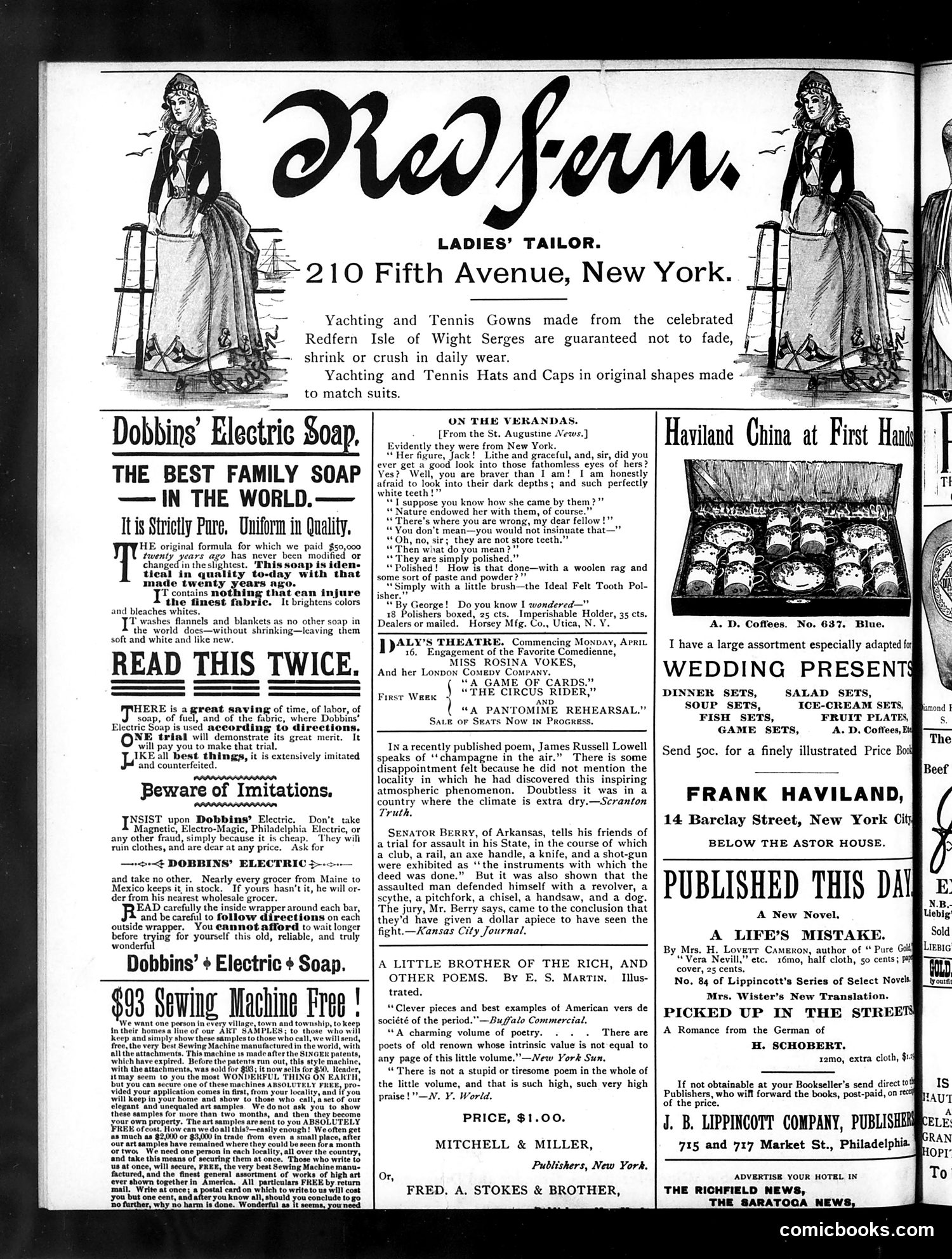
This is primarily an **advertising page** from Life magazine, not a political cartoon page. It contains multiple product advertisements typical of late 19th-century American publications. The main content includes ads for: - **Red Fern Ladies' Tailor** (Fifth Avenue, New York) — offering yacht and tennis wear - **Dobbins' Electric Soap** — claiming superiority over imitators; notably includes a humorous anecdote about a woman's teeth being "polished" rather than natural, advertising the "Ideal Felt Tooth Polisher" - **Theater announcements** and **book advertisements** The one satirical element is the brief "ON THE VERANDAS" dialogue making fun of New York society types discussing a woman's appearance and dental care — gentle social satire rather than political commentary. This reflects Life's mid-period function as a **humor and lifestyle magazine** mixed heavily with advertising, rather than primarily political satire.
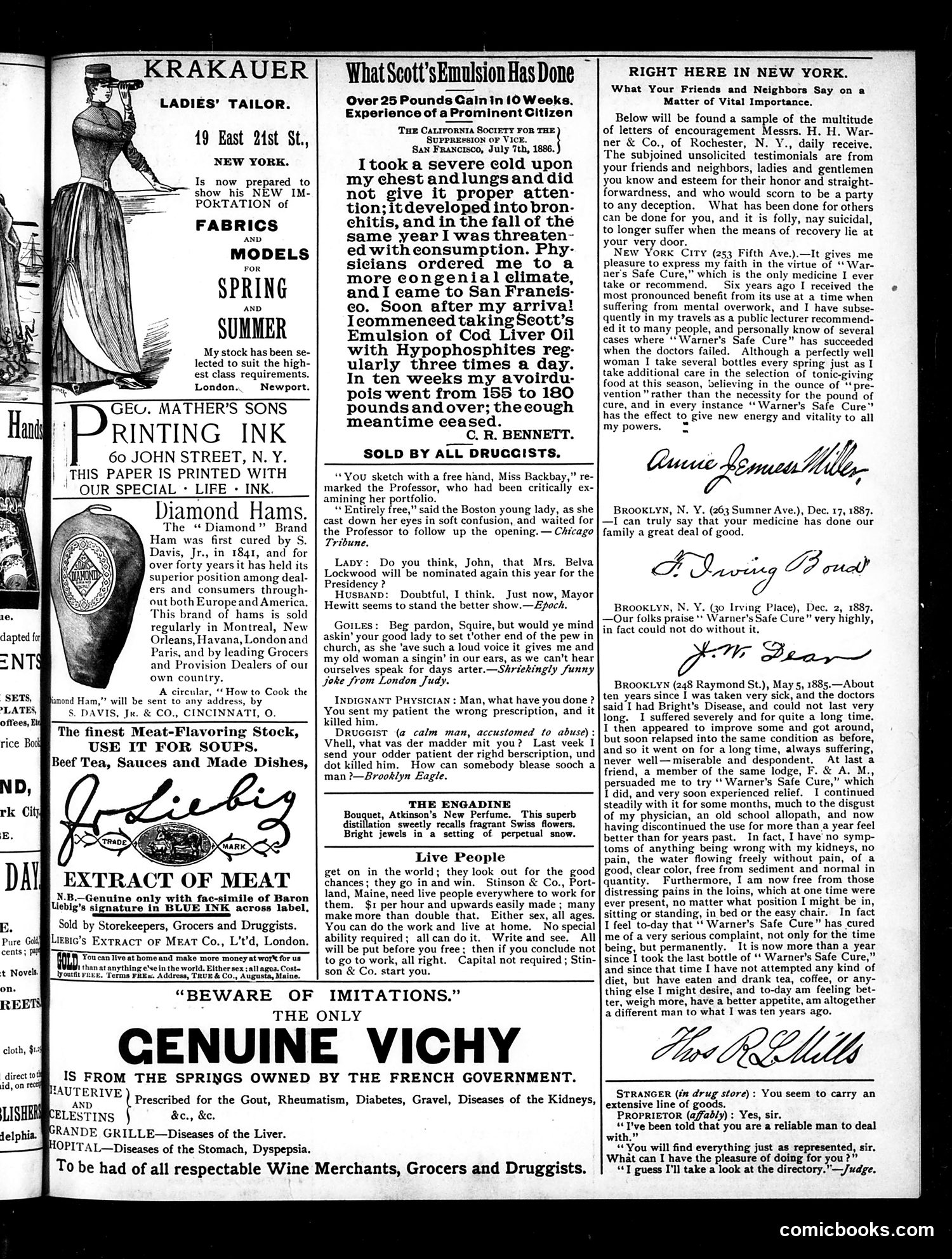
This page is primarily **advertisements and short humor pieces**—typical of Life magazine's format as a satirical weekly. The main content includes: **Advertisements** for legitimate products (Scott's Emulsion cod liver oil, Diamond Hams, printing ink, perfume) mixed with **brief comic anecdotes** that satirize social pretension and professional incompetence: - A Boston woman's affected artistic pretension - A joke about **Belva Lockwood**, an actual 1880s women's suffrage activist and presidential candidate, treated as absurdly unelectable compared to Mayor Hewitt - A rural church complaint about a woman's loud singing - A darkly comic exchange between a doctor and pharmacist, each having killed a patient with prescriptions The **humor targets** include: women's ambition for political office (still considered laughable), artistic affectation, rural uncouthness, and professional incompetence. No single coherent "cartoon" dominates; instead, this represents Life's standard mix of **classified ads, product testimonials, and joke columns**—a snapshot of 1880s commercial and social satire aimed at educated, middle-class readers.
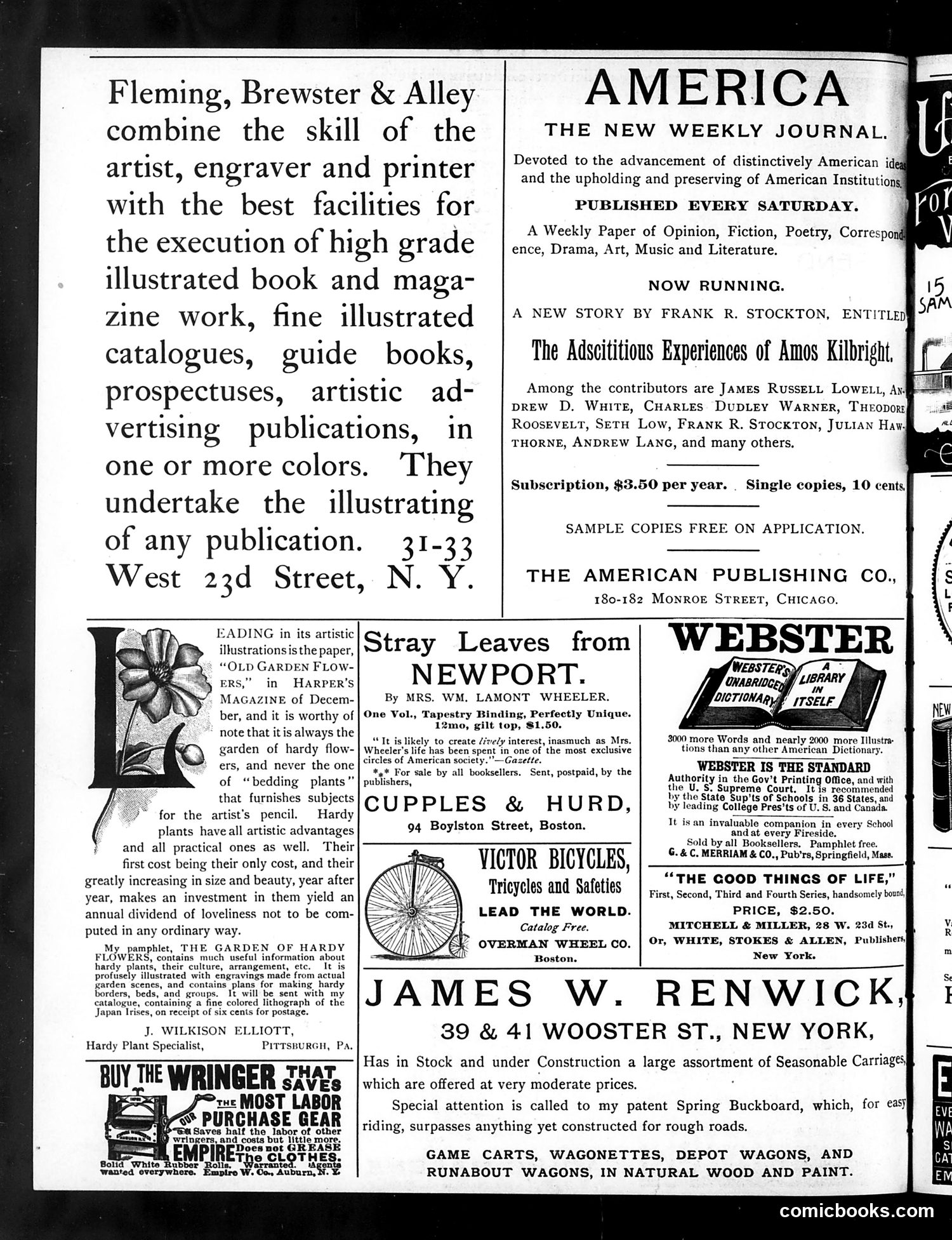
This page is primarily **advertising and editorial content** rather than political satire. There is no cartoon visible. The page promotes *America*, a new weekly journal featuring fiction, poetry, and opinion pieces by prominent American contributors including Theodore Roosevelt, James Russell Lowell, and Charles Dudley Warner. The publication costs $3.50 annually or 10 cents per issue. The remainder consists of commercial advertisements for various products and services: printing services (Fleming, Brewster & Alley), a novel titled *Stray Leaves from Newport* about high society, the Webster Dictionary, Victor Bicycles, James W. Renwick's carriage business, and various other goods. There is a small decorative illustration of a hardy flower in the lower left, but this is ornamental rather than satirical. The page functions as a mix of period journalism promotion and era-appropriate consumer advertising.
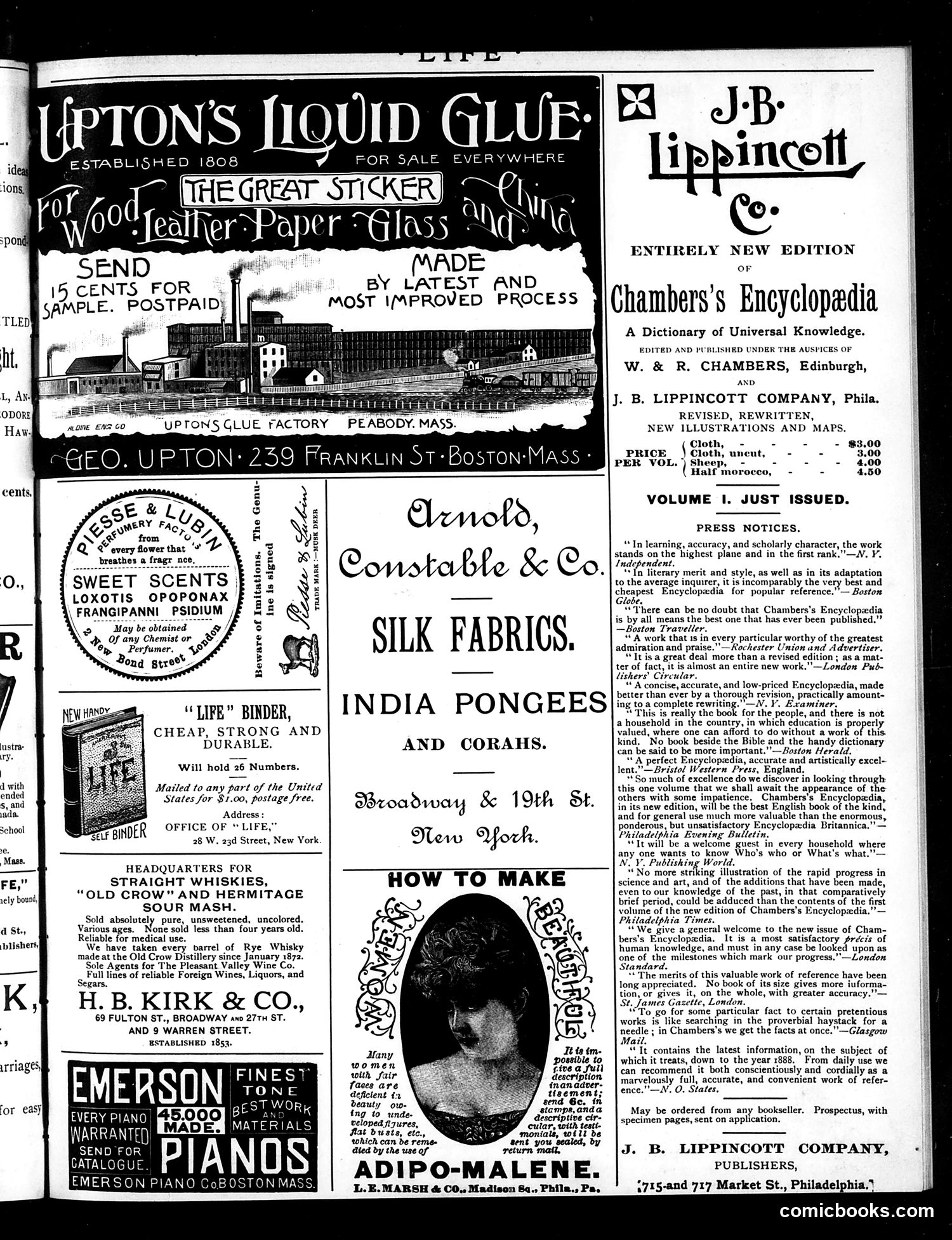
This is primarily an **advertising page** from Life magazine, not a satirical cartoon. The page showcases various consumer products typical of the late 19th century: **Notable advertisements include:** - Upton's Liquid Glue (established 1808) - "Life" Binder for magazine subscribers - Sweet Scents perfume - H.B. Kirk & Co. whiskey ("Old Crow") - Emerson Pianos - Arnold Constable & Co. silk fabrics - Adipo-Malene (a beauty/figure enhancement product) - Chambers's Encyclopaedia (newly revised edition) **The only quasi-editorial content** is a small illustrated feature titled "How to Make" featuring a woman's portrait and text about Adipo-Malene, which appears to be a beauty/weight-gain product marketed to women with "undeveloped figures." The page reflects period consumer culture: the prominence of alcohol, beauty products targeting women's appearance anxieties, and educational/self-improvement materials. There is no political satire evident on this particular page.
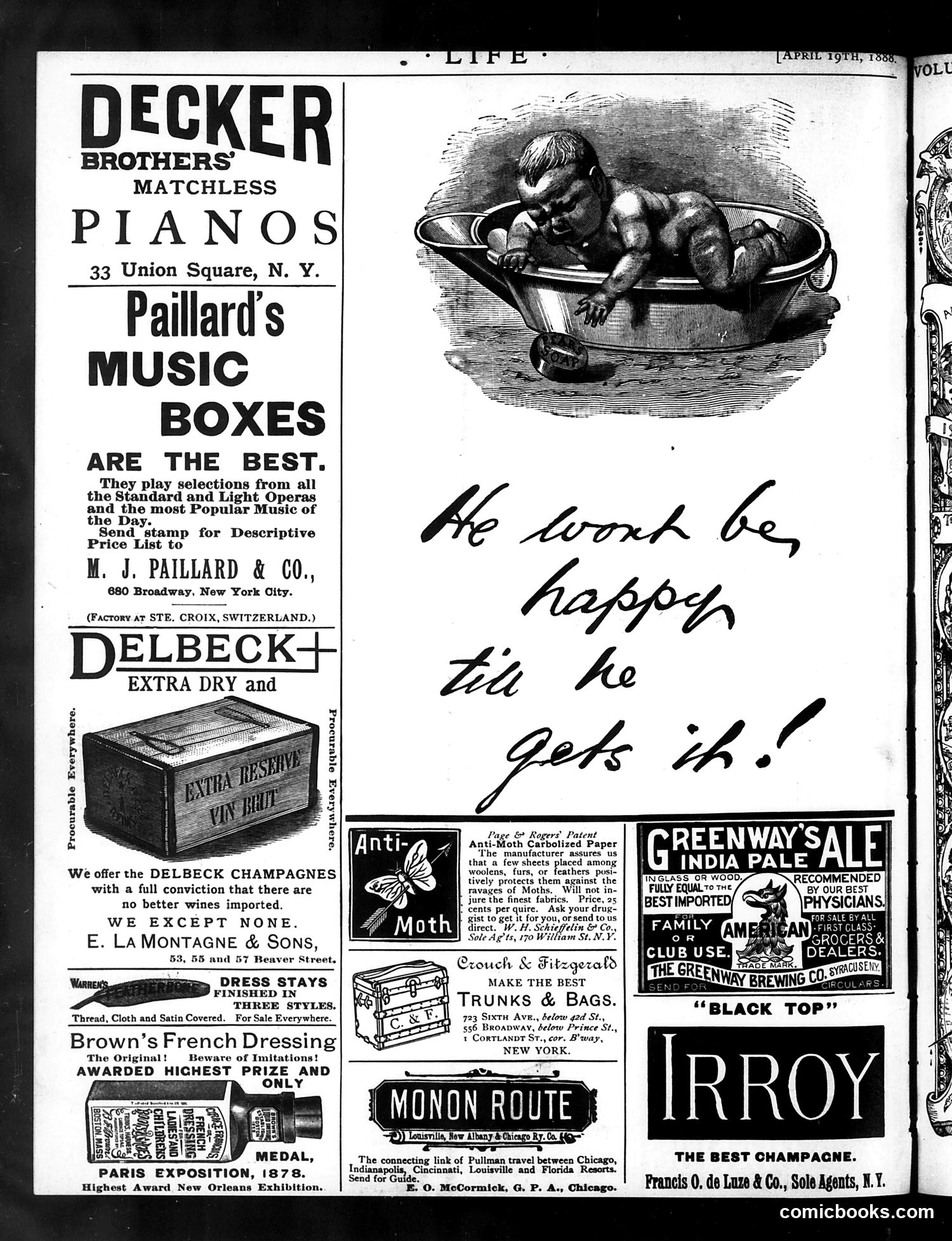
This page is **primarily advertising**, not editorial satire or political cartooning. The dominant content consists of Victorian-era product advertisements for luxury goods and services typical of the period. The single illustration—a cherubic infant in a bathtub with handwritten text reading "He work be happy till he gets it!"—appears to be an advertisement or decorative element, likely promoting a bath-related product, though the specific item isn't clear from the visible text. The ads themselves reflect late-19th-century consumer culture: imported champagne (Delbeck, Greenway's, LeRoy), pianos, music boxes, dress stays, trunks, and anti-moth paper. The references to "Paris Exposition, 1878" and "Highest Award New Orleans Exhibition" exemplify how advertisers marketed products through claimed international prestige. There is **no discernible political cartoon or satire** on this page—it's a straightforward commercial advertising page from Life magazine's revenue-generating content.